It’s hunting season here in Ohio! All around the countryside, hunters are sneaking though the fields, climbing tree stands, and checking their trail cams. The deer are careful and on alert, listening and sniffing the air for the sign of trouble. Failure to sniff out the enemy can have deadly results for the hunted.
As Christians, we have to be on guard against temptations and situations that can cause us to fall away from the Lord God. 1 Peter 5:8 warns us to “Be alert and of sober mind. Your enemy the devil prowls around like a roaring lion looking for someone to devour”. Peter, in his letter to the Christians across Asia Minor (modern Turkey), has tried to encourage the believers to stand firm in the face of persecution. Instead of getting revenge or lashing out against people who have hurt us, Peter encourages us to rejoice in our sufferings and be thankful for the opportunity to do good to those who hurt us (1 Peter 3:8-12).
It is easy to want to strike back, to say something hurtful, or to defend ourselves. But God has a higher purpose in mind behind our suffering. He wants to shape and mold us into mature Christians. Sometimes, we have to endure hard times to allow that change towards maturity to occur. It is tempting to want to respond in kind to those who hurt us. We have to stand firm and resist the urge to take the bait!
Peter reminds the Christians that this is a sneaky trap, set by our enemy, the devil. We have to be on the alert, and watchful to avoid falling into the traps set by the enemy. Like deer trying to avoid the hunter, we avoid the traps of temptation by seeking to do God’s will. Peter asks us to be alert and sober minded. Resisting the temptation to lash out at our enemies or to hurt other people is not easy. But the more we resist, the easier it is to stand firm against the schemes of the devil. God wants us to trust Him. As we obey Him, He will “restore you and make you strong, firm and steadfast” (1 Peter 5:10).
One of the strongest building materials is steel. All the great towers and skyscrapers today are built out of steel. It is a very hard metal and very durable. But it does not start that way. It begins as a piece of iron ore. To transform the iron ore into steel, the iron must be heated to extreme temperatures and exposed to blasts of super hot air to blow out the impurities. When it is quickly cooled, the result is steel – a pure form, durable, and able to stand the test of time. It is only tough and useable because of the intense “heat and violent blasts of air” that transforms it.
The apostle Peter wrote his letters to Christians scattered out across Asia Minor (Turkey today). The Christians there were struggling because of hardship and persecution. Living a life of faith in God was very difficult and dangerous. As the Roman empire continued to persecute the Christians across the empire, the apostles, like Peter, worked hard to encourage the children of God.
Peter reminds us in his letter that we have a “living hope” (1 Peter 1:3-4). No matter what kinds of trouble we experience in life, we can be assured that the hope that we have in Jesus is true and eternal. We know this because Jesus has been raised from the dead, proving that every promise that He made is true. No matter what kinds of sorrow we face in this life, we can be assured of an “inheritance that can never perish, spoil or fade. Kept in heaven for you” (1 Peter 1:3-4). Jesus promised to return to this world to make things right. Then, our promise will be revealed before our very eyes as we enjoy eternity with God the Father and His son Jesus Christ in God’s glorious earthly kingdom.
Despite being persecuted and threatened by the Romans, Peter reminds the Christians that they are to put their faith in God and serve Him. Like the first Christians, God allows us to experience trouble and sorrow because, like heat to iron, He wants to create a tougher, more usable child of God. God desires for each of us to endure troubling times. We are a chosen people (1 Peter 2:9-10). As God’s chosen people, we can be assured that He will use hard times to strengthen us. It is God’s will that we suffer for doing good (1 Peter 3:17). Jesus suffered greatly on the cross. But the result of His suffering has brought us closer to God (3:18). Who knows what incredible things God will bring about because His people are willing to suffer for doing good?
Questions for Discussion:
Are good works the way to earn a blessing? (1 Peter 3:9-12)
Why be gentle and respectful to unbelievers? (1 Peter 3:15)
What is the best way to lead others in the church? What is the best way to follow church leadership?
At the end of 1 Peter, Peter gives some exhortations to leaders in the church and then to the general assembly. His exhortation to leadership, while brief, is powerfully meaningful:
1 Peter 5:2-3 (ESV)
2 shepherd the flock of God that is among you, exercising oversight, not under compulsion, but willingly, as God would have you; not for shameful gain, but eagerly;
3 not domineering over those in your charge, but being examples to the flock.
Leaders in the church are commanded to shepherd the flock not by abusing authority but by being examples. Peter is repeating what Jesus taught him years before (see Matthew 20:25-28). Jesus served others in love, showing everyone how to live a godly life. He did not collect taxes, lead an army, start a big corporation, or run for President (or Caesar, not that it was a democracy!), but even if he held a prominent worldly position, he would not have led through fear or domination.
How many times has this gone wrong in the history of the Christian church? How often are leaders tempted to lead this way? As a pastor, knowing how common this problem is leads me to greater personal reflection and humility. My job is to serve willingly and eagerly and to be a good example to the people in our congregation. That sounds simple and straightforward, but the other way is tempting. Leaders, we must keep the servant’s towel wrapped around our waist at all times!
Peter goes on to admonish the whole assembly to be humble, to cast anxieties to God, and to be watchful. Each of these dispositions is important. First, humility is a foundational Christian attribute. It’s like the key to the door of growth. Humility says, “I don’t know everything yet. I can still learn more.” Everyone in the church should be humble before God and before the Scriptures. There is always more to learn. There is always more to live.
Second, we are to cast our anxieties to God. This world is full of trouble and brokenness. All of us experience anxiety from time to time. We must remember that God cares about every aspect of our lives. What a crazy thing to believe, but it is true — the Creator of the Universe wants a relationship with you! God cares for you!
Finally, we are to be watchful. There are influences of darkness in the world around us (see: anxieties above). The powers of darkness, led by the adversary/devil, have built systems to damage our faith and lead us into temptation. Just as our Lord Jesus taught, we seek God instead. He will deliver us from evil, and the promise is, that as we resist, the devil will flee (see also James 4:7).
-Will Barlow
Reflection Questions:
(Leaders) How do you stay humble and focused on serving the people around you?
(Non-leaders) What can you do if you are concerned about your leaders and how they are behaving?
Are there things in your life that need more watchfulness or resisting the powers of darkness? What can you do to strengthen your resolve in those categories?
Have you ever wondered what gifts you have been given by God? Have you ever doubted that you even HAVE a gift from God? In the middle of 1 Peter 4, Peter gives a simple statement about gifts that should arrest our attention:
1 Peter 4:10-11 (ESV)
10 As each has received a gift, use it to serve one another, as good stewards of God’s varied grace:
11 whoever speaks, as one who speaks oracles of God; whoever serves, as one who serves by the strength that God supplies–in order that in everything God may be glorified through Jesus Christ. To him belong glory and dominion forever and ever. Amen.
We are first comforted (or perhaps surprised!) to hear that we have received a gift. What are we to do with our gift? We are commanded to serve one another in love — that is the way that we can use God’s grace appropriately.
Peter also gives two large categories for gifts from God: speaking gifts and serving gifts. Unfortunately, in the modern Western church, most Christians think of the “speaking gifts” when they think of gifts. And so, when asked, “what is your gift?” so many are tempted to think that they do not even have one. But Peter does not teach this, nor do the rest of the Scriptures. For example, giving mercy is listed as a gift in Romans 12, and administration is listed as a gift in 1 Corinthians 12. The gifts of God come in many shapes and sizes.
If you are unsure what your gift is (or gifts are!), what can you do? I believe that Peter would encourage you to get more involved in a local congregation of Jesus followers. Try volunteering for a food drive, helping to set up for a special event, or working with the children’s ministry. Do you have any musical ability? Perhaps your worship team could use an extra instrument or voice. Has God put a desire for preaching or teaching in your heart? Ask your pastor how you can develop this desire into something more concrete. Do you have a heart for the homeless, those in prison, single parents, or another disadvantaged group of people in your community? The opportunities for exploration and service are virtually endless!
Many times, I think we overcomplicate the idea of gifts. We are each unique people, valued by our infinite Creator. None of us are alike in every way. God has especially given you abilities that I may not have, and He has given me abilities that you may not have. And even if we have the same gift type, we will express it uniquely! This is the value and the beauty of the Body of Christ — we are both designed to fit in and belong to the church of Jesus Christ, AND we are designed to stand out in unique ways.
Ask God to show you what desires He would like you to pursue. As you pursue those gifts, remember that it’s all about Him. It’s His ability, His power — even your life belongs to Him! So love Him with your whole heart and love your neighbor as yourself. As you do, you’ll learn more about Him and more about how He has uniquely gifted and enabled you to do good works that point back to Him.
-Will Barlow
Reflection Questions
Do you have any ideas about the gifts that you have? What can you do to learn more about yourself and about God?
What gifts of others do you especially appreciate? How does this practice of thankfulness for others’ gifts help us greater appreciate the Body of Christ?
What next steps are you going to take to develop an awareness of your gifts and how they can be used to serve others and glorify God?
Will Barlow is the head pastor at Compass Christian Church in Louisville, KY. He lives near Louisville with his wife of 15 years (Becca) and three children (Liam, Hannah, and Isaac). Besides theology, he enjoys playing sports, watching sports, and spending time with his family.
This week at FUEL we focused on the life of Peter. Peter is an amazing character in the Bible. His life was full of ups and downs. His faith was high and it was low. Yet, Peter was used to do great works for God. I find a lot of parallels between Peter’s life and ours as believers. Today’s devotion is not as much focused on Peter’s life, but rather how he uses what he learned from his life experiences.
1 Peter 1 starts by proclaiming the good news and our hope in Christ. He says in verse three, that through mercy we have been given a new birth through the resurrection of Jesus. Now Peter continues this by saying that even though we have our hope in Jesus we will have a lot of grief and many trials. This is true for our lives as well, most of us have gone through something that is incredibly challenging. Life can really beat us down or we build sandcastles on false beliefs. But when you have a living hope through Jesus Christ, you have a strong foundation to rely on during the waves of life.
Peter also faces many trials in his life such as when he was called out on the water by Jesus, he took his eyes off of Jesus and began to sink because of his lack of faith. Peter also denies Jesus three times. He is ashamed and scared because of what might happen to him so he turns his back on Jesus. But even through all of these difficulties and trials Jesus calls him back. I know that I have taken my eyes off from Christ and maybe even have denied my faith. But he continues to call me back and offers grace.
Peter uses his life experiences to help strengthen fellow believers. He says in verse six and seven that trials come and that “these have come so that your faith … may be proved genuine and may result in praise, glory and honor when Jesus Christ is revealed” Even when we face trials and setbacks in our life, we can still return to Christ. Or as Amber shared on Monday night, we all need a comeback. So the next time you find yourself sinking, think about Peter and remember that if he can be pulled out of the water, so can you! Peter reminds us in verse 23 “For you have been born again, not of perishable seed, but of imperishable, through the living and enduring word of God.”
-Camden Bormes
If you would like to hear Amber speaking on comebacks, check out the FUEL 2023 Monday Evening General Session on youtube (where you can also find all the other general sessions as well). Amber starts speaking, with sound, at 36 minutes.
Reflection Questions
What trials have you already been through? Have they helped to prove the worth of your faith? If so, how?
Are you currently in need of a comeback (has a trial beaten you down)? What steps could be useful in the process of a comeback? How might the living and enduring word of God play a part?
What can we learn from Peter about faith? About Jesus? About God?
Chapter 4 ends with verse 19: Therefore, let those who suffer according to God’s will entrust their souls to a faithful Creator while doing good (ESV).
The suffering in the New Testament is related to living a life set apart from worldliness, which is opposed to God’s will. It is not God’s will that we should suffer, but when we follow in the ways that he has prescribed for us we will undoubtedly face opposition and ultimately suffer for the sake of the Gospel. We need to trust that our creator will ultimately use that suffering for good. There’s a popular song that we sing at my church that has the line “you take what the enemy meant for evil, and you turn it for good” (drawing on Genesis 50 for inspiration).
Chapter 5 then begins with Peter addressing the leaders of the church, specifically calling to mind the sufferings of Christ. Pastors/elders are to function in the role of shepherds for the congregations that have been entrusted to them in leadership. The verb that is translated as “shepherd” also can be translated as “feed” – does this directive remind you of any instructions that Peter himself received from Jesus?
In John 21 three times Jesus asks Peter if he loves him (notice a correlation between Peter’s three denials of Jesus and the three affirmations that Jesus receives from him?) and three times tells him to feed his sheep (this is a different Greek word in John, but it means essentially the same thing). As the primary leader of the church Peter was to feed Jesus’ sheep, meaning Christians. The impetus for this spiritual leadership is not to be out of self-importance or in Peter’s case even that Jesus chose him to lead, but out of love for his master and savior (and friend!). When we see Peter lead, he is following in obedience to the one who called him out of the boat and invested in him and entrusted him to feed his sheep. Peter certainly was not doing this for gain or for an easy life, I imagine his life would have been much easier had he simply decided to go back to fishing full time, but he faced many trials and much opposition in his preaching the word and leading the church.
In the same way, those of us who are called to be pastors and elders (who are specifically addressed here, but anyone who holds an office in the church should take heed of this) should be using their love of Jesus as their motivation for leading. Presumably most church leaders start off this way, but it can easily go to one’s head. There are many public instances of pastors who have become controlling, power hungry, and abusive (quite often we see this in large churches with lucrative opportunities for pastors) – but even in small churches the desire to control can infiltrate the hearts of those who are called to lead or “run” the church. Elders (I’ll include pastors in this title from here on out) are to be willing and eager to carry out the work that they have been called to. With a calling to leadership comes responsibility – a significant thing to note is that we who are in authority (and who teach) are held to a higher level of accountability (James 3:1). Those who are in authority are to be an example to those who they oversee spiritually, and humility is one way in which we should be an example. Jesus stated that he was gentle and humble (Matthew 11:29), and we see in Philippians 2 that humility was essential in Jesus salvific work as God’s anointed one.
As Jesus was humble and as we who are elders (overseers) are to be humble (following Christ’s example), so then are the members of the body to exercise humility and submit to those who are in authority over them. If leaders are humble and operating as Jesus would expect them to, then humble Christians submitting to the godly authority that has been placed over them will thrive in their submission. We’re never going to agree on everything and that is why the decisions of local congregations are to be subject to the elders and not left up to the democratic will of a large collective. Elders absolutely can delegate responsibilities and set up clear roles for the body (Acts 6), but the authority over the church should lie with them.
We just added two new elders at my church yesterday. The process was not a short one… Myself and our other elders had many discussions on who we thought would be a good fit to assume these offices and eventually recommended that these two individuals be confirmed as elders. We don’t accept nominations for elders, but rather we look for men who meet the requirements of elders as listed in Titus 1, and then we have a confirmation vote. Other churches do things differently and may have boards structured in different ways or may be more egalitarian in the way that they define elders, I don’t condemn that, but we need to take seriously the guidelines that are listed in scripture and not be too quick to structure things in a way that is more reflective of the nation/society we live in than how the early church did things. Regardless of our views on church leadership one thing we need to be able to do is disagree with grace and love.
We need to make sure that whatever disagreements we have are dealt with in love and we need to not let them distract from what God would have us do and we need to make sure that we keep our minds clear (5:8, reaffirming 4:7), be on the lookout, and refrain from being anxious (cast those anxieties on God, see also Matthew 6), because the enemy prowls like a lion looking for someone to devour. When we allow conflict to take root or we allow anxiety to be prevalent in our churches, bad things will happen. We may often think about the enemy being on the prowl for individuals, but he’d also love to devour a local church and render it ineffective at making disciples or worse, cause it to die out (is that really worse?). I bet we could all think of examples of things we can (or do) divide over, one such argument could be what Peter means by “our enemy the devil”, but we need to take seriously the words of the author of Hebrews when he/she says: “Strive for peace with everyone, and for the holiness without which no one will see the Lord. See to it that no one fails to obtain the grace of God; that no “root of bitterness” springs up and causes trouble, and by it many become defiled;” (Hebrews 12:14–15 ESV).
-J.J. Fletcher
Reflection Questions:
1. For those of you in authority: do you do it willingly? Eagerly? Without being domineering? Sometimes we do have to be forceful and make unpopular decisions, but that can still be done in a graceful and kind way. Do you need to be humbler, or do you think you have that well under control? Do you have an individual in mind that has authority problems with whom you can practice extra grace?
2. For those of you under authority: Do you respect those who have been placed in authority over you? Do you easily submit to that authority? Do you gossip about the leaders of your church and cause problems that way? Do you stop attending church when changes occur, or decisions are made that you disagree with? Do you go church hopping and just stick around till someone ticks you off and move on to the next place (which might just be going back to a former church until the vicious cycle starts over again?
Podcast Recommendation: The Rise and Fall of Mars Hill (from Christianity Today). It can be difficult to listen at times, but it has lots of examples on how to do leadership wrong, which we can benefit from.
At the beginning of chapter four Peter says to “arm yourself with the same way of thinking” aligning this directive with Jesus suffering in the flesh. While Jesus’ suffering was likely to exceed what these Christians endured, they were still facing a culture that might ostracize, if not outright persecute or kill them.
Peter points out distinctions in how the gentiles live according to the flesh (perverting many things that God intended for good), and how we as believers are to pursue the will of God – this means among other things giving up things that might feel good or make us feel like we belong.
We’ll home in on what Peter writes in verses 7-11:
“The end of all things is at hand; therefore be self-controlled and sober-minded for the sake of your prayers. Above all, keep loving one another earnestly, since love covers a multitude of sins. Show hospitality to one another without grumbling. As each has received a gift, use it to serve one another, as good stewards of God’s varied grace: whoever speaks, as one who speaks oracles of God; whoever serves, as one who serves by the strength that God supplies—in order that in everything God may be glorified through Jesus Christ. To him belong glory and dominion forever and ever. Amen.” (1 Peter 4:7–11 ESV)
Considering the coming kingdom (which is immanent, but we don’t know when it will come): Exert Self-Control! Many times, we see this attribute called for in the life of believers (at least 18 times in the ESV). Looking in the letter of James (which I preached from yesterday), lack of self-control can lead to self-deception. When we allow our thoughts to be clouded by worldly things or self-centered behaviors, we are going to miss what God would have us do. By being sober (or clear) minded we can think critically, and we need to think clearly so that we can be effective in our prayers. Jesus gave us a model by which to structure our prayers, but our prayers are not meant to be mindless or rote… We need to be looking at things through the lens of God’s spirit, which allows us to see things that our physical eyes cannot see. Think back to 1 Peter 3 where it says a man should live with his wife in an understanding way as not to have his prayers hindered – the way that we think, live, and act has a direct impact on how we pray and the effectiveness of our prayers.
We’re instructed to love one another earnestly, because love covers a multitude of sins. (Greater love has no one than this, that someone lay down his life for his friends. John 15:13). “…in the face of extreme social hostility, love will be necessary for spiritual survival. For Peter the primacy of love is accompanied by a qualification, and this qualification is a partial citation of Proverbs 10:12 similar to James 5:20—’love covers over a multitude of sins,’ rather than magnifying the faults of others. After all, love is patient and doesn’t keep a record of wrongs (1 Corinthians 13:4, 5)” (J. Daryl Charles, “1 Peter,” in Hebrews–Revelation, vol. 13 of The Expositor’s Bible Commentary Revised Edition).
How does the Church expect to thrive if we let piddly little things (or even larger disagreements) get in the way of caring for each other? How are we to expect to overcome the world through Jesus if we don’t exercise with others the grace that we have been shown (we all kind of stink at times, to put it mildly)?
We need to show hospitality in a world that that is oft inhospitable to Jesus’ way of living. If we’re inhospitable to other believers, they might find hospitality in places that will draw them away from the grace of God. We shouldn’t grumble when we have an opportunity to be hospitable, but rather see it as an opportunity to be the hands and feet of Jesus (Genesis 12 says Abraham was blessed to be a blessing, and through grace and mercy we’ve also been blessed to be a blessing as well).
In everything we do we need to do so viewing ourselves as representatives of God, as ambassadors of the kingdom, and imitators of Christ Jesus (Philippians 2:3-8).
-JJ Fletcher
Reflection Questions
How does my life look like the life of Jesus and how does it look different?
How does hospitality with fellow believers prime me to be hospitable to those who I disagree with?
Am I doing well at being self-controlled? What are my biggest obstacles to living in this way? Who can I ask for help or be accountable to help me in this endeavor?
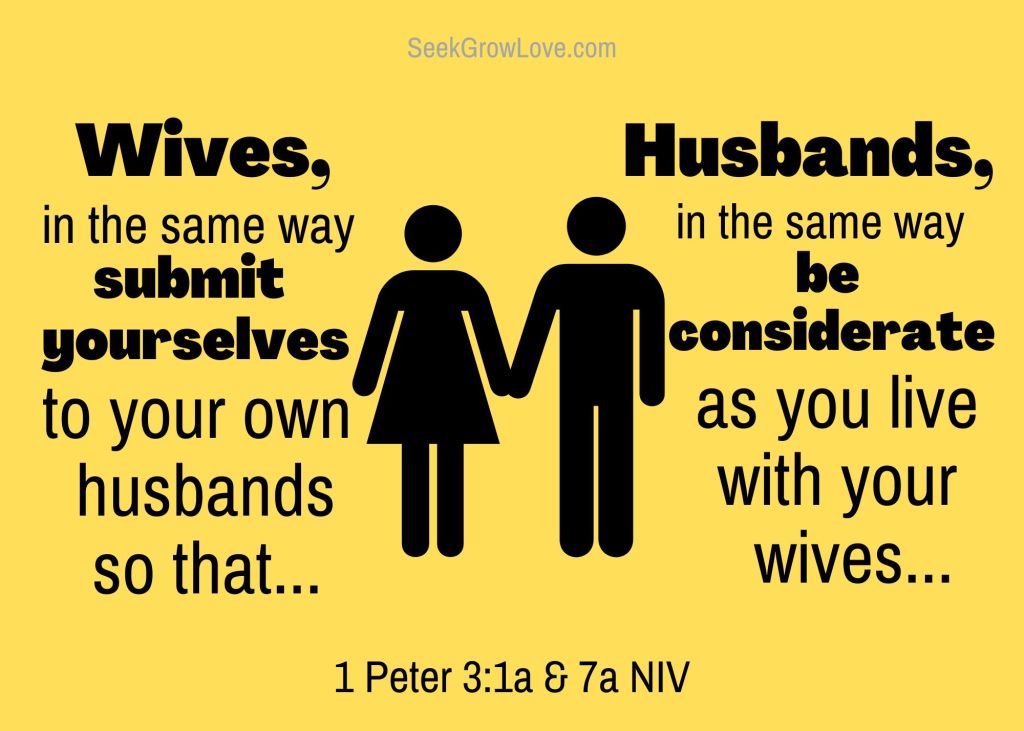
Gender is a hot topic these days. We live in a society where there is much flexibility in how someone chooses to live their life, irrespective of cultural norms or the directives of our creator (let’s stick to what Peter writes about in his letter). Misogyny and radical feminism are two ways in which humans have messed up what was designed to be a tremendous blessing from God.
There is a lot to unpack here as Peter begins by addressing wives. In reading the text and then looking at commentaries it appears that foremost in Peter’s mind is a woman who has come to a saving faith in Jesus but is married to a man who does not share that faith (though we can gain something from this even if we’re not in that demographic).
The way that societies functioned, specifically the society that Peter would be writing to, did not offer much in the way of opportunity for a woman to exert influence over her husband. Her options may be quite limited in what her husband allowed her to do or permitted her to go. Where a husband and father who came to faith would be expected (even simply allowed) to bring his family along with him to religious functions, the same could not be said for the wife.
So how is a woman to minister to her unbelieving husband? How does she influence him intentionally in a way to bring him into the body of Christ? Nagging is probably not the most effective way to do this, in fact it might have the opposite effect; rather, the solution that Peter proposes is to allow the gospel of Jesus (i.e., the gospel of the Kingdom) to radically influence your way of living. Being salt and light (Matthew 5:13-14) is not just something that you are to be for people whom you may be unfamiliar with, even more importantly it is something you are to be with those who you are most intimate with. Living a life that bears the fruit of the spirit (Galatians 5:22) and exemplifies Jesus’ beatitudes (Matthew 5:3-11; Luke 6:20-26) will make you a more desirable (and influential) person.
Obviously, there is no way to guarantee that an unbelieving spouse will come to faith, but by being holistically attractive (not just externally, but internally as well) you will have a far better chance to influence them than if you were to try to get by on physical attraction (I don’t even know how that would really work) but be ugly on the inside.
Peter addresses the ladies in verses 1-6, but he shifts gears in verse 7 and speaks to husbands. He says to “live with your wives in an understanding way” (ESV), literally living with her “according to knowledge” as opposed to living with her in “sheer thoughtlessness” as the Expositor’s Bible Commentary puts it. I can speak from experience, it is very easy to do what I want and expect my wife to pick up the slack, but that is not the way that Peter instructs husbands to operate. Instead of living in a way that could breed resentment and other problems (infidelity?), husbands are commanded to live in a thoughtful way.
Husbands are instructed to honor their wives as “the weaker vessel.” Huh? What does that mean? There are different ways to look at this… Societally women were weaker (we’ve already considered the lack of influence), typically women are weaker in physical strength (I can think of a few ladies that could probably wipe the floor with their husbands in a fight), and sometimes women are more emotionally fragile (have a wider range of feelings?) than men. The word for weaker (ἀσθενεστέρῳ) can be translated with lots of nuance, but one big take away from this is that women are not inferior to men. Whatever Peter is getting at with the idea of the wife being a weaker vessel, something is very clear: we are co-heirs of all the benefits that come with accepting Jesus and believing in the kingdom message. As objects of God’s salvation there is no distinction between male and female, just as there is no distinction between Jew or Greek. While husbands and wives may be called to different roles in their relationship and even in their roles in the church, this is not because of a lack of capability, this is the function that God has laid out. Husbands and wives are to minister to one another and to minister to others. We can use our marriages as an example and an opportunity in ministry. Authentic Christianity has done more to liberate women from misogyny and oppression than any other organization ever has; that being said, it has not changed the fact that men and women are different. We have equality in standing before God, we have equality in salvation, we ought to have equality in rights, but we are still different and that is a blessing. As the church is a body with many parts, the one flesh that we become in marriage takes into account our uniqueness as individuals and the differences in our physiology. We are to be reliant on one another (do not read as co-dependency), and we are responsible to one another to meet the needs that we have as image bearers of God and the uniqueness that we have as men and women.
-J.J. Fletcher
Action/Reflection:
To those of us who are married: We should evaluate where we are at in living as Peter instructs. Hopefully you are married to a fellow believer who you can discuss this passage with and commit to one another to implement these tactics in your union. If married to a non-believer, behave in a way that is intentional in living the gospel out to them.
To those of you who are engaged or hope to be married one day: Look for a spouse who takes scripture seriously and is willing to change their behavior to conform to what scripture dictates, both in their life as an individual and the way that they approach relationships.
For those of you who are called to a life of singleness (or just end up that way) or those of you who know someone who fits that description: I believe that the behaviors that the relational and internal things that Peter speaks of here will be beneficial in building authentic relationships that help navigate the potential challenges that a life of singleness may bring.
Let’s pretend I’m going to build a house with stones.
First, I’d need a bunch of stones dumped in my yard. Then I would need to expertly stack them, making sure to pick the right stones that fit together and that don’t fall over in the breeze. I’d also need some kind of mortar or clay to hold them together. I can imagine some of the stones would be a bit too big to be lifting and moving around, so I’d need a tractor with a bucket, or even better, a crane. There’s a lot that would go into this.
Now let’s pretend I actually completed my stone house. I still have a giant pile of rocks that I didn’t use. Some are just weird shapes, or cracked, or plain ugly. There is one stone in particular that was my least favorite because I kept tripping over it. I don’t want anything to do with these stones anymore.
Now I throw a little stone house-warming party, and my neighbor comes over. He says, “Hey, I want to build a stone house, too. Can I use the stones you didn’t want? I’ve got just the spot for each of them, especially that one you kept tripping over.”
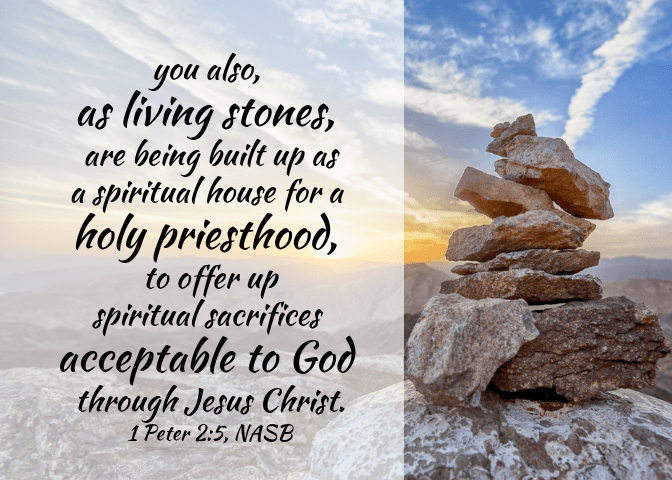
“Come to him, a living stone, though rejected by mortals yet chosen and precious in God’s sight, and like living stones, let yourselves be built into a spiritual house, to be a holy priesthood, to offer spiritual sacrifices acceptable to God through Jesus Christ.” (1 Peter 2:4-5 NRSV)
Now that we’ve heard and accepted the good news (remember yesterday’s reading?), we’ve become “living stones” to God. The world will look at us and scoff because we’re weirdly shaped and of no use to them, but God has a special use for all of us. He especially chose each of us for his project.
God is building us together into what Peter calls a “spiritual house” to be a “royal priesthood” to “offer spiritual sacrifices.” Peter is using this imagery to prompt us to imagine ourselves as the temple of God. The temple is a sacred space where the divine lives, just as we are to be sacred spaces where God’s spirit dwells.
The priests are like mediators between the divine realm and the world, helping to make connections between the two. For us to be a royal priesthood means that we have access to God that we are to share with others. We are to connect God and people. We are to bring people into the experience of who God is.
The last part of that is that we are to make “spiritual sacrifices.” Naturally, when we think of sacrifices in the context of a temple, images of bloody animals appear in our head. If not, then I just made you think of bloody animals, and you’re welcome. Peter’s not suggesting that we do the kind of sacrifice that requires killing animals, but the kind that requires doing the right thing even if (or especially if) it costs us something.
The perfect example we have of this, of course, is Jesus. In the face of suffering and rejection, he chose to do the right thing and offer his life on our behalf. Doing the right thing didn’t just cost him something—it cost him everything. God notices and responds to our sacrifices. In Jesus’ case, he was resurrected and exalted to God’s right hand. He was rejected by the world but made into the stone holding the whole house together.
We’re to follow Jesus’ example and be willing to put ourselves in God’s hands as we do the right things, knowing we could very well lose something in the process. Just as God saw Jesus’ sacrifices, he will acknowledge and respond to ours. That doesn’t mean that we should do good things expecting a reward, but that God is just, and will remember the trouble we went through while pursuing His purposes.
We know the world is going to be skeptical of our stone house. One hope is that through being God’s servants and living blamelessly (doing the right thing), the world may look at us and see honor in what we do. We are witnesses and priests to them, representing God to them as Christ did to us. We can hope that the fruit of our sacrifice is that God can gather even more living stones to make the stone house bigger and stronger.
Thanks for coming along with me this week on our journey through the book of James and the beginning of 1 Peter.
-Jay Laurent
Internal Inquiries
1. How does it make you feel knowing that God chose you to be one of his living stones?
2. What kinds of spiritual sacrifices have you made? What did it cost you?
Everything is dying. Your phone’s battery is draining and will need to be recharged. Your phone itself will someday give out or become so slow or outdated that you’ll need a new and shiny one. But that one will die too. Your car will get you places…until it doesn’t. Your body itself will eventually lose its ability to sustain the delicate balance known as life, and will stop functioning altogether. This will happen to you, everyone you know, and everyone you don’t know.
The human race and life on earth are in deep trouble if the wrong supervolcano decides to erupt or if a very large random rock hurtling through space collides with earth. Our existence is a very delicate thing.
Even the sun as we know it is dying. It’s said that in somewhere around 4 to 5 billion years, our sun will eventually begin to die as its hydrogen fuel runs out. It will swell to a red giant and swallow at least Mercury, Venus, and our own planet before becoming a white dwarf.
It’s predicted that eventually the universe itself will expand hopelessly into a cold and dark nothingness of no usable energy. It’s called “heat death” and is a lot like winter, but much worse.
That’s a lot to take in all at once. The realization that everything we know is fading away can lead us to a dark place. It may remind you of Nietzsche’s caution that “if you gaze long enough into an abyss, the abyss will gaze back into you.” What gives? Is there anything that lasts?
“For ‘All flesh is like grass and all its glory like the flower of grass. The grass withers, and the flower falls, but the word of the Lord endures forever.’ That word is the good news that was announced to you.” (1 Peter 1:24-25 NRSV)
Not everything dies and fades away. Peter is telling us that the good news you were given—the word of God—endures forever. To us, the phrase “word of God” can often mean the Bible, but the way the Bible uses it is so much more broad and rich. I tend to think of it as something like God’s life-giving wisdom, through which he created everything. In John 1 we can read about how Jesus, through his life and ministry, became the perfect embodiment of that word among us, carrying on another chapter of something that was always there.
That chapter seemed to come to a close when Jesus was executed. To his followers, it must have felt like all hope was lost. But we know how that story ends up! We are shown there is more to come when Jesus is resurrected. It’s another chapter of this everlasting word.
As there was more to come for Jesus, there will be more to come for us. Because of Jesus’ resurrection, we are given hope and an inheritance that won’t fade away. Jesus is said to be the “firstfruits” of the resurrection, meaning his was the first resurrection, and we’re given confidence ours will be yet to come.
Paul tells us in 1 Corinthians 15 that through resurrection, the dead are “sown” perishable, but raised imperishable. Resurrection transforms things that have perished (or would perish) into things that can’t perish. It transforms the dust of the ground into something new and alive and beautiful. Remembering that Jesus was transformed from a dead man into some kind of mysterious, eternal, resurrected being, we embrace the living hope that someday we’ll experience the same transformation.
As we reflect on how resurrection will transform us, there are hopeful rumblings that it will transform all of creation into a new heaven and a new earth. How mind-blowing is it to think of an entire universe raised imperishable? What does that even look like? That’s such an amazing mystery to think about!
There’s no way for me to know how long I’m going to live, or how long there will be an earth or sun or universe. I do, however, know that God outlives all of those things! If God is around, there is always more to come. There is always another chapter of the word.
So let’s not grasp at the things that are going to die and fade away. Instead, let’s keep our hope in what will last forever—what Peter calls “the living and enduring word of God.”
-Jay Laurent
Questions to ponder
1. What might Peter say our response should be now that we’ve heard the good news (hint: verses 13-16 might offer a good start)?
2. What other things besides the word of God do you think are “imperishable”?









 Seek Grow Love