Have you ever wondered what your purpose is? Why are you here? What am I suppose to accomplish in this lifetime?
I think it’s pretty simple yet we make it so complicated sometimes, or at least I do.
Luke 12:22-23
Do Not Be Anxious
[22] And he said to his disciples, “Therefore I tell you, do not be anxious about your life, what you will eat, nor about your body, what you will put on. [23] For life is more than food, and the body more than clothing.
I am blessed because I rarely worry about what I am going to eat or what I am going to wear. If Jesus is telling his disciples not to worry about their essential needs, I highly doubt I should be worried about what others may think concerning the kind of car I drive, the shoes I wear, the house I live in, or even if I’m going to have enough money saved so I retire in 30 years, etc. Don’t get me wrong, I believe there is value in planning ahead and being wise with your money, but if you do it at the expense of being less generous, spending less time with family and friends, and most importantly getting so consumed that you forget about your relationship with God. It’s all in vain and meaningless.
Luke 12:31
[31] Instead, seek his kingdom, and these things will be added to you.
This sums up how we ought to live and where our priorities should lie. Seeking the Kingdom isn’t always the easiest decision in the moment, but it is always the best decision. Seeking the kingdom isn’t always the best financial decision in the moment, but it’s always the best financial choice in the end. Seeking the kingdom won’t always give you everything you think you need and want now, but it will give you everything you thought you wanted and needed and so much more when the Kingdom is revealed.
I challenge you and myself to see how we can make a real difference for the coming kingdom now, and how we can store up treasure in heaven where no thief can steal and no moth can destroy!
Luke 12:33-34
[33] Sell your possessions, and give to the needy. Provide yourselves with moneybags that do not grow old, with a treasure in the heavens that does not fail, where no thief approaches and no moth destroys. [34] For where your treasure is, there will your heart be also.
-Luke Elwell
Reflection Questions
Is there a time when you where anxious about something? How else could you have reacted?
What are some ways to seek the Kingdom? How will you personally seek the Kingdom today?
In Luke 11 the disciples ask Jesus how to pray and he gives them the Lord’s prayer, which you probably heard before.
1 One day Jesus was praying in a certain place. When he finished, one of his disciples said to him, “Lord, teach us to pray, just as John taught his disciples.”
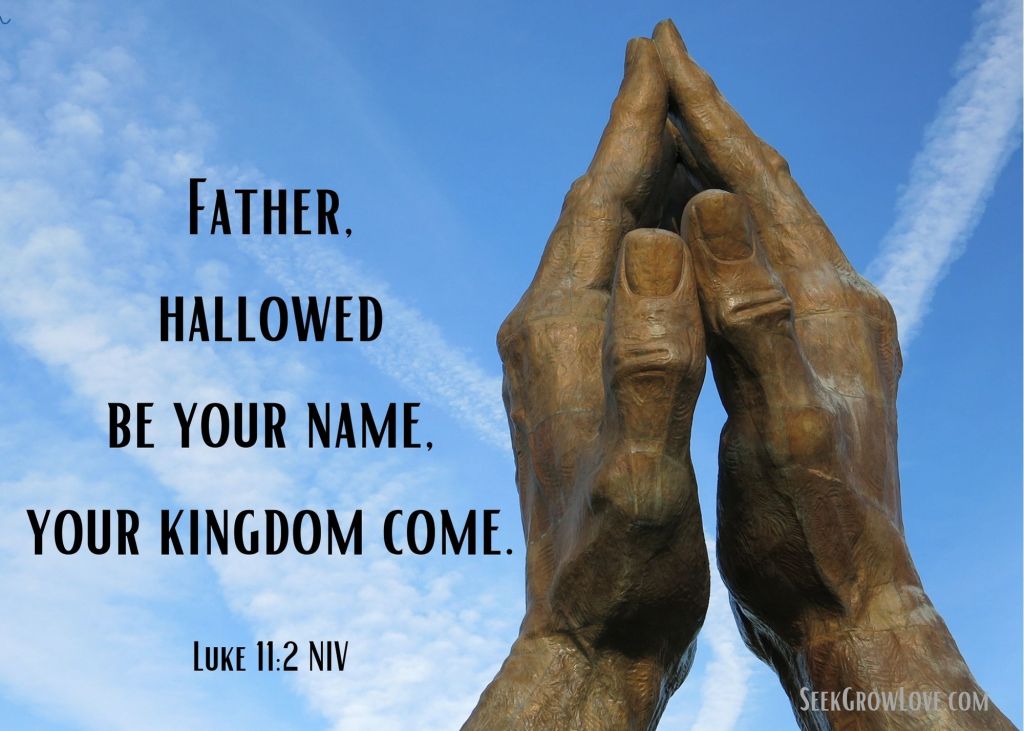
2 He said to them, “When you pray, say: “‘Father, hallowed be your name, your kingdom come. 3 Give us each day our daily bread. 4 Forgive us our sins, for we also forgive everyone who sins against us. And lead us not into temptation.’”
There are several parts of this prayer that are important and that I think we sometimes miss. First he praises God and asks for the kingdom to come. I think it is important to start our prayers by focusing on God, because he deserves the respect and it helps to remind us that he is more important and greater than our problems. Then it is important to remind ourselves that we are sinners in need of forgiveness and that we need to forgive others as well. Also, when praying for ourselves we need to keep it simple, by only asking for the basics of our physical needs and for God to guide us spiritually.
Then later he goes on.
9 “So I say to you: Ask and it will be given to you; seek and you will find; knock and the door will be opened to you. 10 For everyone who asks receives; the one who seeks finds; and to the one who knocks, the door will be opened.
God is very good at giving gifts, and he is not looking to hide himself from us. If you need something then ask for it. If you need more wisdom or patience to deal with an issue in your life, then ask God for it, and keep on asking God for it. Just make sure to check your motives as it says in James 4:3. If you are asking for your own selfish reasons then you may need to rethink your request. But if you are asking for something for the reason of helping to further the kingdom and the gospel then God is excited to give to his children.
-Chris Mattison
(Originally posted here December 14, 2017)
Reflection Questions
Who has taught you how to pray? What have you learned about prayer? What do you think you could still learn about prayer?
In what areas can your prayer life use another lesson from Jesus?
Are there any sections/topics of Jesus’ short sample prayer in Luke 11:2-4 that you do not often include in your prayers? How could you remember these things better while praying?
I think that Martha gets a bit of a bad rap. Today she might even be what we call a “Karen.” It’s easy to read this last little portion of Luke 10 and think, “Well, better not be her,” and move on. But the thing is, most of us do have a little bit of Martha in us. We all have tasks that need accomplishing, people to take care of, and work to do. And all these things, while completely worthy of our time and dedication, can all too easily become a distraction from a relationship with Christ.
I don’t know about you, but different days I find myself relating to different sisters from this story. Fortunately for us, either way works out, because you either have the affirmation to keep being a Mary, or a gentle nudge that you’re being too Martha. Jesus broke cultural expectations in this story, encouraging his followers to stop and be present, rather than allowing work and responsibilities, however noble, to be a distraction from what really matters. The Bible tells us that we are to be anxious for nothing.
“Do not be anxious about anything, but in everything, by prayer and petition, with thanksgiving, present your requests to God. And the peace of God, which transcends all understanding, will guard your hearts and your minds in Christ Jesus.” – Philippians 4:6-7
Even when our anxieties are totally justified, we are not to become anxious, but instead find rest in God’s overwhelming peace. He is here for us, always, all we need to do is be with Him.
-Isabella Osborn
Reflection Questions
Is your approach to a relationship with God and His son more like Mary’s, or Martha’s?
Do you ever find yourself getting so caught up in working for Christ that you forget to just be with him?
On days when you feel yourself drowning in work and overwhelmed with tasks, what can you do to remind yourself to pause, and refocus your day on God? How can you do this during the Christmas season?
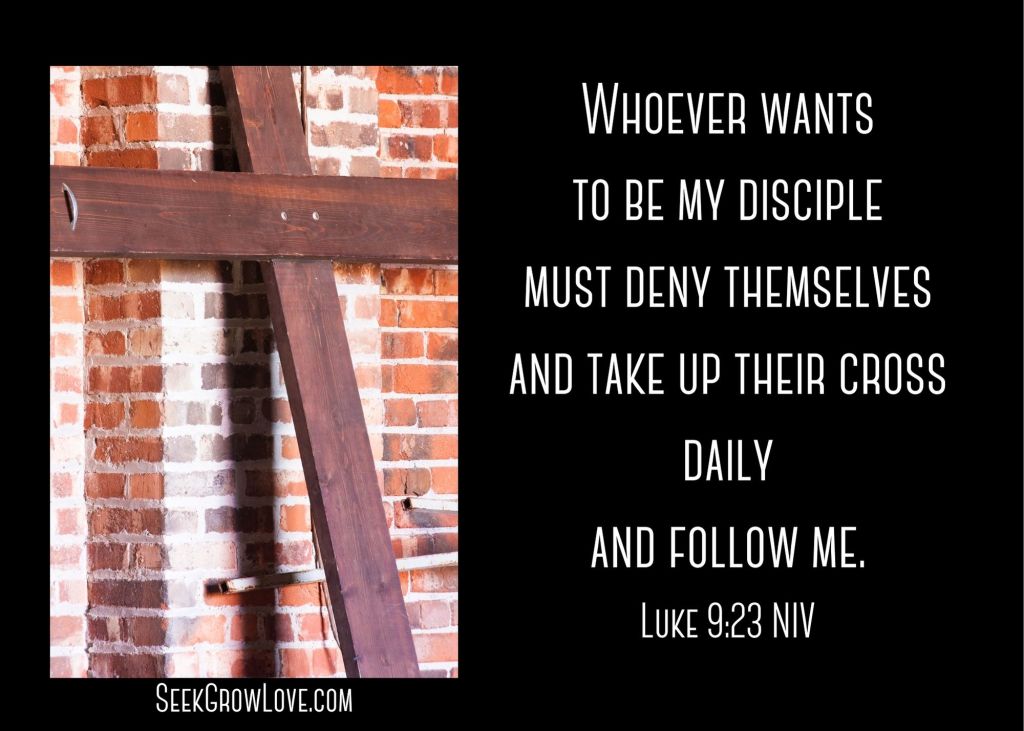
“Then he said to them all: ‘Whoever wants to be my disciple must deny themselves and take up their cross daily and follow me. For whoever wants to save their life will lose it, but whoever loses their life for me will save it. What good is it for someone to gain the whole world, and yet lose or forfeit their very self? Whoever is ashamed of me and my words, the Son of Man will be ashamed of them when he comes in his glory and in the glory of the Father and of the holy angels.” – Luke 9:23-26
What does the cross mean to you? Today, it is often seen around us as a symbol of Christianity, a beacon of hope, and a reminder of God’s love. Sometimes in our culture, it is even used in fashion and design outside the church for its aesthetic appeal. It’s “cool.”
But in ancient times, under the Roman Empire, it was feared. The cross was a means of torture and death. To hear their Lord say, “Take up your cross daily” was a terrifying concept. Early Christians died for the cross; for what it meant. Sometimes they even took up their cross literally. They denied themselves at all costs to take up their cross and be a true disciple.
To take up your cross is the noblest thing you can do. Jesus was a cross-bearer, leading the way for all who wish to follow him. He took up the ultimate cross, and denied himself in the ultimate way, giving up his entire life for a world of undeserving people. Following in his footsteps doesn’t mean giving oneself up for crucifixion, but being willing to deny your own wants and desires and follow God’s calling for your life daily, no matter what that is.
-Isabella Osborn
Reflection Questions:
What cross are you being called to bear? Will you make the decision to answer that call today?
Even if you are in a season of unknowns, what is the universal cross we are all called to bear?
Bearing a cross, while unimaginably fulfilling, can definitely come with difficulty and be a huge burden. In what ways can you find joy in taking up your cross, even when the endeavor you’ve been charged with is a challenging one?
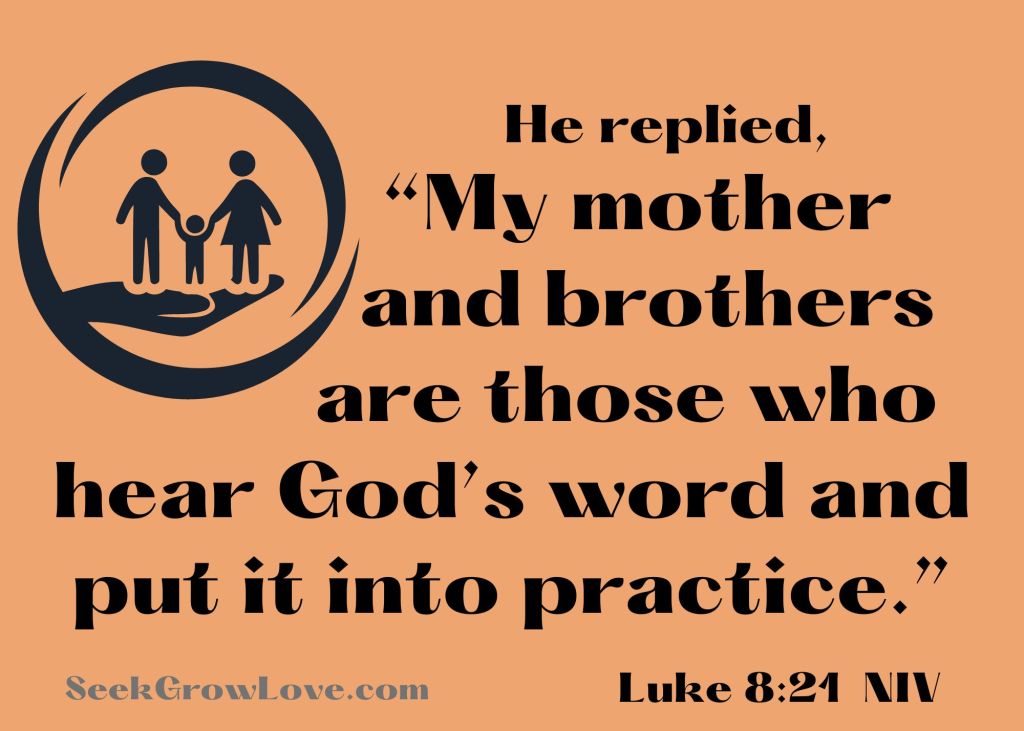
The words we see Jesus speaking in the Bible aren’t simply a set of rules for a better life on this earth. They are an invitation to accept adoption into the family of God. We see him referring to this family and clearly opening its doors to us in Luke 8:21.
“Then His mother and brothers came to Him, and could not approach Him because of the crowd. And it was told Him by some, who said, ‘Your mother and Your brothers are standing outside, desiring to see You.’ But He answered and said to them, ‘My mother and My brothers are these who hear the word of God and do it.” ’ – Luke 8:19-21
Under the New Covenant, Christ opened up who a relationship with the God of Abraham is available to. To be part of the Family of God is no longer simply to be a Jew; it is free to be accepted by both Jew and Gentile. In this text Jesus is not dissing his earthly mother in any way, in contrast, his words flow from a place that embraces all and desires every person to take part in the family of God. At the time, the disciples assumed that Jesus would put his own family in a higher position than all the other people to whom he had no obligation. But in the following verse, he reveals that every human being can become a member of his family. Closeness to Jesus depends only upon “hearing the word and doing it.”
Those who hear the word of God and do it are disciples; disciples are followers of Christ; followers of Christ are Christians. Christianity is not something you must be – or even can be – born into. Even if one is born into a Christian family, to become a part of the family of God is something different. It’s a choice to be part of something bigger than yourself and this life. To become a true Christian is to embrace your identity as a child of God and follower of Christ. It does not require a specific gene or to be part of a familial bloodline. It does not require anything, in fact, other than total commitment to the Gospel and a relationship with God.
-Isabella Osborn
Reflection Questions
Do you think that a relationship with our heavenly Father requires effort and nurturing, in the same way that your relationship with your mother, brother, or sister requires nurturing to grow and thrive?
What must you do to accept a place in the family of God? Once accepted, what steps can be taken in order to keep your faith and relationship with God growing stronger and stronger? What about to strengthen your relationship with your brothers and sisters in Christ?
What might “hearing the word and doing it” entail? How will you make the conscious, deliberate decision to “hear the word and do it” as we approach a new year?
There are few instances recorded in the Bible that describe Jesus being amazed, but one of them is found in Luke 7. When Jesus came into Capernaum, word spread, and when a Roman centurion heard that the Messiah was in town, he didn’t hesitate to send help for his sick servant. Those who were sent attempted to persuade Jesus to come by attesting to the centurion’s worthiness, confirming that he loves their nation, and even built the synagogue. But that’s not why Jesus went with them. He went with them because he was astounded by the man’s faith; faith even greater than he had witnessed in his own people. He was astounded by the amount of compassion and love in the man’s heart. On his way to the centurion’s home, he received another message, this time the centurion was declaring his unworthiness to be within Christ’s vicinity, asking only for a simple word of healing. In doing so, he further displayed immense humility as well as abounding faith.
This soldier showed more awareness of Christ’s purpose and authority on earth than even the Jews. His level of faith is what we should strive for as followers of Christ, a humble and simple faith that doesn’t waver, a faith that even the Messiah can’t help but be impressed by. A faith that acknowledges Christ’s sovereignty in every situation, whether or not a request is fulfilled. Knowing in every scenario that we serve a God who is fully capable of supernatural, miraculous phenomenons, but that He is also good no matter how He answers our prayers and requests. Let us pray today that God instills within us a faith as deep and true as the faith modeled by the centurion over 2,000 years ago, and thank Him that we have so many examples of immense faith to reflect on and live by recorded in His Word.
-Isabella Osborn
Reflection Questions:
Where do you find yourself sometimes initially looking for worthiness in the world?
How do we know that God sees us as worthy, despite how much distance there is between us and Him?
In what ways does the story of Jesus healing the Centurion’s servant apply to your own life?
How can you make it your first instinct to turn to God when facing difficult circumstances?
Luke 6 is an instruction manual for Christ-followers; if you desire to live for him, these scriptures lay out how to do it. However, a lot of his words of guidance completely contradict what our instincts tell us, and what the world around us accepts as the norm.
We’ve all heard it many times before: love your enemies. Three words so commonly spoken within the church, but rarely fully absorbed. By habit, we show abounding love and affection towards the people in our lives who are close, and easy to love; to our family, our friends, the people we “click” with. But when it comes to the people we face who are difficult to even be around, how do you know how to begin showing them love in the same way we show love to those with whom it comes naturally? It often goes against every fiber of our being. But that’s the world in us, not God.
“Do not conform to the pattern of this world, but be transformed by the renewing of your mind. Then you will be able to test and approve what God’s will is—his good, pleasing and perfect will.” Romans 12:2
As children of God, we live in this world, but we are not of it. To step out of the patterns of the world and into the lifestyle described in the Bible is to free yourself from the enslavement of sin. Because we are in such close proximity to ideas and actions that contradict God’s will for us, it’s so easy to fall into the trap that pulls us farther away from God. But we are not of the world, we are of God, and our God is a God of love; He is the very definition of Love. To embody true, pure, godly love is to love all people, and to show it in your actions, in how you speak, and in everything you do. God’s love knows no bounds, it is limitless. It seeps into every space that allows room for it, and fights to get into every space that is full, flowing endlessly in every direction. It’s a love that isn’t “fair,” it isn’t earned. It isn’t exclusive, and it never runs out.
This is the love that we are to allow into our lives, the deepest form of love that cannot be found anywhere outside of God. And when we have that love in our lives, we are to show it to everyone around us, no matter who they are, whether friend or foe. It’s a light that doesn’t go out and never stops shining. By this love, Christ lives in us.
-Isabella Osborn
Reflection Questions
What does Luke 6:35 mean to you? Does it fill you with hope and enthusiasm?
How can you show God’s love to those you don’t normally feel obligated to show love to?
What are some differences in how “even sinners” love (Luke 32-34), versus how we (as sinners, but also followers of Christ), are to love?
Looking outward rather than inward is a common tendency among mankind. I cannot stress the importance of making the decision to accept our downfalls and repent instead of continuing on in a faux form of oblivious happiness. It’s difficult in our fast-paced, always moving lives to make enough time to stop and reflect on some of the crucial lessons given to us on this topic throughout Jesus’ ministry, and Luke 5 has so many of them.
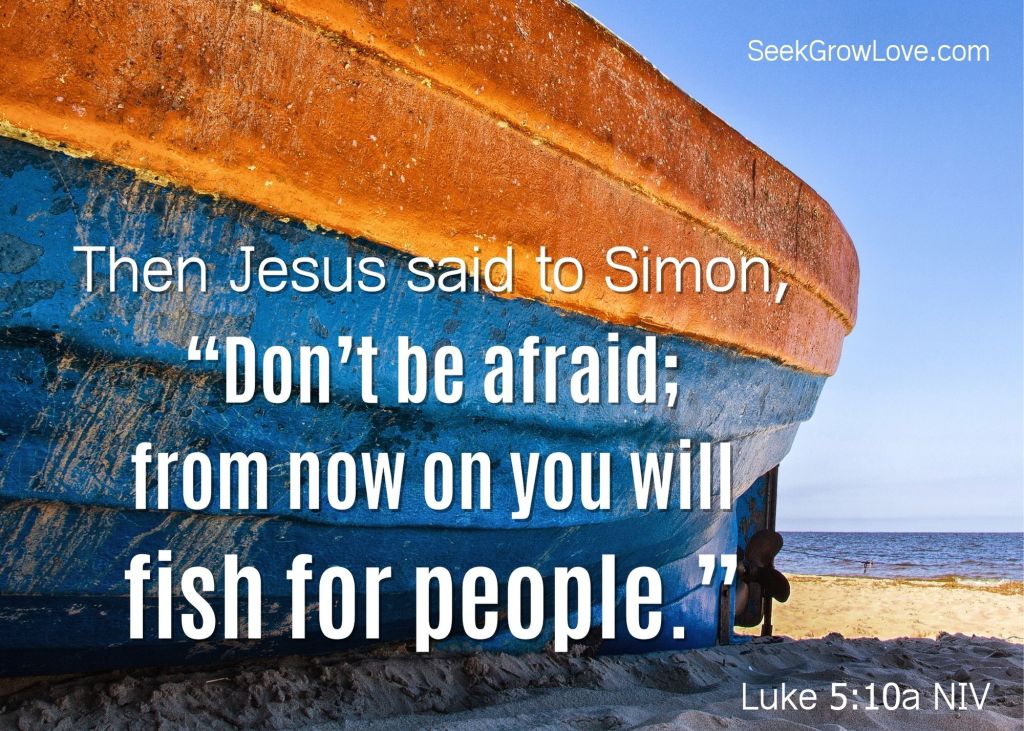
In verses 1-11 we see Jesus go before Simon Peter and his fishers who had no luck with catching fish all night. Jesus commands them to cast their nets again and a miracle occurs where every net is filled so heavy the boats began to sink. While this is an extraordinary story and example of Jesus’s ability to perform miracles and convert crowds, there’s a powerful underlying message within the conversation between Simon Peter and Jesus. When Simon sees the miracle, his first reaction wasn’t to shout in joy or surprise at the amount of fish he was just blessed with. It was to repent. Simon Peter acknowledged at that moment the truth of God and the fact that Jesus was the Messiah, and found himself unworthy. Jesus, however, does not judge or criticize Simon Peter, but instead gives him a purpose and a promise; the promise of the kingdom as long as he followed him and made fishers of men. Many times we come to expect blessings from God without realizing the greatest reward is already promised. In the same way, Simon Peter understood how he was not worthy of the miracle granted to him, and repented.
We too must come to understand the price of our sins and how we are unworthy of God’s grace. Without repentance of our sins, we can never truly come to accept why we’re unworthy of this reward, and why Jesus died on the cross for our sins, forming a New Covenant under which all our sins are freely forgiven. So in all that we do, repent and show thanks to God for the sacrifice of Jesus and the promise bestowed upon us.
-Isabella Osborn
Reflection Questions
What can you learn from Peter in Luke 5:1-11? What can you learn from Jesus in this passage? Which message did you most need to hear today?
What do you see when you look inward? How does it make you feel? What does it make you want to do? Pray about it?
What purpose and promise do you think Jesus sets before you?
Temptation is a struggle that humanity has been at war with since the beginning of time. Temptation changed our world from a perfect paradise with no sin and no pain to a broken world full of flawed people. It was a result of the first human succumbing to the pressure of temptation that there hasn’t since been a single human capable of fully breaking free from the grasp of sin – constantly giving in to temptation, and consistently turning away from God and rejecting His love.
Until Jesus.
When Adam and Eve ate the fruit from the tree of knowledge of good and evil in Genesis 3, they failed massively, and their failure brought misery upon the entire earth (not to say that anyone else, if put in the same situation, wouldn’t have eventually made the same choice and given in to temptation). When Christ was tempted, on the other hand, he triumphed. His victory over temptation was a victory over Satan, bringing hope to all humanity for a day when we can be free from the bondage of sin. For a day when the world is not only set back to the state it was in at the beginning of time, but a state unfathomably better. Under Adam we were slaves to sin, but through Christ we have been set free.
As broken humans living in a broken world, we are just as susceptible as Adam to the call of evil, and temptation lurks all around us. But just as we have the failure and weakness of Man within us, we also have the hope and grace of God through Christ who sets us free. We have the power to overcome, and to stand firm in our identity as a child of God as Jesus did in the wilderness.
-Isabella Osborn
Reflection Questions
What 3 things did the devil use to tempt Jesus in Luke 4? How did Jesus respond to each temptation?
What are your 3 biggest temptations? How can you use the same power Jesus used to overcome these temptations? Think specifically.
Do you more often see yourself as a child of Adam (and all humanity), or a child of God?
In today’s reading, the last portion has a major theme : “the son of.” The author guides us from Jesus all the way back to the earliest days of history with “the son of Adam, the son of God.” The names and numbers of generations here differ from the names and numbers in Matthew 1. It seems Matthew was proving a point about the care and concern of God. Luke is being historically accurate. But this really isn’t the point. What’s interesting about Luke 3 is that this theme doesn’t begin in verse 23. Instead, it begins in verse 2, and grows throughout the passage.
John is the son of Zechariah. (V.2) We all know this. Why does the author repeat it? Because we need to have sons in mind. We know who John’s parents are and where he comes from. In preaching a baptism of repentance, John is calling for a radical life change. A change in both action and status. More on that in a moment.
In verse 7, John says to his listeners “you brood of vipers.” That is a claim of THEIR parentage, and not a nice one. They were “sons of snakes.” For those who desire to follow John, he calls us to account in how they live. Moreover, John basically explains that he isn’t talking about our physical, biological parents. Having Abraham as your biological ancestor, no matter how good Abraham was, does not mean that a person can escape condemnation. Instead, there needs to be a change in every person’s life. It seems our parentage is determined by how we share our abundance with the less fortunate. Who our “fathers” are is determined by whether we play fairly, by the rules of life and the laws of the land and by finding contentment in our lives.
In verse 21, Jesus goes to “fulfill all righteousness” by being baptized. In that moment, the Holy Spirit descends and a cloud says “You are my beloved Son; with you I am well pleased.”
A couple thoughts to pull you through the day :
Jesus is a real man, with a real family, a real history, who lived in a real time and place. A bunch of names (like at the beginning of the chapter) and a genealogy (like at the end) shouldn’t make us glaze over, but perk up. Luke isn’t trying to confuse his audience. He is situating this story in time and place. This is decidedly not the fairy tale “once upon a time” but something much more like “December 8th, 7pm, in Granger, IN, at Jake’s home, while he types in his pajamas.” These names should ground the story in the real world more.
John calls out his hearers and says “Don’t trust in your parentage.” For me, that hits home. I had believing grandparents on both sides, and a mom and dad who raised me in the church and encouraged me to love God. I can’t ride their coattails. It’s not about what they did, but what I do. But maybe, John’s warning for you could be a word of comfort: nothing that came before holds you back. Did your family not pass on morals, or pass on morals that were detrimental? Did you not know the state of your parents’ souls because you didn’t really know your parents? Do you love your parents but couldn’t imagine living the way they do? Then you are not bound to be like them. We are all called to cast aside our parentage as a source of confidence or weakness, and come before God as ourselves.
John talks about repentance and changing our actions. When we do so, we no longer have snakes for parents. But who is our parent then? I think the hope is what we are introduced to in John 1:12-13 “12 Yet to all who did receive him, to those who believed in his name, he gave the right to become children of God— 13 children born not of natural descent, nor of human decision or a husband’s will, but born of God.” Those who believe in the name of Jesus are able to call God their father. John’s talk of righteousness must be understood in light of Jesus. You are a sinner saved only by grace, and you cannot save yourself. But if you trust in the name of Jesus, you can be saved. This Christmas season, we are reminded of the great and awesome gift of Jesus the Messiah. Do you trust in Jesus as your Lord and Savior? If you have, then in response to HIM making you a child of God, you can and must live a righteous life.
In some sense, every human is a children of God. If Adam is “the father of us all”, and he is “the son of God” we are in a sense, children of God. This however, does not mean that every person is saved. If we live like children of the devil, we truly are children of the devil. These are not my words, but the words of Jesus in John 8. This does truly mean that when we hear the statements this time of year about the “brotherhood of man” and “we are all one”, those statements are true. Instead of filling us with warm fuzzies, let it move us to speak to our brothers and sisters about salvation from dead actions, harm and pain to love, grace and hope that can only be found in Christ Jesus.
May you today, see the reality of Jesus in this Christmas time.
May you let go of familial pride or shame and come to God only and forever through Jesus.
May you become what you were meant to be, a son or daughter of God through righteous action and salvation in Jesus, and may you share your salvation with the world.
So for one final time this season from me :
Merry Christmas!
– Jake Ballard
Jake Ballard is pastor at Timberland Bible Church. If you’d like to hear more from him, you can find Timberland on Facebook (https://www.facebook.com/TimberlandBibleChurch/ ) and on Instagram (https://instagram.com/timberlandbiblechurch?igshid=t52xoq9esc7e). The church streams the Worship Gathering every Sunday at 10:30. Besides studying and teaching God’s word, he is raising three beautiful children with the love of his life, loves Christmas, Harry Potter, Christmas, Board Games, and Christmas. He is also going to be teaching New Testament Survey II, which is available from Atlanta Bible College with their ABC4U program (https://www.atlantabiblecollege.com). If you’d like to reach out to talk Bible, talk faith, or talk about your favorite Christmas Song (and why Mariah Carey sings it), look Jacob Ballard up on Facebook (https://www.facebook.com/jacob.ballard.336 ) or email him at jakea.ballard@yahoo.com. God bless you all!
Reflection Questions
What do you think John may have learned from his father Zechariah, whom we met back in Luke 1?
Look again at John’s message in Luke 3, what do you think he might tell you if you asked him the same question the crowd, tax collectors and soldiers asked, “What shall we do?”
Do you see yourself as a child of God? Why or why not? What does it mean to be a child of God? What privileges and responsibilities come with the position?





 Seek Grow Love