Look Inside

Luke 5

Monday, December 13, 2022

Looking outward rather than inward is a common tendency among mankind. I cannot stress the importance of making the decision to accept our downfalls and repent instead of continuing on in a faux form of oblivious happiness. It’s difficult in our fast-paced, always moving lives to make enough time to stop and reflect on some of the crucial lessons given to us on this topic throughout Jesus’ ministry, and Luke 5 has so many of them.

In verses 1-11 we see Jesus go before Simon Peter and his fishers who had no luck with catching fish all night. Jesus commands them to cast their nets again and a miracle occurs where every net is filled so heavy the boats began to sink. While this is an extraordinary story and example of Jesus’s ability to perform miracles and convert crowds, there’s a powerful underlying message within the conversation between Simon Peter and Jesus. When Simon sees the miracle, his first reaction wasn’t to shout in joy or surprise at the amount of fish he was just blessed with. It was to repent. Simon Peter acknowledged at that moment the truth of God and the fact that Jesus was the Messiah, and found himself unworthy. Jesus, however, does not judge or criticize Simon Peter, but instead gives him a purpose and a promise; the promise of the kingdom as long as he followed him and made fishers of men. Many times we come to expect blessings from God without realizing the greatest reward is already promised. In the same way, Simon Peter understood how he was not worthy of the miracle granted to him, and repented.

We too must come to understand the price of our sins and how we are unworthy of God’s grace. Without repentance of our sins, we can never truly come to accept why we’re unworthy of this reward, and why Jesus died on the cross for our sins, forming a New Covenant under which all our sins are freely forgiven. So in all that we do, repent and show thanks to God for the sacrifice of Jesus and the promise bestowed upon us.

-Isabella Osborn

Reflection Questions

  1. What can you learn from Peter in Luke 5:1-11? What can you learn from Jesus in this passage? Which message did you most need to hear today?
  2. What do you see when you look inward? How does it make you feel? What does it make you want to do? Pray about it?
  3. What purpose and promise do you think Jesus sets before you?

Victory!

Luke 4

Sunday, December 11, 2022


Temptation is a struggle that humanity has been at war with since the beginning of time. Temptation changed our world from a perfect paradise with no sin and no pain to a broken world full of flawed people. It was a result of the first human succumbing to the pressure of temptation that there hasn’t since been a single human capable of fully breaking free from the grasp of sin – constantly giving in to temptation, and consistently turning away from God and rejecting His love.


Until Jesus.


When Adam and Eve ate the fruit from the tree of knowledge of good and evil in Genesis 3, they failed massively, and their failure brought misery upon the entire earth (not to say that anyone else, if put in the same situation, wouldn’t have eventually made the same choice and given in to temptation). When Christ was tempted, on the other hand, he triumphed. His victory over temptation was a victory over Satan, bringing hope to all humanity for a day when we can be free from the bondage of sin. For a day when the world is not only set back to the state it was in at the beginning of time, but a state unfathomably better. Under Adam we were slaves to sin, but through Christ we have been set free.


As broken humans living in a broken world, we are just as susceptible as Adam to the call of evil, and temptation lurks all around us. But just as we have the failure and weakness of Man within us, we also have the hope and grace of God through Christ who sets us free. We have the power to overcome, and to stand firm in our identity as a child of God as Jesus did in the wilderness.

-Isabella Osborn

Reflection Questions

  1. What 3 things did the devil use to tempt Jesus in Luke 4? How did Jesus respond to each temptation?
  2. What are your 3 biggest temptations? How can you use the same power Jesus used to overcome these temptations? Think specifically.
  3. Do you more often see yourself as a child of Adam (and all humanity), or a child of God?

Who’s Your Daddy?

Luke 3

Saturday, December 10, 2022

In today’s reading, the last portion has a major theme : “the son of.” The author guides us from Jesus all the way back to the earliest days of history with “the son of Adam, the son of God.” The names and numbers of generations here differ from the names and numbers in Matthew 1. It seems Matthew was proving a point about the care and concern of God. Luke is being historically accurate. But this really isn’t the point. What’s interesting about Luke 3 is that this theme doesn’t begin in verse 23. Instead, it begins in verse 2, and grows throughout the passage. 

John is the son of Zechariah. (V.2) We all know this. Why does the author repeat it? Because we need to have sons in mind. We know who John’s parents are and where he comes from. In preaching a baptism of repentance, John is calling for a radical life change. A change in both action and status. More on that in a moment. 

In verse 7, John says to his listeners “you brood of vipers.” That is a claim of THEIR parentage, and not a nice one. They were “sons of snakes.” For those who desire to follow John, he calls us to account in how they live. Moreover, John basically explains that he isn’t talking about our physical, biological parents. Having Abraham as your biological ancestor, no matter how good Abraham was, does not mean that a person can escape condemnation. Instead, there needs to be a change in every person’s life. It seems our parentage is determined by how we share our abundance with the less fortunate. Who our “fathers” are is determined by whether we play fairly, by the rules of life and the laws of the land and by finding contentment in our lives. 

In verse 21, Jesus goes to “fulfill all righteousness” by being baptized. In that moment, the Holy Spirit descends and a cloud says “You are my beloved Son; with you I am well pleased.”

A couple thoughts to pull you through the day :

  • Jesus is a real man, with a real family, a real history, who lived in a real time and place. A bunch of names (like at the beginning of the chapter) and a genealogy (like at the end) shouldn’t make us glaze over, but perk up. Luke isn’t trying to confuse his audience. He is situating this story in time and place. This is decidedly not the fairy tale “once upon a time” but something much more like “December 8th, 7pm, in Granger, IN, at Jake’s home, while he types in his pajamas.” These names should ground the story in the real world more. 
  • John calls out his hearers and says “Don’t trust in your parentage.” For me, that hits home. I had believing grandparents on both sides, and a mom and dad who raised me in the church and encouraged me to love God. I can’t ride their coattails. It’s not about what they did, but what I do. But maybe, John’s warning for you could be a word of comfort: nothing that came before holds you back. Did your family not pass on morals, or pass on morals that were detrimental? Did you not know the state of your parents’ souls because you didn’t really know your parents? Do you love your parents but couldn’t imagine living the way they do? Then you are not bound to be like them. We are all called to cast aside our parentage as a source of confidence or weakness, and come before God as ourselves. 
  • John talks about repentance and changing our actions. When we do so, we no longer have snakes for parents. But who is our parent then? I think the hope is what we are introduced to in John 1:12-13 “12 Yet to all who did receive him, to those who believed in his name, he gave the right to become children of God— 13 children born not of natural descent, nor of human decision or a husband’s will, but born of God.” Those who believe in the name of Jesus are able to call God their father. John’s talk of righteousness must be understood in light of Jesus. You are a sinner saved only by grace, and you cannot save yourself. But if you trust in the name of Jesus, you can be saved. This Christmas season, we are reminded of the great and awesome gift of Jesus the Messiah. Do you trust in Jesus as your Lord and Savior? If you have, then in response to HIM making you a child of God, you can and must live a righteous life. 
  • In some sense, every human is a children of God. If Adam is “the father of us all”, and he is “the son of God” we are in a sense, children of God. This however, does not mean that every person is saved. If we live like children of the devil, we truly are children of the devil. These are not my words, but the words of Jesus in John 8. This does truly mean that when we hear the statements this time of year about the “brotherhood of man” and “we are all one”, those statements are true. Instead of filling us with warm fuzzies, let it move us to speak to our brothers and sisters about salvation from dead actions, harm and pain to love, grace and hope that can only be found in Christ Jesus. 

May you today, see the reality of Jesus in this Christmas time. 

May you let go of familial pride or shame and come to God only and forever through Jesus. 

May you become what you were meant to be, a son or daughter of God through righteous action and salvation in Jesus, and may you share your salvation with the world. 

So for one final time this season from me :

Merry Christmas!

– Jake Ballard

Jake Ballard is pastor at Timberland Bible Church. If you’d like to hear more from him, you can find Timberland on Facebook (https://www.facebook.com/TimberlandBibleChurch/ ) and on Instagram (https://instagram.com/timberlandbiblechurch?igshid=t52xoq9esc7e). The church streams the Worship Gathering every Sunday at 10:30. Besides studying and teaching God’s word, he is raising three beautiful children with the love of his life, loves Christmas, Harry Potter, Christmas, Board Games, and Christmas. He is also going to be teaching New Testament Survey II, which is available from Atlanta Bible College with their ABC4U program (https://www.atlantabiblecollege.com). If you’d like to reach out to talk Bible, talk faith, or talk about your favorite Christmas Song (and why Mariah Carey sings it), look Jacob Ballard up on Facebook (https://www.facebook.com/jacob.ballard.336 ) or email him at jakea.ballard@yahoo.com. 
God bless you all!

Reflection Questions

  1. What do you think John may have learned from his father Zechariah, whom we met back in Luke 1?
  2. Look again at John’s message in Luke 3, what do you think he might tell you if you asked him the same question the crowd, tax collectors and soldiers asked, “What shall we do?”
  3. Do you see yourself as a child of God? Why or why not? What does it mean to be a child of God? What privileges and responsibilities come with the position?

Unexpected Moments

Luke 2

Friday, December 9, 2022

Sheep are stinky. 

Consequently, shepherds stink. 

Tending sheep, especially overnight, was a pretty thankless job, and took a toll on a lot of those who did it. Shepherds were not very well thought of by those who had more respectable agrarian jobs, or those who worked in the city. 

But God chose them to be the first ones to know the messiah is born. They saw him in the manger after the angels made their Christmas announcement!

Old people who spend their days alone can sometimes be weird. 

In fact, some of the best people are the old weird people who spend most of their time in prayer to God. The family of Jesus are accosted when they take him to be consecrated on the eighth day. Simeon and Anna may have been well respected, but they were still both older, and both a little weird. 

But God chose them to be among the first to share the message of the Messiah. They spoke the message, Simeon ready for death, knowing the Messiah had come!

The story of Jesus is full of unexpected moments like this. You didn’t see shepherds shouting out with joy, speaking to all who would listen. You didn’t see Simeon and Anna stopping families to talk on the way to the temple. You didn’t see a twelve year old boy going toe-to-toe, blow-for-blow with the religious scholars of the day. 

But God chose these moments, these people, these places, to give us a clue that in the rest of Luke we’re going to see unexpected moments. 

With the familiarity of the passage at Christmas, it may seem common place. But as you read Luke 2 today, remind yourself again just how radical *and strange* the birth of Christ was. May you find comfort in the fact that no matter if you are

Old

Young

Weird

Normal

Or even stinky

God is choosing you to believe in Christ this Christmas. It is up to you to choose to believe. 

-Jake Ballard

Reflection Questions

  1. What do you find most surprising in Luke 2?
  2. Do you believe in Christ? How will that change your day, season and life?

MERRY CHRISTMAS!

Luke 1

Thursday, December 8, 2022

I love Christmas. 

Does that really need an explanation? What’s not to love about a time of year where we get to celebrate Jesus? Celebrate the Messiah who is and brings us hope, peace, joy, and love? Celebrate with cookies and pies and presents and parties? It is a joyous time of year, both for the cultural wrappings and baggage, (which is fine*!) but also for the Church traditions, teachings, giving, serving, and singing! 

The story of the birth of Christ, however, doesn’t begin in the Hill Country of Judea, as much as Linus from  A Charlie Brown Christmas would have you believe. Instead, Luke, author of the most chronologically accurate account of the life of Christ**, brings us farther back than Matthew, and tells us about the announcements of coming births of John and Jesus to their respective mothers. 

To be fair, today’s reading is 80 verses long! That’s long! I want to give you rapid fire thoughts and questions as the devotion for today:

Theophilus means in Greek “Friend of God.” While there may have been a person who commissioned the work from Luke, it could also be a title. Are you the friend of God to whom Luke is writing? Do you need to hear an accurate, orderly account of the life of Jesus to know with certainty the things you have been taught?

Both Zechariah and Mary respond to Gabriel, the messenger angel, with a similar question: How can this be? However, there are a few differences. Zechariah is a older man, a husband, a priest, that is a leader of the people, working in the temple. Mary is a young woman, unmarried,  virginal, still probably in the house of her mother and father until her time to be wed to Joseph had come. Gabriel (but really, God) expected Zechariah to comply, to say “Lord I believe” and to follow through on the promise of God. Mary growing up in an agrarian society, would know that in her current state, babies would be impossible to come by. 

When God announces his plan to you, do you trust that he will follow through? How much of him have you seen? Are you overlooking miracles? However, know that he isn’t mad when you ask him how to accomplish the (what appears to be) impossible. You too may just need the Holy Spirit to do the impossible. Are you willing to say “I am the Lord’s servant. May your word to me be fulfilled”?

A quick note, without a question, is that John, in the womb of Elizabeth, responded to the Messiah. Elizabeth thinks her baby is a person before he is born. 

Final thought – Both Mary and Zechariah sing their joy to God. Take some time today and ponder what song you would sing if you could sing it. The lyrics don’t have to be perfect or rhyme. Their doesn’t need to be a meter, or pitch. But what would you sing to God to give him glory? Or, find a song that shares your heart, and sing that to God, thinking of all the blessings he has given you. 

No matter the song in your heart, starting today, have yourself a merry little Christmas now. 

-Jake Ballard

* The wise men weren’t at the manger, but that’s OK! Use that to teach people about Jesus!

**In the author’s correct and very humble opinion.

QUESTIONS

See Above!

How do you fit into His story?

Luke 24

The Easter Story is one of the most beautiful stories ever written, and the best part is, it’s even true! It is a part of a plan written by God and fulfilled through Jesus by his obedience to death on the cross all those years ago. There was purpose in this suffering: so that the sins of the world could be forgiven. There is purpose in every season. Likewise there was purpose in his life of ministry and ultimately purpose in his resurrection. All the seasons of his life brought about God´s perfect and pleasing will. God can use anything and everything for His good. Even pain and suffering. Even a blood-stained cross. Even the death of His precious son.

Jesus knew what he was called to do and he followed through, he died on the cross for our sins. For three days the world was without hope. At the time they all believed that a Savior would come with sword and shield to bring victory over the Romans. It would then make sense that they would reject Jesus as their Messiah because his entire life and tragic death was the exact opposite as how they expected their Savior to come. Thankfully though, God gives us what we need not what we think we want. 

Although Jesus´ disciples were plainly told all the things that were to take place including the hope of Jesus´ resurrection, there was no anticipation of his return because they had forgotten that God´s plans are larger than life- even larger than death, Jesus´ death. They hoped that Jesus would be the one to redeem Israel. Not only did he redeem Israel, but the world, just not in the way they believed it would happen. 

Someone asked me recently what my passions were. But it got me thinking, how do my passions and talents fit together into God´s grand plan? How do I fit into His story? The women who first found the tomb empty were staying focused on doing their ministry. Likewise the disciples all took part in the Great Commission, being witnesses of all that had happened. After Jesus´ ascension they set out to spread the gospel even to the point of becoming martyrs. How can I use where I am in life and who I am in Christ to further God’s plan?

Jesus entrusted his entire life- even life itself- into God´s hands. And it wasn´t without God´s response to Jesus´ obedience. The process is like the call and response section in the back of the hymn books. Back and forth between God and His people. It started in the beginning with God when he created the world and everything in it and brought forth the plan of salvation. Jesus already did his part by dying on the cross, and is now continually interceding for us to God. It’s our turn to call on God and turn our life into a living sacrifice in order for Him to respond in immeasurable ways. Jesus submitted to God´s will and God answered by raising him from the grave. In the same way I believe we as Christians are expected to follow the example Jesus set before us of obeying God´s calling for our life. Use the God-given talents and the passions he has placed on your heart to live for Him, serving Him wholeheartedly. And in God´s timing, His will and His ways will prevail.

-Makayla Railton

Today’s Bible reading passages can be read or listened to at BibleGateway – Joshua 1-2 and Luke 24

Now What?

Luke 23:26-56

Imagine this: one day, a man approaches and asks you to follow him. Perhaps he astonishes you with a miracle or shows you undeserved kindness. Bewildered and intrigued, you leave everything behind to follow him. For three years, you have no home nor income, but you witness incredible miracles—from calming storms to raising a dead man to life. You yourself were given authority to drive out demons, cure diseases, and proclaim the coming Kingdom of God. This man turned your brokenness into purpose; finally you belong. Then, in a chaotic turn of events, the man is called a criminal and is nailed to a cross. You deny him and watch him die. 

But all those who knew Jesus, including the women who had followed him from Galilee, stood at a distance, watching these things. (Luke 23:49) 

The day following Jesus’s death must’ve been a quiet one for his followers. His body was still buried, lifeless. They were grieving for the man they loved, but also probably for the way their lives would inevitably change. They were left wondering, Now what?

That same question still applies to us today: Jesus died, so now what? Every year, we dedicate a weekend to remembering Jesus’s death and subsequent resurrection. We grieve the way he suffered and rejoice in his triumph over sin and death. Jesus’s sacrifice should change the way we live our lives! Yet, it’s too easy to forget about the weight of his suffering and significance of his victory as we return to our normal lives. 

As you await tomorrow’s celebration of Jesus’ resurrection, find a quiet moment to  reflect upon this question: 

“Is what you’re living for worth Christ dying for?” -Leonard Ravenhill

I have been crucified with Christ and I no longer live, but Christ lives in me. The life I now live in the body, I live by faith in the Son of God, who loved me and gave himself for me. (Galatians 2:20)

-Mackenzie McClain

Today’s Bible reading passages can be read or listened to at BibleGateway – Deuteronomy 33-34 and Luke 23:26-56

Funhouse Mirrors

Luke 23:1-25

Have you ever looked at yourself through the mirrors in a funhouse? Maybe they made your legs appear shorter or your figure much rounder. Of course, just because the mirror makes you look one way doesn’t mean that you actually look like that. Sometimes people seem to see us through funhouse mirrors; they get a distorted image of who we actually are. 

Jesus, too, was often seen through funhouse mirrors. Many people perceived him to be a traitor and criminal. Yet, standing in front of the mirror was actually the begotten Son of God, the promised Messiah. 

After Jesus’s arrest, he stood before government and religious officers, as was customary. Jesus was beaten by the guards, accused by the leaders, and ridiculed by the crowds. It’s a disgustingly difficult chapter to read because of the undeserved nastiness towards Jesus.  

So Pilate asked Jesus, “Are you the king of the Jews?”

“You have said so,” Jesus replied. (Luke 23:3)

Jesus didn’t deny Pilate’s allegations. If I were Jesus, I would probably burst into tears shouting, “It’s not fair!” After all, he had never sinned, nonetheless committed a crime worthy of death on a cross. Yet, he continued to refrain from defending himself. 

He (Herod) plied him with many questions, but Jesus gave him no answer. (Luke 23:9)

Jesus’ goal wasn’t to appease man but to please God. God already saw the real Jesus, the one standing in front of the mirror. Let us learn from Jesus’ example: You don’t have to get the last word. It’s okay to be misunderstood. There’s no need to get even. You have nothing to prove. 

Because God sees you—the real you. 

I’m an open book to you; even from a distance, you know what I’m thinking. You know when I leave and when I get back; I’m never out of your sight. You know everything I’m going to say before I start the first sentence. I look behind me and you’re there, then up ahead and you’re there, too—your reassuring presence, coming and going. This is too much, too wonderful—I can’t take it all in! (Psalm 139 from The Message)

-Mackenzie McClain

Today’s Bible reading passages can be read or listened to at BibleGateway – Deuteronomy 31-32 and Luke 23:1-25

Known & Loved

Luke 22:39-71

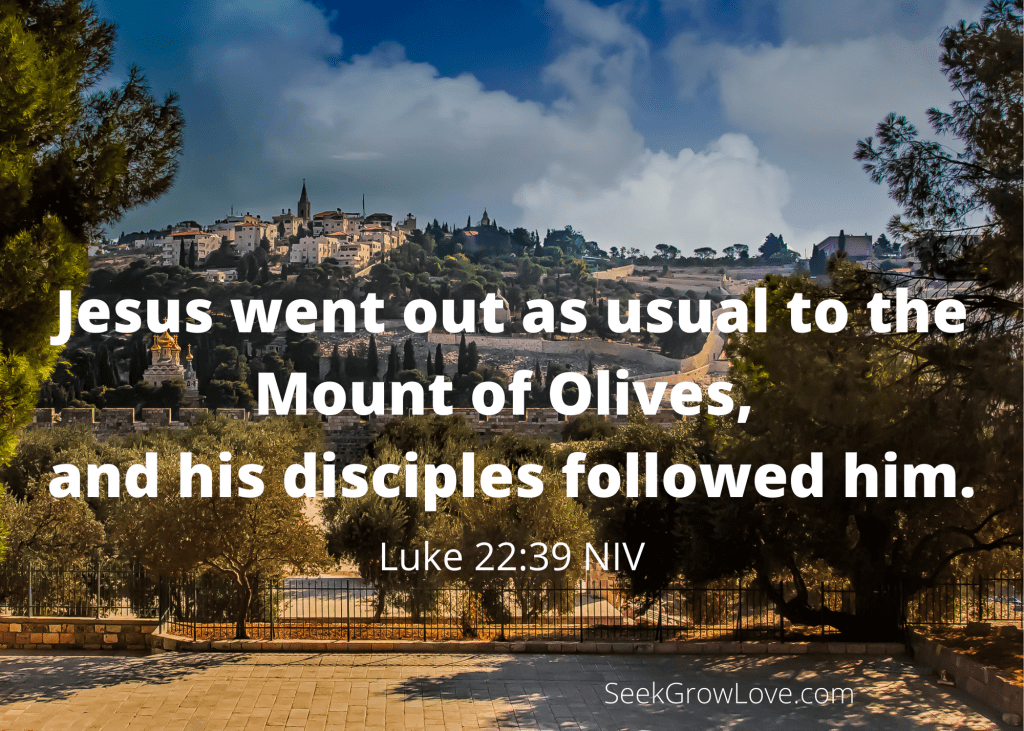
After Jesus finished the Passover meal with his disciples, he retreated to the Mount of Olives, which is just outside of Jerusalem, to pray. While there, he was arrested by a crowd led by Judas, one of his own disciples. Jesus’s choice to stay at the Mount of Olives was significant for two reasons: 

  1. Jesus knew Judas would betray him. 

In a previous conversation among the disciples, Jesus predicts that one of the twelve would betray him, even calling out Judas by name (John 13). The very night of the Last Supper, he makes a similar remark: 

“The hand of him who is going to betray me is with mine on the table” (Luke 22:21). 

  1. Judas knew Jesus would be at the Mount of Olives. 

During the week leading up to Jesus’s death, he and his disciples had spent every night at the Mount of Olives: 

Each day Jesus was teaching at the temple, and each evening he went out to spend the night on the hill called the Mount of Olives” (Luke 21:37). 

Judas surely knew where Jesus would be on this particular night, yet Jesus didn’t try to hide. 

Instead, Jesus invited Judas to his table to eat dinner together. 

Jesus stayed the night in the very place Judas knew he would be. 

You and I were a lot like Judas. We were full of ugly thoughts, misguided intentions, mixed-up priorities, and shameful feelings. Jesus saw our filthy sin, yet he invited us into his presence to give us freedom from it. The greatest irony is that the person who knows our flaws best, loves us the greatest. 

You are fully known, and yet you are deeply loved.

But God demonstrates his own love for us in this: While we were still sinners, Christ died for us. (Romans 5:8)

-Mackenzie McClain

Today’s Bible reading passages can be read or listened to at BibleGateway here – Deuteronomy 29-30 and Luke 22:39-71.

The Not Last Supper

Luke 22:1-38

God is an epic story-teller. One trick up every story-teller’s sleeve is repetition, only each new repetition brings a new twist. The story in today’s chapter is titled, The Last Supper, implying that other suppers preceded it. 

The first meal of this kind is found in Exodus; the Israelites were captive to Pharaoh in Egypt, who worked them ruthlessly.  God sent a series of plagues to convince Pharaoh to let His people go, which would culminate in the death of all firstborn sons—people and livestock alike. To save the Israelites from this horrific plague, God gave specific instructions to Moses and Aaron:

“On that same night I will pass through Egypt and strike down every firstborn of both people and animals, and I will bring judgment on all the gods of Egypt. I am the LORD. The blood will be a sign for you on the houses where you are, and when I see the blood, I will pass over you. No destructive plague will touch you when I strike Egypt.” (Exodus 12:12-13)

The Israelites with the blood of the lamb slathered on their door frames were safe, as the angel of death passed over their houses. God ordered the Israelites to commemorate the day God saved Israel, and they did so every year. 

Over one thousand years later, in the week leading up to Jesus’ death, Jesus celebrated Passover with his disciples in Jerusalem. This time, there was a new twist. Jesus gives new meaning to the emblems eaten that meal: 

And he (Jesus) took bread, gave thanks and broke it, and gave it to them, saying, “This is my body given for you; do this in remembrance of me.” In the same way, after the supper he took the cup, saying, “This cup is the new covenant in my blood, which is poured out for you.” (Luke 22:19-20).

Jesus’s body was given for you, his blood poured out for you. His sacrifice marks a new covenant in which Jesus’ death atones for the sin of the world: 

Behold the Lamb of God who takes away the sin of the world. (John 1:29)

Have you ever read a story in the Bible with a hint of jealousy, wishing you, too, could have witnessed that moment? I know I have. I had a seat at that table with Jesus, eating and drinking, hearing his wisdom, and honoring his upcoming sacrifice. The good news for us is that “The Last Supper” isn’t really Jesus’s last supper: 

And he (Jesus) said to them (the disciples), “I have eagerly desired to eat this Passover with you before I suffer. For I tell you, I will not eat it again until it finds fulfillment in the kingdom of God.” (Luke 22:15-16)

It’s another feast with another twist. This time we’ll be eating and drinking in physical communion with Jesus, but in the Kingdom of God. I am excitedly awaiting that day, but in the meantime we have the honor of commemorating Jesus’ sacrifice regularly through Communion. The next time you take Communion, do it in remembrance—and in sweet anticipation—of all Jesus has done and is yet to do. 

-Mackenzie McClain

Today’s Bible reading passages can be read or listened to at BibleGateway here – Deuteronomy 27-28 and Luke 22:1-38