Jesus vs. Demons

Matthew 8

January 8

Jesus has just finished his impressive Sermon on the Mount and many are following him. They hear something different in his teaching and are drawn to him. Now, it’s time for them to see something different! Jesus is not all talk. He shows them the love and power of God which God gave to His Son to put into action to make believers, to convince the people that the Messiah was in their midst. Jesus is incredible to watch. He conquers disease, isolation, paralysis, suffering, fevers, demon possession, storms and the elements. He teaches a better way (add love) and he demonstrates what that looks like, with a healthy dose of God’s power.

Jesus is not scared of the leper who has been ostracized, feared and shunned because of the painful sores on his body and this contagious disease. Rather, he stops, listens, reaches out his hand, touches him, and heals him with compassion and power.

Likewise, he heals the Roman centurion’s servant (without even touching or seeing him) because of the faith of the centurion. He heals Peter’s mother-in-law of a fever and she responds by serving him. He heals the sick and demon-possessed and in a mighty way he calms the storm and amazes his disciples.

Those are all great accounts of awesome acts, but today I want to look a little deeper at the last events of Matthew 8 – the healing of two demon-possessed men in the region of the Gadarenes. It is certainly not because I have a wealth of information to share with you about demon-possession. It is indeed one of those Bible topics I know is in there, but still have a lot of questions about. It might be easier to try to ignore it and read right over it – but then I would be missing a chunk of Jesus’ life and power and I don’t want to do that. And I can’t help but feel that if I understand this a little more…there could be something useful for me to learn and put into action myself today.

So, what do we learn about these specific demons from this passage?

They are powerful and violent and have control over people even in a physical manner.

They are smart in spiritual matters. They recognize Jesus as the Son of God! They know that there will be a time coming when Jesus will do battle against them and torture them. (Matthew 8:29)

Despite all the power these demons have displayed over people, and the fear they have instilled in others, they are now in Jesus’ presence (since he was bold enough to go where others wouldn’t). And in Jesus’ presence they are begging him. They realize the Son of God, Jesus, has power over them. They have more than met their match.

And then there are the townspeople’s reaction to Jesus! They hear that Jesus has freed these two men from the demons that controlled them and terrorized their roadways. And they learn that Jesus had sent the demons (as per their request) into a herd of pigs which then rushed down the steep bank and drowned in the water. And their response is to plead with Jesus to leave town, leave them alone. They had grown accustomed to the demon possessed men. It might not be pleasant, but it was what they knew. They were used to their violent ways and were practiced at trying to avoid personal injury; maybe some demons weren’t too bad to have around. After all, the townspeople were still able to raise their pigs and have a decent way of life.

Until Jesus came around. He freed the men and sent the demons packing, but the pigs were lost. The people feared what they did not know. And, they were likely a bit upset about their material loss.

Help me to not grow comfortable in the presence of evil. Help me never be more attached to my material goods than to what is right. Help me to see clearly evil for what it is. And help me see clearly the power of God for what it is. Help me to see the power God has given Jesus over spiritual darkness and demons – then, now and in the future. Help me always choose good over evil, whatever the cost.

-Marcia Railton

Questions for Reflection and Discussion

1 – What’s the worst storm you have ever been in? How would you react (both that day, and the following month) if Jesus had appeared in the middle of it and calmed the storm with his words? How did the disciples react? Why do you think Jesus calmed this storm but not all storms?

2 – Did reading this chapter make you think of any questions you have for God? Talk to Him about them.

3 – Jesus wasn’t afraid to help the outcasts, touch the lepers, and go where others wouldn’t dare. If Jesus were in your town today where do you think we would find him?

See Clearly

Matthew 7

January 7

“Do not judge, or you too will be judged.” (Matthew 7:1 – NIV) Its a loaded statement. We don’t like to feel judged and told that we are wrong, so we won’t judge and tell other people they are wrong. And so this single verse is used to justify, and even demand, blind acceptance of others and all their deeds. You are free to be gay – I have no right to judge. You are free to have the right to an abortion – I have no right to judge. You are free to believe you are a woman when God made you a man – I have no right to judge. You are free to hook up with anyone anytime you want – I have no right to judge. And that is what some would have us believe a good Christian should do. Let them be them and accept them for it. Their way is just as good as my way.

Only trouble is – the rest of this passage continues.

“For in the same way you judge others, you will be judged, and with the measure you use, it will be measured to you.” (Matthew 7:2 – NIV) If you use a yard stick to measure yourself but a meter stick to measure others, they will always be coming up short. It is not a fair and right judgment or measure. It is skewed in your favor to make others look less than. They just don’t measure up to your greatness.

Here’s a little true story example – I have been known to be put out and upset when someone I am waiting for is running late. How could they inconvenience me by not operating more according to my clock and my time schedule? Only trouble is, yesterday I was caught by a train (it happens here in northern Indiana – the crossroads of America) and I didn’t show up exactly when someone else was expecting me, but of course my tardiness was excusable, because it wasn’t my fault, I didn’t know a train was going to be coming, etc…. It is not my right to condemn, chastise, be upset with others if I am not willing to be measured in the same way. Late is late. And, in actuality, it’s not my clock or their clock that really matters anyway – but what does God’s clock or measuring stick or word say? That is what matters.

The passage continues, “Why do you look at the speck of sawdust in your brother’s eye and pay no attention to the PLANK in your own eye?…You hypocrite, FIRST take the plank out of your own eye, AND THEN you will see clearly to remove the speck from your brother’s eye.” (Matthew 7:3, 5 – NIV). If a brother has a speck in his eye and there was something loving you could do to help him get that irritating, painful thing out, wouldn’t you want to? Wouldn’t God want you to? But, how much help could I be in this delicate operation if my own eye has a beam sticking out of it? I can’t see clearly to help others out of sin when I am swimming in it myself. That sin in my own life is first priority. I must deal with it. Get rid of it. It may hurt like crazy to pull that beam out – but until I do, my usefulness to help guide and correct others is gone. Pull it out. Heal. See Clearly. Then, I can help others, with the same word of God, same guidelines, same measuring stick and same mercy and compassion that saved me.

It is very true I am not the judge and the jury. God is and He will share that job with His Son. But I DO have a responsibility to watch myself closely, to hold myself accountable to the Word of God, and to be very aware of what is happening around me – including the sin that so easily entangles.

All paths are not created equal. Some – the narrow ones that not many people are willing to stay on – lead to life. Others – the wide, easy, popular ones where the majority are – leads to destruction. It would be foolish of me to not be judging which path I am on at all times. See clearly the two paths.

We are told, “Watch out for false prophets. They come to you in sheep’s clothing, but inwardly they are ferocious wolves” (Matthew 7:15). This will require VERY keen eyesight and insight. We will have to be wise in judging what may at first seem right and true but in fact is cleverly disguised, dangerous, deadly lies which are leading many down the wrong path. Watch out! See clearly those who are deceiving and being deceived. Blind acceptance will take you somewhere you do not want to go.

Make sure you are not sitting in the house of the foolish builder as the wind picks up. Many in that house have heard the word of God. They may profess Christianity and call him Lord and even seek to serve him. But they are not acting any different from the world. They are not doing the will of God. They have grown comfortable with the plank in their eye. They have befriended the wolf in sheep’s clothing. They have failed to put Jesus’ words into practice. They are on the wide path approaching the wide gate that leads to destruction.

Get out and move to the house of the wise builder before the downpour comes! Hear Jesus and listen. Do what he says. Take the plank out of your eye. See clearly. Help your brother take the speck out of his. Don’t make friends with the wolf just because he dressed up like a sheep.

See clearly. All paths are not the same. All houses will not stand. All choices are not okay. All churches will not be saved. Some will lead to life. Some will lead to death. Use the same measuring stick – God’s Word and the teachings of Jesus. And put it into practice! See clearly. Judge roads and gates and houses and wolves wisely. Your life truly depends on this.

-Marcia Railton

Questions for Reflection and Discussion

  1. What was the difference between the wise and foolish builder? What fate awaited each? How can you put into practice the words of Jesus from Matthew 7 today?
  2. When we were introduced to John the Baptist and to Jesus we were told what they were preaching – see Matthew 3:2 and 4:17 to remember. Are any lessons from Matthew 7 connected to this preaching theme? If so, how?
  3. Is it easier for you to see your own sins or the sins of others? What advice does Jesus give? Pray to see clearly your own sins first so you can deal with them.
  4. How do you feel when you read Matthew 7:21-23? How does it relate to the rest of the chapter? How can we live now to avoid hearing these words from Jesus?

To Worry or Not to Worry

Matthew 6

January 6

What do you find yourself worrying about?

Finances, relationships, life decisions like which college or what job will fit you best, what people think of you or your family, pandemics, what your test result will be (covid test, spelling test, pregnancy test, SAT test, etc…), who will play with you at recess, the health of your parent, your child, your grandparent, your pet or yourself, how you will pay your bills, if your clothes are fashionable, global warming, flights and travel plans (or the lack thereof), government instability, natural disasters, and the list goes on. And on. And on.

There is a lot we can worry about. And the last two years hasn’t helped our worry levels. Anxiety is on the rise across all ages, but hitting young people especially hard. How can we help protect ourselves and our kids from the damage done by worry?

Worry does not change what will happen or what has already happened. (Though so often we waste much time worrying about what never happens at all.)

Worry does not change how well or how poorly we will respond to what does happen.

Worry does steal our thankfulness.

Worry does make us feel bad – and has a proven strong link to depression.

Worry does strip our focus off of God and His goodness and love and righteousness.

Can we agree that worry isn’t helpful? That we will be better off spending as little time as possible stuck in a worry cycle? So what do we do when we catch ourselves (or one dear to us) catching a ride on the worry train?

Yesterday I read a suggestion to limit yourself to a specific 5-15 minutes a day to worry. If you catch yourself worrying any other time of the day tell yourself it is not the time to worry now, but you will do that at the prescribed worry time (say, 6:10-6:20 pm). Interesting idea I have not tried yet.

But, I can tell you what HAS worked for me, and my family and friends, over and over again. Three times in the last three days I have heard and experienced the overwhelming power of turning to God in His Scriptures to combat our worry and anxiety.

A dear friend was worried about a new job possibility that appeared to be a closing door. She wisely decided to put a hold on her worried thoughts and instead took the time to write out her Bible passage for the day which happened to be about new beginnings. And when she was done – the phone rang with some positive information about the job.

My husband was stuck in a hotel overseas concerned about not receiving a negative covid test result so he could begin work he had been sent to do. It appeared there was nothing to do but wait and worry. Until, he decided to use the time instead to do the last 2 days of Bible reading and devotions. When he was done – the email came with the negative results and he got to work.

I was struggling with a decision that was weighing heavily on me for the past two months. But Monday was my deadline. I needed to contact my boss to let them know if I was going to pursue a job opportunity with them or not. I was worried about making the best decision and what it would mean for me and my family and those I would (or wouldn’t) encounter at work. I was struggling to know what I wanted..and what God wanted. Early Monday morning I was preparing the devotion on John the Baptist from Matthew 3 but wanted to check on some background information so turned to Luke 1. And, there was my answer as clear as could be, repeated twice in Luke 1:41-44. The letter has been written and peace has been growing while the worry has been wiped away. God sent the answer to my worry when I was in His Word. I know I didn’t give a lot of details, but ask me later and I can fill in the rest of the story but the important part is that in God’s Word the worry disappeared.

It sounds almost like magic. But, it’s not. It’s God at work. And God at work beats me at worry any day! And it happens again and again. My son has a great story about finding peace in his college decision when he was faithful in his Bible reading. Two generations earlier my mom has a similar story of the same peace discovered in scripture regarding a previously worrisome huge move and new job for her young family.

Often the answer and peace doesn’t come the same day. When our youngest was in elementary school she struggled with worry – especially at night. She would lie in bed long past bedtime thinking of what might go wrong the next day or the next year. Together we created some posters of Philippians 4:4-9 and stuck them to the wall by her bed. Here’s verses 4-7, but you might want to look up 8-9 as well and you can make a beautiful poster for your bedside, too.

Rejoice in the Lord always. I will say it again: Rejoice! Let your gentleness be evident to all. The Lord is near. Do not be anxious about anything, but in every situation, by prayer and petition, with thanksgiving, present your requests to God. And the peace of God, which transcends all understanding, will guard your hearts and your minds in Christ Jesus.”

It didn’t happen overnight, but she read and re-read those words every night. She put those Scriptures deep into her memory and into her heart. She turned to God in prayer and petition with thanksgiving. Under those circumstances worry had no chance to thrive. Over time her worry shrank and her peace grew and she slept soundly. She still does.

There is a lot we CAN worry about. And the worry can mess with our mind, diminish our health, steal our sleep, damage our relationships and take us deeper into depression and further away from God’s will for us. Or, we can SEEK HIM. Open the Bible He’s given to you where He reveals Himself and His answers for life and peace. Seek Him in prayer, just as Jesus taught. We can rest in peace knowing God is at work. He is feeding the birds. He is growing the lilies of the field. He is supplying answers. He is giving peace. That doesn’t mean that every day will be easy and no troubles will come. It just means that God is still there in those trials. He still has a plan. He still loves. He still guides. He still provides. He is still right. He still has a Kingdom like no other coming around the bend. Seek Him, His Kingdom, His righteousness. Rest easy knowing it’s gonna be alright. God is at work so I don’t have to worry.

-Marcia Railton

Reflection and Discussion Questions

  1. What did you used to worry about that you don’t worry about any more? What changed? Are you worried about something now? Do you think you will also be worried about it next year? 10 years from now? In the Kingdom? How could seeking God’s kingdom help take care of a worry problem?
  2. Describe an environment in which worry grows. Describe an environment in which worry can not thrive. Which environment do you want to live in? What steps can you include today to start changing your daily schedule and environment to reduce worry?
  3. Philippians 4:4-9 says prayer helps replace anxiety. In Matthew 6 the Lord’s Prayer, fasting, and teaching on our treasures all accompany Jesus’ teaching on worry. What can we learn about prayer from these passages? What pieces do you see in the Lord’s Prayer? Any aspects of Jesus’ prayer that you feel your prayer life could use more of? If so, practice adding those into your prayers today.
  4. How can you use the lessons of prayer and not worrying to help someone else today? Who?

Add Love

Matthew 5

January 5

It’s only been 5 days, but so far I am enjoying the one chapter a day pace for 2022. It’s allowing us a bit more time to soak in the lessons of each chapter before rushing into the next. However, as we look at Matthew chapter 5 today I can’t help but feel that this chapter would be a good one to cover just one VERSE per day! Jesus knew how to stack a sermon with plenty to mull over on the way home. It is possible that Matthew included some bits and pieces from other sermons to lump them all together into what is now known as The Sermon on the Mount found in Matthew 5, 6 and 7. Whether it was all said by Jesus in one particular sitting, or spread out, or often repeated for various audiences, these words of Jesus are priceless and worthy of being read over and over again, finding something new and inspiring every time.

We will save a longer discussion on the Beatitudes for another day/week/month. Until then, watch your attitudes. The right ones, as judged by God and not man, will come with great reward.

It’s okay, even preferred, to be persecuted for following Jesus. Follow anyway. The reward is great. And you are not the first to endure such opposition.

Be different from the world. Keep your saltiness (preserving life, adding spiritual savoring, disinfecting worldliness). Keep shining in the darkness. Keep doing good. Represent your Heavenly Father well.

Keep the Old Testament – with a New Testament heart.

Jesus knew people would think that now that the Messiah was here the old laws and scriptures would be done away with. Laws aren’t a lot of fun, let’s just love instead. He saw it back then, we still see it today. But Jesus clearly stated, “Do not think that I have come to abolish the Law or the Prophets; I have not come to abolish them but to fulfill them” (Matthew 5:17). Jesus challenged those sitting at his feet and he challenges us today. Think of the BEST people you can think of. Who is known for being righteous? At that time it was the Pharisees and teachers of the law. But Jesus said, “For I tell you that unless your righteousness surpasses that of the Pharisees and the teachers of the law, you will certainly not enter the kingdom of heaven” (Matthew 5:20). Ouch! Did that say what I think it said? Read it again. But Jesus said, “For I tell you that unless your righteousness surpasses that of the Pharisees and the teachers of the law, you will certainly not enter the kingdom of heaven” (Matthew 5:20). Something MORE is needed. Following the Old Testament laws one by one to show the world how good you are doesn’t cut it. But that doesn’t mean we throw out the law and the prophets and the Old Testament. Rather than throwing it out, we add to it. We don’t need to add more laws, the Pharisees already tried that, too. Instead, we add to it the heart of Jesus – the New Testament heart. What does that look like? Jesus knew we would ask, so he gives us six examples in Matthew 5.

Don’t pat yourself on the back for not murdering anyone today. Add love. Control your anger toward others. Don’t let that put-down out of your mouth. Work at relationships. Forgive and ask for forgiveness. And still, don’t murder.

Don’t pat yourself on the back for not committing adultery today. Add love. Guard yourself from lust. Take it seriously. There are consequences. Show respect and responsibility. And still, don’t commit adultery.

Don’t pat yourself on the back for doing a divorce in a legal, friendly manner. Add love. Work at it again. Take it seriously. There are consequences for everyone.

Don’t pat yourself on the back for keeping one oath made to God. Watch your words. Take them seriously. Stop making promises. Realize God is so much greater than you. Realize there is so much beyond your control. Keep it simple. Watch for influence from the evil one.

Don’t pat yourself on the back for getting even. Add love. Add sacrifice. Add service. Add generosity. Even when it’s hard. Even when it’s not deserved.

Don’t pat yourself on the back for taking good care of people who take good care of you. Add love. For all. God knows. He’s got this. Don’t worry if it’s not fair now. You will see sunshine and rain. They (your enemies) will, too. It’s okay. Pray for them, even if they hurt you – or especially if they hurt you. Your actions and your prayers will show that you are God’s child. Work at being like Him.

Keep the commandments and add love.

Marcia Railton

Questions for Reflection and Discussion

  1. Where is society trying to throw away the laws of God? What would they replace it with? Is this a good idea or a dangerous one? Why?
  2. Do you more often focus on the law or on love? Think of a particular instance where you leaned one way or another. How do we do both? What could you have done in the example you thought of to add in more of the lesser ingredient?
  3. What is the danger in weighing in too heavily in the law, neglecting love? What is the danger in weighing in too heavily in love, neglecting the law?
  4. Have you ever been afraid of the dark? What about spiritual darkness? How important is light? And spiritual light? What dims your light? What helps it shine brighter? Do you feel more like a match or a floodlight? How can we remember to be a light and shine in the darkness?

There’s a War Out There

Matthew 4

January 4

Deserts are dangerous places! Wild animals, extreme temperatures, lack of water, and don’t forget the devil, the tempter or Satan – he goes by many names – even in our short desert passage in Matthew 4 (vs. 1, 3, 10).

But, dangerous deserts aren’t his only hang-out. He was also spotted in an other-wise perfect garden giving a tantalizing advertisement for forbidden fruit. And, oh the trouble he caused there! The spiraling, echoing repercussions of which we can still feel and see and hear today. The darkness. The evil. The distance from God and His will and His way.

Don’t assume that if you don’t see a crafty red fellow with horns and a spiked tail or a wily talking snake that you are free from temptation and the spiritual battle between good and evil. Paul says it well in Ephesians 6:10-18. I encourage you to read the whole passage, but here I will include verses 11-14a

“Put on the full armor of God, so that you can take your stand against the devil’s schemes. 12 For our struggle is not against flesh and blood, but against the rulers, against the authorities, against the powers of this dark world and against the spiritual forces of evil in the heavenly realms. 13 Therefore put on the full armor of God, so that when the day of evil comes, you may be able to stand your ground, and after you have done everything, to stand. 14 Stand firm then…”

Jesus shows us how to Stand Firm against the devil’s schemes. Adam and Eve show us how to crumble, reject God and His truth, listening instead to Satan’s lies and pursuing selfish gain and ultimately paying the consequences – which lasts for generations to come. Let’s not follow in Adam and Eve’s footprints as they take the serpent’s bait and then try to hide from God in their guilt.

Let’s look again at Jesus’ victorious example in Matthew 4:1-11.

It is interesting that Jesus had just completed a 40 day fast in the desert when Satan appears ready to tempt him with food. Certainly a fast of this length would make you hungry, so at first it seems maybe Jesus will be weakened by his current circumstances. However, keep in mind that a fast is NOT just not eating, an extreme diet plan. It is rather giving up typical food, schedules, conveniences, practices, self to instead focus on seeking God and drawing near to Him. 40 days of seeking God, sacrificing self “needs” to focus on His desires. Jesus’ stomach was empty but his spiritual tank was full up and ready for battle. He was armed with all the ingredients necessary for a successful stand against Satan. Truth. Righteousness. The gospel of peace. Faith to extinguish ALL the flaming arrows of the evil one. Salvation. AND interestingly the only offensive piece of equipment in the armor of God – the Sword of the Spirit which is the Word of God. He was prepared to not just protect himself but he was also prepared to do battle with the forces that wanted to tear him from God and His will. He was armed with Scripture. He knew it well and he knew how to use it to rebuke Satan’s attacks.

That, is what I want. I want to stand firm in victory over Satan because armed with God’s armor and using God’s word has power over evil. I want to know and love and be practiced in God’s word so I can use God’s light from His words to scatter the darkness. And, that is what I want for you, too. Let’s suit up with the armor of God and His Word!

Questions for reflection and discussion

  1. On a scale of 1-10 how aware are you of the spiritual battle being waged right now? In Scott Deane’s class on Daniel and Revelation for Atlanta Bible College, he often said, “What happens in the spiritual world affects what happens in the physical world.” Do you see evidence of this in Scripture? Do you see evidence of this in our world today?
  2. When do you feel weak against evil and Satan’s attempts to pull you from God and His will? When do you feel spiritually strong? How can you make changes to increase the amount of time you feel more spiritually prepared to face the devil’s schemes?
  3. What was Jesus’ message when he began preaching (Matt 4:17)? Where did we hear this before? (Matt 3:2) Do you think we will hear it again in Matthew? Is it a message we still need to hear today?
  4. Who did Jesus call to follow him and fish for men in Matthew 4? What did they give up to follow Jesus? What are you willing to give up in order to have more time and resources to follow Jesus and fish for men? How are your fishing for men skills? How can you develop them more? Who do you know who is currently in darkness and in need of being caught for Jesus? What can you do this week to share Jesus with them?

The Opening Act

Matthew 3

January 3

The prophecies foretold in the Old Testament and fulfilled in the New Testament continue in chapter 3, but this time in regards to a man known as John the Baptist. Isaiah prophesied that there would be, “A voice of one calling in the desert, ‘Prepare the way for the Lord, make straight paths for him'” (Matthew 3:3, and original thought in Isaiah 40:3). This John is a relative of Jesus, born to Zechariah the priest and his wife Elizabeth. See Luke 1 for more on his family and the events surrounding his own miraculous birth about 6 months before the birth of Jesus. Even as a pre-born baby in his mother’s previously barren and aging womb John reacted with joy at Mary’s greeting when she came to tell Elizabeth about her encounter with the angel Gabriel and the child she would carry. These young men, Jesus and John, have quite a connection. They go way back – not just to their days in utero, but going back 700 years to Isaiah’s prophecy.

John had a job to do. A job that had been waiting for him for 700 years – prepare the way for the Lord. He was the opening act. His job was to prepare the audience. Pump them up. Get the crowd ready to listen to and appreciate and adore the one who would come after him, the one who is greater than he is, the one who is the main act, the show stopper. He got to introduce the crowd to the one who could be their Savior.

John definitely had a way of getting people’s attention. But not in a flashy way at all. I don’t think he would be found in the mega church today. He was the preacher out in the desert. The one wearing weird, worn and outdated clothing and also known for his curious all-natural diet. He wasn’t about gaining popularity points or fitting in. He knew it wasn’t about him. It was about Jesus. And he had a job to do.

His message was, “Repent, for the kingdom of heaven is near” (Matthew 3:2). With Jesus’ earthly ministry now ready to start, it was time to make changes. They were closer to God’s kingdom now than they ever had been before. A kingdom needs a king and they were about to get their first look at the king chosen by God to rule His kingdom. But were they ready? No.

Repent of your sins, turn your life around. Stop using your religion as a show to look better than others. Stop relying on your impressive family tree for salvation. Repent of your sins, turn your life around. Start producing good fruit that shows you have changed. Start preparations for the coming judgment day. It’s closer than you think. Repent of your sins, turn your life around. For the Kingdom of heaven and the judgment day that comes with it is closer than you think. Let me introduce you to God’s chosen king – His Son Jesus!

-Marcia Railton

Questions for reflection and discussion

  1. Repentance is not just feeling sorry or regret for doing wrong, but also a commitment and action for change, turning from your sins to do right. In what ways have you sinned and need to repent? What will it look like to turn in the opposite direction and do right? What good fruit is God wanting to see in your life?
  2. Jesus, even though sinless, was baptized by John to set an example for believers. Baptism is a physical act to show your need for repentance and your acceptance of a Savior. Have you been baptized? If so, what does it mean to you? If not, do you have questions about baptism you would like to discuss with a spiritual mentor or pastor?
  3. What was seen and heard at the end of Jesus’ baptism? What do you think Jesus was feeling or thinking at this moment? What do you think God was feeling or thinking at this moment? How do you feel, what do you think, as you envision this scene?
  4. Who has been a John the Baptist for you – someone who helped point the way and introduce you to Jesus? If you know Jesus now, who will you introduce to Jesus?

Fulfilled

Matthew 2

January 2

While I am greatly looking forward to this year’s reading plan, I must say I am a little sad knowing we won’t be in the Old Testament everyday as we were last year. There is a LOT of good stuff in the Old Testament! Thankfully, even our New Testament readings will often take us back to the foundations laid in the Old Testament. My NIV Study Bible notes say that Matthew quotes from various Old Testament authors at least 47 times throughout his book of 28 chapters. He obviously knew his Scriptures well and saw great value in them. Matthew, inspired by God, would use these Old Testament passages wisely to show the connections from the plans God set into motion while working with the patriachs, kings and His chosen people, the Jews in the Old Testament to the birth, life, death, resurrection, ascension, and coming return of God’s Son the Messiah/Christ/Anointed One/Jesus! It is great fun reading through the Old Testament to find the clues leading to Jesus, and in the New Testament finding the prophecies fulfilled which had been spoken centuries before, pointing all generations and all peoples to this one-of-a-kind king that would show us God’s heart and purpose and plan like it had never been revealed before.

Two weeks ago the children and youth of our church performed a play called “Long Foretold”. It is a Christmas play from the Answers in Genesis organization which included not just the nativity but also many of the prophecies that would begin to see fulfillment with the birth of Jesus. The seed of woman that would crush the head of the serpent (Genesis 3:14-15). All nations shall be blessed through Abraham (Genesis 18:17-18). A child would come (Isaiah 9:6) – born of a virgin (Isaiah 7:13-14). A ruler would come from Bethlehem (Micah 5:2-5), from the tribe of Judah (Genesis 49:8-10), from the line of David (Isaiah 9:7). Kings from afar will bring gifts and worship (Psalm 72:10-11). Foretold in the Old Testament. Fulfilled in the New Testament. The Scriptures are all about Jesus who is God’s Son and God’s ultimate plan of redemption. God’s Scriptures are perfect in revealing this plan.

But what happens when traditions take over and God’s word is replaced bit by bit with human ideas and misconceptions. Errors occur. Then we get three kings bowing at the manger next to the shepherds. But what does Matthew 2 -the only Biblical account of the magi – say? It does not record how many magi had traveled from the east – only that they brought three gifts. We only know it was more than one but it could have been four, five or a much larger group of magi or wise men, never referred to as kings. We know that these learned men from the East (possibly Persia) saw a new star in the sky and recognized it as a sign that a new king of the Jews was born. They had heard amazing things about this king and wanted to worship and bring gifts and see him for themselves. So they traveled to Jerusalem, straight to the king’s palace, a likely place to find a child king. But King Herod the Great had heard no such news and was in no mood to welcome a child who would take his place. He wants more information so he calls in Jerusalem’s own “wise men” – the chief priests and teachers of the law. They are very familiar with the Scriptures and reveal that the long-awaited Messiah was to be born in Bethlehem, a small town near Jerusalem. The magi’s journey continues and now they follow the star directly to the HOUSE and find the CHILD (not the baby in the manger).

While we aren’t told, it is interesting to think about where the wise men from a far away country to the east of Israel would have received this information that a star would signal the birth of a Jewish king that would be like no other. In the play “Long Foretold”, as well as many other sources, a possible link is explored between these wise men from the east and Daniel, the devout Jewish exile who was elevated to the role of lead prefect of the wise men of Babylon (also in the East) about 550 years before the birth of Christ. We know Daniel was faithful in serving and speaking for his God even in a foreign pagan country so it makes sense that he would have passed along Jewish knowledge to the wise men under him. We know Daniel prophesied about the coming Messiah. And we know that SOME information God gave him was to be sealed up and saved for a future time. Perhaps this was information saved for the generation of wise men that would see the star and travel to Jerusalem to welcome the Jewish child king. Perhaps there is yet more information sealed up awaiting the generation of wise men (and women) who will be on earth to welcome the return of this same king with a trumpet blast. Get all of the accurate information you can and act on it! You don’t want to be unprepared when the King comes into town.

-Marcia Railton

Reflection and Discussion Questions -pick and choose
  • How many times in Matthew 2 does Matthew quote or refer to what the prophets had said? What do you think he is trying to tell his readers? As we go through the book of Matthew this month take note of all the times he writes about the prophets and the Old Testament. Can you find at least 47?
  • Do a little research on King Herod the Great. Who was he? What motivated him? What is he known for? His death is recorded in Matthew 2:19, thus making it safe for Mary, Joseph and Jesus to exit out of Egypt and return to the land of Israel (sound familiar from anything in the Old Testament)? What members of Herod’s family will we see later in Matthew?
  • We are not told a lot of information about the magi. But from their actions, what can we learn about them? What characteristics found in the wise men would we be wise for us to work on today?
  • Look up or create your own list of Old Testament prophecies of the Messiah and New Testament fulfillments of these prophecies. You can even create a matching game for family devotions or your small group. Why is it important to see the Old Testament connection? Are there some prophecies of Jesus not yet fulfilled? How does that make you feel?

Devotion

Matthew 1

January 1

de·vo·tion | \ di-ˈvō-shən (noun) – 1. a feeling of strong love or loyalty; 2. the use of time, money, energy, etc., for a particular purpose 3. prayer, worship, or other religious activities that are done in private.

So it begins.  A new year, a new beginning! (but in reality, pretty much the same as yesterday, just with a couple minutes more or less daylight than the surrounding days depending on which hemisphere you live in.) As anticipated, we are beginning a new set of readings for this year! Yay! Today it begins with Matthew 1, which goes through the family tree of Jesus through the line of his father, Joseph., and the DM from God about Jesus.  It is a showcase of how God has been devoted to his people, Israel, faithfully moving generation-to-generation, literally or metaphorically, to begin the path of Jesus Christ and the redemption of us who follow Him.  In so doing, God displays his devotion to us; His love, His use of time, and the pouring out of His holy blessing.  Because of this, we should do nothing less than be devoted to Him in the same manner (John 4:19). What does it mean to be devoted to God?  Today, we look at the three definitions for the word devotion to gain a clearer picture of how we can remain faithful, not only to reading God’s word this year, but drawing closer to Him through this daily activity.

When Joseph woke up, he did what the angel of the Lord had commanded him and took Mary home as his wife. But he did not consummate their marriage until she gave birth to a son. And he gave him the name Jesus. – Matthew 1:24-25

1. A Strong Love or Loyalty – On our very best days, we seek God in every aspect of our day.  We plan alongside Him; we move with Him; and it is because we love Him and desire to do His will.  But then there are other days where we are faithful and devoted to Him, and our flighty human nature begins to tug.  Those days, usually Mondays, we are in a place of love, but not necessarily acting on a response.  We still must find the will to be faithful, true, and loyal, because God is still in these moments forgiving, restoring, healing, and moving us.  Devote yourself to reading the Word of God throughout this year. Hopefully, in this blog. Follow, share, and do His will in this manner and your relationship with Him will grow stronger. 

Thus there were fourteen generations in all from Abraham to David, fourteen from David to the exile to Babylon, and fourteen from the exile to the Messiah. – Matthew 1:17

2. The Use of Time for a Particular Purpose – It is obvious from reading the genealogy in Matthew 1 that God uses time precisely. This may be used as evidence that God had created a family tree from Adam to Second Adam, Jesus, before the creation of the world. He set them apart.  There is no doubt that setting aside time for a particular purpose has its perks.  Christians have been doing it for centuries, coming together at the same time and location to worship God.  In doing this, the weekly life of the family or individual is governed by their meeting as a body of believers, “Sorry, we can’t do that because we have church.”  In the same manner, your individual time of worship and devotion with God should govern each of your days, not simply be the remaining portions.  Set aside time that doesn’t have distractions, doctor’s appointments, or drudgery. This is time only for you and God.

Because Joseph, her husband, was faithful to the law, and yet did not want to expose her to public disgrace, he had in mind to divorce her quietly. But after he had considered this, an angel of the Lord appeared to him in a dream and said, “Joseph son of David, do not be afraid to take Mary home as your wife, because what is conceived in her is from the Holy Spirit. – Matthew 1:19-20

3. Religious Activities Done in Private – Joseph wanted to “put away” Mary privately instead of humiliating her in public because he was faithful.  WHAT?!  He was faithful to the law and the customs of His people, which many of us often confuse with the Will of God.  It is also in private that Joseph receives a direct message – God’s will is moving in a much different direction and will change the foundation and fulfillment of the Law.  Being devoted to God is not solely in the public display, although the symbols of baptism and communion are important public, visible representations that acknowledge our walk with Christ.  Before giving us the model prayer in Matthew 6, Jesus discourages us from making our prayer, devotion, and fasting times something that we draw attention to because when we do, we draw attention to ourselves.  It is welcome, and highly encouraged, that you read these devotions alongside someone you know, but it’s not to showcase your devoutness, or to shout in the streets your sufferings for Christ, or to display your streaks.  There will be time to declare your faith and testimony in public, but it is guided by what is done behind the closed doors of those who are devoted.

-Aaron Winnner

QUESTIONS TO PONDER/DISCUSS

you may pick and choose your favorites

  • In this chapter we see several names for the baby born. What names do you find in verses 1, 16, 21, 23, 25 (some are repeated) and what is the significance and meaning of each? Footnotes may be helpful. What will help us remember the importance of these names?
  • Which definition of devotion do you feel you are doing the best with right now? Which one could use a little work? What would your family, friends, neighbors say you are devoted to? Better yet – what would God say you are devoted to?
  • The angel told Joseph in a dream, “Do not be afraid to take Mary home as your wife…” (Matthew 1:20). Think about what God may be wanting you to do today, this week, this month, this year. It might go against your natural tendencies or the customs of the land. It may be something that causes you fear and some anxiety. Pray for the direction and follow-through to step out in devotion to God and be an active part of His plans for redemption.
  • Many people find great benefit from the practice of journaling – often writing down thoughts, questions, feelings, quotes helps them stick a little better. You may enjoy daily writing out a verse from each chapter. You can either write out the verse pictured with each devotion, or when reading through the day’s chapter look for a special verse that you want to write down to take with you through the day.

The link to read today’s chapter, Matthew 1, on BibleGateway.com is now at the top, directly below the title and picture.

And here’s the reading plan for the year to print and mark your progress. Looking forward to Seeking Growing and Loving together with you in 2022! God has good things in store for those who seek Him!

Resurrection Changes Everything

Today’s Bible Reading – Matthew 28 and Exodus 5-6

                During the 20th century among the more liberal wing of Christianity it became fashionable to interpret the Bible in a less literal more metaphorical way.  The story of the resurrection of Jesus was regarded not as historical fact but something that happened inside the disciples of Jesus that gave them hope.  The Episcopal bishop John Shelby Spong famously wrote of the resurrection of Jesus as a myth which opened the disciples’ eyes to the reality of God and the meaning of Jesus Christ. (whatever that means).

                John Updike is a well regarded novelist and poet, not a theologian, but he uses the tools of a poet to counter the theological attempts to reduce the resurrection of Jesus to a simple myth.  In his poem Seven Stanzas at Easter he writes:

Make no mistake: if He rose at all
it was as His body;
if the cells’ dissolution did not reverse, the molecules
reknit, the amino acids rekindle,
the Church will fall.


It was not as the flowers,
each soft Spring recurrent;
it was not as His Spirit in the mouths and fuddled
eyes of the eleven apostles;
it was as His flesh: ours.

The same hinged thumbs and toes,
the same valved heart
that-pierced-died, withered, paused, and then
regathered out of enduring Might
new strength to enclose.

Let us not mock God with metaphor,
analogy, sidestepping, transcendence;
making of the event a parable, a sign painted in the
faded credulity of earlier ages:
let us walk through the door.

The stone is rolled back, not papier-mâché,
not a stone in a story,
but the vast rock of materiality that in the slow
grinding of time will eclipse for each of us
the wide light of day.

And if we will have an angel at the tomb,
make it a real angel,
weighty with Max Planck’s quanta, vivid with hair,
opaque in the dawn light, robed in real linen
spun on a definite loom.

Let us not seek to make it less monstrous,
for our own convenience, our own sense of beauty,
lest, awakened in one unthinkable hour, we are
embarrassed by the miracle,
and crushed by remonstrance.

John Updike

https://www.poemhunter.com/poem/seven-stanzas-at-easter/

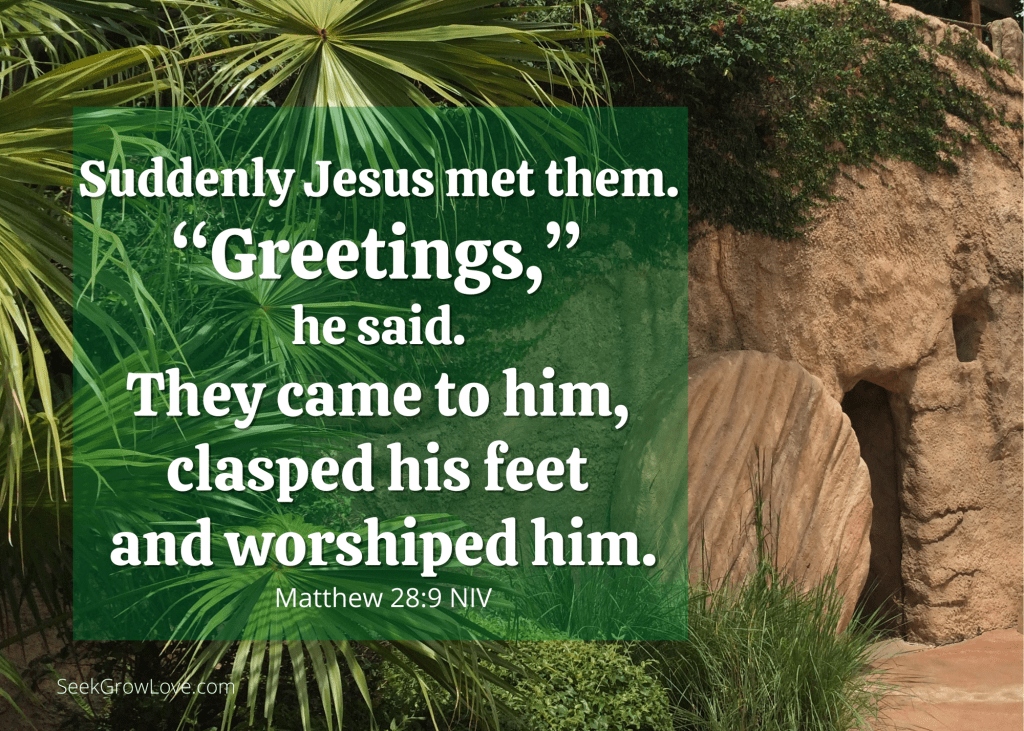
                What Updike so poetically states is that the resurrection of Jesus is no myth, no allegory, it actually happened.  Jesus’ dead corpse physically rose up from the tomb in which it had been buried.  Jesus was really raised to everlasting life.  The first disciples of Jesus would certainly have agreed whole-heartedly.

                Today’s passage from Matthew 28 is one of four Gospel accounts of the resurrection of Jesus.  Each of the Gospels, Matthew, Mark, Luke and John include and omit different elements of the story.  This is always true of witnesses.  In a trial or a new article when multiple witnesses are interviewed they will tell the story in different ways and include and exclude data.  Each person sees and experiences things from their own unique perspective.  In fact, if all witnesses say exactly the same thing in exactly the same way it raises suspicions that they got together and colluded beforehand what their statement was going to be.  Eye-witness accounts should have different details.  But the overall story should be the same.  This is true with the story of Jesus’ resurrection.  Each of the Gospels gives different details and some alter the chronological order of events, but they are all in agreement of the important facts- Jesus physically rose from the dead and there were numerous eye-witnesses.

                Outside of the Gospels, the Apostle Paul also offers his own testimony.  In the book of Acts Paul encountered the risen Christ while he was on his way to Damascus to persecute the Church.  And later, Paul wrote to the Corinthians about the resurrection of the dead:

For what I received I passed on to you as of first importance: that Christ died for our sins according to the Scriptures, that he was buried, that he was raised on the third day according to the Scriptures, and that he appeared to Cephas, and then to the Twelve. After that, he appeared to more than five hundred of the brothers and sisters at the same time, most of whom are still living, though some have fallen asleep. Then he appeared to James, then to all the apostles, and last of all he appeared to me also, as to one abnormally born. (I Corinthians 15:3-8, New International Version).

                Paul makes it clear that not only is the death of Jesus foundational to Christianity but so is his resurrection that was witnessed by more than 500 people including Paul.  According to the Old Testament Law it took two or three witnesses to confirm something as factual.  More than 500 witnesses is way more than necessary to confirm a fact.  Jesus really did rise from the dead.

                Paul then connects the resurrection of Jesus to the resurrection of all people.

12 But if it is preached that Christ has been raised from the dead, how can some of you say that there is no resurrection of the dead? 13 If there is no resurrection of the dead, then not even Christ has been raised. 14 And if Christ has not been raised, our preaching is useless and so is your faith. 15 More than that, we are then found to be false witnesses about God, for we have testified about God that he raised Christ from the dead. But he did not raise him if in fact the dead are not raised. 16 For if the dead are not raised, then Christ has not been raised either. 17 And if Christ has not been raised, your faith is futile; you are still in your sins. 18 Then those also who have fallen asleep in Christ are lost. 19 If only for this life we have hope in Christ, we are of all people most to be pitied.

20 But Christ has indeed been raised from the dead, the firstfruits of those who have fallen asleep. (I Corinthians 15:3-8)

Paul says here that if there is no resurrection of Jesus and no resurrection of the followers of Jesus, then we are wasting our time talking about faith.  The true, bodily resurrection of Jesus is no myth, it is central to our faith and it changes everything.

The Apostles certainly believed it was true.  They took up Jesus’ commission to go into all of the world and proclaim the good news that Christ has died and Christ has risen, and Christ will come again.  You and I are part of that same tradition.  We are called to pass along this same truth.  It is who we are.  Jesus Christ really did rise from the dead.  Jesus Christ really is coming again to raise those who have died and are asleep in their graves from death to everlasting life.  That is our hope and joy.  That is the foundation on which to live your whole life.

-Jeff Fletcher

In Despair

Today’s Bible Reading – Matthew 27 and Exodus 3-4

                As we move through the Gospel of Matthew one chapter per day it’s pretty amazing how quickly we move through the life of Jesus.  Matthew brings us through the entire earthly life of Jesus so quickly.  Think about it for a minute.  Less than a month ago we were celebrating Christmas and the birth of Jesus.  Just a week later we were celebrating the start of a new year, 2021 and we started the book of Matthew which summarized roughly 2000 years of Israel’s history from Abraham down to Jesus.  We heard the angels announcement to Joseph that Mary was going to give birth to God’s son.  We read of his birth, the visit from the magi and Herod’s attempt to have Jesus killed and his rescue to Egypt.  We fast forwarded to his 12th year visiting the temple and being precocious in his questions of the learned doctors of Jewish Law. Just like that Jesus is 30 and being baptized by John in the Jordan River and going into the wilderness to be tempted by Satan.  Then he’s calling disciples, performing miracles, preaching the Torah in a way that is more authoritative than the average rabbi.  Before we know it 3 more years have passed and Jesus is in Jerusalem having his last supper with his disciples and preparing them for his approaching death.

                Now, here we are reaching the climax of Matthew’s Gospel.  Jesus is tried, condemned and crucified.  This was not how any of his followers or any of the Jews for over 1000 years imagined how the story would go.  They envisioned the son of David as a triumphant King leading an armed rebellion and  defeating the powerful and oppressive Romans and being free to finally worship God under the rule of God’s anointed King, descended from the great King David of old.  Instead, they get a meek and gentle man being falsely accused and  refusing to defend himself, being rejected by his own people and, despite his complete innocence, meekly suffering and going to his death in the most shameful way imaginable: beaten, stripped naked and nailed to an execution pole for all to see and mock and serve as warning to any who might dare to defy Rome’s hegemony over the whole world.

                For the Apostle Paul and most every Christian since that day, this is foundational to the entire Christian message and the central event in the history of the world.

Paul wrote in I Corinthians 15:

15 Now, brothers, I must remind you of the Good News which I proclaimed to you, and which you received, and on which you have taken your stand, and by which you are being saved — provided you keep holding fast to the message I proclaimed to you. For if you don’t, your trust will have been in vain. For among the first things I passed on to you was what I also received, namely this: the Messiah died for our sins, in accordance with what the Tanakh says; and he was buried; and he was raised on the third day, in accordance with what the Tanakh says; and he was seen by Kefa, then by the Twelve;

(Complete Jewish Bible Translation)

                Paul reminds his readers that one of the first things he passed on to his students was the death of the Messiah, Jesus, for their sins as a fulfillment of the teaching of the Hebrew Bible (Tanakh or Old Testament).  Matthew tells the story more or less chronologically and it builds up to this.  But for Paul, this was among the first things he taught.  Whether it’s shared first as in Paul or toward the end as in Matthew, either way the death of Jesus and with it his resurrection, is the most important thing for Christianity.

                There is much for you to think about in this chapter but I will simply pause to name two and they both have to do with despair and death.  Matthew places side by side two men who have reached a crisis in their life, Judas and Jesus.  For both their crisis has brought them into great anguish and to the brink of death.

                Judas is in despair because he has betrayed his teacher and friend.  He sold Jesus out for 30 pieces of silver.  One might try to get Judas off of the hook by suggesting that he didn’t really have a choice in the matter.  It was God’s plan.  I’ve even heard it suggested and even wondered myself if Judas wasn’t simply trying to force Jesus to go to war against Rome.  Judas was a Zealot and growing impatient with Jesus.  Maybe he assumed that when Jesus was arrested he and the other disciples would defend him and bring him into his Kingdom.  When Judas realized that his plan backfired and Jesus was going to die without bringing in the Kingdom he was overcome with guilt and despair.  Or maybe he was just greedy and sold out his friend for the money.  Or maybe some combination of things.  Sometimes we humans beings do things and we don’t even understand why we did it, but afterwards we are filled with shame and regret and despair of life. 

                Judas responded to his despair by taking his own life.  Suicide is the final act of despair.  The suicide rate in the US has been going up each year.  I imagine when the deaths related to Covid are finally tallied we will see a significant number of deaths were not from Covid but because of people’s despair over Covid and the Covid related isolation, economic losses, disenfranchised grief, increased substance abuse and loss of connection with faith communities and other sources of hope and meaning.  Judas’ story ends in a tragic death of despair.

                Jesus is also facing his own existential despair.  He’s been betrayed, denied, abandoned and rejected by his friends and followers and all his fellow Jews.  Jesus was beaten nearly to death and is alone on the cross and has all of the guilt and shame of the world heaped upon him.  In his agony and isolation he cries out to God in despair ,“My God, my God why have you forsaken me?”  Jesus is having the worst day of his life, just as Judas did and Jesus is in extreme pain, just as Judas was and Jesus was about to die, just as Judas did.  And yet, their deaths couldn’t be more different.  Jesus never lost his connection to and faith in his father, even at this point of greatest pain.  Even as Jesus cries out, he is praying and maintaining his connection to his faith tradition.  “My God, My God why have you forsaken me” is the opening prayer of Psalm 22.  This was a Lament Psalm.  The Hebrews were very familiar with suffering.  They had been slaves for over 400 years in Egypt.  They spent 40 years traveling in the wilderness.  They spent 70 years in exile in Babylon.  The Hebrews knew suffering and it was in suffering that God continued to sustain them and draw them back unto himself.  Every Psalm of lament, no matter how much hurt or pain they processed, no matter how angry or betrayed by God they felt, there was always a remembering of the ways God had been with them and helped them in the past, and there was the hope and trust that God would sustain them through the suffering and restore them to wholeness and joy.

                Jesus never lost his connection to the father, even in the depths of pain and despair.  He surrendered his life to God, but he did not take his own life as Judas did.  Judas’ tragic death ends with no hope for him.  Jesus’ tragic death ends with hope for him and for everyone.

                We all go through periods of hurt, pain, disillusionment, brokenness, anger, shame, guilt and pain.  When we go through those time we are in a moment of decision.  Do we give in completely to the despair and give up on God, or do we cling to faith, remembering God’s faithfulness in the past and hope in the future.  That will make all the difference in how our story ends.  It doesn’t have to end like Judas.  Jesus offers the path to hope and life.

-Pastor Jeff Fletcher