Majestic

Revelation 4

Revelation 4 10b 11

Where are some places you have been that could be described with the word “majestic”? Maybe somewhere like Niagara Falls, the Grand Canyon, Appalachian Mountains, the beach, redwood forests, etc. There are many things about these areas and more that make them majestic; however, there is one thing that links them all together. That is, their creator. God is what makes these scenes and places majestic.

This is what comes to mind when I read the imagery in Revelation chapter 4. All of the thrones and elders with crowns and different animals and faces and a rainbow, four faces and eyes everywhere. Flashes of lightning and thunder going on in the background. It is all just majestic, and for what reason? On the surface of this chapter I would say it is safe to say it is to illustrate the importance and demonstration of worship. To worship our God in a holy way because He is holy. It says in verse 11 that, “He is to receive glory…. for You created all things”. So, we ought to worship God in a holy majestic way as all of creation does as well.

As far as the in-depth meaning of all the imagery in this chapter you must research what each animal represents in that time and worldview of Judaism as well as understanding the importance of the use of certain gems in reference to objects and people.

Jesse Allen

Pillars

Revelation 3

Revelation 3 12 .png

I live and work in Louisiana and the land down here is often very wet and soggy. Most of it in fact, is considered to be swamp land.  But nevertheless, people build on this land close to rivers and lakes. For my day job I work on building shorefront and boat houses. In order to do so we must use “piles” or otherwise known as oversized telephone poles and we drive them with a machine into the ground. When we drive 4 to 8 of them for a boat house, they create a pillar like effect which can support up to and if designed well over 15,000-pound boats. Each pile is driven with the machine with over 20,000+ pounds of force. That is really strong.

One of the most encouraging verses I can think of in the Bible is located in Revelation 3:12

“’He who overcomes, I will make him a pillar in the temple of My God, and he will not go out from it anymore; and I will write on him the name of My God; and the name of the city of My God, the new Jerusalem, which comes down out of heaven from My God, and My new name.”

The one who overcomes this world and all of its false hopes and temptations and focuses on Jesus will be like a pillar of faith in the temple and in the New Jerusalem. They will have written on them his own name YHWH. This is something I strive to have every day –  to allow myself to represent the LORD almighty everyday by carrying his name through my actions. Although I fail sometimes with this, I learn a little bit everyday how I can overcome my shortcomings.

Today I want you to focus on how you can be a pillar of faith in your communities and how you can carry the name of God with your actions. Also don’t forget to keep looking up phrases you see and don’t understand!

Jesse Allen

Overcome

Revelation 2

To him who OVERCOMES
“He who has an ear, let him hear what the Spirit says to the churches. To him who overcomes, I will grant to eat of the tree of life which is in the Paradise of God.”  Revelation 2:7
One of the phrases I would like you all to notice and underline when it repeats is this, “To him who overcomes”. This phrase refers to specific obstacles in Revelation 2 however this phrase could mean any obstacle in the way of your relationship with God. If you overcome your greatest fears and struggles and rely on Jesus, your relationship with God will thrive.
Jesse Allen

Signs

READ REVELATION CHAPTER 1

Revelation 1 3 road sign

Why do road signs exist? Road signs are very useful for driving and directing traffic and preventing unwanted circumstances. If followed correctly the road signs are very helpful to everyday life. They stop us before we get hit by other cars in the intersection, they warn us of upcoming obstacles and they generally help us know where we are at and where we are going.

“In the United States, the 1900s also came with a call for signs to meet automobile industry growth.Drivers were easily getting lost without signs. The signs that did exist at the time were often damaged or broken. As a result, Americans were becoming aware of a need for signs.”[1]

What do signs have to do with Revelation? Well I’m glad you asked. Actually, it’s in the very first verse of Revelation. In the NASB Rev. 1:1 says this “The revelation of Jesus Christ, which God gave Him to show to His bond-servants, the things which must soon take place; and He sent and communicated it by His angel to His bondservant John,”

The word communicated also can mean signified or to be made known. In other words God used an angel to “signify” (use signs, just like we use road signs) to communicate with John, so he could then reveal to “His bond servants” (Us/Christians) the things that have taken place, that are taking place and that will take place in the future (Revelation 1:19), during the time John was receiving this Revelation.  Hence the name of the book.

So, road signs are a sort of revelation of roadways and intersections, just like the things revealed to John in Revelation, passed down to us, are like road signs to living a Christian life. What John writes in the book of Revelation must be taken seriously just like road signs we encounter every day. That is because what John says, sees, hears, feels, and smells in Revelation are warnings, and guidelines on how to correctly live one’s life as a disciple of Jesus. While at the same time revealing consequences for the unjust/ungodly, and rewards for the Righteous and Godly. Revelation exists in the form it does not to confuse its readers (although it can be confusing at times) but to simplify the life of a Christian and not get lost.

Revelation, as we will find out in further investigation, has many different signs of its own resulting in various objects, colors, shapes, smells, images, numbers, places and characters. I want you throughout this entire study of revelation (Not just my part) to write down all the different colors, numbers, images, metaphors, etc. Look them up and question what they mean. Circle/underline/write down phrases that occur more than twice and also question what they have to do with Christian discipleship. You may be surprised how interesting they can be!

Jesse Allen


[1] https://www.degemmill.com/history-traffic-signs/

Clarification of the Christ

Colossians 1:15-20

colossians 1 15 NIV

I love to look deeper into these verses in Colossians to fully understand what Paul was writing and why. Paul was poetic in his language and using wording that the Israelites used to describe the personification of wisdom. If you look through the Old Testament it is not likely that you will find the phrase “Holy Spirit”. You will however find the term “Spirit of God” which we discover is the same thing, God’s power within us. Likewise “word of God” is not seen in the Old Testament. Once there is a reference to the “word of the LORD” but the majority of the references toward the Word of God are seen describing this personification of wisdom. A different way of saying the same thing. Jesus is the living embodiment of the Word of God.

“He is the image of the invisible God” – Jesus is called the image of God in these verses and in 2 Corinthians 4:4. In Hebrews 1:3 he is described as “the radiance of God’s glory and the exact representation of His being”. Two truths are revealed through the first half of this verse: God has remained unseen “no one has ever seen God” John 4:18 and second, Jesus reveals the nature and character of God for he is the image of God in which humanity was originally created in Genesis 1:26. It is the image that we as the faithful will be transformed into upon Jesus’ return.

“The firstborn over all creation” – Paul borrowed from his Jewish upbringing; firstborn was a Hebrew way of saying someone was especially honored. The nation of Israel was called firstborn (Exodus 4:22), as was David (Psalm 89:27). The word, in these instances, did not refer to their physical birth but to their place of honor before God. So here Paul is saying that Jesus has a place of honor over all creation.

“By him all things were created” seven times in these verses Paul mentions “all creation”, “all things”, and “everything” stressing that the Christ is supreme over all through the power God granted him. The tense at the end of this verse was not translated correctly in the NIV, it says “all things were” however the original language was not past-tense “were” rather present “are”.

“Before all things” like with firstborn this does not speak of time but importance. The Christ is before all things in importance for it is only through him that all things will be restored.

“All things hold together” he will usher in a new age in which sinful man will be redeemed and united with our holy God.

This passage speaks of the importance of the Christ, the place of honor over all things that he holds. Additionally it points to both Jesus’ place of honor over the church and those who will be resurrected to eternal life as well as a chronological order. Jesus was the beginning of the church as we know it. And he was the first, and only one to this point, which God raised to new life. We the faithful will follow suit once Jesus returns.

“All (his) fullness dwell” (his) was added to many translations which adds to the confusion and skepticism that people may have concerning these verses. Before moving forward think about what happens to those who come to God through Jesus. We are filled with God’s spirit, His power and character, at least to a point. But Jesus was filled with the fullness of God, all power and authority were given to him. He also displayed the nature, character, and attributes of God. Paul also had another reason for his choice of words, “fullness” was a popular term among the Gnostics who used it to refer to the combination of all supernatural influences. So Paul used their own word to elevate the Christ above all other religious ideas and systems.

“To reconcile to himself all things” Jesus’ death, burial, and resurrection set the stage for not only the faithful to be made new but also all of creation. Unfortunately it does not mean that everyone will be saved from sin and ultimately death. We have free will and we make our own choices. But God does not give up on us. I believe that even those He has already seen reject Him are given daily opportunities for redemption.

It is important that we have a clear understanding of who Jesus is and the reason that we need a Christ, Messiah.

To be continued… (by someone else)

Jeff Ransom


(Editor’s Note – Thank you Jeff for finishing off the book of Proverbs with us this week, and giving us two free theme days to think on!  Tomorrow we will begin looking at the book of Revelation – one chapter a day through the month of November.  And in December we will finish off the New Testament with the book of Luke.  So many precious things in God’s Word!  Keep taking it in.)

Baptism – What is the Big Deal?

Matthew 3:13-17

Matt 3 17 (1)

Conversations abound over the importance of water baptism. Is it the baptism or simply a confession of faith? If baptism, then is it pouring, sprinkling or immersion? There is a semi-famous song about this. What about infant versus conscious baptism? What about those who do not have access to water? So many questions surround this topic. And these are just focusing on the methods and timing. What about what happens when we are baptized? What is the point or reason for being baptized? Why is it a public thing? It can be exhausting and at times confusing.

So let us look at the example set by Jesus. He travels from Nazareth in Galilee to the Jordan River where his cousin John is baptizing people in droves. Baptism itself was commonplace but it was a simple cleansing ritual. It was not too deep or meaningful and was certainly not a public spectacle. The people had never seen anything like what John was doing. In addition to the large masses of people coming to him he was telling them that this baptism was for the repentance of their sins. John was the precursor to Jesus, the keynote speaker if you will. He was highlighting the points that would be vital to Jesus’ ministry – repentance and the coming kingdom.

Jesus came to John to be baptized. John however recognized Jesus as the Messiah and understood that it was Jesus who should be baptizing John. He tried to argue with Jesus because he understood that among them only Jesus was righteous and sinless. Jesus was the only one who did not need this baptism.

Jesus’ response was that he must be baptized to fulfill all righteousness. In doing so he was consecrated by God and officially approved by Him. His baptism had nothing to do with Levitical Law though. John’s message of repentance and the coming kingdom pointed to a Messiah who would be righteous and bring righteousness to the sinner. Jesus was identifying with the sinful world even though he himself was without sin. His baptism also marked the arrival of the long expected Messiah and the beginning of Jesus’ ministry. And finally his baptism was symbolic of his death, burial, and resurrection and was an example for his followers to come.

Upon being baptized the spirit of God rested upon him. This is the moment when God gave Jesus all authority and power to carry out his Father’s perfect will here on earth. Jesus later told his disciples that this same spirit, a portion only however, would come upon them. It is the same spirit received by all who come to God through Jesus and the waters of baptism. This spirit strengthened and encouraged Jesus when he needed it most, as it does for each of those who faithfully follow his example.

So he comes up out of the water and the Spirit of God comes upon him and then it happens! Something incredible! Something amazing! Something that has not happened for four hundred years. Man hears the first words from God since the close of the Old Testament. His silence is broken so that He can confirm Jesus is His son, “Whom I love, with him I am well pleased.” This statement in itself is timeless. God was not simply pleased that Jesus was beginning his ministry. It is the culmination of a millennia old plan to bring all people back to Him. The fulfillment of His covenant with Abram is realized in this moment. All people will be blessed through Jesus if they choose Yahweh as their God and Jesus as the way to Him. Past, present and future balanced on this man’s obedience to God.

John was baptizing in a river and most examples of baptism in the New Testament appear to be in or around large bodies of water so immersion in water makes the most sense for how we ought to be baptized. There are biblical examples of baptism of the spirit alone, a confession of faith without involvement of water. These examples however appear to be the exception and not the rule. People without access to water or without time to get to water are exceptions.

If someone has the means and opportunity to go through the waters of baptism and does not are they saved by confession of sin and repentance alone? I do not know just as I do not know if someone who confesses, repents, and is baptized is saved. We have biblical and personal examples of people being baptized and living in a way that is completely opposed to God’s will. God alone knows our hearts. He knows where we stand.

One of the radical things about what John was doing is that those who came to him to be baptized were obeying God from their heart. It is a conscious decision to be baptized. I was “baptized” as an infant but it meant nothing to me. I had not made the choice to change my life. I had not chosen God or His son until I was a grown man. That has been the point from the beginning, back when Adam and Eve were in the Garden. They had a choice to choose God or not, trust Him or not. They chose not. Jesus presents to the whole world that very same choice.

In this moment when Jesus was baptized God’s confirmation of Jesus was both for his assurance and for a witness to others. This is the same reason for us to publicly surrender and commit to God through Jesus. We need the inner confirmation of His great blessing upon us, and the world needs the testimony of a life committed to His will through Jesus.


To be continued…

Jeff Ransom

From a Wise Mom

Proverbs 31

Proverbs 31 1 2 NIV

This proverb is the words of wisdom from a mother to her son, who just happens to be a king. She cautions him against giving into his desires. Her words advise against dulling the senses with excessive alcohol until no longer remembering what he is working towards and ending up mistreating those around him. Wise words for us all. Moderation or in most case, abstaining all together, are key to carrying out the will of God. I must admit though that verses 6 and 7 perplexed me. She is teaching her son one thing but advising something else for others? That made me dig deeper (Strong’s Concordance here I come!). While most versions say “Give” the Hebrew could just as easily translate as “Leave”. This would mean that she is acknowledging that others drink but he ought to avoid it. So that actually makes a lot more sense and hey guess what? I did not have to stretch or twist God’s word to figure that out. Score one for hard work and discernment.

In addition to staying away from mind numbing substances, she urges him to champion the cause of those less fortunate. To speak for those who have no voice and defend those in need. This is very near and dear to the heart of Christianity. Jesus himself uplifted the most destitute of peoples and worked to save those who others thought unworthy. Going out into the world and making disciples of all nations is, at its heart, administering to the lost and broken. It is what we are called as Christians to do for the glory of God and in the name of Jesus.

I saved the third verse for the end because it ties into the final two thirds of the proverb. She says “women”, plural. That he would be faithful to one woman and save himself the trouble and ruin that would come from chasing many women around. She then gives a thorough description of the qualities of a wife worth pursuing. Many look at this portion of Scripture and see an antiquated view of women, being in their proper place. Yet anyone with that mindset is clearly not reading or understanding what was written. This describes a woman who works hard alongside her husband. She is not the dutiful housewife but an equal. She is shrewd enough to make major decisions such as purchasing land and dealing in various business affairs. She is wise and praised as a teacher. She is a woman of God who is strong in faith and character. She is what I pray for all young women to grow into and what all godly men should be seeking.

Mothers are so wise! God bless them for putting up with us.


To be continued…

Jeff Ransom

Contentment and So Much More

Proverbs 30

Proverbs 30 8 9 NIV

The author of this proverb, Agur, begins by belittling his understanding. The irony is that his words hold great wisdom. He is not bragging about his knowledge and understanding. He is declaring the LORD our God as unfathomably great. He asks six questions, five of which identify the power of God. The sixth is prophetic of the yet unborn son of God, Jesus. Additionally, his understanding of the perfection of God’s word and the refuge it provides us is astounding. This is a man of great wisdom who humbly recognizes his insignificance before God which in itself makes him all the more wise.

He then focuses on two requests of God; honesty and contentment. He asks that falsehoods and lies be kept far from him. He provides a variety of ways in which lies and deception can bring curses down upon our heads. They destroy our relationships and cause us to spiral ever further from the God who loves us. Entwined in these illustrations are lessons of being satisfied with what we have. Appreciating that our needs are met and being content with that is not easy when there is often so much more that we want. God provides for our needs, the author acknowledged this. Everything beyond our needs comes from our desires which are, more often than not, borne of our sinful natures.

Agur then contrasts contentment with greed. First pointing to leeches which will gorge themselves beyond their needs. Then he personifies four things which are never satisfied. Two of these are actually life-giving; the womb and land. These are bookended by destructive examples; the grave and fire.

Verse seventeen seems oddly out of place and more than a little disturbing. It actually goes with the theme of honesty. The person suffering such a creepy fate has been dishonest in action and words with their family, and likely with everyone else in their life. Ultimately they will be alone and everything they had will be scattered among the people around them.

How do the eagle, snake, ship and couple fit together? Is this what Agur did not understand? I doubt it. Each of these examples can be seen as somewhat mysterious in what path they will take. The eagle is not limited in the great expanse of the sky just as there are few obstacles that the snake could not overcome. Without a rudder and someone to steer, the ship would be tossed at the whim of the sea just as the whims of men and women often make courtship, that is dating for all those not familiar with the term, tumultuous. So how does this fit in with what Agur is trying to convey? It goes back to his self-proclaimed ignorance of, well, everything but specifically of God’s ways and will.

And then we get back to a verse that makes us scratch our head. The mention of the adulteress is actually an example of someone who is neither content with their relationship or dealing honestly with others. Additionally, she is completely without remorse as she sees nothing wrong with her actions. My prayer is that none of us would get caught up in this specific type of behavior but even more so that we would be remorseful of any actions that we take or words that we use which hurt others.

Up until verse 21, Agur has been consistent with themes of God’s power and majesty, honesty, and contentment. Somewhat enigmatic but consistent nonetheless. Beginning with verse 21 though he expands his words of wisdom. First to include the injustices of the world or what he refers to as four things by which the earth cannot bear. Of the four examples the first and last are of one who is raised to a higher position, likely without the benefit of knowledge or understanding of their responsibilities. This type of unfair promotion can lead to disaster in most cases. It is not uncommon though to see someone with little knowledge of how to manage situations or how to lead people placed in a high position. Additionally it is a warning to us not to seek after something we are not prepared or equipped to handle. I guess that goes back to one of the main ideas as well, contentment.

Agur then reminds us that wisdom and understanding are not reserved for anyone. Young and old, big and small may seek after these great treasures. His specific examples are of course of the small creatures and the wisdom found in how they act. The contrast however is of larger creatures and their “stately bearing.” The imagery used is of pride and arrogance. Perhaps a reminder of humility in our own positions, whatever they may be. Given how this proverb concludes that would certainly seem to be the final lesson.

So what have we learned from Agur, other than that he has a pretty cool name? Humility is greatly valued, especially in light of our amazing God’s power. He was in awe of the gift of God’s word that has been given to all men. He esteemed honesty and contentment as the greatest gifts to request from God. And he reminds us that it is not our age or size that matters but our willingness to seek after wisdom that counts.


To be continued…

Jeff Ransom

Sucked into Sin

Proverbs 29

Proverbs 29 16 NIV

This chapter of proverbs continues the thoughts from the previous one – speaking on the contrasts from the wicked and the righteous. Proverbs 28 and 29 give us wonderful examples, not only of recognizing sinful ways but, of the habits that could sneak into our own lives. Many a good man and woman have been corrupted in time by the allure of sin. Additionally, it is noted in this proverb that those who we surround ourselves with can lead us into sin. We must choose carefully who we associate with and be wary that they do not drag us into sin and away from God.

In my youth I hung out with people that did a lot of things that I knew were not good. Drugs, alcohol, and other activities were happening all around me. I hung out with them because I liked being around them but I never let myself fall into their ways. I always thought that made me okay but all it would have taken is one encounter with law enforcement and I would have been found just as guilty as the rest. Wow! That hit me like a ton of bricks when I first realized that. God was watching out for me but I was really pushing the boundaries of His grace and I realize that now. In that I am reminded that we are not to put our God to the test. Yet that is exactly what I was doing for years. He truly is merciful and gracious!

One last thought from this passage that actually ties back to what I wrote about for Proverbs 27 concerning anger, check it out if you missed it. Giving full vent to our anger as this proverb points out is bad. Yet I said before that it is good. No, not is good, but may be good and can help. Verse 11 says that a wise man keeps himself under control. Anger released rationally, controlled, is what I spoke of the previous day. This is talking about rage. Rage is uncontrolled, irrational, and violent. There can be no compassion or concern in rage but you can have both while angry. Understanding this is important for our relationships. That is why we have the saying, “Count to ten before speaking.”

In closing, I urge you to be aware of the various ways in which we can get sucked into sin. Be careful to not place yourself into a situation where you become guilty by association. And remember that we were created for relationships. They are vitally important to our God and to our daily existence. Treat them with the care that they deserve.

To be continued…

Jeff Ransom

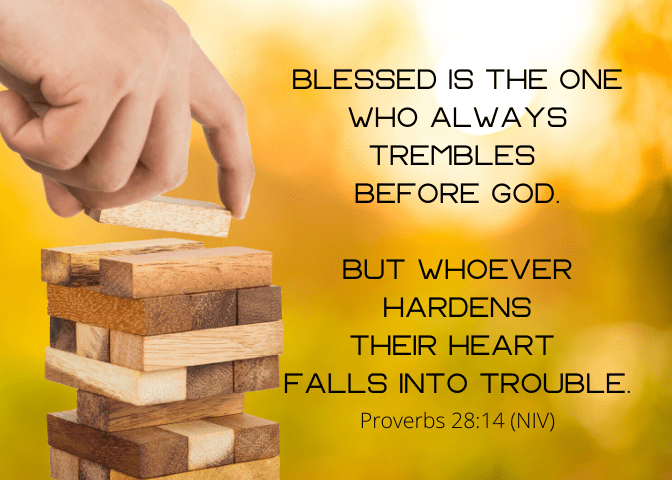
Sin Jenga

Proverbs 28

Proverbs 28 14 NIV Jenga

Proverbs 27 was like an onion, or a parfait because everyone likes parfaits. Proverb 28 however is more like a banana. It is more straightforward in its message. It could rightly be summed up as the destiny of good and evil. It is a series of contrasts between those who do what is right and those who do not.

The author calls out those who are well acquainted with poverty and suffering and yet, given the chance, oppress others suffering in the same ways. This sin is greater than those who have never known hunger and are oppressive. For a poor man to be placed in authority who becomes oppressive utterly destroys the hope of the poor. This is like a game of sin Jenga, stacking one sin upon another and hoping that it does not fall down.

In many facets of life we see sinful people praising sinful ways. They promote sin as something to be desired. Truthfully they have great advertising though. Sin is often that which is most physically pleasurable and is easily obtainable. It often helps people to temporarily forget their troubles and sorrows. Temporary is the key to all of this though. Each way that man chooses to sin is fleeting and temporary. The pleasure ends and emptiness is left. The good times come to a close and the pain returns with a vengeance. They believe that the easy way through life is to not care or get involved. But that ultimately leads to a life of loneliness and sinful ways that leave us numb to the good and the bad.

Another point from this passage is that evil men do not understand, or do not want to understand, the judgement of God. Knowing God makes us accountable to someone other than ourselves. It is painful enough for some to deal with their own conscience. It is as inescapable as our shadow after all. Then you add on the thought of God knowing everything that we do. For some people that is just too much. They can numb themselves of their guilt through drugs, alcohol, and other activities but they can never numb themselves from God’s presence. This is why, for some, it is preferable to give in completely to sin and run from God. It is better for the moment but God’s word tells us that it is better to be with Him. All will eventually stand before Him to be judged. At that time they will realize the futility of their efforts to numb themselves in sin’s embrace.

I mentioned earlier that our conscience is unescapable. It is the conscience of the guilty that cages them with bars of fear. A fear that haunts them night and day. They live in fear of being discovered in their sin. Those who are truly bold in their sin are in fear of being proven wrong in their assertions. They make excuses for actions which no one has challenged or questioned. The righteous however are freed from such fears. They can be bold, not because they are without sin, but because they admit their sins and make attempts to remove them from their lives.

I have often been frustrated at people who I know from experience are horrible ungodly people yet they prosper far more than I do. You know who I am talking about. They are the ones that seem to have it all and everything always goes their way. Yet they are the most vile, slimy, loathsome examples of humanity. As my faith and understanding of God’s ways increased, I began to understand that they think that they are successful. Others see them as being successful as well, even I did for a time. But what they are building has no foundation. Everything that they gather around them is perishable. They might as well be gathering bread which will rot and mold. Ultimately, they will be clinging to nothing more than fuzzy green clumps of rotted material. That is what they place their hope in. The righteous however place their hope in God. The one who is eternal, imperishable. I like that image a whole lot more than the image of what the wicked will be holding onto.

To be continued…


Jeff Ransom