Love Like Jesus

Luke 22 & John 13

John 13 is the only chapter in the four gospels that record Jesus washing his disciples’ feet. In John 13.34 Jesus teaches “A new commandment I give to you, that you love one another, even as I have loved you, that you also love another”. What is the newness of this commandment Jesus gives his disciples and to us? I believe it is the phrase “even as I have loved you”. The way believers are to love each other is no longer patterned after how we would want to be loved (Lev.19.18) but there is a new way to love each other. The new pattern of love is Jesus himself. 

What does it mean to love other Christians like Jesus? This is a very tall order! Where do we start?! I believe the washing of the disciples feet provides a framework for what Jesus had in mind when he said love each other as I have loved you. 

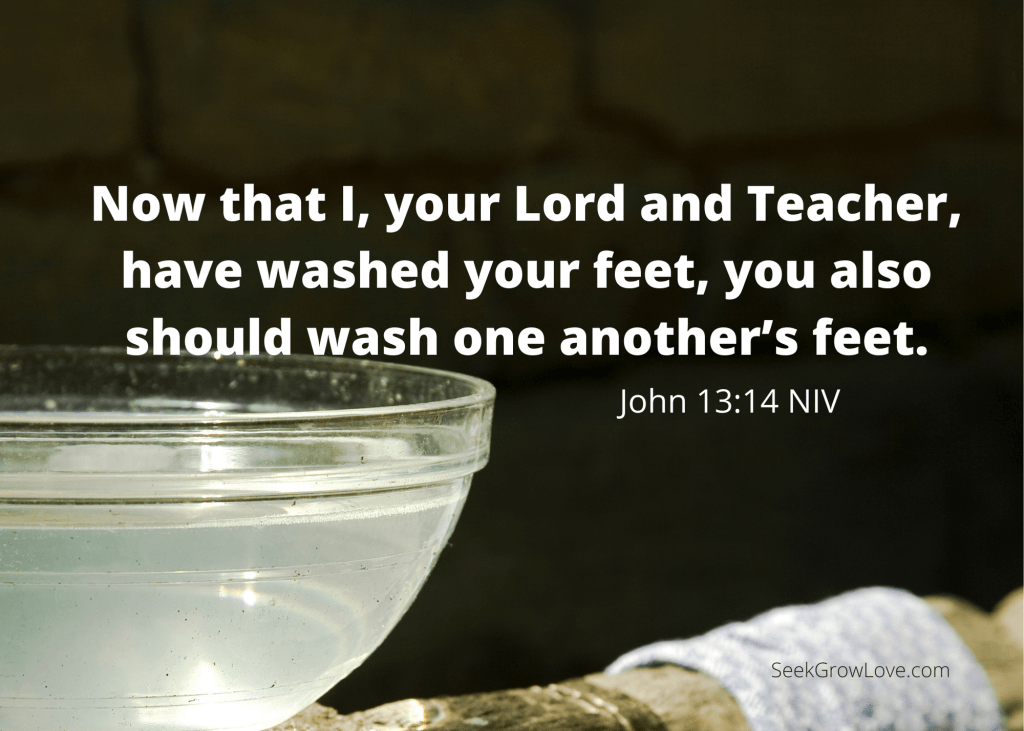
There are two lessons/principles we can learn from Jesus in this account that we can emulate in our lives towards other believers. The first one can be read in John 13.4-5,12-15. Jesus illustrates humility. Jesus as Lord and teacher took the position of a common house servant when he got on his hands and knees and girded himself with a towel to wash feet. If anyone’s feet should have been washed it was Jesus yet the holy selfless Lord and teacher put aside his rightful privileges to serve his students. Jesus humbled himself. Likewise we as Christians are called to humble ourselves before each other and seek out the interest of others before ourself (Eph. 4.2, 5.21, Phil. 2.3-5). 

The second lesson we can learn form Jesus is that to love each other involves humbling ourselves before each other and serving one another in practical ways. The act of washing feet in antiquity served a very practical purpose. Most people wore open-toed shoes or sandals and people walked everywhere. The result was people’s feet would easily become dirty, rough, and caked with filth. No one would want to track the dirt through someone’s home so either the homeowner or a servant would wash the guests feet as they came in. It was practical for the guest and the homeowner. 

What is involved in loving other Christians as Jesus loved us? Looking at the real life illustration of Jesus washing his students’ feet, we learn to love one another involves humbling ourselves before others and serving them in practical ways. 

-Jacob Rohrer

Today’s Bible passages can be read or listened to at BibleGateway here – Luke 22 & John 13

Tomorrow we will read John 14-17.

The Most Needed Ministry

Matthew 26 & Mark 14

In the closing moments of Jesus’ life after the last supper he took his three closest disciples and prayed. Jesus was a man of prayer and it is fitting that in the final moments before he is handed over he prays to his Father. I cannot emphasize enough the importance of prayer. Many of us are guilty of not praying as we ought to. Look at the degree to which Jesus expected his three closest disciples to pray. In Matthew 26.36-41 and Mark 14.32-38 he asks them to remain and watch while Jesus went off and prayed. Watch and pray are synonymous words. To watch is to pray and to pray is to watch. 

When Jesus comes back the first time he questions Peter, James, and John and says, ”You couldn’t keep watch for an hour?” Jesus expected his disciples to pray for a whole hour! Many of us can only last a few minutes let alone an hour. If prayer was important to Jesus and his ministry and his relationship with God CERTAINLY it must be a priority for us. I would venture to say prayer is one of the most neglected and undervalued ministries. Jesus never believed prayer was expendable, neither should we. 

Do you want to grow with God? Do you want to grow in spirituality? Do you want deeper intimacy in your relationship with God and other believers? Do you want to combat spiritual darkness? Do you want to see people saved? Pray. Pray. Pray. 

If we will give ourselves over to the ministry of prayer and intercession God will grow and mature us. Prayer is too valuable to discard, it’s too precious to pass over, and it’s too powerful to be ignored.

Lord Jesus stir in our hearts a desire and hunger for prayer! Raise up men and women who will pray! Amen!

-Jacob Rohrer

Today’s Bible passages can be read or listened to at BibleGateway here – Matthew 26 & Mark 14

Tomorrow we will read Luke 22 & John 13.

Test Yourself!

Matthew 25

Today as we look at Matthew 25 we should take notice that though we are starting a new chapter the context surrounding this chapter is the same as that of chapter 24. Matthew 24 and 25 are a single unit of thought. This can be seen in verse 1 with the word “then” (the NIV says “at that time”) indicating what Jesus was speaking about in chapter 24 is continuing into chapter 25. The focus of the chapter is about the end of this age when Jesus returns and the judgement that he will enact. 

There are three pictures of judgement in chapter 25. The first two are parables (the parable of the ten virgins and the parable of the talents) and the last one is a description of the judgement scene. 

In the first parable there are ten virgins who wait for the bridegroom. The bridegroom delays in appearing and all fall asleep but suddenly the bridegroom appears but only five are ready for the bridegroom while the other five are not ready and they are denied entrance into the wedding feast. The virgins denied entrance are then told by the bridegroom he never knew them. 

The second parable is about a master and his slaves. The master gives each slave a talent (an amount of money) and went on a journey. When the master returns only two of the three slaves honored the master with what they were given. The third slave squandered his talent and is rebuked by the master and the slave is thrown out into the outer darkness.

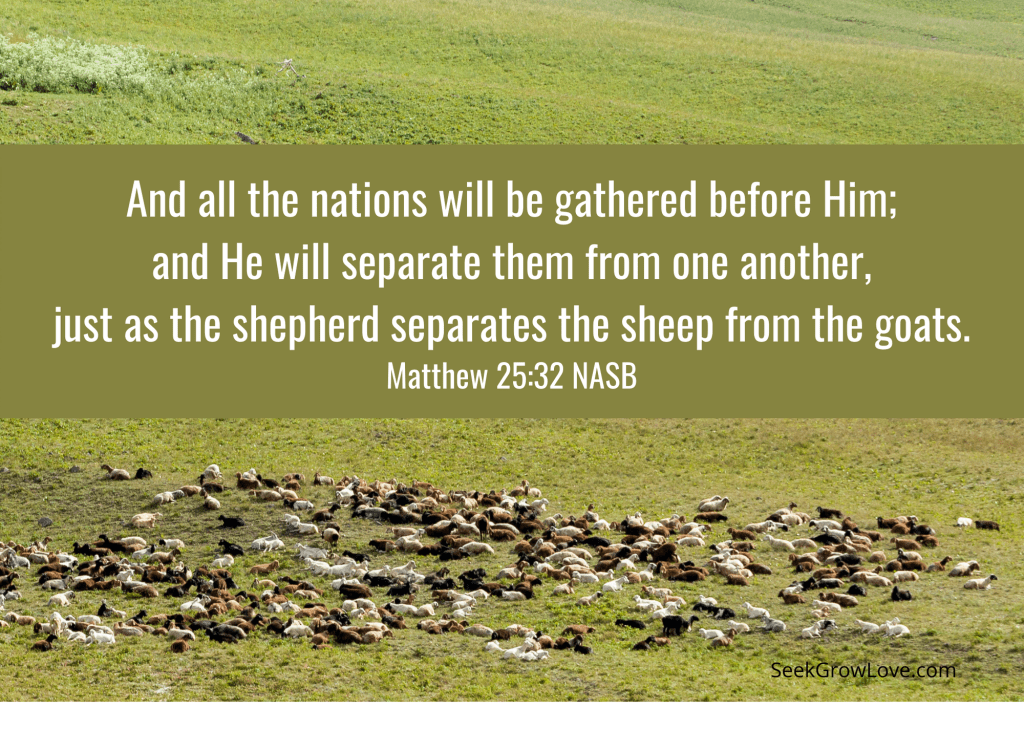
The third picture of judgement involves Jesus separating goats from sheep among the nations. The sheep and goats represent those who belong to Jesus and those who do not. The sheep (believers) are rewarded with the kingdom and the goats (non-believers) are cast into hell with satan and his demons. 

What are we to make of this chapter? What does Jesus want us to learn from these three pictures of judgement? I believe it is this.

There is a judgement coming and not everyone who calls themself a Christian will enter into life. The reality is, not everyone who calls themself a Christian is a true believer. In all three teachings there is one group of people who are then divided into those who are accepted and those who are rejected. Many people comprise the Church but not everyone who attends church is a true believer. The judgement of Christ sorts out the self-deceived from the real believers. Jesus himself teaches this earlier in Matthew 13.24-30, 36-43 in the parable of the tares. And he also teaches this in Matthew 7.21-22. 

Who are you? Are you deceived or a true believer in Christ? The five virgins were accepted into the feast because they were ready and prepared. The 2 slaves were honored by the master because they were faithful with what the master had given them. And the sheep entered the kingdom because they loved and served other Christians in need. 

A true believer will have evidence of salvation in their life. A true believer bears the fruit of the spirit, they grow in holiness, they grow in their disdain for sin, they hunger for the scriptures, they serve other Christians and people. A real believer matures and grows in Christ.

Paul tells the Corinthians in II Cor. 13.5 to test themselves against the scriptures to see if they are in the faith. Compare yourself to scripture and to the words of Jesus. Have you really received salvation from God? In addition to this, talk with mature believers closest to you about this serious matter if you question your salvation.

-Jacob Rohrer

Today’s Bible passage can be read or listened to at BibleGateway here – Matthew 25

Tomorrow we will read Matthew 26 and Mark 14.

Don’t Be Deceived

Matthew 24

Today’s devotion comes from Matthew’s account of what you read in Mark 13 yesterday. In the twenty fourth and twenty fifth verse Jesus says “For false Christs and false prophets will arise and will show great signs and wonders, so as to mislead, if possible, even the elect. Behold, I have told you in advance”. 

There is a huge difference between a good tested quality product and a cheap knockoff version. The same is with Christ but even more so. Jesus warns his disciples and us that there will be people who claim to be God’s real messiah and savior. Jesus is telling all of us don’t be fooled. I want to highlight 2 aspects of Jesus’ warning.

The first is notice the plurality of “Christs” and “prophets”. There have been and will be multiple people who seek to deceive people and other Christians. This had a very real meaning to the first century church. Before the time of Jesus and after him there were multiple Jewish men who claimed to be God’s real messiah. And even in our time there have been many who have claimed to be God’s special prophet or savior. 

The second aspect of this warning I want to highlight is that Jesus says that signs and wonders will accompany these false prophets and Christs. It’s easy to dismiss someone as crazy if they claim to be a prophet or Christ but what if miraculous events accompany their claims? What are we supposed to think!? Remember that there is a supernatural enemy that opposes God, Jesus, and Christians. For every miracle God performs a counterfeit miracle can be performed by Satan and spiritual darkness. An example of this can be found in Exodus 7.8-13. There must be other factors we must take into consideration such as – does what the person say align with scripture? Is God glorified? 

Though we probably will not encounter someone who will say, “Follow me, I’m the savior of the world” it doesn’t mean that there aren’t false teachers who teach false doctrine. We must always be critical of the teaching that we allow into our lives. Remember to test EVERYTHING against the scriptures. Whether it comes from your friends, your pastor, or even your parents. The best way to avoid deception is a two step process: one, know what the scriptures teach, and two, test everything against the scriptures. If it conforms with scripture receive it. If it doesn’t conform with scripture, reject it. 

-Jacob Rohrer

Today’s Bible passage can be read or listened to at BibleGateway here – Matthew 24

Tomorrow we will read Matthew 25

Be on the Alert!

Mark 13

Many teachings and thoughts could be extracted from the Olivet Discourse (Matt. 24, Mk. 13, Lk. 21). For us this section of the gospels will be the focal point of our devotions today and tomorrow. For our devotion this morning I want to look at the last verse of Mark 13 where Jesus concludes “What I say to you I say to all, ‘Be on the alert’”.

This section of the gospels (Matt. 24, Mk. 13, and Lk. 21) have in mind two future events. Jesus prophesies the destruction of the Jerusalem temple (AD 70) and speaks to the events that will foretell of his second coming. In Mark 13.31 the message Jesus communicates to his disciples is the one he also wants all those who follow him to know as well, namely, “Be on the alert”. The New Testament as a whole has an urgency to it. This theme of being on alert and aware of the coming of the Lord is present throughout the New Testament. Though Jesus ascended two thousand years ago and hasn’t come back yet it does not mean we should live complacent lives as Christians. Here are some other texts that speak to urgency in the Christian life:

“Love does no wrong to a neighbor; therefore love is the fulfillment of the law. Do this, knowing the time, that it is already the hour for you to awaken from sleep; for now salvation is nearer to us than when we first believed. The night is almost gone, and the day is near. Therefore, let us lay aside the deeds of darkness and put on the armor of light. Let us behave properly in the day…” —Romans 13.11-13

“Therefore be careful how you walk, not as unwise men but as wise, making the most of your time, because the days are evil. So then do not be foolish, but understand what the will of the Lord is” — Ephesians 5.15-17

“…let us be alert and sober…” (Read I Thess. 5.1-8)

What does it mean to live on the alert as a Christian? What did Jesus mean when he spoke these words? In light of these texts above and the whole of the New Testament to live alertly is to have the conduct of our lives be in line with the words of Jesus. To live alertly means to quit wasting time with sinful behaviors and practices and start living in light of eternity and the judgement seat of Christ (II Cor. 5.10). 

Is there a sense of urgency in your following of Jesus? If the day of judgement was tomorrow would you be ready? Not only in the sense of would you be saved or not but would you be proud of the life you lived and know that you were sold out for Christ with the time God had given you? Don’t be complacent, be on the alert.

-Jacob Rohrer

Today’s Bible passage can be read or listened to at BibleGateway here – Mark 13

Tomorrow we will read Matthew 24.

Not So Sweet and Mild Jesus

Matthew 23 and Luke 20-21

I have a confession to make. I really don’t like conflict and because of that I don’t always confront situations or people as I should or as is necessary. Now thankfully the Lord is growing me in this area because the reality is confrontation and conflict is necessary. Actually the New Testament teaches that there is a time and place for believers to hold each other accountable with regard to sin. Many Christians and churches struggle with this. It’s uncomfortable, awkward, and scary yet our Lord himself exemplified this in today’s chapter of Matthew 23 (read Matt. 18.15). 

Seven times in Matthew 23 Jesus says “woe to you” with reference to the Pharisees. “Woe” is a prophetic denunciation that the prophets in the Old Testament used to warn people that their behavior was not pleasing to God and if they didn’t correct their actions God’s punishment and judgement would come. 

The crime of the Pharisees was that they were so caught up in religious activities that it compromised true obedience God really desired. Jesus loves and forgives but he will not tolerate empty obedience and religious service. He will not be sweet to that which God hates and opposes. Likewise as followers of Jesus we must strive to become like him in all respects including standing up for the truth even when that means calling out sin and that which God hates. 

This must be done with great wisdom and care and love. I’ll include passages that speak to this theme. I’d encourage you to read them and get exposed to this New Testament teaching. We as Christians have a duty to lovingly hold other believers accountable with regard to sin. 

Passages for further study:

.Matt. 16.21-23

.Matt. 18.15-20

.I Cor. 5.1-5

.Gal. 2.11-14

.Gal. 6.1

.Eph. 5.11-14

.I Tim. 5.20

.Tit. 3.10-11

.Jam. 4.17

Jacob Rohrer

Today’s Bible passages can be read or listened to at Bible Gateway here – Matthew 23 and Luke 20-21.

Tomorrow we will read Mark 13.

The Greatest Commandment

Matthew 22/Mark 12

There’s a song on K-Love (Christian radio station) called “Love God and Love People” by Danny Gokey. The chorus goes “Gotta keep it real simple, keep it real simple bring everything back down to ground zero, cause it all comes down to this love God and love people”. The song is very catchy, yet while this command is simple at the same time it takes an entire lifetime to grow and mature in living out the greatest command God has given to his people. 

The greatest commandment is found in today’s passage and it comes from the lips of the greatest teacher who ever walked the earth, our Lord Jesus Christ. I could say much on this topic yet I will keep it brief and to the point. The two commandments Jesus states as the first and second most important come from the Old Testament. The first and greatest commandment, love God, comes from Deuteronomy 6.4-5. The second commandment, love people, comes from Leviticus 19.18. These two texts Jesus sees as the greatest commandments because the whole law of God can be summed up in these two commands. Also, Jesus not only tells us the two most important commandments but he gives us the divine priority of Christian love. God comes first and only then people. As Christians we do not love people first and then God. We love God first in priority then our neighbor. A blessed Christian life is one that seeks to love God before all else.

For the rest of this devotion, I want to focus on the first and greatest commandment. What does it mean to love God? To love God means to love him with our entire person or being. There are three aspects of our person that we are to love God with in Deuteronomy 6.4-5. These three are; the mind, the soul, and our might. 

To love God with our mind means primarily that we engage with the truth God has revealed about himself in scripture. In short, we love God when we read, study, and meditate upon the Bible. To love God with our soul means to love him with our emotions, affections, and desires. If we say we know God yet are unmoved by him, we don’t know him. It is impossible to love God and remain cold and indifferent. Our emotions do not form the foundation of our relationship with God but they do accentuate and enhance our experience of God. Lastly, to love God with our might is to love him with our physical body and ability and the resources he has given us. To love God with our body can mean using it for serving other people. 

To love God means to love him first in priority and to love him with every area of our life and being.

-Jacob Rohrer

Today’s Bible passages can be read at BibleGateway here – Matthew 22 and Mark 12

Tomorrow we will read Matthew 23 and Luke 20-21.

Matthew 20-21

Election day is only a few days away. Every election cycle seems more divisive as the sides pick and choose what truths they want to adhere to from news media and officials. When we see each side yelling at each other and calling the other names, it can seem like it’s hopeless. How can we piece back together mutual respect and trust – despite the fact that we believe differently? 

In our reading today, we read about Jesus’ triumphal entry, in addition to some parables. In Matthew 21, we get the story: 

6 The disciples went and did as Jesus had instructed them. 7 They brought the donkey and the colt and placed their cloaks on them for Jesus to sit on. 8 A very large crowd spread their cloaks on the road, while others cut branches from the trees and spread them on the road. 9 The crowds that went ahead of him and those that followed shouted,

“Hosanna to the Son of David!”

“Blessed is he who comes in the name of the Lord!”

“Hosanna in the highest heaven!”

Jesus rides into Jerusalem on a donkey, a sign of suffering, humility, industry, and peace rather than a horse, a sign of war and wealth, to show how his kingdom would be different. The people are sure to welcome him into the city and even drape their coats on the ground so that the donkey’s feet would not touch the ground. Even though the people warmly welcomed Jesus and gave him the honor he deserved, the Pharisees saw this and were jealous. After the triumphal entry, they began plotting against Jesus to kill him. 

In the swirl of the election cycle, our focus can get hazy. As we’ve read this week, there is so much that can cloud our vision and cause us to stumble and fall in our pursuit of God. But, as we inch closer and closer to the day when our votes are counted for this country, we need to rest in the truth that this is not our home. We are a holy priesthood – a set-apart nation. We are the kingdom of God on earth, ambassadors of Christ. We are not waiting with bated breath for the winner of this election season to save us. 

Our King rode in on a donkey 2,000 years ago. He is who we are waiting on, who we are trusting in. He is the one who saved us.

~ Cayce Fletcher

Today’s Bible passage can be read or listened to at BibleGateway here – Matthew 20-21.

Tomorrow, we will read Luke 18:15-19:48.

Matthew 19 & Mark 10

In Tim Keller’s book, Counterfeit Gods, he describes the ways that we put other areas of our life in the role of ‘god of our lives.’ Though the handmade idols that the Israelites worshipped – like the Baals and Golden Calves – may not exist anymore, idolatry is still very present in our modern day life. Keller describes how we, as humans, have a tendency to make good things god things, and consequently, we allow those things to turn our focus away from God. Sex, marriage, money, wealth, (self-)righteousness, and status can all be good things, but these things cannot be the ultimate thing. 

In today’s passage, we meet the Pharisees who were trying to trip Jesus up with a question about divorce. They wanted to know if Jesus was going to contradict the law of Moses by saying that divorce was not legal. After Jesus responded that divorce should not happen outside of sexual immorality, the disciples were amazed and said, “If this is the situation between a husband and wife, it is better not to marry” (v. 10). Jesus agrees with them in v. 12 when he talks about the eunuchs who chose to live that way for the sake of the Kingdom. 

Then, later on in Matthew 19, a rich young ruler comes and asks Jesus what rule he needs to follow to get eternal life. Jesus tells him the thing that he needs to do is give his possessions to the poor. He “went away sad, because he had great wealth” (v. 22). When Jesus tells his disciples that it is incredibly difficult for a rich man to enter the Kingdom, they are amazed and asked “Who can be saved?” (v. 25). Jesus responds in v. 26, “With man this is impossible, but with God all things are possible.”

In Matthew 19, Jesus focuses on 3 areas of life, and in each case, he shows the disciples that they need to obediently follow what God says, despite how contrary it looks to the world. These 3 areas of life can be areas where we all easily fall into idolatry. They are good things – but they cannot be the ultimate thing. These things cannot be our god, but we try to put them in that place. 

The pharisees (and the rich young ruler) struggle with self-righteousness. They wanted to be good enough to be their own god – so that in effect, they wouldn’t actually need God. Though no one in the story seemed to struggle with marriage and sex, the question the Pharisees asked brings up this next idol that so many people make an ultimate thing. Both of these marriage and sex are created by God, but so often, we do not act with obedience to God’s word in these areas, and we step out of God’s design for us. By doing so, we are making these things an idol. The last area is money and wealth. The rich young ruler had so much wealth that he went away grieving. We don’t know if he made the choice to act with obedience to what Jesus commanded him to do, or if he decided that his wealth was too important to him to follow Jesus and ‘enter life.’ What we do know is that he mourned for his wealth. The disciples were amazed that Jesus spoke so harshly of wealthy people. In a culture that values money and possessions (like our own), the pursuit of wealth always seems like a good thing. However, like we’ve read this past week in the book of Luke, money can become an idol in our life, and the Bible says plainly that we cannot serve two masters: God and money (Matt. 6:24). 

When it’s so easy to fall into idolatry, who then can be saved? Jesus reassures us that “With man this is impossible, but with God all things are possible.” If you find yourself in a place of idolatry – putting good things in the place of the ultimate thing, turn back to God. He is the one with whom all things are possible. 

~ Cayce Fletcher

Today’s Bible passage can be read or listened to at BibleGateway here – Matthew 19 & Mark 10.

Tomorrow, we will read Matthew 20-21.

Luke 17:11-18:14

In today’s reading, we read four different stories: (1) the healing of the ten lepers, (2) the teachings on the coming of the Kingdom, (3) a parable on persistence in prayer, and (4) a parable on the dangers of self-righteousness. Throughout all of these passages, Jesus clearly teaches the importance of humility and the dangers of pride in ourselves. 

In Luke 18:9-14 it says: 

9 To some who were confident of their own righteousness and looked down on everyone else, Jesus told this parable: 10 “Two men went up to the temple to pray, one a Pharisee and the other a tax collector. 11 The Pharisee stood by himself and prayed: ‘God, I thank you that I am not like other people—robbers, evildoers, adulterers—or even like this tax collector. 12 I fast twice a week and give a tenth of all I get.’

13 “But the tax collector stood at a distance. He would not even look up to heaven, but beat his breast and said, ‘God, have mercy on me, a sinner.’

14 “I tell you that this man, rather than the other, went home justified before God. For all those who exalt themselves will be humbled, and those who humble themselves will be exalted.”

The Pharisee in this story believed that he had done everything right. Because of this, he boasted in his own righteousness and looked down on others. When we look at the Pharisee’s actions, we may question why the Pharisee was not the better person in the parable. The Pharisee has been following the law and doing a much better job than the people he was looking down on. Whereas tax collectors were notorious for stealing money when they came to collect taxes for the government of the foreign military occupying their lands. Even though that was the case, the tax collector was the one who was justified before God! 

Why would this be the case? Why would the person whose life did not follow the law be the person who was justified before God? It’s all about the way that we view ourselves in relation to God. As Romans 3:23 states, “For all have sinned, and come short of the glory of God.” None of us are truly righteous. We all fall short. So, none of us have a right to boast in the few things that we do – none of those things make us righteous when you compare our righteousness to God’s. 

Knowing this, how should we lead our lives? We should still strive for righteousness, but we need to recognize that our actions are an outpouring of our relationship with God. Those actions – going to church, tithing, mentoring, having a ministry, evangelizing, or writing a devotion – those actions are not the things that save us. What saves us is the love that God has for us and the faith we have in him. 

~ Cayce Fletcher

Today’s Bible passage can be read or listened to at BibleGateway here – Luke 17:11-18:14.

Tomorrow we will read Matthew 19 & Mark 10.