Generosity and Thanksgiving

Theme Week – Thanks: 2 Corinthians 9

Old Testament: Ezekiel 43 & 44

Poetry: Psalm 110

When Abraham (still Abram at the time) was called by God to set off for unknown lands, to seek adventure in going to the place that God would show him, we see that God not only tells him what he is doing, but WHY he is doing it. Genesis 12:1-3 reads this way :

“Now the Lord said to Abram, “Go from your country and your kindred and your father’s house to the land that I will show you. And I will make of you a great nation, and I will bless you and make your name great, so that you will be a blessing. I will bless those who bless you, and him who dishonors you I will curse, and in you all the families of the earth shall be blessed.””

So that you will be a blessing. 

In you all the families of the earth shall be blessed. 

Interesting, isn’t it? Abraham is blessed to be a blessing. When we use that terminology, blessed to be a blessing, we begin to understand that is what happened with every person God used. 

God blessed Abraham with a family so that there will be those who follow God.

He blessed Moses with the Law so that that Israel might walk in his ways. 

And he blessed the prophets with his Word so that the people could be drawn back to God. 

Again he blessed the Kings with success so that there might be peace. 

Ultimately, he blessed Jesus with his Spirit so that the world might be saved. 

But don’t hear Abraham, Moses, Prophets, Kings, and Jesus and think these blessing are out of your reach!

In the time of Paul, Jerusalem was undergoing a severe famine and the church in Jerusalem were rather poor. In contrast, Corinth would have been an extravagantly wealthy region ; a port city with a major trading lane would cause riches to flow in. Paul, in his missionary journeys, encourages the Gentile churches to share in the needs of the poor in Jerusalem. Paul encourages the Corinthians to give generously and cheerfully. He lets them know that they “will be enriched in every way to be generous in every way.” Blessed to be a blessing. 

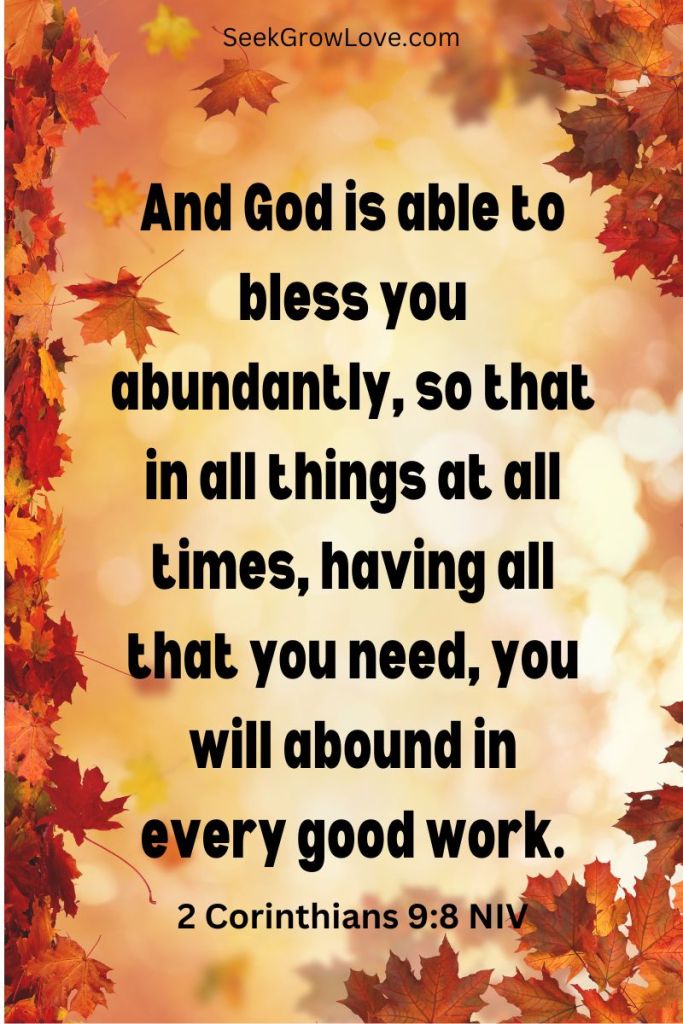
Often, human look at life as a zero-sum game: if I give what I have to someone else, then I lose and they win. But Paul reminds the Corinthians that this world is not a battle of wealth between the haves and the have-nots. “God is able to make all grace abound to you, so that having all sufficiency in all things at all times, you may abound in every good work.” (2 Corinthians 9:8) If God owns the cattle on a thousand hills (Psalm 50:10), do you think he is unable to meet your needs, even when you give “until it pinches a little.” C. S. Lewis speaks about the amount one “ought” to give and he writes “I am afraid the only safe rule is to give more than we can spare.” We might be afraid to give generously, but only in giving generously will we receive generously, just like the farmer can only reap bountifully when he sows bountifully. 

I want to be very clear : when Jesus prayed for his care from the Father, he asked for bread (“daily bread”) and water, rather than steak and Starbucks. This is not a lack of the provision of God, but the reality that giving extravagantly and full of joy does not mean that we will receive a sudden windfall, or be able to buy the nice car. God is not concerned with your riches or wealth in this life but with your obedience. God promises to care for your needs, not necessarily your wants. Obedience does produce something infinitely valuable though : the ability to do more good. ”So that you may abound in every good work.” “You will be enriched in every way to be generous in every way.” Your generosity will “produce thanksgiving to God… overflowing in many thanksgivings to God.” And we have seen how important thanksgiving is. In fact, that is what Paul ends this encouragement to give with, thanksgiving!

 We see that God wants us to give cheerfully and generously, and he will continue to bless us to be a blessing. Our giving is done because we know that every blessing given is already a gift, and everything we own belongs to the God who owns everything. As we give, we can remember that God has already given the greatest gift of all, and our generosity can and will result in thanksgiving to God for his inexpressible gift!

-Jake Ballard

Questions and Application

  1. “Blessed to be a blessing.” :  Have you thought about how this description defined so much of the interaction of God’s people with the world? What are some of the blessings you have been thanking God for this week? How can you use those blessings to bless the world around you?
  2. “Trusting God with Generosity” : Lewis’ call to give more than we can spare requires that we trust that God will meet our needs even when budgets seem to say we can’t. Not everyone is called to sell everything they have and give to the poor, but some were (and maybe are). How much is the right amount to give for you? Who around you needs to be blessed?
  3. “Supplying the needs of the saints” : I have tried to be very clear that Paul was talking about giving money. We should give money to make sure we meet the needs of those around us who lack funds. There are three important points to remember. First, if we are young and don’t have a job, it is very hard to give money. A way to help is to give what you can ; your time or your talents, for example. Second, however, if you give of your time and talents, that doesn’t excuse you from giving money if you can. You should be willing to give everything to God, time, talent and treasure (money). Third, and the opposite of the last points, if you give money to a ministry, that is not a substitute for volunteering your time and abilities. All three, the time you are given, the talents (abilities) you have and the treasure (money) you own, are blessings from God, and are given so you can bless others. 
Holiness and Thanksgiving

Theme Week – Thanks: Romans 1

Old Testament: Ezekiel 41 & 42

Poetry: Psalm 109

Yesterday, we learned that giving thanks to God is a part of our duty as those saved by grace through faith in Jesus. Today in Romans we see what happens to our souls when we don’t give thanks to God. 

In the magnum opus that is Romans, Paul lays out the case that Jews and gentiles both are redeemed by grace through faith in Jesus, that we are all members of Israel made new and we all can be grafted into the people of God. But to get to that point, Paul has let us know there is some bad news ; people are unrighteous. To be clear, God is angry at sin and those things that oppose his good will upon the Earth. God’s desire for humanity has been “made clear” by his creative action and people are without excuse to worship him. (Rom. 1:18-20)

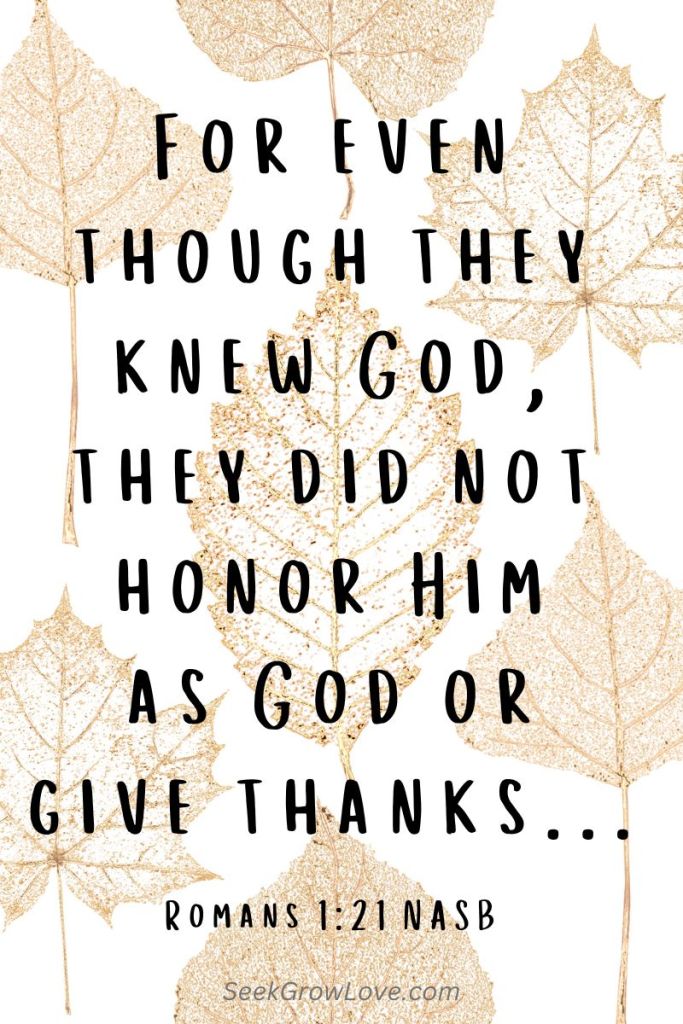
Then we get to the point : “For although they knew God, they did not honor him as God or give thanks to him, but they became futile in their thinking, and their foolish hearts were darkened.” (Rom. 1:21)

Read that again : Paul seems to be connecting what they did not do and what happened to them. When people who could know God do not honor him or give thanks to him, they THEREFORE become futile in thinking and have darkened hearts. Which could also mean that if we want to not become futile in our thinking, if we do not want our hearts to remain in the dark, we need to honor God as God and give thanks to him. 

Now, let’s be clear about Paul’s point : we are not going to give thanks to God enough to be saved. Romans presents a powerful case that we can’t save ourselves! “We have all sinned and fallen short of the glory of God” (Rom. 3:23) and “the wages of sin is death.” (Rom. 6:23) However, we also remember what God gave: “the free gift of God is eternal life through Jesus Christ our Lord.” (Rom. 6:23) 

Rather than simply “being thankful”, today give thanks to God for Jesus Christ our Lord, through and in whom we have salvation : “Thanks be to God through Jesus Christ our Lord… There is therefore now no condemnation for those who are in Christ Jesus.” (Rom. 7:25-8:1)

Application and Reflection

Paul gives us a number of different ideas of what to be thankful for today : 

  1. Paul gives thanks to God for the church in Rome. (Rom. 1:8) When was the last time you gave thanks to God for your local church? Your local youth group or youth pastor or pastor? Take a moment to give thanks to God for that today.
  2. Paul gives thanks to God for the salvation of others! (Rom. 6:17) Look around at your mom, dad, brothers, sisters, and other family. Think about those people around you who know the salvation of God found in Jesus. Thank God for those who know Jesus around you. If you have some people who need to know more about Jesus and God, how can you share the gospel message of salvation by grace through faith with them?
  3. Paul says that we should give thanks for our food (Rom. 14:6) Will you take the time before every bite of food today to remember that God has given you this food? Will you make sure that God is honored by your thanks today?

-Jake Ballard

Paradise

Old Testament: Ezekiel 37 & 38

Poetry: Psalm 107

New Testament: Revelation 22

     Revelation 22 begins with a few more verses describing New Jerusalem, a topic which began in chapter 21. It is full of life. I go back and forth on how to visualize this from the details we have. The city is described with one street, paved in gold like glass. The street leads to the throne of God and Christ – it is the most important destination. Perhaps the street spirals up to them, and the clarity of the gold helps the light from the throne reach everywhere. The river of the water of life passes down the center of the street, and the tree of life is on either side (v. 2). So perhaps the water goes through a tunnel carved in the thick trunk of the tree of life, which has grown quite large since being transplanted from the Garden of Eden. The design does not concern me greatly, the key is the offer of life and blessings. This is a place of contentment and worship – it has no temple because it needs none, all within it are constantly in the presence of God and Christ, bathed in their glory.

     Rather than design, I am interested in the idea that things have, at last, moved beyond the stage where God considers them “very good” (Genesis 1:31). After each of the first five days of creation God declared the work “good”; after day six it was “very good” – notably with the addition of humans. It may be that things didn’t remain at “very good” for long before they slid into distress and pain due to the addition of sin, but that isn’t the point in this chapter. God has restored matters. The curse is gone! But I think God more than restored things and passed “very good” to “perfect.” I suspect the needed element for that to take place involves free will – God would not force Adam and Eve to love and accept Him, it was to be our choice if we would seek companionship with Him.

     Well, talking about this sort of thing with God can wait, and by the time we enter those kinds of conversations with God we will be better equipped to do so. For now, we know the challenges we face, and the Spirit we have been entrusted with to face them. Let us continue toward the paradise God has planned for us.

     The Greek word for “paradise,” by the way (Luke 23:43; Revelation 2:7), from which we get our English word “paradise,” comes from a Persian word for a pleasure garden. It seems like we are striving to get back to a garden, where we could eat from the tree of life and perhaps even walk with God.

     With understanding and acceptance of each other.

     Loving and loved.

     Forever.

     These are goals worth having.

     Lord, the book says a blessing is on those who read and hear the words of this prophecy and heed the things written in it, for the time is near. Help us be attentive to these words, and all that you direct for our lives. Thank you for the gift of your words. Do not let us be drawn astray from you, your message, or your work. You are a gracious God. In Jesus’ name I pray to you, Amen.

-Daniel Smead

Reflection Questions

  1. We are repeatedly told there will be no night in the time of the New Jerusalem – what do you associate with night that you will be pleased to have end?
  2. How do you find the curse affecting your life this week? How is knowing Jesus, and believers, helping you to deal with the curse now?
  3. Looking back over Revelation, what directions stand out to you for your life? How is it going? Do you think you should call on someone to help you be accountable for what you feel called to do?

A Glimpse of Coming Glory

Old Testament: Ezekiel 35 & 36

Poetry: Psalm 106

New Testament: Revelation 21

     In Revelation 21 we have come to the climax of events. In the Garden of Eden God set out to undo the separation between Himself and us, and that goal is at last complete. Humans may have been short sighted during history and at times tied themselves in knots over other issues, but God wanted to return to our sides. With “the first things” passed away there will be no more pain. Evil is removed from the scene and God is changing the universe, making everything new. He intends to freely give the water of life to those who overcome (John 4:14).

     God lists some of those who will not receive what He offers, addressing several issues that were raised in the book, murder, sorcery, idolatry – but it begins with the cowardly (v. 8). I wonder if that is directed at early readers, facing persecution in the Roman Empire and possibly hesitant to commit. But it extends to later readers, who might question if they wish to stand up for Jesus’ name and his authority and risk conflict, or if it would be simpler and safer not to, even to appear to be unsaved. Some of God’s servants, like Gideon, were called to serve while not eager to act on their own. That may seem to give a basis for seeing hiding as credible. But I think God chose from the reluctant to make a point, and to stir the hearts of others. And those were not Christ’s disciples, already gifted with the Spirit. He expects something else from us. Not that I am saying we are to be abrasive and offensive in an eagerness to act, there are proper and wise moments and ways to stand up, and we are not always the right people to do so in a situation. Like I said, the appearance of that word first in the list strikes me. It convicts me, all too often, of taking an easier route. But I work for Jesus, and I’ve never heard of anyone braver than him. I leave it to you how it makes you feel. 

     John is taken to a tall mountain by an angel to see “the bride, the wife of the Lamb” and arrives at “the holy city, Jerusalem” (v. 9, 10). It is reminiscent of Ezekiel being shown the new temple, which was on a mountain (Ezekiel 40). I have taught about Revelation 21 numerous times. I have considered taping a cardboard mockup on a globe of the world to show the size of New Jerusalem. I didn’t end up attaching it, and I wasn’t sure if it should be a cube or a ziggurat, or a pyramid (we are told its base is square, and the height). Just describing my idea to the students got the gist across. New Jerusalem is large.

     Earth’s breathable atmosphere extends out for about eleven miles at the equator. Perhaps you have heard the idea about being able to see the Great Wall of China from orbit. You can’t. You could bump into New Jerusalem in orbit. We aren’t totally sure of the size of the city, it depends on how you understand twelve thousand stadia, the 1995 NASB says 1,380 miles and some other versions say 1,500 miles. The International Space Station orbits about 250 miles from Earth. The Hubble telescope is 340 miles out. The upper range of what are known as “low Earth orbit” satellites is 1,243 miles, so the city would tower above all of them, if they were still around. (Which they won’t be.) But the geostationary satellites are much further out, at 22,236 miles. And the Moon is 238,900 miles away, which is nowhere near it. Speaking of the Moon, it has a diameter of 2,159 miles. Earth is 7,917.5 miles in diameter. Under the smaller estimate for the city (1,380 miles) it is 15.69% of the width of Earth, and my cardboard mockup needed to be 1.88 inches wide for a standard 12-inch globe.

     We are told that with God’s new heaven and new Earth there is no longer a sea (v. 1). If that refers to the Mediterranean Sea it seems like a necessary removal, to give New Jerusalem ground space to fit. If it was centered on the location of Jerusalem it would extend about halfway through Greece, assuming it was aligned square with the equator. It also couldn’t be flat on the bottom since the Earth curves, which matters at this size.

     I think this raises some questions. When God replaces the Earth, will it be the same size as the old one? What is being described here sounds like God planned on expansion. The millennium just took place, a thousand years without plagues, famine, and war. It didn’t start off with very many mortal people, but I think the population had a good opportunity for growth. It may be that the number saved during human history leading up to Christ’s return will be just a fraction of those who will ultimately be saved, guided in part by the priests we are being prepared to be. Oh, may it be so.

     My questions are skipping over a rather obvious point. The angel who volunteers to show New Jerusalem to John does so under the description of “the bride, the wife of the Lamb” (v. 9). It isn’t clear to me whether that is because the bride (the population) is inside the city, or because the city is simply a symbol of those who have been accepted as Christ’s bride. The names inscribed on it, of the twelve tribes and the twelve apostles, may not simply be honoring those figures but symbolizing all who came from the lineage of those figures. Consider the description of its size and splendor, and the statements that none with bad character will enter. It says that God and the Lamb provide it with temple and light and lamp. All of this fits the idea that New Jerusalem is the people of God. Now, perhaps the language here presents people and city in another of the Bible’s double fulfillments and both cases are true. Whatever God intends it will be wonderful, and the beautiful description given in this chapter leaves me in awe and anticipation. I say, rejoice in your Lord!

     Thank you, Father, for giving us this glimpse of the glory that lies ahead. Thank you for your commitment to us, that you did not give up on the work of Your hands, but took such care and effort to restore what had been damaged. Please help us to value what you value, to seek what you desire. There are so many lost sheep, so many hurting hearts, that you desire to be blessed by the love of your son. Please shape me into who you desire me to be, until I am complete. Thank you, in the name of Jesus, Amen.

-Daniel Smead

Reflection Questions

  1. What does God’s commitment to fixing what was broken tell you about Him? What does it say about how God sees us?
  2. What are some of the “first things” that will have passed away when the events of Revelation 21 have come to be?
  3. If (when) you are tempted to hide, what helps you overcome that temptation and stand up?

Judgment: The Positive and The Negative

Old Testament: Ezekiel 33 & 34

Poetry: Psalm 105

New Testament: Revelation 20

     Revelation 20 involves God’s judgment, and it may make sense to put 19:20-21 in your mental image of the passage so the beast, the false prophet and their armies are in there. Verse ten reiterates the judgment of the beast and the false prophet, pairing them with the devil they had served. I see the passage with alternating sections of negative and positive references to judgment (19:20–20:3, 7-10, 15) and (20:4-6; 11-14). Grouped this way the text has every use of “lake of fire” (a different phrase appears in 21:8).

     After 19:20-21 establishes the punishment of those who served the dragon, chapter 20 opens with very satisfying language about the serpent not being able to deceive the nations. He is chained and sealed away for a thousand years.

     The description of the saints’ resurrection which follows in verses four to six may seem notably out of sequence. The first resurrection takes place at the last trumpet, in the twinkling of an eye (meaning in the time it takes to blink; 1 Corinthians 15:52). At Christ’s return the dead in Christ rise first, at the sound of the trumpet, and his servants who remain alive rise to meet him just afterward (1 Thessalonians 4:14‑17). That happens before Jesus fights the armies of the antichrist. It seems that the first resurrection was skipped over in Revelation 19. It also seems questionable for there to be an evaluation of the martyrs like is described in the vision. God knows all about them – they are raised because of who they are. It seems that the evaluation was described just for the sake of the vision, and what this passage presents as “judgment” clearly would need to be a fully positive judgment.

     Recognizing all of that, I think God wanted this text here, after a description of what happened to the devil. It contrasts what happened with those who accepted the mark of the beast (dead) and the leaders of the conspiracy (burning) and the one who inspired that conspiracy (imprisoned for a thousand years) to those who stood firm against it (they come to life and reign with Christ for a thousand years). Considering what these martyrs suffered, God wants to emphasize their acceptance and glorification, although that called for it being addressed out of sequence.

     In verses seven to nine Satan is again free, for a short time. Perhaps this represents a winnowing of the nations before God makes the next big change in the status of earth. Satan again deceives the nations who are willing to be deceived and assembles them for judgment (even if he doesn’t understand that is what he is doing). And this time judgment comes on him as well. God is closing out the books, after this there won’t be anyone else around able to be tempted. God could have left this entire story unmentioned, but He wanted us to know this part of the future, to be aware that our enemy will be permanently dealt with. (Not that Genesis 3:15 didn’t already indicate it.)

     I like the imagery in verse 11, as though perhaps God’s majesty surges up, and all that is nearby is not holy enough to remain. “Earth and heaven fled away, and no place was found for them” (v. 11). We continue to be reminded that this is a vision, as the lake of fire is still present for the later part of the vision and did not flee away. Maybe this is looking toward the next part of the story, that God is in the process of replacing heaven and earth (2 Peter 3:12). The description of death and Hades being thrown into the lake of fire is very positive (v. 14), but also serves as another reminder that we are reading about a vision (as it is hard to figure how John knew this happened except by being made aware of it).

     Elements of both the positive judgment scenes (v. 4-6, 11-14) can be found in Daniel 7:9ff, with the thrones, the books, and the fire, but they are mixed. It is a common statement that prophets of the Old Testament saw future events like we might see a distant mountain range, unable to tell very well how large a valley was between the peaks. Events from Christ’s first coming and second coming could be discussed right next to each other in a passage. With Daniel 7, making distinctions relevant to the existence of multiple resurrections wasn’t purposeful. And with Revelation John could not see and appreciate all the things happening in fully accurate order.

     I questioned whether to think of the judgment in Revelation 20:11-15 as neutral, or to break it between a positive first four verses and a ‘negative’ verse 15, because it raises the idea of someone’s name not being found in the book of life. It is interesting to think that verse 15 involves a resurrection too late in history to be relevant for the reader and so may not be intended as a warning for us. But I suppose it will be a warning to people during the millennium.

     Lord, your judgments are true. Thank you for offering your mercy. Please open my heart to accept your gracious offer, for myself, and for others. Don’t allow me to remain burdened with the past. Don’t let me be held back by refusing to forgive. Lord, let me listen so well to you now that I will not be deceived by the evil one or accept any of his lies. Let me seek your truth, and love it. In the name of your beloved son, Amen.

-Daniel Smead

Reflection Questions

  1. What do you think it will be like for people in the millennium to read the Bible?
  2. How does it make you feel to think that God is eager to praise those who have faithfully served Christ?
  3. The text refers to “priests of God and of Christ” who will “reign with Him for a thousand years” (v. 6) – have you given much thought to what that might involve?

She Falls

Old Testament: Ezekiel 29 & 30

Poetry: Psalm 103

New Testament: Revelation 18

     Revelation 18 pictures the shock of those who supported and gained from the success of Babylon the great, and then see it destroyed. As others have said, true wealth is found only in Christ, so those who tried to gain from corrupting themselves with Babylon did so at the cost of their lives (Matthew 16:26). When the voice from heaven warns to come out of Babylon it isn’t just about leaving before the city falls if you happen to be there, but to avoid contamination with its practices lest we fall as well (compare 2 Corinthians 6:17).

     It is again difficult to decide whether some details in the chapter were meant literally. Does Babylon engage in sorcery, or does that express its evil influence on those caught up with it? Which of the trade goods listed are we to think Babylon truly receives – the list wasn’t going to include modern luxury items, but is it just trying to give the feel of wealth based on first century items? Is it in the slave trade, or does it wreck people’s characters? Some will ask if Babylon is a port city at all, or a system with a global reach. Is Babylon destroyed and burned in a single hour, or does it just suffer a rapid fall? (In Revelation 17:12 we were told that the ten kings shared their power with the Beast for one hour, so we may have a reason to see this time reference as metaphorical. Contrast for example the effort taken in the text to show that three and a half years / 42 months / 1260 days is a precise figure.) That last point would be simple to explain in our modern society, however, as a collapse after a single hour which leaves fire behind could refer to a nuclear attack.

     You might hear part of this chapter and think you were in the Old Testament (for example you could compare Ezekiel 27). There is that feel to it. You could imagine Jonah saying these things about Nineveh. It’s all from the same God. Sometimes God gets to show mercy, but when judgment is called for God does not hold back. In fact, after recounting the despair of the kings and merchants and sailors who sinned with Babylon, the chapter calls on God’s servants to rejoice in what has come about. In Revelation 18:21 a strong angel announces Babylon’s permanent fall and punctuates the point by throwing “a stone like a great millstone” into the sea. Jeremiah never went to Babylon, but he sent a scroll there with Seraiah describing the fate of the city and told him to read it aloud, and then tie a stone to it and throw it into the middle of the Euphrates (Jeremiah 51:63). The judgment of God was being left to sink to the bottom, like the city would sink. As I said, we are reading words in a familiar style.

     I’ve long been struck by cases where God set up instructions that don’t seem to have end conditions. How long was the Garden of Eden guarded by an angel with a flaming sword (Genesis 3:24)? Perhaps it was until the flood of Noah’s day destroyed it, or it could have all withered away first. And while the millennium brings grace across the world, will the former site of Babylon the great sit as a blighted patch reminding people of old evils? That may be its fate. As the angel said, no more will the sounds of music, work or happiness be found in her. But then “in her was found the blood of prophets and of saints and of all who have been slain on the earth.” It seems like Babylon the great is worthy of the treatment it receives. We would do well to learn its lesson in advance and turn our backs on all its ways and put our hearts fully toward that other city (the one with foundations; Hebrews 11:10).

     Lord, thank you for sanctifying us by the Spirit and faith in the truth. Thank you for teaching us to take pleasure in righteousness. Thank you for disciplining us for our good, so that we may share in your holiness. Thank you for giving us sound words through your servants. Please help us to listen, and to reflect on what you have said. Help us to grow in your will. And in everything we do, in word or deed, may we do all in the name of the Lord Jesus. Through him we give thanks to you, dear God. Amen.

-Daniel Smead

Reflection Questions

1.  When you envision God, do you see God as preferring to show mercy or to give judgment?

2.  What do you find yourself most valuing about your life as a Christian?

3.  What do you most look forward to in your future as a Christian?

4.  What do you most appreciate being able to share with others as a Christian?

One Bad Woman

Old Testament: Ezekiel 27 & 28

Poetry: Psalm 102

New Testament: Revelation 17

     Revelation 17 begins a section about “the great harlot,” or Babylon the great (17:1) which finishes in chapter 18. One of the seven angels from the seven bowls introduces the topic, and later John is shown the bride of Christ, meaning the new Jerusalem (21:9‑10, perhaps by the same angel). So, in these chapters John sees two cities portrayed as women, one a pure bride partnered with Christ, and the other an immoral prostitute partnered with the antichrist. God is making the sides in the conflict clear and wants us to be clear about our choice.

     Babylon’s fall had been announced in 14:8 and 16:19 – from those verses alone we know that it made nations drunk on the wine of its immorality and was given the wine of God’s wrath to drink. Revelation is picking up from Old Testament texts about Babylon with a somewhat different feel, there Babylon brought punishment on countries for God in war. Babylon was described as itself being the cup of God’s wrath which those nations drank from, maddening them. But after its work was done God turned against Babylon, and the city was also defeated (Jeremiah 25:15ff; 51:7, 11). With Revelation Babylon the great’s immorality is key, and it brings destruction to others by association; it is then destroyed for what it did to God’s servants, and the destruction comes at the hands of its allies.

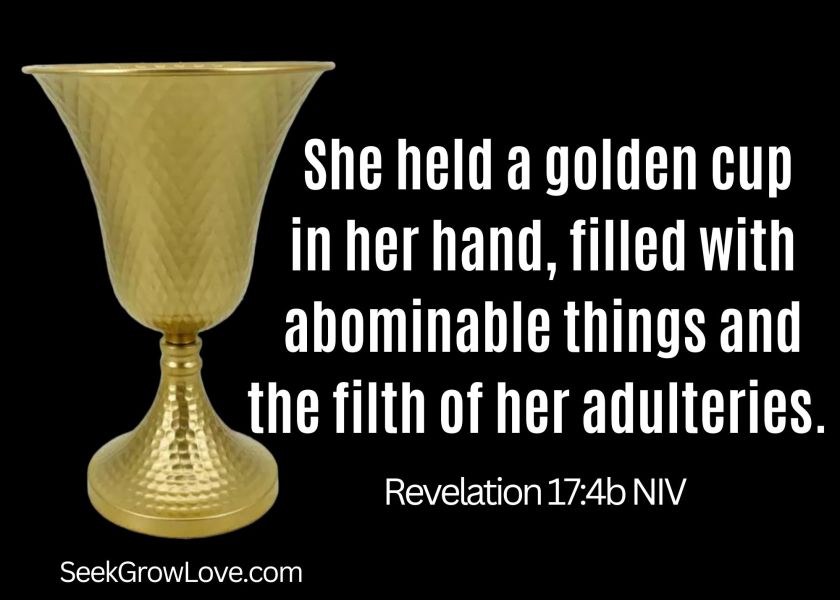
     The vision shows Babylon as a wealthy, richly dressed prostitute, drunk on the blood of God’s servants and offering her immorality from a valuable cup. She is sitting on “a scarlet beast, full of blasphemous names, having seven heads and ten horns,” which is a simple depiction of the Beast from Revelation 13:1. We may be meant to see Babylon as trying to use the Beast, in riding on it, but the Beast uses Babylon, gaining influence from it. In 17:18 we are told that Babylon is the “great city” that reigns (or “has a kingdom”) over the kings of the earth. The identity of the city remains in dispute, but like so much about Revelation it should become much clearer later. The city is presented like an imperial capital, though some authors want to treat it as a culturally unifying site important for its influence in other ways.

     People often question how ‘literally’ to take things in scripture, particularly if they don’t see how events favor a near-term fulfillment. The reestablishment of Israel in 1948, for example, was highly significant for earlier generations in the Church of God but many other groups doubted it would ever take place. As another example, when the two witnesses die their bodies are seen by “the peoples and tribes and tongues and nations” and “those who dwell on the earth rejoice over them” (11:9, 10). In 1962 the communications satellite Telestar I launched, and it was hailed as allowing live broadcasts to be relayed around the world. A few years earlier people would have thought in terms of the witnesses’ photos being published in newspapers. And technology keeps advancing, along with the speed at which changes increase. The iPhone was introduced in 2007, and it is thought that already over two‑thirds of the world’s population has a smartphone – a much simpler way for ‘everyone’ to be shown events happening anywhere in the world. I’ve begun to wonder if the fact that those devices permit use of translation services, which at least partially undo God’s choice to confuse the languages at Babel/Babylon (the name through Hebrew and Greek) could end up relevant to the fact of Babylon the great being the name given for the city, and an aspect of its influence. What is a global false religion without the ability to communicate globally, after all? It’s just a thought.

     I find it disturbing to think that the corruption pictured in Revelation 17 with Babylon the great could come to pass through human failings. But I think that may be part of what God wanted us to recognize, that even before any supernatural power got involved the situation was awful. And that could be why the end of the age comes when it does, because things reach the point that it is time for change.

     Lord, I do not feel endangered today, where I am, but I know you have servants who face risks in many countries around the world today. Please strengthen the hearts of your people, and protect them. They are faithful, help them to remain faithful. Let them trust you and stand firm. Keep them from the evil one, and sanctify them in the truth. And Lord, as I do not feel endangered, let me be bold for you. Let me not forget what your son has done for me. In his name I pray this, Amen.

-Daniel Smead

Reflection Questions

  1. Do you ever struggle over whether a scripture ought to be seen as literal or figurative? What helps you to make up your mind about that?
  2. Is there a Christian or a ministry that you regularly pray on behalf of? If so, consider writing them a note today to share your appreciation for them. If not, consider saying a prayer today for someone whose ministry matters to you who you haven’t seen in a while.

7 Bowls

Old Testament: Ezekiel 25 & 26

Poetry: Psalm 101

New Testament: Revelation 16

     I tend to think of the seals, trumpets, and bowls of God’s wrath as a sequence, but when I’m away from reading Revelation for a while I can lose track of how late in the book the bowls appear. Way back at the sixth seal we are told of God’s wrath, and that people would try to hide from it in caves and beneath rocks (6:15-17). Now, in chapter 16, that wrath comes. Its targets, as Paul stated, are not Christ’s followers (1 Thessalonians 5:9); they are people who served the Beast, killed God’s servants, and would not repent. Considering the nature of some of the bowls, it may be hard to imagine how anyone is protected from their impact – but during years of drought God made sure that Elijah ate and drank.

     Several bowls seem to build on earlier parts of Revelation. While the second and third trumpets affected just a fraction of the sea and rivers, they are fully affected by the pouring of the second and third bowls. With the fifth seal a vision came to John of those who died for the word of God, crying out for judgment (6:9‑10), the angel of the third bowl declares that such judgment is happening and is fully justified (16:6). Those with only blood to drink had poured out the blood of the righteous. The comment “they are worthy” is ambiguous, it may describe the martyrs as worthy of being avenged, or their killers as worthy of this punishment. Either interpretation may feel different than how “worthiness” was discussed in chapters 3-5. There worthy believers were dressed in white. There also a great search took place for one worthy to open the seals on God’s scroll, and the lamb was found. But God does not just watch over the righteous, He also does not leave the guilty unpunished (Exodus 34:7).

     Part of the effect of the fourth trumpet was to bring darkness in a third of each day. The fourth and fifth bowls of wrath initially scorched with the sun those who defy God, and then plunged them into darkness. In both cases the people chose to blaspheme God, rather than repent. (I bypassed the first bowl, and the sores it brought; those sores remind me of Job. I see these people as anti-Jobs, beyond trust or accepting help, who simply lash out.)

     The sixth bowl involves the river Euphrates drying up, as preparation for eastern armies to reach the site of Armageddon (in the north of Israel). That is as opposed to the sixth trumpet when an army tied to the Euphrates killed a third of the population (9:15). Also, evil spirits come from the dragon and the two beasts to gather the kings of the world to Armageddon. When the seven seals and seven trumpets were listed there was a lengthy pause after each of the sixth entries, and there is also a pause after the sixth bowl, but this one is fairly short, just a brief comment from Jesus about his coming like a thief.

     With the seventh bowl the fall of Babylon begins (see chapter 18). The worst earthquake in history occurs, and Jerusalem splits in three. Language about the islands and mountains moving (Revelation 16:20; 6:14) suggests there is overlap between the seventh bowl and the sixth seal. Overlap of language also seems to link the seventh bowl with the seventh trumpet (16:18, 21; 11:19). Even if we can tie the timing together for those two moments we can’t say much about the overall chronology of the seals and trumpets. Some of those events are stated to take months or years, and God may just want us to know about all of them but not to understand interconnections.

     The famous four horsemen from the first four seals collectively tie to the devastation of humanity. Whatever it is the “victors” of such conflict may think they have gained, they do not possess the wisdom to avoid fighting the army of Christ. The battle of Armageddon will be massive and destructive, but it will at least be decisive, and it launches a time of peace and restoration on earth.

     Also mentioned with the seventh bowl is hail the weight of a talent (v. 21), which may mean it is a hundred pounds. The heaviest recorded hailstone so far is 2.25 pounds. A bit lighter case, 1.9375 pounds and the size of a softball, left a ten-inch pit where it struck. Why will God use such large hailstones? If the goal is to impress, why not just have a lot of hail? But that has been done. The hail accumulation record is from 1959, when a 54-square-mile section of Kansas received a 19-inch covering of hailstones. I find that much hail difficult to envision already. Amassing a hundred pounds of ice layer by layer in the clouds may only be feasible with a miracle of air pressure. Penny-sized hail requires 40-mile-per-hour updrafts. Grapefruit-sized hail requires 98-mile-per-hour updrafts. Tornadoes do achieve winds over 300-miles-per-hour, but anyway I think you see the issue. Just referring to the weight of the hail may lead us to underplay in our minds the significance of the storm itself.

     But still, why 100-pound hailstones? Perhaps because God will be dealing with people who would seek to hide from judgment beneath rocks, and in caves. And at least some portion of those refusing to acknowledge their sins will be the world’s most powerful and haughty, those who were content with their actions and amassed huge wealth in service of the Beast and Babylon. Some of them might even be sealed in bunkers when the bowls of God’s wrath are tipped out. Perhaps they will check in on events through video, and then just turn off the screens. But God does not intend for anyone to remain comfortably oblivious to the truth, or even comparatively so, in whatever hideaways they find for themselves. A hundred pounds of ice will put a hole in quite a lot of concrete, steel, and pretension. And God has excellent aim (Joshua 10:11).

     Lord, let me not be complacent, comparing myself to those who will one day go far astray. Truly, without your grace, I would be quite different. But no one sets out to be deceived and destroyed. Please help me be observant of others’ needs, not inattentive. The world is a less distressing place than it will be, but even now there are issues I feel I can only bring to you in prayer. Let me pray, but also show me where I should act. Please help me to trust in you, and to keep my compassion and hope. You are a great God, and you continue to work powerfully. In Jesus’ name I pray, Amen.

-Daniel Smead

Reflection Questions

  1. Revelation 16 describes the last plagues God enacts in this age, which finish His wrath (15:1). What do you think it shows us about how God views wickedness? How do you think it might have affected people over the centuries?
  2. Are you sometimes comforted by considering God’s promises to bring judgment on the wicked? Maybe, like you see a rainbow and remember God’s mercy, you can see hail and recognize that He won’t just let things go on forever.
  3. Revelation 6:16-17 refers to people who wished to hide from “the presence of Him who sits on the throne, and from the wrath of the Lamb; for the great day of their wrath has come.” (Revelation 15 and 16 don’t refer to matters that way.) Do you find it jarring to think of Jesus expressing the wrath shown in the chapter?

Good!

Old Testament: Ezekiel 23 & 24

Poetry: Psalm 100

New Testament: Revelation 15

I chose to write about Psalm 100 because of how much we can learn from it despite its shortness. This is a great chapter to read, and it only takes a minute of your whole day. The first thing I would like to point out is that in verse four it says, “Bless his name.” This verse is talking about God and how we should give thanks to him and bless his name. Now if you’re like me you might be thinking, why should we bless God’s name? Well, God blessing us and us blessing God are not the same thing at all. God does not profit from us blessing him. It’s not like he gets stronger or better anytime someone blesses him. On the other hand, when God blesses us, we benefit from it. In this verse, it is talking more about how we should praise him.

Throughout the whole Psalm, it talks about how we should praise God. As a church, I believe we should be more joyful, and excited. This Psalm is a great example of how we should praise God. It tells us we should serve God with gladness, shout joyfully, enter his gates with thanksgiving, and give thanks to God.

Usually when we think of ‘good’ we use it to mean something between ok and great. But in this passage, it is saying that he is righteous and about how great God is. This reminds me of the popular song below:

God is good, all the time

And all the time, God is good.

This Psalm is a great one to meditate on. Here are some points from Psalm 100 that you can meditate on.

God made us

We are the sheep in his pasture

The Lord himself is God

His lovingkindness is everlasting

The Lord is good

His faithfulness continues to all generations

Throughout the whole book of Psalms, it says, “His lovingkindness is everlasting”. In fact, it says it 34 times. Of those 34 times, 26 of them are all in Psalm 136. It even says it in every single verse.

Even in this short Psalm we can take so much from it.

-Makayla Railton

(Originally posted for SeekGrowLove on January 26, 2018)

Reflection Questions

  1. Do you believe the Lord God is good? Why?
  2. How can you work to bless His name today?
  3. Where can you post Psalm 100 to see and remember it often?

Moldy Berries

*Old Testament: Ezekiel 21 & 22

Poetry: Psalm 99

New Testament: Revelation 14

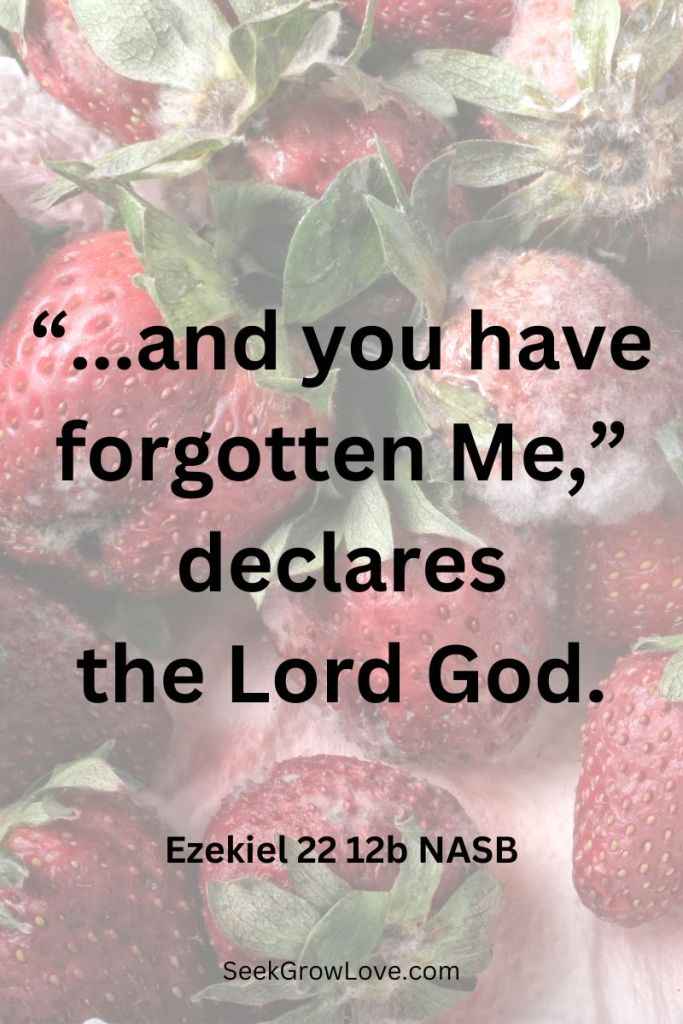
It seems as though fresh strawberries go bad so quickly. You get a package at the grocery and then sometimes by the next day they already start to expire. Maybe that morning you are in a rush when you see that one moldy spot. You know it’s not good, but you will get rid of that bad strawberry later. But, then you forget and by the time you check back in on them, half the package is moldy. And worse yet, this isn’t the first batch you have lost in such a manner. You knew better from previous experiences and yet you managed to find yourself in the same exact trouble.

This happened to me this week. I was reminded of these bad strawberries when reading Ezekiel 22. Time and time again, we see the Israelites in the hot seat after continuous rebellion against God. They should know better from previous experience, but they do not use that knowledge to do better.

I think it is interesting in verses 6-13 God declares the vile things that Israel had within itself. These things were not all immediately there. Rather, I imagine the Israelites allowed one bad thing in at a time until eventually almost the whole batch became rotten. Just as we do not always discard that moldy strawberry when we should, the Israelites did not turn to God and rid themselves of the sin when they noticed it. Rather they turned their heads and allowed more to sneak in and take hold.

In doing these terrible things, they forgot God. They turned their heads from Him and, to stay with the strawberry analogy, allowed the mold to consume them. These things that they did hurt one another and were against the very principles of their creator. These were against the very principles of loving God with all our heart, soul and mind and loving our neighbors as ourselves.

So with that I want to challenge you and myself with the following question. Are there any moldy strawberries in our life right now that we are ignoring? If so, let us, with God’s help, throw that strawberry out so that the mold from it will not spread further in our heart.

-Hannah Deane

Reflection Questions

  1. Just like Hannah asked, “Are there any moldy strawberries in our life right now that we are ignoring? If so, let us, with God’s help, throw that strawberry out so that the mold from it will not spread further in our heart.”
  2. When have you seen the progression of sin overpower and block out a desire to serve and follow God?