Hello My Name is Barabbas

John 18

April 15

About 43% of the Bible is told as a narrative—like a story. From our favorite Old Testament heroes to Jesus’ parables, scripture is full of stories. Of course, how we read a narrative is different from how we read one of Paul’s letters or David’s songs.

To take away practical life application from the Bible stories I read, I ask myself two questions: 

  1. How can I see myself reflected in the characters portrayed? By using scripture as a mirror, I see facets of myself reflected—my personality, my tendencies, my sin, my thoughts, my feelings, and my potential.
  2. What can I learn about God’s character? The Bible is God’s revelation of Himself to humankind. Since God does not change (Malachi 3:6), the God of Abraham, Moses, Gideon, Daniel, and Jesus that we read about is our God, too. 

Let’s practice this process with the story of Barabbas. 

According to Jewish tradition, during the time of Passover, one prisoner was pardoned from their impending execution. Although Pilate was a Roman, to gain favor with his Jewish constituents, he decided to let one prisoner free. Having not found a reason to charge Jesus, he offers Jesus or Barabbas, an actual criminal, to the crowd. (see also Matthew 27:17)

Pilate went out again to the Jews gathered there and said, “I find no basis for a charge against him. But it is your custom for me to release to you one prisoner at the time of the Passover. Do you want me to release the ‘king of the Jews’?”

They shouted back, “No, not him! Give us Barabbas!” Now Barabbas had taken part in an uprising (John 18:38-40).

When we hold up the mirror to scripture, we see ourselves in Barabbas. We’ve committed horrible sin, we deserve to die, yet Jesus died in our stead.

Barabbas deserved to hang on the cross, but Jesus took his place. 

You deserved to hang on the cross, but Jesus took your place. 

In this story, Just as we learn about who we are, we also learn about who God is. He is rich in mercy and forgiveness. He fulfills his promises. He longs for our salvation. He sacrifices the one he holds most dear for us. 

-Mackenzie McClain

Discussion Questions: 

  1. Take a closer look at some of the other characters portrayed in this chapter: Judas, Peter, and Pilate. How do you see yourself reflected in their stories?
  2. Examine the story of Jesus’ death and resurrection as a whole. What does God reveal about his character? 

Bring God Glory

John 17

April 14

Jesus spent most of his life hidden. From his first 30 years of life, only three events are recorded in the Gospels: he was born, strangers brought him presents, and he got lost on a road trip. Even during his few years of public ministry, he ordered his disciples to keep his identity a secret. After healing lepers and giving sight to the blind, he instructed those who witnessed such miracles not to tell anyone. 

It’s clear that Jesus wasn’t about glory—not his own glory, anyways. He kept his head down and sought to fulfill his appointed mission. He recruited twelve loyal friends, challenged tradition, performed miracles, preached the Kingdom, and submitted himself to death on the cross. 

In the final moments before his arrest, he prays—for himself, for his disciples, and for us. One of his first remarks is this: 

“I have brought you glory on earth by finishing the work you gave me to do.” (John 17:4). 

What a beautiful reminder for us of how we should live each day. Have you carried out the work God has for you today? Have you given God the glory? In the final moments of my life, I hope I can say that I’ve brought God glory on earth by finishing the work He gave me to do. I hope the same for you, too. 

Jesus eventually got his glory. In fact, that same night he prayed for his glory to finally be revealed. Now, he’s seated in his throne at the right hand of God. 

God intends for us to follow the same path as Jesus: to live quietly and to be rewarded greatly. In the meantime, let’s keep our heads down, working, and our hands lifted up, praising God. Let’s soldier on, continuing the cause of Christ. 

Not to us, LORD, not to us

but to your name be the glory,

Because of your love and faithfulness 

(Psalm 115:1). 

-Mackenzie McClain

Discussion Questions: 

  1. What is the work God has given you to do? 
  2. We live in a culture that emphasizes building your own name, fame, and following. How is that message contradictory to how God wants us to live?  
  3. What does it mean to give God glory?

Object Permanence

John 16

April 13

Object permanence is a milestone babies hit when they begin to understand that an object still exists when they can’t see or hear it. When their mother leaves the room, she still exists; when their favorite toy is hidden under a blanket, it still exists, too. 

Object permanence is a skill Jesus reinforced in his disciples on their final night together, before his arrest and subsequent death. 

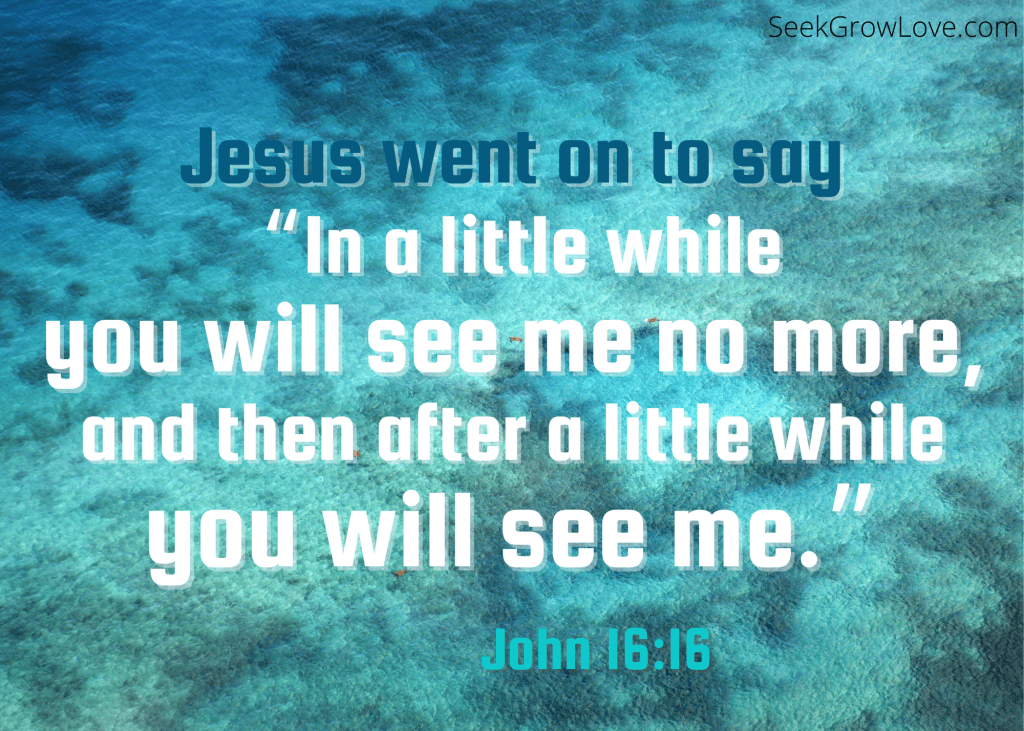
Jesus went on to say, “In a little while you will see me no more, and then after a little while you will see me” (John 16:16).

The disciples mourned Jesus’ death, and they rejoiced at his resurrection just three days later. Even though they could not see Jesus, he wasn’t gone forever. Just like a baby’s favorite toy hidden under a blanket, Jesus was merely out of sight for a little while. 

You and I have never seen Jesus, yet the disciples’ hope is our hope, too. We can’t see Jesus now, but we will someday—when he brings his Father’s Kingdom down to Earth. We have faith that even though we cannot see him, he is real and he is working. After all, faith is the certainty of the things we cannot see (Hebrews 11:1). 

Although we’ve never seen Jesus, we can see the impact of his life all over our own lives—the freedom of forgiveness, peace in unfathomable situations, victory over temptation and sin. 

Therefore we do not lose heart. Though outwardly we are wasting away, yet inwardly we are being renewed day by day. For our light and momentary troubles are achieving for us an eternal glory that far outweighs them all. So we fix our eyes not on what is seen, but on what is unseen, since what is seen is temporary, but what is unseen is eternal (2 Corinthians 4:16-18). 

We have the same hope as the disciples. We can’t see Jesus now, but we will soon. 

Jesus is coming soon. 

We will see Jesus face to face. 

-Mackenzie McClain

Discussion Questions: 

  1. Even though you’ve never seen Jesus, have you seen evidence of his existence in your life? How so? 
  2. How would you live your life differently if you were constantly reminded of Jesus’ coming return? 

The Scary Gardener & Reckless Vine

John 15

April 12

I have a story to tell you. It’s the scariest horror story and, simultaneously, the greatest love story. I’m not talking about ghosts falling in love. No, I’m talking about a garden. 

We’re all little branches in a big, beautiful garden. It’s our job to grow fruit to please the Gardener. 

A day is coming, however, when the Gardener will cut off the fruitless branches—the diseased, dead, good-for-nothing twigs. 

If you do not remain in me, you are like a branch that is thrown away and withers; such branches are picked up, thrown into the fire and burned”(John 15:6).

It’s scary to think about the judgment that is coming—about the branches thrown into the fire. The Bible is filled with examples of people meeting God’s wrath, like a flooded Earth, a pillar of salt, a plethora of plagues, and people dropping dead. That day is coming for us, too. This begs the question, are you living in a manner that is consistent with your calling to be holy, to bear good fruit? 

I have good news for you, Little Branch. There is a Vine who is crazy about you. His job is to keep you close, to hem you in, to wrap around you, and cover you in grace. This Vine is Jesus, and he says: 

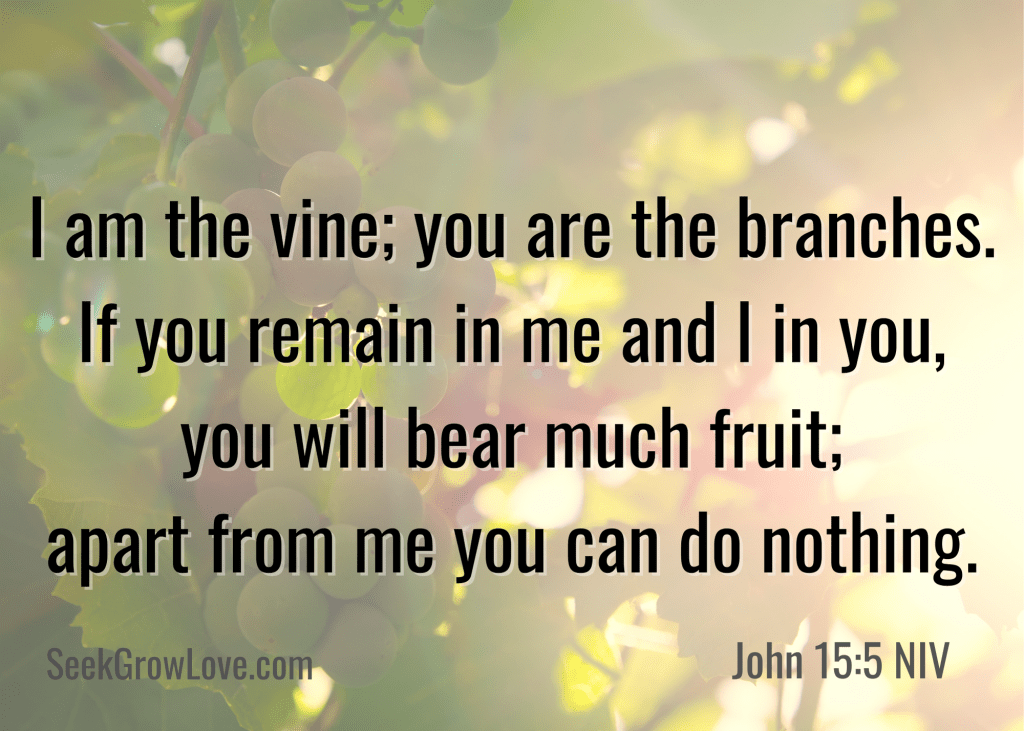
“Abide in me, and I in you.  As the branch cannot bear fruit by itself, unless it abides in the vine, neither can you, unless you abide in me” (John 15:4).  

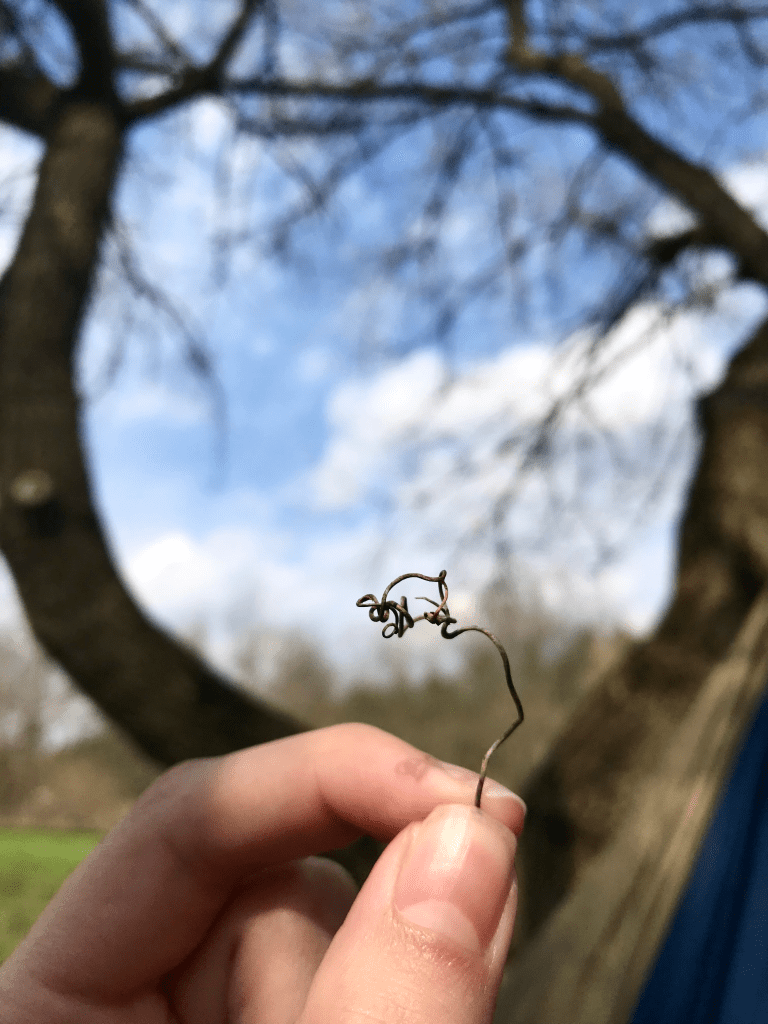
I took this picture of a vine in my sister’s backyard. Look at the way it twists, turns, and loop-de-loops to seek out and envelop a branch. The love Jesus has for you is the same. It’s reckless and unrelenting. It’s the well that never runs dry, the shepherd that leaves the ninety-nine to rescue the one, and the blood-stained body on the cross. 

The same Jesus who first told us to “Come,” also tells us to “Abide.” To remain. To stay. To obey. 

“If you keep my commandments, you will abide in my love” (John 15:10a). 

-Mackenzie McClain

Discussion & Reflection Questions: 

  1. As the old hymn says, are you ready for judgment day? Are you bearing good fruit? 
  2. What commands do you struggle to obey? Where in your life do you need a good pruning? 
  3. How has Jesus’ love changed your life?

Together in Love

John 14

April 11

Still gathered around the table in the upper room—the same table where the last Passover meal was shared—Jesus gives his disciples a series of encouraging remarks. One such remark has left many Biblical Unitarians scratching their heads:  

“Believe me when I say that I am in the Father and the Father is in me” (John 14:11a). 

What does he mean… in? Jesus in the Father? And the Father in Jesus? 

I teach English to sixth graders for a living, so I’m well aware of how tricky prepositions can be. In, the supposedly simple, two-letter word, has 18 different usages according to the Oxford dictionary. Now consider we’re reading the translation from the original Aramaic words Jesus spoke to Greek to English, which has muddled the meaning even further. 

Fortunately for us, Jesus uses similar language just a couple pages later, in John 17: 

“My prayer is not for them alone. I pray also for those who will believe in me through their message, that all of them may be one, Father, just as you are in me and I am in you. May they also be in us so that the world may believe that you have sent me” (John 17:21). 

I have made you known to them, and will continue to make you known in order that the love you have for me may be in them and that I myself may be in them.” (John 17:26). 

In these passages, in refers to a tight bond. The intimate relationship between God and Jesus is available to you, too. You can have close communion with the church body, with Jesus, and with God himself. 

Now, it’s clear that Jesus wasn’t pointing to a trinity, but a… billionity. Okay, I made that word up (I have an English degree, so I get to do stuff like that). Through Jesus we have unity with God and unity with each other—with all the believers on earth. We’re perfectly bound together with love.

In love. 

Jesus is the glue that holds us all together. He takes a billion broken people and makes us Church. 

From him (Jesus) the whole body, joined and held together by every supporting ligament, grows and builds itself up in love, as each part does its work (Ephesians 4:16). 

-Mackenzie McClain

Discussion & Reflection Questions: 

  1. Why did Jesus place such high importance on Church? What can we accomplish together that we cannot do on our own?
  2. Are you doing more than just sitting in the same row with people at Church? How are you, personally, contributing to the mission of the Church? 
  3. Thank God for your Church family. Pick a few fellow members and send them a card or a text, telling them of the impact they’ve made on your life. 

Known by Your Love

John 13

April 10

Do the people you pass in your daily life know that you follow Jesus? Your coworker in the adjacent cubicle, the cashier at the grocery store, your neighbor down the street? How do they know? It’s probably not the length of your prayers, the Bible verses you have memorized, the fancy church jargon you use, or the gourmet casseroles you bring to your church potlucks. 

They will know you by your love. 

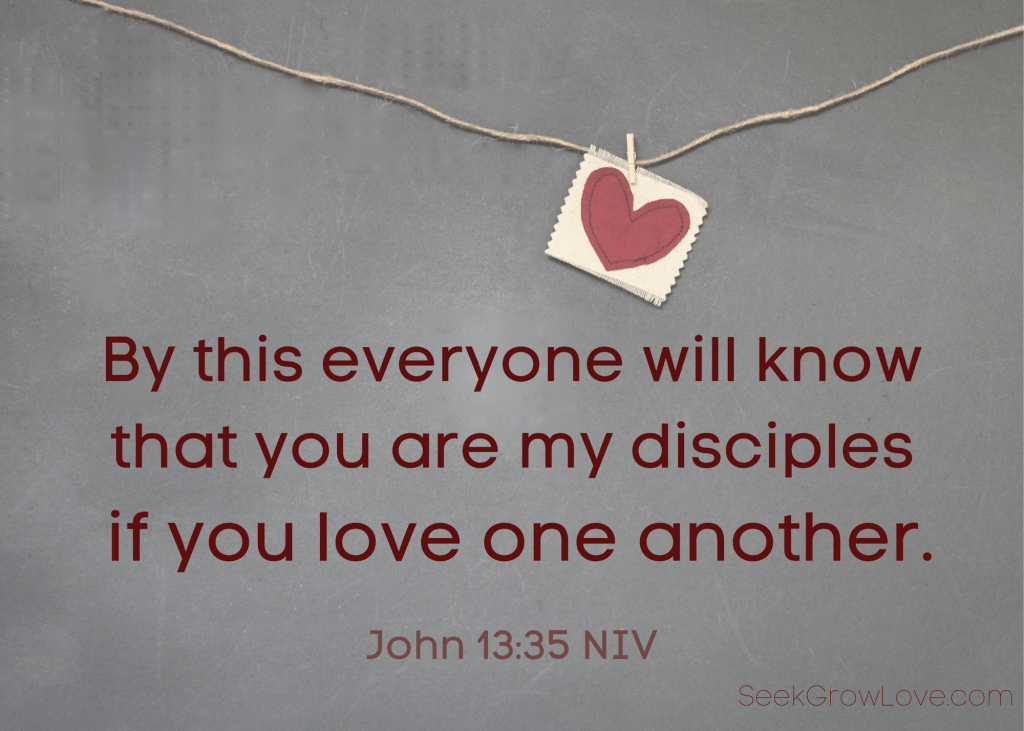
“A new command I give you: Love one another. As I have loved you, so you must love one another. By this everyone will know that you are my disciples, if you love one another” (John 13:34-35).

Following Jesus isn’t about knowing the most, but loving the most. 

Love is our faith in action. It might not always make sense to unbelievers, especially in the midst of our self-obsessed culture. 

Love your enemies and pray for those who persecute you (Matthew 5:44). 

Sell your possessions and give to the poor (Luke 12:33). 

Honor one another above yourselves (Romans 12:10).

Look after orphans and widows in their distress (James 1:27). 

Carry each other’s burdens (Galatians 6:2). 

We ought to lay down our lives for our brothers and sisters (1 John 3:16). 

When we love—even when it doesn’t make sense—we show our allegiance to Jesus. He is the perfect personification of love. This week, we celebrate the love he showed on the cross, where he bled and died to win your heart, where he was scoffed at by a world who couldn’t make sense of such great love. 

If we’re followers of Jesus, we’ll do as Jesus did. We’re called to pour even when our cup is empty, to give when it hurts, to expect nothing in return, and to lay down our lives for others. By this, the world will know you belong to Jesus. 

-Mackenzie McClain

Discussion & Reflection Questions: 

  1. Who will you show this nonsensical love to this week? How will you do it?
  2. Loving others cost Jesus his life. What might loving others cost you?
  3. By being known as a follower of Jesus, people will make assumptions about who Jesus is based upon how they see you act. What implications does this have for how you live your daily life? 

Triumphant

John 12

April 9

The next day the great crowd that had come to the festival heard that Jesus was coming to Jerusalem. So they took branches of palm trees and went out to meet him, shouting,

“Hosanna!
Blessed is the one who comes in the name of the Lord—
    the King of Israel!”

John 12:12-13

The headings in our Bibles weren’t original to the text. I’m not sure who came up with the name “Triumphal Entry” for the portion of text we’re going to look at today, or when it was so titled, but it begs some questioning.

Triumphal implies the celebration of a great victory or achievement. And while on this day, crowds lined the streets with palm branches and shouted praises to him; within days of the hosannas, the crowd turned ugly, demanding His crucifixion.

You see, the people shouting ‘Hosanna’ had false expectations. They expected Jesus to restore Israel to its former glory, to establish God’s earthly kingdom with them at the top. What they didn’t know was that the true enemies that had to be defeated were not the Gentiles, but rather sin and death. And this could not be done on a white horse and with great armies. Instead, it took humility, a willingness to take the form of a servant and submit to the punishment that God’s people deserve for their sin.

Paul describes this perfect picture of humility in Philippians 2. He says that Jesus, “emptied himself, taking the form of a slave” and that he “humbled himself and became obedient to the point of death – even death on a cross.”

Throughout Scripture we find that humility is the path to victory and exaltation. We don’t expect to find real strength in those who are humble. But God has a way of turning our expectations upside down. He has a way of showing his glory through things we revile.

As we near our Easter celebrations, let’s prepare our hearts by seeking humility in our own life. Let’s also seek to see Jesus as he really is. Immediately after He ascended into heaven in Acts 1:9, he was seated at the right hand of the Father. He was triumphant over sin and death, he lives in triumph now, and he will return one day to triumph forever over the evil of this world.

That is something to celebrate.

-Susan Landry

Questions for Reflection and Discussion:

  1. Do you ever think about asking God to correct you if you’re wrong in any of your beliefs?
  2. How can we grow in humility?
  3. Look up the following verses about Jesus being seated at God’s right hand and discuss: Colossians 3:1, Ephesians 1:16-21

Bad Timing?

John 11

April 8

Have you ever questioned God’s timing? How about feeling like maybe God isn’t as concerned about you as you wish he was? Have you ever felt let down by him?

Martha, Mary and Lazarus were friends of Jesus. They knew that he was tuned into God’s will and that he was God’s Messiah. So when Lazarus fell seriously ill his sisters sent for Jesus. Instead of coming right away, Jesus waited days to come. He said,

 “This illness does not lead to death; rather it is for God’s glory, so that the Son of God may be glorified through it.”

I have to wonder if, when they found out that Lazarus had died, if anyone who heard him say that questioned. Could Jesus have been wrong?

When he does finally arrive, Martha said to Jesus, “Lord, if you had been here, my brother would not have died.”  Mary expresses the same disappointment. We’re told, When Mary came where Jesus was and saw him, she knelt at his feet and said to him, “Lord, if you had been here, my brother would not have died.” They must have felt a bit abandoned by him in that moment.

But I have to imagine that their joy, their utter amazement, when he raises their brother from the dead had to trump whatever disappointment they had felt. In THAT moment, they knew that Jesus was perfectly attuned to his Father’s timing.

In Isaiah 55:8-9 God tells us:

For my thoughts are not your thoughts, nor are your ways my ways, says the LORD. For as the heavens are higher than the earth, so are my ways higher than your ways and my thoughts than your thoughts.

Maybe you’ve questioned God’s timing in those situations where you just know what needs to happen for things to work out. Maybe you’ve had things not work out the way you had planned, or hoped, they would.

The thing about God is that we can trust him even when we don’t understand.

-Susan Landry

Questions for Reflection and Discussion:

  1. Martha and Mary were Jesus’ friends, and they addressed him pretty directly when he shows up after their brother died. Does it seem that Jesus is mad at them for sharing their disappointment, their not understanding, with him?
  2. Do you think we can tell God that we are disappointed with him, or do you think that is inappropriate?
  3. When you are unsure of God’s timing in a situation in your life, what are some ways you can surrender that to him and trust him in the midst of your uncertainty?

Believe the Works

John 10

If I am not doing the works of my Father, then do not believe me. But if I do them, even though you do not believe me, believe the works, so that you may know and understand that the Father is in me and I am in the Father.

John 10:37-38

In chapter 10 we get to see Jesus once again being challenged by the Pharisees. His reply here reminds us that our actions matter more than our words. He tells them that since they don’t believe his words, to judge him by his actions.

This mirrors what Jesus said in Matthew 7:

Thus, by their fruit you will recognize them.

And also what we read in Proverbs 20:

Even a child makes himself known by his acts, by whether his conduct is pure and upright.

It also reminds me of this saying a friend shared with me several years ago:

I don’t trust words. I even question actions. But I never doubt patterns.

You see, people can lie with their words. They can even act in the ‘right’ way and mislead you…for awhile. Eventually, if we are looking for them, patterns reveal themselves.

Not only is this something we should be aware of and be watching for in others in order to live a discerning life; but also something that we should be aware of in our own life. I’m wondering if we could confidently say, “Even if you don’t believe my words, watch my actions. That will convince you.” Paul said something like that to the church in Corinth when he wrote:

Follow my example, as I follow the example of Christ.

After Jesus issues his challenge to the Pharisees and the others listening, we’re told that he goes away from them, but many people followed him to where he went. Then we’re told that:

And many believed in him there.

I guess his actions spoke for themselves.

-Susan Landry

Questions for Reflection and Discussion:

  1. Discuss the idea of not trusting words, even actions, but watching for patterns. Why is this important?
  2. Why is it so scary to think about telling people they could ignore our words and just watch our actions? Why do you think Paul was confident enough to say that?
  3. Take some time to look for patterns in your own life.
    1. Look for patterns that may reveal things you want to change.
    2. Look for patterns that show positive traits that could point someone to Christ.

Forgiven Much, Loves Much

John 9

April 6

Jesus heals a man born blind with a spit-filled mudpie. Creative. Unexpected. A tiny bit gross.

Totally worth it though, I imagine, to the man who can now see.

What we’re going to focus on, however, is the reaction to this healing by the elite, the ultra-religious, the Pharisees. Because this man’s miraculous healing happened on the Sabbath, they’re a little put out. A lot, actually.

As they drill him for information about the person who healed him, he does pretty good holding his own:

“Here is an astonishing thing! You do not know where he comes from, and yet he opened my eyes.We know that God does not listen to sinners, but he does listen to one who worships him and obeys his will.Never since the world began has it been heard that anyone opened the eyes of a person born blind.If this man were not from God, he could do nothing.”

They answered him, “You were born entirely in sins, and are you trying to teach us?” And they drove him out.

What they’re really saying is, “Who do you think you are?”

Matthew Poole’s commentary captures the attitude of their statement in this interpretation of their words:

Thou that art such a marked villain from thy mother’s womb, or that art such an ignorant idiot, dost thou think thyself fit to instruct us about true and false prophets, who are of God, and who are not? Surely we are to be thy teachers, and not thou ours.

It’s an indignant attitude, definitely an attitude of pride, wouldn’t you say? But we’ve all been there. We refuse the information because we don’t like the source. Maybe it’s because we feel superior (like the Pharisees). Or perhaps we simply don’t like them.

This passage reminds me of another time we can see the Pharisees’ pride shine a spotlight on their shame.

Luke describes a time that Jesus was dining at a Pharisee’s home and a sinful woman anointed him. In chapter 7 it says that she was “at his feet, weeping, and began to bathe his feet with her tears and to dry them with her hair. Then she continued kissing his feet and anointing them with the ointment.”

The passage goes on to describe how Jesus puts the shocked and indignant religious crowd in their place. He tells them that her sins, which are many, are forgiven—for she loved much. But he who is forgiven little, loves little.””

In both of these cases, we see beautiful examples of how Christ’s mercies are most valued by those who have felt the want of them. (Matthew Henry’s commentary on John 9:34)

There’s a song by Ten Shekel Shirt that captures this, I think. And it’s a good place to pause and reflect after this chapter.

I come to Your feet and weep
Remembering how You changed me
I kneel at Your feet humbly
I pour out my love and my thanks

I am the one who’s been forgiven much
I am the one who loves much

I sit at Your feet in peace
Sensing a smile over me
I’m here at Your feet gladly
Giving my love and my thanks

Listen here: https://www.youtube.com/watch?v=_VrfvALiE8s

-Susan Landry

Questions for Reflection and Discussion:

  1. Have you ever struggled to accept something as truth just because of the source? Why do you think that is? How can we be better at preventing this attitude?
  2. Do you feel like you are someone who ‘loves much’ or ‘loves little’? If you’re unsure, pay attention to your actions, thoughts, and words for the next week and ask God to show you.
  3. Re-read John 9:40-41. Restate Jesus’ words in a different way. What is he saying? What can we learn from his statement?