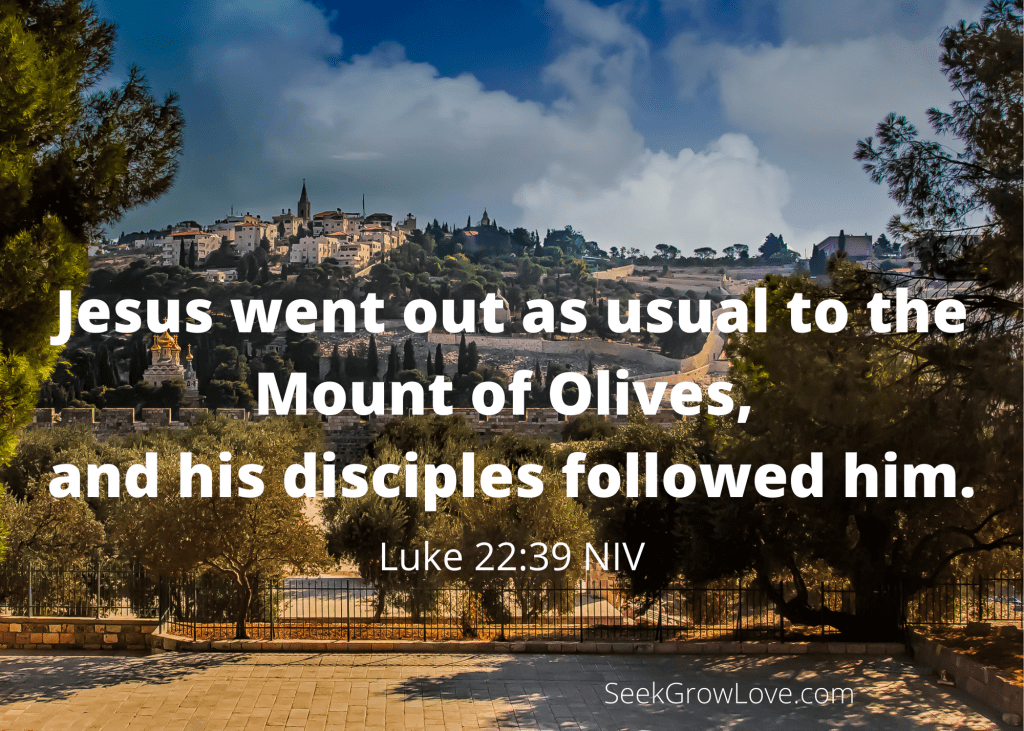
After Jesus finished the Passover meal with his disciples, he retreated to the Mount of Olives, which is just outside of Jerusalem, to pray. While there, he was arrested by a crowd led by Judas, one of his own disciples. Jesus’s choice to stay at the Mount of Olives was significant for two reasons:
Jesus knew Judas would betray him.
In a previous conversation among the disciples, Jesus predicts that one of the twelve would betray him, even calling out Judas by name (John 13). The very night of the Last Supper, he makes a similar remark:
“The hand of him who is going to betray me is with mine on the table” (Luke 22:21).
Judas knew Jesus would be at the Mount of Olives.
During the week leading up to Jesus’s death, he and his disciples had spent every night at the Mount of Olives:
Each day Jesus was teaching at the temple, and each evening he went out to spend the night on the hill called the Mount of Olives” (Luke 21:37).
Judas surely knew where Jesus would be on this particular night, yet Jesus didn’t try to hide.
Instead, Jesus invited Judas to his table to eat dinner together.
Jesus stayed the night in the very place Judas knew he would be.
You and I were a lot like Judas. We were full of ugly thoughts, misguided intentions, mixed-up priorities, and shameful feelings. Jesus saw our filthy sin, yet he invited us into his presence to give us freedom from it. The greatest irony is that the person who knows our flaws best, loves us the greatest.
You are fully known, and yet you are deeply loved.
But God demonstrates his own love for us in this: While we were still sinners, Christ died for us. (Romans 5:8)
God is an epic story-teller. One trick up every story-teller’s sleeve is repetition, only each new repetition brings a new twist. The story in today’s chapter is titled, The Last Supper, implying that other suppers preceded it.
The first meal of this kind is found in Exodus; the Israelites were captive to Pharaoh in Egypt, who worked them ruthlessly. God sent a series of plagues to convince Pharaoh to let His people go, which would culminate in the death of all firstborn sons—people and livestock alike. To save the Israelites from this horrific plague, God gave specific instructions to Moses and Aaron:
“On that same night I will pass through Egypt and strike down every firstborn of both people and animals, and I will bring judgment on all the gods of Egypt. I am the LORD. The blood will be a sign for you on the houses where you are, and when I see the blood, I will pass over you. No destructive plague will touch you when I strike Egypt.” (Exodus 12:12-13)
The Israelites with the blood of the lamb slathered on their door frames were safe, as the angel of death passed over their houses. God ordered the Israelites to commemorate the day God saved Israel, and they did so every year.
Over one thousand years later, in the week leading up to Jesus’ death, Jesus celebrated Passover with his disciples in Jerusalem. This time, there was a new twist. Jesus gives new meaning to the emblems eaten that meal:
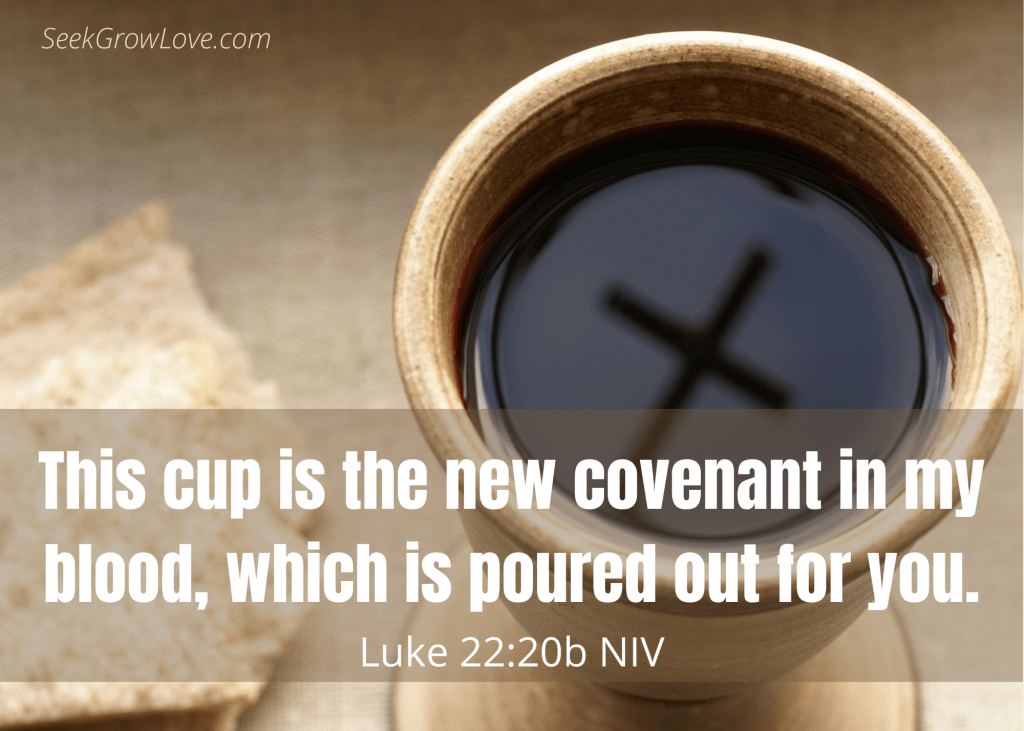
And he (Jesus) took bread, gave thanks and broke it, and gave it to them, saying, “This is my body given for you; do this in remembrance of me.” In the same way, after the supper he took the cup, saying, “This cup is the new covenant in my blood, which is poured out for you.” (Luke 22:19-20).
Jesus’s body was given for you, his blood poured out for you. His sacrifice marks a new covenant in which Jesus’ death atones for the sin of the world:
Behold the Lamb of God who takes away the sin of the world. (John 1:29)
Have you ever read a story in the Bible with a hint of jealousy, wishing you, too, could have witnessed that moment? I know I have. I had a seat at that table with Jesus, eating and drinking, hearing his wisdom, and honoring his upcoming sacrifice. The good news for us is that “The Last Supper” isn’t really Jesus’s last supper:
And he (Jesus) said to them (the disciples), “I have eagerly desired to eat this Passover with you before I suffer. For I tell you, I will not eat it again until it finds fulfillment in the kingdom of God.” (Luke 22:15-16)
It’s another feast with another twist. This time we’ll be eating and drinking in physical communion with Jesus, but in the Kingdom of God. I am excitedly awaiting that day, but in the meantime we have the honor of commemorating Jesus’ sacrifice regularly through Communion. The next time you take Communion, do it in remembrance—and in sweet anticipation—of all Jesus has done and is yet to do.
My young cousin got a bag of sour gummy worms for Christmas this past year. The following week, he carried the bag along everywhere he went, proudly savoring each lick. He loved those sour gummy worms! At the end of the week, he tried to give me his precious worms; of course, I declined because I don’t delight in stealing candy from children. As he was leaving my house, he hid the candy in my bedroom because he wanted me to have them. He didn’t have much to give, but he gave all he had and did so sincerely.
Luke describes a similar encounter Jesus had with a poor widow at the temple:
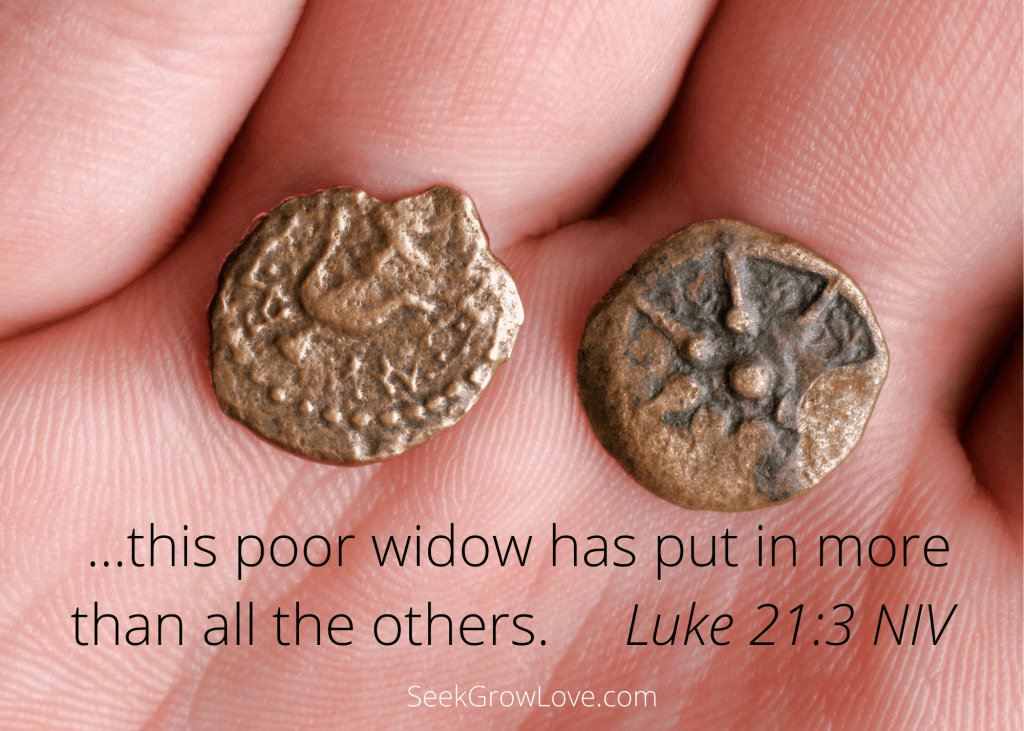
As Jesus looked up, he saw the rich putting their gifts into the temple treasury. He also saw a poor widow put in two very small copper coins. “Truly I tell you,” he said, “this poor widow has put in more than all the others. All these people gave their gifts out of their wealth; but she out of her poverty put in all she had to live on.” (Luke 21:1-4)
We know three things about the woman mentioned: she was poor, she was a widow, and she gave a small amount of money to the church. Her story isn’t flashy and her name isn’t even mentioned. Yet, she honored God by giving the little she had. And you know what? Jesus said her gift was greater than all the others.
Jesus had spent the past day discussing the intricate details of religious rules and hypothetical situations. They were concerned with religion, but perhaps not the conditions of their hearts. Their attitudes are juxtaposed by the poor widow whose heart was generous and faithful. By the world’s standards, the poor widow’s actions were foolish. She should have used the money to feed her family and allowed the Jews with more money to support the church. In God’s eyes, her giving was a reflection of her faith, and I am sure her family didn’t go hungry that night.
To be clear, God doesn’t need your money—neither your time nor gifts.
I could have bought my own bag of sour gummy worms at the gas station down the street. In the same way, God can accomplish anything and everything by his own accord. However, He still wants your sour gummy worms, copper coins, and anything you have to give.
God wants your trust.
God wants you to participate in the mission of the Church.
God wants to bless you.
-Mackenzie McClain
Today’s Bible reading passages can be read or listened to at BibleGateway here – Deuteronomy 25-26 and Luke 21
Remember the king that was greeted with palm leaves and shouts of hosanna yesterday? Today, we see him bombarded with questions meant to entangle him. The religious elite were threatened by Jesus—by his growing popularity, his radical views of religion, and his claim to be the Messiah. The teachers of the law and Pharisees tried to make Jesus stumble.
Keeping a close watch on him, they (the teachers of the law and chief priests) sent spies, who pretended to be sincere. They hoped to catch Jesus in something he said, so that they might hand him over to the power and authority of the governor (Luke 20:20).
The religious elite were trying to make Jesus stumble through an intense line of questioning, just like the lawyers do to criminals on TV. Of all the questions thrown in Jesus’ direction, I find this question most interesting:
Is it right for us to pay taxes to Caesar or not? (Luke 20:22)
It’s a lose-lose question. If he sided with Caesar, he would be in trouble with the Jews; if he sided against Caesar, he would be in trouble with the Romans. Instead of pleading the fifth or requesting to see his lawyer, he answered with the perfect solution. Since it’s Caesar’s image on the denarius, that is to be given back to Caesar. However, whatever is God’s should be given back to God.
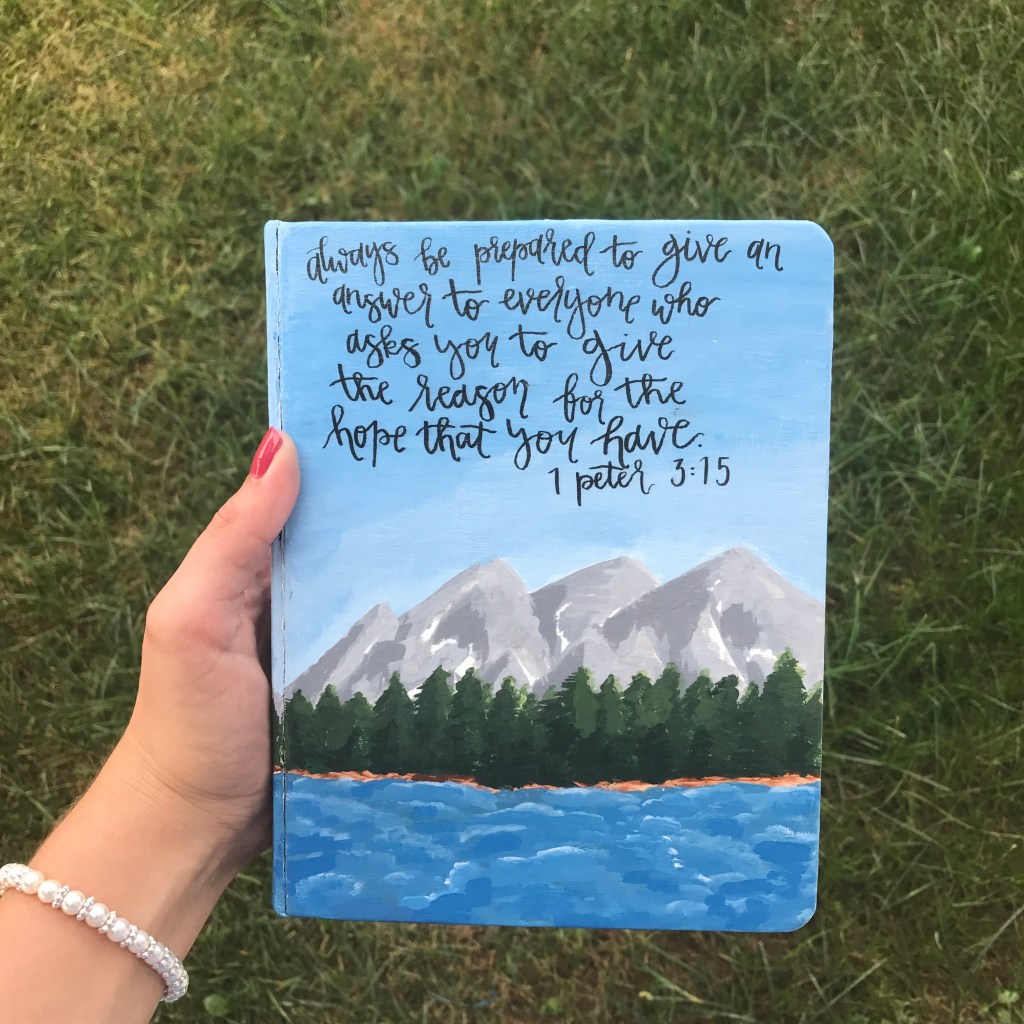
His answer is so profound yet simple that it literally silences the crowd—better than any answer given by a fancy attorney on TV. Jesus spent the first thirty years of his life preparing for interactions like this one. He was so in tune with God’s spirit that the perfect words just seemed to flow out of his mouth effortlessly. In the same way, we should prepare ourselves to answer tough questions and defend our faith—this includes praying for wisdom and understanding, studying truth, and committing scripture to memory. As a reminder of just that, I painted the following verse on the cover of my Bible:
Always be prepared to give an answer to everyone who asks you to give the reason for the hope that you have (1 Peter 3:15).
Paul likens scripture to a sword, but we must wield it well in order to enact its power. Every time I open my Bible, I want to grow more confident in my faith so that I can rise to the defense of it and share it with others.
How will you build up your defense?
-Mackenzie McClain
Today’s Bible reading passages can be read or listened to at BibleGateway here – Deuteronomy 23-24 and Luke 20
I love to plan parties! I’m usually up late the night before a big party getting all the details just right—making signs, assembling favors, and arranging decorations. Meanwhile, my God plans parades centuries in advance! He planned the famous parade we commemorate each year on Palm Sunday: Jesus’ triumphant entry into Jerusalem.
Daniel received a vision about Jesus’ journey to Jerusalem, about 600 years before it was to happen:
“Know and understand this: From the time the word goes out to restore and rebuild Jerusalem until the Anointed One, the ruler, comes, there will be seven ‘sevens,’ and sixty-two ‘sevens.’” (Daniel 9:25)
It’s important to note that the ‘sevens’ described by Daniel are each periods of seven years. The math makes my head spin (not everybody used the same calendar back then… talk about confusing!), but historians have found Daniel’s vision astonishingly accurate. The time between the issue to rebuild Jerusalem went out (Nehemiah 2) and Jesus’ triumphal entry into Jerusalem is just as God said it would be, to the very year. God’s timing is perfect and His plans always prevail.
In the book of Zechariah, the world’s best party planner gives even more insight into how this day would unfold:
“Rejoice greatly, Daughter Zion! Shout, Daughter Jerusalem! See, your king comes to you, righteous and victorious, lowly and riding on a donkey, on a colt, the foal of a donkey.” (Zechariah 9:9)
And so it came to be—Jesus rode into Jerusalem on a donkey. The gospels contain several descriptions of that bitter-sweet day—Matthew 21, Mark 11, Luke 19, and John 12. Up until this point, Jesus kept his status as the begotten Son of God a secret, urging his disciples not to reveal his identity to anyone (Matthew 16:20). On that day, however, his disciples shouted among the masses, “Blessed is the king who comes in the name of the Lord!” (Luke 19:38). In that same city, in that same week, the cries of “Hosanna!” would turn into shouts of “Crucify!”
As we wave our palm leaves at church this morning, remembering Jesus’ triumphal entrance into Jerusalem years ago, let us also remember the parade still to come. Close your eyes and imagine the grandeur of Jesus’ second coming—the roar of the trumpets, the raising of the dead, and the overwhelming noise of centuries worth of believers worshipping at the feet of Jesus. No more death, no more crying, no more pain:
And I saw the holy city, new Jerusalem, coming down out of heaven from God, prepared as a bride adorned for her husband. And I heard a loud voice from the throne saying, “Behold, the dwelling place of God is with man. He will dwell with them, and they will be his people, and God himself will be with them as their God. He will wipe away every tear from their eyes, and death shall be no more, neither shall there be mourning, nor crying, nor pain anymore, for the former things have passed away. (Revelation 21:2-4)
God’s timing is perfect and His plans always prevail. 2,000 years ago Jesus journeyed to Jerusalem to die. Soon he will return to Jerusalem again to bring life everlasting.
Hosanna in the highest!
-Mackenzie McClain
Today’s Bible readings can be read or listened to at BibleGateway here – Deuteronomy 21-22 and Luke 19
I’ve already confessed to you that I like to hang on to things (see Sunday’s devotional thought for reference), so I might as well let you know that something else I’ve kept from my past is a set of mixed tapes I created when I was in high school.
Cassette tapes predate CDs for those of you who aren’t familiar with the old school technology. And before iTunes, if we wanted recordings of our favorite songs, without actually buying the music artist’s tape, we had to have a tape player with a recording feature and sit and listen to the radio and wait for the song to eventually come on. The worst was when the DJ would continue talking as the song started – this just meant that we cut off part of the song, deal with the DJ talking, or wait until the song played later in the day.
But eventually, we ended up with customized playlists of all of our favorite songs. And why I’ve kept them up until this point seems silly…I no longer have a tape player to listen to them with.
You might be wondering why I am sharing all this with you…
As I read through Deuteronomy 11 and 12 today, verses 2 and 7 caught my attention. Moses is continuing to let the Israelites know what is expected of them as they prepare to cross the Jordan and enter the Promised Land.
He wants them to realize that it was them, his audience, not their children, who experienced first hand “the discipline of the LORD your God; his majesty, his mighty hand, his outstretched arm…” (Ch11 v2)
Multiple times through scripture the recounting of God’s greatest acts of saving the Israelites from the Egyptians is recorded, much like listening to my mixed tape over and over again.
I suppose I have kept my tapes as a way to share with the generations who will follow me about the awesome music of the 1990s.
In the same way, I have stories of my own that I can share with today’s youth about the amazing acts that God has performed in my life.
And it’s not just a way to pass the time, but sharing our testimonies is actually a responsibility that we have. It’s a way that we teach one another about God’s provision and goodness. It’s a way that we can encourage one another through difficult circumstances. It’s a way that we can pave a path of hope for what’s to come.
Sharing how God has impacted YOUR life can dramatically influence the lives of others. So do not hesitate to pull out the oldies and goodies of God’s greatest hits in your life. Tell others your testimony, for “it was your own eyes that saw all these great things the LORD has done”.
-Bethany Ligon
You can read or listen to today’s Bible reading passages at BibleGateway here – Deuteronomy 11-12 and Luke 14
There is so much we haven’t covered in this past week. Just today both the Queen of Sheba and Beelzebul get mentioned in the span of a few verses. And we never even touched on Numbers or Deuteronomy. But today I want to touch on two things in chapter 11 that I hope will encourage you through the end of lent up to Resurrection Sunday.
The first is the hope in the good gifts from our Good Good Father. Jesus teaches that reluctant friends are willing to help to persistent demands. I’m a dad; I understand the power of persistent asking! But if my precious (and slightly precocious) daughter asks me for a unicorn, I’m not going to give her a spider. If she wants a PB&J, I won’t give her rotten ham and toe jam. I know what she wants and I WANT to give her gifts, because it brings her joy.
God wants to see that joy on your face. He is willing to give you his Spirit. God’s Spirit is a powerful, active, guiding, teaching, comforting, and encouraging reality for the church. Called the comforter, the advocate, the Spirit of truth, the Spirit, though mysterious, is how God wants to interact with and empower you for his ministry and for your living. All you have to do is ask, and God is ready to give you this great gift.
At the other end of the chapter, after Jesus thoroughly ticks off the scribes and pharisees for a majority of the chapter, we read that the Pharisees “began to get hostile” and were “plotting to catch him” in his words. But I want you to remember 9:52. Jesus set his face toward Jerusalem. He is walking there on purpose. While we could try and analyze God’s sovereign control versus human free will in a passage like this, I think there is something more life changing than that. God’s smart enough to work out all things for the good of his people. Jesus knows where his story leads; God is going to use human pride and sin to erase sin and pride. He is going to use the taking of life to bring about eternal life. He is going to transform the pain of this world into joy of the next. Think about that. These leaders think they are taking out a revolutionary “rabbi of the people” who has wounded their egos. Satan is stoking the flames of pride and stubbornness because he wants to take out the Messiah. But God is using all of this in his plan to save humanity.
Today, when life feels out of control, or overwhelming…
When you are stressed, depressed or obsessed…
When you don’t know where to go, what to do, or how you’ll get through…
Ask God for the Spirit. To empower you. Embolden you. Comfort you. Teach you. Guide you. Speak through you.
And he will pour it out.
Ask God to work all his for your good. Ask your dad to help. Your wise father to work things out in ways you don’t or can’t see. And believe he is already working. Not every pain will end. Sometimes victory is shaped like a cross. But, the end will be a world made better by you, a world blessed by you, and you blessed by the God over all things. Eternal life and eternal peace, in the presence of God, through the death of Jesus, by the power of the Spirit.
God be with you during these final days of Lent and Easter.
-Jake Ballard
—————————————————
Jake Ballard is pastor at Timberland Bible Church. If you’d like to hear more from him, find Timberland on Facebook (https://www.facebook.com/TimberlandBibleChurch/ ) and on Instagram (https://instagram.com/timberlandbiblechurch?igshid=t52xoq9esc7e). The church streams the Worship Gathering every Sunday at 10:30 and Sunday School at 9:30. Besides studying and teaching God’s word, he is raising three beautiful children with the love of his life, plays board games and roleplaying games with amazing friends weekly and tries and fails to be less nerdy every day. If you’d like to reach out to talk Bible, talk faith, or talk about Star Trek, look Jacob Ballard up on Facebook (https://www.facebook.com/jacob.ballard.336 )or email him at jakea.ballard@yahoo.com.
God bless you all!
Read or listen to today’s Bible reading passages at BibleGateway – Deuteronomy 5-6 and Luke 11
Today, the scene is set in Martha and Mary’s home. Jesus has set his face toward Jerusalem, and this story is propelling his journey to the cross. Mary and Martha, sisters, are arguing, as sisters do. Martha has invited Jesus and his crew of AT LEAST twelve hungry men (possibly more if some of the seventy or seventy-two disciples have come along) over for dinner. She’s got a lot of social pressure placed on her, because to have people in her home and NOT feed them, and feed them well, would look bad on her whole family. It would be shameful.
And Mary is just sitting at his feet.
Martha, rushing, busy, sweating, harried.
Mary, content, lounging, comfortable, relaxed.
I feel for Martha. “LORD, don’t you care that my sister isn’t working as hard as I am” she says in frustration, with slightly gritted teeth. “She isn’t serving you the way that I am, isn’t trying to be as good for you as I am! TELL HER TO GET UP AND HELP ME!” Of course she is troubled, worried, bothered, anxious.
We are all Martha. We are all so worried. So anxious and bothered. So troubled.
But Jesus just calls out to her, to us. “Martha, Martha…” Can you hear the compassion when he says her name? When he says your name? You are so busy, so laden down with cares and concerns, with worries, about how you will succeed, how you will make sure everyone is taken care of, how you will serve. But Jesus isn’t worried about all that. He calls out to you and says something beautiful.
There is only one thing necessary. It’s the good thing that Mary chose, to sit at his feet, listen to him, rest in him, love him.
Will you choose the good?
Is that your one thing? Do you want to serve, to prove how strong, and powerful, and mighty, and good, and honorable you are? Or are you willing to sit at the feet of Jesus, to learn from him, grow from him, but most of all love and rest in him? To be sure, there is a time to serve. Jesus is in the room teaching how to live. But, will you listen to his words? We can get so busy “serving him” we don’t actually hear what he says. There are those casting out demons and performing miracles who don’t know the Lord, and whom the Lord doesn’t know (see Matthew 7).
The one that is necessary, listening to the words of Jesus and resting in him, give our service purpose and grounding.
Will you choose the good?
Will you choose to rest in the one whose yoke is easy, whose burden is light, who will give your soul rest?
Will you choose the good?
Jesus, primarily, calls us to himself. There will be a time for service, but the first and foremost command is to be with him, in peace and rest. Are you listening to that call? For some of us, the command to “come and die” is terrifying. But for some of us, “come and rest” is worse. We have to admit that we are not superheroes, no matter what we tell ourselves. We might just be people, like everyone else.
Will you choose the good?
Jesus gives us rest. This is the upside down kingdom we receive when we have a relationship with Christ. We take up his work so we may rest. We serve with him so we may reign with him. We take in his death so that we may live.
Will you choose the good?
-Jacob Ballard
Read or listen to today’s Bible reading passages at BibleGateway – Deuteronomy 3-4 and Luke 10
I enjoy video games. I could bore you with my digital adventures during quarantine, but I’d like to focus on a much more recent experience. I was playing a game that came out recently, and loving it. At one point a warning came up : “This is your last chance to purchase any gadget or suit upgrades. Do you wish to proceed?” I had an experience in the past when the game didn’t warn me we were in the final stages. So I backed up, upgraded, and went into the end game in full force.
Most people don’t have a moment like that. Very few have been able to determine when the “end” of their life was going to begin.
Jesus isn’t most people.
In Luke 9:51, we read a powerful phrase. “When the days drew near for him to be taken up, he set his face to go to Jerusalem.” The phrase “set his face” is sometimes rendered as “He was determined” or “he set out for”. While both of these translations have merit, I like the “wooden” translation of “set his face.”
“He was determined” feels a little passive. He made a decision to take steps to go to Jerusalem.
“He set out for” however, makes it feel as if he started to power-walk all the way to Judea.
Instead, he set his face. We aren’t even halfway through Luke telling of Jesus’ life, but we begin to see that everything that happens from here on, Jesus is doing with his endgame in mind. Every healing he performs is done with his face looking at Jerusalem. Every teaching he gives ends with him setting his face back to Jerusalem. Every step he takes, north, south, east or west, takes him one step closer to the Place of the Skull. Every healing he performs puts him one step closer to the scars across his back. Every breath of teaching he pours out gets him closer to the last breath of this life.
And it gets him closer to the ascension. To the life beyond death. To the glory after humilation. Every breath he breathes gets him closer to new breath, new Spirit filling his body. Every healing he performs puts him one step closer to a body, unbroken and healed. Every step he takes takes him one step closer to the Mount of Olives, and the ascension to the Throne of God.
That’s a good end game.
So when Jesus teaches anything in the rest of Luke, consider that he thought it was important enough to say as he walked his final days on Earth. Whether he was teaching and loving Mary and Martha in their own home, correcting the Pharisees about their view of sinners and tax collectors and the God who loves them in Luke 15, or teaching about the End Times in Luke 17, every event and teaching of Jesus are the ones that gained his attention after he “set his face” to go to Jerusalem.
Let this devotion urge you to reconsider how we read these words today. Don’t read Luke as another item on your busy checklist. But hear them as the words of Jesus that they are, pouring over you, through you and into you, and let them change you today. As we move ever closer to Easter, may we read Luke and set our own faces toward Jerusalem.
-Jake Ballard
You can read or listen to today’s Bible passages at BibleGateway – Deuteronomy 1-2 and Luke 9
Jesus is not know for being particularly easy with his teaching. It can be just plain difficult.
Sometimes the teachings are easy enough to understand but hard in their application. We know what Jesus said about enemies. He didn’t mince words or obfuscate. Love them. Full Stop. But, when you have an enemy, you don’t WANT to love them. If you HAVE to love them, then you CAN’T hate them, and in the darkest parts we want to hate some people. But Jesus came to shine a light into even those parts and to change them. So, love (wish and seek the best for) your enemies and pray (bring their needs, cares, and burdens before God) for those who persecute you. That is hard.
Other times Jesus doesn’t seem to make a ton of sense. A lot of the people in John 6 stopped following him because he said, “You have to eat my body and drink my blood.” And today we can say, “Oh yeah, he was talking about communion.” But THEY didn’t know that. There is a rabbi talking about eating a person and drinking his blood, and they are just thinking about the number of Torah laws and cultural traditions they would have to break. But mostly, they would be thinking “WHAT?! WHY?! What is he on about?” Maybe we shouldn’t be so quick to judge. But they didn’t seem to get it, because his mission wasn’t complete yet.
And sometimes, the teaching is BOTH hard to understand and seems difficult in the day-to-day living.
Luke 8 is full of them. Why does Jesus, who is so insistent on US spreading the Kingdom message to all corners of the world, teach with hiddenness? Why does he say, “Go into all the world” and tell everyone to keep it quiet? Why does he teach in parables, so that the crowds would be confused? I could give an astute scholarly answer, that references the nature of prophecy and the different purposes for the mission of Jesus and mission of the church, but in the end it is a head scratcher. It feels weird. It feels hard. It weighs on me.
Nothing weighs heavier on me from this chapter than Luke 8:18. As a reminder: “18 So take care how you listen; for whoever has, to him more shall be given; and whoever does not have, even what he thinks he has shall be taken away from him.” That’s a hard one! Why should the rich get richer and the poor get poorer? Is that what Jesus is saying?
Though the questions are important, there are times for answers. And of course that is not what he is saying.
Jesus has just finished saying that a light will not bet covered up but put on a lampstand, and how everything will be disclosed and made known. He has been speaking about the knowledge of the Kingdom, the Gospel, the Word of God, the Knowledge of God, the Logos of God, up to this point. So the question we need to answer is “whoever has what?” Whoever has a desire and thirst to learn the things of God. Whoever has a desire to serve Jesus. Whoever has a desire to follow him where he leads. Whoever, once the lamp is lighted, wants to see it in its fulness. THAT person will be given more. They will actually acquire the knowledge they are looking for. They will be equipped to serve. They will be empowered to follow. They will see the light, and it will fill them up, all the way from the inside out.
But whoever does not have those desires…
Well, what little power, strength, might, authority, ability, talent…
It’ll be taken away.
It’s a hard teaching. But it makes sense. Jesus comes to offer life. If we don’t want life, we don’t get it. It’s not forced upon us.
You may be wondering, “But right now I don’t want it. I am reading because it’s a habit I can’t break. I am reading while crying because I want it to be true but can’t pull out that belief in me.” Welcome to the Christian Faith, where desires like that have existed beside the “most devout” since the dawn of the church! Ancient Christian authors wrote statements like (and forgive the modern paraphrase) “I don’t want God, but I want to want God.” Even a man declared to Jesus “Lord I believe, help my unbelief.” Maybe you have believing unbelief, or unbelieving belief. Maybe you want to want God. Or want to want to want him.
Jesus can work with that glimmer.
Because in the end he will work with us on all the hard passages, on the ones that weigh on us, on the things that are hard to understand and hard to live out.
The promise from scripture is that, if you let him work, “He will finish the good work he began in us.”
Jesus will give you understanding and peace when you don’t.
Jesus will give you the skills and ability for service.
Jesus will give you power to follow.
Do you want him to? Do you want to want him to?
-Jacob Ballard
Today’s Bible reading can be read or listened to at BibleGateway – Numbers 35-36 and Luke 8