Still gathered around the table in the upper room—the same table where the last Passover meal was shared—Jesus gives his disciples a series of encouraging remarks. One such remark has left many Biblical Unitarians scratching their heads:
“Believe me when I say that I am in the Father and the Father is in me” (John 14:11a).
What does he mean… in? Jesus in the Father? And the Father in Jesus?
I teach English to sixth graders for a living, so I’m well aware of how tricky prepositions can be. In, the supposedly simple, two-letter word, has 18 different usages according to the Oxford dictionary. Now consider we’re reading the translation from the original Aramaic words Jesus spoke to Greek to English, which has muddled the meaning even further.
Fortunately for us, Jesus uses similar language just a couple pages later, in John 17:
“My prayer is not for them alone. I pray also for those who will believe in me through their message, that all of them may be one, Father, just as you are in me and I am in you. May they also be in us so that the world may believe that you have sent me” (John 17:21).
“I have made you known to them, and will continue to make you known in order that the love you have for me may be in them and that I myself may be in them.” (John 17:26).
In these passages, in refers to a tight bond. The intimate relationship between God and Jesus is available to you, too. You can have close communion with the church body, with Jesus, and with God himself.
Now, it’s clear that Jesus wasn’t pointing to a trinity, but a… billionity. Okay, I made that word up (I have an English degree, so I get to do stuff like that). Through Jesus we have unity with God and unity with each other—with all the believers on earth. We’re perfectly bound together with love.
In love.
Jesus is the glue that holds us all together. He takes a billion broken people and makes us Church.
From him (Jesus) the whole body, joined and held together by every supporting ligament, grows and builds itself up in love, as each part does its work (Ephesians 4:16).
-Mackenzie McClain
Discussion & Reflection Questions:
Why did Jesus place such high importance on Church? What can we accomplish together that we cannot do on our own?
Are you doing more than just sitting in the same row with people at Church? How are you, personally, contributing to the mission of the Church?
Thank God for your Church family. Pick a few fellow members and send them a card or a text, telling them of the impact they’ve made on your life.
Do the people you pass in your daily life know that you follow Jesus? Your coworker in the adjacent cubicle, the cashier at the grocery store, your neighbor down the street? How do they know? It’s probably not the length of your prayers, the Bible verses you have memorized, the fancy church jargon you use, or the gourmet casseroles you bring to your church potlucks.
They will know you by your love.
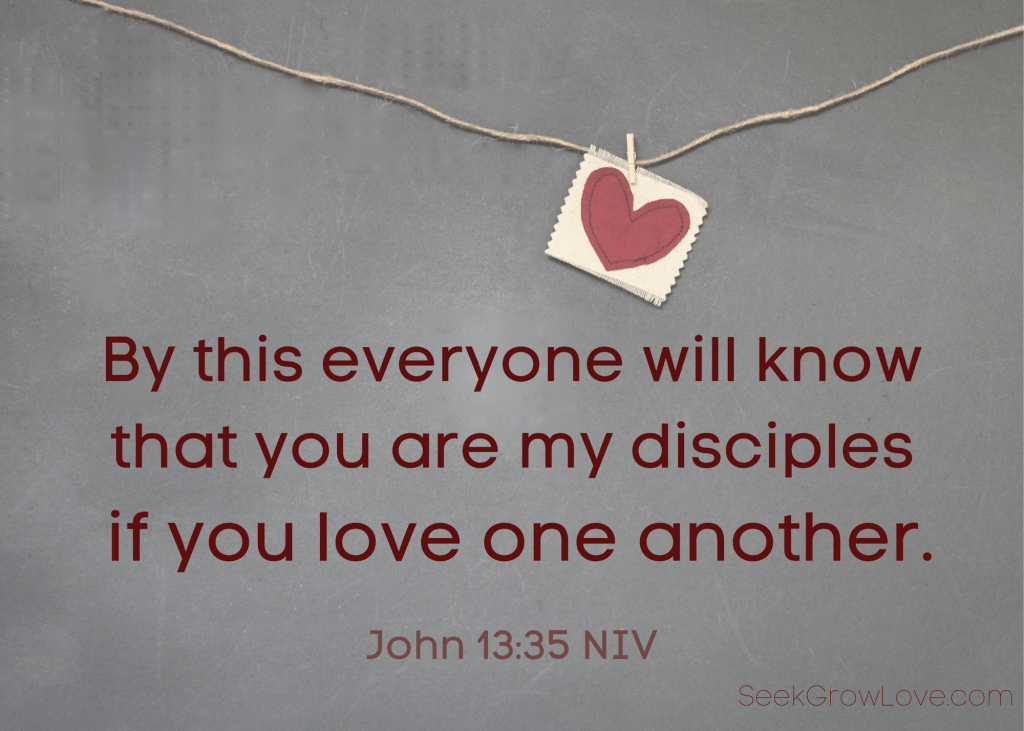
“A new command I give you: Love one another. As I have loved you, so you must love one another. By this everyone will know that you are my disciples, if you love one another” (John 13:34-35).
Following Jesus isn’t about knowing the most, but loving the most.
Love is our faith in action. It might not always make sense to unbelievers, especially in the midst of our self-obsessed culture.
Love your enemies and pray for those who persecute you (Matthew 5:44).
Sell your possessions and give to the poor (Luke 12:33).
Honor one another above yourselves (Romans 12:10).
Look after orphans and widows in their distress (James 1:27).
Carry each other’s burdens (Galatians 6:2).
We ought to lay down our lives for our brothers and sisters (1 John 3:16).
When we love—even when it doesn’t make sense—we show our allegiance to Jesus. He is the perfect personification of love. This week, we celebrate the love he showed on the cross, where he bled and died to win your heart, where he was scoffed at by a world who couldn’t make sense of such great love.
If we’re followers of Jesus, we’ll do as Jesus did. We’re called to pour even when our cup is empty, to give when it hurts, to expect nothing in return, and to lay down our lives for others. By this, the world will know you belong to Jesus.
-Mackenzie McClain
Discussion & Reflection Questions:
Who will you show this nonsensical love to this week? How will you do it?
Loving others cost Jesus his life. What might loving others cost you?
By being known as a follower of Jesus, people will make assumptions about who Jesus is based upon how they see you act. What implications does this have for how you live your daily life?
The next day the great crowd that had come to the festival heard that Jesus was coming to Jerusalem. So they took branches of palm trees and went out to meet him, shouting,
“Hosanna! Blessed is the one who comes in the name of the Lord— the King of Israel!”
John 12:12-13
The headings in our Bibles weren’t original to the text. I’m not sure who came up with the name “Triumphal Entry” for the portion of text we’re going to look at today, or when it was so titled, but it begs some questioning.
Triumphal implies the celebration of a great victory or achievement. And while on this day, crowds lined the streets with palm branches and shouted praises to him; within days of the hosannas, the crowd turned ugly, demanding His crucifixion.
You see, the people shouting ‘Hosanna’ had false expectations. They expected Jesus to restore Israel to its former glory, to establish God’s earthly kingdom with them at the top. What they didn’t know was that the true enemies that had to be defeated were not the Gentiles, but rather sin and death. And this could not be done on a white horse and with great armies. Instead, it took humility, a willingness to take the form of a servant and submit to the punishment that God’s people deserve for their sin.
Paul describes this perfect picture of humility in Philippians 2. He says that Jesus, “emptied himself, taking the form of a slave” and that he “humbled himself and became obedient to the point of death – even death on a cross.”
Throughout Scripture we find that humility is the path to victory and exaltation. We don’t expect to find real strength in those who are humble. But God has a way of turning our expectations upside down. He has a way of showing his glory through things we revile.
As we near our Easter celebrations, let’s prepare our hearts by seeking humility in our own life. Let’s also seek to see Jesus as he really is. Immediately after He ascended into heaven in Acts 1:9, he was seated at the right hand of the Father. He was triumphant over sin and death, he lives in triumph now, and he will return one day to triumph forever over the evil of this world.
That is something to celebrate.
-Susan Landry
Questions for Reflection and Discussion:
Do you ever think about asking God to correct you if you’re wrong in any of your beliefs?
How can we grow in humility?
Look up the following verses about Jesus being seated at God’s right hand and discuss: Colossians 3:1, Ephesians 1:16-21
Have you ever questioned God’s timing? How about feeling like maybe God isn’t as concerned about you as you wish he was? Have you ever felt let down by him?
Martha, Mary and Lazarus were friends of Jesus. They knew that he was tuned into God’s will and that he was God’s Messiah. So when Lazarus fell seriously ill his sisters sent for Jesus. Instead of coming right away, Jesus waited days to come. He said,
“This illness does not lead to death; rather it is for God’s glory, so that the Son of God may be glorified through it.”
I have to wonder if, when they found out that Lazarus had died, if anyone who heard him say that questioned. Could Jesus have been wrong?
When he does finally arrive, Martha said to Jesus, “Lord, if you had been here, my brother would not have died.” Mary expresses the same disappointment. We’re told, When Mary came where Jesus was and saw him, she knelt at his feet and said to him, “Lord, if you had been here, my brother would not have died.” They must have felt a bit abandoned by him in that moment.
But I have to imagine that their joy, their utter amazement, when he raises their brother from the dead had to trump whatever disappointment they had felt. In THAT moment, they knew that Jesus was perfectly attuned to his Father’s timing.
In Isaiah 55:8-9 God tells us:
For my thoughts are not your thoughts, nor are your ways my ways, says the LORD. For as the heavens are higher than the earth, so are my ways higher than your ways and my thoughts than your thoughts.
Maybe you’ve questioned God’s timing in those situations where you just know what needs to happen for things to work out. Maybe you’ve had things not work out the way you had planned, or hoped, they would.
The thing about God is that we can trust him even when we don’t understand.
-Susan Landry
Questions for Reflection and Discussion:
Martha and Mary were Jesus’ friends, and they addressed him pretty directly when he shows up after their brother died. Does it seem that Jesus is mad at them for sharing their disappointment, their not understanding, with him?
Do you think we can tell God that we are disappointed with him, or do you think that is inappropriate?
When you are unsure of God’s timing in a situation in your life, what are some ways you can surrender that to him and trust him in the midst of your uncertainty?
If I am not doing the works of my Father, then do not believe me. But if I do them, even though you do not believe me, believe the works, so that you may know and understand that the Father is in me and I am in the Father.
John 10:37-38
In chapter 10 we get to see Jesus once again being challenged by the Pharisees. His reply here reminds us that our actions matter more than our words. He tells them that since they don’t believe his words, to judge him by his actions.
This mirrors what Jesus said in Matthew 7:
Thus, by their fruit you will recognize them.
And also what we read in Proverbs 20:
Even a child makes himself known by his acts, by whether his conduct is pure and upright.
It also reminds me of this saying a friend shared with me several years ago:
I don’t trust words. I even question actions. But I never doubt patterns.
You see, people can lie with their words. They can even act in the ‘right’ way and mislead you…for awhile. Eventually, if we are looking for them, patterns reveal themselves.
Not only is this something we should be aware of and be watching for in others in order to live a discerning life; but also something that we should be aware of in our own life. I’m wondering if we could confidently say, “Even if you don’t believe my words, watch my actions. That will convince you.” Paul said something like that to the church in Corinth when he wrote:
Follow my example, as I follow the example of Christ.
After Jesus issues his challenge to the Pharisees and the others listening, we’re told that he goes away from them, but many people followed him to where he went. Then we’re told that:
And many believed in him there.
I guess his actions spoke for themselves.
-Susan Landry
Questions for Reflection and Discussion:
Discuss the idea of not trusting words, even actions, but watching for patterns. Why is this important?
Why is it so scary to think about telling people they could ignore our words and just watch our actions? Why do you think Paul was confident enough to say that?
Take some time to look for patterns in your own life.
Look for patterns that may reveal things you want to change.
Look for patterns that show positive traits that could point someone to Christ.
Jesus heals a man born blind with a spit-filled mudpie. Creative. Unexpected. A tiny bit gross.
Totally worth it though, I imagine, to the man who can now see.
What we’re going to focus on, however, is the reaction to this healing by the elite, the ultra-religious, the Pharisees. Because this man’s miraculous healing happened on the Sabbath, they’re a little put out. A lot, actually.
As they drill him for information about the person who healed him, he does pretty good holding his own:
“Here is an astonishing thing! You do not know where he comes from, and yet he opened my eyes.We know that God does not listen to sinners, but he does listen to one who worships him and obeys his will.Never since the world began has it been heard that anyone opened the eyes of a person born blind.If this man were not from God, he could do nothing.”
They answered him, “You were born entirely in sins, and are you trying to teach us?” And they drove him out.
What they’re really saying is, “Who do you think you are?”
Matthew Poole’s commentary captures the attitude of their statement in this interpretation of their words:
Thou that art such a marked villain from thy mother’s womb, or that art such an ignorant idiot, dost thou think thyself fit to instruct us about true and false prophets, who are of God, and who are not? Surely we are to be thy teachers, and not thou ours.
It’s an indignant attitude, definitely an attitude of pride, wouldn’t you say? But we’ve all been there. We refuse the information because we don’t like the source. Maybe it’s because we feel superior (like the Pharisees). Or perhaps we simply don’t like them.
This passage reminds me of another time we can see the Pharisees’ pride shine a spotlight on their shame.
Luke describes a time that Jesus was dining at a Pharisee’s home and a sinful woman anointed him. In chapter 7 it says that she was “at his feet, weeping, and began to bathe his feet with her tears and to dry them with her hair. Then she continued kissing his feet and anointing them with the ointment.”
The passage goes on to describe how Jesus puts the shocked and indignant religious crowd in their place. He tells them that “her sins, which are many, are forgiven—for she loved much. But he who is forgiven little, loves little.””
In both of these cases, we see beautiful examples of how Christ’s mercies are most valued by those who have felt the want of them. (Matthew Henry’s commentary on John 9:34)
There’s a song by Ten Shekel Shirt that captures this, I think. And it’s a good place to pause and reflect after this chapter.
I come to Your feet and weep Remembering how You changed me I kneel at Your feet humbly I pour out my love and my thanks
I am the one who’s been forgiven much I am the one who loves much
I sit at Your feet in peace Sensing a smile over me I’m here at Your feet gladly Giving my love and my thanks
Have you ever struggled to accept something as truth just because of the source? Why do you think that is? How can we be better at preventing this attitude?
Do you feel like you are someone who ‘loves much’ or ‘loves little’? If you’re unsure, pay attention to your actions, thoughts, and words for the next week and ask God to show you.
Re-read John 9:40-41. Restate Jesus’ words in a different way. What is he saying? What can we learn from his statement?
We’re going to primarily look at one verse from John 8 today. It’s a verse that offers us (perhaps) a small glimpse into Jesus as more than just the say-er of the fancy red words in our Bibles.
I love verses that give insight into what some of our beloved Bible figures were feeling. For example, some translations of Judges 14:7 tell us that a woman was ‘pleasing’ to Samson. But the NIV version (and some others) say, “Then he went down and talked with the woman, and he liked her.” It’s such a simple way to describe how he felt. No flowery language, just, ‘he liked her.’
John 8:25 isn’t quite that direct in expressing how Jesus is feeling, but still paints a picture we can relate to. Jesus has been talking with the Pharisees, and every statement he makes is countered with pushback and ignorant questions. It’s obvious that their intent is to trip him up or catch him in a mistake (unlikely). They are not really listening.
We’ve all had conversations with people who are listening only enough to pick our words apart, people who are looking for a debate more than understanding. Thinking about those experiences, perhaps you can hear the exasperation in Jesus’ voice in verse 25:
They said to him, “Who are you?” Jesus said to them, “Why do I speak to you at all?”
I can almost see Jesus doing a facepalm or simply quietly closing his eyes and shaking his head. Talking to people who aren’t genuinely interested in understanding is wearying.
I should note that some versions of the Bible translate this verse a bit differently. Your version may say:
“Who are you?” they asked. “Just what I have been telling you from the beginning,” Jesus replied.
I consulted a number of commentaries on the differences and what I found is best summed up by this commentary, which says, “the commentators are almost hopelessly divided.” All do seem to agree that regardless of which translation is correct, there seems to be some exasperation in Jesus’ reply.
And who could blame him?
-Susan Landry
Questions for Reflection and Discussion:
1 While we can probably think of times we’ve talked with others who are not genuinely interested in understanding what we have to say, it would be wise of us to also consider if we have ever been that person.
a. What types of conversations do you find yourself tuning out? Listening only to critique or correct? Or simply waiting for your turn to talk?
b. Are there things you can do to limit the frequency of this occurring?
c. Pray for God to soften your heart to seek to listen in order to truly understand the person who is talking.
2. Being a poor listener to people can damage our relationships. What about how well we listen to God?
a. Do you ever find yourself tuning out what you know God may be trying to speak into your life? Why do you think we do that?
b. What can we do to better position ourselves to truly listen to God?
Having attended Refuel north earlier this month, I’ve realized more than ever the importance of companionship in Christ. This is referenced in Genesis 2:18
“Then the Lord God said, ‘It is not good for the man to be alone; I will make him a helper suitable for him.’”
While this verse is more commonly used in the context of marriage, I think it works here as well. God knows it is not good for us to be alone, we need human interactions. We need friends that can hold us accountable, and support us always. That is a friendship only found in your brothers and sisters in Christ. God wants us to connect, to fellowship together, and to love each other.
-Julia Simon
Questions for Reflection and Discussion
Why do you think there are two accounts of creation – one in Genesis 1:1-2:3 and one in Genesis 2:4-25? What do they have in common? What differences do you see? What is emphasized in each account?
How is the Garden of Eden described? Where have you most enjoyed a paradise setting created by God? How would you describe it? What do you most appreciate about God’s creation? What work do you like to do (or would like to try doing) in God’s creation?
List as many reasons as you can why it is not good to be alone. Some might come from Scripture, some from personal experience or what you have seen in others.
How do you view being created as a helper? God is described many times as being a helper (for example, Psalm 115:9-11). In what relationships can you become more of a helper? How?
How one starts a story has quite a lot to do with how the rest of the story plays out.
Once upon a time…
A Long Time Ago in a Galaxy Far, Far Away…
It was the best of times, it was the worst of times.
It was a bright cold day in April, and the clocks were striking thirteen.
And my personal favorite in fiction:
Mr. and Mrs. Dursley, of number four, Privet Drive, were proud to say that they were perfectly normal, thank you very much.
Today we start the story of creation, and the first four words tell us quite a lot.
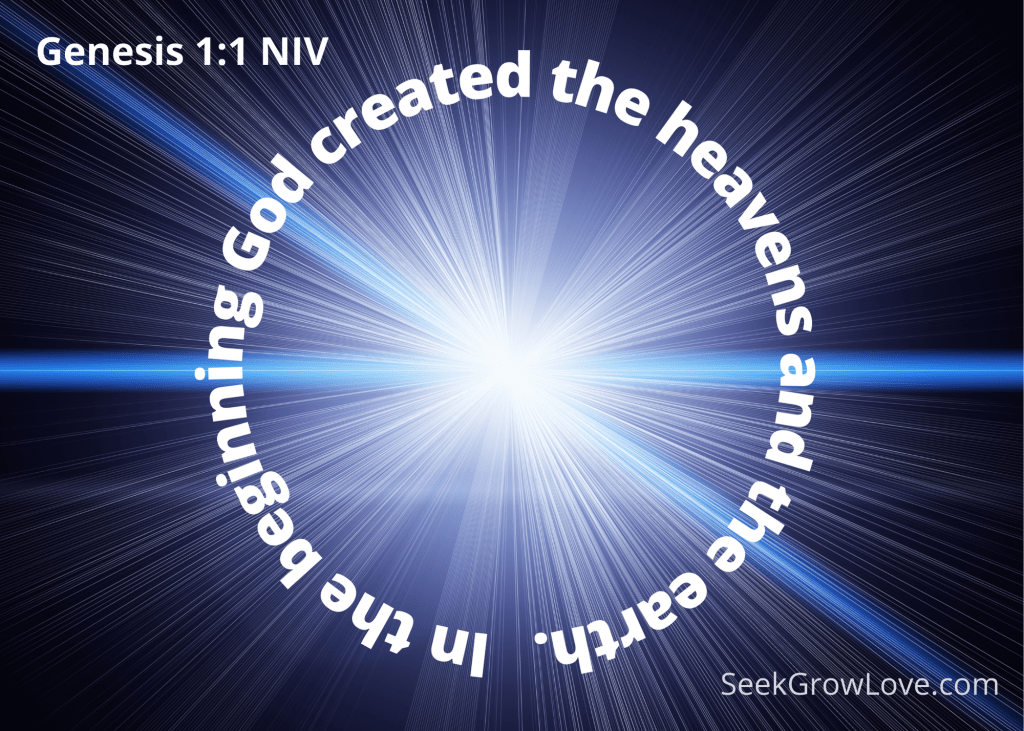
In the beginning God…
Anything and everything that comes next depends on this text and, as such, these words are fascinating.
Apologetics is an art form and a science. Apologetics means, simply, “defending ones faith,” and so Christian Apologetics is about giving reasons for why we believe anything we believe. Why do we believe the Bible is the word of God? Why do we believe Jesus is the Son of God and Messiah? Why do we believe God exists at all? These are good questions and it’s important that you have general answers to them.
But Genesis 1:1 doesn’t answer them. Genesis 1:1 assumed God is. There is no argument for or against him. There is no argument about other gods or goddesses, about how this book is his word versus other books that say conflicting things, nor does it defend the “contradictions”that some non-believers point out in the text.
Genesis 1:1 just says “God created.” Simple. Easy. Plain.
But of course, it is anything but simple and easy and plain.
I could spend quite some time talking about my own interactions with the text, trying to understand it and science at the same time. I could work to show you whether this text is poetry or narrative and how the text in chapter 1 relates to the order of creation in chapter 2. I could tell you that through strong but loving conversations with important people I have worked out the perfect explanation to the text. I could tell you exactly how you should read this text, end of story, done, nice and easy.
I could tell you that, but I won’t.
My own interactions with the text have been difficult.
People smarter than me read this text literally verbatim as the God’s-eye view of what happened in Genesis. Other people, still smarter than I, say “it’s a metaphor and symbolical account of creation and we need to understand how to read this literately.”
I have come to some strong conclusions but truthfully I hold them loosely because I know what a struggle it was to get to where I am, and I could change tomorrow.
The only thing I can tell you with certainty is that this text tells us with all seriousness that God is not a distant observer of space-time, nor one and same with the universe, but a powerful mover-and-shaper of all things by the word of his mouth.
And because the story starts this way, it changes how the rest of the story plays out. God makes light and calls it good, and the metaphor of light is good in the rest of Scripture. God calls for the earth to bring forth plants. He invites creation to participate with him in the creative act, it would seem. God makes the creatures of the ocean, from the great “tanninim”, which could be interpreted as sea monsters, whales, or dragons, worshipped by other cultures. God creates with his mouth the very things that others worship, because all things exist due to his will.
Speaking of the will of God for creation, that brings us to the most important part of Genesis 1 in our reading today.
Humanity is part of but also the fulfillment of creation. God not only makes us, but he makes us in his image. He not only invites us to participate in the creative act, but even invites, empowers, and also demands that we rule over creation. And this is not one man given this role, but humanity, the many as both male and female. We ALL are made in the image of God.
Whatever we think about Genesis 1, what we learn is that humanity is made in the image of God, meaning we have value and worth given by God which cannot be taken away. We learn that God created so that there would be a people who would love him, as Genesis functions are the precursor to the central story of the Old Testament, the Exodus. And we learn that when God looks at his creation, with humans in the midst of a world he lovingly called into being, he says it is
“Very Good.”
-Jake Ballard
Questions for Reflection and Discussion
How do you interpret Genesis One? I encourage you to accept church tradition/theology and challenge church tradition/theology, to accept scientific discoveries and challenge scientific discoveries. In both “church” and “science”, we find truth. But, we need to balance truth with wisdom, and see that much that comes from both “church” and “science” are interpretations and value judgments, rather than simple, plain truths. How will you continually seek to understand God’s word? Who do you turn to listen to about church tradition, theology, science and how to interpret each of those factors?
Even though Genesis One assumes the existence of God, and doesn’t try to argue for him but just proves him via his actions with his people, how do you answer the questions presented above? : “Why do we believe the Bible is the word of God? Why do we believe Jesus is the Son of God and Messiah? Why do we believe God exists at all?” What is your answer for your friend who might ask you any one of these questions. If you don’t have a ready answer, then are you “prepared to give an answer to everyone who asks you to give the reason for the hope that you have”?(1 Peter 3:15)
Too often we are told that humanity and all life is a cosmic accident brought about by the random chance of amino acids bursting forth into life in a hot pool of water millions of years ago (a bad interpretation of science, see above). However, this is not true. You are not a cosmic accident, but the keystone of God’s creative act. How does it make you feel that you are part of the final creation of God in Genesis One? Do you believe that God made this world and then declared that it is all very good? How can you honor the role to rule over creation that God has given you and how might you enjoy the very good creation of God this week?
We are happy to announce a NEW Bible reading plan for SeekGrowLove readers in 2022!
We are going to intentionally slow down and each day focus on just ONE Bible chapter. Through the year we will cover every chapter of the New Testament (reading one gospel in each season) and 105 chapters highlighting the best of the Old Testament, with at least one chapter from each of the books. Much thanks to Bob Jones, Old Testament instructor at Atlanta Bible College, for his invaluable help in selecting the Old Testament chapters we have included.
Print and share the printable reading plan attached below. Since we are intentionally slowing down and focusing on just one chapter a day it is a great time for new readers (individuals, families, youth groups, Sunday School classes, etc…). Readers will receive daily email devotions based on that day’s Bible chapter if they sign up as a subscriber at https://seekgrowlove.com/. Seek Grow Love can also be found and liked on facebook to read the devotions there.
An addition this year will be reflection and discussion questions at the end of every devotion which will help us further connect to God and His Scriptures on a personal level. Working through these questions can be very useful for personal contemplation or journaling. Also, they may be used within a mentor relationship or amongst accountability partners. Pray about who God may be prompting you to invite on a journey with you into His Word and His heart. And do you have kids at home – or church kids on your heart? With one chapter a day and discussion questions that can be used during family devotions or by a young person working through God’s word, this is a great opportunity to challenge yourself, your family, your youth class, your accountability partner to SeekGrowLove!








 Seek Grow Love