Paul’s Prayer: Strong Holy Hearts

TUESDAY

1 Thessalonians 3-13a

I Thessalonians 3

1Th. 3:1   Therefore when we could bear it no longer, we decided to be left alone in Athens; 2 and we sent Timothy, our brother and co-worker for God in proclaiming the gospel of Christ, to strengthen and encourage you for the sake of your faith, 3 so that no one would be shaken by these persecutions. Indeed, you yourselves know that this is what we are destined for. 4 In fact, when we were with you, we told you beforehand that we were to suffer persecution; so it turned out, as you know. 5 For this reason, when I could bear it no longer, I sent to find out about your faith; I was afraid that somehow the tempter had tempted you and that our labor had been in vain.


1Th. 3:6   But Timothy has just now come to us from you, and has brought us the good news of your faith and love. He has told us also that you always remember us kindly and long to see us—just as we long to see you. 7 For this reason, brothers and sisters, during all our distress and persecution we have been encouraged about you through your faith. 8 For we now live, if you continue to stand firm in the Lord. 9 How can we thank God enough for you in return for all the joy that we feel before our God because of you? 10 Night and day we pray most earnestly that we may see you face to face and restore whatever is lacking in your faith.


1Th. 3:11   Now may our God and Father himself and our Lord Jesus direct our way to you. 12 And may the Lord make you increase and abound in love for one another and for all, just as we abound in love for you. 13 And may he so strengthen your hearts in holiness that you may be blameless before our God and Father at the coming of our Lord Jesus with all his saints.


I highlighted Paul’s prayer at the end of this chapter. In several of Paul’s letters, he offers a prayer in the middle. In these prayers, he often prays about the things which he is about to write. In this prayer, after praying that God will make it possible for him to return to Thessaloniki, he prays three things for the Thessalonians:


  1. May they increase and abound in love for one another,
  2. May God strengthen their hearts in holiness.
  3. May they be blameless before God at the coming of our Lord Jesus.


Paul gives practical teaching on these three things in chapter 4 and we will be looking at his teachings on holiness in the remainder of these devotions this week.

-Greg Demmitt

 

Not As a Human Word

MONDAY

1 Thessalonians 2-13

Please read 1Thessalonians 2. My perspective in writing these devotions is that you are reading the scriptures. Nothing I write can be as important to you as what God can say to you as you read his word.


1Th. 2:1   You yourselves know, brothers and sisters, that our coming to you was not in vain, 2 but though we had already suffered and been shamefully mistreated at Philippi, as you know, we had courage in our God to declare to you the gospel of God in spite of great opposition. 3 For our appeal does not spring from deceit or impure motives or trickery, 4 but just as we have been approved by God to be entrusted with the message of the gospel, even so we speak, not to please mortals, but to please God who tests our hearts. 5 As you know and as God is our witness, we never came with words of flattery or with a pretext for greed; 6 nor did we seek praise from mortals, whether from you or from others, 7 though we might have made demands as apostles of Christ. But we were gentle among you, like a nurse tenderly caring for her own children. 8 So deeply do we care for you that we are determined to share with you not only the gospel of God but also our own selves, because you have become very dear to us.


1Th. 2:9   You remember our labor and toil, brothers and sisters; we worked night and day, so that we might not burden any of you while we proclaimed to you the gospel of God. 10 You are witnesses, and God also, how pure, upright, and blameless our conduct was toward you believers. 11 As you know, we dealt with each one of you like a father with his children, 12 urging and encouraging you and pleading that you lead a life worthy of God, who calls you into his own kingdom and glory.


1Th. 2:13   We also constantly give thanks to God for this, that when you received the word of God that you heard from us, you accepted it not as a human word but as what it really is, God’s word, which is also at work in you believers. 14 For you, brothers and sisters, became imitators of the churches of God in Christ Jesus that are in Judea, for you suffered the same things from your own compatriots as they did from the Jews, 15 who killed both the Lord Jesus and the prophets, and drove us out; they displease God and oppose everyone 16 by hindering us from speaking to the Gentiles so that they may be saved. Thus they have constantly been filling up the measure of their sins; but God’s wrath has overtaken them at last.


1Th. 2:17   As for us, brothers and sisters, when, for a short time, we were made orphans by being separated from you—in person, not in heart—we longed with great eagerness to see you face to face. 18 For we wanted to come to you—certainly I, Paul, wanted to again and again—but Satan blocked our way. 19 For what is our hope or joy or crown of boasting before our Lord Jesus at his coming? Is it not you? 20 Yes, you are our glory and joy!


I highlighted verse 13. We can ask ourselves, “how do I receive the word of God?” Do we see it from a human perspective, or is God speaking to us.


Let me add one thing right now. It’s likely that most of the people in Thessaloniki heard the word rather than read it. Only about 10 percent of the people could read. That means this letter was written to be read out loud. It also suggests that we might understand it better if we study it as a speech rather than a work of literature. For example, if we focus on the written word, we might spend a lot of time digging into the meaning of each word. If we take a rhetorical approach, meaning understanding it as a speech, we focus more on the impact of the words. Those who study rhetoric think that this letter sounds like a half-time speech given to a football team that is winning but needs to be encouraged to play hard in the second half. Paul doesn’t write as if the Thessaloniki Christians are messing up, but rather as if they need to be encouraged to keep doing the things that they have already been doing well.


Again we ask, “Do you hear this word as the word of the Lord?” What does it look like when someone hears the word of the Lord?


-Greg Demmitt

Let Me Introduce You to the Thessalonians

SUNDAY

1 Thessalonians 1-2,3

Acts 17:11  These were more noble than those in Thessalonica, in that they received the word with all readiness of mind, and searched the scriptures daily, whether those things were so.

This was one of my earliest memory verses. Back in that day, we called our youth group the Bereans because we searched the scriptures daily. That’s certainly a good idea, but the verse gives the Thessaloniki (this is the modern name of the still-existing city) church a bad rap. The preceding verses in Acts show that some exciting things happened during the three weeks Paul and company ministered in this ancient city.


Acts 17:1   After Paul and Silas had passed through Amphipolis and Apollonia, they came to Thessalonica, where there was a synagogue of the Jews. 2 And Paul went in, as was his custom, and on three sabbath days argued with them from the scriptures, 3 explaining and proving that it was necessary for the Messiah to suffer and to rise from the dead, and saying, “This is the Messiah, Jesus whom I am proclaiming to you.” 4 Some of them were persuaded and joined Paul and Silas, as did a great many of the devout Greeks and not a few of the leading women. 5 But the Jews became jealous, and with the help of some ruffians in the marketplaces they formed a mob and set the city in an uproar. While they were searching for Paul and Silas to bring them out to the assembly, they attacked Jason’s house. 6 When they could not find them, they dragged Jason and some believers before the city authorities, shouting, “These people who have been turning the world upside down have come here also, 7 and Jason has entertained them as guests. They are all acting contrary to the decrees of the emperor, saying that there is another king named Jesus.” 8 The people and the city officials were disturbed when they heard this, 9 and after they had taken bail from Jason and the others, they let them go.


So, while the Jews in Thessaloniki did not receive the good news about Jesus, the non-Jews did. Something very exciting happened there in a very short time, so exciting that Paul wrote this in what was his very first letter:


1Th. 1:1   Paul, Silvanus, and Timothy,  to the church of the Thessalonians in God the Father and the Lord Jesus Christ:  Grace to you and peace. 2   We always give thanks to God for all of you and mention you in our prayers, constantly 3 remembering before our God and Father your work of faith and labor of love and steadfastness of hope in our Lord Jesus Christ. 4 For we know, brothers and sisters beloved by God, that he has chosen you, 5 because our message of the gospel came to you not in word only, but also in power and in the Holy Spirit and with full conviction; just as you know what kind of persons we proved to be among you for your sake. 6 And you became imitators of us and of the Lord, for in spite of persecution you received the word with joy inspired by the Holy Spirit, 7 so that you became an example to all the believers in Macedonia and in Achaia. 8 For the word of the Lord has sounded forth from you not only in Macedonia and Achaia, but in every place your faith in God has become known, so that we have no need to speak about it. 9 For the people of those regions report about us what kind of welcome we had among you, and how you turned to God from idols, to serve a living and true God, 10 and to wait for his Son from heaven, whom he raised from the dead—Jesus, who rescues us from the wrath that is coming.


This week we will look at this letter to a very young church in which the word of God exploded in a life-changing way.


-Greg Demmitt

Thief

Jacob

A THIEF redeemed (1)

Read Genesis 27:1-37 and Genesis 35:9-12


My husband and I attended Atlanta Bible College when it was located in Morrow, GA and lived in one of the duplexes across the street from the college. One bright Saturday morning we decided that it would be a perfect day to ride our bikes. We went out to our patio so we could hop on our bikes and ride like the wind. However, wind was all we found on the patio and we quickly realized that our bikes had been stolen, never to be seen again. As a broke college student I remember feeling so angry that this had been taken from me because it wasn’t something that could be easily replaced at the time. Now imagine how you might feel had a bike or even something much more precious been stolen from you by a thief. It seems Esau had some rather strong feelings toward his twin brother Jacob after his blessing was snatched away from him.

Jacob was the favorite child of Rebekah and he was pretty cunning. We read in Genesis 27 that with the help of his mother, Jacob tricked his father Isaac into giving him the blessing that was meant for Esau. While Esau was out doing what Isaac had told him to do to prepare for his blessing Jacob was getting dressed up in goatskin so he could trick his father. He even went so far as to lie to his blind, on the verge of death father that he was back from hunting so quickly because God caused the animal to come to him (Gen. 27:20).

Although I’m sure God was not pleased with Jacob’s actions God didn’t strike him down or have the earth swallow him up but instead God eventually changes Jacob’s name to Israel (Genesis 35:9-12) and makes him a nation. Many times when God is mentioned in the Bible He is referred to as the “God of Jacob”. When doing a search in the NASB version of the Bible, Biblegateway.com brings up 353 results for “Jacob.

I’ll be honest, in the past I have found it difficult to be a Jacob fan because I would get hung up on his flaws; but thankfully, God sees things much differently than I sometimes do. Jacob was a thief and a liar in whom God saw potential. Instead of writing him off God redeemed him for His own and made him into a great nation.

-Lacey Dunn

Flawed

Read Genesis Chapter 1, Chapter 3:1-13, Romans 3:23-24

Romans 3-23

Let’s go back to the beginning in Genesis Chapter 1 when God began to shape and create the world. It describes God creating light, seasons, plants, animals and of course people. Just take a moment and imagine how the earth must have been. I imagine that I can feel soft green lush grass beneath my feet and can smell the fresh scent of earth and the soft sweet smell of flowers. I imagine I can hear the strange exotic sounds of creatures that have just come to life. I imagine that I feel surrounded by peace that comes from being in the presence of God and the freedom of never knowing sin and its pain. That is the world that Adam and Eve were created in! The world they lived in was literally flawless, a perfect creation of God.

Sadly, this chapter of human history was short lived. In Genesis 3 we read how the serpent tricked Eve and then Eve shared her downfall with Adam. When their eyes were opened, they saw they were naked, they knew they had made a big mistake, and they realized for the first time that they were flawed. My question is, why did God make Adam and Eve? Had he made another man first and made a woman out of his rib would the outcome have changed? I believe the answer is no. God is perfect yet we are not. In fact even Romans 3:23 reminds us that we all have flaws but through the gift of God’s grace (Romans 3:24) we are redeemed.

Although this is a sad story; it can also be encouraging. When God made Adam and Eve He knew that they would fall short but He in His wisdom decided it was still worth it to create them. Adam and Eve still had worth in God’s eyes just as you and I have worth in God’s eyes, no matter our flaws.

God sees past the flaws that we see. God sees our potential.

-Lacey Dunn

Our Week of Unity

IMG_0272 (1)

I’ve enjoyed writing this week’s devotions and sharing with you Paul’s words on unity. Today I want to recap what we’ve learned and encourage you to start living out these ideas in your own life.


I began this week talking about the conflict-ridden times we are living in and the fact that the Church is not immune to divisiveness. The church has struggled with unity since its inception, but this isn’t how it should be. Paul wanted unity for the church in Philippi—he said this would make his joy complete. Unity is also what is needed in every church today. This is why we should pursue it.


On Monday, I said that to be unified we must be striving towards the same idea—to be of same mind. And the idea around which we should be unified is living out the Gospel. This should be our singular purpose in life and everything else should pale in comparison to it.


The next day we moved to Paul’s advice on the way towards unity. Humility, the lowering of one’s self and self-interests, is how he says we should go about achieving unity. Our agendas should be subject to God’s. Paul pointed to Christ as the prime example of living in humility and subjecting oneself to God’s will. We must follow Christ’s pattern of humility if we are to have unity in our churches.


On Wednesday, we learned about four enemies of unity and why they’re so destructive to churches. The first is pride, which promotes self-interest instead of the Gospel. The second is gossip, which divides people by pointing out others shortcomings without trying to help them. The third enemy is complaining. When we complain, we are saying that we think something is wrong, but we don’t care enough about the body to address the issue in the proper way. The fourth enemy to unity we see is argument, but not just simple disagreement. Arguments that are fueled by a desire to be proved right and arguments that are filled with bitterness instead of love drive churches apart. All four of these enemies are real dangers that we should fight against with love and humility.


On Thursday I spoke about our union with Christ and how essential it is to church unity. Union with Christ has two aspects: knowing him and being like him. In knowing him we must truly understand what he did, why he did it, and what that means for us. In being like him, we must strive to live as he lived, in subjection to the will of God and in the service of others. Christ is the head of the body; if we want unity in the body, we must be united with him.


Yesterday I spoke about Paul’s final advice for the Philippians on unity and four principles we can take from it. The first is of reconciliation. When two or more people in the church are divided, the church should work together to bring everyone back into unity. The second principle is about exercising gentleness. Just as Jesus was gentle when caring for those who were weak and needed special attention, the Church today needs that same gentleness in its ministry. The next principle is that we should live our lives worry free from the troubles that plague this age and that, when we do face struggles, we should bring them to God in prayer. The final principle we see is that we should fill our minds with things that are good instead of the rot that is a hallmark of this world. These four principles will go a long way towards promoting unity in our churches.


I hope you’ve enjoyed reading these devotions this week, along with the words of Paul to the Philippians. But we are not called to simply be hearers (or readers) of the word—we must also be doers. The words of Paul to the Philippians are challenging, but the results from following them would be life changing and paradigm shifting for the Church. If we want to see unity in the Church, we must start by applying these ideas in our own lives as individuals—living in humility, having the Gospel be our primary focus, and not gossiping, complaining, or arguing.


– Joel Fletcher

Paul’s Final Exhortation for Unity

Philippians 4

IMG_0280

Yesterday we took a break from our discussion on unity in the body to talk about our union with Christ—the head of the body. Today we’re back to the theme of unity in the Church and looking at Philippians 4, where Paul offers the Philippians some final exhortations for unity. From Paul’s advice to the church at Philippi in this passage, we can see four principles that, if applied, will help promote unity in our own churches.


The first principle we see here is reconciliation. In verse 2 Paul calls attention to an apparent disagreement that was causing strife among two of the woman in the church. He urged them to “be of the same mind in the Lord.” These women had been workers, alongside Paul, for the Gospel and this disagreement between them was hindering their ministry. Personal differences should never get in the way of our commitment to the Gospel. When disagreements arise, the church should work together towards reconciliation so that it can get back to its primary focus.


The second principle we can take from this passage is to live gently. Paul says in verse 5 (NRSV) to “Let your gentleness be known to everyone.” Gentleness is one of the Fruit of the Spirit, but one that I think is often overlooked. This comes from a misunderstanding of what gentleness is all about. Many people equate gentleness to weakness, but it is actually a sign of strength. A weak person is one who lacks strength but a gentle person is one who appears weak for the benefit of others. Gentleness allows us to care for those who are weak and need special attention. Jesus was gentle—this aided him greatly in his ministry to sick and inflicted. If we want to have inclusive churches that minister to the needs of those who are weak, we must promote gentleness.


Living worry free is another principle Paul pushes in this passage that can aide our goal of church unity. In verses 6 and 7 (NRSV) he says “Do not worry about anything, but in everything by prayer and supplication with thanksgiving let your requests be made known to God. And the peace of God, which surpasses all understanding, will guard your hearts and your minds in Christ Jesus.” Worry and anxiety are enemies of the Gospel. Worry is a prison; the Gospel is freedom. Worry keeps us focused on the evils of the age we live in—all the bad things that come about from our sinful nature. It takes our minds off the hope we have in the future Kingdom of God, where everything will be made right and worry rendered obsolete. When bad things do happen in our lives, we shouldn’t spend time thinking about how much worse they could get or why it is happening to us. We should instead bring our concerns before a God who can offer us peace that we won’t find anywhere else, and that can get us through this evil age until we dwell with him in His kingdom. A church at peace and without worry is one that is focused on the future and making a difference in the present.


The final unity principle Paul offers in Philippians 4 is filling our minds with that which is good. In verse (NRSV) he says, “Finally, beloved, whatever is true, whatever is honorable, whatever is just, whatever is pure, whatever is pleasing, whatever is commendable, if there is any excellence and if there is anything worthy of praise, think about these things.” There are a lot of things in this world that try to grab our attention and many of them are not beneficial. Our minds our shaped by what we take in, just as our bodies are by the food we eat. This is why what we think about is so important. If we want to get good out, we must put good in. If we want to be unified in our purpose, we must be unified in our thinking, and that thinking should be on things that are true, honorable, just, pure, pleasing, commendable, and excellent.


While they are not always easy to follow, these four principles will go a long way towards promoting unity within the Church.


– Joel Fletcher

Union with Christ

Philippians 3

IMG-0279

The last few days we’ve been talking about unity in the body. Today I want to spend some time discussing unity (or union) with the head of the body. Our connection with Jesus affects every relationship in our lives. If we are to achieve unity in our local church, we must maintain union with our Lord.


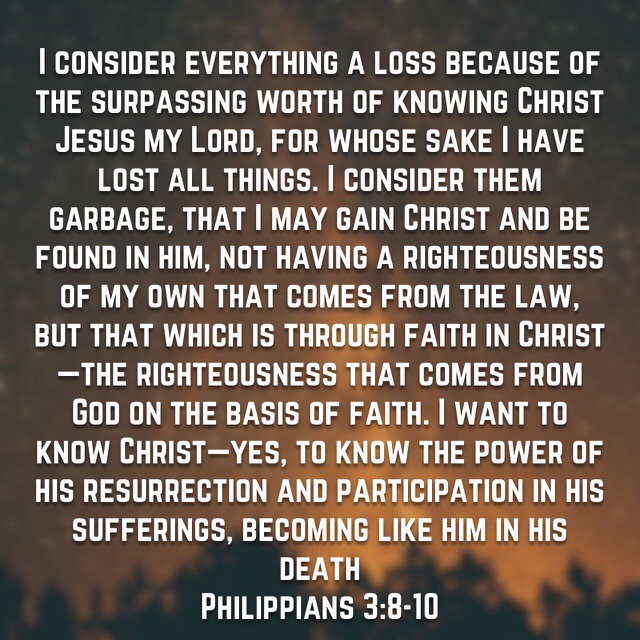
Union with Christ has two important aspects. The first is knowing him. This does not mean to know who he is or to know some things about him. It is to understand what he went through and why he endured it. It is to realize that without him we are hopeless. It means communicating with him. It means recognizing that our own efforts count as nothing towards our salvation and that only through him can we be saved and that this is a good thing. Paul says that everything he could boast about in himself is garbage compared to the worth of knowing Christ (Phil. 3:8), and in John 17:3 Jesus says that eternal life is to know the only true God and His son. Knowing Christ is essential for salvation and for being united with him.


The second aspect of our union with Christ is being like him. Earlier in Philippians, Paul tells readers to have the same mind as Christ (2:5).  Just as Jesus lived to serve the will of God, we should. Just as he was willing to give up his life for others, we should. He lived perfectly and we should strive to do the same. In Galatians 2:20 (ESV) Paul says, “I have been crucified with Christ. It is no longer I who live, but Christ who lives in me. And the life I now live in the flesh I live by faith in the Son of God, who loved me and gave himself for me.” Union with Christ is about emptying ourselves of the muck that comes from our sinful nature and replacing it with the holiness that comes from Christ—out with the old, in with the new.


“Therefore, if anyone is in [union] Christ, the new creation has come: The old has gone, the new is here!” (1 Corinthians 5:17, NIV)


In this life, we will never achieve perfect union with Jesus. We will not fully know him or be totally like him until we can be with him—without the presence of sin. Paul recognized this and writes that despite his shortcoming he would “press on toward the goal for the prize of the heavenly call of God in Christ Jesus” (Phil. 3:14, NRSV). We, too, should press on towards the goal to have union with Jesus. It won’t be perfect, but it will go a long way in furthering our own spiritual development and the unity of the Church.

– Joel Fletcher

Four Enemies of Unity

Philippians 2:12-30

IMG-0276

Yesterday we learned about Paul’s advice for moving towards unity—having an attitude of humility. Today, I’d like to discuss some attitudes and actions that can hinder unity. These four enemies of unity that I will mention are just some of the obstacles that get in the way of the Church achieving unity. 

Enemy 1: Pride

Pride is the opposite of humility. In humility, we put ourselves in the service of others; in pride, we use others to serve our own purpose. It is an easy trap to fall into; pride catches those who do well and convinces them that this gives them cause to boast in themselves. It inflates their ego—giving them a reason to look down on others and view their own ideals as the be-all-end-all. When even just one person in a church body is infected by pride, it can have terrible consequences for church unity. This why Paul cautioned against boasting in one’s self and works:

“For it is by grace you have been saved, through faith—and this is not from yourselves, it is the gift of God—not by works, so that no one can boast. For we are God’s handiwork, created in Christ Jesus to do good works, which God prepared in advance for us to do.” (Ephesians 2:8-10, NIV)

Enemy 2: Gossip

There is no redeemable quality in gossip—it is a destroyer of friendships and communities. Gossip is broadcasting the shortcoming of others with no attempt to help them get better. It is a mechanism used to make the one gossiping feel better about themselves. Where gossip is present, unity cannot exist. The one being gossiped about is treated like an outsider and is pushed away from the community. Gossip is a unity killer.

“Do not let any unwholesome talk come out of your mouths, but only what is helpful for building others up according to their needs, that it may benefit those who listen.” (Ephesians 4:29, NIV)

Enemy 3: Complaining/Grumbling 

When we complain or grumble about something we don’t like, this is typically a sign we are struggling with pride and not embracing humility. If something is actually wrong, grumbling under your breath about it is not the way to go. Never will a good solution be found when it is brought to the attention of leaders through complaining. If we feel something is not being done the way it should be, we should humbly voice our concern to those in leadership after much prayer and meditation. Complainers don’t promote unity—those who genuinely want what is best for the church need to find the right way to address changes. 

Enemy 4: Arguing 

By arguing, I don’t mean mere disagreement, but an incessant need to be proved right (which also comes from pride). When a person goes around trying to convince everyone that their own views on various issues are right and then get angry when they’re not agreed with, it is not beneficial. We must always be striving to find the truth, but we must never do so in a matter that is unloving. Our discussions should be edifying and result in a more unified body; not filled with bitterness and anger which causes strife.  

“Do everything without grumbling or arguing, so that you may become blameless and pure, ‘children of God without fault in a warped and crooked generation.’ Then you will shine among them like stars in the sky as you hold firmly to the word of life. And then I will be able to boast on the day of Christ that I did not run or labor in vain. But even if I am being poured out like a drink offering on the sacrifice and service coming from your faith, I am glad and rejoice with all of you. So you too should be glad and rejoice with me.” (Philippians 2:14-28, NIV)

Each one of these enemies come about naturally from our human nature. We must fight against them just as we do with other sins. We must instead embrace humility, love, peace, and encouragement in order to promote unity and avoid these divisive enemies. 

If you struggle with any of these, start pushing them out of your life today. 

– Joel Fletcher

The Way Towards Unity

Philippians 2:1-11

IMG-0275

In Philippians 2 we find our memory verse for this week, in which Paul exhorts the church at Philippi towards unity: “If then there is any encouragement in Christ, any consolation from love, any sharing in the Spirit, any compassion and sympathy, make my joy complete: be of the same mind, having the same love, being in full accord and of one mind (Philippians 2:1-2, NRSV). In the verses that follow, Paul gives the Philippians some instruction on how they can work towards achieving that unity.


Paul’s advice for the Philippians is to pursue humility in order to achieve unity. Humility is to hold one’s self or self-interest in a low or modest regard. In practicing humility, those in Philippi would be placing the interests of others and the agenda of God above their own desires and concerns. This lowering of one’s self would allow room for the Gospel to take over each member’s life and for the church to come together for the purpose furthering the Gospel in their community. In this, they would be unified.


But Paul doesn’t stop at giving them some ideal to chase after; he offers a model to copy—a perfect one. Jesus had more reason than anyone to pursue self-interests: he was like God. When tempted to have all the kingdoms of the world put under his rule without having to suffer first, he refused (Matt. 4:8-10). Jesus always subjected himself to God. God’s agenda was the only one he cared about—even if it meant torture and death. Paul called the Philippians to have this same mentality, and we should too.


Each one of us has objects we hold as valuable (physical and otherwise), some of them justifiably and others not. We have families and jobs, both of which are important and should not be neglected. We also have ideas, opinions, and agendas that we might say (or at least our actions would suggest) are just as important. What we must remember, and what our actions must mirror, is that all of the things we find value in must pale (greatly) in comparison to the worth we place on the Gospel—God’s agenda.


Can you image what the Church would look like if we were all unified around and living out this common idea? What a sight that would be…will be.

– Joel Fletcher