Leadership

1 Timothy 1-3

Devotion by Jenn Haynes (OH)

There was a time when I didn’t think very much of Paul. It was as a teenager reading his instructions to Timothy here in Chapter 2. I had faith, though, that God was speaking through this man, and SURELY there was something here that I just wasn’t understanding correctly. It wouldn’t be the first or last time that I had to look at a scripture passage and throw up my hands, admitting that I just didn’t have an answer. 

I’ve gone back and forth, looking at explanations and trying to get insight on what exactly was happening at this church. I got the impression that the women there were not behaving the way they should be. Admittedly, some scholars use Chapter 2 as absolute reasoning for why women should not be leaders in the church. Obviously, this doesn’t sit well with me, being a female church leader. Many say that it’s specifically addressing a problem within that church, where women were using wealth, fashion, and beauty to loudly and boldly repeat false teachings that they didn’t fully understand, and it was turning others away. Also, some translations point not to Paul refusing to give women authority over men, but rather specifically not giving them authority over their husbands. I heartily agree here, as that would cause disharmony within a balanced marriage that is seeking to honor Christ. 

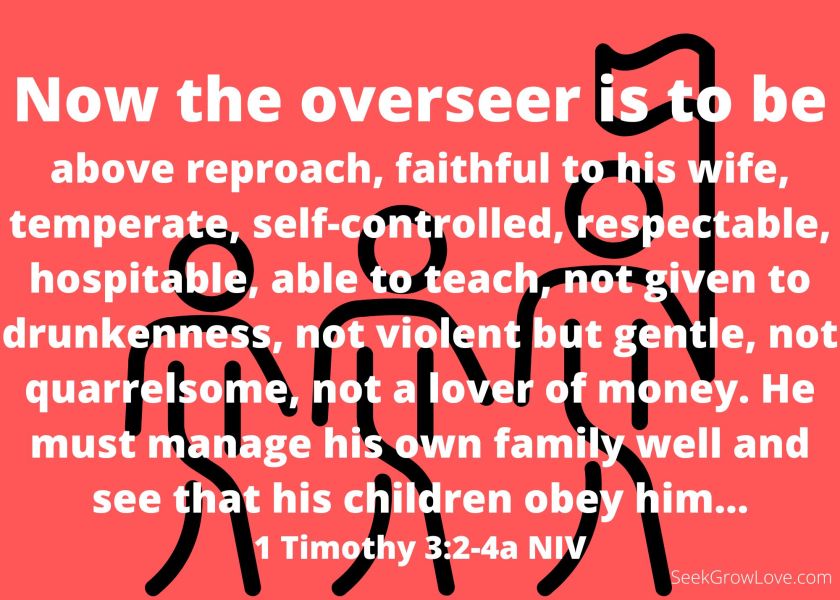
Looking into the whole of scripture, we actually do see female leaders throughout the Old and New Testaments. Those female leaders had wisdom, were full of grace and mercy, and were servant leaders as we are all called to be. They strove toward truth and righteousness, and they were held up for those qualities. We see many of those qualities listed here in the first chapters of Timothy, giving us a wonderful outline of what a good leader looks like. 

We are to worship and pray together without anger. We are to focus more on our actions than our appearances. We are to be faithful to our spouses and full of self-control, managing our lives, money, and families in a way that honors God. We are all to be worthy of respect. 

That’s a lot to place on an imperfect human being. We hear about scandals with our leaders all the time. They make for sensational news. But this is not what we want to see in anyone, especially in our church leaders who are to be leading others to Christ. 

Stepping up as a leader in our church means greater accountability. James 3:1 warns us about this: “Not many of you should become teachers, my fellow believers, because you know that we who teach will be judged more strictly.”

How many people have turned away from Christ because of the actions of those in his church? Too many. 

Reflection Questions: 

Are you a sort of leader in your church? Even if you don’t have a named role, are there those who would follow your example? Have you ever thought deeply about what kind of responsibility that is? People are looking to you and your example when you proclaim yourself to be a Christ follower. Are you following his example in your words and actions? 

Go through Paul’s list of qualifications of a good leader. Where do you hold up to the standard, and where could you use improvement? How could you do better to be a good example for others, someone others would respect and want to follow. 

Prayer:

My prayer is that we all take to heart the fact that we are representing Christ when we call ourselves Christians. Pray that God opens your eyes to where you can be a better example to others and that you lead those around you closer to a relationship with him. 

A Slippery Sin

Philippians 1-2

Devotion by Jenn Haynes (OH)

One of the sins that always frightens me most is the sin of pride. It’s slippery and hard to recognize because one of the symptoms of this particular sin is the inability to see a fault in ourselves. I’ve seen many people who claim humility – they are quick to point out their easily recognized flaws and will readily acknowledge when someone else is better than them at something that they are terrible at. I think of that as easy humility. It’s a quick reassurance to ourselves that we are not guilty of the terrible sin of pride. It makes us feel better about ourselves and our attitudes.

But pride doesn’t have to show up in every aspect of our lives. You can be humble about your skills playing an instrument, while still being enmeshed in pride in some other area. Sometimes pride disguises itself. For example, not seeking counsel because you believe you already have the answers? Pride. Insisting on things being done a certain way because you think it is the RIGHT way, when really it’s just the way you PREFER? Pride.

Philippians 2:3-4 says:

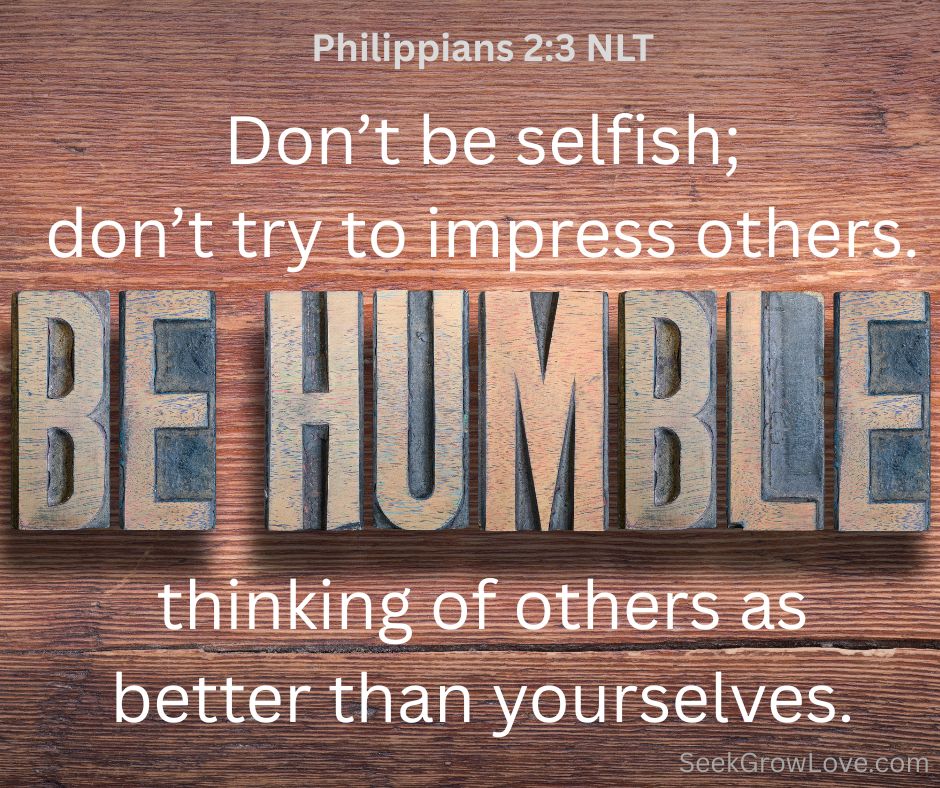
Do nothing out of selfish ambition or vain conceit. Rather, in humility value others above yourselves,  not looking to your own interests but each of you to the interests of the others.

It’s an easy thing to say. I bet most of us think we already place others before us. We serve others, we give of our time and resources, we pray over their needs. But Paul calls us to do more than this. He says do NOTHING out of selfish ambition or conceit. 

We all have agendas. We all have goals. Do every single one of our agendas and goals look out for the interest of others? I know mine don’t always. I struggle with shopping for gifts for others because I keep seeing things I would like to get myself! We are trained by the world to look out for ourselves! We must do what is best for ourselves! 

Let’s be clear – God wants you to take care of yourself and do good things for yourself as well. But in this letter Paul is talking to the church as a whole and to the people working within that church. We, as a body of Christ, are to be working together in complete humility, putting others before ourselves. I’ve had to say many times, both to myself and to others, “This isn’t about you.” 

Because it’s not. None of this is about you. The types of songs we sing in worship. How we conduct meetings. How the furniture is arranged. How we do prayer requests or announcements. What type of public events we hold. I could go on. None of those things are about you. 

We have one mission as a church. We are to live and serve like Christ. We are to go and make disciples, baptize, teach, serve, and love. We are to do Christ’s work, and not once did Jesus ever put his own agenda before God’s agenda. He was the ultimate example of what it looks like to put God’s will before our own. 

Reflection Questions: 

Where are you guilty of pride? Don’t stop at the easy answers either. Look deep. Do you find yourself getting frustrated over people in church doing things “the wrong way” when really it’s just not the way you would do them? Do you find yourself not asking for counsel in an issue because you think you already have the answer? Do you find yourself not praying over decisions?

What areas of your life would look different if you put others before yourself? What areas of your church would look different if you put others before yourself? (Note that I didn’t ask what areas would look different if OTHERS were more humble or selfless. We are looking just at ourselves, so don’t start down that dangerous path.)

Prayer:

My prayer for you is that our church bodies be united in humility to do Jesus’ work. I pray that we are able to keep the slippery sin of pride far away from us. I pray that others are able to see Jesus Christ in us because we are continually showing them love and putting them first above ourselves.

Relationship Inventory

Ephesians 4-6

Devotion by Jenn Haynes (OH)

Relationships are tricky things. They are a blessing to us, and yet they don’t come without thorns. God decided in the very beginning that we weren’t to be alone. We were created to be with others. The final three chapters of Ephesians center around how to be in relationships. From the bond found in church bodies and friendships,to slave/servant and master, to children and parents, to husband and wife, we see a wide array of relationships. And they all start in the same place: unity in Christ. 

What a tricky thing to do, being one in spirit and purpose when we aren’t always one in mind. For example, you could look at the political atmosphere in our country. I know Christians who are Democrat, and Christians who are Republican, and a vast array in between or beyond. They are definitely not of one mind, though I like to believe that most are of one spirit: they want our country to be a good, safe place to live. We just all have a different ideas of how that should happen, and we prioritize different ideals, right? 

The same goes in every relationship. In churches, I rarely see a lack of peace because someone desperately WANTS to go against Christ and destroy his church. Usually I just see different groups of people with different priorities and different ideas of how things should be done. One in spirit, but not one in mind. This holds true in every relationship. No matter how united we are in our goal, we will find differences that lead to conflict. 

So how do we handle relationships when we differ in mind? Paul gives us a lot of advice here, so I’ll list some highlights: 

1. Be humble, gentle, and patient in love. Show humility by admitting that maybe your way doesn’t have to be THE way. And of course be gentle and patient when you are disagreeing.

2. Seek God in determining your place in the body of Christ, as well as in your relationships. Many times our conflicts occur because we have stepped away from where God wants us. 

3. Deal with your anger in a Godly way. Don’t let it take root and stew in your bitterness. Evaluate what you’re actually angry about. Is it righteous anger? Is this anger God would have in the same situation, or is this YOUR anger – anger that things aren’t going the way YOU want them to. If it’s Godly anger, then you need to speak up in truth. If it’s your anger, then you need to stop letting it get in the way of the work God wants to do in you and through you. 

4. No unwholesome talk. This means you DON’T put others down. You don’t gossip, and you don’t say hurtful things about those who are one with you in the body of Christ. You don’t put down your children, you don’t put down your spouse, you don’t put down your friends, and you don’t put down your church body. You can’t be unified in mind and purpose if your speech is keeping you apart.

5. Ephesians 4:32 – Be kind and compassionate to one another, forgiving each other, just as in Christ God forgave you.  That verse is so important to good relationships that I put it to song and had my children memorize it when they were small. God forgave you for all your stupid, stupid mistakes, sins and words. So forgive others for theirs. 

6. Do not wait for others to follow Paul’s advice here. It starts with you. Paul didn’t say this, but we see it in every example of a good disciple. You can’t control others’ actions and emotions. But you can control yours. And good disciples take the first steps and live as an example to others. 

Paul goes on in the rest of Ephesians with more good advice, specifically pertaining to certain relationships. But these foundations he lays out in chapter four pave the way. You are called to be united in Christ. So it’s time for a relationship inventory. 

Reflection Questions:

 First, are you united in spirit in this relationship? (As in, do you have the same goal, and is that goal Godly?) If you aren’t, then maybe it’s time to place some safety distance in that relationship so that it doesn’t affect the work God would like to do in your life. If you ARE united in spirit, you can move on to further analysis. 

If you’re united in Spirit, are you currently not united in mind about an issue? 

Are there negative feelings attached to that issue? Are you angry, bitter, hurt, jealous, anxious, or something similar? You need to find out the root cause. Do those feelings stem from something that is ungodly, or do they come from a more personal place? If you look at it hard enough, is this really just a difference of opinion, or is this an issue of righteousness? Most of the time, it’s a difference of opinion. If that’s the case, it’s time to start looking at Paul’s suggestions there in chapter 4. Most of all, show love. Rather than saying, “I’m angry at this person because of….” start actively saying, “I love this person because…” and you will see a radical shift in your relationships with others. Even if you have to start small with, “I love this person because God told me to.” Doing what God asks is a wonderful place to start. 

Prayer Thoughts:

My prayer for you today is that you read through these passages and really try to apply them to your relationships. I pray that you are able to recognize a difference of opinion for what it is – a difference in how your beautiful brains think, not a reason to be angry and distrustful. I pray that you find unity in spirit and unity in mind in your relationships. I pray that when you don’t find that unity, you step up and be a good disciple by making the first move toward togetherness. I pray that you love and forgive others as Christ forgave you.

The Meaning of the Mystery

Colossians 1-4

Wow – today we have the whole book of Colossians to read and digest.   After Ephesians  Colossians is the next doctrinal and correction teaching which we have in our Bibles.  The message of the kingdom is proclaimed all through the Old Testament and the blessing to the Gentile nations is included in that message.  However, the fulness of the teaching of the mystery of the church of the body of Christ is hinted at in Romans 16:25, talked about in 1 Corinthians 2 and especially in 15:50-58, explained at length in Ephesians 3, and now the glory of the mystery proclaimed in Colossians 1:26-27.  What is this mystery and why is it so important to the church that Paul would put so much emphasis on it?

The book of Colossians is one of the ones written by Paul while in prison at Rome.  It follows Ephesians in the pattern where the first half of the book is doctrinal teaching and the second half of the book is a practical section correcting and teaching us how to live out this amazing Christ in us.  Read these 4 short chapters with this main distinction in mind.

Colossians 1:15-18(NKJV)  He is the image of the invisible God, the firstborn over all creation. 16 For by Him all things were created that are in heaven and that are on earth, visible and invisible, whether thrones or dominions or principalities or powers. All things were created through Him and for Him. 17 And He is before all things, and in Him all things consist. 18 And He is the head of the body, the church, who is the beginning, the firstborn from the dead, that in all things He may have the preeminence.

The meaning of the mystery is that it is the sacred secret of God’s purpose which has been revealed to those that have the ears to hear and eyes to see.  Christ died for our sin and to give us a newness of life which we now can receive.  This brings us as children into the family of God, members of His own household.  The body of Christ is a spiritually bonded people who all have the DNA of holy spirit to bring us together.  Whether Jew or Gentile, slave or free, male or female we all become one in Christ.  All tribalism is swallowed up by the coming of the one body of Christ with him as the head.  It is Christ in each one of us which then unites us together.  Amazing what God has done for us!!

The message of the kingdom changes on the day of Pentecost when the new covenant is instituted with believers in Christ. The time period between the passion of Christ and his glorious kingdom on earth was not revealed in the OT Bible.  That is why the apostles ask him before Jesus ascends whether the kingdom is going to be restored that day.  Jesus answers them that the timing of all these events are in the Father’s hands.  The mystery revealed by Paul and Peter later on is that the time of the church of the body of Christ is now and is alive in Christ.

Colossians 1:24-28 I(NKJV) now rejoice in my sufferings for you, and fill up in my flesh what is lacking in the afflictions of Christ, for the sake of His body, which is the church, 25 of which I became a minister according to the stewardship from God which was given to me for you, to fulfill the word of God, 26 the mystery which has been hidden from ages and from generations, but now has been revealed to His saints. 27 To them God willed to make known what are the riches of the glory of this mystery among the Gentiles: which is Christ in you, the hope of glory. 28 Him we preach, warning every man and teaching every man in all wisdom, that we may present every man perfect in Christ Jesus.

Ephesians 3:6-7(NLT) And this is God’s plan: Both Gentiles and Jews who believe the Good News share equally in the riches inherited by God’s children. Both are part of the same body, and both enjoy the promise of blessings because they belong to Christ Jesus. 7 By God’s grace and mighty power, I have been given the privilege of serving him by spreading this Good News.

How does the mystery revealed intersect with our preaching and teaching of the kingdom message?

Colossians 2:6-10(NLT)  And now, just as you accepted Christ Jesus as your Lord, you must continue to follow him. 7 Let your roots grow down into him, and let your lives be built on him. Then your faith will grow strong in the truth you were taught, and you will overflow with thankfulness. 8 Don’t let anyone capture you with empty philosophies and high-sounding nonsense that come from human thinking and from the spiritual powers of this world, rather than from Christ. 9 For in Christ lives all the fullness of God in a human body. 10 So you also are complete through your union with Christ, who is the head over every ruler and authority.

Chapters 3 and 4 are the practical application teaching us about the doctrine taught in chapters 1-2.

How do the message themes compare between chapters 1-2 to chapters 3-4? 

Colossians 3:12-15(NLT) Since God chose you to be the holy people he loves, you must clothe yourselves with tenderhearted mercy, kindness, humility, gentleness, and patience. 13 Make allowance for each other’s faults and forgive anyone who offends you. Remember, the Lord forgave you, so you must forgive others. 14 Above all, clothe yourselves with love, which binds us all together in perfect harmony. 15 And let the peace that comes from Christ rule in your hearts. For as members of one body you are called to live in peace. And always be thankful.

What is our motivation for doing the good works God calls us to do?

Colossians 4:2-6(NLT) Devote yourselves to prayer with an alert mind and a thankful heart. 3 Pray for us, too, that God will give us many opportunities to speak about his mysterious plan concerning Christ. That is why I am here in chains. 4 Pray that I will proclaim this message as clearly as I should. 5 Live wisely among those who are not believers, and make the most of every opportunity. 6 Let your conversation be gracious and attractive so that you will have the right response for everyone.

How do we develop our willingness and ability to give a Godly answer to every person we talk to about Christ?

I pray for you as did Paul centuries ago that you will live out this wonderful mystery of Christ as part of the body of Christ, his church.  Remember who you are this day!

Love in Christ Tom Siderius

The “One Anothers”

Romans 14-16

Romans 14:10-13 So why do you condemn another believer? Why do you look down on another believer? Remember, we will all stand before the judgment seat of God. 11 For the Scriptures say,
“‘As surely as I live,’ says the LORD,
‘every knee will bend to me,
and every tongue will declare allegiance to God.’”
12 Yes, each of us will give a personal account to God. 13 So let’s stop condemning each other. Decide instead to live in such a way that you will not cause another believer to stumble and fall.

The ministry of strengthening individuals and the church is based on two main elements.  We are instructed to encourage one another, and to build up one another.  Note the importance of “the one anothers” in the instructions God gives us in His Word.

To love one another.

John 13:34-35(NLT) So now I am giving you a new commandment: Love each other. Just as I have loved you, you should love each other. 35 Your love for one another will prove to the world that you are my disciples.”

To welcome one another.

1 Corinthians 16:19-20(NLT) The churches here in the province of Asia send greetings in the Lord, as do Aquila and Priscilla and all the others who gather in their home for church meetings. 20 All the brothers and sisters here send greetings to you. Greet each other with a sacred kiss.

To have great affection and honor for one another.

Romans 12:10(NLT) Love each other with genuine affection, and take delight in honoring each other.

To pray earnestly for one another.

James 5:16(NLT) Confess your sins to each other and pray for each other so that you may be healed. The earnest prayer of a righteous person has great power and produces wonderful results.

To care for one another.

1 Corinthians 12:25(NLT) This makes for harmony among the members, so that all the members care for each other.

To accept one another

Romans 15:1b-9(NLT) We must not just please ourselves. 2 We should help others do what is right and build them up in the Lord. 3 For even Christ didn’t live to please himself. As the Scriptures say, “The insults of those who insult you, O God, have fallen on me.” 4 Such things were written in the Scriptures long ago to teach us. And the Scriptures give us hope and encouragement as we wait patiently for God’s promises to be fulfilled.
5 May God, who gives this patience and encouragement, help you live in complete harmony with each other, as is fitting for followers of Christ Jesus. 6 Then all of you can join together with one voice, giving praise and glory to God, the Father of our Lord Jesus Christ.
7 Therefore, accept each other just as Christ has accepted you so that God will be given glory. 8 Remember that Christ came as a servant to the Jews to show that God is true to the promises he made to their ancestors. 9 He also came so that the Gentiles might give glory to God for his mercies to them.

Have you also noticed the“one another’s” that God does not instruct us to do? For example, to chastise one another, humble one another, tear down one another, gossip about one another, or pressure one another. 

This is hardly an exhaustive list, but do you see the theme of all these verses?  Together we are the body of Christ, and those things that we do to strengthen the body are a group effort.  Everyone has a responsibility for one another to do the things that only you can do.  There is only one “you” in the church today, and God is counting on you. Love, care, welcome, prayer, and encouragement are all ministry to others.  Don’t make the Christian walk of trust and faith too complicated for people.   We need to become like the little child in Jesus’ teaching, where we hear the truth with simple hearts of believing.  In the small and personal ministries of people to others in the church the true love of God in Christ becomes alive and evident.

Romans 16:25-27 Now all glory to God, who is able to make you strong, just as my Good News says. This message about Jesus Christ has revealed his plan for you Gentiles, a plan kept secret from the beginning of time. 26 But now as the prophets foretold and as the eternal God has commanded, this message is made known to all Gentiles everywhere, so that they too might believe and obey him. 27 All glory to the only wise God, through Jesus Christ, forever. Amen.

Thanks to God for revealing the sacred secret so that we as Gentiles can share in the promises made and kept by God.

Love in Christ – Tom Siderius

Reflection Questions

  1. When have you fallen into the trap of condemning or looking down upon another believer? What is the problem with this? What would have been a better response and attitude on your part?
  2. Make a list of “one anothers” that we are NOT to do if we are living according to God’s way. Which ones come too easy for you? How can you work towards stopping these “one anothers”?
  3. What responsibility towards one another does God want to see YOU take part in today? How many different positive “one anothers” can you do today to build up the body of Christ and please God? Who benefits and how? Pray for God’s help in eliminating negative “one anothers” and focusing instead on seeing, doing, speaking, positive ones instead.

Encouraging Fellowship

Acts 20:1-3, Romans 1-3

Devotion by Merry Peterson (Canada)

Have you ever wondered what makes Christian fellowship oh so sweet?  Paul in this passage has expressed his earnest desire to be among his fellow brothers and sisters in Christ.  His heart aches to be present with them, instead he finds himself writing a letter to them.  He states in Romans chapter 1, verse 12 so “that I may be encouraged together with you by the mutual faith”.  What he is expressing is his desire for the encouragement that comes from fellowshipping with one another.

When we get together as Christians to worship, sing, hang out together, share a meal, or other activities where we truly interact is when fellowship is sweetest.  For an extended period of time I lived on the west coast.  Let me tell you it is a very long way away from most of our churches in our conference of churches.  I loved our 2 local congregations but it was ever so sweet when I would get to attend a camp or conference activity with other like-minded believers back east.  I always found it encouraging and always had the opportunity to encourage and minister to others as we fellowshipped together.  It was rejuvenating.  The Apostle Paul is longing for that same rejuvenating fellowship. 

Notice he mentions by mutual faith – that is why it is so important that we should fellowship together as believers.  In Proverbs 27:17 we read “As iron sharpens iron, So a man sharpens the countenance of his friend.”  To sharpen iron it must be rubbed against another piece of iron.  This picture reminds us that by fellowshipping together – sometimes literally rubbing elbows – we are strengthening and encouraging one another providing the most mutual benefit. That is why Paul in other writing mentions not to forget the assembling of ourselves together – so we don’t lose the mutual benefit of encouraging one another.  In our technological age of on-line church and digital meeting spaces let’s not forget what the Apostle Paul really yearned for, and felt was most beneficial – fellowship with other Christian believers.  Let’s remember that meeting together is for mutual benefit in the faith – uplifting, encouraging, and helping to rejuvenate our brothers and sisters in the faith so they too can have joy for the journey.

For Reflection:

 How can I be more diligent in taking part in opportunities to fellowship with other believers?

Have I taken this sweet, refreshing gift for granted that Paul longed for?

Gifts for the Body

I Corinthians 12:7  “But the manifestation of the Spirit is given to each one for the profit of all:” (NKJV)

1 Corinthians 12-14

Devotion by Merry Peterson (Canada)

Did you know you are a gift to everyone?  We are all given certain gifts for the common good of all believers.  God by His Spirit enables us to do different things but it is for a purpose – to benefit those whom we are in Christian fellowship with. As Paul was writing to the church body in Corinth he was letting them know that they all had various spiritual gifts.  They were the emerging church at the time, still getting established in the ideas and practices of the Christian faith.  Paul was reminding them of their individual gifts and that those gifts were to be used for the common good, edifying their brothers and sisters in Christ.

 Do you have a certain gift that God has given you?  I have a friend who has a God given gift of artistic ability. She blesses and encourages others with her drawings of Bible scriptures surrounded by scenes from nature.  I find encouragement each time I see one of her illustrations.  Sure, I can draw a stick figure – but I can’t meticulously draw the intricate details of a flower or butterfly that inspires the soul like she can – that is her God-given gift. 

Each one of us has a different gift and we are to use it to benefit our brothers and sisters in Christ.  Some people are empowered with prayer abilities, others give good Godly advice, others are good at teaching.  Some have the gift of evangelism or hospitality, and some are just plain the most helpful people you know.  These are all gifts that are given to us by God’s Spirit and they are all different.  My abilities are different than my friend’s abilities.  God doesn’t skip any one of us in the giving of these gifts – he wants us to use our specific gift for the benefit of everyone.  No one can say that one gift is better than another because all of these gifts were meant to be used together to make a complete picture for how a body of believers should function together building each other up.  Just imagine if your Christian fellowship group didn’t have anyone with a musical gift – the worship service might sound terrible!  We need each person to exercise their spiritual gift so that we all can be enriched and God can be glorified. 

For Reflection:

  1. What gifts has God given you to help enrich the lives of those you are in fellowship with? 
  2. How have you been enriched by the gifts of others recently?         
  3. Have you thanked God for your gifts and the gifts of others?

Merry Peterson pastors the Freedom In Christ Church in Welland, Ontario, Canada.  She has enjoyed being in pastoral ministry for many years and has worked on the side in education in both public and private sectors in various capacities.

Getting Back to Business

1 Corinthians 5-8

Devotion by Emilee (Ross) Christian

I really enjoyed today’s reading. Paul had some zingers that actually got me laughing – my favorite being 8:2. In our reading today, we learn this letter is a response to one from the Corinthians (7:1). After a lengthy introduction in chapters 1-4, Paul gets right to addressing some specific concerns regarding the Corinthian church. There is a lot that can be discussed here, but the key seemed to be Paul encouraging the Corinthian church to remove distractions and get back to the business of spreading the Gospel. 

Earlier this week I wrote about how the early church was moving in the days of the Apostles. In today’s reading, we see a church that has come to a standstill. It seems the Cornintian church lost focus on spreading the Gospel and what it meant to be the body of Christ. Paul mentions when he told the church to stay away from people “who indulge in sexual sin, or are greedy, or cheat people, or worship idols” he was referring specifically to believers who partake in these actions (5:10 NLT). Paul plainly puts that to stay away from all such people, you’d have to leave this earth – that was another one of those zingers I found humorous. The problem Paul has with the Corinthians is they are allowing a man living in sexual sin with this step mother to be an active member of their church. It’s a distraction. It’s giving the church a bad name, as Paul writes even pagans don’t tolerate such behavior. Paul is NOT telling the church to avoid sinners, but he is telling us to get the sin out of the church. There is a difference. Allowing one who is actively participating in sin with no signs of repentance within the church causes a distraction. Discord can break out amongst the people in the church over the issue. I believe Paul is also concerned with the Corinthians giving the church a bad name, in turn hindering the spread of “sincerity and truth” (5:8 NLT). He continues this idea in chapter 6, regarding the Corinthians use of the public courts to settle disputes. He doesn’t like that this is being done in front of non-believers. Why? Because, it is distracting from the Gospel message. It’s the same way with the issues of marriage and food discussed in chapters 7 and 8. 

We have to remember the church was on a mission. Our New Testament stories and scripture come from what the early church did. Paul understood the importance of the movement and the urgency to share the Gospel. It seemed this specific Corinthian church had forgotten. Paul is urging the Corinthians to remove distractions and get back to the business of the church. I believe that is the biggest take away from today’s scripture. It’s not about whether we should be married or not, whether we eat this or that. It’s not even about what people we should avoid or allow in the church. It’s about refocusing the efforts of the church to do the work of Christ. Jesus tells us the two most important commandments are to love God and secondly love others. That is the movement to which Paul wants the Corinthians to return. It must be our focus as well. Paul sums it up pretty nicely in his opening statement in chapter 8, “But while knowledge makes us feel important, it is love that strengthens the church” (verse 1 NLT). 

Reflection Questions

  1. What distractions have gotten in the way of you intentionally spreading the Gospel? How can you minimize them (or eliminate them or use them to your advantage – depending on what your distractions are) so that you focus more on how to best love God and love others which must include spreading the good news?
  2. What should our response be to sin in the church? What should our response be to sin outside of the church? Why the difference? What happens when we get it mixed up and treat outside sin as we are supposed to treat inside sin? What happens when we get it mixed up and treat inside sin as we are supposed to treat outside sin?
  3. After reading the whole Bible passage today, re-read 1 Corinthians 8:2. What is Paul saying in this verse? Why is he saying it? What can you learn from it? And how could you put it into practice?
  4. What do you think God wants you personally to learn and put into practice today from this letter from Paul to the church in Corinth?

Believers on the Move

Acts 18:19-19:41

Devotion by Emilee (Ross) Christian

We revisit the story of the early church in today’s reading of Acts 18:19-19:41. In this section we meet Apollos, an influential Jew converting many to Christ. Paul concludes his second missionary journey and begins his third. There is an encounter with the Holy Spirit and men of Ephesus. We learn about God giving Paul the ability to perform miraculous signs. We get a story about demon casting and see how God can use all things for His good. Finally, this section ends with a huge riot in Ephesus. So much happened in this section, but the undercurrent was the movement in the church, the believers. I think it’s worth taking a closer look at what the believers were actually doing, so we can follow their example. 

In today’s reading, the collective term “the believers” is first used in 18:23 when “Paul went back through Galatia and Phrygia, visiting and strengthening all the believers” (NLT). Here, the church is seen hosting Paul and allowing themselves to be encouraged and strengthened through his teachings. In various letters Paul commends hospitality. The church is supposed to be a hospitable place. Soon many families will gather together for the holiday season. While this can cause stress, I challenge you to consider it a blessing and an opportunity to share God’s love by welcoming people into your home. 

The believers were also strengthened by Paul’s visit. We, too, need to allow ourselves to be encouraged. It is important we put ourselves in situations where we can feel revitalized. Find what reignites your passion for the Gospel. Maybe that’s simply going to church on a weekly basis. It could be attending a Bible Study, instead of leading one. Time alone in the Word. Church Camp or conferences. Attending a Christian concert. I think it is worth noting that while the early believers were welcoming and serving Paul, they also allowed themselves to be served as Paul’s visit strengthened their faith. 

Next we see believers teaching, correcting, and learning. I love the story in Acts 18:24-26. We meet Apollos, a man on fire for the Lord. In Ephesus, he meets Priscilla and Aquila, two students of Paul’s. Scripture says Priscilla and Aquila pulled Apollos aside and “explained the way of God more accurately” (18:26 NLT). They did not publicly call out Apollos, telling him he was wrong. Rather quietly and respectfully this couple sought to fill in the gaps in Apollos’ understanding of scripture. Furthermore, Apollos welcomed their knowledge. He was not so prideful, he could not learn. This is such a wonderful example of church conflict being resolved peacefully. We can learn from these early believers to have open hearts, ready to search scripture to receive truth, and share our own perspective and understanding of scripture in non-threatening ways. 

This next part of Apollos’ story especially intrigues me. Apollos has a desire to go to Achaia and shared it with his fellow believers. They in turn encourage him to go. We can follow this example by sharing with our brothers and sisters in the church our desires, hopes, plans. From little side stories like these, it is clear to me the church is meant to act as a unit, not one sole individual acting on his or her own. Apollos allowed himself to be encouraged by his fellow believers then set off to do the work God planned for him. Here we see the church in movement by sharing and encouraging. 

These believers in Ephesus not only encourage Apollos to go to Achaia, but intercede on his behalf. They write to their friends in Achaia asking them to welcome Apollos. Again, it is a short and sweet detail in this grand passage of Paul’s journeys. Yet, it shows how the early church was moving and interacting with one another during the time of the Apostles. It serves as a reminder to us how we should be interacting with one another. How can you intercede for those brothers and sisters around you? Are there unmet needs you may be able to provide? 

Looking into Chapter 19 Paul has some interesting interactions with the people of Ephesus. These twelve men were like Apollos believing in “John’s Baptism,” understanding the repentant side of the story, but not quite grasping the Jesus-new-life part. This new creation baptism was something Paul personally experienced. Essentially, he provides these Ephesian men with the rest of the story and they are “baptized in the name of the Lord Jesus” (19:5 NLT). So, what are members of the church doing here? Getting baptized. Baptism is a public declaration of our faith. This symbolic action helps solidify our understanding of a new life in Christ. How can we follow the example here from the early church? Get baptized. Baptism has meant all sorts of different things to different people. However, in my opinion, scripture has made it pretty clear. Baptism is our call to action after hearing, believing, and accepting the Gospel. Baptism is not a necessity to our salvation but a consequence. It is what the early church did, it is what we should do. 

The next time “believers” are collectively mentioned as a group is in Acts 19:18. In the aftermath of the Sons of Sceva story, believers still practicing sorcery and incantation confess and repent by burning books associated with sorcery. While I am certainly not advocating for the burning of books, it is the action of physically turning away from their sin that is notable here. The church today can follow this example. The church is made up of humans. We are going to make mistakes, mess up, have our good and bad days. On the bad days, it is important we take responsibility. When the Ephesian people turned away from their sin “the message about the Lord spread widely and had a powerful effect” (20 NLT). This shows that repentance is not just for the sake of the sinner but can be used for spreading the Gospel. 

Finally, the last time we see the believers in this section is during the riot in Ephesus. Here, the believers are seen as protecting and defending Paul. I found the small details in this story fascinating. In Acts 19:30 the believers prevent Paul from entering the amphitheater where the rioting was taking place. While some of Paul’s companions are swept up in the chaos, Paul is held back. The Greek word used here is translated as “would not allow.” Eventually, the people are calmed down and dispersed with nothing more than shouting and confusion to show for their rioting. I have to wonder if the situation would have been made worse had Paul been present. Even some of Paul’s friends who were province officials sensed Paul would be in danger had he gone with the rioters. While we may not be facing an angry mob head on, in what ways can we protect and defend our fellow believers? Does your church have connections with missionaries who are in danger? Can you financially contribute to these organizations? Can you organize prayer for these people? Are there justice groups for which you could be involved? The early church played a role in protecting and defending other believers, so how can we?

The believers of the early church are seen acting in so many ways throughout this section. They are welcoming. Receptive of encouragement. They are teachers, correcting and learning from one another. They are involved in each other’s lives. They are responsive to the call of baptism. They are repentant. Lastly they are seen as protecting and defending. My hope is by further looking at their actions we can seek action as well. May we learn from the example of the early church and may their actions guide us as we continue the spread of the Gospel, two thousand years later.   

Reflection Questions

  1. From above: “How can you intercede for those brothers and sisters around you? Are there unmet needs you may be able to provide? “
  2. And, “The early church played a role in protecting and defending other believers, so how can we?”
  3. How can you be more like the early church believers today?

Chosen – for Something

Be Strong and Do It!

1 Chronicles 26-29 & Psalm 127

Have you ever had an idea, or plans for something that you spent time putting together, but were not able to actually carry it out?

It might be because you don’t have the means, the talent, the time, but whatever the case, it can be disheartening, so I appreciate David’s example here on not being downtrodden about it but instead taking an opportunity to guide the nation and his son, directing them to serve God.

I also think it is pretty cool that despite David not being allowed to build the temple, we see an example of God’s Spirit working in David to come up with the plans.  Just because he wasn’t allowed to build, didn’t mean that he wasn’t able to still do something for the LORD.

In this case, David wasn’t allowed to build because of being a warrior who had killed others, but it is also a reminder to me that there isn’t just one thing to do.  God may call us differently or gift us differently to accomplish more things.  God didn’t use David to build the temple because of David’s actions over the past. But in other cases, God is just using people in different ways – not because one thing is better than the other (thinking of Paul describing the body – each part needs the others to properly function), but because multiple things need to be done.  We might sometimes feel saddened by being unable to do what we want, but that shouldn’t stop us from doing something.  We are all able to serve, but that service might look different from how others serve depending on our skills, or physical abilities, or God-given direction.

And then as we continue reading, we see how things are generously donated to the building of the temple, and to keep us all in check, David offers this in 29:14 “But who am I, and who are my people, that we should be able to give as generously as this? Everything comes from you, and we have given you only what comes from your hand.”

In a world/culture that is heavily focused on earning what we have, sometimes we need that reminder that the only reason we have is because God has given us things.  And that can fill us with gratefulness and love and inspire us to give as well.

~Stephanie Fletcher

Reflection Questions

  1. Is there a job that you have wished God would chose you for, but He has not? What can you learn from David? What other jobs do you think God IS asking you to do? In what ways are God’s plans better than ours?
  2. What has God given to you that you can use to serve Him?
  3. Our Psalm today was written by Solomon and he wrote: “Unless the Lord builds the house, those who build it labor in vain.” (Psalm 127:1 ESV). What did Solomon learn from his dad? How can you apply these words to how you are building your house/life/family and how you are building/supporting/growing God’s house/church?