Set Apart – Together

Earlier this week we read about the importance of being set apart from the world as a follower of Christ. To be called out. Sometimes at work, I get “called out” of a meeting to talk to someone. Sometimes I help patients of mine by intentionally setting him/her apart from other distractions to complete a task. Since I work at a hospital, I frequently go to the waiting room to call out a name, asking that person to stand up and separate from the others to come with me.  Depending on your contexts in life, being called out or set apart might bring that visual of being alone or isolated from others. Maybe sometimes that might sound nice?  For sure at other times, that can sound scary and undesirable.

While we are asked to be set apart from the world in the spiritual sense, we are not created to live, love, worship, and serve in isolation. In fact, 2020 shed some light into the devastations that can be caused by being set apart….alone. That isn’t what Jesus was talking about. The Greek word most frequently translated as church in our Bible is “ekklesia” which means the idea of an assembly of called out people.  The church is called to be set apart from the world. Since our English language often associates the word “church” with building and not the group of people, it is easy to overlook the meaning of the importance of our calling sometimes. In the New Testament we see a group of people called out from the world…..TO GOD. A group asked to be set apart together.

Ephesians 3:16-21: 

I pray that out of his glorious riches he may strengthen you with power through his Spirit in your inner being, 17 so that Christ may dwell in your hearts through faith. And I pray that you, being rooted and established in love, 18 may have power, together with all the Lord’s holy people, to grasp how wide and long and high and deep is the love of Christ, 19 and to know this love that surpasses knowledge—that you may be filled to the measure of all the fullness of God.

20 Now to him who is able to do immeasurably more than all we ask or imagine, according to his power that is at work within us, 21 to him be glory in the church and in Christ Jesus throughout all generations, for ever and ever! Amen.

He calls us out to love one another. To be mindful of other’s needs and meet them. To edify one another. To be unified. To bring glory to God and Jesus in what we do as an ekklesia. To come together in prayer. To find strength and function as one member of a greater body. 

As we navigate another season of viruses and news stories laden with fear and confusion, let us not do it alone. And let us also not find our church families looking and sounding just like the world. Instead, let us actively seek to be set apart from the world following Jesus in our own individual lives, to find the planks in our own eye, so we can best build up the ekklesia  as we await the return of His son.

We are the church.

“For where two or three gather in my name, there I am with them.”  Matthew 18:20

-Jennifer Hall

This week the devotions are on other passages reminding us of the importance of of being connected to God, Christ and the church, but if you are using the SeekGrowLove Bible reading plan keep enjoying the daily passages. They can be read or listened to here at BibleGateway Job 13-14 and 2 Corinthians 8

A Seemingly Small Part

of God’s work,

1 Corinthians 12

When we think of the ear, we most likely are thinking about those lumpy, peculiar bits of cartilage just on the outside of our head.  While their shape helps us to ping the location of the sound, the majority of the work is being done on the inside.  The eardrum is vibrating, creating the analog beating that is then turned to electronic impulses that our brain interprets.  But even just beyond the eardrum, there is great work happening that is equally important to the overall function and health of the body, although this is assuming you are not hearing alarming noises at the present. Enter the eustachian tube.  It is the gravity-driven country road between the other side of your ear and the top of your throat.  This little pathway is responsible for a couple of very key functions, which you may never be aware of if all is going according to plan.  It sends any junk the ear makes down and out.  It prevents bacteria and any other intruders from creeping up.  But finally, its primary function might just sweep you off your feet, literally.  The regulation of gas and pressure behind our eardrum is important to hearing, but even more important to balance.  If this is the slightest bit off, we may be experiencing a case of vertigo, an internal roller coaster that never leaves the station. The room will spin.  Sweat forms on our brow.  Our eyes jitter.  Our head pounds.  Nausea fills our belly until our body cannot take it any longer and we “blow chunks” as one might put it more indelicately. Oh, and yes, you may lose your hearing too.  All because a space less than a quarter of a square inch doesn’t have the right amount of pressurized gas.

In Chapter 12 of 1 Corinthians, Paul speaks of the ear, but also hands, feet, and eyes.  The metaphors for the functions of each part of our body are endless.  Physically, we can “survive” without some parts, but we recognize that functioning as a whole is disabled because something, or to Paul’s analogy, someone, is missing.  While it may be more obvious when a man or woman is missing an eye or a digit, it is equally important to recognize when we are missing the kidneys and a liver which are removing the poison, or the amygdala which is controlling our rage and lashing out, and yes, the eustachian tube which is providing a steady balance.  These parts are easily overlooked, and many times, the people fulfilling these roles are not only disregarded, but are themselves unaware they are doing them.  These aren’t the folks performing miracles, preaching in the street, or speaking in tongues.  These are the ones who watchfully discern, the ones who are unflinchingly faithful, who make and show perfect peace, and those who have an infinite amount of helping hands to extend.  These are of special modesty, but of equal concern (v.25).

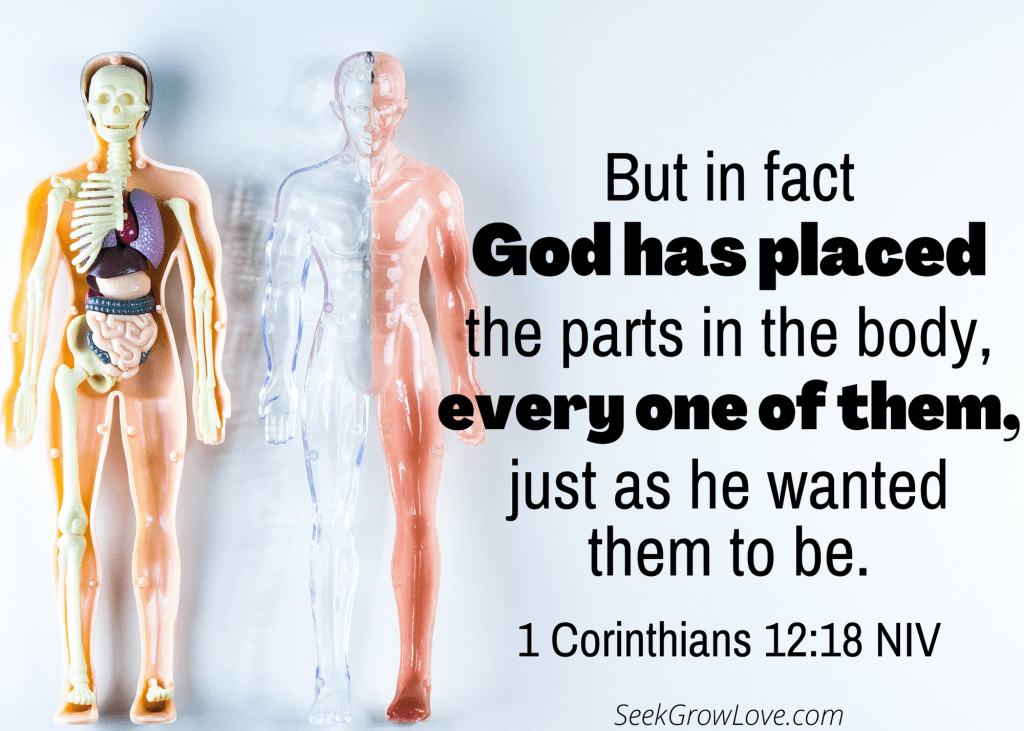
“But in fact God has placed the parts in the body, every one of them, just as he wanted them to be.” – 1 Corinthians 12:18

Now, for the bit with application.  We often give much love to the “showier” bits.  Those who take on a responsibility during a worship service or teach a class, but for a moment, think about the hidden parts among your church body.  Who stands watch (physically or emotionally) at the door of your church?  Who finds a way to create harmony between a foot and a hand vying for the same attention? Who shares their faith when doubt is beginning to spread among the believers?  It is time to take notice.  To recognize. Find a way to show this part of the body some love today. A call, a text, a card, a small token, or a chore done.  It is a very important bit of “self” care. Chances are they will be modest.  They will say they aren’t really doing anything important.  The truth is, they might be the very part keeping the church on their feet, preventing potential headaches, heading off a building rejection of the stomach, or simply lending a listening ear.  If they suffer, so do we, BUT if they rejoice, so do we.  We absolutely need all the parts to be the church we are called to be.

“On the contrary, those parts of the body that seem to be weaker are indispensable, and the parts that we think are less honorable we treat with special honor. And the parts that are unpresentable are treated with special modesty, while our presentable parts need no special treatment.” – 1 Corinthians 12:22-24a

–Aaron Winner

Today’s Bible reading passages can be read or listened to at BibleGateway here – Nehemiah 11-13 and 1 Corinthians 12

Peace and Building Up

Romans 14

So far this week, I’ve been focusing on the Old Testament reading, since fewer people are as familiar with the Old Testament, and there is a lot to learn from it.  But today, I’d like to point out something from Romans 14.

Romans 14 is written to “strong” Christians, and discussed the topic of doing things that may offend a brother (i.e. cause someone to stumble into sin).  Back in the day, apparently there were some who felt they shouldn’t eat meat, because it may have been sacrificed to an idol.  But since we know idols are nothing, it’s fine to eat meat, as long as we thank God for it.  But here comes the rub, in Romans 14:15, “If your brother is distressed because of what you eat, you are no longer acting in love.  Do not by your eating destroy your brother for whom Christ died.”

It continues in Romans 14:19 by saying, “Let us therefore make every effort to do what leads to peace and to mutual edification.”  And in Romans 14:21, “It is better not to eat meat or drink wine or to do anything else that will cause your brother to fall.”

I share this because it hits me personally.  Years ago, we had someone in our church who thought it was a sin to drink wine.  I happened to drink wine (sparingly, but still…).  Somehow, it came up that I drank, and he came to me to point out my sin.  I was familiar with this passage, and others like it, and knew it wasn’t a sin to drink, but it’s a sin to get drunk.  Of course I thanked him for his concern and for pointing this out, while secretly I was scoffing.

But Beth, my late wife, pointed out 1 Corinthians 8:9, “Be careful, however, that the exercise of your freedom does not become a stumbling block to the weak.”  In my arrogance, I was quick to point out that he was the weak one here, and I am the strong one.  That was irrelevant.  I was commanded to do things that lead to peace and to not put a stumbling block in front of the weak.  So, with Beth’s persistence, I was able to comply.

This points out a truth I’ve come to understand over the years.  Many times, we may recognize what God has to say, but we don’t necessarily want to do it.  In cases like these, I have found that it really helps to have an accountability partner to help hold us accountable, to do what God demands, even if we don’t necessarily want to obey.  And ultimately, obeying God works out best for everybody.

So if you haven’t considered having an accountability partner before, you may want to consider how this could be used to draw you closer to God.

-Steve Mattison

Today’s Bible reading passages can be read or listened to at BibleGateway here – 2 Chronicles 29-30 and Romans 14

Stand Firm – Back at Church

Romans 1

In today’s Bible reading I will be looking at Romans 1.  I want to specifically focus on where he says “…that we may be mutually encouraged by each other’s faith, both yours and mine.”  I think this is especially important to take note of since covid made it hard to gather for a long time and I think we can all agree that to some degree our Faith was affected.  This is why I think it is important that I go to church, to be able to meet with like-minded believers who are going to support me in my own walk with the Lord and for me to be able to support them as well.  God did not intend for us to be alone, but for us to have fellowship with one another and encourage each other to live daily for Him.  As life is returning to normal at this stage of the pandemic I think it is important that we make an effort to rebuild our church communities and get ourselves back into those routines that will draw us closer to God.

Earlier this week you heard about our recent Midwest Family Camp theme of standing firm in our faith and its importance.  Throughout verses 21 and 22  we can see the effect that happens when we are not standing firm in our faith,For although they knew God, they did not honor him as God or give thanks to him, but they became futile in their thinking, and their foolish hearts were darkened.  Claiming to be wise, they became fools”  This is why it is important to be in a community of believers, iron sharpens iron, and wise Godly people can point out when our thinking becomes futile, or when we are not honoring God with our actions.  Without these leaders in our churches we may become like the fools that Paul is talking about here, and if you read on, these foolish people do not end up living fun or flourishing lives. 

In our churches we need people who are willing to step up as leaders and examples of what standing firm and walking with God looks like. 

Katie-Beth (Fletcher) Mattison

Today’s Bible reading passages can be read or listened to at BibleGateway here – 2 Chronicles 3-4 and Romans 1

Wise Ants

Proverbs 30

Have you ever thought about ants as something besides a pest? Before I started researching facts about ants, I just thought about them as annoying insects that carried away crumbs left around your house. However, research proves that ants are much more than just annoying pests, they are also very intelligent and good at working together.

Ants are able to come together as large groups and use all of their intellect as a whole.

Ants are officially the world’s smartest insects and have 250,000 brain cells.

Ants are the only non-mammals who can learn through interaction.

Research is not the only thing that proves that ants are smart; the Bible also describes the wisdom of ants. In Proverbs 30:24, it says that there are multiple small things on the earth that are very wise. The first thing listed that is small but wise is ants. Proverbs 30:25 says that ants are wise because they spend their summer gathering food for the winter, even though they are small. While ants are wise because they gather food for the winter in preparation, they are also wise in the method by which they gather their food; teamwork. Each ant is able to gather some food by itself. It may be able to gather enough food for a month if it works alone, but it wouldn’t be able to gather enough food for the entire winter if it worked alone. But when an ant works as part of a colony, it is able to help make sure all the ants in the colony have enough food for the winter. As Christians, we should be the same way. We should be working together to help each other stand firm in God’s word, instead of trying to do God’s will by ourselves and stumbling in our faith throughout the process.

As Christians, we should be working together to help each other to better understand the Bible. Understanding the Bible gives us wisdom, which in turn helps us to stand firm in our faith. Every person reads the Bible differently and learns different things when they read it. Working together with fellow believers to study the Bible allows us to each learn the things others learned when they read the Bible that we wouldn’t have learned by ourselves. The more lessons we learn from the Bible, the sturdier foundation we are able to build our faith upon.

Not only can spending time with other Christians help you to build a stronger foundation, but it also helps you to draw closer to Jesus, allowing you to live your life more like Jesus. Matthew 18:20 says that where two or three believers gather together, Jesus will also be there in the believers’ midst. When Jesus is in the midst of a group of believers, each believer becomes stronger in their faith. This allows them to imitate Jesus better in every action of their life and to stand firm in their faith throughout hardships with less difficulty.

Throughout our lives, we will all face trials that try to shake us from our faith including people who try to challenge our faith. Many people who try to cause you to fall away from your faith come with reasons and logic that very subtly oppose the Bible. If you try to stand by yourself without surrounding yourself with fellow believers, there is a good chance you may start to fall away from your faith because you start to believe what others say. However, if you are surrounded by other Christians, they can help you find the flaws in the logic and continue to stand firm in your faith. Hebrews 10:24-25 says, “And let us consider how to stimulate one another to love and good deeds, not forsaking our own assembling together, as is the habit of some, but encouraging one another; and all the more as you see the day drawing near.”  Just like ants, we need to be gathering with other fellow believers and working together, so that we can stand firm in our faith.

–Kaitlyn Hamilton

Today’s Bible reading passages can be read or listened to at BibleGateway here – 1 Chronicles 27-29 and Proverbs 30

Conflict

Acts 25

Conflict within the church weakens community, and ultimately destroys the credibility of the church. In the eyes of the Romans, Paul’s arrest was just another Jewish squabble that needed to be controlled and contained. Arguments in the church make the world look down on us, instead of how God intended the church to be; a light to unbelievers, pointing others to God. Certainly God can still bring good out of conflict but the purpose of the church is to be Christ’s hands and feet doing God’s work.

It is hard to be doing God’s work while you are fighting with your brothers and sisters in Christ. Paul was following God’s direction for his life by going to Jerusalem where he knew he would be imprisoned by the Jewish leaders. From the time Jesus called him on the road to Damascus Paul had been obeying God’s instruction to preach the gospel to the Gentiles. Paul and the Jewish leaders had a lot in common. They both believed in God, and followed all the Jewish teachings and traditions. The difference between Paul and the Jewish leaders is that the Jewish leaders were not listening to God like Paul was and it was creating conflict that affected everyone within the church, the Jewish leaders, and the Romans and Gentiles.

-Makayla Railton

Today’s Bible reading passages can be read or listened to at BibleGateway here – 1 Kings 7-8 and Acts 25

The Early Church : The Purity and Persecution of the Early Church

Acts 5


Today, I’d like to focus on two more aspects of the church, both of which defined the church in its earliest days: purity and persecution. 


Purity


Yesterday, we read how God used his church to care for the least fortunate. No one in the church had any need. One of the ways this was accomplished, remember is that those who had property would sell it and give the proceeds to the church. There was no demand or command to do this, but those who did were honored by the church. In Acts 5:1-11, we read about a husband and wife duo who tried to buy the affection of the church. They sold a piece of property, but kept back a portion. But that wasn’t the problem. In verse 7, Peter asked Sapphira whether this was ALL the money they received for the land. THAT was the lie. They wanted everyone to think they were just as good as those who gave ALL their money to the church. 


But the church is not about building up our own ego. The church is about caring for those who need help. When Ananias and Sapphira lied, they lied to the Holy Spirit and they lied to God! In our world, some use church or religion for their own status. God has shown since the birth of the church that he’s not fooled. He desires to keep his people pure, focused on his mission, his goals, and not on themselves. 


Persecution


The disciples kept proclaiming Jesus. Those who were powerful were being told there was someone more powerful. Those who denied the resurrection were shown there was a resurrection. Those who considered themselves righteous were proven to be wicked. That is going to make people mad. They had told them that they couldn’t preach in the name of Jesus, but the apostles reply “We must obey God rather than human beings!” What an AMAZING testimony. They are not worried about people. They aren’t worried about the commands of men, of governments, of those who can kill the body but not the soul. 


God said “Go!” and so they go. Jesus said “Disciple others!” and so they disciple. The Holy Spirit gives them words and so they speak. 


Because of this, they were flogged (v40) and ordered not to speak. And the reaction of the disciples is fascinating. They were rejoicing. Rejoicing because they were counted worthy to suffer disgrace. Counted worthy to suffer. God thinks of them highly enough to be humiliated. 


Because in our humiliation, in our suffering, in our rejection, we look most like Jesus. God reverses our fortunes in the same way that he raised Jesus from the dead and sat him at his right hand.

In our humiliation, God gives glory. 

In our suffering, God gives joy. 

In our rejection, God gives acceptance. 

In our weakness, God gives Jesus. 

May you, my brothers and sisters, be more like the early church, today. 

May the message fill your mouth and the mission compel your feet. 

May the Spirit of God give you power and the love of God give you passion.

May the dedication of the apostles and the purity of the church define your own worship of God. 


May you do all this so that God is glorified, Jesus is honored, and many find faith. 

-Jake Ballard

Jake Ballard is pastor at Timberland Bible Church. If you’d like to hear more from him, you can find Timberland on Facebook (https://www.facebook.com/TimberlandBibleChurch/ ) and on Instagram (https://instagram.com/timberlandbiblechurch?igshid=t52xoq9esc7e). The church streams the Worship Gathering every Sunday at 10:30. Besides studying and teaching God’s word, he is raising three beautiful children with the love of his life, plays board games and roleplaying games with amazing friends weekly and recently celebrated both Cinco de Mayo and May the Fourth (Be with you). If you’d like to reach out to talk Bible, talk faith, or talk about Star Wars, look Jacob Ballard up on Facebook (https://www.facebook.com/jacob.ballard.336 )or email him at jakea.ballard@yahoo.com
God bless you all!

Today’s Bible reading passages can be read or listened to at BibleGateway here – 1 Samuel 21-22 and Acts 5

Church Potlucks

Deuteronomy 15-16

“Three times a year all your men must appear before the LORD your God at the place he will choose…No man should appear before the LORD empty-handed: Each of you must bring a gift in proportion to the way the LORD your God has blessed you.” – Deuteronomy 16:16-17

Church potlucks! We at Lakeshore Bible Church in Tempe, AZ, love our potlucks. 

By my estimation, in the last 12 months, due to the pandemic, I figure that we have missed out on at least four or five regularly calendared potlucks. 

Easter, Thanksgiving, Christmas, plus two church congregational meetings/potlucks. I miss the casseroles, the crockpot meatballs, the pies and cakes. Who doesn’t love potlucks?!?

As I was reading through Deuteronomy 16 today, it struck me that the festivals that God commanded His people to celebrate were week-long church potlucks!

Here are the similarities:

1 – Church-wide Community. God called the Israelites to gather together at specific times each year at a specific place for a special occasion. 

  • The Feast of Unleavened Bread was to remember how God brought the Israelites out of Egypt without much notice.
  • The Feast of Weeks is also known as the Feast of Pentecost or the Feast of the Harvest. During this seven day celebration, the people were to show joy and thankfulness for the blessing of the year’s harvest.
  • The Feast of Tabernacles (or Booths) is for remembering the journey from Egypt to the Promised Land, when the Israelites lived in tents for 40 years.

Likewise, we get together today, we often gather to celebrate a special holiday or occasion.

2 – Food! What is a celebration without food? During the three festivals mentioned in today’s reading passage, people are instructed with what to eat and how to prepare it. 

3 – Ceremony of Remembering. At each of the festivals mentioned in Deuteronomy 16, part of the time was dedicated to remembering what God had done for His chosen people. 

What I so appreciate about church potlucks today is the opportunity to sit down with others and spend time in conversation over a meal. Sometimes, these conversations are about current life events. But other times, these conversations include recollections of years gone by; how God acted on our behalf; and how our lives changed as a result. 

While we may not have special ceremonies of remembrance during a church potluck, God’s prior interventions and current activities in our lives certainly are exchanged.

So while I might be stretching it a bit to do a direct comparison between the three feasts and today’s modern church potlucks, let’s not forget that it is God’s intention for His people to gather regularly and remember all the things He has done for us!  

-Bethany Ligon

You can read or listen to today’s Bible reading passages at BibleGateway here – Deuteronomy 15-16 and Luke 16

Blessed are…


Luke 6

Recently, both my Sunday School and Wednesday night groups went through the first part of Matthew, chapter 5. This is the beginning of Matthew’s rendition of “The Sermon on the Mount”, and it starts with “the Beatitudes”. It is a list of traits that show who are the blessed ones. When you read the list of the eight “Blessed Attitudes” in Matthew, you could easily see implicit commands. Be more poor in spirit, be more gentle, hunger and thirst for righteousness better. Something like that. 

In the recent years, I read an interesting take on the Beatitudes in Matthew. This author said that the first four are brokenness and oppression that no one chooses, and that God is on the side of those oppressed ones. This would seem clear with “mourn” (Matthew 5:4); but if poor in spirit means “impoverished of God’s goodness” rather than “humble”, we could see that this would be a rather impressive switch. 

The reason I bring up this reading in Matthew is because Luke doesn’t need a ton of interpretive work to see the blessedness of the broken. In your reading you read Luke 6. This is part of the passage we read:

20 And turning His gaze toward His disciples, He began to say, “Blessed are you who are poor, for yours is the kingdom of God.

21 Blessed are you who hunger now, for you shall be satisfied. Blessed are you who weep now, for you shall laugh.

22 Blessed are you when men hate you, and ostracize you, and insult you, and scorn your name as evil, for the sake of the Son of Man.

23 Be glad in that day and leap for joy, for behold, your reward is great in heaven. For in the same way their fathers used to treat the prophets. 

24 But woe to you who are rich, for you are receiving your comfort in full.

25 Woe to you who are well-fed now, for you shall be hungry. Woe to you who laugh now, for you shall mourn and weep.

26 Woe to you when all men speak well of you, for their fathers used to treat the false prophets in the same way.

Blessed are the poor. Not the poor in spirit, the humble, the ones who recognize their own spiritual poverty.

Jesus blesses those who don’t have coins to rub together. 

Because God wants to give them a kingdom. 


Blessed are you who hunger. No hunger for righteousness, thirst for truth, and desire the goodness of God. 

Jesus blesses those whose stomachs are growling. 

Because God wants to give them food for now and eternity.


Blessed are you who weep. Not mourn over the sins of the world and the things that drag us away from God. 

Jesus blesses those who cry because of stress, pain, heartache, and loss. 

Because God will give them laughter. 

Blessed are you when you are hated because of Jesus. 

Jesus blesses those who are only trying to follow in his footsteps in the middle of a world that may hate them. 

Because God has a great reward in heaven, waiting to be given. 


And Jesus follows up with some strong language : woe to the rich, the well-fed, the laughing, and the well-thought-of. Those who have all the blessings this world has to offer don’t share any in the world to come. 

What does this have to do with you?

Jesus clearly doesn’t want us to suffer needlessly. He never wants anyone to suffer needlessly.

And part of what we are called to do is to end the needless suffering around us. 


Jesus told his disciples “you will always have the poor with you”, and what that text is really saying is “never stop giving to those who need help.” (Deuteronomy 15:11) 

God is on the side of the poor; He will bless them in his kingdom, but he is using YOU to alleviate their poverty now. 

Jesus told his disciples “you give them something to eat” (Luke 9:13), and the early church made sure that every person was fed and taken care of. (Acts 2:44-46)

God is on the side of the hungry; He will give them food in his kingdom, but he is using YOU to feed them now. 


Jesus always encouraged and comforted his disciples (John 14), and the church lived life together, weeping together so they could rejoice together (Romans 12:15). 

God is on the side of the weeping; He will give them comfort in his kingdom, but he is using YOU to comfort them now. 


Jesus said “I will never leave you nor forsake you” (Hebrews 13:5) and that “the one who endures to the end will be saved.” (Matthew 24:13)

God is on the side of those hated for his son; He will bless them beyond all measure in his kingdom. 


Your call is to be a great blessing to all those whom God desires to bless. May you bring blessing wherever you go; you are blessed to be a blessing

-Jake Ballard

You can read or listen to today’s Bible reading at BibleGateway – Numbers 31-32 and Luke 6

Giving and Serving

Numbers 7-8 and Psalm 38-39

The Tabernacle played a very important role for the Jews before the Temple era.  The Tabernacle served as the central area where the Jews worshiped God.  Therefore, it was important that the Tabernacle was well taken care of.  We discussed two days ago that the Levites were responsible for the upkeep of the Tabernacle.  Although not all the tribes participated in the actual work of the upkeep of the Tabernacle, the tribes did provide gifts for the Tabernacle.  When we think about the church today, we may not all partake in the physical upkeep of the church building.  However, we should follow the example set in Numbers 7, and everyone should provide for the needs of the church.

After 88 verses describing the different gifts that the tribes presented to the Tabernacle, Moses communicates with God.  Moses went into the tent of meeting (the Tabernacle), and God spoke to Moses from above the mercy seat that was on the Ark of the Covenant.  The Ark of the Covenant represented the presence of God to the Israelites, and it was an extremely important artifact for the Israelites.  I, along with Indiana Jones, have often wondered where in the world the Ark of the Covenant is located today. 

Chapter eight talks more about the responsibilities of the Levites.  Not only were the Levites responsible for the upkeep of the Tabernacle, but they were responsible for serving the people of Israel at the Tabernacle.  The upkeep of the Tabernacle and the upkeep of our church buildings are important, but it is all for naught if we neglect the people of God.  Therefore, let these two chapters serve as a reminder to provide for our church buildings, but also more importantly to care for the people of God.

A note from Psalms:

“But for you, O LORD, do I wait; it is you, O Lord my God, who will answer.” Psalm 38:15

Praise God that we serve a good God who hears and answers our prayers.  God may not always answer our prayers the way we want or expect to, but he will provide an answer.  Sometimes, we need to remember to wait on the LORD.

-Kyle McClain

Links to today’s Bible reading – Numbers 7-8 and Psalm 38-39