It can be easy to get into the weeds when discussing and debating theology. There are many years behind us of writing and interpretation of the scriptures, and we can easily lose focus on the big picture when we’re bogged down in the minutiae. One could simply read scripture and take away that Jesus died for the sins of the world and that whoever believes in him will be saved. On the flip side, books have been written digging into how Jesus’ death and resurrection functionally deal with sin. Atonement theories such as Penal Substitution, Christus Victor, and Scapegoat Theory (among others) are ways to try to understand exactly the process through which God forgives through Jesus. The main thing we should remember is that the blood of Jesus brings forgiveness, regardless of the thoughts that we might have about how exactly God reconciles everything through Jesus.
The Pharisees were very much concerned with the letter of the law. Now I believe we should strive to understand scripture, but sometimes I can allow my views on specific doctrines or practices to overshadow others. We need to be striving to see the big picture and get to the spirit behind the words of scripture.
In today’s text, we see Jesus’ warning against the leaven of the Pharisees. This calls out things like false doctrine and hypocrisy that were present in the lives of the Pharisees that clashed with Jesus. This bad leaven will corrupt the “bread” that comes from it.
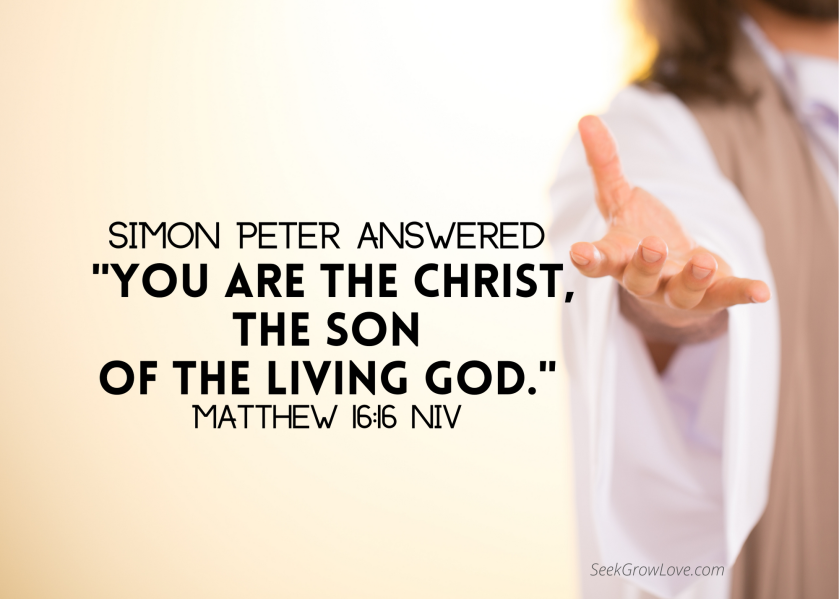
Jesus recognizes that there are key things that the disciples need to know and understand, specifically relating to his death and resurrection. But also, the big picture needs to be in view. Jesus asks Peter, who do people think that Jesus is, and he spits off a few theories, but then Jesus asks Peter who he thinks Jesus is, and he answers: You are the Christ, the Son of the living God.
Big Picture. None of the things that Jesus shows and teaches Peter and the disciples will be impactful without this pig picture. Jesus is the Son of God. Jesus is the Messiah. This confession is the foundation of the Church. We’re not always going to agree on everything, but we must agree on this primary fact: Jesus is the Savior, and in Him we must put our faith and hope.
Reflection Questions:
1. What distracts you from the big picture?
2. Does your need to know how sometimes distract you from simply accepting what you read in scripture?
3. Have ingrained habits or false things that you have been taught stood in your way of implementing your faith in every aspect of your life? Take a step back and look at the big picture in scripture and weigh your thoughts against what you see in the Bible.
Yet another day filled with nonstop demands. Coming off of the Sermon on the Mount, Jesus was besieged by disciple gathering, teaching, preaching, casting out demons, raising the dead, calming the sea and continually surrounded by crowds with physical and spiritual needs. As people were clamoring for his attention, he was able to pivot toward the need, to be present in the moment and respond to the need whether it was physical, emotional or spiritual.. He was taking a quick break to eat when Jairus, a leader of the local synagogue came to Jesus with a big request. His daughter had just died and he was asking Jesus to come to his house to raise her back to life. Understanding the urgency, Jesus got up from his meal and started walking toward Jairus’ home.
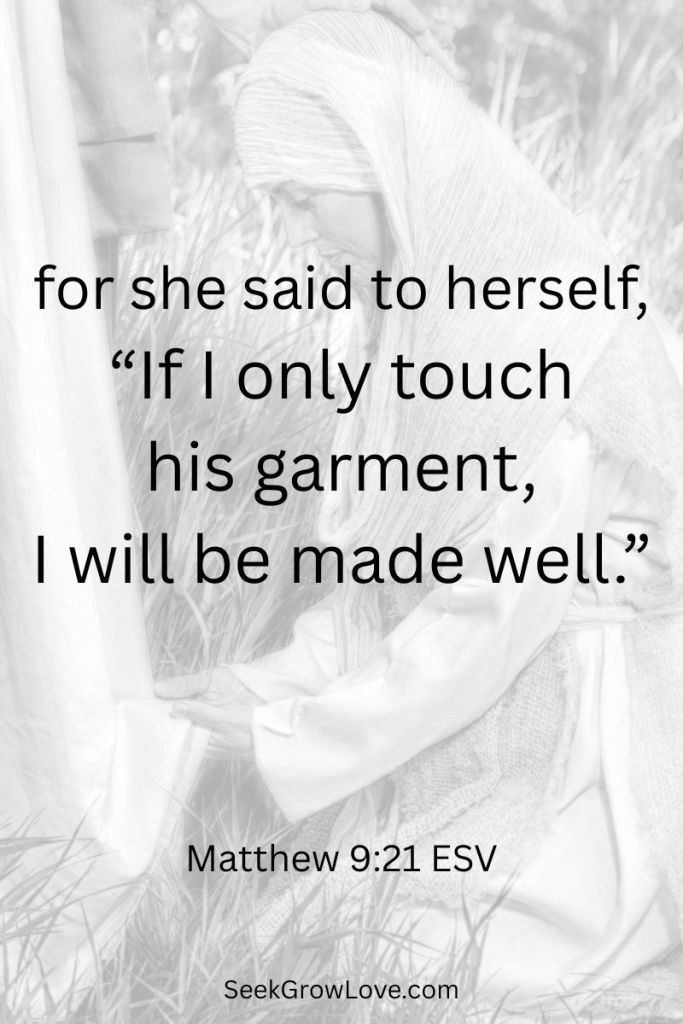
The crowds were pressing in on him, jostling as he tried to move forward. But he suddenly stopped and said, “Who just touched me”? The version of this story in Luke indicates that his disciples thought this was a ridiculous question as many in the crowd had been touching him. Yet, this touch was different because Jesus immediately felt power surge from him. He turned and identified the one who touched him as a woman who had been hemorrhaging for 12 years and was hanging on by a thread. She had searched for help, but because she was bleeding was considered unclean with no one allowed to touch or help her. She had heard about Jesus and knew that he was her only chance. Being desperate and determined, she fought her way through the crowd with the belief that if she could only touch the hem of his robe, she would be healed. In Jewish culture, the hem or fringe of a garment, known as the “tzitzit,” held religious significance as a reminder of the commandments of God. The act of the woman reaching out to touch the hem of Jesus’ garment can be seen as an expression of her faith in His divine authority and power to heal. Her belief that merely touching His garment would result in healing underscores the depth of her faith and the recognition of Jesus’ messianic identity. She was very deliberate in her action, one that was fueled by her faith. He looked at her with compassion. He saw so much more than she saw, so much more than others saw. He saw a woman who had enough faith to reach out despite her unclean condition. He saw great faith from one who was marginalized, a woman who was bleeding.
In that moment, she was not only healed of her physical problem, but she was also healed spiritually and emotionally as Jesus addressed her as daughter. No longer was she unclean or an outcast, she was included in his family and found a place where she could now belong. Jesus saw in her a great faith and knew that she had come to him out of desperation, with determination and with her intentional act of faith, received her healing. It was a small, seemingly insignificant act, that resulted in her transformation, both physically and spiritually. This woman, who acted with the courage, deliberate action and with the intention to connect with the Son of God was transformed from an outcast to a daughter and one who has traveled through history to reveal to us an example of great faith.
Questions for reflection
Imagine yourself in the crowd that day. People were pushing and jostling Jesus, perhaps wanting to see what he was going to do with the daughter of Jairus. How do you think the crowd reacted when he stopped to look at this woman who was unclean?
What characteristic of this woman in the story do you find most intriguing?
Why do you think she was focused on touching his garment rather than addressing him directly?
Have you ever had a time where you felt on the “outside” or marginalized like this woman? How do you think she reacted when he called her “daughter”?
What insights about faith demonstrated by this woman can we gain about our own faith?
How determined and intentional are you about your own faith?
It had been a flurry of activity and much of it miraculous. Following the Sermon on the Mount we see the healing of the Centurion’s servant, healing Peter’s mother-in-law, and then crowds overwhelming him for healing of the sick and casting out spirits. He was exhausted and knew he needed rest, so moved onto gathering his disciples in a boat and set out on the Sea of Galilee with his disciples to escape the pressure of the crowds. He quickly fell asleep, oblivious to a building storm. The boat was buffeted about in the wind and waves; the storm so strong that it was described as cataclysmic or a mega storm. The disciples, several of whom were fishermen and used to life on the sea, became frightened, fearing they were going to die. In their fear, they woke Jesus, crying that they were about to perish. His first response was to respond, “Why are you fearful, you of little faith?” He then gave the command for the wind to abate and the waves to calm, a remarkable illustration of power over the elements. Jesus often used that phrase “little faith” to challenge his followers. He is saying just look at me and see what I can do. . . that is what a mature faith looks like. A big faith, one that is developed, is one where eyes and heart are fixed on the master of the wind even in the midst of the storm.
Fear is something that we are well acquainted with. Our brains are wired to look for threats to help ensure our survival. If we are walking through the woods and a bear jumps out, it triggers a fight or flight response to help us react in a way to help us survive—either fight the bear or hope we can run faster than our companions. The disciples, in the midst of this storm, feared for their life—they were in a fight or flight response. Jesus, however, took this opportunity to teach a lesson about faith. These disciples had just been witnesses to incredible miracles; yet in their immature faith, were afraid for themselves. We’ve all been there, finding ourselves in the midst of life’s storms and being battered by circumstances beyond our control or even by our brain’s proclivity at conjuring up imagined threats to our wellbeing. Consequently, it is easy to get caught up in a cycle of fear and anxiety about our lives. A loved one becomes ill, someone loses a job, financial problems hang over our heads, and in addition, we are caught up in a myriad of “what ifs”. What if I fail? What if my relationship falls apart? What if I disappoint others? And the list goes on and on in our weary brains. Jesus speaks to us as he did to his disciples. . . what about faith? Where does your faith impact your fears in your life? How would it feel to have some freedom from the fears that seem to plague us? Faith does not pretend that a storm does not exist. It does not exempt us from efforts to take care of ourselves and others. Faith ensures that we are not overcome with anxiety, stress and worry. Faith allows us to focus on Jesus who provides the calm in the midst of our storms.
Questions for reflection
What are some of the storms you are experiencing right now?
Imagine yourself in the boat with the disciples. How overwhelming does that fear feel? How would you respond to Jesus commanding the storm to abate?
Jesus uses the phrase, “little faith”. Where are you in your faith journey? Do you feel like your faith is growing and developing into a more mature faith?
How is your faith impacting some of the fears you are experiencing in your life? How do you think you can find the peace within the midst of your storms?
Storytime when putting the grandchildren to bed is the best. One of my favorite books is called “Tale of Two Beasts”. In the story, a little girl is walking through the forest and finds a small beast hanging upside down from a branch. She decides to take this little one home and turn him into a pet. The book first tells the story from the perspective of the little girl. The second part of the book tells the story from the perspective of the little beast. Gradually, the two tales come together in a happy ending as they learn to appreciate one another despite their differing perspectives. I love the book because it teaches something I think is important and that is to step back and consider the perspectives of others throughout life. Many, if not most, children’s books attempt to teach a lesson through storytelling. In Matthew 13, we see that Jesus knew the power of stories in teaching abstract principles through parables. He knew that using parables was an effective way to communicate profound truths about faith and life. He merely looked around him and identified familiar elements and characters like farmers, fishermen, bread making, and harvesting crops that could be used to help his listeners understand deeper spiritual truth. Using learning principles that we’ve identified today, he uses metaphors and similes to draw comparisons of the everyday to deeper spiritual truths. These stories stay with us and help us to understand and remember what Jesus wanted us to know. The stories told over 2000 years ago still have relevance to us today.
The beautiful thing about parables is it teaches a truth that at first glance seems simple yet allowing for increasing layers of understanding. Like the layers of an onion, a parable provides layers of depth and nuance that with reflection and application can reveal increasing insights while challenging individuals to grapple with the truths and grow from them. Jesus is using these stories to turn the listener into a participant rather than just the audience—the best way to learn. Parables Jesus shared are sprinkled throughout the gospels; Matthew 13 contains several significant ones teaching about faith and the Kingdom of God.
Parable of the Sower: A sower scatters seeds on different types of soil; the path, rocky ground, thorn and good soil with each type of soil representing different responses to the message of the Kingdom of Heaven. It asks, “How do you receive the message of the kingdom?”
Tares and the Wheat: The combination of tares and wheat together teach lessons about the coexistence of good and evil in the world, emphasizing the importance of discernment and patient waiting. It asks, “How do you understand and identify between good and evil?”
The Mustard Seed: Just as a tiny mustard seed can grow into a large plant, even the smallest amount of faith can be transformative. It asks, “How does your faith, even if it is found in small belief and actions, lead to significant outcomes?”
The Leaven: A woman mixes leaven into the dough causing it to rise and transform into a delicious loaf of bread just as the message of the Kingdom of Heaven can gradually and irreversibly alter the world. It asks, “How can you be influential by sharing the message of the Kingdom of Heaven?
Hidden Treasures: A man discovers a treasure and recognizes its value, selling everything to buy the field where the treasure is hidden. The discovery of the message of the Kingdom of Heaven is a remarkable treasure that is worth sacrificing everything to obtain it. It asks, “What are you willing to sacrifice to pursue the incomparable value of the Kingdom of Heaven?”
Costly Pearl: A merchant is actively searching for fine pearls and when he finds one of great value, sells everything he has to purchase it just as a person searches for truth and spiritual connection. It asks, “How are you diligent in your search for truth and are you willing to give up everything to make it yours?”
The Dragnet: The fisherman casts out a net that gathers in all kinds of fish, just as the message of the kingdom will gather in all types who will eventually be subjected to God’s judgment. It asks, “How do you respond to the “all types” gathered together by the gospel message”?
As you engage in these stories, immerse yourself in the “world” that Jesus is creating for us. If it is the Parable of the Sower, imagine yourself walking through the field and seeing where the seeds you scatter are landing. If it is “The Leaven”, imagine that you are the one making the bread and leaven to make it rise. Becoming a part of the story will allow you to deeply engage with the lesson Jesus is teaching. Approach them with an open heart and mind, asking, “What can I learn and take away from this story”. Reflect on the story and connect the teachings with your own life asking, “How is what I am learning impacting my faith, my relationships and my behavior”? The ultimate test is to begin to apply what you have learned and allow those insights to change how you live.
Questions for reflection
Which of these parables resonate most closely with you?
Focus on one parable. Imagine yourself in the context of the story and immerse yourself for a moment in the action. How does that impact your understanding of the parable?
If Jesus was walking through your world today, what might he choose to build a parable around?
How do you think a parable might increase your faith?
Take a look around you. You might see people who are exhausted and depleted by life and all the challenges it brings. You may hear phrases like “I never have enough time”, “There is always too much to do”, “I’m always stressed about money”, “I am feeling so isolated and lonely”, “My anxiety is paralyzing me”. Those common phrases bear witness to people who are struggling to manage life burdens and feeling continually overwhelmed with no relief in sight. All of us feel the weight of life at times whether it be physical exhaustion, emotional depletion, or spiritual unrest. Jesus had been teaching his disciples and followers that the law only brought burdens, but a relationship with him provides the freedom and lightness that comes with shared burdens. The passage we will explore out of Matthew 11 offers hope in the midst of life challenges.
It begins with an invitation from Jesus to “come”. It’s a simple imperative statement. It’s not a question or a plea—it is a gentle command to connect with him and to create a relationship with him. It is an invitation to bring whatever is weighing you down and share the burden with him without shame, guilt or fear. He is inviting us into a safe space where he will share the burden and offer some respite to you from bearing it all yourself.
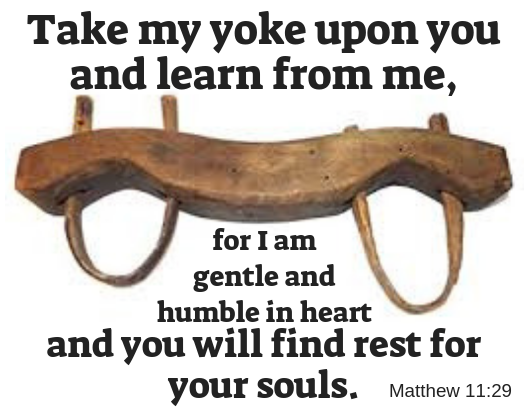
With this invitation comes the metaphor of putting on a yoke with him, which at first glance, may feel like even more of a burden and more constrictive. He uses a yoke as a metaphor to help us picture the beauty of that “shackling”. A yoke joins two animals, such as oxen, together so that the animals can share the workload and become more productive. The farmer may choose to shackle an older ox with a younger one or an unruly one with one that is steadier in order to help them both in the work. The biblical scholar William Barclay describes the creation of a yoke by a carpenter who measures the ox and followed by several fittings, creates a customized yoke that gives the ox comfort while he works. He also says that there is a legend about Jesus which may or may not be true, that as a carpenter, Jesus had a reputation of making some of the best yokes in the region and had a sign about his door that said, “My yokel fits well”! Fact or fiction, this is the type of yoke that he is inviting us to take on with him—one that is comfortable, that allows him to lead and gives us relief from bearing burdens by ourselves.
In the book, The Ragamuffin Gospel, Brennan Manning addressed a specific audience, and as it happens, the same audience Jesus’s invitation is for. He said that the “ragamuffin gospel” is for:
The bedraggled, beat-up, and burnt-out. It is for the sorely burdened who are still shifting the heavy suitcase from one hand to the other. It is for the wobbly and weak-kneed who know they don’t have it altogether. It is for inconsistent, unsteady disciples whose cheese is falling off their cracker. It is for poor, weak, sinful men and women with hereditary faults and limited talents. It is for earthen vessels who shuffle along on feet of clay. It is for the bent and the bruised who feel that their lives are a grave disappointment to God. It is for smart people who know they are stupid and honest disciples who admit they are scalawags.
What would it look like if we actually did this? We wake up in the morning knowing that we can’t bear the burden of the day and just simply asked him to share the burden? How would your life be different?
This is an invitation to join with Jesus who describes himself as gentle and humble in heart so that we might find rest for our souls. In this, he will equip us, teach us, support us, relieve us and guide us as we live our lives. It is a clear path. . . Come to him, Take his yoke, learn from him, and find rest for your weary soul.
Questions for reflection
What is your initial response to the command to “come”? What then is your initial response to be “yoked”?
Why do you think we tend to handle our burdens by ourselves? Why might we hesitate to share the burdens with Jesus?
When you think about being “yoked” together with Jesus, does that feel constrictive or freeing? How do you think you could more intentionally share your burdens as a result of this invitation?
It might take a lot to surprise Jesus, but surprised and amazed he was. We could initially assume that this reaction was directed toward his disciples. Perhaps it was from a crowd’s reaction to one of his teachings. Maybe, just maybe, it was due to an interaction with a rabbi in a synagogue. Instead, we are told that he “marveled” at the response of a Roman soldier, an unlikely scenario. People in the area were abuzz with the news of the teachings and miracles of Jesus. This talk had reached the ears of a Centurion, a Roman soldier that oversaw 100 soldiers occupying the region. This centurion, likely well versed in the pantheon of Roman gods, heard news of the one claiming to be the son of the living God. This powerful man, when his servant became ill, decided to seek out this Jesus by asking a group of Jewish elders to intercede on his behalf. They were willing to do so as this Centurion had helped them build a synagogue. This intercessory group met Jesus as he entered the town and presented the request, at which time Jesus set off to the Centurion’s house. He had just been teaching the concept of “loving your enemies” and here he was heading to the home of a Roman. As they drew close, they were met with another group of emissaries with the message that the Centurion did not feel worthy to have Jesus in his home, but believed that he could just say the word and the servant would be healed. Jesus was astonished. Here was a Roman, a man of authority, a pagan, and an enemy of the Jewish people who had enough faith to believe that Jesus could heal with a word. The Greek word “thaumazo” used to describe the reaction of Jesus to this man’s faith is translated as “amazed” or “marveled”. The only other time that this word is used in the New Testament is when Jesus “marveled” at the lack of faith of those in Nazareth. This centurion was an unlikely person to “amaze” Jesus, yet Jesus described him as having “great” faith. In other places, Jesus describes “little” faith in describing his disciple’s response to him. Little faith from the disciples; great faith from the Centurion. He demonstrated great faith by believing without seeing, stepping out of his culture and authority to humble himself, and trusting what he had heard about Jesus. As a man of authority, he understood the power of the authority that Jesus had and had confidence to make the request of him. Such confidence is the essence of faith. It is that confidence that prompted Jesus to respond with “Truly I tell you, I have not found anyone in Israel with such great faith”.
Questions for Reflection
In what ways were the actions of the Centurion a surprise in this story? How did he act differently than what we might expect of a man in his culture and situation?
What prompted the Centurion to make this request? Why do you think he was reluctant to approach Jesus directly? What did this tell Jesus about this man?
Why do you think Jesus marveled at this request? Why did he identify this man as one with great faith?
When looking at your own faith, where would you place it on a scale of “little faith” to “great faith”?
How do you think you could grow your faith into one that was considered “great”?
It was a warm day by the Sea of Galilee as Jesus and his disciples rested, ate and talked. They had been on a rigorous schedule following the launch of Jesus’s ministry. Word about the healings and teachings had spread and people were intrigued by this new itinerant preacher who was sharing a new message about the Kingdom of God. Folks from all around the region began to seek him out and as Jesus noticed the gathering of the crowds, he moved up the hill to a place where the crowds could see and hear him. He began to speak, resulting in what we know as the Sermon on the Mount. He spoke about the Kingdom of God in a way they had never heard before, turning everything they knew about religion, the law and the kingdom upside down. Donald Kraybill in his book, The Upside Down Kingdom, describes how Jesus presented an introduction to the Kingdom of God that was totally opposite of what the world’s definition might be. In these teachings, Jesus provided a vision of what a life lived with the Kingdom of God in their minds and in their hearts might look like. Instead of a focus on following the law, he called for the transformation of their hearts and lives.
The upside down kingdom, as described by Jesus, included flipping their perspectives in several ways:
In a world where power, money, status, aggression, revenge and self-centeredness were valued, he provided a new perspective in the Beatitudes where those who were poor, sad, without status, gentle, forgiving, merciful and looking for peace would be the very ones who were blessed, happy and would receive the ultimate rewards.
The keys to the kingdom were found in sharing your light with the world. That light was not just keeping the law but letting others see the change in your heart and life.
Keeping the law was not just about following the rules but about creating relationships which reflected the love of Jesus and one another. You choose not to covet for example, not because it is a rule, but because it destroys relationships. Loving God is fleshed out in loving your neighbor by respecting them, sacrificing for them and even loving those you consider your enemies.
He encouraged them to pray with a focus on building a more personal and intimate relationship with God by providing a template with The Lord’s Prayer.
Instead of focusing on the temporary and insubstantial values of the world, our attention should be on those values of the Kingdom of God which are lasting and substantive.
In a world that is filled with anxiety about the future, Jesus reminds them that this worry is just a waste of time and energy. Instead, if you focus on seeking the Kingdom, these other things will fall into place.
We are called to an upside down kingdom where transformed lives allow people to begin to experience the Kingdom of God. Jesus provided a vision of what a transformed life looks like so that followers can begin the journey toward that destination. Those steps in that journey come with every intentional decision and choice we, as followers, take. If I want to reflect God’s kingdom, then I choose to spend time in prayer, focus my time and energy on kingdom values, treat the poor and marginalized with kindness and on and on. Every choice moves us in the direction of more fully reflecting the Kingdom of God in our lives. Every thought, belief and action is an opportunity to more fully reflect that transformed life.
Questions for reflection:
How does the term “upside down kingdom” impact how you read the teachings of the Sermon on the Mount?
Which of the teachings contained in this sermon resonate with you?
How do you respond to the idea that each day we are faced with opportunities to intentionally transform into the vision that Jesus has created?
It’s easy to become overwhelmed with the need for transformation and just shut down. How does it make you feel if you approach it as one decision or choice at a time?
What is one area of your life where you would like to work on transformation?
The name Ezra comes from a Hebrew word that means “help.” Ezra was a man of integrity, trusted by the king. Most importantly, though, Ezra was a man of God. He committed himself to knowing the Word of God. In Ezra chapter 7, verse 10, it says, “For Ezra had set his heart to study the Law of the Lord, and to do it and to teach his statutes and rules in Israel.” So not only did Ezra study the Word, but he lived it out so he could share his knowledge and heart with others – in this way he embodied what it truly means to be a helper.
Paul says in 1 Timothy 4:2 to “preach the word; be ready in season and out of season; reprove, rebuke, and exhort, with complete patience and teaching.” This is exactly what Ezra did. He knew the Word so he could then go out and teach it. When Ezra is sent by the king to Jerusalem, he finds the Israelites in bad shape. They had been disobedient to God, neglecting all of His ways. Ezra was equipped and ready to handle this unexpected discovery because He knew God’s word inside and out. He set about helping the Israelites find their way back to God. He was a true leader; he cared about people, lifted them up, prayed for their repentance, taught them the Word, and showed them how to live out a life of faith.
In all areas of my life, I want to be like Ezra. I pray and hope people see me as someone with integrity, someone they can trust. I want to know God’s word and keep it in my heart, so I am prepared to help in all seasons. Above all, I want to share God with others and proclaim His goodness, mercy and love.
Reflection Questions:
Have you committed yourself to knowing the Word? How do you study it? How do you best commit it to your heart?
Have you ever known a great leader? In what ways was this person like Ezra? What wisdom did that person impart to you?
This world needs more Ezras. How can you be more like Ezra today in your walk with God?
Sometimes (usually in the midst of a scuffle with technology) I wonder if living in 2025 is really for me. Maybe I would have been more suited for life in the 1800s, living life on the prairie. But then I remember how much I love indoor plumbing.
I kid, but in all seriousness I wonder, do you ever feel this way, too? Why are you placed in the here and now? For me, feeling equipped doesn’t always come easy. My guess is that you often feel the same. The world moves quickly and so much is happening…and sometimes I feel a bit helpless. What can I even contribute to the story? Where is my place here?
I bet this, in part, is what Esther wrestled with when Mordecai relays to her in chapter 4, verse 14, “And who knows whether you have not come to the kingdom for such a time as this?”
At first, she was in fear of her life, knowing that if she approached the king she would likely be put to death. In no way did she feel prepared to do what Mordecai asked of her – as if she was in a position to approach the king as anyone special. But, when Mordecai reminds her of what is at stake, she is convicted and courageously decides to take action.
I want to confront my insecurities and fears like Esther. Whether I’m facing a small task or a life-altering one, I want to show up for God. Because He told me, I know that I am made in His image, and He has placed me here, in this place and at this moment, for His purposes. I want to be an instrument He can use to further His Kingdom. How about you?
Reflection Questions:
Have you ever felt inadequate or out of place? What did you do in response to that?
Has there been a time in your life when you were called to be brave, like Esther, beyond your own strength? How did you experience God in that moment?
What is God calling you to do today? How can you be courageous and embrace what He has for you?
When was the last time you were faced with the question of readiness? Ready to make a career change, get married, have a baby, retire, begin a new ministry? When, if ever, are we 100% ready? If we’re honest, I’d say almost never. We can make the decision, though, to prepare ourselves and make progress every day towards that next step. Will we make mistakes? Yes. Will we stumble? Of course. But, if we commit our hearts, relying on God to guide us in the journey, we can trust that He will equip us for all we need. Like Paul reminds us in Romans, God works for the good of us in all things, as long as we are living for His purposes.
So today brings us again to Zechariah, and a similar question he asks the Israelites on behalf of God. He asks them if they are ready to be the kind of people ready to receive God’s Kingdom. The Lord says, “These are the things you are to do: Speak the truth to each other, and render true and sound judgment in your courts; do not plot evil against each other, and do not love to swear falsely…” (Zech 8:16-17)
Like asking ourselves if we are ready for the next step in this earthly life, Zechariah’s question is one we can ask ourselves today regarding our Kingdom life. Are we ready to be the kind of people ready to receive God’s new Kingdom here on earth? Our hearts should be thankful for His guidance and pure in our intentions, desiring to obey God’s word and striving to be the kind of people He calls us to be.
Reflection Questions:
Are you ready to be ready for the Kingdom to come? Check your heart.
What can you do today to become more ready than you were yesterday?







 Seek Grow Love