
Old Testament: 2 Chronicles 31-32
Poetry: Psalm 105
New Testament: Titus 3
Life is so busy and complicated that I have to create lots of reminders for myself. Fortunately, my phone and computer and watch all have features where I can set reminders for myself. “Doctors appointment Tuesday at 3:00. Take the garbage to the dump on the way to work in the morning. Stop by the store after work and pick up some milk and bread.” I can even set reminders months or years in advance. I can set alarms to remind me that in 2 hours I have a meeting. In 1 hour I have a meeting. In 15 minutes I have a meeting. The Meeting is now starting. Maybe I’m too busy or maybe I’m getting old, but I find myself more and more needing reminders.
Do you ever need reminders? Little kids need to be reminded to brush their teeth, make their bed, do their homework. What do you need reminders for?
The Apostle Paul thought reminders were important for Christians. I guess he understood how easy it can be to forget what’s important when we are busy living life and doing what’s necessary or urgent. Do Christians ever forget important things about God, about Jesus, about how we are supposed to live? Yep, we sure do.
In Titus 3 Paul tells Titus to remind the believers of some important things.
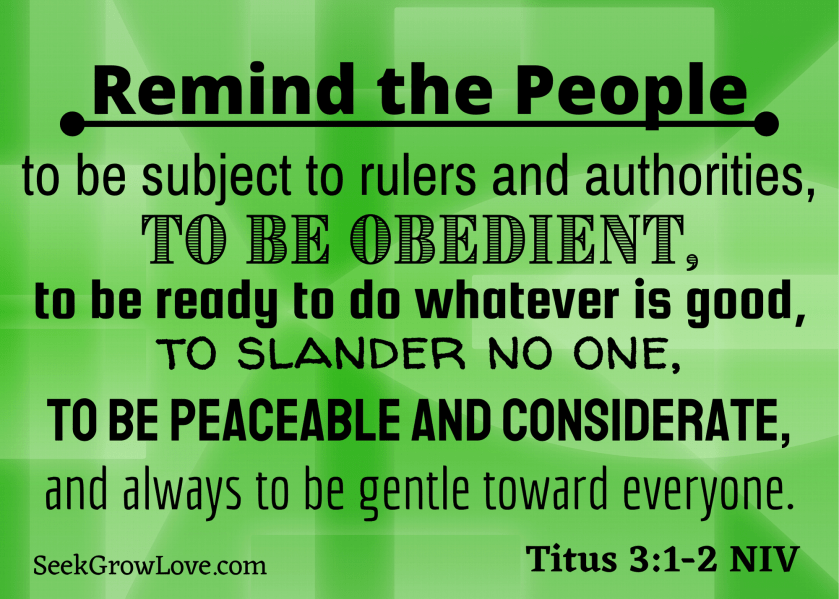
“Remind the people to be subject to rulers and authorities, to be obedient, to be ready to do whatever is good, to slander no one, to be peaceable and considerate, and always to be gentle toward everyone.” -Titus 3:1-2
Those reminders were important in the first century when Christianity was brand new and people were still learning the basics, but it’s been 2000 years. We’ve certainly got being a Christian all figured out by now, don’t we? Do we really need to be reminded to obey people in authority? Do we need to be reminded to always be ready to do good? Don’t all Christians always do what is good? Certainly we never slander or falsely accuse someone of wrong doing. I’m always peaceable and considerate and gentle toward everyone, aren’t you? (My tongue is in my cheek- that means I’m kidding).
To tell the truth, I still need to be reminded of all of those things. Just because I’ve been reading the Bible for over 50 years doesn’t mean I always remember to do good. I still need to be reminded to be considerate and gentle, and so do you. That’s why Christianity was never designed to be lived in isolation, but in community. We need each other. There’s a passage in Hebrews (a different book from today’s reading, but important) Hebrews 10:24-25 says that Christians shouldn’t get out of the habit of meeting together, because we need to encourage (I think Hebrews says “spur one another on”, like a rider spurs on a horse) each other.
Following Jesus is hard some times. Being obedient to God is hard some times. Remembering to do good and be gentle is hard sometimes. I need help, I need encouragement to keep on doing what is right. I need you, and you need me, we need each other.
I’ve read the Bible many times in my life and I need to keep on reading it to help me remember all the important things I need to remember. Today’s readings in Isaiah 63-64 and Titus 3 remind us both about God’s wrath and about God’s mercy. God has both. God hates sin, he hates it when his children are brutal to each other. He hates it when his children fight and argue. He hates sin because he loves us and he knows that sin hurts us. We hurt each other when we sin. No parent likes to see their children hurt each other. We learned that from our Father, God.
So keep reading your Bible and keep coming to Church and meeting with other believers so that you can remind them and they can remind you to keep on following Jesus.
“Hey Siri set a reminder for 7 a.m. tomorrow: be considerate and gentle to everyone.”
“Alexa, remind me to get up for Church Sunday at 8:00.”
-Jeff Fletcher
(Originally posted here on October 4, 2021 – when we were reading Titus and Isaiah together. This year, we get to start Isaiah tomorrow.)
Reflection Questions
- What do you need reminders for?
- Look at the list of things Paul told Titus to remind the people to do. For each one ask yourself why is this important and how well am I doing this? If you were to choose one to focus on reminding yourself to do for the next 14 days, which one needs your most attention right now?
- What is your attitude toward those who give you reminders?
- How can you encourage others to do what is right?

 Seek Grow Love