An Important Letter

Titus 1-3

Devotion by John Tullis (OH)

Everyone likes to get a letter in the mail!  Especially around Christmas time.  Getting a letter from a friend or loved one might seem old fashioned, but letters have a way of being more personal and intimate.  Receiving a letter from a mentor or person you respect is especially important when the letter includes an important message. 

The Book of Titus is a letter written by Paul to his “true son in the common faith” Titus.  Titus was an early Christian leader and a close friend of the apostle Paul.  He is best known as being the leader of the churches in Crete and Corinth.  He was sent by Paul to these churches to help them solve problems.   In this letter, he asks Titus to ask the people in the churches to stop arguing with each other over silly things and to focus on doing good things in the name of Jesus.

To help the church at Crete, Paul sent recommendations on how to pick good leaders to look after the church (Titus 1:5-9).  Having leaders who are qualified is important in leading a church.  Like shepherds of a flock of sheep, the “elders” of the church look after us and protect us from making mistakes that can harm us.  Their job is to help us do good works for God.

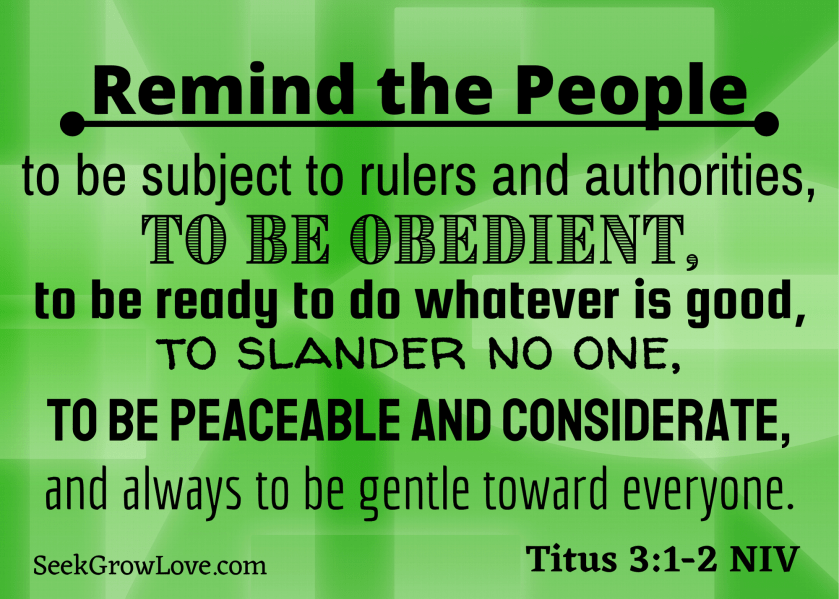
Paul also reminds us that we should always do good because we are Christians. Paul writes that the grace of God “teaches us to say ‘No’ to ungodliness and worldly passions”.  As Christians we should always seek to serve other people and be good to them.  Sometimes it is hard to live obediently for God.  Paul asks us to be “self-controlled” and live upright and godly lives.  It’s not easy, but God wants to help us and to “purify for himself a people that are his very own, eager to do what is good”. (Titus 2:11-15).

It is important to always remember that God has shown His mercy to us not only because He wants us to be good, but so that He could adopt us into His family.  Paul hopes that each of us “might become heirs having the hope of eternal life” (Titus 3:7).  Living a godly life is how we declare our thankfulness for His great mercy.  As we accept God’s gift of grace, it makes us want to do good things for the Kingdom of God.

Questions for Discussion:

  1. In Titus 2:2, what does it mean to be “self-controlled”?
  2. What does Paul mean when he says to “avoid foolish controversies” in Titus 3:9?

True Fellowship

Romans 8-10

The book of Romans has been called the Magna Carta of the Word by many writers when they describe the freedoms that God shows us in its pages.  Romans 8 is the start of a transition from the doctrine of salvation that is presented in Chapters 1-7.  Chapter 8 is about walking in the spirit and what true fellowship with God is based on.  Chapter 9 moves to a section that is concerned with Israel and their relationship to the church and salvation in Christ.

Chapter 7 ends with these verses where Paul tells us of his frustration with his walk of believing
Romans 7:21-25. I have discovered this principle of life—that when I want to do what is right, I inevitably do what is wrong. 22 I love God’s law with all my heart. 23 But there is another power within me that is at war with my mind. This power makes me a slave to the sin that is still within me. 24 Oh, what a miserable person I am! Who will free me from this life that is dominated by sin and death? 25 Thank God! The answer is in Jesus Christ our Lord. So, you see how it is: In my mind I really want to obey God’s law, but because of my sinful nature I am a slave to sin.

Paul has trouble with his Christian Walk???

But then Romans 8 begins with this contrast of truth about who we really are in Christ:

Romans 8:1-4(NLT) So now there is no condemnation for those who belong to Christ Jesus. 2 And because you belong to him, the power of the life-giving Spirit has freed you from the power of sin that leads to death. 3 The law of Moses was unable to save us because of the weakness of our sinful nature. So God did what the law could not do. He sent his own Son in a body like the bodies we sinners have. And in that body God declared an end to sin’s control over us by giving his Son as a sacrifice for our sins. 4 He did this so that the just requirement of the law would be fully satisfied for us, who no longer follow our sinful nature but instead follow the Spirit.

The transition that we are being taught by Paul is that when we walk in fellowship with God, then we are able to overcome our sin nature.  We will be without condemnation when we are guided by the spirit of God that He has given us.  Our spiritual nature of Christ in us gives us the power and ability to do the will of God and do good in this world.  

We have Christ in us when we are born again by God’s spirit but our daily walk with God is one of obedience to fellowship with Him, or disobedience to living without God’s fellowship.  Christ walked in perfect fellowship with God and because he always did the Father’s will, he was not condemned by the law.  

What are the ways we can grow in our ability to be in fellowship with God and His Son?

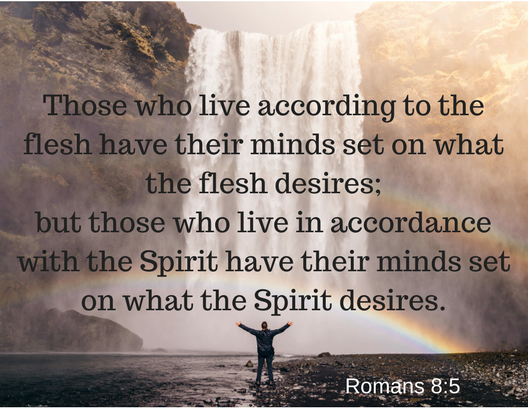
Romans 8:5-6(NLT) Those who are dominated by the sinful nature think about sinful things, but those who are controlled by the Holy Spirit think about things that please the Spirit. 6 So letting your sinful nature control your mind leads to death. But letting the Spirit control your mind leads to life and peace.

The Old Testament law really is a law of life, but the Pharisees and scribes had turned it into a law to control people politically and physically.  Look sometime at the undoable complexity of the rulemaking in the Talmud and Mishnah.  Those regulations are only to control people from a human standpoint.  Jesus Christ does all of God’s intentions for the true interpretation of the law of Moses.  He is judged righteous by God because of his obedience.  God gives to us the righteousness of Christ when we confess him as lord and savior.  

Romans 10:9-13(NLT) If you openly declare that Jesus is Lord and believe in your heart that God raised him from the dead, you will be saved. 10 For it is by believing in your heart that you are made right with God, and it is by openly declaring your faith that you are saved. 11 As the Scriptures tell us, “Anyone who trusts in him will never be disgraced.” 12 Jew and Gentile are the same in this respect. They have the same Lord, who gives generously to all who call on him. 13 For “Everyone who calls on the name of the LORD will be saved.”

Our salvation is received by grace from God and is not dependent on our works or actions before that point.  We cannot earn our salvation, but we receive it by trust that Christ is what we need in our lives.  To confess him as lord is to say fully in our hearts that we cannot do this ourselves but will follow and obey him.  Many denominations have reduced this as a simple confession of “Jesus is Lord”, but to truly say this declaration it means that I understand the complete futility and incompetence of my own efforts.  I need the righteousness that comes only from God in Christ to overcome the sinful person who is me.

What righteous thing have you done that will impress God with your goodness?

Before or after the point of your salvation?

Grace from God is the only way to fellowship with Him.  We can approach the throne of grace because the righteous son of God is there to advocate for us.  God sees us with the righteousness of the Christ in us and then we are able to have fellowship with a righteous God.  By our own efforts we fall completely short of this.  That is why we are able to walk with no condemnation from the law of Moses or the law of slavery to sin that we are delivered from. 

Why do we need Christ’s intercession with God on our behalf?

Have a victorious day today walking in fellowship with God with Christ beside you.

Romans 8:38-39(NLT) And I am convinced that nothing can ever separate us from God’s love. Neither death nor life, neither angels nor demons, neither our fears for today nor our worries about tomorrow—not even the powers of hell can separate us from God’s love. 39 No power in the sky above or in the earth below—indeed, nothing in all creation will ever be able to separate us from the love of God that is revealed in Christ Jesus our Lord.

Only God’s love can change us and this fallen world.  Thanks be to our God that He truly loves us so much to save us and take care of us each and every day.

Love in Christ – Tom Siderius

See Reflection Questions Above

Hearts Far from God

Isaiah 28-30

July 11, 2025

              Within the contents of Isaiah 28-30, there are a few verses that stick out to me that I think are worth dwelling on. The first of those is Isaiah 29:13 which reads:

 [13] And the Lord said: “Because this people draw near with their mouth and honor me with their lips, while their hearts are far from me, and their fear of me is a commandment taught by men, – Isaiah 29:13 (ESV)

I think this verse describes what is happening a lot in the Church today. Many of us, me included, are guilty of claiming with our mouth that we are living holy and righteous while not giving up the areas we need to improve. I don’t want to be someone always ready to give a good answer, something that sounds intelligent, ready to glorify God, but do not live out what my mouth claims. I don’t want to be someone who is ready to sing a worship song but not ready to forgive the person who has wronged me.

The next verse I wish for us to dwell on is Isaiah 29:19.

 [19] The meek shall obtain fresh joy in the LORD, and the poor among mankind shall exult in the Holy One of Israel. – Isaiah 29:19 (ESV)

              This verse can act as an encouragement for some and a warning to others. Whether you are rich or poor, strong or weak, short or tall, educated or uneducated, I think this verse tells us to adopt a mindset of being humble. Throughout the Bible, over and over, God helps those in need and sympathizes with the struggling. Especially in America, it is so easy to live in comfort and the mindset of self-reliance. We blind ourselves with the things we possess or the abilities we have and try to forget how much we depend on God. Let us remember that God will make great the meek and lift up the lowly.

The last verse that I want to cover is Isaiah 30:18.

 [18] Therefore the LORD waits to be gracious to you, and therefore he exalts himself to show mercy to you. For the LORD is a God of justice; blessed are all those who wait for him. – Isaiah 30:18 (ESV)

When we receive God’s grace it is freeing to know that despite all that we have done that is evil, God still chooses us and extends forgiveness toward us. Sometimes it is hard to see that God is gracious with us. We constantly need to be reminded of the fact that God will be gracious with us if only we would turn to him and allow his grace to change us.

Application Questions:

If you have received grace from God, how does your life reflect that?

Who is someone who needs to hear about God’s grace today?

Will you be a talker or a doer of following God?

-Jeremiah Grable

Power & Pride OR Loyalty & Compassion

2 Samuel 8-9

1 Chronicles 18

I bet we all have experience with someone who is prideful.  We’ve heard stories of wildly successful people, and in their triumph, they forget the people who helped them get there.  

In 2 Samuel 8, we hear about some of David’s great victories in battle- he’s at the top of his game- a picture of power and achievement.

Then, in stark contrast, chapter 9 gives us a glimpse at a softer and more compassionate side of David where he actively looks for someone “from the house of Saul to whom I can show God’s kindness?”  David remembers the promises that he made to Jonathan and, in his moment of power, chooses kindness over vengeance. David easily could’ve broken his promise and basked in his victories- instead, he extended grace to a man who could offer him nothing in return.

This act of unexpected mercy shines a light on David’s character, revealing a heart that prioritizes loyalty and compassion over pride and power.

-Hope Fletcher

Reflection Questions

  1. When have you been tempted toward the power and pride side – or deep into its territory? Have you found a good way to resist pridefulness?
  2. Who do you admire for their loyalty and compassion?
  3. Whom can you (will you) seek out to show a bit of God’s kindness to?

Messy Parts

Joshua 1-4

Then Joshua son of Nun sent two men secretly from Shittim as spies, saying, “Go, view the land, especially Jericho.” So they went, and entered the house of a prostitute whose name was Rahab, and spent the night there. Joshua 2:1 (NRSV)

Context is important. Out of context, this verse might convey something completely different from the story that follows. In the same way, when we hear an unsavory detail about an individual, it could easily prejudice our opinion of them. Everyone has messy parts of their lives, but those messy parts don’t tell the whole story.

Descriptors carry weight. Rahab the prostitute… If, in casual conversation, you hear that about someone, what do you think? The modern vernacular is “sex worker” trying to clean up a description about someone who works in a profession that is not lacking in crude descriptors. We won’t go there. You probably don’t think the best of that individual. You ask what happened that they went down that path in their life? So many questions… or maybe none. We write them off as someone who is living outside of God’s will and God’s grace.

The spies are commissioned to go and get a close-up of what Jericho is about. Boots on the ground in an espionage mission to help determine what will need to happen to eliminate a fortress city that is currently situated in the land that has been promised to God’s people.  

The spies get there, they meet a prostitute, and they go lay low in her house. Probably not who they expected to find as a sympathizer. Rahab is knowledgeable about the God of Israel. She offers and provides help to these spies and ensures they remain hidden from the Canaanites, who are wary and fearful of the impending insurgence of Israelites into “their land”.

But a prostitute…

Everyone does not get to choose their lot in life. Millions of people are trafficked or remain in a human sex trafficking situation at any given time. These people do not enter this willingly, it is essentially slavery.

Rahab. A prostitute. By choice? We don’t get much clarity here, but Rahab was likely forced into this situation where she engaged in prostitution. Slavery of this kind would not have been uncommon. Perhaps she was widowed or divorced and had no other recourse? Again, we don’t know. What we do know is that this unlikely ally to the people of Israel changed the course of history. While her profession was unsavory, her heart was made of gold. She had respect for Yahweh, the God of the Israelites, and she was willing to help Israel for a guarantee of safety and liberation. Seems legit. It’s a bad situation Rahab has found herself in, but she has heard of the power of God and wants to be a part of the community that is protected by the almighty God.

The spies promise her safety if she protects them, and they uphold their end of the bargain after she keeps them safe (Josh 6:22).  When Jericho is destroyed, Rahab and her household are spared.

James 2:23-26 says, “And the scripture was fulfilled that says, “Abraham believed God, and it was credited to him as righteousness,” and he was called God’s friend. You see that a person is considered righteous by what they do and not by faith alone. In the same way, was not even Rahab the prostitute considered righteous for what she did when she gave lodging to the spies and sent them off in a different direction? As the body without the spirit is dead, so faith without deeds is dead” (NIV).

Describing Rahab as a prostitute, something that she did in Jericho, does not do her justice. We are, after all, talking about King David’s great-great-great grandmother. She is not just a footnote in history; she is in the genealogy of the savior of the world (Matthew 1:5)! Rahab is, in her actions, a savior for the Israelites, especially the two spies who trusted her, and is an ancestor to Jesus, the most consequential figure in human history. The Son of Man, the Son of God, the anointed king of the coming Kingdom of God.

When I think about Rahab, I think about a talk that Tony Campolo gave about throwing a birthday party for a prostitute at 3 AM. You can watch it here: https://www.youtube.com/watch?v=kWlMV-UmueM&ab_channel=EvanCourtney

Don’t write people off. They may be far from God or living in situations that, for lack of a better descriptor, we would call complex. No one is beyond redemption, and we should strive to extend grace and try to bring the joy that we find in Christ into the lives of everyone we meet, whether they be a pastor, an executive, that elderly woman who sits three rows in front of you every week at church, or the prostitute you bump into at a diner at 3 AM when you are adjusting to being many time zones away from home.

-JJ Fletcher

Reflection Questions:

  1. Why is it so easy to dismiss “unsavory” people?
  2. Do you have “unsavory” parts to your life that you don’t want anyone to know about? What if people knew? How would they treat you? Is there a way you can use the messy parts of your story to help someone else?
  3. What can we glean from the role of Rahab in the victory of the Israelites over Jericho? What can we glean from how the spies treated and trusted her?
  4. Sin is sin. Why does sexual sin have a different gravitas than most other sins?

Searching for Cause and Effect

Job 21-25 (NLT)

The book of Job is poetry not narrative and in the English it does not necessarily read as well as it could.  Try reading this epic poem in a version of the Bible like the New Living Translation which I am quoting here, as it gives the speeches and poetry more flow. 

We don’t know who wrote the book but it is probably not Job himself.  Maybe Elihu?  Or Moses?  What about Solomon?  We don’t know if the record is exactly what the people involved said or is it the gist of their arguments?  Holy men of God wrote what God showed them to write and the scene in heaven at the beginning argues for someone who is very conversant with God and the Hebrew scriptures.  Remember that the timeframe of this book predates the Law of Moses and the OT writings, but is very complimentary with them.

In today’s chapters Job continues to proclaim his innocence, and the comforters continue to reason with him from their human logic and understanding of God.  Job does not disagree with their logic, but protests that he does not deserve God’s punishment because he has not sinned.

Job 21:1-6(NLT) Job’s Seventh Speech: A Response to Zophar
1 Then Job spoke again:
2 “Listen closely to what I am saying.
That’s one consolation you can give me.
3 Bear with me, and let me speak.
After I have spoken, you may resume mocking me.
4 “My complaint is with God, not with people.
I have good reason to be so impatient.
5 Look at me and be stunned.
Put your hand over your mouth in shock.
6 When I think about what I am saying, I shudder.
My body trembles.

Job 21:34 34 “How can your empty clichés comfort me?
All your explanations are lies!”

Job 22:1-5(NLT) Eliphaz’s Third Response to Job
1 Then Eliphaz the Temanite replied:
2 “Can a person do anything to help God?
Can even a wise person be helpful to him?
3 Is it any advantage to the Almighty if you are righteous?
Would it be any gain to him if you were perfect?
4 Is it because you’re so pious that he accuses you
and brings judgment against you?
5 No, it’s because of your wickedness!
There’s no limit to your sins.

Human logic demands that there is cause and effect in this life, even in our relationship with God.  We continue to try to justify our own selves by pointing out to God all the good and minimizing all the evil of our hearts.  Human nature causes us to want to earn our salvation and position because this is how we do it in the world.  Our positions and wealth, family, friends, and possessions are a result of our hard work and shrewd dealing.  Even if we are Christian we usually see it that God is the giver of all that is good, but I must deserve it because I have served Him so well. 

Job 22:26-30(NLT) “Then you will take delight in the Almighty
and look up to God.
27 You will pray to him, and he will hear you,
and you will fulfill your vows to him.
28 You will succeed in whatever you choose to do,
and light will shine on the road ahead of you.
29 If people are in trouble and you say, ‘Help them,’
God will save them.
30 Even sinners will be rescued;
they will be rescued because your hands are pure.”

Job 23:1-5(NLT)  Job’s Eighth Speech: A Response to Eliphaz
1 Then Job spoke again:
2 “My complaint today is still a bitter one,
and I try hard not to groan aloud.
3 If only I knew where to find God,
I would go to his court.
4 I would lay out my case
and present my arguments.
5 Then I would listen to his reply
and understand what he says to me.

Job 23:10-13 (NLT) “But he knows where I am going.
And when he tests me, I will come out as pure as gold.
11 For I have stayed on God’s paths;
I have followed his ways and not turned aside.
12 I have not departed from his commands,
but have treasured his words more than daily food.
13 But once he has made his decision, who can change his mind?
Whatever he wants to do, he does.

-Tom Siderius

Questions for Reflection:

What are the true motivations of your heart for the things that you do?

Are we trying to earn our way to the grace that God gives freely?

Wonderful Statutes. Wonderful God.

OLD TESTAMENT: Obadiah

*POETRY: Psalm 119:129-136

NEW TESTAMENT: Revelation 10

When’s the last time you paid God a compliment? We all like to be complimented, even if it’s just about our new shoes, nice watch, or friendly smile. In Psalm 119:129 we see a beautiful example of a compliment to God. The psalmist says, “Your statutes are wonderful…” What a beautiful place to connect with our God in relationship. Often the distractions that infiltrate every aspect of our lives, push out what should be a natural response to the greatness and goodness of God.

What naturally follows from the fact that God’s statutes are wonderful is that we obey them. That is what the Psalmist says, “… therefore I obey them.” This is something I have found hard to do with all that the world has to offer. On the outside the world’s handouts appear innocuous, but they are often a distraction that take us off course from following God, or even acknowledging Him. Is God our priority? Do we love and cling to his word? Are we ready to obey him?

 “The unfolding of your words gives light; it gives understanding to the simple.” (Psalm 119:130 NIV) The first part of the verse uses the well-known example of light representing good. (Sorry Star Wars fans, the light versus dark paradigm predates George Lucas by a few thousand years.) We also see that God’s word can be understood by the simple-minded. You do not need your PhD to discern the light that the Bible contains. All you need is a heart longing for God and a willingness to open his word.

In verse 131 the psalmist uses the metaphor of opening one’s mouth and panting to show the severity of how much he longs for God’s commands and authority. And yet, it is more than just commands and rules to be followed but it is about a relationship with God.

In verse 132 we see that he imparts grace to those who love him. Earlier in the Old Testament we see examples of when people did not love his name but rather chose to follow a path without God. A doozy being Sodom and Gomorrah when God not only withheld grace but also doled out punishment for the sin of the city by obliterating the whole place.

The psalmist shows his heartbreaking emotion for the people who do not keep his law. Everyone who has experienced God’s changing power within them knows the heart aching emotion the psalmist is going through. God is the center of all creation, the source of true happiness, and the one we should be living for.

-Bridger Grable

Reflection Questions

  1. How does the Psalmist compliment God? How can you compliment God today?
  2. What is the Psalmist’s response to God? What is your response to God today?
  3. Which verse in today’s section of Psalm 119 would you like to post in your home and work on memorizing?

Rahab – Used by God

Old Testament: Joshua 2

Poetry: Psalm 44

New Testament: Romans 15

Isn’t it funny how you can read the same passage of scripture numerous times and still find new nuggets within it? I know the story of Rahab quite well, and since I love studying strong women of the Bible, I even read a historical fiction novella about her (“Unashamed” by Francine Rivers, if you’re interested). Still, I discovered a rabbit trail of new insight into Rahab through an oft-overlooked Bible feature: the footnote. 

In the first verse of Joshua 2 (NIV), upon noticing a footnote following the word “prostitute,” I glanced to the bottom of the page to find this clarification: “or possibly, an innkeeper.” Excuse me? “Innkeeper” and “prostitute” are very different occupations! As I dug deeper, I found respectable commentaries arguing on both sides of the fence why one interpretation was definitely more likely than the other, and some even suggested that she operated both an inn and a brothel. In either case, Rahab was a Gentile who, because she met many travelers, was privy to a lot of information about the happenings outside her city walls, including the miraculous power of the God of Israel. When the king’s men came to inquire about the spies, she not only hid them, but committed treason by leading the guards astray to chase after the spies, knowing full well they were hiding on her roof. Rahab risked her life to protect the spies, and the spies honored her request to spare her life (and the lives of her family) when they would later take over Jericho. Not only was her physical life spared, but Rahab married Salmon (who was perhaps one of the spies), became grafted into God’s chosen people, and is mentioned as an ancestor to Jesus. 

Let’s assume that she was a prostitute, as many interpretations of the Bible seem to imply. This woman was super important to the success of God’s people. Though we think she had a dark past, Rahab feared and trusted God perhaps even more than the Israelites did. How cool is it that God used not only a Gentile, but a promiscuous one at that, to help His people gain their Promised Land! It really gives us all hope that God can use us no matter our histories. In Romans 15, Paul reminds his readers that he is preaching not only to his fellow Jews, but also to help the Gentiles know about the saving power of Jesus. Thank God that his grace is for all of us! 

Psalm 44 ties well into this storyline of conquering Jericho, confirming over and over again that it is only by God’s power that people throughout history have conquered their enemies: “They did not conquer the lands with their swords; it was not their own strength that gave them victory. It was by your mighty power that they succeeded… only by your power can we push back our enemies; only in your name can we trample our foes… it is you who gives us victory over our enemies.” (Psalm 44:3,5,7)

I’ll close with this blessing for your day from Romans 15:13 (NIV): “May the God of hope fill you with all joy and peace as you trust in him, so that you may overflow with hope by the power of the Holy Spirit.” 

-Rachel Cain

Reflections: 

– God has a history of using “unworthy” people (like Rahab) for His glory. Reflect on your life, your unworthiness. How has God used your story for His glory? In what ways can you allow Him to do that even more in the coming years? 

– Can you think of anyone in your life whom you would have judged as unworthy, whom God has saved for his glory? Praise God for His faithfulness to all of us! 

– For further reading about Rahab, check out this article: https://tidings.org/articles/her-name-is-rahab/

A Pretty Awesome Formula

Old Testament: Deuteronomy 15 & 16

Poetry: Job 35

New Testament: Romans 3

Remember that time that you held an imaginary debate or argument in your mind with either an imaginary figure or your spouse, coworker, boss, or friend?  We have all been there before.  Evidently, Paul has been there before as well.  Except this time, Paul records this imaginary debate in Romans 3.  How exciting! 

Romans 3:1-8 gives the impression that Paul is debating an imaginary figure on how the Jews fit into the bigger picture.  Paul’s conclusion to this mini debate is that the Jews are not better off, “For we have already charged that all, both Jews and Greeks, are under sin,” (Romans 1:9 ESV).  There we have it.  All of mankind is under sin.  This conjoins the Jews and the Greeks together.  If you don’t believe Paul, no need to worry.  Paul has plenty of ammunition to help prove this point.  Paul quotes a number of scriptures from the Old Testament in the following verses to bring home this point.

After Paul’s introduction, his letter to the saints at Rome has been rather gloomy thus far.  However, verse 21 is where we start to see a shift.  Paul recognizes that we are all under sin… “BUT NOW…”.  This is where it gets fun!  This passage in Romans 3:21-31 can preach!  Essentially, this is a teaching on the doctrine of salvation, as the righteousness of God is revealed through faith in Christ Jesus for all who believe.

Many are able to quote Romans 3:23: “for all have sinned and fall short of the glory of God.”  Paul is only halfway through his sentence when we have a verse break.  Don’t forget about verse 24: “And are justified by his grace as a gift, through the redemption that is in Christ Jesus.”    Paul compares God’s grace to a gift.  Whenever you are given a gift from someone, you have two choices: you can receive it and open it or you can deny the gift.  I have many memories as a child of receiving gifts from my parents for Christmas, my birthday, or other special occasions.  Not once did I ever reject a gift that my parents gave me; I openly received the gifts every single time.  Nearly every child receives the gifts they are given without a second thought.  We need to mimic the attitude of a child here and gladly receive God’s gift of grace with open arms.  How do we receive God’s grace?  Well, fortunately for us, Paul tells us exactly how to receive that grace in the following verse.  Paul tells us that it is “to be received by faith,” (Romans 3:25).

Paul crams a lot in this short passage to conclude chapter three, as he talks about our salvation.  You can sum up Paul’s discussion in the following formula: sin + grace + faith = justification.  Paul will later reveal to his audience that the justification leads to eternal salvation. For you math nerds out there, that’s a pretty awesome formula.  For those of you not interested in math, trust me, that’s still a pretty awesome formula.

As we go through our lives, let’s remember to keep our arms open wide ready to receive God’s free gift of salvation.

-Kyle McClain

Reflection Questions

  1. Have you ever rejected a gift given to you? Have you rejected or gladly received God’s free gift of salvation? Who do you know who might need some more information or encouragement to receive this gift?
  2. How would you define and describe each of the words in the following formula: Sin + Grace + Faith = Justification. What is the importance of each one?
  3. In the gloomy moments of your life, how can Romans 3 lift your spirits and bring joy, hope and peace?

Down, but Not Out

Psalm 37:24 NLT – Down, but Not Out

Old Testament: Leviticus 10 & 11

Poetry: Psalm 37

New Testament: Acts 9

Today’s reading in Acts is the conversion of the Apostle Paul, once called Saul. This is a huge moment for the church. This man once persecuted Christians. Remember, he was there nodding in agreement when they stoned Stephen to death. After His encounter with Jesus, he became a servant to the Gospel. He wrote many books in the New Testament and was instrumental in spreading Christianity to the Gentiles. He is an important figure. However, I’m not going to focus on him today. I felt a little guilty about skipping over his story, but I’m reasoning most of us know Paul. Paul’s been taught many times to us and will be many times again. Instead, I want to share some insight I gained after doing a word study years ago on a verse in Psalms 37.

Psalms 37:23-24 says, “The LORD directs the steps of the godly. He delights in every detail of their lives. Though they stumble, they will never fall.” (NLT)
In the English language, the words “stumble” and “fall” mean the same thing. A look at the original Hebrew text for this verse reveals something different.

The Hebrew word used for the term “stumble” in verse 24 is the word “Qual” meaning to fall or lie down. The Hebrew word for the term “fall” in verse 24 is the verb “Hofal” which means to pitch, reel, cast down. In fact, the word Hofal is used throughout the Old Testament to describe objects being thrown. A more literal translation for this verse is: “Though they [the godly] fall, they will not be thrown out.” Or in other words, “down but not out!”

Understanding this verse in its original language reveals God’s amazing grace. Even when we struggle, even when we fall, God has not abandoned us.

We will make mistakes. We will sin. Earlier this week we read Leviticus 4 and 5 which gave instructions on the proper sacrificial offerings for unintentional sins. Sometimes our sin is not always deliberate. Sin can be the result of a broken heart.

Several years ago, I went through a very difficult breakup. I was mad at God. Mad at myself. Mad at the boy. In my anger, I threw a tantrum.

I witness tantrums on a daily basis. Let me tell you, there is a difference when a young child throws a tantrum and when a young child is deliberately disobedient.

When a young child throws a tantrum it is in anger because something did not go his or her way. In the early years of development, children are still learning how to handle big emotions. Instead of quietly moping or dealing with it, children whine, scream, throw themselves on the floor, talk back, run, hit friends, hit you, throw things. Literally ANYTHING to make it clear they are unhappy with you and the situation, while at the same time trying desperately to get your attention because they still need your affection. As mad as they are at you, they don’t want to be left alone.

During that period of my life, I fell, and I fell hard. Though I never walked completely away from God, I definitely ran around on fire screaming at God but refusing to jump into the refreshing pool of living water that could heal me. I took the long road towards healing. While it may have made me a more understanding teacher, I definitely would not recommend.

Once I was ready to properly deal with my disappointment and work through things with God, it took me twice as long to recover. I had to deal with the breakup and deal with the damage I caused while being angry with God. Thankfully, amazingly, God does not leave us. He does not cast us out. Though we may sin, struggle, fall along His righteous path, He does not throw us away. Our freedom to continue along His righteous path is bought with the precious blood of His son. In the words of Dr. Joe Martin “Hallelujah! Praise God! Amen!” *slam a table or wall*

-Emilee Ross

Reflection Questions

  1. This Psalm was written by David. What did he know about the godly stumbling? What could a full fall (or throwing out) have looked like for David? How was God holding his hand?
  2. When have you stumbled? Did you throw a tantrum? What could have a full fall (or throwing out) looked like in your situation? How was God holding your hand?
  3. What characteristics of God make Him really good at holding the hands of the godly, even when they stumble. What role does Jesus play? Be thankful!