Paul’s journey to Rome in this passage is anything but simple. When those with Paul on the ship to Rome went days without seeing the guiding light of stars or the sun, they gave up hope of ever being saved. But then Paul spoke. He shared with them what the angel of God had told him. He assured them that although their situation seemed dire, they would be delivered. It was God’s plan for Paul to appear before Caesar and Paul, neither Paul nor those with him, were to be lost at sea before that could happen.
Although this situation and the knowledge that he was to be tried by Caesar when he reached Rome must have been difficult, Paul kept trusting God. When God sent word to him, Paul did not look at the situation and doubt what God was saying. He believed God’s word, and so much so that he shared what God had planned. From the passage we can see that Paul did not even question the way in which they were to be saved- a shipwreck! Here Paul is lost at sea, facing trial by the ruler of the Roman empire and now finds out he is to be preserved for that by being saved through a shipwreck. That is a lot to take in and yet, Paul remained faithful.
This made me think of a time in my own life when I was being driven to an airport on a major highway. A car sideswiped us, and we went across several lanes of traffic, nearly hit a concrete barrier and then swerved back over a few lanes. In that moment, it seemed the vehicle I was in was going to be hit again. The situation seemed taut and like there could be no good outcome. However, miraculously the vehicle I was in and the vehicle that had hit us suffered no injuries and were not hit a second time in the busy traffic. Even in a situation that seemed hopeless, God preserved us, and we even got to the airport on time.
Sometimes, though, in these moments it is easier to think of what could happen, like getting hit a second time or being lost at sea and not on what we should be thinking about- God. But we must look to Paul as an example and trust God in tough circumstances as he did.
-Hannah Deane
Today’s Bible reading passages can be read or listened to at BibleGateway here – 1 Kings 11-12 and Acts 27
It is interesting how some people basically stay in one place all their lives and others seem to travel about quite frequently. No one can accuse the apostle Paul of being a homebody! In Acts 18 we notice that Paul travels quite extensively staying in one place for a little while, and then traveling to another place. Sometimes the places he traveled to received the gospel message with readiness and welcomed him, and at other times he received more hostile treatment. Everywhere he went he shared the gospel message. About the first thing he would do each place he went was to go to the synagogue and teach there about Jesus being the promised Messiah and way to salvation.
Among his travels he met Priscilla and Aquila and they were strengthened in the faith. So much so that later when Paul travelled on to a new location without them they were able to teach another man named Apollos more clearly about the gospel. It seems whether near to home or far away these early Christians were ready and willing to share the message with whoever would listen and believe. They were truly ready to give an answer in season for the hope they held within them.
We should be ready and willing just as they were to give an answer for the hope that we hold within us. Whether God gives us the opportunity to travel from place to place, or whether He asks us to be the light within our own community. Our willingness should always be present, just as it was with the early Christians, to share the hope we have in Christ.
-Pastor Merry Peterson
Today’s Bible reading passages can be read or listened to at BibleGateway here –2 Samuel 17-18 and Acts 18
We’re going to take a little break from discussing Joshua today to look at Psalm 69. This is one of the Psalms which is most often quoted or referenced in the New Testament (probably coming in 3rd after Psalm 110 and Psalm 22). Similar to Psalm 22, it is a portrait of a suffering servant. In the New Testament these verses will be used to describe Jesus, the ultimate suffering servant. But most likely, there have been a time or two when you thought theses verses could have been describing you, too.
Have you ever felt like you were sinking? Your troubles choking out your breath? The saddest picture I find is from verse 3 “I am worn out calling for help, my throat is parched, my eyes fail, looking for my God.” You can tell someone needs a hug! They are feeling so desperate. Their suffering is so great!
But this is not the cry of someone who has just had a couple bad days in a row – flat tire, sickness, general stress mounting. No, this is David, Jesus, or you surrounded by enemies. You know you aren’t perfect, certainly God knows that (verse 5) but these enemies don’t want to destroy you for something evil you have done, but for the very God you serve. They don’t understand you or your God so they hate you without reason and seek to bring you down for who and what you stand for. “For I endure scorn for your sake…zeal for your house consumes me, and the insults of those who insult you fall on me…people make sport of me. Those who sit at the gate (the town elders, ie – politicians, city councils, professors and principals) mock me” (Psalm 69:7a, 9, 11b, 12a).
Just this week I heard of the 3rd grader in trouble for wearing her favorite mask to school. It said Jesus Loves Me and the principal didn’t like that. Or the college student who was told he had to reserve a small “free speech zone” on campus from which to speak to others about his Christian beliefs and excitement. And when he complied with their rules he was once again told by campus police that he had to stop because some of the students were still complaining. Luckily the Supreme Court had something to say about that one recently.
Surrounded by enemies. We, in America, are watching our nation slip (or free-fall nosedive) from being a nation of “In God we Trust” where the large majority claimed Christianity to a foreign feeling country where our rights are being restricted at every turn. Suddenly “Dare to be a Daniel” means something to us. As new laws and policies develop, we have a new-found appreciation for what our brothers and sisters in Pakistan and other Christian hostile nations have endured for generations. Surrounded by enemies – for our faith? It feels so strange to us – but we are not the first to feel this way. Remember Paul, repeatedly thrown in jail for the crime of speaking the name of Jesus? David, Daniel, Jeremiah, Jesus, Paul and the disciples, the list goes on and on and includes many modern and Biblical role models and even martyrs. Hopefully you didn’t sign up to be a follower of Christ because you thought it was always going to be easy and pleasant. Surrounded by enemies – for our faith! Christians unite, and take up our armor of God (but that takes us into another devotion for another day).
Back to Psalm 69 – After saying his eyes fail looking for God, and all he does see is enemies who insult God surrounding him, he says, “But I pray to you, O LORD”. He is NOT throwing in the towel. Even though it is sometimes hard to see God in the suffering, we keep on praying to Him, knowing He is the Creator, the Sustainer, our Loving and Powerful Rock. Even when it looks bleak, we know the war is far from over. And, we know who does indeed win the war. And, that is why we don’t give up and don’t give in. We are not swayed by the town elders or those who mock us or try to destroy us because of our God. Our God is bigger.
There is one verse towards the end of the psalm that says, “I will praise God’s name in song and glorify him with thanksgiving.” (Psalm 69:30). Doesn’t that sound like he is having a good, sunny, easy day! It’s almost like this verse landed smack dab in the wrong Psalm. Singing, praising, glorifying, thanking. What happened to the enemy surrounds and I am scared and suffering? Oh, it’s still there. In fact, the verse IMMEDIATELY proceeding the praising, singing, glorifying, thanking says, “I am in pain and distress; may your salvation, O God, protect me.” (Psalm 69:29). The trouble isn’t over, but David is still praising. It reminds me of Julie Andrews/ Maria (yes, The Sound of Music was my favorite growing up). Anytime she needed a confidence boost, when she was scared in a thunderstorm, or when the dog bit or the bee stung – she burst into song. We have something much better to sing about than girls in white dresses with blue satin sashes. We have a God who saves, even though we suffer. When we are caught in the storm we have a God who saves. And even while the winds blow and our enemies surround we can pray and lift our voice in song. Jesus did, too. After the Last Supper, before going to the Mount of Olives knowing that is where he would be physically surrounded by his enemies, he sang a hymn.
I’ve already confessed to you that I like to hang on to things (see Sunday’s devotional thought for reference), so I might as well let you know that something else I’ve kept from my past is a set of mixed tapes I created when I was in high school.
Cassette tapes predate CDs for those of you who aren’t familiar with the old school technology. And before iTunes, if we wanted recordings of our favorite songs, without actually buying the music artist’s tape, we had to have a tape player with a recording feature and sit and listen to the radio and wait for the song to eventually come on. The worst was when the DJ would continue talking as the song started – this just meant that we cut off part of the song, deal with the DJ talking, or wait until the song played later in the day.
But eventually, we ended up with customized playlists of all of our favorite songs. And why I’ve kept them up until this point seems silly…I no longer have a tape player to listen to them with.
You might be wondering why I am sharing all this with you…
As I read through Deuteronomy 11 and 12 today, verses 2 and 7 caught my attention. Moses is continuing to let the Israelites know what is expected of them as they prepare to cross the Jordan and enter the Promised Land.
He wants them to realize that it was them, his audience, not their children, who experienced first hand “the discipline of the LORD your God; his majesty, his mighty hand, his outstretched arm…” (Ch11 v2)
Multiple times through scripture the recounting of God’s greatest acts of saving the Israelites from the Egyptians is recorded, much like listening to my mixed tape over and over again.
I suppose I have kept my tapes as a way to share with the generations who will follow me about the awesome music of the 1990s.
In the same way, I have stories of my own that I can share with today’s youth about the amazing acts that God has performed in my life.
And it’s not just a way to pass the time, but sharing our testimonies is actually a responsibility that we have. It’s a way that we teach one another about God’s provision and goodness. It’s a way that we can encourage one another through difficult circumstances. It’s a way that we can pave a path of hope for what’s to come.
Sharing how God has impacted YOUR life can dramatically influence the lives of others. So do not hesitate to pull out the oldies and goodies of God’s greatest hits in your life. Tell others your testimony, for “it was your own eyes that saw all these great things the LORD has done”.
-Bethany Ligon
You can read or listen to today’s Bible reading passages at BibleGateway here – Deuteronomy 11-12 and Luke 14
There is so much we haven’t covered in this past week. Just today both the Queen of Sheba and Beelzebul get mentioned in the span of a few verses. And we never even touched on Numbers or Deuteronomy. But today I want to touch on two things in chapter 11 that I hope will encourage you through the end of lent up to Resurrection Sunday.
The first is the hope in the good gifts from our Good Good Father. Jesus teaches that reluctant friends are willing to help to persistent demands. I’m a dad; I understand the power of persistent asking! But if my precious (and slightly precocious) daughter asks me for a unicorn, I’m not going to give her a spider. If she wants a PB&J, I won’t give her rotten ham and toe jam. I know what she wants and I WANT to give her gifts, because it brings her joy.
God wants to see that joy on your face. He is willing to give you his Spirit. God’s Spirit is a powerful, active, guiding, teaching, comforting, and encouraging reality for the church. Called the comforter, the advocate, the Spirit of truth, the Spirit, though mysterious, is how God wants to interact with and empower you for his ministry and for your living. All you have to do is ask, and God is ready to give you this great gift.
At the other end of the chapter, after Jesus thoroughly ticks off the scribes and pharisees for a majority of the chapter, we read that the Pharisees “began to get hostile” and were “plotting to catch him” in his words. But I want you to remember 9:52. Jesus set his face toward Jerusalem. He is walking there on purpose. While we could try and analyze God’s sovereign control versus human free will in a passage like this, I think there is something more life changing than that. God’s smart enough to work out all things for the good of his people. Jesus knows where his story leads; God is going to use human pride and sin to erase sin and pride. He is going to use the taking of life to bring about eternal life. He is going to transform the pain of this world into joy of the next. Think about that. These leaders think they are taking out a revolutionary “rabbi of the people” who has wounded their egos. Satan is stoking the flames of pride and stubbornness because he wants to take out the Messiah. But God is using all of this in his plan to save humanity.
Today, when life feels out of control, or overwhelming…
When you are stressed, depressed or obsessed…
When you don’t know where to go, what to do, or how you’ll get through…
Ask God for the Spirit. To empower you. Embolden you. Comfort you. Teach you. Guide you. Speak through you.
And he will pour it out.
Ask God to work all his for your good. Ask your dad to help. Your wise father to work things out in ways you don’t or can’t see. And believe he is already working. Not every pain will end. Sometimes victory is shaped like a cross. But, the end will be a world made better by you, a world blessed by you, and you blessed by the God over all things. Eternal life and eternal peace, in the presence of God, through the death of Jesus, by the power of the Spirit.
God be with you during these final days of Lent and Easter.
-Jake Ballard
—————————————————
Jake Ballard is pastor at Timberland Bible Church. If you’d like to hear more from him, find Timberland on Facebook (https://www.facebook.com/TimberlandBibleChurch/ ) and on Instagram (https://instagram.com/timberlandbiblechurch?igshid=t52xoq9esc7e). The church streams the Worship Gathering every Sunday at 10:30 and Sunday School at 9:30. Besides studying and teaching God’s word, he is raising three beautiful children with the love of his life, plays board games and roleplaying games with amazing friends weekly and tries and fails to be less nerdy every day. If you’d like to reach out to talk Bible, talk faith, or talk about Star Trek, look Jacob Ballard up on Facebook (https://www.facebook.com/jacob.ballard.336 )or email him at jakea.ballard@yahoo.com.
God bless you all!
Read or listen to today’s Bible reading passages at BibleGateway – Deuteronomy 5-6 and Luke 11
Recently, both my Sunday School and Wednesday night groups went through the first part of Matthew, chapter 5. This is the beginning of Matthew’s rendition of “The Sermon on the Mount”, and it starts with “the Beatitudes”. It is a list of traits that show who are the blessed ones. When you read the list of the eight “Blessed Attitudes” in Matthew, you could easily see implicit commands. Be more poor in spirit, be more gentle, hunger and thirst for righteousness better. Something like that.
In the recent years, I read an interesting take on the Beatitudes in Matthew. This author said that the first four are brokenness and oppression that no one chooses, and that God is on the side of those oppressed ones. This would seem clear with “mourn” (Matthew 5:4); but if poor in spirit means “impoverished of God’s goodness” rather than “humble”, we could see that this would be a rather impressive switch.
The reason I bring up this reading in Matthew is because Luke doesn’t need a ton of interpretive work to see the blessedness of the broken. In your reading you read Luke 6. This is part of the passage we read:
20 And turning His gaze toward His disciples, He began to say, “Blessed are you who are poor, for yours is the kingdom of God.
21 Blessed are you who hunger now, for you shall be satisfied. Blessed are you who weep now, for you shall laugh.
22 Blessed are you when men hate you, and ostracize you, and insult you, and scorn your name as evil, for the sake of the Son of Man.
23 Be glad in that day and leap for joy, for behold, your reward is great in heaven. For in the same way their fathers used to treat the prophets.
24 But woe to you who are rich, for you are receiving your comfort in full.
25 Woe to you who are well-fed now, for you shall be hungry. Woe to you who laugh now, for you shall mourn and weep.
26 Woe to you when all men speak well of you, for their fathers used to treat the false prophets in the same way.
Blessed are the poor. Not the poor in spirit, the humble, the ones who recognize their own spiritual poverty.
Jesus blesses those who don’t have coins to rub together.
Because God wants to give them a kingdom.
Blessed are you who hunger. No hunger for righteousness, thirst for truth, and desire the goodness of God.
Jesus blesses those whose stomachs are growling.
Because God wants to give them food for now and eternity.
Blessed are you who weep. Not mourn over the sins of the world and the things that drag us away from God.
Jesus blesses those who cry because of stress, pain, heartache, and loss.
Because God will give them laughter.
Blessed are you when you are hated because of Jesus.
Jesus blesses those who are only trying to follow in his footsteps in the middle of a world that may hate them.
Because God has a great reward in heaven, waiting to be given.
And Jesus follows up with some strong language : woe to the rich, the well-fed, the laughing, and the well-thought-of. Those who have all the blessings this world has to offer don’t share any in the world to come.
What does this have to do with you?
Jesus clearly doesn’t want us to suffer needlessly. He never wants anyone to suffer needlessly.
And part of what we are called to do is to end the needless suffering around us.
Jesus told his disciples “you will always have the poor with you”, and what that text is really saying is “never stop giving to those who need help.” (Deuteronomy 15:11)
God is on the side of the poor; He will bless them in his kingdom, but he is using YOU to alleviate their poverty now.
Jesus told his disciples “you give them something to eat” (Luke 9:13), and the early church made sure that every person was fed and taken care of. (Acts 2:44-46)
God is on the side of the hungry; He will give them food in his kingdom, but he is using YOU to feed them now.
Jesus always encouraged and comforted his disciples (John 14), and the church lived life together, weeping together so they could rejoice together (Romans 12:15).
God is on the side of the weeping; He will give them comfort in his kingdom, but he is using YOU to comfort them now.
Jesus said “I will never leave you nor forsake you” (Hebrews 13:5) and that “the one who endures to the end will be saved.” (Matthew 24:13)
God is on the side of those hated for his son; He will bless them beyond all measure in his kingdom.
Your call is to be a great blessing to all those whom God desires to bless. May you bring blessing wherever you go; you are blessed to be a blessing.
-Jake Ballard
You can read or listen to today’s Bible reading at BibleGateway – Numbers 31-32 and Luke 6
This past year has been quite the crazy one to say the least! The main contributor to this for many was COVID-19 and how we responded to it. Many governments throughout the world encouraged their citizens to quarantine because of the virus. These decisions received a lot of support and a lot of backlash at the same time (you’re never going to be able to please everybody!). I’m not here to provide support or backlash for these decisions, but I am here to inform you that this was nothing new. In Numbers chapter 5 verses 2-3, God commanded the Israelites to “quarantine” the “unclean” people. The word “quarantine” isn’t found in any translations that I found, but that is precisely what was taking place. Now obviously the circumstances are by far and away vastly different in Numbers chapter 5 compared to the year 2020. Therefore, take this bit of information for what it is worth in comparison to our past year’s circumstances.
Chapter 5 also describes a test to see if a woman has committed adultery against her husband. Sex outside of marriage was not something that the nation of Israel took very lightly, as God had very strict rules for them in this regard. It’s a shame that our society does not value the sanctity of marriage like the Israelites in the Old Testament. Our society teaches us that the physical benefits of marriage are for everyone, whether married or not, and that hinders many marriages. Let’s revisit and exemplify the positive values demonstrated by the Israelites and live a sanctified life.
Speaking of living a sanctified life, there were some Israelites who took this concept above and beyond. Those Israelites took on the Nazirite vow. The purpose of the Nazirite vow was to “separate himself to the LORD,” (Numbers 6:2). There were a number of different rules revolving around the Nazirite vow, but the two most well-known ones are abstaining from alcohol and cutting your hair. Some may recall that the judge Samson took on the Nazirite vow, and he did not cut his hair – until a lady came in and ruined it for him. We don’t necessarily need to take on the Nazirite vow ourselves, however, we shall strive to live lives that are set apart from the rest of the world – the purpose of the Nazirite vow.
A note from Psalms:
“The righteous shall inherit the land and dwell upon it forever.” Psalm 37:29
What a glorious hope that we have! If we live a sanctified life, then we can inherit the land forever and ever!
As we move through the Gospel of Matthew one chapter per day it’s pretty amazing how quickly we move through the life of Jesus. Matthew brings us through the entire earthly life of Jesus so quickly. Think about it for a minute. Less than a month ago we were celebrating Christmas and the birth of Jesus. Just a week later we were celebrating the start of a new year, 2021 and we started the book of Matthew which summarized roughly 2000 years of Israel’s history from Abraham down to Jesus. We heard the angels announcement to Joseph that Mary was going to give birth to God’s son. We read of his birth, the visit from the magi and Herod’s attempt to have Jesus killed and his rescue to Egypt. We fast forwarded to his 12th year visiting the temple and being precocious in his questions of the learned doctors of Jewish Law. Just like that Jesus is 30 and being baptized by John in the Jordan River and going into the wilderness to be tempted by Satan. Then he’s calling disciples, performing miracles, preaching the Torah in a way that is more authoritative than the average rabbi. Before we know it 3 more years have passed and Jesus is in Jerusalem having his last supper with his disciples and preparing them for his approaching death.
Now, here we are reaching the climax of Matthew’s Gospel. Jesus is tried, condemned and crucified. This was not how any of his followers or any of the Jews for over 1000 years imagined how the story would go. They envisioned the son of David as a triumphant King leading an armed rebellion and defeating the powerful and oppressive Romans and being free to finally worship God under the rule of God’s anointed King, descended from the great King David of old. Instead, they get a meek and gentle man being falsely accused and refusing to defend himself, being rejected by his own people and, despite his complete innocence, meekly suffering and going to his death in the most shameful way imaginable: beaten, stripped naked and nailed to an execution pole for all to see and mock and serve as warning to any who might dare to defy Rome’s hegemony over the whole world.
For the Apostle Paul and most every Christian since that day, this is foundational to the entire Christian message and the central event in the history of the world.
Paul wrote in I Corinthians 15:
15 Now, brothers, I must remind you of the Good News which I proclaimed to you, and which you received, and on which you have taken your stand, 2 and by which you are being saved — provided you keep holding fast to the message I proclaimed to you. For if you don’t, your trust will have been in vain. 3 For among the first things I passed on to you was what I also received, namely this: the Messiah died for our sins, in accordance with what the Tanakh says; 4 and he was buried; and he was raised on the third day, in accordance with what the Tanakh says; 5 and he was seen by Kefa, then by the Twelve;
(Complete Jewish Bible Translation)
Paul reminds his readers that one of the first things he passed on to his students was the death of the Messiah, Jesus, for their sins as a fulfillment of the teaching of the Hebrew Bible (Tanakh or Old Testament). Matthew tells the story more or less chronologically and it builds up to this. But for Paul, this was among the first things he taught. Whether it’s shared first as in Paul or toward the end as in Matthew, either way the death of Jesus and with it his resurrection, is the most important thing for Christianity.
There is much for you to think about in this chapter but I will simply pause to name two and they both have to do with despair and death. Matthew places side by side two men who have reached a crisis in their life, Judas and Jesus. For both their crisis has brought them into great anguish and to the brink of death.
Judas is in despair because he has betrayed his teacher and friend. He sold Jesus out for 30 pieces of silver. One might try to get Judas off of the hook by suggesting that he didn’t really have a choice in the matter. It was God’s plan. I’ve even heard it suggested and even wondered myself if Judas wasn’t simply trying to force Jesus to go to war against Rome. Judas was a Zealot and growing impatient with Jesus. Maybe he assumed that when Jesus was arrested he and the other disciples would defend him and bring him into his Kingdom. When Judas realized that his plan backfired and Jesus was going to die without bringing in the Kingdom he was overcome with guilt and despair. Or maybe he was just greedy and sold out his friend for the money. Or maybe some combination of things. Sometimes we humans beings do things and we don’t even understand why we did it, but afterwards we are filled with shame and regret and despair of life.
Judas responded to his despair by taking his own life. Suicide is the final act of despair. The suicide rate in the US has been going up each year. I imagine when the deaths related to Covid are finally tallied we will see a significant number of deaths were not from Covid but because of people’s despair over Covid and the Covid related isolation, economic losses, disenfranchised grief, increased substance abuse and loss of connection with faith communities and other sources of hope and meaning. Judas’ story ends in a tragic death of despair.
Jesus is also facing his own existential despair. He’s been betrayed, denied, abandoned and rejected by his friends and followers and all his fellow Jews. Jesus was beaten nearly to death and is alone on the cross and has all of the guilt and shame of the world heaped upon him. In his agony and isolation he cries out to God in despair ,“My God, my God why have you forsaken me?” Jesus is having the worst day of his life, just as Judas did and Jesus is in extreme pain, just as Judas was and Jesus was about to die, just as Judas did. And yet, their deaths couldn’t be more different. Jesus never lost his connection to and faith in his father, even at this point of greatest pain. Even as Jesus cries out, he is praying and maintaining his connection to his faith tradition. “My God, My God why have you forsaken me” is the opening prayer of Psalm 22. This was a Lament Psalm. The Hebrews were very familiar with suffering. They had been slaves for over 400 years in Egypt. They spent 40 years traveling in the wilderness. They spent 70 years in exile in Babylon. The Hebrews knew suffering and it was in suffering that God continued to sustain them and draw them back unto himself. Every Psalm of lament, no matter how much hurt or pain they processed, no matter how angry or betrayed by God they felt, there was always a remembering of the ways God had been with them and helped them in the past, and there was the hope and trust that God would sustain them through the suffering and restore them to wholeness and joy.
Jesus never lost his connection to the father, even in the depths of pain and despair. He surrendered his life to God, but he did not take his own life as Judas did. Judas’ tragic death ends with no hope for him. Jesus’ tragic death ends with hope for him and for everyone.
We all go through periods of hurt, pain, disillusionment, brokenness, anger, shame, guilt and pain. When we go through those time we are in a moment of decision. Do we give in completely to the despair and give up on God, or do we cling to faith, remembering God’s faithfulness in the past and hope in the future. That will make all the difference in how our story ends. It doesn’t have to end like Judas. Jesus offers the path to hope and life.
More than any year in recent history, people are looking forward to the closing of 2020. There is no magical spell that will make our worries disappear as the zero turns to a one, yet for many there will be a great sigh; a new year brings a new promise. There are some prognosticators who say the worst is yet to come, yet for some reason, I have a renewed sense of hope. I have longed for an eventual reprieve, rest, and relief from restrictions. The whole world is longing to move forward, and see 2020 left on the side of the road in the rearview mirror, “Good riddance. Goodbye.” as we blow it a sardonic kiss. Mwwahh.
As we have seen in our time with Revelation this week, any break we have is temporary because the worst is yet to come <balloon pops>. The pandemic we have seen up to this point will pale in comparison to the plagues preceding the Kingdom of God. Although there has been some pretty intense weather and natural disasters this year, this isn’t even close to what is being forecasted for future calamities. While many wars have waned in the wake of coronavirus, war will be truly inescapable, pressing in on all sides before the coming of Christ. It is so true that grief, sorrow, exhaustion, frustration, and anxiety have been intensely felt in 2020, and I would never make light of that, but when compared to the longing of the earth that is to come, it will easily eclipse all we have felt this year. The people, and the earth itself, will be longing more than ever for refreshing.
Then I heard what sounded like a great multitude, like the roar of rushing waters and like loud peals of thunder, shouting: Hallelujah! For our Lord God Almighty reigns! Let us rejoice and be glad and give him glory! For the wedding of the Lamb has come, and his bride has made herself ready. – Revelation 19:6,7
And I heard a loud voice from the throne saying, “Look! God’s dwelling place is now among the people, and he will dwell with them. They will be his people, and God himself will be with them and be their God. ‘He will wipe every tear from their eyes. There will be no more death’ or mourning or crying or pain, for the old order of things has passed away.” Revelation 21:3,4
The best news of the gospel of Jesus Christ is this ultimate reprieve will come alongside our Lord and Savior. This will be the greatest of all welcomes and simultaneously, the best of all riddances. While we can retain some small hope that our life will return to the way it was a year ago, was it not still filled with tears, death, mourning, crying, pain, the entirety of the whole old order? To long for a return to 2019, or even a better version of the past, is similar to the cry of the children of Israel in the desert to return to Egypt because at least their bellies were full there (Ex 16:2,3). Life as we know it (or even knew it) is marginally mediocre when we compare it to what is in store for us. If we are to cry out, to groan, to bemoan, let us do so as people who are ready to be rid of our sin and the captivity it has placed upon us and the earth once and for all (Ex 2:23). Our present suffering, no matter how great, is nothing compared to the glory that awaits.
“I consider that our present sufferings are not worth comparing with the glory that will be revealed in us. For the creation waits in eager expectation for the children of God to be revealed. For the creation was subjected to frustration, not by its own choice, but by the will of the one who subjected it, in hope that the creation itself will be liberated from its bondage to decay and brought into the freedom and glory of the children of God. We know that the whole creation has been groaning as in the pains of childbirth right up to the present time.” Rom 8:18-22
-Aaron Winner
If you have been reading along all year, congratulations! Today we read the final chapters of God’s Inspired Word – Revelation 19-22.
Tomorrow we begin a New Year and a New 2021 Bible reading plan! Every day we will read 2 passages – an Old Testament passage (usually just 2 chapters) and a New Testament or Psalms/Proverbs passage (often just one chapter or a few short Psalms). Our writers may write about one of the day’s passages, or some will choose to write all week on a chosen theme, giving us the opportunity to dive a little deeper into some relevant subject matter and what Scripture teaches on that topic.
Print your copy of our Bible reading plan below – and let’s see what God has to tell us in 2021! Seek Him! Grow Your Faith! Love!
There is much to take in with today’s reading as John describes the throne room of heaven and the events that unfold, marking the Kingdom of God being set into motion. There are angels, horsemen, and elders, each executing and exacting the will of God. If you are a bit overwhelmed by today’s reading, you are not alone. John, who spent more time with Jesus than most, is still awestruck by the worship of God happening before him, and he is doing his best to describe heavenly things for which there is no earthly vocabulary (something important to keep in mind as we examine the remainder of this book and prophecy). With a resounding question, John’s attention is drawn to the hand of God:
“And I saw a mighty angel proclaiming in a loud voice, “Who is worthy to break the seals and open the scroll?” But no one in heaven or on earth or under the earth could open the scroll or even look inside it. I wept and wept because no one was found who was worthy to open the scroll or look inside.” Rev 5:2-4
John weeps, for the content of the scroll could very well never be known. Salvation’s plan locked inside this scroll with no one on heaven or earth who is worthy of removing the seven seals that keep it shut. This is seemingly the end of the road. Without a Savior, life on earth has no redemption. This is most definitely worth a weep, knowing that for some, their story stops here. They have put everything in what they alone can achieve, yet they are like every other creature in heaven and on earth. Without the hope delivered in the next verses, all that would remain is remorse and regret (Luke 13:27,28).
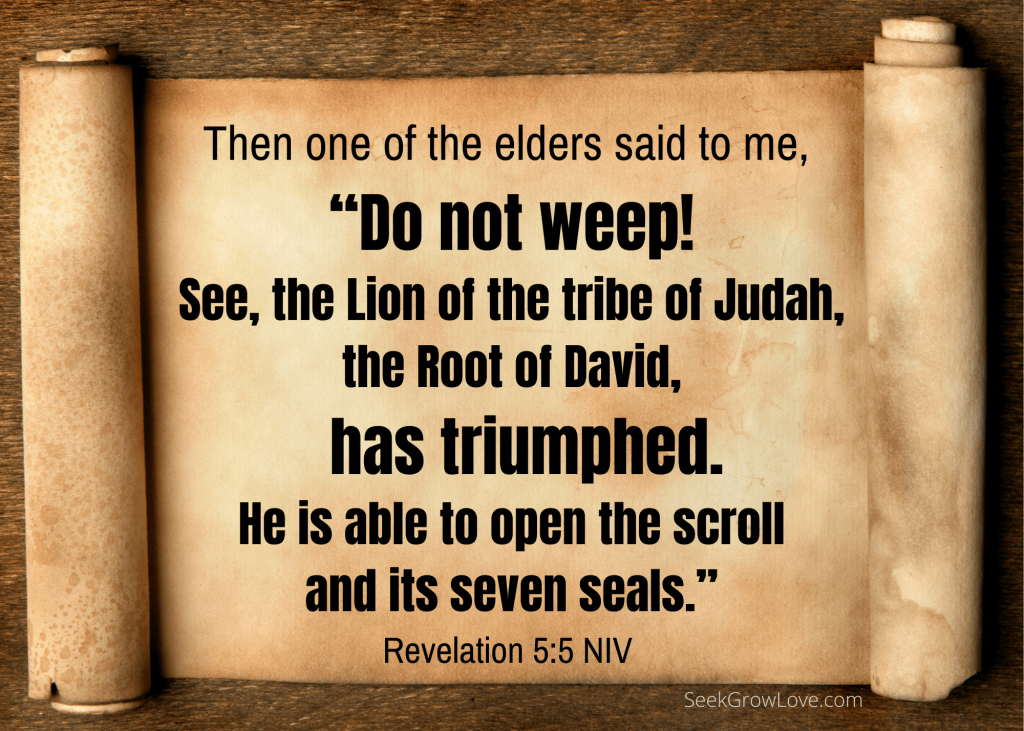
Then one of the elders said to me, “Do not weep! See, the Lion of the tribe of Judah, the Root of David, has triumphed. He is able to open the scroll and its seven seals.” Rev 5:5
Salvation is a gift of God, paid for by the blood of Jesus Christ (Eph 2:8,9). In the moments when we are overcome with great grief, sense the defeating drift of sin, are lost or lonely, feel pressed or persecuted, let Jesus Christ step forward. Do not reach deeper into empty stores, pour out of a broken vessel, or pick up the shattered pieces; let him do what we cannot. We need only lift our heads – to pray, to seek, to take heart – as we listen to the words of the elder that Jesus Christ, the Lamb of God, has triumphed. He will step forward and unfurl a new banner, renewing and restoring the purpose of our life. He alone is worthy to open the scroll, yet we are indeed the beneficiaries of the prize of his propitiation.
And they sang a new song, saying: “You are worthy to take the scroll and to open its seals,because you were slain, and with your blood you purchased for God persons from every tribe and language and people and nation.” Rev 5:9
-Aaron Winner
Today’s Bible passage can be read or listened to at BibleGateway here – Revelation 4-8.






 Seek Grow Love