A teacher poses a challenging question in his class. Most students begin to ponder, some begin to turn and whisper, some cross their fingers and hope they are not asked to contribute. Not a single hand goes in the air. The teacher repeats the question; this time, he says it in a different way. It doesn’t help. Thoughts become more frantic. Anxiety increases. Some students begin to avoid eye contact. At the moment that it seems that the teacher will start combing the class for a response, a lone hand ascends into the air. It is that kid who knows everything. Thank you, that kid who knows everything! The teacher calls on her, and you are saved from having to answer the question. All’s right with the world; you now can rest easy.
I have seen this scenario played out many times as both a student and a teacher. No matter how difficult the question, it seems there is always one person in our lives who is prepared to answer it. Whether it is at school, in your family, your circles of friends, or your work, there is always that one person (who very well may be you) that you turn to that has the experience, knowledge, or wisdom it takes to figure out life’s most difficult questions.
A passage in today’s text is like “that kid who knows everything.” It is the all-encompassing answer that holds God’s key and fundamental truth in which we can fix our hope. It stops us from over-thinking, stifles our anxiety, and helps us to take on, not avoid challenging situations, like:
When you are having trouble making sense of the world around you
When you feel like your prayers are not being answered
When you seek “the reason” THIS is happening to YOU
When you lose someone or something you dearly love
When justice cannot be found
When we lose our health or happiness
When we face many other examples from Job 19:7-20
This is Job’s answer and ours:
Job 19:25-27 – “I know that my redeemer lives, and that in the end he will stand on the earth. And after my skin has been destroyed, yet in my flesh I will see God; I myself will see him with my own eyes—I, and not another. How my heart yearns within me!”
It is not resignation. It is not a cop-out. It does not mean you stop seeking, studying, or pursuing. It is the assurance and peace which you can rest in and be guided in while you are waiting.
-Aaron Winner
(Originally posted December 18, 2016)
Reflection Questions
What are some of the hard questions Job was wrestling with? What hard questions do you have?
What was Job’s “that kid who knows everything” answer in Job 19? What is the definition of redeemer? Do you have one – who lives? How do you know?
What is your hope for the future? How does this give you peace today?
If you’ve ever been to the Texas Roadhouse restaurant, there is one thing you can always count on: bread and cinnamon butter. This is provided before every meal as a free appetizer, and on more than one occasion, we’ve had enough to be full by the time our actual meal arrived (the same can be said of the breadsticks at Olive Garden). Those rolls were not the meal, and were never intended to be the only thing you enjoyed: however, it gave you a taste of what was to come later, and whet your appetite for more (if you had enough room left in your stomach).
Our passage in Matthew 14 reminds me of our experiences at Texas Roadhouse: it offers us a “taste of what’s to come” in the kingdom of God. There were many people following Jesus at the time, and they were hungry from their journey of traveling after him: so Jesus miraculously offers them enough bread and fish to feed 5,000 men (probably about 10,000 people when you include women and children). What Jesus was doing was showing them what the kingdom of God was going to be like, as he was talking to them about its splendor. In Isaiah 25:6-9, we learn that the kingdom of God will be a time of tremendous feasting and the end of hunger forever: Jesus gives the crowd a foretaste of what this incredible moment will be like by doing this miracle for them.
There are two cautions that all Christians should be aware of when it comes to the kingdom of God. First, there are some Christians who are only focused on the kingdom of God in the future. While we still wait for the kingdom to come fully, we are able to presently experience some of it NOW and offer that to others (notice that Jesus invited his disciples to perform this miracle first). We are able to enjoy some of the kingdom of God’s blessings now, through the power of the Holy Spirit in our lives, as we anxiously await to experience it fully in the end when Jesus comes. We should never neglect the fact that “the kingdom of God is in our midst” when we have Christ dwelling inside of us (Luke 17:20-21).
The second caution for Christians is living too much in this life without having a hope for the future reign of God’s kingdom. Jesus is very clear: the kingdom of God will not come fully until he returns (Matthew 25:31-40). While we can experience an “appetizer” now, it’s not the full meal: never fill up completely on the blessings of this age, but look forward with hope towards the future when Jesus returns. We should LOVE his appearing in the clouds, longing for that day to come soon (2 Timothy 4:8). We need a balance of now and then: living for the future kingdom today, with hope that it is coming soon.
Do you look forward to Jesus’ return and the kingdom of God? How can you enjoy it today?
Talon Paul
Reflection Questions
Do you look forward to Jesus’ return and the kingdom of God?
How can you enjoy it today?
How can you help feed (spiritually and/or physically) those who are hungry for more of Jesus and those in need of an appetizer of the coming glorious feast in the kingdom of God?
Here we are, the last day of 2023. We’ve come to the end of the year. We’ve also come to the end of this eight day focus on the life of Jesus. We started with the announcement that he was to be born, then his birth announcement, his escape to Egypt, his new beginning in Nazareth, his baptism and testing, his ministry, his death, this resurrection, his ascension to heaven and now we’ve reached the end. Revelation 21 is a picture of what the future will be after all of the other prophecies surrounding the end of this age and the return of Jesus to reign are completed. I’m going to insert one passage from 1 Corinthians 15 to help transition us to Revelation 21.
“But Christ has indeed been raised from the dead, the firstfruits of those who have fallen asleep. For since death came through a man, the resurrection of the dead comes also through a man. For as in Adam all die, so in Christ all will be made alive. But each in turn: Christ, the firstfruits; then, when he comes, those who belong to him. Then the end will come, when he hands over the kingdom to God the Father after he has destroyed all dominion, authority and power.” (1 Corinthians 15:20-24).
Paul here gives the basic outline: Christ died and became alive again. When he comes again those who belong to Christ will, in the same way become alive again, never more to die. Jesus will reign for a time, Revelation 20 says it will be 1000 year or a millennium, and at the end of that time there will be a final judgment and all of the powers which opposed God since the beginning will finally be destroyed, at which time Jesus will hand over the kingdom to God himself who will come and reign over us in person.
Today’s reading in Revelation 21 shows what will happen after Jesus hands over the kingdom to God. God sets up his kingdom on earth, in what Revelation calls the New Jerusalem (it’s much larger than the present city of Jerusalem).
This brings the Bible full circle. In Genesis 1-3 when God first created the earth, he came to the Garden of Eden to visit with Adam and Eve in person. After they sinned and were cast out of the garden, they were separated from God. They could no longer dwell in the presence of God. God made provision for his people through various tabernacles and temples that would have a very holy place where the glory of God would come and where a representative of the people, the high priest would come once a year. But God’s presence was always mediated by other forms- a burning bush, an angel, pillar of fire or pillar of cloud. Now, in Revelation 21, God is back fully on earth with his people, in an unmediated direct way. There’s no need for a temple now, for everyone who is there has been made holy by the blood of Jesus which has cleansed them from their sins. They are immortal and sinless. There will be no more death or pain or brokenness. The Lord God announces, “I am making everything new.”
Tomorrow begins a new year, 2024. My best guess is, not much will change in the world. Yes, you’ll need a new calendar. People might have a new insurance plan. But there will still be sickness, there will still be wars, people will still be snarky on social media and the Democrats and Republicans will continue to fight. And people will still die. That’s not going to change until Jesus returns and puts a final nail in the coffin of evil in this world. This passage gives us a hopeful picture of what the world will be like after that happens, when God comes to live with us, when the final enemy of death will be destroyed and God makes all things new.
The world will be the same tomorrow, but you can be made new. If you put your full faith and trust in Jesus and follow him, he will make you new. 2 Corinthians 5:17 says: “Therefore, if anyone is in Christ, he is a new creation; the old has gone, the new has come!”. Will you choose to be in Christ, will you be made new? Happy new year and happy new you!
-Jeff Fletcher
Reflection Questions
How would you describe Revelation 21 to someone who has never read it before? What do you find most exciting about the New Heaven and the New Earth and New Jerusalem?
Have you chosen to be in Christ? How does life in Christ create a new creation?
Through your Bible reading what have you learned about God and His Son Jesus in 2023? How can what you learned change you? How can you put this knowledge to use in 2024? Who needs to know what you know? Thank God for revealing Himself to you through His holy Scriptures.
Watch for the NEW 2024 SeekGrowLove Bible reading plan to be revealed later today!
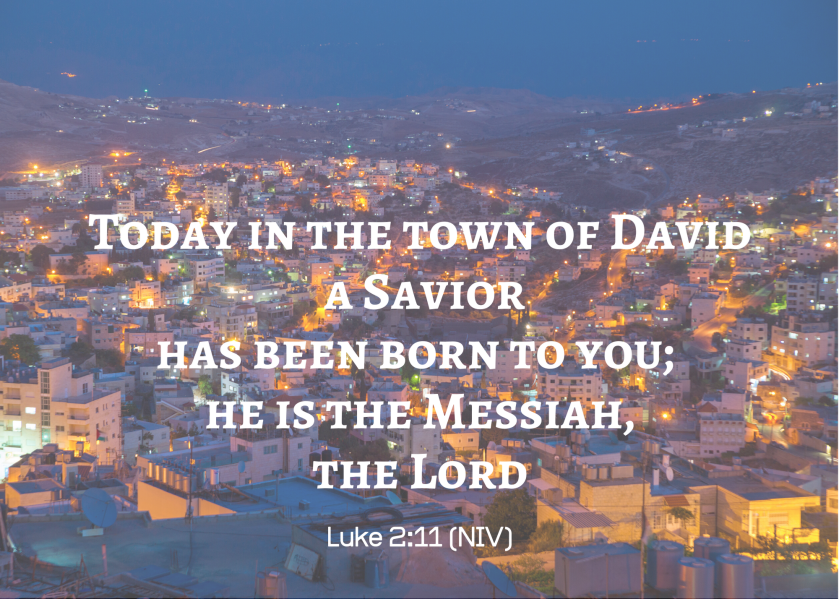
“For unto you is born this day in the city of David a Savior, who is Christ the Lord.”
It’s Christmas Day! The day we have all been waiting for. Unless you’re really, really good, you likely will have already gotten up, peeked in your stocking and maybe opened gifts with your family. You may have even eaten a large meal. Maybe now you’re taking a few minutes to check your email and give some attention to your devotions for the day. Whether you’re reading this at 8 a.m. or 8 p.m., it’s still Christmas Day. A day you’ve been waiting for. Christmas comes every year so at most, you’ve had to wait 364 days for Christmas.
The people of Israel had to wait hundreds of years for the first Christmas. From the time King David was first promised that his son would be the Messiah and would reign forever, it had been many generations. Now that day had finally come. Normally, when a royal birth happens, especially a future King, it’s a pretty big deal. There are grand proclamations that come from out of important palaces in important cities. The whole community might stand outside the walls of the royal palace to hear the great news officially announced. But this first Christmas announcement was quite different. It wasn’t in the city of Jerusalem outside the palace walls, it was in the fields of rural Bethlehem. The audience wasn’t the whole city gathered, it was a few sleepy shepherds in the middle of the night making sure their sheep were safe from predators. The one making the announcement wasn’t the royal page or member of the court of Jerusalem, it was an angelic messenger of God.
News of the Messiah’s birth went largely unnoticed for many years. It would take several announcements from God “a voice from heaven saying, this is my beloved son, with whom I am well pleased.” Eventually, his few disciples understood that he was the Messiah. What finally sold many people was his death and resurrection. The Bible says that one day “every knee shall bow and every tongue confess that Jesus is Lord” (Messiah/king). On this Christmas Day, let us be sure that we not only hear and believe the Good News that at long last the promised Messiah was born in a manger in Bethlehem over 2000 years ago, but that he died for our sins and God raised him up from death and clothed him in immortality, he has ascended to the side of God and will come again to reign over all. One day every knee will bow, but for today, be sure that you are bowing and giving your allegiance to King Jesus, and be sure to share this news with everyone you know.
Merry Christmas!
-Jeff Fletcher
Reflection Questions
How was God’s plan for a Messiah different from what many people expected? What do you love about how God brought about His plan for a Messiah? What does His plan reveal about Him?
Does your holiday festivities show that you are celebrating that Jesus is Lord? How are you bowing before him and confessing that he is Lord – yesterday, today and tomorrow?
How can you share the good news of great joy? Who needs to hear it?
Every city has a story. My parents and extended family grew up in Cleveland, Ohio, and most school breaks, I went to Cleveland. While some refer to it as “the mistake on the lake”, I love the city! I like the architecture and history, the cultural diversity and ethnic foods, the Westside market, being right on Lake Erie, the Metropark system, a plethora of cute donut shops putting my hometown in southern Indiana to shame, and what is still my favorite ice cream place ever, Malley’s! But, while I enjoyed visiting and genuinely liked the place, I didn’t have the memories of what it used to be like or appreciate the changes as much as those in my family who had known its previous years. It seemed like around every corner though someone had a story. My Dad’s old high school is now an apartment complex. My Mom’s old church that she went to take pictures of is….shall we say…. no longer in a neighborhood welcoming cheerful little ladies in Oldsmobiles with cameras driving slowly down the street snapping photos and pointing. Now Cleveland hasn’t been destroyed like Jerusalem was, and it is still a great city, but as a person who never saw the “olden days”, I couldn’t appreciate all of the changes in the same way. In today’s reading of Isaiah 61, I think it is important to remember that Isaiah KNEW Jerusalem. He had grown up there in its glory days, and he knew what it had been. Similar to stories of people who see their cities and countries devastated by war today, Isaiah had seen a city destroyed. When he uses phrases like verse 4 “ancient ruins” and “devastations of many generations”, he could visualize exactly what it used to be. How painful that must have been without the promise God gave him that he shared with others through his prophecy.
The Hebrew name for Jerusalem is Yerushalayim which I recently learned while attending a Bible study, is a combination of the Hebrew word “Yireh” (referencing an abiding place) and “Shalem” (meaning peace or complete). Hence….sometimes we hear “the City of Peace”. Hmm. If you haven’t heard much about Jerusalem yourself, a quick Wikipedia scan of facts doesn’t seem to cry out “city of peace” to me:
destroyed twice
besieged 23 times
attacked 52 times
captured and recaptured 44 times
And really, who could possibly keep count of the violence and destruction given – it’s one of the world’s oldest cities. But, it is also a city of current world conflict, not just the past. We see its involvement in current world events, and we can read of its historical and future significance in the Bible. In fact, Jerusalem is mentioned over 800 times in the Bible! It seems to be a place that is important to God. Eternal peace also seems to be important to Him, and while Isaiah saw the city destroyed once, Isaiah also prophesied the LORD’s message regarding a coming day of peace that we’ve read about several times this week already.
For those hearing this in Isaiah’s days (and for the next 700 years or so!) there would have been some questions. While we certainly still have our own questions today, Jesus himself takes care of explaining Isaiah 61 pretty nicely in Luke 4.
“And He came to Nazareth, where He had been brought up; and as was His custom, He entered the synagogue on the Sabbath, and stood up to read. 17 And the scroll of Isaiah the prophet was handed to Him. And He unrolled the scroll and found the place where it was written:
18 “the spirit of the lord is upon me,
because he anointed me to bring good news to the poor.
he has sent me to proclaim release to captives,
and recovery of sight to the blind,
to set free those who are oppressed,
19 to proclaim the favorable year of the Lord.”
20 And He rolled up the scroll, gave it back to the attendant, and sat down; and the eyes of all the people in the synagogue were intently directed at Him. 21 Now He began to say to them, “Today this Scripture has been fulfilled in your hearing.”
I love to picture Jesus just unrolling the scroll written ~700 years before, skimming along to see….oh yes….this is one of the passages talking about me.
Some of Isaiah’s prophecies are already fulfilled, some are yet to achieve complete fulfillment in the New Jerusalem. But, in our generation, we have the privilege of looking back at so many already which have taken place to provide assurance and hope for the best one yet to come. We can thank God that through Jesus, we do have peace and reconciliation with Him, and one day, we will all live in true peace. Until then, may we all seek to know the word of God the way Jesus did, may we all seek to be peacemakers, and may we share the message of true peace with others in a world in desperate need.
Behold, the Lord has proclaimed to the end of the earth:
Say to the daughter of Zion, “Behold, your salvation is coming;
Behold His reward is with Him, and His compensation before Him.”
12 And they will call them, “The holy people,
The redeemed of the Lord”;
And you will be called, “Sought Out, A City Not Abandoned.
1. Jerusalem isn’t alone in not always being a place of peace. Our minds can be places of war and devastation sometimes. What worried, anxious, angry, depressed, un-peaceful weights should you share with the LORD through Jesus today?
2. How does looking back over history and seeing scriptures fulfilled boost your confidence in the Bible and its message? Are there questions you have that you could ask someone in the body of Christ?
3. How can you use the hope of Isaiah’s message to find peace with God and to be a peacemaker in situations in your life?
Today’s Old Testament reading of Isaiah 55-56 is another encouraging message for those who reflect and return to God. Along with instructions to listen carefully, incline ears, and come to Him, we also read terms like mercy, compassion, and the phrase “abundantly pardon”. People who return to God ( a daily need it seems!) are not just scraping by in a free trial period or conditional agreement. They are abundantly pardoned. The preceding chapters told us how (and through whom) that works, and it is not through anything we do. We are unworthy, but when we seek Him, we are recipients of abundant love, provision, and pardon in ways we far too often take for granted.
Some of my favorite passages in the Bible are the ones that remind me that God’s ways are perfect, and He has a plan and understanding that is superior to mine. One example is Proverbs 16:9, and another is right here in Isaiah 55:9:
I don’t know how you feel, but I read this and I say…..thank goodness!
As I was reading along in Isaiah 55 the reference to the plants stood out to me in verse 13. I really enjoy plants….learning about them, looking at them, growing them, sometimes killing them, watching perennials spread and annuals do their thing, seeing flowers turn into fruits, milkweed attract monarchs, learning about their medicinal and nutritional uses, smelling them. Pretty much, God’s creation of plants and nature are good things for us all around! (In fact, I learned a new term at work recently from a colleague who works with me with our pediatric patients who all need more time outside it seems, and if you haven’t heard of “forest bathing”…..it’s a thing!) But, back to verse 13. I was familiar with juniper, but wanted a reminder what the myrtle plant was that was going to replace stinging nettle.
And while I learned myrtle is apparently a lovely, fragrant, evergreen shrub, I also learned that it is quite Biblically significant. It is referenced as a choice plant according to Isaiah 41 and included in Zechariah’s prophecy. Interestingly, it also pops up in the book of Esther since her Hebrew name (instead of the Persian one), Hadassah, is the feminine form of the word “hadas” or “myrtle”. Jews and Christians celebrating the Feast of Booths often use myrtle in their sukkots and celebrations. In fact, that is coming up next week so myrtle of the world is undoubtedly getting ready to make some appearances!
But, whether or not you ever see or grow myrtle, the message of a beautiful, fragrant, fertile, eternal hope God has in store for you is one to keep alive no matter what!
Isaiah 56 continues to call God’s people to a pursuit of righteousness and obedience and shares the promise with those of us who may not be biological descendants of Jacob.
-Jennifer Hall
Reflection Questions:
1. Consider the abundant, complete, and perfect pardoning you have received regardless of the gunk in your life. Have you allowed God to share that forgiveness and hope?
2. What is hard about sharing forgiveness and mercy toward others as we are called to do as followers of Jesus? How can you extend abundant pardon toward another today?
3. As you reflect on God’s ways being higher than yours, how can you better trust and rely on Him to plan your steps and make sense of this world even when you don’t get it?
Book of James Introduction
The Book of James was written by a man named James, who was probably the brother of Jesus (Matthew 13:55) and the leader of the Jerusalem church (Acts 15:13). The book was written to the Jews who were scattered among the nations. These Jews were obviously persecuted based on the way James started chapter 1. These may have been Jews who were part of the Jerusalem church that were scattered after Stephen’s martyrdom (Acts 8:1).
The main point of the book is to encourage the reader to actively live faithfully for God. This can be summed up by looking at a couple of verses:
James 1:21 – Therefore, get rid of all moral filth and the evil that is so prevalent and humbly accept the word planted in you, which can save you.
James 1:22 – Do not merely listen to the word, and so deceive yourselves. Do what it says.
James 2:17 – …faith by itself, if it is not accompanied by action, is dead.
James 4:17 – Anyone, then, who knows the good he ought to do and doesn’t do it, sins.
Here are some interesting verses about the author:
Acts 12:17 – After Peter was rescued from prison, he told his friends to tell James and the other brothers and sisters…
Acts 15:13 – James was an important member of the council that met in Jerusalem
Acts 21:18 – Paul went to see James after Paul’s last missionary journey to give James a detailed report of his missionary journeys
1 Corinthians 15:7 – Jesus appeared to James, then to all the apostles
Galatians 1:19 – Paul went to see James on his first trip to Jerusalem after his conversion
Galatians 2:9 – Paul called James a pillar of the church
Jude 1:1 – Jude identified himself as the brother of James
As you read the book of James, consider how it applies to you: How do you react during trials? How do you treat those who are less fortunate than yourself? How do you speak? Do you resist the devil and draw near to God? Are your prayers powerful and effective?
I’ll close with James 5:20, “remember this: Whoever turns a sinner from the error of his ways will save him from death and cover over a multitude of sins.”
Today’s Old Testament reading of Isaiah 53 actually starts mid-way in the last of four “Servant Songs” from the book of Isaiah. If you didn’t read Isaiah 52 already, you might want to back up to Isaiah 52:13 since that is often considered the start of this poem.
Recently, I learned a new word at a Bible class I was attending when the teacher mentioned the variations of “pericopes” Bible publishers use. For some reason the word entertained me enough to laugh, and while I couldn’t remember the word writing this and had to look it up and laughed again saying it to myself, it just means the heading at the top of the divisions of scripture. In my Bible, the pericope for Isaiah 53 is called The Suffering Servant, giving a good clue that this is a rather serious subject.
I have been enjoying a Christian historical fiction book recently set during the time of Jesus as a Jewish family is piecing together scriptures and promises as they are hearing what is going on near their “out of town relatives in Nazareth”. I have been struck by how much of Isaiah they knew and were waiting to see fulfilled and come clear, and how much what we know of our Messiah today is woven together throughout scripture. It brings such credibility and contextual understanding to have the Old with the New Testament and Isaiah 53 is certainly one of those linking passages. From what I can see, it is directly quoted at least eight times in the New Testament in a variety of writings including Matthew, Luke, John, Romans, Acts, and I Peter. Beyond these, we also see more New Testament references to the chapter’s concept referenced indirectly.
If you are doing the New Testament readings this week wrapping up Mark as well, you will certainly see the parallel to this concept that a blameless Messiah suffered torture and humiliation as an intercessor for the sins of all. It was prophesied about hundreds of years before Jesus came into existence in the womb of Mary, and it came true, bringing credibility to the well-preserved and passed down Hebrew scriptures. We have a mediator between God and us. We don’t have to sacrifice animals, recite chants, or come up with meaningless ways to “pay back” for our sins. We can’t fix the problem. But the son of God did:
Isaiah 54 starts with shouts for joy and continues on with an encouraging message that supersedes whatever brings shame, sorrow, and feelings of abandonment. While the main character in chapter 53 was the Servant, in this chapter we are reunited with a female character mentioned earlier in Isaiah. Earlier in Isaiah this woman was abandoned by her husband and then later reunited with him. (Side note: I know someone who had this happen in real life just like Israel did!) This woman seems to be a personified “Zion”, sometimes representing the city of Jerusalem, sometimes the nation of Israel, sometimes the descendants of Abraham. Whatever the case in chapter 54….she’s getting good news! While she’s felt abandoned and forsaken for a time, she is given a lot of beautiful promises. She doesn’t need to fear weapons, enemies, or past mistakes. She is promised everlasting comfort, compassion, peace, and some pretty cool gems (like maybe the ones in the New Jerusalem?!). I couldn’t even pick a favorite verse to pull out, but here’s one I liked and I’m sure you’ll find other words of encouragement in this chapter.
“For the mountains may be removed and the hills may shake,
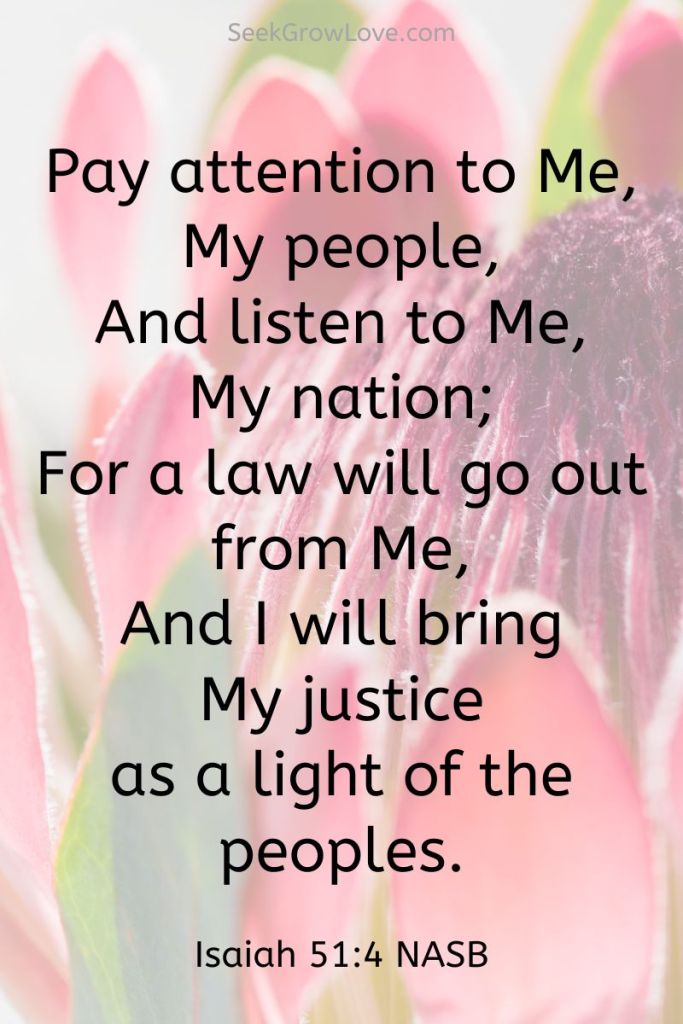
Our Old Testament reading today, coming from Isaiah 51 & 52 starts with a call to attention. In the first 7 verses the reader is instructed three times to “listen” or “pay attention”. In fact, depending on your version, you might even have a good old fashioned “Hearken!” Isaiah 51:1 calls those who are pursuing righteousness to listen and verse 7 speaks to those who know righteousness. I was challenged as I considered the implication that those being asked to listen were those pursuing rightousness when I consider how poorly a job I do at times pursuing God compared to pursuing everything else. Even amidst Assyrian captivity, the LORD was aware of His people and this chapter is full of comfort for them. We are showered with words like joy, gladness, thanksgiving, and justice. I even found myself humming “Therefore the Redeemed of the LORD shall return. . .” reading through this chapter. The source of comfort and hope described throughout Isaiah 51 is attributed to the LORD. It isn’t going to come from political freedom, overtaking enemies, gaining wealth, or stockpiling weapons and food. It comes from,
“. . .the Lord your God, who stirs up the sea so that its waves roar (the Lord of armies is His name). 16 And I have put My words in your mouth and have covered you with the shadow of My hand, to cestablish the heavens, to found the earth, and to say to Zion, ‘You are My people.’ ”
Thankfully, while he was speaking to the nation of Israel at that time when he said “You are my people”, today, if we are believers and followers of the promised Messiah talked about in Isaiah, we are also His people. We also have a hope of eternal security and an unshakable kingdom yet to come.
Isaiah 52 continues the message of removing the weight from the burden of sin and oppression and shares a message of liberty and redemption. Isaiah again seems to be conducive to use for song lyrics if you are familiar with “Our God Reigns” which is based on this chapter. And Chapter 52 concludes with the exalted servant Messiah imagery. The sprinkle he offers in verse 15 doesn’t come in rainbow variety as a donut or ice cream topping. It is the same word used in Leviticus 16 referencing sacrificial blood. The servant was sacrificed for our sins. And at his name, one day, every knee should bow.
“Behold, My Servant will prosper,
He will be high and lifted up and greatly exalted.”
Well, here is the biggest rescue scene ever! Mark 13:24-27, “But in those days, after that tribulation, the sun will be darkened, and the moon will not give its light, and the stars will be falling from heaven, and the powers in the heavens will be shaken.”
Can you picture it? The utter despair and hopelessness that the world will experience?
Well, thankfully there’s more. “And then they will see the Son of Man coming in clouds with great power and glory. And then he will send out the angels and gather his elect from the four winds, from the ends of the earth to the ends of heaven.”
Does that give you chills? Just when everything appears to be doomed and evil is going to win, God steps in and sends Jesus back. For us.
Verses 19-20 say, “For in those days there will be such tribulation as has not been from the beginning of the creation that God created until now, and never will be. And if the Lord had not cut short the days, no human being would be saved. But for the sake of the elect, whom he chose, he shortened the days.”
It isn’t going to be fun, in those last days, for believers. Those who follow Jesus Christ will be persecuted; sadly, some to the point of breaking. This is why we need each other – to be encouraged to stand firm. Verses 32-33 say, “But concerning that day or that hour, no one knows, not even the angels in heaven, nor the Son, but only the Father.33 Be on guard, keep awake.[a] For you do not know when the time will come.”
But we do know that it WILL come.
Amy Blanchard
Reflection Questions
We must encourage one another to be on guard, to stay awake, and to stand firm. We must see one another to do this, build genuine relationships, and be available to serve one another. Hebrews 10:25 tells us to not neglect meeting together. If you do not have a church you call home, please reach out to someone to help you find one. If you do, are you involved in ways that encourage others, serve others, support others?
Trusting God’s promise of being rescued can be hard. What are some ways He has come through for you already? Keep reminding yourself of the times He has shown Himself faithful to you.
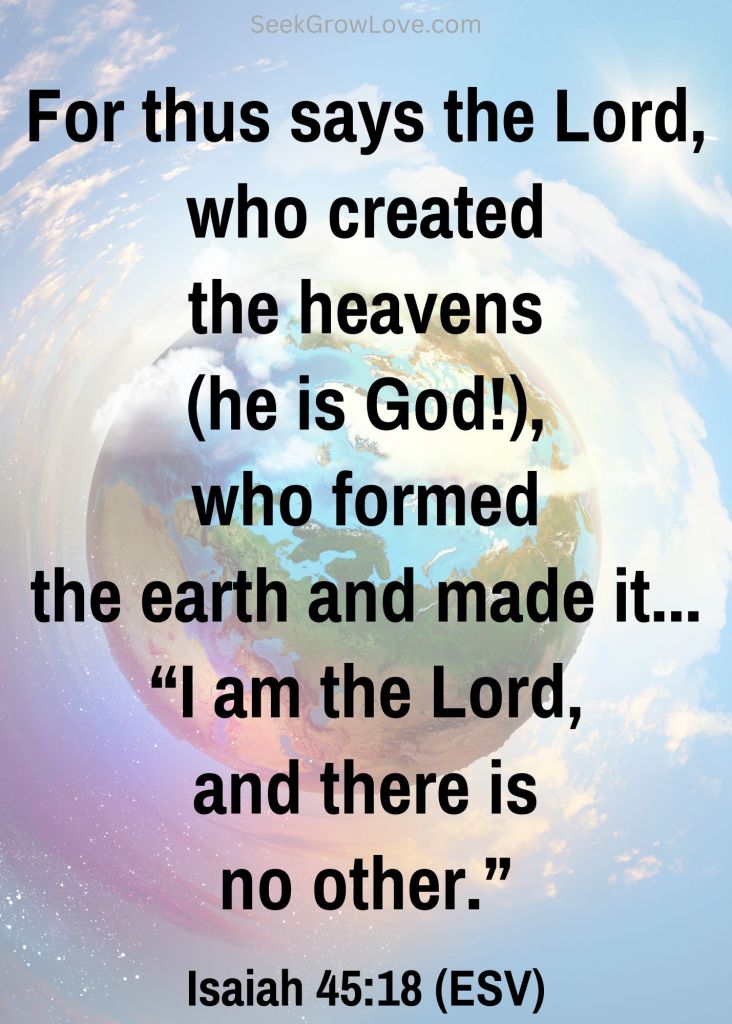
“For thus says the Lord, who created the heavens (he is God!), who formed the earth and made it (he established it; he did not create it empty, he formed it to be inhabited!): “I am the Lord, and there is no other.” –Isaiah 45:18 (ESV)
Isaiah 45 begins, “Thus says the LORD…”. This is repeated in verses 11, 14, & 18. This phrase speaks of confidence and certainty; God has spoken and He only says what is true. In verses 6, 18, 21, & 22 God says, “I am the LORD, and there is no other”. In this chapter of Isaiah God speaks and He tells us how all-powerful He is and that there is none like Him.
In chapter 46, verse 5 God asks the question, “To whom will you liken me and make me equal, and compare me, that we may be alike? He speaks of the worthlessness of idols and then says, in verses 8-11, Remember this and stand firm… for I am God, and there is no other; I am God, and there is none like me… declaring the end from the beginning… My counsel shall stand, and I will accomplish all my purpose… I have spoken, and I will bring it to pass; I have purposed, and I will do it.
There just aren’t words big enough to describe our awe of God. I checked the thesaurus: awesome, incredible, spectacular, astonishing, stunning, amazing, magnificent, wondrous, majestic. Our God, my God, your God, speaks to us and will accomplish what He says he will do. He has a purpose and He will complete it. We can rely on that without doubt. I encourage you to take some time and read some of God’s promises and bask in the fact that each one already has or will happen. You can start with Isaiah 45:22-23 “Turn to me and be saved, all the ends of the earth! For I am God, and there is no other. By myself I have sworn; from my mouth has gone out in righteousness a word that shall not return: ‘To me every knee shall bow, every tongue shall swear allegiance”
These chapters fill me with hope and confidence in our almighty God. Let me leave you with a beautiful image from Isaiah 45:8 “Shower, O heavens, from above, and let the clouds rain down righteousness; let the earth open, that salvation and righteousness may bear fruit; let the earth cause them both to sprout; I the Lord have created it.”
Amy Blanchard
Since there aren’t any words that can adequately describe God – His power, His supremeness, how absolutely we can trust him – sit for a minute (preferably longer) and feel. I know that sounds odd, but try it.
God speaking for two chapters on how He is the greatest and only perfect One and how He WILL succeed gives me chills. I like action movies – you know, the ones where the good guys win (American movies). There is always a specific moment, whether it’s a line, a visual cue, or the background music changes when you know “it’s done”, the good guys are going to win. Picture the “cavalry coming over the hill” scene in so many movies. One is in Avengers: Endgame (spoiler alert). Just when Captain America is about to be defeated and overtaken by a huge army The Avengers assemble. They rescue him and save the world. (https://www.youtube.com/watch?v=4pFUP0HZwWM) When these scenes happen, you feel something – relief, power, joy. What do you feel when you read some of the passages from today’s chapters in Isaiah? (And just for fun – what are some of the differences between the Avengers scene and this passage in Isaiah?)
God created all of our emotions. Thank Him for them. What are you feeling today?


 (Originally posted December 18, 2016)




 Seek Grow Love