The Israelites’ failures in the desert can be summarized simply down to disobedience. Even though God was leading the way, they stubbornly chose their own. Will the new generation do the same?
Once they have crossed the Jordan, the people have dedicated themselves to follow and obey. God quickly puts that to the test. He promises them Jericho but he tells them to take it in the most unorthodox way. He is going to show them that it will all be done by his power and not theirs.
Imagine being excited to fight for God! He has proven he is with you. You are ready to go out on his behalf and the order comes down the command chain that we are not fighting but instead we are marching. Talk about a let down. You get to come back to camp and tell everyone of your great triumphs – err, a few miles walk around a city wall. And it gets worse. They have to do it for 6 days without seeing any results.
I’m sure there was plenty of confusion and likely complaining. But on day 7, it was different. They got to walk around 7 times and wait for it, SHOUT! Talk about a warrior’s perfect picture of their first battle. I’m sure this tugged on all their desires to take this in their own hands and do what they were trained to do – fight.
They were faithful – and after the 7th trip on the 7th day, they let out a shout and the wall collapsed and they finally got to fight. Although they did not understand God’s way in the beginning or during the process, it made sense in the end. They were able to go in and take the city without loss. Had they tried any other way, this level of success was unattainable.
Most had learned that following God’s way (even when you don’t fully understand) was the best path. If interested in finding out again what happens when they disobey, you don’t have to look far, just read the next chapter.
-John Wincapaw
Questions for Reflection and Discussion
When would God have you be silent? How well do you do this? When would God want you to SHOUT? How well do you do this?
In what ways does God’s battle plans today seem crazy to a world that does not follow and obey God?
Why was Rahab and her family spared (see Joshua chapter 2)? How can we be involved in saving lives from the coming destruction?
See, I am setting before you today a blessing and a curse—the blessing if you obey the commands of the Lord your God that I am giving you today; the curse if you disobey the commands of the Lord your God and turn from the way that I command you today by following other gods.
Chapter 11 is a constant reminder for obedience. We see multiple reminders to be careful – which to me shows how easy it is mess up. If we are not paying attention we can easily fall.
The Israelites are about to finally leave the wilderness and go into the land that was promised. Before entering they are given some instruction to help them not fall away like those before them. It was focused on obedience to the law and commands that were being given to them.
We often think of obedience as a restriction from the things we would like to do. But here we are reminded that God desires blessing for us and those blessings are for those who make the choice of obedience.
Obedience isn’t just knowing God or about his commands. It is making the choice to follow them. Making the choice to have them be a priority in your life. Surrounding yourself with reminders to do what is right so you are not tempted to fall away.
It is a choice! We are not forced to do anything. God did not create humans as robots. He gave us the choice to obey or not. We make a choice everyday and that choice is tied together with love. If we love God we will obey him!
Those that love God will obey God. Those that obey God will be blessed by God.
-John Wincapaw
Questions for Reflection and Discussion
When have you experienced God’s blessings for obedience?
Can you think of a time you may have experienced God’s punishment or curses because of a time of disobedience?
What have you seen of God’s power and might with your own eyes? How can you pass this along to those younger than you who did not experience what you did? Why is that important to do?
Love is one of the most powerful things in the world. You love your friends and your church, but most importantly you love your family. God is our father and he gives unconditional love to us. As we should give him this love he also shows us many times in the Bible, that love comes with boundaries and rules. The commands in Deuteronomy 6 show this. In any relationship there has to be boundaries and rules in order for it to be a healthy and loving relationship. These rules, like not putting your lord your God to the test, must be followed. Love comes with these boundaries and rules to have a steady balance. Look at the relationships you have. The love you have with certain people comes with certain boundaries and rules.
-Genesis Dylewski
Questions for Reflection and Discussion
How do you show your love for God? With your heart? With your soul? With your strength? Are there any areas of your life where you feel you should love God more? How so?
What was to be taught to the children? How? Why? How well are you passing along the knowledge of who God is, and how to love and obey Him to the younger generation? What can you do this week and throughout the year to increase your involvement and effectiveness with teaching and encouraging the children and youth in their Christian faith and upbringing? What will happen if we don’t?
In this first chapter of Exodus, we see that the Israelites are viewed as a formidable threat due to their increasing numbers. There was a great fear that the Israelites would continue to multiply and if war were to break out, they would choose to join with Egypt’s enemies and eventually leave the country. In verse 16, we read of the horrific remedy that the king of Egypt concocted and delivered to the midwives: “When you are helping the Hebrew women during childbirth on the delivery stool, if you see that the baby is a boy, kill him; but if it is a girl, let her live.”
We then read with great relief in verse 17 that the midwives “feared God and did not do what the king of Egypt had told them to do; they let the boys live.”
Do we always have the courage to do what is right in the eyes of God—even at great risk and cost to ourselves? We might think that we would never be put in such a dire predicament, but I believe our faith is tested in both big and small ways. Our faithfulness in the “small things” can actually speak to the overall health of our faith. As stated in Luke 16:10, “The one who is faithful in a very little thing is also faithful in much; and the one who is unrighteous in a very little thing is also unrighteous in much.” Imagine you are eating dinner at a restaurant and you notice the server forgot to charge you for that delicious artichoke and spinach appetizer. Do you think, “Ha! It’s my lucky day!” or do you remember that the right thing to do in the eyes of our Heavenly Father is to pay for everything that you ordered?
I have a theory. I think that it might actually be easier to make the right choice in dire circumstances as opposed to authentically living out our faith on a daily basis amidst the small trials and challenges of life that constantly wash up against us. Have you ever been in the ocean or even in a tidal pool at a water park and found it hard to regain your footing after getting knocked down by a wave? Even the smallest of waves can wipe us out and deplete us of strength if we don’t feel like we can catch our breath between the waves. Psalm 42 gives us some comfort for these times:
6 “My soul is downcast within me; therefore I will remember you in the land of the Jordan, the heights of Hermon—from Mount Mizar. 7 Deep calls to deep in the roar of your waterfalls; all your waves and breakers have swept over me. 8 By day the Lord directs his love, at night his song is with me—a prayer to the God of my life.”
May we be encouraged by this reminder that God’s song is with us and that He rewards our faithfulness. Verses 20-21 of Exodus 1 demonstrates how God rewarded the faithfulness of the Hebrew midwives: “So God was kind to the midwives and the people increased and became even more numerous. And because the midwives feared God, he gave them families of their own.”
May our goal always be to please our Heavenly Father in the big and “small” things and to lean into Him when the waves of challenge sweep over us.
-Kristy Cisneros
Questions for Reflection and Discussion
Do you find it difficult to live out your faith authentically when faced with the big and small challenges of life?
How can we better lean into God during times of challenge?
Which heroes of the faith inspire you with how they leaned into God during times of trouble?
There are many different times that different people in the Bible confess their true faith. At the beginning of Genesis 22, God tells Abraham to sacrifice his only son. We see Abrahams’s true faith when he doesn’t protest or complain. He just does what God told him to do. I for one am very jealous of his faith.
As Abraham was stretching out his arm to slay his son, an angel of the Lord called to him from heaven telling him to stop. Then, they heard a rustle from behind them and it was a ram. This shows us that God is with us and He will always provide a way. We just have to have faith like Abraham. I hope that we can all grow our faith in the near future and fully trust in Him.
-Nik Ransom (youth who attended reFUEL: North last month, and son of one of our writers two weeks ago)
Questions for Reflection and Discussion
Take a moment and think about what you love most in life. Would you be willing to give whatever it is if God told you to? Would you give it up with or without hesitation?
Abraham is known as a man of great faith. Why? What does James have to say about Abraham in the New Testament? (James 2:14-26) Is it possible to have great faith without action/deeds/obedience? How can we practice growing our faith?
Re-read the account of Abraham willing to sacrifice his son Isaac while knowing what you know of God’s sacrifice of His son Jesus. What similarities do you find? What differences? What does this say of God’s sacrifice and love for you?
Many of us know the story of Noah and the flood. The earth was full of sin. Noah was commanded to build an ark because God was going to wipe out all the earth. Animals came two by two to enter into the ark which Noah had built. It rained for 40 days and 40 nights. At some time Noah sent out birds to see if the land was dry. The dove returned with an olive branch or a freshly picked olive leaf, depending on what version of the Bible you are reading. Noah and his family and all the animals went off the ark. God promised to never destroy the whole earth with floods again and made the rainbow a sign of this promise. But, there is more to the story than just this.
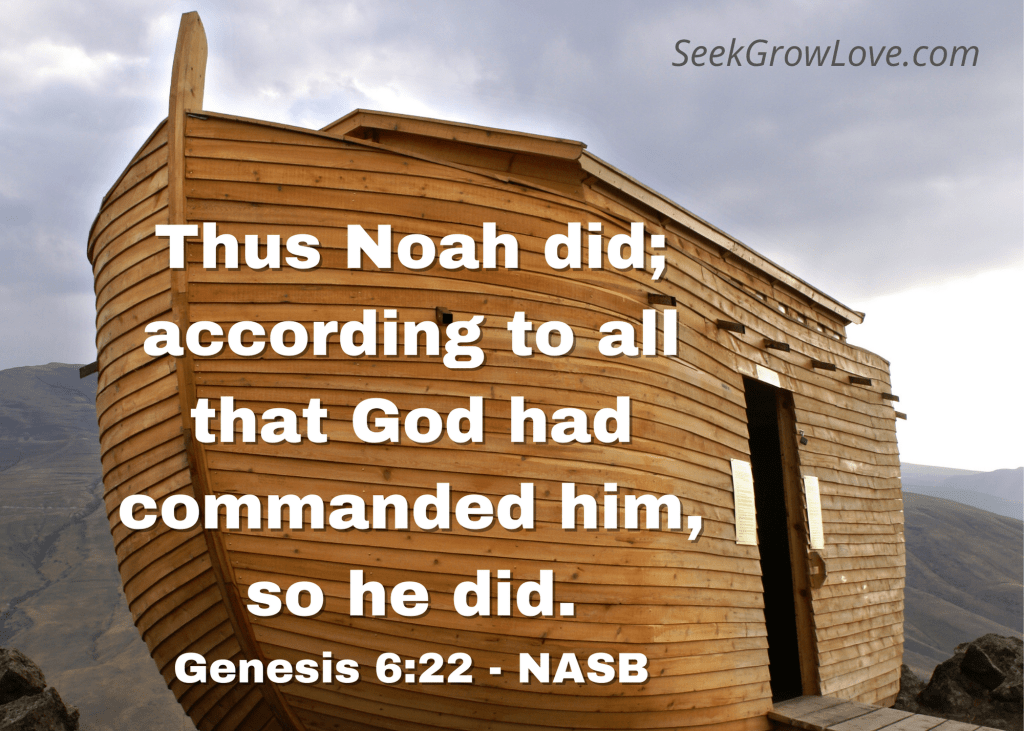
When we read the story of Noah and the flood, we see that Noah built the ark just as he was commanded. Have you ever taken the time to imagine what would have happened if Noah had just said no? What about if he had decided he would only take the animals he liked with him, leaving animals like mosquitoes, spiders, and snakes off the ark? What if he had decided he knew a better way to build an ark than the way God told him? But Noah didn’t. We are told in verse 22 that “Noah did; according to all that God had commanded him, so he did.”
Noah built the ark exactly as he was told. He built it out of gopher wood and covered it inside and out with pitch. Noah made the length, breadth, and height of the ark exactly as he had been commanded to do. He put the window and door at the exact location, which God had commanded him to. Noah did everything according to what God had commanded him.
Not only did Noah continue to do everything as God commanded, which is difficult enough by itself, he also did it all while the earth was filled with corruption. Noah spent years obeying God, building the ark, while he was living in a corrupt world. Not only did Noah build the ark while living in a corrupt world, he did it for many years, while the animals started coming to the ark, and the earth kept growing in its corruption.
We know that, in the end times, our world will be as corrupt as the world was in Noah’s time. Our world is already starting to look similar to Noah’s. We have to obey God while living in an evil world and continue doing so, overcoming whatever the world puts against us. The question is: When the time comes will you be able to obey God while living in a corrupt world, not losing faith, for years, just as Noah did?
-Kaitlyn Hamilton
Questions for Reflection and Discussion
Do a little research on the ark. Did it look like the photo above? What were the dimensions? Measure out what those dimensions would look like in your yard, neighborhood, church property or playground. You may find some interesting information online, including from the Ark Encounter site (a life-size ark museum Answers in Genesis built in Kentucky).
Since our 2022 SeekGrowLove reading plan only includes 105 of the BEST chapters from the Old Testament, tomorrow we will be jumping forward to Genesis 12, rather than finishing the rest of Noah’s story. But take a little time reviewing the rest of this account (through 9:17). What do we learn about God? What do you think God may have been thinking or feeling as he watched the destruction of the flood? What about as he watched the faithfulness of Noah and his family?
God probably isn’t asking you to build an ark, but what does He want you to do? What directions has he given you to follow as you work on the mission He has given? How well are you following those directions? What obstacles are in your way? How can you better deal with them in order to stay on track with God’s work? What rewards are there for sticking with His tasks, even when they are really difficult? What happens if you don’t? What will help you become a person known for doing what God asks of you?
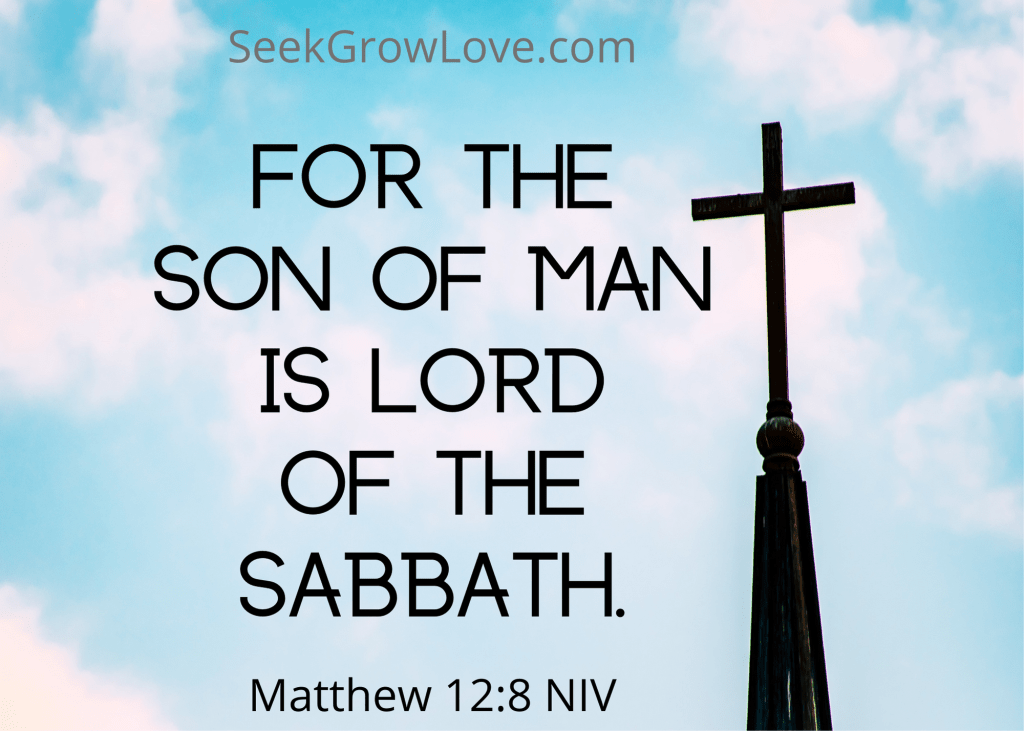
Jesus is at it again. Back in Matthew 5 we discussed how Jesus didn’t abolish the Old Testament but he breathed new life into the old laws with his teachings. The most important thing wasn’t following the letter of the law but having the heart of Jesus – adding love. Here in Matthew 12 the Pharisees are upset that Jesus’ disciples picked some heads of grain to eat when they were hungry on the Sabbath. Picking some grains is a lot like harvesting and harvesting is work and work is not allowed on the Sabbath. The Pharisees loved nit-picking the law, making it really hard for anyone to succeed in following the law, thus finding fault in everyone else, which they thought made themselves look better. Their microscopic vision into the smallest detail of the law took the focus off of the big picture – how are you doing at being God’s people. The law had been given by God to create a healthy, righteous people devoted to God and kind to others. But this extreme fascination with catching everyone’s slightest mistake was not healthy, righteous, kind, or pleasing to God. Instead of the law being used to make a holy people for God, it was being used to divide and tear down and pull people further from their love for God. The law was good. Their use of it was not. It wasn’t time to throw away the law. It was time to add love.
The purpose of the Sabbath was to put time (a whole day) aside to stop busyness and focus on rest, worship and loving God. It was given as a gift by a gracious and loving God who knew what people would do if they didn’t take time to rest and refocus. He knew all healthy relationships take time and this was the perfect opportunity to add a date day with God on the calendar – every week. A mini-vacation with God and family every 7th day. It’s a great way to create a spiritually, mentally, physically healthy people for God. But the benefits dwindled when the Pharisees turned it into a legalistic checklist of don’t do this and don’t do that.
Jesus wisely gave the Old-Testament-loving Pharisees two examples from the Scriptures of cases where the Sabbath regulations were broken by Godly people doing Godly things, and God didn’t strike them down dead. In fact, He seemed to approve of the exceptions to the rule. Likewise, Jesus is confident God also approved of him healing, doing good and helping others on the Sabbath.
In calling himself the Lord of the Sabbath, Jesus wasn’t saying he was the Lord of something that ought to be thrown out because it had outlived its usefulness. No. He recognized the worth of the Sabbath AND the good that could be done during a day devoted to God. It wasn’t about a checklist and Sabbath day spies making sure you aren’t breaking the law. It is about a day to focus on God, your relationship with Him and the good that He wants you to do for Him. It is a day devoted to loving God and loving others to help us refocus and build our spiritual muscles to take us through the next 6 days doing His will in love.
-Marcia Railton
Questions for Reflection and Discussion
Does your week generally include a Sabbath day of rest and devotion to God? If so, what does it usually look like? What do you appreciate most about it? Do you do it more for what you gain from it, or to please God? (either answer is legitimate). If you don’t normally include a Sabbath rest on your calendar, do you see value in trying a Sabbath rest? How might it look different from your typical day? What would be challenging about making this change? What benefits might you expect to see?
Re-read Matthew 12:33-37. This week have you been producing good fruit or bad fruit? How so? What about your words? Why do you think your words are so important – at least one of the things you will be judged by? Do you find it easier to say the right thing or do the right thing? Were there any words you said recently that you wouldn’t want Jesus to repeat to you on judgment day? How can we stop careless words which will get us into trouble?
Jesus welcomes us as a part of his family, if we do what? (Matthew 12:50) On a scale of 1-10 how are you doing in this area? What could you do today to boost your score? What benefits are there for those who are in Jesus’ family?
“Do not judge, or you too will be judged.” (Matthew 7:1 – NIV) Its a loaded statement. We don’t like to feel judged and told that we are wrong, so we won’t judge and tell other people they are wrong. And so this single verse is used to justify, and even demand, blind acceptance of others and all their deeds. You are free to be gay – I have no right to judge. You are free to have the right to an abortion – I have no right to judge. You are free to believe you are a woman when God made you a man – I have no right to judge. You are free to hook up with anyone anytime you want – I have no right to judge. And that is what some would have us believe a good Christian should do. Let them be them and accept them for it. Their way is just as good as my way.
Only trouble is – the rest of this passage continues.
“For in the same way you judge others, you will be judged, and with the measure you use, it will be measured to you.” (Matthew 7:2 – NIV) If you use a yard stick to measure yourself but a meter stick to measure others, they will always be coming up short. It is not a fair and right judgment or measure. It is skewed in your favor to make others look less than. They just don’t measure up to your greatness.
Here’s a little true story example – I have been known to be put out and upset when someone I am waiting for is running late. How could they inconvenience me by not operating more according to my clock and my time schedule? Only trouble is, yesterday I was caught by a train (it happens here in northern Indiana – the crossroads of America) and I didn’t show up exactly when someone else was expecting me, but of course my tardiness was excusable, because it wasn’t my fault, I didn’t know a train was going to be coming, etc…. It is not my right to condemn, chastise, be upset with others if I am not willing to be measured in the same way. Late is late. And, in actuality, it’s not my clock or their clock that really matters anyway – but what does God’s clock or measuring stick or word say? That is what matters.
The passage continues, “Why do you look at the speck of sawdust in your brother’s eye and pay no attention to the PLANK in your own eye?…You hypocrite, FIRST take the plank out of your own eye, AND THEN you will see clearly to remove the speck from your brother’s eye.” (Matthew 7:3, 5 – NIV). If a brother has a speck in his eye and there was something loving you could do to help him get that irritating, painful thing out, wouldn’t you want to? Wouldn’t God want you to? But, how much help could I be in this delicate operation if my own eye has a beam sticking out of it? I can’t see clearly to help others out of sin when I am swimming in it myself. That sin in my own life is first priority. I must deal with it. Get rid of it. It may hurt like crazy to pull that beam out – but until I do, my usefulness to help guide and correct others is gone. Pull it out. Heal. See Clearly. Then, I can help others, with the same word of God, same guidelines, same measuring stick and same mercy and compassion that saved me.
It is very true I am not the judge and the jury. God is and He will share that job with His Son. But I DO have a responsibility to watch myself closely, to hold myself accountable to the Word of God, and to be very aware of what is happening around me – including the sin that so easily entangles.
All paths are not created equal. Some – the narrow ones that not many people are willing to stay on – lead to life. Others – the wide, easy, popular ones where the majority are – leads to destruction. It would be foolish of me to not be judging which path I am on at all times. See clearly the two paths.
We are told, “Watch out for false prophets. They come to you in sheep’s clothing, but inwardly they are ferocious wolves” (Matthew 7:15). This will require VERY keen eyesight and insight. We will have to be wise in judging what may at first seem right and true but in fact is cleverly disguised, dangerous, deadly lies which are leading many down the wrong path. Watch out! See clearly those who are deceiving and being deceived. Blind acceptance will take you somewhere you do not want to go.
Make sure you are not sitting in the house of the foolish builder as the wind picks up. Many in that house have heard the word of God. They may profess Christianity and call him Lord and even seek to serve him. But they are not acting any different from the world. They are not doing the will of God. They have grown comfortable with the plank in their eye. They have befriended the wolf in sheep’s clothing. They have failed to put Jesus’ words into practice. They are on the wide path approaching the wide gate that leads to destruction.
Get out and move to the house of the wise builder before the downpour comes! Hear Jesus and listen. Do what he says. Take the plank out of your eye. See clearly. Help your brother take the speck out of his. Don’t make friends with the wolf just because he dressed up like a sheep.
See clearly. All paths are not the same. All houses will not stand. All choices are not okay. All churches will not be saved. Some will lead to life. Some will lead to death. Use the same measuring stick – God’s Word and the teachings of Jesus. And put it into practice! See clearly. Judge roads and gates and houses and wolves wisely. Your life truly depends on this.
-Marcia Railton
Questions for Reflection and Discussion
What was the difference between the wise and foolish builder? What fate awaited each? How can you put into practice the words of Jesus from Matthew 7 today?
When we were introduced to John the Baptist and to Jesus we were told what they were preaching – see Matthew 3:2 and 4:17 to remember. Are any lessons from Matthew 7 connected to this preaching theme? If so, how?
Is it easier for you to see your own sins or the sins of others? What advice does Jesus give? Pray to see clearly your own sins first so you can deal with them.
How do you feel when you read Matthew 7:21-23? How does it relate to the rest of the chapter? How can we live now to avoid hearing these words from Jesus?
It’s only been 5 days, but so far I am enjoying the one chapter a day pace for 2022. It’s allowing us a bit more time to soak in the lessons of each chapter before rushing into the next. However, as we look at Matthew chapter 5 today I can’t help but feel that this chapter would be a good one to cover just one VERSE per day! Jesus knew how to stack a sermon with plenty to mull over on the way home. It is possible that Matthew included some bits and pieces from other sermons to lump them all together into what is now known as The Sermon on the Mount found in Matthew 5, 6 and 7. Whether it was all said by Jesus in one particular sitting, or spread out, or often repeated for various audiences, these words of Jesus are priceless and worthy of being read over and over again, finding something new and inspiring every time.
We will save a longer discussion on the Beatitudes for another day/week/month. Until then, watch your attitudes. The right ones, as judged by God and not man, will come with great reward.
It’s okay, even preferred, to be persecuted for following Jesus. Follow anyway. The reward is great. And you are not the first to endure such opposition.
Be different from the world. Keep your saltiness (preserving life, adding spiritual savoring, disinfecting worldliness). Keep shining in the darkness. Keep doing good. Represent your Heavenly Father well.
Keep the Old Testament – with a New Testament heart.
Jesus knew people would think that now that the Messiah was here the old laws and scriptures would be done away with. Laws aren’t a lot of fun, let’s just love instead. He saw it back then, we still see it today. But Jesus clearly stated, “Do not think that I have come to abolish the Law or the Prophets; I have not come to abolish them but to fulfill them” (Matthew 5:17). Jesus challenged those sitting at his feet and he challenges us today. Think of the BEST people you can think of. Who is known for being righteous? At that time it was the Pharisees and teachers of the law. But Jesus said, “For I tell you that unless your righteousness surpasses that of the Pharisees and the teachers of the law, you will certainly not enter the kingdom of heaven” (Matthew 5:20). Ouch! Did that say what I think it said? Read it again. But Jesus said, “For I tell you that unless your righteousness surpasses that of the Pharisees and the teachers of the law, you will certainly not enter the kingdom of heaven” (Matthew 5:20). Something MORE is needed. Following the Old Testament laws one by one to show the world how good you are doesn’t cut it. But that doesn’t mean we throw out the law and the prophets and the Old Testament. Rather than throwing it out, we add to it. We don’t need to add more laws, the Pharisees already tried that, too. Instead, we add to it the heart of Jesus – the New Testament heart. What does that look like? Jesus knew we would ask, so he gives us six examples in Matthew 5.
Don’t pat yourself on the back for not murdering anyone today. Add love. Control your anger toward others. Don’t let that put-down out of your mouth. Work at relationships. Forgive and ask for forgiveness. And still, don’t murder.
Don’t pat yourself on the back for not committing adultery today. Add love. Guard yourself from lust. Take it seriously. There are consequences. Show respect and responsibility. And still, don’t commit adultery.
Don’t pat yourself on the back for doing a divorce in a legal, friendly manner. Add love. Work at it again. Take it seriously. There are consequences for everyone.
Don’t pat yourself on the back for keeping one oath made to God. Watch your words. Take them seriously. Stop making promises. Realize God is so much greater than you. Realize there is so much beyond your control. Keep it simple. Watch for influence from the evil one.
Don’t pat yourself on the back for getting even. Add love. Add sacrifice. Add service. Add generosity. Even when it’s hard. Even when it’s not deserved.
Don’t pat yourself on the back for taking good care of people who take good care of you. Add love. For all. God knows. He’s got this. Don’t worry if it’s not fair now. You will see sunshine and rain. They (your enemies) will, too. It’s okay. Pray for them, even if they hurt you – or especially if they hurt you. Your actions and your prayers will show that you are God’s child. Work at being like Him.
Keep the commandments and add love.
Marcia Railton
Questions for Reflection and Discussion
Where is society trying to throw away the laws of God? What would they replace it with? Is this a good idea or a dangerous one? Why?
Do you more often focus on the law or on love? Think of a particular instance where you leaned one way or another. How do we do both? What could you have done in the example you thought of to add in more of the lesser ingredient?
What is the danger in weighing in too heavily in the law, neglecting love? What is the danger in weighing in too heavily in love, neglecting the law?
Have you ever been afraid of the dark? What about spiritual darkness? How important is light? And spiritual light? What dims your light? What helps it shine brighter? Do you feel more like a match or a floodlight? How can we remember to be a light and shine in the darkness?
Many people point to Micah 6:8 as a simple, straightforward verse telling us how to get right with God: Micah 6:8: “He has shown you, O man, what is good. And what does the Lord require of you? To act justly and to love mercy and to walk humbly with your God.”
Let’s look at this in context.
Micah 6 starts out as a courtroom scene. “Plead your case”… “For the Lord has a case against his people”. God then reminded His people of the things He had done for them including leading them out of Egypt, protecting them from Balaam’s cursing them, and leading them into the promised land.
We might pause here to remind ourselves how the Israelites reacted to each of God’s protections that He pointed out to them here.
He led them out of Egypt to be His people, but they grumbled repeatedly, wanting to go back to Egypt; worshiped a golden calf; and didn’t trust that God could bring them into the promised land – so they had to wander in the desert for 40 years.
He caused Balaam to bless Israel instead of cursing them. This was a spiritual battle God was fighting on their behalf, without them even knowing about it. Their response was to sin sexually with Moab’s women and worship Moab’s gods – so God sent a plague and killed many of the Israelites.
He caused the Jordan River (at flood stage) to dry up, letting the Israelites cross on dry ground. This was reminiscent of what He had done for the Israelites when they had left Egypt 40 years earlier. God had done for Israel what they could not have done for themselves – but the people didn’t remember all the righteous acts God had done for them, and turned away again and again.
In Micah 6:6-7, we see that things we do can’t reconcile us to God, including bowing down to Him (presumably in hollow worship), performing sacrifices (remember that to obey is better than sacrifice), even sacrificing things most precious to us – including our children. None of these things can reconcile us to God.
Then, we find the beautiful verse of what God really wants. Not religious ceremonies, but moral and ethical conduct – “To act justly and to love mercy and to walk humbly with your God.”
None of us can do these things until we first submit to God as broken sinners and allow Him to transform our lives. We can only act justly once we have been justified. We can only love mercy (and extend it to others) once we have experienced and recognized God’s mercy. We can only walk humbly with our God after we bow humbly before Him, confess our sins, and claim his promise of forgiveness (I John 1:9).
Titus 3:5 reminds us, “He saved us, not because of righteous things we had done, but because of his mercy.” So people are misguided if they think they can follow this formula from Micah 6:8 to be saved. It’s only because of our saving relationship with God that we can do what He requires in Micah 6:8.
As we continue reading Micah, we see that Israel hasn’t lived up to God’s requirements, so in 6:13, He says, “Therefore, I have begun to destroy you, to ruin you because of your sins.” If God treated Israel this way, and if God doesn’t change, I’ll let you consider for yourself the implications for you and the implications for our nation.
Micah 7:13 is pointing to a time still in the future to us, when “the earth will become desolate because of its inhabitants, as the result of their deeds.”
But the last 3 verses of Micah remind us of who God is and what He has done in the past.
Micah 7:18-20: “18 Who is a God like you, who pardons sin and forgives the transgression of the remnant of his inheritance? You do not stay angry forever but delight to show mercy.
19 You will again have compassion on us; you will tread our sins underfoot and hurl all our iniquities into the depths of the sea.
20 You will be faithful to Jacob, and show love to Abraham, as you pledged on oath to our ancestors in days long ago.”
To quote Warren Wiersbe from his Bible commentary, “the better we know the character of God, the more we can trust Him for the future. The better we know the promises and covenants of God, the more peace we will have in our hearts when things fall apart.”
In closing,
We need to recognize we can never measure up to God’s requirements on our own.
We need to humbly come to God as broken sinners, confessing our sins, and asking for His forgiveness.
We need to remember who He is, what He has done in the past, and what promises He has made for the future.
We then need to develop a deep personal relationship with God.
Only then can we “be imitators of God as dearly loved children” (Ephesians 5:1). And only then can we live a life acceptable to God – “To act justly and to love mercy and to walk humbly with your God.”
-Steve Mattison
Read or listen to today’s Bible reading plan passages at Bible Gateway.com here – Micah 5-7 and Revelation 10





 Seek Grow Love