Today’s Old Testament reading includes strong, powerful David sparing King Saul’s life in a cave when he could have easily taken revenge and killed the king, clearing the way for his own rule and prosperity. Strong, bold, but full of mercy and God-fearing appreciation for those God had placed in power.
Today’s New Testament reading tells of Stephen, “a man full of God’s grace and power, did great wonders and miraculous signs among the people” (Acts 6:8). But, not everyone was a fan. Just as David and Jesus had run into opposition, now it was Stephen’s turn. Jealousy, arguing, false witnesses ensued. Stephen remained steadfast. I love the descriptions of this man. Those who argued against Stephen, “could not stand up against his wisdom or the Spirit by whom he spoke.” (Acts 6:10) and even the Sanhedrin saw that, “his face was like the face of an angel” (Acts 6:15). We will read more of Stephen’s story tomorrow.
Motherhood is on my mind today. The characteristics displayed in today’s reading of both David and Stephen are characteristics I want to help develop in my children. Strong, bold, full of grace and wisdom and the Spirit of God, also able to face opposition and remain steadfast and godly.
We do not hear anything about Stephan’s family or mother. We know very little of David’s mother – though in yesterday’s reading we learned that he cared for and provided for the safety of his mother and father when Saul was seeking to kill David (1 Samuel 22:3). Just like the Disney princesses (and princes), they seem to have grown and developed with no maternal influence mentioned. But, we know, for better or worse every child ever born has had a mother. It is perhaps a good reminder to me that God doesn’t NEED me to grow my children into the Davids or Stephens or Hannahs or Marys he wants them to be. But, what a privilege to get that opportunity to do my best in His Spirit to develop those characteristics in my children. And, I am so thankful for the mother who did that for me.
-Marcia Railton
Today’s Bible reading passages can be read or listened to at BibleGateway here – 1 Samuel 23-24 and Acts 6
Today, I’d like to focus on two more aspects of the church, both of which defined the church in its earliest days: purity and persecution.
Purity
Yesterday, we read how God used his church to care for the least fortunate. No one in the church had any need. One of the ways this was accomplished, remember is that those who had property would sell it and give the proceeds to the church. There was no demand or command to do this, but those who did were honored by the church. In Acts 5:1-11, we read about a husband and wife duo who tried to buy the affection of the church. They sold a piece of property, but kept back a portion. But that wasn’t the problem. In verse 7, Peter asked Sapphira whether this was ALL the money they received for the land. THAT was the lie. They wanted everyone to think they were just as good as those who gave ALL their money to the church.
But the church is not about building up our own ego. The church is about caring for those who need help. When Ananias and Sapphira lied, they lied to the Holy Spirit and they lied to God! In our world, some use church or religion for their own status. God has shown since the birth of the church that he’s not fooled. He desires to keep his people pure, focused on his mission, his goals, and not on themselves.
Persecution
The disciples kept proclaiming Jesus. Those who were powerful were being told there was someone more powerful. Those who denied the resurrection were shown there was a resurrection. Those who considered themselves righteous were proven to be wicked. That is going to make people mad. They had told them that they couldn’t preach in the name of Jesus, but the apostles reply “We must obey God rather than human beings!” What an AMAZING testimony. They are not worried about people. They aren’t worried about the commands of men, of governments, of those who can kill the body but not the soul.
God said “Go!” and so they go. Jesus said “Disciple others!” and so they disciple. The Holy Spirit gives them words and so they speak.
Because of this, they were flogged (v40) and ordered not to speak. And the reaction of the disciples is fascinating. They were rejoicing. Rejoicing because they were counted worthy to suffer disgrace. Counted worthy to suffer. God thinks of them highly enough to be humiliated.
Because in our humiliation, in our suffering, in our rejection, we look most like Jesus. God reverses our fortunes in the same way that he raised Jesus from the dead and sat him at his right hand.
In our humiliation, God gives glory.
In our suffering, God gives joy.
In our rejection, God gives acceptance.
In our weakness, God gives Jesus.
May you, my brothers and sisters, be more like the early church, today.
May the message fill your mouth and the mission compel your feet.
May the Spirit of God give you power and the love of God give you passion.
May the dedication of the apostles and the purity of the church define your own worship of God.
May you do all this so that God is glorified, Jesus is honored, and many find faith.
-Jake Ballard
Jake Ballard is pastor at Timberland Bible Church. If you’d like to hear more from him, you can find Timberland on Facebook (https://www.facebook.com/TimberlandBibleChurch/ ) and on Instagram (https://instagram.com/timberlandbiblechurch?igshid=t52xoq9esc7e). The church streams the Worship Gathering every Sunday at 10:30. Besides studying and teaching God’s word, he is raising three beautiful children with the love of his life, plays board games and roleplaying games with amazing friends weekly and recently celebrated both Cinco de Mayo and May the Fourth (Be with you). If you’d like to reach out to talk Bible, talk faith, or talk about Star Wars, look Jacob Ballard up on Facebook (https://www.facebook.com/jacob.ballard.336 )or email him at jakea.ballard@yahoo.com. God bless you all!
Today’s Bible reading passages can be read or listened to at BibleGateway here – 1 Samuel 21-22 and Acts 5
The early church was a special time in history. Jesus has just been raised. He has gone up, bodily, into heaven, and has poured out his Spirit upon those who follow him. (Rom. 8:9) In our day discussions about doctrines and divisions about drivel develop daily.
BUT in the EARLY CHURCH, they were passionately pleading for the Pierced. They didn’t argue and debate about the number of angels that can dance on the head of a pin (to be fair, no-one has ever really debated that question). We can get so distracted from what was the early church’s singular focus : giving everyone and anyone the message of Jesus, and changing their world with the power of Jesus.
In chapter three, a man who had been begging for years is healed. This is the first of many, many miracles recorded in the book of Acts. The disciples were passionately sharing the message and gift of Jesus with everyone! They tell their fellow Israelites that God healed this man because of his servant Jesus. They tell the Sanhedrin and high priest about Jesus. They count it as a joy when they are persecuted and beaten for Jesus. They know their reward in heaven is great, because the righteous are persecuted by the wicked (Matt. 5:12).
In our lives, are we passionate about the message and work of Jesus then and now? If you aren’t don’t try to be passionate!
Instead, remember your sins, your mistakes, your failures. Remember that for even the smallest, you were separated from God. You were condemned to destruction, because that is the fate of those without God. And remember that God loved you enough to give you Jesus to redeem you. Jesus loved you enough to die in your place. They love you SO MUCH they love you just as you are, and they love you TOO MUCH to let you stay there, and want to make your life better, freer, holier, more and more wonderful.
The early church was passionate because they knew the truth of Christ. We will be passionate when we remember it.
-Jake Ballard
Today’s Bible reading passages can be read or listened to at BibleGateway here – 1 Samuel 17-18 and Acts 3
So far this week, we have been speaking of “the early church”, but that is a bit anachronistic. Because, today, we come to the founding, the start, the inception, of the church. Pentecost is a Jewish high holy day, one of the great feasts through the year, and it is 50 days after passover. Pentecost, of the Feast of Weeks, of Shauvot was to commemorate the giving of the Torah to the people of God. On THIS Pentecost, something new was given.
In verse two of chapter two, we see that there is a great sound, along with fire that came among the people. But verse four is where the new thing God was doing happens. “All of them were filled with the Holy Spirit”. Of course, reading a verse like this, a few questions come to mind. What is the Holy Spirit?What does it mean to be filled with the Holy Spirit?How is this new?
The Holy Spirit is the personal, powerful, presence of God. In John 13-17, Jesus teaches his disciples that the Holy Spirit will come, guide, teach, comfort, and council them. In Acts, the Holy Spirit speaks to the apostles and decides on what the church should do. (See Acts 8:29 and 15:28-29) The Holy Spirit is listed alongside the Father and the Son in certain salutations and greetings to the church, and as part of the authority in which we should be baptized as believers. The Spirit, in other places, is like water poured out on people, as fire that burns up the chaff, as wind that moves over the face of the world. It is not easy to pin down. It’s not easy to understand.
However, these followers weren’t getting a strong theological point on the Spirit. They were drenched in it, spoke various languages by it. To be filled with the Spirit in the book of Acts was to display the power of God in signs and miracles (like speaking in tongues or raising the dead, keep reading Acts!). But they were also filled with the Spirit in order to be bold. (Acts 4:31) The power of God was in all these people, changing both their outward actions and their inward personalities, making them into people who could confidently face anything that came their way because they were connected to God by his Power in the authority of Jesus.
And the Holy Spirit had never worked that way until Pentecost. This amazing, moving, shaping, guiding power of God had come upon specific people, leaders like Moses and prophets like Aaron. When it came upon these specific people, they could lose the power of the Spirit, like Samson or Saul. But in Pentecost, anyone who believed that Jesus was the Messiah was given the Spirit to speak the word. That is why Peter quotes Joel in vs. 17-21. It proves that Jesus, in giving his people the Spirit, he was both fulfilling prophecy and giving them the power they would need to be his witnesses.
Monday, we were left with the difficult question : will you follow Jesus?Yesterday, we were left with another doozy : will you be his witness, near, far, and to the ends of the earth?
Today, I want to encourage you : you can’t do it! (That’s not helpful!) No, those questions are too big for me and you. But with God, all things are possible. The same power that raised Jesus Christ from the grave is available to you in grace. You don’t HAVE to follow Jesus on your own, or be a witness in your own wisdom and power. You can join with the early church, and this power will come upon you and empower you. Peter said “Repent and be baptized, every one of you in the name of Jesus Christ for the forgiveness of sins. And you will receive the gift of the Holy Spirit.” God’s Holy Spirit, his power and presence, will be in your life, guiding and teaching you. It will fill you to the brim with power, but more importantly with courage, with confidence, with grace, with forgiveness, with hope, and with love.
The more I study the Holy Spirit, the more questions I have. But I have learned one thing : I want more of it in my life.
Join me in asking for God’s Holy Spirit to fill your life, today.
-Jake Ballard
Today’s Bible reading passages can be read or listened to at BibleGateway here – 1 Samuel 15-16 and Acts 2
On Sunday, we discovered the message of the early church. This message is two pronged. It is the message from Jesus and the message about Jesus, it is the Kingdom and the King. The message of the church is the message of Jesus himself, “The Kingdom of God has come near! Repent and believe the good news!” The Kingdom of God, the rule and reign of God, is breaking out among his people, and will one day be over the whole earth. The way we enter that kingdom now, and are given the resurrection to eternal life in the Kingdom in the future, is through the King, Jesus the Messiah, who died to take away our sins and make us righteous. If we believe in this good news, we can be saved. That is the message of the church, both the early church and today.
But just what was the mission of the church? We know now what they said, but what did they do? Jesus tells us in Acts 1:8. After being empowered by God’s Spirit they would “… be [Jesus’] witnesses in Jerusalem, and in all Judea and Samaria, and to the ends of the earth.” That’s seems pretty big. What does it mean? In this case, a witness was one who would tell of the truth of what they had heard and seen. They were to go tell others about the Messiah. Even more than that, they were called to live in accordance with that message as a witness to the Messiah Jesus. And they were to go to Jerusalem, Judea, Samaria and the ends of the Earth.
My friends, this is our mission still today, at least in principle. Have you experienced the love of God? Tell others. Have you experienced the forgiveness of God? Show others. Have you found the people of God? Invite others to join! That is what it means to be a witness, to tell, show, invite others to experience what you have. If you are still searching for this love, forgiveness or people, keep searching. But they are there, and I am inviting you in to a God who has changed me. This starts in our own local area. Jerusalem was where the church already was. We need to give the message to our neighbors before we worry about the rest of the world. Does everyone you know know you love Jesus? They should! Once they do, it spreads out to our broader locations. Our state, country, even our enemies. And then, we take it with us to Africa, Asia, South America. But sadly, America is a mission field. We don’t need to go halfway around the world to find large populations who don’t know God. Sometimes, it’s fifteen minutes from our house!
Ask God to lead you in your mission. Be a witness for Jesus today, to your neighbors, your family, your friends. And maybe someday, even today, he will use you to reach the “ends of the Earth!”
-Jacob Ballard
Today’s Bible reading passages can be read or listened to at BibleGateway here –1 Samuel 13-14 and Acts 1
In John 21, Jesus has a number of more appearances to the disciples. After the disciples go fishing, Jesus shows up on a beach, and feeds them. Jesus takes the time to “restore” Peter. After asking him three times if Peter loved him, and hearing Peter’s three replies, he says in 18-19
“Truly, truly, I say to you, when you were younger, you used to gird yourself and walk wherever you wished; but when you grow old, you will stretch out your hands and someone else will gird you, and bring you where you do not wish to go.” Now this He said, signifying by what kind of death he would glorify God. And when He had spoken this, He said to him, “Follow Me!”
Very often, when we first start following Jesus, we may think “Well, now life will be good!” We may hear preachers say “just pray and believe” and then life will go really well. And Scripture itself says that “And we know that God causes all things to work together for good to those who love God, to those who are called according to His purpose.” (Rom. 8:28) But we need to be careful before thinking this means we won’t have troubles, pains, and even death in spite of, or even CAUSED BY, following Jesus. Jesus himself warned his followers that they would have trouble (See John 16:33; “you will have trouble”). And the early church, especially the lives of the disciples, prove that we will have trouble.
Most of our knowledge of the apostles come from church tradition; we don’t know the following, but it is generally accepted. Simon Peter, Andrew, Philip, Simon the Zealot, and Matthias were all crucified by Rome. James the son of Zebedee and James the son of Alpheus were both killed in Jerusalem by the ruling authorities. Matthew, Thomas, Thaddeus/Jude and Bartholomew/Nathanel were all killed while speaking of their faith. Paul, the thirteenth apostle “to the gentiles” was beheaded after a long time in prison. Only John, as Jesus prophesied, died of old age.
I don’t bring this up to scare you or to make you depressed. I want you to know that a bunch of hillbilly fisherman from the backwoods of a small nation oppressed by an Empire changed the world. The truth of Christianity is proved in these men. They gained no power, no prestige, no wealth, no control by dedicating their lives to the gospel message. They truly believed, to the point of death, that a man named Jesus lived, taught, died, and was raised again. They didn’t go out conquering with armies. They gave their lives so others may find life. They lived knowing that God would work everything out for the good of those who love him; because they were called according to his purpose, they would be raised according to his son.
That is the kind of passion and dedication I want to have for Jesus. I am asking myself “if Jesus sent me to speak his name, would I go? Would I be willing to die to make sure that others could find life?” I want my answer to be yes.
How about you? How would you answer that question? Jesus is turning to you and saying “Follow me!”
-Jacob Ballard
Today’s Bible reading passages can be read or listened to at BibleGateway here – 1 Samuel 11-12 and John 21
I love the book of John, and I am so glad I get to lead us in this week, because John 20 is one of my favorite chapters.
This week we are discussing the early church. We will be ending John and moving into Acts. While Luke shows us the crucifixion, resurrection, and later the coming of the Spirit at Pentecost as the beginning of the church, John shows us the beginning of the church here in chapter 20.
In the opening verses, Jesus is RISEN! Jesus, in John, clearly laid down his life of his own accord, and clearly takes it up again. There is no doubt in the mind of Jesus or the author about what he was doing. Jesus was saving humanity! Jesus was giving the final sign that he is the Messiah, and 8th sign, signifying that he is creating something new. The disciples sprint to see the empty tomb but go away. Mary stays. Jesus sends her to let them know that his words were true, he had been raised, just as he said. He sends her out.
This sending of Mary is mirrored in what Jesus does to the apostles is verse 19. They are sitting in fear, but Jesus shows up and gives them his peace. Then in verse 22-23 we get a weird picture. Jesus breathes on his disciples, post-CoViD, masks, and social distancing, we may feel like Jesus was in their personal space. But he says, “Receive the spirit”. The Holy Spirit, the power, presence, and promise of God to those who would believe in the Messiah, is the very breath of Jesus. What John is showing is that this powerful spirit that shows up in Acts and shakes the city and changes the world, is the breath of Christ. He gives his disciples spirit for power, for forgiveness, for judgement. This is John showing us the birth of the church.
However, the verses I want us to really see are the last three of the chapter. “Doubting” Thomas gets an unfair, if earned, nickname. Yes he doubted. But no one has ever brushed off a crucifixion before. No one gets executed and wakes up a couple days later. Jesus is the exception to the rule. But when Jesus shows up, Thomas believes, declaring “My Lord and My God.” Jesus recognizes the belief of Thomas and says “Because you have seen me, you believe. Blessed are those who did not see, and yet believed.”
My brothers and sisters, that is you. Jesus spoke of how YOU are blessed for having faith without sight. Jesus knows that it is a difficult thing to believe, to be the church. But, like Mary, like Peter, like Thomas, like John, we are called, in faith, to tell others the message of the early church, the message that is still true today. “These things (the book of John) are written so that you may believe that Jesus is the Christ, the Son of God and that by believing you may have life in His name.” (John 20:31) If you believe, have faith without sight, that Jesus is the Christ, as John has been showing, as Peter and Paul declared, as Jesus himself testified to for 40 days on earth, then YOU have life in his name. That is the message of the early church, it is the message of the medieval church, it is the message of the contemporary church, and it will be the message of the church until the end of the age. Jesus is the Christ, the Son of God, and we have life in his name.
Let us, his breath-filled, Spirit-empowered followers, be his witnesses to the world.
-Jake Ballard
Today’s Bible reading passages can be read or listened to at Bible Gateway here – 1 Samuel 9-10 and John 20
When I was a kid in public school back in the dark ages, we used to begin each school day by standing at our desks, placing our hand over our heart, facing the United States flag and pledging our allegiance to that flag. We did it day after day, year after year. I never thought much about it, it was just something you did. In music classes we sang “God bless America, land that I love…” Then in 6th grade we had a new kid in the class named John. I didn’t like John very much- as an early bloomer I had actually been the tallest kid in the class for the previous couple of years (with the exception of Linda, a freakishly tall girl). But among the boys I was the tallest which was a great help on the basketball court where I ruled during recess and after school. But tall, lanky John was a good 2-3 inches taller than me. Fortunately, his height did not translate into coordination and he wasn’t any good at basketball, so I still ruled supreme there, but it was still annoying that my height domination had been superceded. (Fun fact, I stopped growing after 6th grade, so while I was a massively tall presence on the basketball court at 5’10” in sixth grade, by the time I hit 9th grade, still 5’10” I was too short, not quick enough and didn’t have a good enough outside jump shot so I didn’t bother to try out for the high school team. Post-up skills don’t go very well with being NOT the tallest kid on the team).
But I digress, back to lanky, uncoordinated taller John who wore clothes that looked outdated and never seemed to comb his hair, and was just a weird kid. What really set this weird kid, John, apart was that when the rest of us stood by our desks to pledge allegiance to the flag every morning, John didn’t stand. What is with this strange outlier among us? Eventually, I discovered the reason for this. John said he didn’t stand for the pledge of allegiance because he was a Jehovah’s Witness and it was against his religion. His parent also didn’t vote, and they didn’t celebrate their birthdays or Christmas. I was quite relieved that I wasn’t a Jehovah’s Witness. I got to celebrate my birthday and Christmas, I didn’t have to be the odd-ball sitting during the pledge, and my parents got to vote for Richard Nixon as President. (that didn’t age well, now, did it?).
It was at that time that I first became aware that for some religious people there was a connection between their religious faith, how they worshipped God on Sunday, and other parts of their life like politics. It’s been nearly 50 years since I learned that Jehovah’s Witnesses like John didn’t pledge allegiance to the flag, but I still remember that day I learned it.
What do we mean by allegiance? Webster’s dictionary defines allegiance as:
That’s a lot to unpack but for our purposes look at some of those synonyms like commitment, devotion, faith etc… those are all clearly religious words. For many people their flag represents their nation, their family, their people, their way of life, all that matters to them. Particularly those who serve in the military often have a ferocious loyalty and allegiance. The Marine Core motto is Semper Fi, Latin for Always Faithful.
What does any of this have to do with today’s readings? In his books Salvation by Allegiance Alone and Gospel Allegiance, Matthew Bates makes the case that the Greek word “pistis”, which is often translated “faith” into most English translations of the Bible should more accurately be translated “allegiance.” Salvation, then is transformed from simply faith in Jesus Christ to Allegiance to Jesus as Christ, or more precisely, Allegiance to Jesus as God’s anointed King. What does it look like to place your allegiance in Jesus as God’s anointed King over the whole earth?
In today’s readings in 1 Samuel and John’s Gospel the concept of king and allegiance come to the forefront of both narratives. During the time of Samuel Israel transitioned from being led by various judges: Gideon, Deborah, Samson and others to a place where they demanded to be led by a king. Their stated reason for wanting a king was interesting as they wanted “to be like all of the other nations.” Think of the teenager who makes a request to a parent and when rebuked comes back with “but all the other kids are doing it.” Samuel took the people’s request for a king as a personal rejection of his leadership, but God pointed out that HE had been their king since they left Egypt and that this constituted a rejection of Him, not Samuel. God told Samuel to go ahead and give the people what they wanted, a king, along with a word of warning- kings require those in their kingdom to show them a high level of Allegiance, and if you get a narcissistic, proud man as king you will regret it as he will use his power to enrich and empower himself still more. “Yeah, but we still want to be like everybody else.”
So begins the next phase of Israel’s history in the time of the kings and in coming weeks you will read about those king’s like Saul, David, Solomon and many others. You will see how even the bravest and godliest, like David and the wisest, like Solomon, misused their power and privilege and eventually the kingdom split, then was taken into captivity and constantly battled the empires and kingdoms around them. Having a sinful king was no better than a judge. How much better it would have been if they had simply given their full allegiance to God as their king.
In the Gospel of John Israel gets a do over. God has given them His own son, Jesus, the sinless human representative of God to be their king. After Jesus is arrested and brought before Pilate to be judged and sentenced Pilate looks to persuade the Jewish people to change their minds about Jesus. “Here is your king,” Pilate said to the Jews. But they shouted, “Take him away! Take him away! Crucify him!” “Shall I crucify your king?” Pilate asked. “We have no king but Caesar” the chief priests answered. Finally Pilate handed him over to them to be crucified.”
In the account in Samuel, Israel rejects God as their king so that they can be like everybody else. He gives them that choice. In the Gospel of John, a thousand years after they rejected God as king, God’s son, Jesus, is presented to them as their king, and once again they decisively reject God’s anointed King. Instead, they demanded that he be crucified. They declared their allegiance that day to Caesar, I guess because they wanted to be like everybody else. Not much changed in 1000 years in Israel.
2000 years and half a world a way we still have the same choice. To whom will we give our allegiance? Will we give our allegiance to the principalities and powers of this age. Will we give our loyalty to trying to be like everybody else, going along with the crowd, whatever direction the crowd decides we should be going? Or will we give our allegiance to God’s anointed king, Jesus?
If you are a Christian living in this world you are a resident alien living in exile. Your body may be in Ohio or Indiana or Virginia or India, but your citizenship is in Heaven because that’s where your King is currently living. One day King Jesus will return from heaven to earth and reign right here on earth during the renewal of all things (See 1 Corinthians 15:20-24). But for now, you and I are living in exile and while living in exile we should strive to be respectful and law abiding in areas that don’t conflict with our primary allegiance to King Jesus (See Romans 13). You can be a good citizen in many ways, but never forget that if you are a follower of Jesus, your allegiance is to him first and foremost, not to your country, or your family, or your friends, or your culture or fashion or whatever seeks to define you. Your allegiance must be to Jesus.
Can you be a Christian and still pledge allegiance to the US flag? My childhood classmate John thought, “No, you can’t” and Christians may not always agree on these kinds of questions, but there should be no doubt in your mind as to whom your ultimate allegiance is due, Jesus Christ the King, and God our Father.
-Jeff Fletcher
Today’s Bible reading passages can be read or listened to at BibleGateway here –1 Samuel 7-8 and John 19.
I was a teenager when the movie Raiders of the Lost Ark first hit the theatres. It instantly became one of my all-time favorite movies. I love the Indiana Jones character and this particular adventure, searching for the Ark of the Covenant, was especially cool to me because it drew from Biblical themes. The Ark of the Covenant was a real thing containing real power. What would happen if it was found and fell into the wrong hands, like the Nazi’s? It was a great story. It got pretty intense toward the end when they tried to open the Ark. Spoiler alert: it doesn’t end well for the Nazi’s.
The Nazi’s in the story should have spent less time plotting the genocide of the Jews and global domination and more time reading their Bibles, because the story of the Ark in 1 Samuel 5-6 should have discouraged them from having anything to do with the Ark. (I know, Raiders of the Lost Ark is fiction- but what happens to the Philistines in today’s reading is True).
One thing we know from reading the Bible is that God doesn’t like to share His glory with idols. God is the one True God and He alone created everything, gives life, sends rain to produce crops and blesses people with fertility. God takes it very personally when people build statues for other “so called” gods and give them credit for sending rain or helping babies to be born.
I find the story of the Philistines stealing the Ark of the Covenant and bringing it in the temple of their “god” Dagon humorous. Dagon was the main god of the Philistines and they offered sacrifices to Dagon so that they could have fertility- their cattle, and their wives. They wanted lots of cattle to feed their bellies, and they wanted lots of sons to grow up and serve in the army to fight their enemies. So they prayed and offered sacrifices to Dagon so that Dagon would make their cows and their wives fertile.
We might excuse the ignorance of the Philistines because maybe they didn’t know any better, maybe no one told them the Truth about the True God. But God made it quite clear to His chosen people, Israel, that they were to worship and serve God alone. But they were often tempted to worship other gods. Several stories in the Old Testament show how God was superior and defeated other “so called” gods. Elijah called down fire from heaven and defeated the prophets of Baal. Samson’s last act after he had been captured and blinded was to push down the pillars of the temple to Dagon and kill a bunch of the Philistines. And here, when the Ark of the Covenant is brought into another temple of Dagon, The statue of Dagon falls down the first time, then falls down again breaking the idol into pieces. The Philistines of that town are afraid so they send the Ark to another town. There, everybody gets tumors and they end up in a panic. Everywhere the stolen Ark is taken trouble comes to the Philistines, so finally they bring the Ark back to Israel along with a guilt offering (golden tumors and rats, what a thoughtful gift).
The Philistines had trouble discerning fact from fiction- the true God, YHWH, the God of Israel, vs. Dagon, a statue that was quite brittle when it fell to the ground.
Truth matters. In today’s reading in John 18, after Jesus is arrested and brought to trial, he appears before Pilate, who is the highest representative of the Roman Empire in the region who ultimately decides all capital cases, who lives and who dies.
Pilate is a politician caught between his boss, Caesar, who has tasked him to keep the Jewish people in line and the Jewish people who can turn on him and cause trouble. He has to carefully consider the political implications of what he’s being asked to do. Like many politicians and people in charge, he is more of a pragmatist than anything else. What is going to work out to my best interests here? He asks Jesus some questions and Jesus gives an answer that he finds quaint. Jesus answered: “The reason I was born and came into the world is to testify to the truth. Everyone on the side of truth listens to me.”
Truth? How naïve. You might imagine the amusement (or scorn) in Pilate’s response when he asks Jesus: “What is Truth?”
If the idea of truth was a quaint notion to a first century Roman politician, it’s become reviled and scorned by 20th and 21st century intellectuals. We live in a time of Postmodernism. Absolute truth has been replaced by relativism. Truth is whatever the people who have the power to control government, the news, the arts and higher education say it is. Truth is what Facebook, or Twitter, or Google’s “fact checkers” say it is.
Whether you and I like it or not we are in the midst of a culture war. It’s the same one that’s been going on since the serpent tempted Eve to question God. It’s the same one that was going on in the temple of Dagon when the stolen Ark was brought in, it’s the same one that was going on when the Jewish leaders lied about Jesus and brought him to Rome to be condemned and executed, it’s the one that was going on when Pilate asked, “What is truth?” It’s going on today in a society where the things we’ve always believed about God and virtue, right and wrong, and pretty obvious things like basic human biology, are all being questioned and redefined. Gender isn’t about biology it is a social construct. If you start introducing facts or science or Truth, you will receive as much scorn as Jesus received from Pilate. But it is a culture war and Jesus told Pilate that there are two sides: one side is false and the other is true. Jesus said that if you are on the side of Truth you listen to Jesus. Pilate chose his side, and so he did what was politically correct and had Jesus crucified to appease the Jewish people. The question you and I must ask ourselves is whose side am I on? Am I on the side of Truth, that listens to the words of Jesus? Pick a side.
-Jeff Fletcher
Today’s Bible reading can be read or listened to at BibleGateway here – 1 Samuel 5-6 and John 18
When was the last time you were purposefully silent? No headphones on with iTunes or Netflix playing in your ears? No talking with someone else, just you in silence?
One respected Christian writer says: “Silence is a kind of substance in which we are able to experience eternity. It is a substance that enters into our souls and if we don’t have it, our souls become impoverished.”- Dallas Willard, Dmin. Lecture, Fuller Seminary 2012
We are constantly surrounded by noise, aren’t we? In actual fact, I think most of us like it that way. Having noise going on makes us feel less… alone. Of course, we don’t like too much noise all the time. We can also relate to The Grinch:
“For tomorrow, I know, all those Who girls and boys, will wake bright and early, they’ll rush for their toys, and then… Oh the noise! Oh the noise, noise, noise, noise! There’s one thing I hate: oh the noise, noise, noise, noise!”- The Grinch in How the Grinch Stole Christmas, Dr. Seuss.
We want enough noise to distract us but not so much noise as to irritate us.
My iPhone 12 now tells me when I’m being exposed to too much noise. Yesterday, I was mowing my grass and decided that I would listen to a book on my iPhone’s Audible program ( ironically the book I was listening to was about the spiritual disciplines including… silence) while I mowed with my headphones on. In order to hear it over the loud noise of my lawnmower I had to have the volume turned up to full. My iPhone didn’t like that and told me I needed to turn it down. (iPhones tell us when and how to do almost everything- when to wake up, how to get where we want to go, when it’s time get up and move around, and turn down that music- iPhones are now our nagging parent I guess).
I have eleven children, most are now adults, but when they were all small, noise was simply a fact in our house. If I wanted quiet I had to go someplace else. During that time I went to a monastery and spent several days in a silent retreat. There was no noise. None. We were not to speak to other people, not even a hello when you passed them in the hall, no chit chat at the dinner table. Just 5 days of silence. A strange thing happened to me during that time of silence. For the first time in my life I really heard God speak to me. Why did I hear God speak to me that week? Because I had turned off all of the other noise, and I was really listening for God’s voice.
Can you really hear God’s voice? A lot of people doubt that this is even possible because they’ve never experienced it.
“The fact that we do not hear does not mean that God is not speaking to us… We know that messages from radio and television programs are passing through our bodies and brains at all hours of the day: messages that an appropriately tuned receiver could pluck from the very air we breathe… We are not attuned to God’s voice. We have not been taught how to hear it sounding out in nature — for as we read in Psalm 19, ‘The heavens announce the glory of God” — or in special communication directed by God to the individual.” (Dallas Willard- Hearing God p. 68-69)
In today’s reading, young Samuel had to be taught how to listen for God’s voice. As we saw yesterday Samuel’s mother, Hannah, gave him to God in gratitude for God giving him to her. Samuel was brought to the House of God where he was being trained by Eli, the priest, to be a servant of God. It’s interesting to notice that it says that at that time the word of the Lord was rare (3:1). Apparently God wasn’t doing much talking, or, maybe the people weren’t doing much listening, you decide.
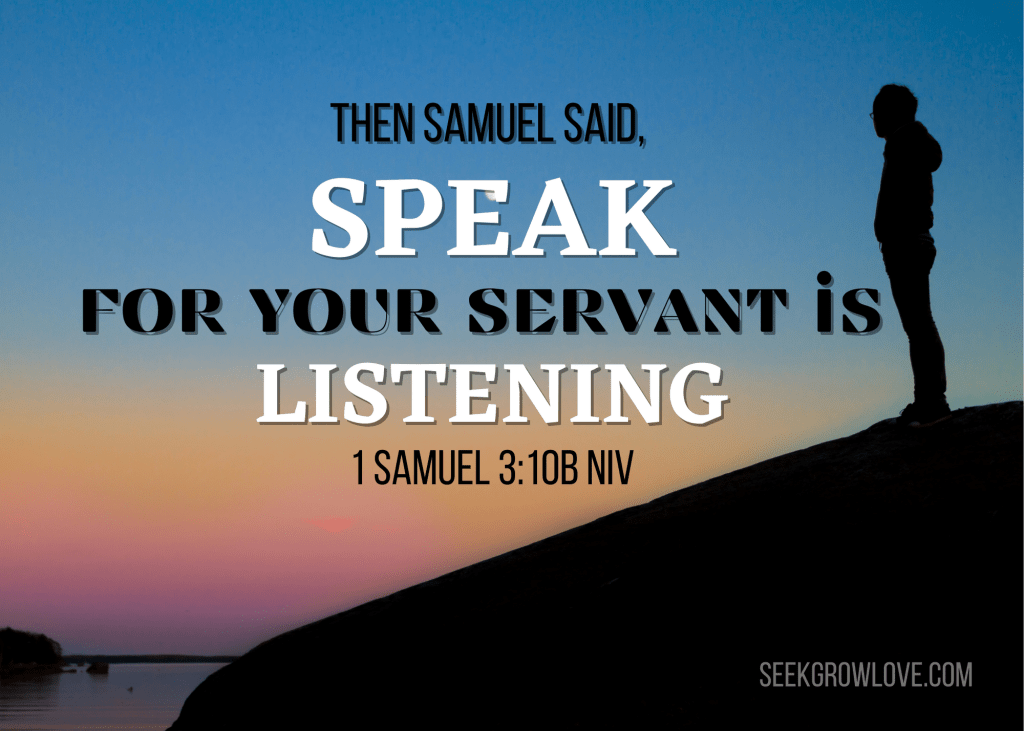
The priests at that time not only served in the temple they also slept in the temple. Picture the scene: Samuel is in bed, it’s quiet, and everyone is trying to go to sleep. Samuel hears a voice speaking in the silence. Samuel assumes it’s Eli calling for him so he comes to Eli’s bed. Eli says “It wasn’t me, go back to bed”. It happens a second time, Samuel gets up and goes to Eli who again says “It’s not me, go back to bed.” It happens a third time and Samuel again runs to Eli, who by now realizes that the boy isn’t trying to stall going to bed but someone really is calling him, and it must be the LORD. So Eli trains Samuel in how to listen for God’s word. Say, “Speak LORD, for your servant is listening.” Samuel does as he is told, and God speaks and Samuel responds, “Speak LORD, your servant is listening”, and then God tells Samuel what is about to happen. God is about to punish Eli and his family for their sin.
At breakfast the next morning Eli asks Samuel what God said and warns him to tell the truth. Samuel delivers the bad news to Eli and the priest accepts this as being a true word from the LORD. As the story unfolds, God backs up His word. The Philistines defeat Israel in battle, they take possession of the Ark of the Covenant, where’s God’s glory resides, and Eli’s two wicked sons are killed. When the report is given to Eli he falls out of his chair and breaks his neck and dies. From then on God keeps speaking to Samuel. Why? Because his servant was listening.
Samuel was faithful and took the words God gave them and shared them with the people. Jesus did the same thing. He listened for the voice of his father and he faithfully shared them with his people. In John 17 Jesus says: “I gave them the words you gave me and they accepted them.” (John 17:8) The words that Jesus spoke were the words that came from his Father. Jesus spent much of the first 30 years of his life studying the scriptures and committing them to memory. He began his ministry by spending 40 days in the wilderness in solitude and silence. His daily habit was to rise up early while it was still dark and pray- you can be sure that his prayers weren’t simply him telling God what he wanted, but included much careful listening.
The word of God was rare in the days of Samuel, was it because God wasn’t speaking, or was it because no one was listening for God’s voice until Samuel?
If it feels to you like the word of God is rare today ask yourself, is it because God isn’t speaking, or is it because we aren’t listening? Try this… turn off the noise, find a place to be silent and place yourself before God and say, “Speak LORD, your servant is listening”. God may speak to you through His written word, the Bible, or through His creation, or through a dream, or maybe even a still, small voice. But you won’t hear God if you don’t shut off the noise and listen for Him.
-Jeff Fletcher
Today’s Bible reading passages can be read or listened to at BibleGateway here – 1 Samuel 3-4 and John 17




 Seek Grow Love