Living Water

Revelation 7

Revelation 7 17

When I am sad it is hard for me to function properly. I usually get anxious and worried and often I am emotionally compromised. It usually takes someone else to put me back on the right train of thought and to change my attitude.

Revelation 7:17 says this, “For the Lamb in the center of the throne will be their shepherd and will guide them to springs of the water of life; and God will wipe every tear from their eyes.”

Often times when we are sad or upset, anxious, mad, or disgusted, Jesus has to Shepard us into a new train of thought. One with a better perspective and one that is better for our well-being. He gives us a new feeling, that which feels like a fresh drink of water and refreshes us. He allows our hearts to be calmed and gives us hope for the future.

This is my prayer this morning, that Jesus would give you hope and that you would find peace in him and his ways. Because he is the Shepherd who leads and guides us through the hills of life.

Jesse Allen

Who is Worthy?

Revelation 5

Revelation 5 2 4 NIV

I remember when I was younger trying to open the jam jar and it was almost impossible. All I wanted was my PBJ and needed to open the seal of the jar so I could be successful. No matter how hard I tried I couldn’t get it open, so naturally I asked my brother if he could somehow open it. Then with ease and hardly a second he had it open. My brother was the key to my Peanut Butter and Jam sandwich.

In revelation 5 John is in the middle of a vision and he has in front of him a throne and next to this throne was a book with 7 seals. He is having a difficult time figuring out who could open this book with these seals but could not find any worthy person. But then it describes the one who was worthy to open the seals in verse 5:5 “The lion that is from Judah, the root of David, has overcome so as to open the book and its 7 seals.”That Lion depicted in this verse is Jesus he is the one who has overcome death and has made it possible for us to do that same thing.

Having someone stronger than us in our lives so we can succeed is vital to being a Christian. We have Jesus to rely on and he makes it possible for us to worship God with pure hearts and minds. He was worthy so we can also be worthy.

I would like you all to write down on a post-it note the one thing that holds you back from your greatest potential and hang it on your mirror that you use daily. Remember this when you read it, Jesus overcame sin and death, and He gives us the power to do the same.

Jesse Allen

Majestic

Revelation 4

Revelation 4 10b 11

Where are some places you have been that could be described with the word “majestic”? Maybe somewhere like Niagara Falls, the Grand Canyon, Appalachian Mountains, the beach, redwood forests, etc. There are many things about these areas and more that make them majestic; however, there is one thing that links them all together. That is, their creator. God is what makes these scenes and places majestic.

This is what comes to mind when I read the imagery in Revelation chapter 4. All of the thrones and elders with crowns and different animals and faces and a rainbow, four faces and eyes everywhere. Flashes of lightning and thunder going on in the background. It is all just majestic, and for what reason? On the surface of this chapter I would say it is safe to say it is to illustrate the importance and demonstration of worship. To worship our God in a holy way because He is holy. It says in verse 11 that, “He is to receive glory…. for You created all things”. So, we ought to worship God in a holy majestic way as all of creation does as well.

As far as the in-depth meaning of all the imagery in this chapter you must research what each animal represents in that time and worldview of Judaism as well as understanding the importance of the use of certain gems in reference to objects and people.

Jesse Allen

Overcome

Revelation 2

To him who OVERCOMES
“He who has an ear, let him hear what the Spirit says to the churches. To him who overcomes, I will grant to eat of the tree of life which is in the Paradise of God.”  Revelation 2:7
One of the phrases I would like you all to notice and underline when it repeats is this, “To him who overcomes”. This phrase refers to specific obstacles in Revelation 2 however this phrase could mean any obstacle in the way of your relationship with God. If you overcome your greatest fears and struggles and rely on Jesus, your relationship with God will thrive.
Jesse Allen

Signs

READ REVELATION CHAPTER 1

Revelation 1 3 road sign

Why do road signs exist? Road signs are very useful for driving and directing traffic and preventing unwanted circumstances. If followed correctly the road signs are very helpful to everyday life. They stop us before we get hit by other cars in the intersection, they warn us of upcoming obstacles and they generally help us know where we are at and where we are going.

“In the United States, the 1900s also came with a call for signs to meet automobile industry growth.Drivers were easily getting lost without signs. The signs that did exist at the time were often damaged or broken. As a result, Americans were becoming aware of a need for signs.”[1]

What do signs have to do with Revelation? Well I’m glad you asked. Actually, it’s in the very first verse of Revelation. In the NASB Rev. 1:1 says this “The revelation of Jesus Christ, which God gave Him to show to His bond-servants, the things which must soon take place; and He sent and communicated it by His angel to His bondservant John,”

The word communicated also can mean signified or to be made known. In other words God used an angel to “signify” (use signs, just like we use road signs) to communicate with John, so he could then reveal to “His bond servants” (Us/Christians) the things that have taken place, that are taking place and that will take place in the future (Revelation 1:19), during the time John was receiving this Revelation.  Hence the name of the book.

So, road signs are a sort of revelation of roadways and intersections, just like the things revealed to John in Revelation, passed down to us, are like road signs to living a Christian life. What John writes in the book of Revelation must be taken seriously just like road signs we encounter every day. That is because what John says, sees, hears, feels, and smells in Revelation are warnings, and guidelines on how to correctly live one’s life as a disciple of Jesus. While at the same time revealing consequences for the unjust/ungodly, and rewards for the Righteous and Godly. Revelation exists in the form it does not to confuse its readers (although it can be confusing at times) but to simplify the life of a Christian and not get lost.

Revelation, as we will find out in further investigation, has many different signs of its own resulting in various objects, colors, shapes, smells, images, numbers, places and characters. I want you throughout this entire study of revelation (Not just my part) to write down all the different colors, numbers, images, metaphors, etc. Look them up and question what they mean. Circle/underline/write down phrases that occur more than twice and also question what they have to do with Christian discipleship. You may be surprised how interesting they can be!

Jesse Allen


[1] https://www.degemmill.com/history-traffic-signs/

Clarification of the Christ

Colossians 1:15-20

colossians 1 15 NIV

I love to look deeper into these verses in Colossians to fully understand what Paul was writing and why. Paul was poetic in his language and using wording that the Israelites used to describe the personification of wisdom. If you look through the Old Testament it is not likely that you will find the phrase “Holy Spirit”. You will however find the term “Spirit of God” which we discover is the same thing, God’s power within us. Likewise “word of God” is not seen in the Old Testament. Once there is a reference to the “word of the LORD” but the majority of the references toward the Word of God are seen describing this personification of wisdom. A different way of saying the same thing. Jesus is the living embodiment of the Word of God.

“He is the image of the invisible God” – Jesus is called the image of God in these verses and in 2 Corinthians 4:4. In Hebrews 1:3 he is described as “the radiance of God’s glory and the exact representation of His being”. Two truths are revealed through the first half of this verse: God has remained unseen “no one has ever seen God” John 4:18 and second, Jesus reveals the nature and character of God for he is the image of God in which humanity was originally created in Genesis 1:26. It is the image that we as the faithful will be transformed into upon Jesus’ return.

“The firstborn over all creation” – Paul borrowed from his Jewish upbringing; firstborn was a Hebrew way of saying someone was especially honored. The nation of Israel was called firstborn (Exodus 4:22), as was David (Psalm 89:27). The word, in these instances, did not refer to their physical birth but to their place of honor before God. So here Paul is saying that Jesus has a place of honor over all creation.

“By him all things were created” seven times in these verses Paul mentions “all creation”, “all things”, and “everything” stressing that the Christ is supreme over all through the power God granted him. The tense at the end of this verse was not translated correctly in the NIV, it says “all things were” however the original language was not past-tense “were” rather present “are”.

“Before all things” like with firstborn this does not speak of time but importance. The Christ is before all things in importance for it is only through him that all things will be restored.

“All things hold together” he will usher in a new age in which sinful man will be redeemed and united with our holy God.

This passage speaks of the importance of the Christ, the place of honor over all things that he holds. Additionally it points to both Jesus’ place of honor over the church and those who will be resurrected to eternal life as well as a chronological order. Jesus was the beginning of the church as we know it. And he was the first, and only one to this point, which God raised to new life. We the faithful will follow suit once Jesus returns.

“All (his) fullness dwell” (his) was added to many translations which adds to the confusion and skepticism that people may have concerning these verses. Before moving forward think about what happens to those who come to God through Jesus. We are filled with God’s spirit, His power and character, at least to a point. But Jesus was filled with the fullness of God, all power and authority were given to him. He also displayed the nature, character, and attributes of God. Paul also had another reason for his choice of words, “fullness” was a popular term among the Gnostics who used it to refer to the combination of all supernatural influences. So Paul used their own word to elevate the Christ above all other religious ideas and systems.

“To reconcile to himself all things” Jesus’ death, burial, and resurrection set the stage for not only the faithful to be made new but also all of creation. Unfortunately it does not mean that everyone will be saved from sin and ultimately death. We have free will and we make our own choices. But God does not give up on us. I believe that even those He has already seen reject Him are given daily opportunities for redemption.

It is important that we have a clear understanding of who Jesus is and the reason that we need a Christ, Messiah.

To be continued… (by someone else)

Jeff Ransom


(Editor’s Note – Thank you Jeff for finishing off the book of Proverbs with us this week, and giving us two free theme days to think on!  Tomorrow we will begin looking at the book of Revelation – one chapter a day through the month of November.  And in December we will finish off the New Testament with the book of Luke.  So many precious things in God’s Word!  Keep taking it in.)

Contentment and So Much More

Proverbs 30

Proverbs 30 8 9 NIV

The author of this proverb, Agur, begins by belittling his understanding. The irony is that his words hold great wisdom. He is not bragging about his knowledge and understanding. He is declaring the LORD our God as unfathomably great. He asks six questions, five of which identify the power of God. The sixth is prophetic of the yet unborn son of God, Jesus. Additionally, his understanding of the perfection of God’s word and the refuge it provides us is astounding. This is a man of great wisdom who humbly recognizes his insignificance before God which in itself makes him all the more wise.

He then focuses on two requests of God; honesty and contentment. He asks that falsehoods and lies be kept far from him. He provides a variety of ways in which lies and deception can bring curses down upon our heads. They destroy our relationships and cause us to spiral ever further from the God who loves us. Entwined in these illustrations are lessons of being satisfied with what we have. Appreciating that our needs are met and being content with that is not easy when there is often so much more that we want. God provides for our needs, the author acknowledged this. Everything beyond our needs comes from our desires which are, more often than not, borne of our sinful natures.

Agur then contrasts contentment with greed. First pointing to leeches which will gorge themselves beyond their needs. Then he personifies four things which are never satisfied. Two of these are actually life-giving; the womb and land. These are bookended by destructive examples; the grave and fire.

Verse seventeen seems oddly out of place and more than a little disturbing. It actually goes with the theme of honesty. The person suffering such a creepy fate has been dishonest in action and words with their family, and likely with everyone else in their life. Ultimately they will be alone and everything they had will be scattered among the people around them.

How do the eagle, snake, ship and couple fit together? Is this what Agur did not understand? I doubt it. Each of these examples can be seen as somewhat mysterious in what path they will take. The eagle is not limited in the great expanse of the sky just as there are few obstacles that the snake could not overcome. Without a rudder and someone to steer, the ship would be tossed at the whim of the sea just as the whims of men and women often make courtship, that is dating for all those not familiar with the term, tumultuous. So how does this fit in with what Agur is trying to convey? It goes back to his self-proclaimed ignorance of, well, everything but specifically of God’s ways and will.

And then we get back to a verse that makes us scratch our head. The mention of the adulteress is actually an example of someone who is neither content with their relationship or dealing honestly with others. Additionally, she is completely without remorse as she sees nothing wrong with her actions. My prayer is that none of us would get caught up in this specific type of behavior but even more so that we would be remorseful of any actions that we take or words that we use which hurt others.

Up until verse 21, Agur has been consistent with themes of God’s power and majesty, honesty, and contentment. Somewhat enigmatic but consistent nonetheless. Beginning with verse 21 though he expands his words of wisdom. First to include the injustices of the world or what he refers to as four things by which the earth cannot bear. Of the four examples the first and last are of one who is raised to a higher position, likely without the benefit of knowledge or understanding of their responsibilities. This type of unfair promotion can lead to disaster in most cases. It is not uncommon though to see someone with little knowledge of how to manage situations or how to lead people placed in a high position. Additionally it is a warning to us not to seek after something we are not prepared or equipped to handle. I guess that goes back to one of the main ideas as well, contentment.

Agur then reminds us that wisdom and understanding are not reserved for anyone. Young and old, big and small may seek after these great treasures. His specific examples are of course of the small creatures and the wisdom found in how they act. The contrast however is of larger creatures and their “stately bearing.” The imagery used is of pride and arrogance. Perhaps a reminder of humility in our own positions, whatever they may be. Given how this proverb concludes that would certainly seem to be the final lesson.

So what have we learned from Agur, other than that he has a pretty cool name? Humility is greatly valued, especially in light of our amazing God’s power. He was in awe of the gift of God’s word that has been given to all men. He esteemed honesty and contentment as the greatest gifts to request from God. And he reminds us that it is not our age or size that matters but our willingness to seek after wisdom that counts.


To be continued…

Jeff Ransom

Sucked into Sin

Proverbs 29

Proverbs 29 16 NIV

This chapter of proverbs continues the thoughts from the previous one – speaking on the contrasts from the wicked and the righteous. Proverbs 28 and 29 give us wonderful examples, not only of recognizing sinful ways but, of the habits that could sneak into our own lives. Many a good man and woman have been corrupted in time by the allure of sin. Additionally, it is noted in this proverb that those who we surround ourselves with can lead us into sin. We must choose carefully who we associate with and be wary that they do not drag us into sin and away from God.

In my youth I hung out with people that did a lot of things that I knew were not good. Drugs, alcohol, and other activities were happening all around me. I hung out with them because I liked being around them but I never let myself fall into their ways. I always thought that made me okay but all it would have taken is one encounter with law enforcement and I would have been found just as guilty as the rest. Wow! That hit me like a ton of bricks when I first realized that. God was watching out for me but I was really pushing the boundaries of His grace and I realize that now. In that I am reminded that we are not to put our God to the test. Yet that is exactly what I was doing for years. He truly is merciful and gracious!

One last thought from this passage that actually ties back to what I wrote about for Proverbs 27 concerning anger, check it out if you missed it. Giving full vent to our anger as this proverb points out is bad. Yet I said before that it is good. No, not is good, but may be good and can help. Verse 11 says that a wise man keeps himself under control. Anger released rationally, controlled, is what I spoke of the previous day. This is talking about rage. Rage is uncontrolled, irrational, and violent. There can be no compassion or concern in rage but you can have both while angry. Understanding this is important for our relationships. That is why we have the saying, “Count to ten before speaking.”

In closing, I urge you to be aware of the various ways in which we can get sucked into sin. Be careful to not place yourself into a situation where you become guilty by association. And remember that we were created for relationships. They are vitally important to our God and to our daily existence. Treat them with the care that they deserve.

To be continued…

Jeff Ransom

In This Moment – Our Relationships

Proverbs 27

Proverbs 27 1 NIV

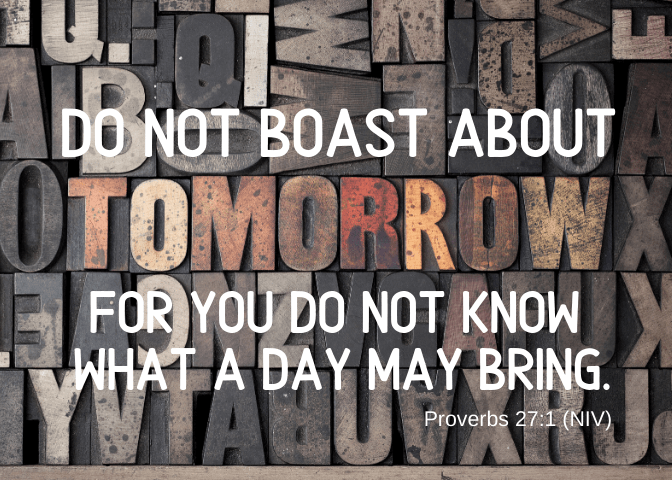
How often do you think about tomorrow? What is it that you think of? Are you hoping for certain things to happen, praying for a specific outcome? Are you dreaming of what might be?

The implication from James 3:13-14 and 4:13-15 as well as Matthew 6:34 is that tomorrow is promised to no one. Ecclesiastes 9:11 tells us that time and chance happen to everyone. With billions of people each doing their own thing for their own reasons it is easy to see how true that last statement is. So we truly cannot boast about tomorrow for we do not even know if it will come to us and if it does, what it will bring.

We are to prepare for tomorrow, but not presume it. When we dream of tomorrow we may find ourselves imagining our own plans being better than God’s. Additionally, thinking to the future is more often than not the primary source of our anxieties. So again I say, prepare for tomorrow but always trust in our incredible God’s will. If He has called you to Him it is to succeed in His will, not to fail in it.

Of the 27 verses of the 27th Proverb, 16 deal directly with relationships (2-6, 9-11, 13-18, 21-22). It is telling of the importance of relationships to our amazing God. He places the greatest emphasis on our relationship with Him and one another all through the Scriptures.

The three points on relationships that this chapter of proverbs focuses on is a humble heart, the sting of honesty, and the destructiveness of things left hidden.

If there is something that you are really good at you are probably accustomed to receiving praise for it. While there is nothing inherently wrong with that we need to remember not to let it go to our head. If you let it, it can inflate our ego. A brilliant writer receives critical acclaim but it is likely that their talent was developed and nurtured by their parents, numerous teachers, and peers. The passion to do what they do is fueled by hundreds of authors that have come before them. Likewise a superstar athlete has family, teachers, coaches, trainers, teammates and even their competition to thank for honing their abilities. As you can see there is nothing that we do that we could honestly boast about. Everything we do and are capable of comes from others guiding us and believing in us. Ultimately this is all traced back to our LORD and Creator. In His image we are strong and creative. We are intelligent and powerful because of Him.

The second point made in this proverb deals with the pain of honesty and how good it can be for us. It can hurt when someone tells you, “You sing horribly!” Well, not so much for me because I already know that. But you get the picture. When someone tells you in such a point blank manner or preferably in a more caring way a truth that you need to hear that is for your benefit. Sometimes it is an honest remark about something we said or how we acted that we know was not right. We need to be called out from time to time over our words and actions. This is what the Bible calls a rebuke, a correction of what we do and say.

One of the honest expressions this passage speaks of is anger. Anger can be cruel, to the one who is angry as well as the one at which the anger is directed. But a sudden outburst of anger may allow us to clear the air. It can move us into a place of reconciliation and forgiveness so that healing can begin. The point is that open and honest communication is not always nice and polite. Sometimes it is not possible to be honest in a demure, quiet way. There are times when honesty hurts. Actually, most of the time honesty hurts. But can we truly grow and mature if everyone around us is sugar-coating and shielding us from the reality of a situation?

The third and final point I took from this proverb goes hand-in-hand with honest communication, burying things away. I mentioned the point of anger and the author continues by asking the rhetorical question, “Who can stand before jealousy?” Jealousy, envy, and the like are like smoldering embers. The heat is held inside, never dying down and ready in an instant to ignite at the first opportunity. They are not easily vented or burned out. While anger may subside soon after being released, jealousy and envy grow stronger the longer they are held. They feed off of our relationships, slowly burning them away to nothing. Be careful of what you hold inside for this is the very reason we have the expression, burning bridges.

There is so much more within this wonderful passage that we could have covered. The significance of being in this moment and trusting God for what may come as well as the importance of relationships is what really stuck out to me. So remember, not only do we owe God but many others for all that we are capable of. Honesty hurts but, when coupled with compassion, is helpful. And finally, be careful what you hold hidden inside for it can destroy your relationships and do great harm to you as well. We were created to be in relationship with God. Our Savior, Jesus, spoke of how vital our relationships are. He simplified the incredibly convoluted system of 613 laws that man had in place to two – love the LORD your God with all your heart and with all your soul and with all your mind; and your neighbor as yourself. The heart of these is relationships. Never forget that.

To be continued…

Jeff Ransom

Only You Can Prevent Forest Fires of the Mouth

Proverbs 26

Proverbs 26 20 NIV

The Smokey Bear Wildfire Prevention campaign started in 1944, and in 1947 the slogan that is familiar to many came to fruition; Only You Can Prevent Forest Fires (updated in 2001 to Wildfires). It is the longest public service campaign in the United States’ history. A campaign was derived to help the prevention of forest fires. Years of education gave the ownership to the general public to be more careful and to care for the world around you. The catchphrase reflects your responsibility.


Our family does not do “traditional” camping (unless a cabin with running water or hotel room is traditional camping to you). This doesn’t mean that we don’t love a good campfire.  This summer we spent some time in the Upper Peninsula of Michigan at our family cabin. The week was filled with cleaning out the overgrowth of trees and brush on the property, which meant a BIG campfire. Our burn pit is close to the lake, but is really in the middle of the woods (like most campfires). Being in the heart of the woods means being surrounded by a plethora of “fuel” if a fire is left to its own devices. So, before we left the cabin or went to bed, we had to make sure that the fire was out.


The wisdom from Proverbs 26:20 resonated with me. It says, “Without wood a fire goes out; without a gossip a quarrel dies down.” You see, a fire is only going to burn if it is fed. Our tongue is the fire and when you remove gossip or the “fuel,” it dies down. The best way to end (avoid) a quarrel? Keep your mouth shut!  Don’t get involved in what doesn’t concern you. Don’t take up offenses of others and don’t be easily offended. Don’t talk about what you don’t know and be very slow to talk about what you do know. Practice self-control in the moment and show Christ-like love at all times. Don’t be the fuel for the fire and the fight!


James 3:5-6 says “Likewise, the tongue is a small part of the body, but it makes great boasts. Consider what a great forest is set on fire by a small spark. The tongue also is a fire, a world of evil among the parts of the body. It corrupts the whole body, sets the whole course of one’s life on fire and is itself set on fire by hell.” This just reinforces that our small tongue can do big damage.


Don’t fuel the flame of gossip and cause fights, only you can prevent wildfires of your mouth!


Erin Bormes