Destroying the Division

Ephesians 1-3

Devotion by Jenn Haynes (OH)

I will be the first to admit that I struggle to let go of hurt. I don’t like to hold grudges. Having bad feelings towards others eats away at me. It gives me an upset stomach. And yet, I still fixate on those feelings and my relationships with those that hurt me never seem to be the same. I cling to that hurt, and that hurt divides us. 

Hurt and grudges don’t seem to have much to do with our passages today, I know. But it’s where my heart went. What stood out to me the most in these scriptures was the idea of division. I don’t know many Jewish people and so I don’t think I can fully appreciate what it meant to be united in grace and salvation with a group of people who were so radically separate from me. But there are others who ARE radically separate from me. We are separated by pain and broken relationships.

Read Chapter 2:14-18:

 For he himself is our peace, who has made the two groups one and has destroyed the barrier, the dividing wall of hostility,by setting aside in his flesh the law with its commands and regulations. His purpose was to create in himself one new humanity out of the two, thus making peace,and in one body to reconcile both of them to God through the cross, by which he put to death their hostility.He came and preached peace to you who were far away and peace to those who were near. For through him we both have access to the Father by one Spirit.

Have you ever felt yourself so divided from another person or another group of people that you felt there was no fixing that gap? I have. But the divide wasn’t a matter of nationality or to what group of people I belong. The divide was pain, hurt, betrayal, pride, and heartache. 

I don’t know what your divide is, but I’m willing to bet that most of you have felt separated from others like I have. It’s painful, and it doesn’t feel like it could ever be mended. 

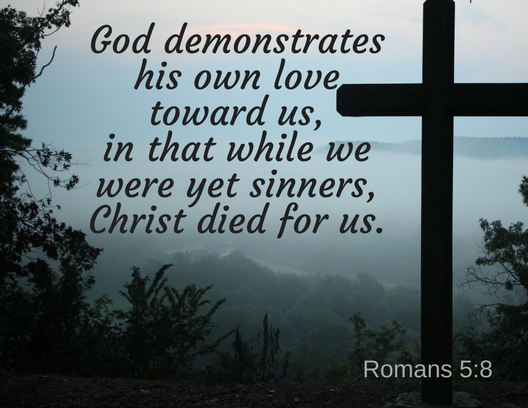
And yet, Jesus Christ destroyed the division. You are a sinner and you have done wrong and yet he died for you. The ones who hurt you? They are sinners and they have done wrong. And he died for them too. 

“He came and preached peace to you who were far away and peace to those who were near.” We all got the same message. We all got the same forgiveness. We all got the same grace. Yes, they hurt you. And you’ve probably hurt someone else. 

Verses 21-22 continue: 

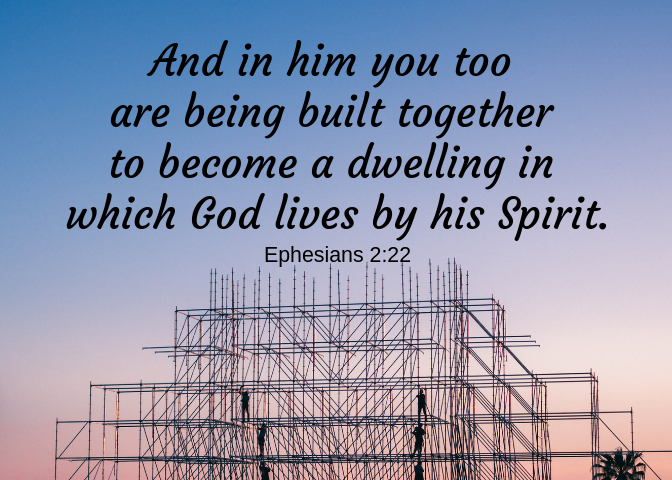
In him the whole building is joined together and rises to become a holy temple in the Lord.  And in him you too are being built together to become a dwelling in which God lives by his Spirit.

In Jesus Christ, we are joined together with those on the other side of that wide divide of hurt. We are to rise as his holy temple. We are to be united as his church. The divide that was too wide for us to cross on our own has been made small by the grace freely offered to all of us sinners. The divide may be hurt or betrayal or a sin done against one side or another. But the people on each side of that divide are equally guilty of sin. And they are equally forgiven. 

Reflection Questions: 

From whom are you divided? Really examine your heart. Do you want to be a united family of God? Do you want to be the temple God wants you to be, or would you rather hang on to your hurt? 

What sins of yours did Christ die for? What sins against you did Christ die for? If Christ died for those sins, and they have been paid for and are no longer yours or theirs, why are you still holding on to them? 

Prayer: 

My prayer for you today is that you find healing. Pray that God softens your heart and fills it with love for him that is so great, there is no room for hurt and division. Pray that you recognize God’s children as your own family, and that you be united in Christ. Pray for peace to settle on you all. 

We Believe It!

Romans 4-7

Romans 5:1 “Therefore, having been justified by faith, we have peace with God through our Lord Jesus Christ,”  (NKJV)

Devotion by Merry Peterson (Canada)

In the part of Ontario where I live there is a museum called ‘Ripley’s Believe It or Not’.  Inside there are lots of strange and unusual items and displays about occurrences that are most, well, quite frankly unusual!  The sign says it all – believe it – or not. Some things in that museum I find really hard to believe.  

Faith is really about belief.  Our belief that God is who He says He is, and will do what He says He will do.  That’s the tenet of having faith – those beliefs about God.  His existence as the supreme ruler of the universe and that His declarations of what He will do He follows through on. 

In the previous chapter we see that Abraham was justified by his faith even though the whole salvation plan through Jesus dying on the cross for our justification hadn’t happened yet in his time.  It was Abraham’s belief that God was in control and able to do what He said He would do that brought him justification.

We as Christians have received justification through Christ’s sacrifice because we live in a different time frame than Abraham.  Christ, the promised savior that God declared would become the sacrifice for sin has indeed died, and risen again, and our justification comes through that fulfilled promise. 

Notice that the fulfilled promise brings peace.  We have peace with God through Christ.  We have peace knowing that our sin is covered by Jesus’ blood, that we are no longer God’s enemies because of our sin.  The blood of Christ washes away the debt of our sin.  We become in good standing with God.  How is this achieved – by our belief that God is in control and follows through on his promises.  He said that Jesus would be the once for all atoning sacrifice for mankind bringing us justification with Himself.  We believe it! 

For Reflection:

Do you have friends or family members who have a hard time with faith?

When did you first start to have faith and believe?

Was there something or someone who helped you truly believe?

Are there ways that you could help guide another person to belief?

Calming the Sea

Matthew 8:14-34
Mark 4-5

Devotion by Shelly Millard (Nebraska)

It had been a flurry of activity and much of it miraculous.  Following the Sermon on the Mount we see the healing of the Centurion’s servant, healing Peter’s mother-in-law, and then crowds overwhelming him for healing of the sick and casting out spirits.  He was exhausted and knew he needed rest, so moved onto gathering his disciples in a boat and set out on the Sea of Galilee with his disciples to escape the pressure of the crowds. He quickly fell asleep, oblivious to a building storm.  The boat was buffeted about in the wind and waves; the storm so strong that it was described as cataclysmic or a mega storm.  The disciples, several of whom were fishermen and used to life on the sea, became frightened, fearing they were going to die.  In their fear, they woke Jesus, crying that they were about to perish.  His first response was to respond, “Why are you fearful, you of little faith?” He then gave the command for the wind to abate and the waves to calm, a remarkable illustration of power over the elements.  Jesus often used that phrase “little faith” to challenge his followers.  He is saying just look at me and see what I can do. . . that is what a mature faith looks like.  A big faith, one that is developed, is one where eyes and heart are fixed on the master of the wind even in the midst of the storm.

Fear is something that we are well acquainted with.  Our brains are wired to look for threats to help ensure our survival.  If we are walking through the woods and a bear jumps out, it triggers a fight or flight response to help us react in a way to help us survive—either fight the bear or hope we can run faster than our companions.  The disciples, in the midst of this storm, feared for their life—they were in a fight or flight response.  Jesus, however, took this opportunity to teach a lesson about faith.  These disciples had just been witnesses to incredible miracles; yet in their immature faith, were afraid for themselves.  We’ve all been there, finding ourselves in the midst of life’s storms and being battered by circumstances beyond our control or even by our brain’s proclivity at conjuring up imagined threats to our wellbeing.  Consequently, it is easy to get caught up in a cycle of fear and anxiety about our lives.  A loved one becomes ill, someone loses a job, financial problems hang over our heads, and in addition, we are caught up in a myriad of “what ifs”.  What if I fail? What if my relationship falls apart?  What if I disappoint others? And the list goes on and on in our weary brains.  Jesus speaks to us as he did to his disciples. . . what about faith?  Where does your faith impact your fears in your life?  How would it feel to have some freedom from the fears that seem to plague us?  Faith does not pretend that a storm does not exist. It does not exempt us from efforts to take care of ourselves and others. Faith ensures that we are not overcome with anxiety, stress and worry.  Faith allows us to focus on Jesus who provides the calm in the midst of our storms.

Questions for reflection

What are some of the storms you are experiencing right now? 

Imagine yourself in the boat with the disciples.  How overwhelming does that fear feel?   How would you respond to Jesus commanding the storm to abate?

Jesus uses the phrase, “little faith”.  Where are you in your faith journey?  Do you feel like your faith is growing and developing into a more mature faith?

How is your faith impacting some of the fears you are experiencing in your life?  How do you think you can find the peace within the midst of your storms?

Anticipation

Zechariah 10-14

Devotion by Carla Hardy (Michigan)

Anticipation. It’s the worst. But it’s also the best. On one hand, being hopeful and excited about an upcoming event can be agonizing. On the other, you can feel joy and peace in the waiting. 

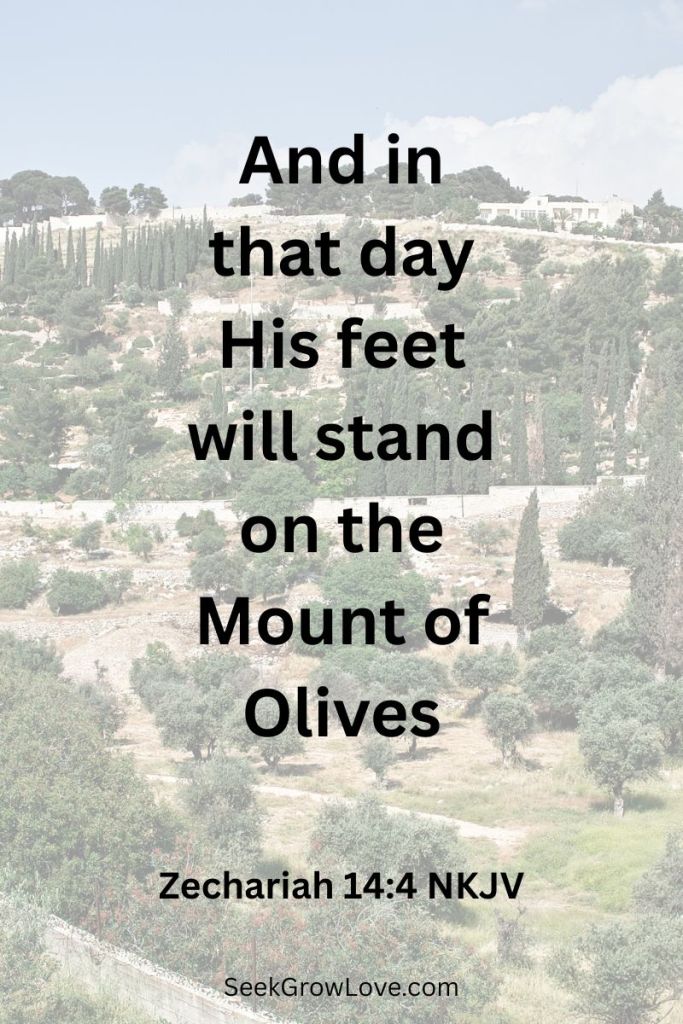
The end of the book of Zechariah paints a vibrant picture for us of the return of Jesus. It tells us what it will look like – his feet on the Mount of Olives, the mountain split into two, his light illuminating all the earth, living waters flowing. But, the book doesn’t reveal a crucial part – the when. No one knows the day or the hour of Jesus’ return, and if you are anything like me, this can drive you a little crazy. I’m filled with so much awe and wonder when I read these verses and meditate on what is to come. But I can’t escape wondering about the when. 

However, I do not want to be anxious about it. I don’t want to focus so much on the when that I neglect two other vital pieces – the who and the why. 

See, when Jesus comes back, I want to be ready for him. Every day I want to know him more, love him more deeply and live more like he did. This is how I prepare. And, I want to be sure that those I love are found the same when he comes back. That is my calling. That is the who. 

And the why? Because God loved us, He sent his son to save us. In focusing on that truth I can live each day trusting God that His timing is best. I don’t need to worry about when. I just need to do my part – preparing, praying, loving and serving. Because He loves me, and I can rest easily in that, waiting for His perfect timing.

Reflection Questions:

  1. How do you handle anticipation?
  2. Who is your “who?”
  3. What is one way today that you can focus on the “why?”

The Creator Holds the Storm

Jeremiah 51-52

-Devotion by Dustin Farr (South Carolina)

When life feels unpredictable, it can be easy to forget that the One who spoke the universe into existence still reigns over every detail. The same God who set the stars in place and shaped the mountains is the One who sees you, knows you, and holds your future. If He can bring order out of chaos in creation, He can bring peace into your storms. Our confidence is not in the size of our own strength, but in the greatness of His power and the goodness of His heart.

Reflection Questions:

  1. How does remembering God as the Creator strengthen your trust in Him during uncertain times?
  2. What current “storm” in your life could you place more fully under His control?
  3. When was the last time you paused to notice the beauty and order of creation, and how did it remind you of God’s power and wisdom?

Restore Us, O God

2 Kings 18:9-19:37
Psalm 46, 80

Have you ever noticed that when you’re in familiar surroundings, you don’t require all of your senses to function? For example, if you wake up in the middle of the night, can you make your way into the bathroom without turning on a light? Or have you ever found yourself “watching” something on the television while simultaneously scrolling on your phone. You look up to watch the television when you hear the music swell because you know something important is about to happen? 

But in unfamiliar environments, you require most of your senses, even if it doesn’t make sense? Am I the only one who turns down the volume of the radio while I’m driving when I am looking for a specific street sign? It’s like the brainpower used to listen to music needs to be redirected towards my sense of sight. Or when I am about to enjoy the first taste of something delicious, I don’t want any distractions; all I want is to savor the flavors in my mouth. Don’t talk to me, don’t have me look or study something, just let me appreciate what’s happening with my tastebuds. 

In today’s Psalm, the author is appealing to God in a time of national territorial struggle. Outside enemy forces are making their presence known and the nation of Israel is seeking God’s protection and restoration.

Three of the nineteen verses are identical. Verses three, seven, and nineteen all say, “Restore us, O God; make your face shine upon us, that we may be saved.” Let’s break this repeated appeal down.

Restore us, O God – make us right, heal us, put us back to where we were. Because of the disobedience of the people, their relationship with God has been broken or gotten off track. The petition to God for restoration acknowledges this. 

Make your face shine upon us – this phrase calls back to the Priestly blessing that is recorded in Numbers 6:24-26. When God’s face is shining upon His people, His blessings, His approval, His favor makes life more peaceful. But this can only be experienced when we are in right standing with God. When we are not in right standing with God, it’s like His face is hidden from us. It’s like the lights in the room are on, but we still cannot see; the volume on the television is turned up high, but we still cannot hear; we can add all the seasoning to food, but we still cannot taste it. We walk through our daily lives like it’s unfamiliar territory. We’re seeking for something to make sense and may even turn to external (and ungodly) sources for relief. But nothing can substitute the experience of God’s face shining upon those He loves and who are in right standing with Him.

That we may be saved – When God’s people have been restored and are in right standing with Him, and His favor is among the people, salvation from threats of the enemy is at hand.

The next time you find yourself in an especially challenging trial, mimic King Hezekiah who literally laid his problem out before God and made his appeal that God take action against the enemy. Ask God if there is anything that needs restoration in your life. Request God to make His face shine upon you. And then believe with all of your heart that God will act on your behalf. The course of action that God may take may not make sense and His timing could be very different than what you would like, but know that God sees those who love him and are committed to remain in right standing with Him. And even in the midst of the hard times, you can find peace to enjoy with all your senses the life God has planned out for you.

Reflection Questions

Describe a time when you felt God’s favor, peace, or presence in a tangible way. What was happening in your heart and life during that season?

What distractions – mental, emotional, digital, or physical – are keeping me from noticing or experiencing God’s presence fully?

How might I align myself with God today so that I am in ‘right standing’ with Him?

-Bethany Ligon

Hope

Isaiah 1-4

Regardless of your political ideas and loyalties, I believe we can all agree that the world is a mess right now. War and the threat of new wars are a daily reality. Mud-slinging goes back and forth between our politicians while important issues that they should be finding solutions to go unresolved and forgotten until the next election cycle. The soaring cost of buying a home or even purchasing groceries shows no sign of significant improvement. Anxiety and stress levels are high, causing many both inside and outside of the church to feel hopeless.

And yet, we have hope! Although there is quite a bit of reading material from the Bible today, I’m going to focus on just one verse that can bring all of us hope. In the NASB 1995, Isaiah 2:4 says:

“And He will judge between the nations, And will render decisions for many peoples; And they will hammer their swords into plowshares and their spears into pruning hooks. Nation will not lift up sword against nations, And never again will they learn war.”

Imagine living in a time and place where God is our judge. Of course, he is already in our hearts, but the nations of our world don’t worship and obey him. Even the USA, with “In God We Trust” printed on our money, documents, and buildings, does not truly and wholly worship God.

Imagine no more need to create bigger and faster weapons. In verse four, by turning weapons into plowshares and pruning hooks, they are creating tools used for growth instead of destruction. Without war or the threat of war, more creativity and time could be devoted to feeding the hungry and easing each other’s burdens. No one would fear their loved ones becoming a casualty of war or going off to fight only to return as a different person because of their experiences.

I encourage you today, as we await God’s Kingdom, to seek out ways to bring good to the damaged world we live in. Regardless of the hate and dismay, help to cultivate life and renewal for your family, church, and community. Seek peace whenever possible and spread hope far and wide.

-Lacey Dunn

Reflection:

• What are ways that you can spread the hope of God’s peace to others in your family, church, school, work, community, etc…

• Take time to imagine what life will be like in God’s Kingdom. What does it look like, smell like, and feel like?

• Are you feeling hopeless? Who is someone you can talk to who can help restore your hope? 

Jehu is Different

2 Kings 9-11

In Second Kings chapters 9-11 we read largely about the obedience of King Jehu in attempting to remove idolatry from Israel.  In the midst of that content there is an interesting concept that rings fairly true to today.  In Second Kings 9:22 Joram asks Jehu if he has come in peace.  Jehu responds, “How can there be peace as long as all the idolatry and witchcraft of your mother Jezebel abound?”  Jehu is clearly communicating that peace does not come between God and evil.  Our application should be a bit cautious, but clear.

Some would take a verse like this to somehow support a Christian committing an act of violence against an unbeliever.  This is not a proper application of this concept and should not be condoned.  Rather, it is important to recognize that there is a difference between the ways of God and the ways of evil, and those who support the ways of God will be different than those who support the ways of evil.  King Jehu recognized that the ways of Joram were opposed to the ways of God so there would be no peace between them.

In the New Testament we find language that concurs with this concept.  Philippians 3:20 says, “But our citizenship is in heaven.  And we eagerly await a Savior from there, the Lord Jesus Christ”.  First Peter 1:1 says in part, “To God’s elect, strangers in the world, scattered through Pontus…”  Once we become a believer, we align ourselves with God and His plan and ways.  This causes us to become strangers in the world, as we are different than the world.  Our citizenship is no longer of the world, but rather we become citizens of heaven.  Our eternity will be on the earth, after Jesus restores it through the millennial kingdom.  This is why Paul says at the end of Philippians 3:20, “And we eagerly await a Savior from there, the Lord Jesus Christ”.  However, our hearts and lives belong to God, who currently resides in heaven.  Our citizenship is with God in heaven, not of this earth.

Therefore, there is not peace between us and the world.  We are different.  Our lives should look different and we should be different than the world.  I believe this is the connection we can make to King Jehu’s response of clearly communicating that peace does not come between God and evil.

How should we respond then?  We should recognize that our lives are different from the world.  Sometimes that will cause awkwardness in our lives.  I attempt to hold pretty clear boundaries for the movies, shows, videos, or even reels I will watch.  If someone sends me a link of a video to watch I will ask about what it is and the content of it.  I sometimes ask if it includes any of the things I attempt to not visually consume.  This causes tension or awkwardness socially.  But I know it is best for me to be different in this way.


However, even though there is not peace between God and the world, we should still strive to live at peace with others.  Romans 12:18 says, “If it is possible, as far as it depends on you, live at peace with everyone.”  My response to King Jehu’s question should not lead me to go against God’s call to peace found here.  I live a different life than the world, but I also strive for peace with others, that I might show them the love of God each day of my life.  In doing this, I may win one for Christ!

-Michael Cisler


Reflection Questions

What are ways in which you can live more for God, and therefore not be at peace with the world?

How can you show others around you that you are intentional about living at peace with all people?

In what ways can we cope with the tension that sometimes is created by living at peace, but being different?

The Weight of Waiting

2 Chronicles 17
1 Kings 15:25-16:34

I was rushed out of the room, carrying a kid in each arm, and taken to the recovery room to wait for the return of my wife. The twins were here, and I had no idea what to do. There was a bassinet nearby, but I honestly couldn’t figure out the logistics of laying down one newborn without compromising my grip on the other. “That’s okay,” I thought. “My wife will be here soon, and she’ll help me sort it all out.”  So I waited. I nervously held onto them in a football hold as the minutes crept by. But then the minutes became longer than expected, and my confidence started to fray. I waited with my little ones—without information, without control, and without a clue. In that intermission, I did the only thing I could think to do: I sang. Out of praise, to stave off fear, and to quiet the echoing newborn cries, I sang:

“From my mother’s womb, you have chosen me, love has called my name,”

and “You’re perfect in all of your ways… perfect in all of your ways to us.”

Waiting isn’t for the faint of heart. To be patient is to fight our innate desire for safety and certainty. It reminds us that we are not in control—that our desires are only a small variable in any given situation. If we’re looking for holy ground—a place where our striving ends and God’s sovereignty begins—look no further than the weight of waiting.

As the northern kingdom of Israel spiraled under a succession of corrupt kings, Jehoshaphat began his reign in Judah. He watched the pendulum swing wildly in the wrong direction. But instead of rushing to react, Jehoshaphat paused. He sought the Lord. He devoted his heart to God’s way first, building his faith and fortifying the kingdom—not through conquest or alliances, but by spreading the Word and Law of the Lord and strengthening what already belonged to Judah.

There were no flashy political plays. No dramatic battles or self-promoting power grabs—all of which might have benefited a new king eager for approval. In contrast to war-beaten, idol-chasing, anxious Israel, Judah found peace—politically and spiritually—by halting, reflecting, focusing, and waiting on the Lord to move.

“The fear of the Lord fell on all the kingdoms of the lands surrounding Judah…”

(2 Chronicles 17:10)

Waiting made Israel restless. But it made Judah rooted.  Israel scrambled. Judah stood still.

So how do we wait in a manner that is pleasing to the Lord when life is beyond our control—when answers are delayed or the enemy seems to be advancing?  We fortify what’s already been entrusted to us. We hold our families, will continue using our gifts in ministry, and give consistently with our tithes. We don’t chase what we don’t yet have—we deepen what God has already given.  We also choose worship over worry. Worry imagines every possible outcome.

Worship reminds us who holds them all.  Even if God is silent, He is moving.  Commit to the wait.  Trust in the Lord.  He will act.

– Aaron Winner

Reflection Questions

  1. How well do you wait? How much do you worry? Can you think of a time where your waiting increased your peace?
  2. What is wise to do while waiting? What is foolish to do while waiting?
  3. What do you appreciate from Aaron’s list of waiting activity – halting, reflecting, focusing, and waiting on the Lord to move?