Imagery of sheep and shepherd are found all throughout the Bible, in both the old and the new testaments. Because of this, I think we sometimes forget some of the metaphorical imagery that comes with the sheep and shepherd dynamic. Sheep are not an intelligent animal in any sense of the word. They often wander off and get themselves in trouble. When threatened by predators, sheep will often clump themselves together in such a tight pack, that sheep in the center will often suffocate. All in all, sheep are fully reliant on their shepherd for protection, food water, and for their own survival.
Here in John 10, when Jesus is speaking about sheep, and he being the good shepherd, the people probably would have seen it as insulting when he compared them to sheep. But the point that Jesus is trying to make, is that like sheep we could not depend on ourselves for salvation from the consequences of our bad choices. God had to send us a shepherd who would “lay down his life for his sheep”. So he sent us His son Jesus. And as Jesus said, no one took his life from him, but he laid it down of his own accord. I don’t think we could have asked God to send us a better shepherd than who He sent us, His one and only son, Jesus. In just over a week, the Thanksgiving season will begin, and I think that this year we need to spend time thanking God, for the gift of the Good Shepherd, who laid down his life willingly, for us his sheep.
Jonny Smith
Today’s Bible passage can be read or listened to at BibleGateway here – John 9:1 – 10:21
Tomorrow’s passages will be the rest of John 10 and Luke 10.
Some days I have trouble feeding my hungry family. It’s not because there isn’t lots of food options in the house (only some of them past-dated). It’s just that sometimes I didn’t plan ahead and I am missing that one ingredient needed for what sounds good, or I am just tired, or it’s simply one of those days I would rather be anywhere but the kitchen. Feeding 5 seems like a rather large chore some days. I can’t even begin to imagine what I would do if I was given the job of feeding 5,000 men! This is definitely time for a miracle!
The Feeding of the 5.000 must have been a favorite event to recall during the time of the early church as it is one of the very few (or, even the only) miracles of Jesus recorded in all 4 gospels. It is fun to see the slight differences each writer brings to their retelling.
Matthew records this event as happening right after Jesus heard about the beheading of John the Baptist(14:13). Mark and Luke recall that the disciples had just returned from their Jesus-appointed “mission trips” and were reporting on all they had experienced. Jesus was definitely looking for a quiet place to be alone with his disciples so he took them to a remote location. But the crowds still found him. As an introvert I love and value the time I have alone with my quiet. But as a follower of Jesus, I must remember so much of the job he would have me do requires connection with others (in-person or even virtually in 2020). Jesus had compassion on the crowd, re-ordered his calendar and priorities, and pushed back his quiet time with God til later (he DID still get his quiet time though – even if it was when most people were sleeping). Luke records, “He welcomed them and spoke to them about the kingdom of God, and healed those who needed healing.” (9:10).
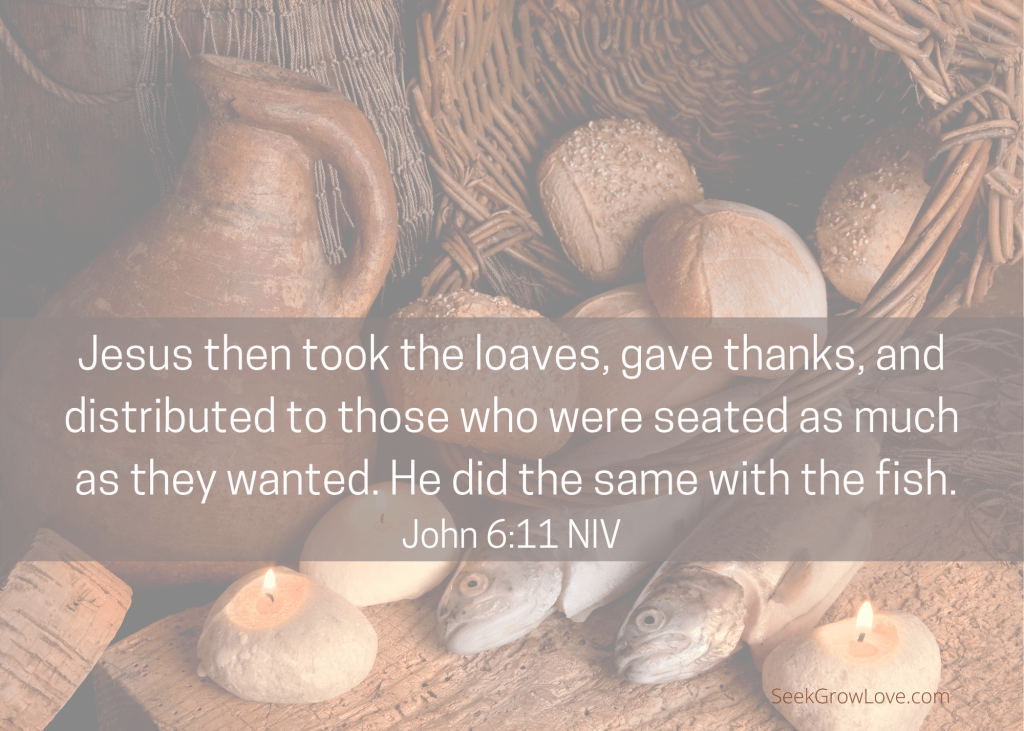
Today we are reading of the event from John’s gospel. John had been an eyewitness to see so many of Jesus’ miracles, but he chose to include only 7 in his gospel account – one of them being the Feeding of the 5,000. Dr. Joe Martin, New Testament professor at Atlanta Bible College, loves to point out all the details we get from John. Unlike the other gospel writers, John wrote his gospel later in life, when the brain’s old memory bank is overflowing with fun little details of events long past. John is in fact the only author who tells where the 5 loaves and 2 fish came from – the little boy’s lunch. John even includes that the loaves were made of barley (a cheaper grain most often consumed by the poor). He also recalls and includes which disciple said what when. He did all he could to help his readers watch this amazing miracle unfold.
Can you picture yourself in that crowd, stomach growling but not wanting to leave to find food – you don’t want to miss a minute with Jesus. And then, you’re told to sit down and the food starts coming – and coming – and coming. Sure, it is simple barley loaves and fish, but they taste so good and filling. Word passes around that all this food came from one little boy’s lunch. How in the world could so many people eat and be filled with 5 loaves and 2 fish? There was no logical explanation. This man Jesus who had taken the bread and fish and gave thanks to his Father had just performed a miracle and you were there to see it and taste it and fill you up inside. You can’t wait to tell your friends and neighbors about your experience with this man Jesus.
After a retelling of the amazing walking on water scene (which truly deserves a devotion of its own), John includes the teaching Jesus gave calling himself the Bread of Life. Jesus realized that since he had miraculously fed the multitudes he would have a following constantly looking for another free lunch . How could he explain to them that through God’s plan, he (Jesus) could offer them so much more than a free meal that would fade away and be replaced with gnawing hunger again. God’s design was so much greater. Jesus said: “For my Father’s will is that everyone who looks to the Son and believes in him shall have eternal life, and I will raise him up at the last day.” (John 6:40).
You may have missed the free lunch, but don’t let this offer pass you by!
Remember Jesus’ words to Satan (and recited from what would become Deuteronomy) “Man does not live on bread alone, but on every word that comes from the mouth of God.” (Matthew 4:4 NIV). Look to God, fill yourself up on His Word and His Son. Nothing else satisfies. Nothing else leads to eternal life but the Bread of Life, the Son of God.
-Marcia Railton
Today’s Bible reading can be read or listened to on BibleGateway here – John 6.
Tomorrow we will read Matthew 15 and Mark 7 as we continue on our 2020 Chronological Bible reading plan.
As we learn more and more about Jesus and find that we are completely astonished by this man, the Son of God – we are left with more questions – what will be my response to him? What must I do to follow him? How do I sign up to be his disciple? What will my job description be as a follower of Christ?
Matthew 9 and 10 give some great guidance for those seeking to follow Jesus. We have the example of Matthew the tax collector who was working hard at his tax collector booth when Jesus came by and said, “Follow me.” That was all it took. No endless paperwork to fill out. No aptitude test – Jesus already knew Matthew’s strengths and weaknesses, as he knows mine and yours – and still he calls – follow me. In order to accept the job, there will be something we must leave behind. It might not be our occupation, as it was for Matthew. It might be our favorite hobby or mindless pastime or those enticing overtime hours. There is simply not enough hours in the day or room in the heart to do everything the world says you deserve to do and effectively follow Christ. A follower will sacrifice, change, give up, adjust schedules.
I am reminded of my dad who never retired from the ministry, but after his kids all grew up, he fulfilled a life-long dream and bought himself a little fishing boat. He loved that little fishing boat, but he loved more his Savior and the people that he worked tirelessly to bring to Jesus – so the boat didn’t get out much.
Which brings us to the second lesson learned from Matthew. As soon as he left behind his tax collector job, he invited Jesus to his house to be his guest – along with all his friends of questionable beliefs, backgrounds, and motives – yes, the “sinners”. You might know a few yourself. Matthew knew his friends and coworkers needed Jesus as much as he did and he took it upon himself to introduce them to one another. When we take on the job of follower of Christ we invite Jesus into our lives, our homes, our family, our circle of friends, neighbors and associates. As Warren Wiersbe says, “God has no secret service” (NT Wiersbe Bible Commentary, p.32). A follower doesn’t cover-up who his boss is. How can you invite your neighbors and coworkers and family to meet Jesus? Take some time to seriously create a list of people you know who would benefit from some time with Jesus (before Jesus returns to judge the earth) and then prayerfully consider how God would have you make the introductions.
When we start really looking at the needs around us – the eternal needs – it is easy to get overwhelmed. Jesus,too, has seen the crowds – like sheep without a shepherd. He instructed his disciples to pray for more workers in the harvest field. We would do well to pray this prayer as well.
A follower isn’t a one man show – rather they have the responsibility (and often joy) of working with others to share the good news. Just as Jesus sent out his disciples to work together (Mark records they went out in pairs), we will find our effectiveness greater when we take the team approach to following Christ. Who are you already working with and who would be a great addition to your current team of Christ followers?
Jesus warns his followers that it won’t be easy – not what you always want to hear at a job interview. But, who wants an easy job? He warns of the opposition his followers will face – from the religious leaders, from the government and even from family. Likewise, we must be prepared to not be swayed or stopped from the task by opposition we face from many fronts. Just as Jesus was persecuted, so will his followers. Expect it and keep working. Jesus says it best, “All men will hate you because of me, but he who stands firm to the end will be saved.” (Matthew 10:22 NIV). There may be times you will be tempted to take the easy road, give in, hide Jesus. Don’t do it. Remember Jesus’ promise and warning: “Whoever acknowledges me before men, I will also acknowledge him before my Father in heaven. But whoever disowns me before men, I will disown him before my Father in heaven.” (Matthew 10:32-33).
Finally, a follower will love Jesus first and most.
How will you pick up your cross today and be his follower?
Marcia Railton
Today’s Bible passage can be read or listened to at BibleGateway here – Matthew 9 & 10.
Tomorrow we will read Matthew 14, Mark 6, and Luke 9:1-17 as we continue learning about Jesus and how to be a follower.
Jesus – how well do we really know him? It is easy to look at passages like today’s and quickly dismiss them as familiar. Oh, yeah, this is where he talks about the parables of the Kingdom of God for awhile, drives out a bunch of demons (whatever those are), calms the storm and heals some people. He was a pretty cool guy.
Indeed, but if we look at these stories more closely can we learn anything that we might not have caught back in our preschool Sunday School days when we may have first heard these amazing and true stories of the Son of God. I enjoyed reading the Wiersbe NT Bible Commentary that pointed out in these chapters of Mark we see that, “God’s servant, Jesus Christ, is the Master of every situation and the Conqueror of every enemy.” (p101). We see him provide victory over danger (the storm), demons, disease and even death! In a world that still has some very real issues with fear, anxiety and worry (and maybe even demons?) – we would do well to take a closer look at this man Jesus – as well as how people responded to him when they were face-to-face with this one-of-a-kind conquering hero servant.
To help me look at Jesus more deeply, I made a chart of what Jesus DID in these passages – his actions and how he responded to various people (and demons). And, then, as I am also interested in how I ought to respond to Jesus – I included how a broad range of people reacted to Jesus, his teachings and what they personally experienced.
My Jesus column included things like:
Jesus saw – both the crowd and then also individual needs
He touched – Peter’s mother-in-law and Jairus’ daughter
He taught – to the crowd in parables and with further explanations for his followers
He slept – in the boat, through the storm (even though we also know some nights he stayed up praying all night)
He spoke – and the demons obeyed
He went with Jairus
He knew power had gone out from him
He ignored what others said (regarding the girl being dead or asleep)
I love the presence of this man. Not shaken by a storm or by a legion of demons (in the Roman army a legion was a group of 6,000 men) or by sickness or even by the science of death or by those who would argue or laugh at him. He knew what they didn’t. He knew he was the Son of God and God would use him to display God’s greatness and power and compassion and wisdom.
And some people (and demons) of his day would see this – and react in different ways. So, on my chart of how others responded to Jesus I included things like:
Peter’s healed mother-in-law – Got up and began to wait on him
Those who heard of Jesus – Brought demon-possessed and sick to Jesus
Teacher of the law – Vowed to follow Jesus
Disciples – Followed him; amazed at Jesus; still terrified – even AFTER the winds and waves obeyed Jesus; questioned who Jesus was (needed to know!)
Demons – Begged Jesus; recognized Jesus as the Son of the Most High God; and had no choice but to obey him
Those who saw the changed life of the formerly possessed man – Scared of Jesus; pleaded with Jesus to leave the area
The man formerly possessed by “Legion” – Begged Jesus to let him go with Jesus – but followed Jesus’ direction to stay and tell others of what Jesus had done for him
Jairus (synagogue ruler with a very ill 12 year old daughter) – Fell at Jesus’ feet; pleaded earnestly for his sick daughter
Poor, sick, desperate woman who had been bleeding for 12 years and spent all she had on doctors who only made her worse – Found Jesus; secretly touched his clothes, confident this would heal her; when healed and Jesus questioned – she fell at his feet, trembling with fear, told him the whole truth
Mourners – Laughed at Jesus
Jairus’ 12 Year Old Daughter – Raised from the dead and walked around
Even though these events happened 2,000 years ago, there are still those who laugh at Jesus, and those who don’t understand and ask him to leave. I pray our eyes are opened and we spend more and more time, “completely astonished” at what he has done. May we turn to Jesus again and again when we are hurt, scared, fearful, spiritually unhealthy, haunted by demons, and in need of wisdom and hope. May we bring our friends and family to him for healing. May we be active and vocal in serving him and telling of what he has done. And, like the disciples who watched him calm the storm, may we remain a bit terrified at what he can and will do. His reign is not over, in many ways it has not even truly begun. The best is yet to come.
Obviously we can’t take just one passage (of which we still have only brushed the surface) and say we know all there is to know about Jesus. There is still so much more. The things we have already read, like how he told the healed paralyzed man to, “Go and sin no more.” and the stern warnings he had for the ‘holier than thou’ Pharisees. As well as all the exciting things we have yet to read in the coming months and days – washing the feet of his disciples, his prayer for those who will believe, the agony of his crucifixion, the victory of his resurrection, the mystery of his ascension and the completely astonishing coming return of Jesus. Now is the time to get to know him and share him. The best is yet to come!
Tomorrow we will read Matthew 9 & 10. Come follow along as we learn more and more about Jesus and how we can respond to him, on our Bible reading plan…
There is something so beautiful about watching a plant grow from a little seed to a strong healthy plant. Christians are compared to plants in this way. A spiritually mature Christian should still continue to grow in their walk with God.
Jesus often taught the crowds and his disciples using parables, which can be found all throughout the Synoptic Gospels. With seven parables in Matthew chapter 13, the parable of the sower is the only parable in this chapter that doesn’t start with “The Kingdom of heaven is like” because this parable is how the Kingdom of God is going to begin. In fact, it is already happening right now.
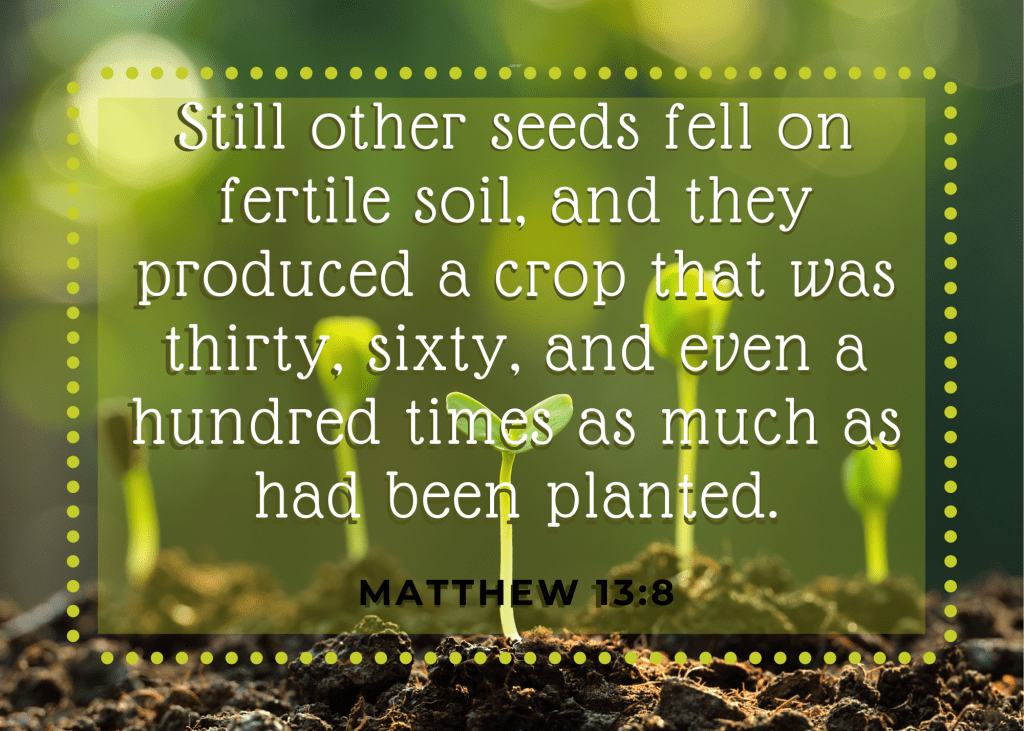
There are four different scenarios of what becomes of the seeds that are sown that Jesus depicts here, being eaten by birds, scorched by the sun, choked by thorns, or producing a crop. Which respectively relate to being taken by the evil one, trouble and persecution, worries of life and the deceitfulness of wealth, or yielding a hundred, sixty, or thirty times what was sown. Out of four scenarios there is only one that has roots, which leads to salvation. By having the deep roots, a foundation on God and his word, you will bear fruit. Fruit that can show God’s love and share the hope that we have with others and by doing so yield sixty or a hundred times what was sown.
To go along with the analogy, John 15:1-8 adds on to it and explains the dire need of having deep roots in God and Jesus.
John 15:5 says, “Yes, I am the vine; you are the branches. Those who remain in me, and I in them, will produce much fruit. For apart from me you can do nothing.”
So how are you going to strengthen your foundation and bear fruits? Be a tree! Three out of the four groups are between a rock and a hard place. So defy the statistics. Commit your life as a living sacrifice for God bearing cherries, apples, bananas, and pears. Put in the effort to focus on your foundation. Make it a priority to spend quality time with God. Paul tells us that fruit will come as a result of our faith, so when they do, nurture them, prune, water, weed, do whatever it takes to help them grow. The parable of the sower shows the importance of how we are living our lives right now. So go, be a tree, rooted in God and overflowing with fruit!
-Makayla Railton
Today’s Bible passage can be read or listened to at BibleGateway – Matthew 13 & Luke 8
Tomorrow we will read Matthew 8:14-34 and Mark 4-5.
Matthew 8:1-13 & Luke 7- Jesus heals a man with Leprosy
Before we get into today’s story, we need to understand the Old Testament law dealing with leprosy. Leviticus 13:1-46 talks in great detail about leprosy. There, we find that leprosy is a skin disease that is more than skin deep, it’s highly infectious, it defiles a person, anyone with leprosy must cover their mouth (this sounds like a mask), be separated from other people (social distance), live outside the town (this sounds like isolation), wear torn clothes, and cry out, “Unclean! Unclean!”
In Matthew 8, we find the story of a man with leprosy. Instead of staying away, we’re told, “A man with leprosy came and knelt before him [Jesus] and said, “Lord, if you are willing, you can make me clean.” I believe this man had great faith. He knew Jesus could heal him, he just didn’t know if Jesus would be willing to. And he violated the law so he could get close enough to Jesus to find out.
Matthew 8:3 says, “Jesus reached out his hand and touched the man. “I am willing,” he said, “Be clean!” Immediately he was cured of his leprosy.” I find this very moving. Jesus demonstrated how much he cared for this man by not just healing him – which was astounding enough. Jesus also touched him. By touching the man, Jesus would have become defiled – made unclean himself. And remember, since no-one could touch a leaper, who knows how long it had been since this man had someone actually touch him. I can’t imagine what that touch meant to the man.
Matthew 8:4 goes on to say that Jesus told the man, “See that you don’t tell anyone…” We find this same story in Mark, and we’re told in Mark 1:45, “Instead, he went out and began to talk freely, spreading the news. As a result, Jesus could no longer enter a town openly but stayed outside in lonely places. Yet the people still came to him from everywhere.”
In this story, I see that leprosy compares well with sin. Sin runs more than skin deep, it is highly infectious, it defiles a person, and whether we admit it or not, it makes us unclean, and separates us from God. When Jesus went to the cross, he took our sin on himself, causing him to be defiled. But he demonstrated his obedience to God and his love for us by doing this anyway. But Jesus’ sacrifice means nothing for us unless we each have faith in Jesus, come submit before him, and ask to be healed (forgiven). Are you willing to get close enough to Jesus to find out what he can do for you?
Finally, at the end of the story, the man disobeyed Jesus’ direct command to him to tell no one. Jesus commanded us to tell everyone. How are you doing with that?
–Steve Mattison
Today’s Bible passage can be read or listened to at BibleGateway here – Matthew 8:1-13, Luke 7
Today’s reading comes from Matthew 5-7. You may know this as “The Sermon on the Mount”, and this may be among the most well known passages in the Bible. The Jews Jesus was teaching knew the Old Testament laws really well. Jesus took this opportunity to focus on what God really requires – he focused on matters of the heart, not just following the letter of the law.
For example, the old law said, “Do not murder, and anyone who murders will be subject to judgment.” Jesus took it further and taught, “But I tell you that anyone who is angry with his brother will be subject to judgment.” This is a difficult teaching, but wait – there’s more.
Then, in Matt 5:42-45, Jesus tells us, “You have heard that it was said, ‘Love your neighbor and hate your enemy.’ But I tell you: Love your enemies and pray for those who persecute you, that you may be sons of your Father in heaven. He causes his sun to rise on the evil and the good, and sends rain on the righteous and the unrighteous.” – This is even harder to follow.
In this passage, Jesus is telling us more of the reason behind his new rules. God loves even those who hate him, and he does them good – in spite of their hatred for Him. And we should imitate this characteristic of God. Jesus takes this even further in verse 48, where he said, “Be perfect, therefore, as your heavenly Father is perfect.” – Ok, now this isn’t possible to obey without some serious help from God.
In the Lord’s prayer, Jesus said, “Forgive us our debts as we also have forgiven our debtors.” Basically, this is asking God to forgive me only to the extent I forgive others. Jesus then told us plainly in Matt 6: 14-15, “For if you forgive men when they sin against you, your heavenly Father will also forgive you. But if you do not forgive men their sins, your Father will not forgive your sins.” – This is a pretty good reason to forgive others! – But still not easy to do.
Then, Jesus tells us in Matt 7: 1-2, “Do not judge, or you too will be judged. For in the same way you judge others, you will be judged, and with the measure you use, it will be measured to you.” – Did you catch that? I will be judged in the same way I judge others. This is a pretty good reason for me to not condemn others! This goes back to the old saying, “Hate the sin, but love the sinner.”
As I read these passages, a couple things jump out to me. First, I need to imitate God as much as possible. Unfortunately, I’m not very good at doing this, so I need to beg for His forgiveness. Fortunately, He is loving and extends grace. From His example, I recognize I need to be loving, and extend grace too.
Second, once I recognize I am a worthless sinner, saved only by the grace of God, it’s suddenly easier for me to be less eager to condemn others. Then, if I can see them through God’s eyes – as other sinners in need of grace – that makes it even easier for me to extend grace to others. And that grace may take the form of forgiving them, or of not judging them, or even turning the other cheek if they hit me. On our own, this isn’t possible, but we can do these things with God’s help. Ultimately, we can (again with God’s help) come to the point of loving or enemies, and blessing those who persecute us.
Jesus closes this section talking about the wise builder (who built on a rock) and the foolish builder (who built on sand). The wise man was likened to someone who listened to Jesus’ teaching, and put it into practice – building his life on the rock. The foolish man was likened to someone who listened to Jesus’ teaching, and didn’t put it into practice – building his life without a foundation. In both instances, storms come. But only the house built on the rock survived. By analogy, only the life founded on Jesus’ teachings will not be destroyed.
So again, we find that today’s reading has implications for us today, and for eternity. And just knowing these truths isn’t enough, we must put them into practice. Please join me in taking this seriously. Apply this to your life. Ask God’s help living up to these requirements that are impossible to accomplish on our own. Become an imitator of God. The reward is eternal.
–Steve Mattison
Today’s Bible reading can be read or listened to at BibleGateway here – Matthew 5-7.
Tomorrow’s reading will be Matthew 8:1-13 and Luke 7 as we continue on our Bible reading plan. SeekGrowLove.
You may be familiar with the story of the “Good Samaritan”. But do you know the story of the “Bad Samaritan”? You might know this better as the story of the woman at the well.
In Jesus’ day, Jews thought very little of Samaritans. It may not be an overstatement to say the Jews hated the Samaritans. The origin of this animosity dated back to the Assyrian invasion of Israel around 721 BC. The Samaritans were of mixed race, partially Jewish, and partially who-knows-what. They weren’t welcome in the Temple in Jerusalem, so they worshiped in their own temple in Samaria. And, as Jesus pointed out, they worshiped what they didn’t even understand.
In John 4, we find Jesus arriving at a well near Sychar around noon. Jesus waited at the well, while his disciples went into town to buy some food. As Jesus waited, a woman came up to draw water. I’ve heard this would have been a very unusual time to draw water – and she probably came then to avoid having to interact with others – because even the people in town would have looked down on her.
Anyway, Jesus started up a conversation with the woman, asking her for water. In doing this, Jesus cut across all the social norms of his day. First, Jesus was a Jew, and the woman was an “inferior” Samaritan. Second, as I understand it, men of the day felt superior to women, and again, wouldn’t typically strike up a conversation. Finally, Jesus was holy and the Samaritan woman wasn’t. And religious leaders of his day felt superior to common sinners, and wouldn’t associate with them. Jesus cut through all of those norms to interact with this woman. The obvious reason given was because Jesus was thirsty, and the woman could draw water from the well. I believe the ulterior motive was to share salvation with this woman and ultimately with the whole city.
Right from the beginning of the conversation, the woman was surprised that Jesus would even talk with her, since he was a Jew. Jesus pointed out that if she understood who it was she was talking with, He could offer her something amazing – water welling up to eternal life. Jesus told her to get her husband, to which she replied, “I don’t have a husband.” When Jesus told her that she had had 5 husbands and that she wasn’t married to the man she was living with then – she recognized Jesus was a prophet. She said, “I know that Messiah is coming. When he comes, he will explain everything to us.” Jesus told her directly, “I who speak to you am he.” The woman left her water jug and immediately went into town to tell everyone that she had found the Messiah. The whole town came out and ultimately believed – first, because of the testimony of the woman, then eventually because of their experience with Jesus.
Often, when we read a story like this, we associate with Jesus. We may think, “I should follow Jesus’ example, break social norms, and associate with those who are “inferior” to me.”
While this may be true, I’d like to focus on the woman, and see what we can learn from her. Although presumably “unworthy”, and probably a social outcast, Jesus revealed Himself to her – little by little. She first recognized he was a Jew, then a prophet, and finally the messiah. Once she recognized that Jesus was the messiah, the savior, she immediately dropped what she was doing to go tell everyone about her experience with Jesus. Then she literally led the people of the town to meet Jesus. Think of how little theology she knew – how few spiritual truths. But she had found the Lord, and she wanted to tell everyone. Her enthusiasm and eagerness to tell others of her experience with the Lord puts us to shame.
When you were introduced to Jesus, what was your reaction? Did you tell everyone you knew about Jesus, and what he had done for you? Did you do everything you could to bring as many people as possible to encounter Jesus?
Jesus pointed out to his disciples, “Open your eyes and look at the fields! They are ripe for harvest.” He wasn’t talking about agriculture, he was talking about a crop for eternal life – people needing to come into a saving relationship with the Lord.
I challenge you to first, truly develop a relationship with Jesus. And once you do, tell everyone you know about the good news, so they can be saved too. The consequences are literally life and death – for eternity. What are you waiting for?
–Steve Mattison
Today’s Bible passage can be read or listened to at BibleGateway here – John 2-4
Tomorrow we will read Mark 2 as we continue Seeking God, Growing our Faith, and Increasing our Love on our 2020 Bible reading plan.
12 Even now— this is the Lord’s declaration— turn to Me with all your heart, with fasting, weeping, and mourning. 13 Tear your hearts, not just your clothes, and return to the Lord your God. For He is gracious and compassionate, slow to anger, rich in faithful love, and He relents from sending disaster. Joel 2:12-13 (HCSB)
Today we’re going to read the book of Joel (hey, that’s my name!). It is one of the shortest books in the Old Testament, so I’ll keep my thoughts on it brief. It was written as a wake up call to God’s people. As you’ve been reading through the Prophets, it should have been quite apparent that God wasn’t the happiest about the actions of His people. That’s why we have this particular section of scripture; if Israel hadn’t messed up so bad, God wouldn’t have had to tell them so. Joel doesn’t say much different than the other Prophets; he is just rehashing the same message because apparently, Israel still hasn’t learned its lesson. Here’s the condensed version of the message: you’ve sinned and made God angry, but He loves you and wants you to live, so turn away from your wickedness.
This message, which was proclaimed to the Jews first, is just as relevant today for us as it was then for them. Only today we have the added part: God loved you so much He sent His only begotten son so you can live eternally (John 3:16). We still live in nations full of wickedness, we still raise idols to a status reserved only for Yahweh, we still do wrong when we know what’s right, and we still let the ungodly have undue influence over us. The words spoken through the Prophets to the people of Israel still hold value for us, and I hope we will do a better job heeding them than the original recipients.
I hope you’ve enjoyed reading through Joel and the last chapters of Ezekiel with me this week.
– Joel Fletcher
Today’s Bible reading passage can be read or listened to at BibleGateway here – Joel 1-3
Tomorrow we will begin the book of Daniel (chapters 1-3) as we continue seeking God on our
I have always connected with David’s ability to cry out to the LORD. He isn’t afraid to depend upon him. He is willing to ask God directly to be delivered from his enemies. Even though David clearly expresses his weaknesses, he holds so much confidence in God that he is still willing to come before him and pray.
When we think about the faith that David had, I think it’s easy for us to say, “Well, of course, we should ask God to conquer our battles.” And that is true, we serve a God who wants us to come to him. Through the sacrifice of his Son, we have the ability to come to God and ask him to intercede for us.
But when reality sets in, we have a tendency to become overwhelmed and ultimately rely on ourselves. We forget to turn to the one who created us for help. I think this is because it’s easier for us to fathom solutions to our problems that we can come up with on our own.
It’s difficult to trust in someone to fight for us that we can’t even fathom.
And yet, David still decides to trust God. So much so that he is praying that others follow suit.
I find all of this relevant with the struggles that are currently overtaking the world. With hunger, disease, unemployment, and fear continuing to rise, it is natural to become overwhelmed. We want to fight for some sort of solution. We have to find some way to cope. But in all of this fighting, we likely end up crippled by fear.
If our first action is to trust in God, our result is very different. We serve a God who will place a hedge of protection over us. He will provide healing for us. Because he loves us that much. A God who can move mountains is the same God who will make you stronger if you choose to come to him.
David saw the glory and mercy that could come from following a path that would lead him to the LORD- a path of righteousness. Imagine what the world would look like if all of us stopped allowing the noise of society to consume us and rested in God.
So, in the fear, in the hunger, in the waiting, let’s choose to take all of that emotion and let it drive us closer to our creator. Let us become a people who are willing to unapologetically depend upon God to fight our battles.
Ironically, if we take refuge in our Almighty, we will see Victory.