Be a tree!

Matthew 13 & Luke 8

There is something so beautiful about watching a plant grow from a little seed to a strong healthy plant. Christians are compared to plants in this way. A spiritually mature Christian should still continue to grow in their walk with God. 

Jesus often taught the crowds and his disciples using parables, which can be found all throughout the Synoptic Gospels. With seven parables in Matthew chapter 13, the parable of the sower is the only parable in this chapter that doesn’t start with “The Kingdom of heaven is like” because this parable is how the Kingdom of God is going to begin. In fact, it is already happening right now. 

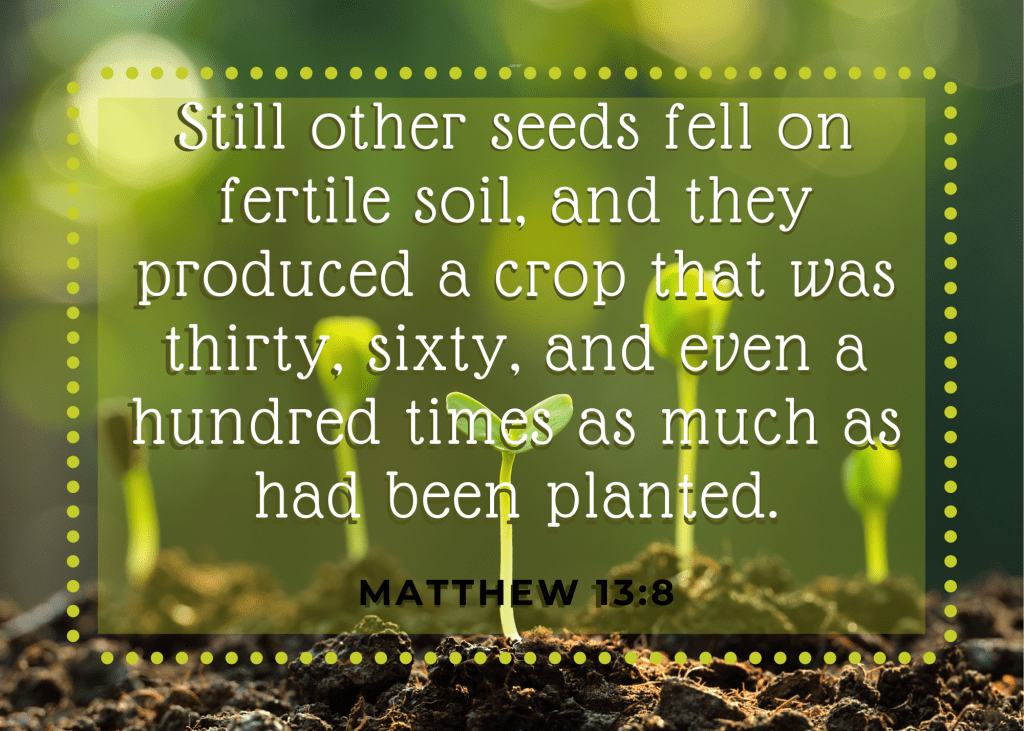
There are four different scenarios of what becomes of the seeds that are sown that Jesus depicts here, being eaten by birds, scorched by the sun, choked by thorns, or producing a crop. Which respectively relate to being taken by the evil one, trouble and persecution, worries of life and the deceitfulness of wealth, or yielding a hundred, sixty, or thirty times what was sown. Out of four scenarios there is only one that has roots, which leads to salvation. By having the deep roots, a foundation on God and his word, you will bear fruit. Fruit that can show God’s love and share the hope that we have with others and by doing so yield sixty or a hundred times what was sown. 

To go along with the analogy, John 15:1-8 adds on to it and explains the dire need of having deep roots in God and Jesus. 

John 15:5 says, “Yes, I am the vine; you are the branches. Those who remain in me, and I in them, will produce much fruit. For apart from me you can do nothing.” 

So how are you going to strengthen your foundation and bear fruits? Be a tree! Three out of the four groups are between a rock and a hard place. So defy the statistics. Commit your life as a living sacrifice for God bearing cherries, apples, bananas, and pears. Put in the effort to focus on your foundation. Make it a priority to spend quality time with God. Paul tells us that fruit will come as a result of our faith, so when they do, nurture them, prune, water, weed, do whatever it takes to help them grow. The parable of the sower shows the importance of how we are living our lives right now. So go, be a tree, rooted in God and overflowing with fruit!

-Makayla Railton

Today’s Bible passage can be read or listened to at BibleGateway – Matthew 13 & Luke 8

Tomorrow we will read Matthew 8:14-34 and Mark 4-5.

His Touch

Matthew 8:1-13 & Luke 7- Jesus heals a man with Leprosy

Before we get into today’s story, we need to understand the Old Testament law dealing with leprosy.  Leviticus 13:1-46 talks in great detail about leprosy.  There, we find that leprosy is a skin disease that is more than skin deep, it’s highly infectious, it defiles a person, anyone with leprosy must cover their mouth (this sounds like a mask), be separated from other people (social distance), live outside the town (this sounds like isolation), wear torn clothes, and cry out, “Unclean! Unclean!”

In Matthew 8, we find the story of a man with leprosy.  Instead of staying away, we’re told, “A man with leprosy came and knelt before him [Jesus] and said, “Lord, if you are willing, you can make me clean.”  I believe this man had great faith.  He knew Jesus could heal him, he just didn’t know if Jesus would be willing to.  And he violated the law so he could get close enough to Jesus to find out.

Matthew 8:3 says, “Jesus reached out his hand and touched the man.  “I am willing,” he said, “Be clean!”  Immediately he was cured of his leprosy.”  I find this very moving.  Jesus demonstrated how much he cared for this man by not just healing him – which was astounding enough.  Jesus also touched him.  By touching the man, Jesus would have become defiled – made unclean himself.  And remember, since no-one could touch a leaper, who knows how long it had been since this man had someone actually touch him.  I can’t imagine what that touch meant to the man.

Matthew 8:4 goes on to say that Jesus told the man, “See that you don’t tell anyone…”  We find this same story in Mark, and we’re told in Mark 1:45, “Instead, he went out and began to talk freely, spreading the news.  As a result, Jesus could no longer enter a town openly but stayed outside in lonely places.  Yet the people still came to him from everywhere.”

In this story, I see that leprosy compares well with sin.  Sin runs more than skin deep, it is highly infectious, it defiles a person, and whether we admit it or not, it makes us unclean, and separates us from God.  When Jesus went to the cross, he took our sin on himself, causing him to be defiled.  But he demonstrated his obedience to God and his love for us by doing this anyway.  But Jesus’ sacrifice means nothing for us unless we each have faith in Jesus, come submit before him, and ask to be healed (forgiven).  Are you willing to get close enough to Jesus to find out what he can do for you?

Finally, at the end of the story, the man disobeyed Jesus’ direct command to him to tell no one.  Jesus commanded us to tell everyone.  How are you doing with that?

–Steve Mattison

Today’s Bible passage can be read or listened to at BibleGateway here – Matthew 8:1-13, Luke 7

Tomorrow’s reading will be Matthew 11.

Who are You Imitating?

Matthew 5-7

Today’s reading comes from Matthew 5-7.  You may know this as “The Sermon on the Mount”, and this may be among the most well known passages in the Bible.  The Jews Jesus was teaching knew the Old Testament laws really well.  Jesus took this opportunity to focus on what God really requires – he focused on matters of the heart, not just following the letter of the law.

For example, the old law said, “Do not murder, and anyone who murders will be subject to judgment.”  Jesus took it further and taught, “But I tell you that anyone who is angry with his brother will be subject to judgment.”  This is a difficult teaching, but wait – there’s more.  

Then, in Matt 5:42-45, Jesus tells us, “You have heard that it was said, ‘Love your neighbor and hate your enemy.’  But I tell you: Love your enemies and pray for those who persecute you, that you may be sons of your Father in heaven.  He causes his sun to rise on the evil and the good, and sends rain on the righteous and the unrighteous.” – This is even harder to follow.

In this passage, Jesus is telling us more of the reason behind his new rules.  God loves even those who hate him, and he does them good – in spite of their hatred for Him.  And we should imitate this characteristic of God.  Jesus takes this even further in verse 48, where he said, “Be perfect, therefore, as your heavenly Father is perfect.”  – Ok, now this isn’t possible to obey without some serious help from God.

In the Lord’s prayer, Jesus said, “Forgive us our debts as we also have forgiven our debtors.”  Basically, this is asking God to forgive me only to the extent I forgive others.  Jesus then told us plainly in Matt 6: 14-15, “For if you forgive men when they sin against you, your heavenly Father will also forgive you.  But if you do not forgive men their sins, your Father will not forgive your sins.”  – This is a pretty good reason to forgive others! – But still not easy to do.

Then, Jesus tells us in Matt 7: 1-2, “Do not judge, or you too will be judged.  For in the same way you judge others, you will be judged, and with the measure you use, it will be measured to you.”  – Did you catch that?  I will be judged in the same way I judge others.  This is a pretty good reason for me to not condemn others!  This goes back to the old saying, “Hate the sin, but love the sinner.”

As I read these passages, a couple things jump out to me.  First, I need to imitate God as much as possible. Unfortunately, I’m not very good at doing this, so I need to beg for His forgiveness.  Fortunately, He is loving and extends grace.  From His example, I recognize I need to be loving, and extend grace too.

Second, once I recognize I am a worthless sinner, saved only by the grace of God, it’s suddenly easier for me to be less eager to condemn others.  Then, if I can see them through God’s eyes – as other sinners in need of grace – that makes it even easier for me to extend grace to others.  And that grace may take the form of forgiving them, or of not judging them, or even turning the other cheek if they hit me.  On our own, this isn’t possible, but we can do these things with God’s help.  Ultimately, we can (again with God’s help) come to the point of loving or enemies, and blessing those who persecute us.

Jesus closes this section talking about the wise builder (who built on a rock) and the foolish builder (who built on sand).  The wise man was likened to someone who listened to Jesus’ teaching, and put it into practice – building his life on the rock.  The foolish man was likened to someone who listened to Jesus’ teaching, and didn’t put it into practice – building his life without a foundation.  In both instances, storms come.  But only the house built on the rock survived.  By analogy, only the life founded on Jesus’ teachings will not be destroyed.

So again, we find that today’s reading has implications for us today, and for eternity.  And just knowing these truths isn’t enough, we must put them into practice.  Please join me in taking this seriously.  Apply this to your life.  Ask God’s help living up to these requirements that are impossible to accomplish on our own.  Become an imitator of God.  The reward is eternal.

–Steve Mattison

Today’s Bible reading can be read or listened to at BibleGateway here – Matthew 5-7.

Tomorrow’s reading will be Matthew 8:1-13 and Luke 7 as we continue on our Bible reading plan. SeekGrowLove.

Jesus Talks with a Samaritan Woman

John 2-4

You may be familiar with the story of the “Good Samaritan”.  But do you know the story of the “Bad Samaritan”?  You might know this better as the story of the woman at the well.

In Jesus’ day, Jews thought very little of Samaritans.  It may not be an overstatement to say the Jews hated the Samaritans.  The origin of this animosity dated back to the Assyrian invasion of Israel around 721 BC.  The Samaritans were of mixed race, partially Jewish, and partially who-knows-what.  They weren’t welcome in the Temple in Jerusalem, so they worshiped in their own temple in Samaria.  And, as Jesus pointed out, they worshiped what they didn’t even understand.

In John 4, we find Jesus arriving at a well near Sychar around noon.  Jesus waited at the well, while his disciples went into town to buy some food.  As Jesus waited, a woman came up to draw water.  I’ve heard this would have been a very unusual time to draw water – and she probably came then to avoid having to interact with others – because even the people in town would have looked down on her.

Anyway, Jesus started up a conversation with the woman, asking her for water.  In doing this, Jesus cut across all the social norms of his day.  First, Jesus was a Jew, and the woman was an “inferior” Samaritan.  Second, as I understand it, men of the day felt superior to women, and again, wouldn’t typically strike up a conversation.  Finally, Jesus was holy and the Samaritan woman wasn’t.  And religious leaders of his day felt superior to common sinners, and wouldn’t associate with them.  Jesus cut through all of those norms to interact with this woman.  The obvious reason given was because Jesus was thirsty, and the woman could draw water from the well.  I believe the ulterior motive was to share salvation with this woman and ultimately with the whole city.

Right from the beginning of the conversation, the woman was surprised that Jesus would even talk with her, since he was a Jew.  Jesus pointed out that if she understood who it was she was talking with, He could offer her something amazing – water welling up to eternal life.  Jesus told her to get her husband, to which she replied, “I don’t have a husband.”  When Jesus told her that she had had 5 husbands and that she wasn’t married to the man she was living with then – she recognized Jesus was a prophet. She said, “I know that Messiah is coming.  When he comes, he will explain everything to us.”  Jesus told her directly, “I who speak to you am he.”  The woman left her water jug and immediately went into town to tell everyone that she had found the Messiah.  The whole town came out and ultimately believed – first, because of the testimony of the woman, then eventually because of their experience with Jesus.

Often, when we read a story like this, we associate with Jesus.  We may think, “I should follow Jesus’ example, break social norms, and associate with those who are “inferior” to me.”  

While this may be true, I’d like to focus on the woman, and see what we can learn from her.  Although presumably “unworthy”, and probably a social outcast, Jesus revealed Himself to her – little by little.  She first recognized he was a Jew, then a prophet, and finally the messiah.  Once she recognized that Jesus was the messiah, the savior, she immediately dropped what she was doing to go tell everyone about her experience with Jesus. Then she literally led the people of the town to meet Jesus.  Think of how little theology she knew – how few spiritual truths.  But she had found the Lord, and she wanted to tell everyone. Her enthusiasm and eagerness to tell others of her experience with the Lord puts us to shame. 

When you were introduced to Jesus, what was your reaction?  Did you tell everyone you knew about Jesus, and what he had done for you?  Did you do everything you could to bring as many people as possible to encounter Jesus?

Jesus pointed out to his disciples, “Open your eyes and look at the fields!  They are ripe for harvest.”  He wasn’t talking about agriculture, he was talking about a crop for eternal life – people needing to come into a saving relationship with the Lord.

I challenge you to first, truly develop a relationship with Jesus.  And once you do, tell everyone you know about the good news, so they can be saved too.  The consequences are literally life and death – for eternity.  What are you waiting for?

–Steve Mattison

Today’s Bible passage can be read or listened to at BibleGateway here – John 2-4

Tomorrow we will read Mark 2 as we continue Seeking God, Growing our Faith, and Increasing our Love on our 2020 Bible reading plan.

Joel 1-3: Minor Prophet, Major Message

12 Even now— this is the Lord’s declaration— turn to Me with all your heart, with fasting, weeping, and mourning. 13 Tear your hearts, not just your clothes, and return to the Lord your God. For He is gracious and compassionate, slow to anger, rich in faithful love, and He relents from sending disaster. Joel 2:12-13 (HCSB)

Today we’re going to read the book of Joel (hey, that’s my name!). It is one of the shortest books in the Old Testament, so I’ll keep my thoughts on it brief. It was written as a wake up call to God’s people. As you’ve been reading through the Prophets, it should have been quite apparent that God wasn’t the happiest about the actions of His people. That’s why we have this particular section of scripture; if Israel hadn’t messed up so bad, God wouldn’t have had to tell them so. Joel doesn’t say much different than the other Prophets; he is just rehashing the same message because apparently, Israel still hasn’t learned its lesson.
Here’s the condensed version of the message: you’ve sinned and made God angry, but He loves you and wants you to live, so turn away from your wickedness. 


This message, which was proclaimed to the Jews first, is just as relevant today for us as it was then for them. Only today we have the added part: God loved you so much He sent His only begotten son so you can live eternally (John 3:16). We still live in nations full of wickedness, we still raise idols to a status reserved only for Yahweh, we still do wrong when we know what’s right, and we still let the ungodly have undue influence over us. The words spoken through the Prophets to the people of Israel still hold value for us, and I hope we will do a better job heeding them than the original recipients. 


I hope you’ve enjoyed reading through Joel and the last chapters of Ezekiel with me this week.

– Joel Fletcher

Today’s Bible reading passage can be read or listened to at BibleGateway here – Joel 1-3

Tomorrow we will begin the book of Daniel (chapters 1-3) as we continue seeking God on our

Trusting in God

Psalm 5, 38, 41-42

psalm 5 11 NIV sgl


I have always connected with David’s ability to cry out to the LORD. He isn’t afraid to depend upon him. He is willing to ask God directly to be delivered from his enemies. Even though David clearly expresses his weaknesses, he holds so much confidence in God that he is still willing to come before him and pray. 


When we think about the faith that David had, I think it’s easy for us to say, “Well, of course, we should ask God to conquer our battles.” And that is true, we serve a God who wants us to come to him. Through the sacrifice of his Son, we have the ability to come to God and ask him to intercede for us.


But when reality sets in, we have a tendency to become overwhelmed and ultimately rely on ourselves. We forget to turn to the one who created us for help. I think this is because it’s easier for us to fathom solutions to our problems that we can come up with on our own. 


It’s difficult to trust in someone to fight for us that we can’t even fathom. 


And yet, David still decides to trust God. So much so that he is praying that others follow suit. 


I find all of this relevant with the struggles that are currently overtaking the world. With hunger, disease, unemployment, and fear continuing to rise, it is natural to become overwhelmed. We want to fight for some sort of solution. We have to find some way to cope. But in all of this fighting, we likely end up crippled by fear. 


If our first action is to trust in God, our result is very different. We serve a God who will place a hedge of protection over us. He will provide healing for us. Because he loves us that much. A God who can move mountains is the same God who will make you stronger if you choose to come to him. 


David saw the glory and mercy that could come from following a path that would lead him to the LORD- a path of righteousness. Imagine what the world would look like if all of us stopped allowing the noise of society to consume us and rested in God. 


So, in the fear, in the hunger, in the waiting, let’s choose to take all of that emotion and let it drive us closer to our creator. Let us become a people who are willing to unapologetically depend upon God to fight our battles. 


Ironically, if we take refuge in our Almighty, we will see Victory. 


-Leslie Jones


Today’s reading can be read or listened at https://www.biblegateway.com/passage/?search=Psalm+5%2C+38%2C+41-42&version=NIV

Tomorrow’s reading will be 2 Samuel 22-23 & Psalm 57 as we continue the 2020 Chronological Bible Reading Plan


Are You Eagerly Waiting?

Hebrews 9

Hebrews 9 15

I asked you a question yesterday as we considered some passages in Hebrew 8.  That question was for you to decide what kind of heart you have.  The reason that is important is because the kind of heart that you have determines what other people see in you.  Do they see a person who loves God?  Do they see a person with a heart for serving Jesus and others?  Do people see a person who trusts God no matter what might happen in your life?  Or, are you like the Israelites?  Do people see a person overcome by sin?  A person impatient with God, who wants things right now?  Do they see a person who is willing to give up everything for all the wrong reasons?  What we learned was that God’s laws and commandments don’t change us unless we allow God to write them in our minds and write them on our hearts.

But allowing God to write on our hearts and in our minds is not easy.  Taking out our old heart of stone and replacing it with one of flesh, required a blood sacrifice.  It always had, but now we know that no more blood is required.  In the past the blood of goats and calves was used to obtain purification and forgiveness for people.  But this ritual had to be repeated regularly and often.  That is, until Christ.  Christ was the perfect sacrifice; He was the only sacrifice without blemish.  His sacrifice was able to totally purify our conscience (minds and hearts) from dead works in order to serve the living God!

Because of Christ’s once and for all sacrifice, He was able to enter heaven itself in the presence of God Himself.  There, Christ, our high priest, continually intercedes on our behalf, to put away our sin.

End of story.  Right?

No.  Not the end of the story.  There is much more good news for us.

Take your Bible out.  Take your pen or highlighter and mark this verse: “So Christ, having been offered once to bear the sins of many, will appear a second time, not to deal with (your) sin, but to save those who are eagerly waiting for Him.”  (Hebrews 9:28)

Today’s question:  Are you eagerly waiting for Him?

Luke Elwell


Enough

Ephesians 2

2

Every Sunday since before I was born, my family has gathered at my grandma’s house for an after-church lunch. It’s a grandiose affair with a lavish spread of food, a fancy tablecloth, and ALWAYS dessert. My littlest cousin, Greta, prides herself on being Grandma’s helper in the kitchen each Sunday. By no means is she qualified to even step foot in a kitchen—she tries to lick the frosting off the chocolate cake, has a fair share of spills, and screams when not allowed to cut the watermelon. Despite her lack of skills and tact, she is the most willing and enthusiastic helper. While my grandma certainly doesn’t need her help, I think her heart bursts into a million little pieces when little Greta pulls up her stool to the counter with wide eyes and ready hands.

Sometimes I feel a lot like a toddler in the kitchen, like I’m not enough. The truth of the matter is that I wasn’t enough.

As for you, you were dead in your transgressions and sins, in which you used to live when you followed the ways of this world and of the ruler of the kingdom of the air, the spirit who is now at work in those who are disobedient. All of us also lived among them at one time, gratifying the cravings of our flesh and following its desires and thoughts. Like the rest, we were by nature deserving of wrath. (Ephesians 2:1-3)

The story doesn’t end there. I am made enough because of who God is and what Jesus did for me.

But because of his great love for us, God, who is rich in mercy, made us alive with Christ even when we were dead in transgressions—it is by grace you have been saved.(Ephesians 2:4-5)

We can choose to wallow in our inadequacy, or we can embrace grace. I’ve seen the joy that comes when we let go of the burden of not being enough in the beaming smile of a little girl with chocolate frosting on her nose. You are so enough that God wants to use you for His Kingdom.

For we are God’s handiwork, created in Christ Jesus to do good works, which God prepared in advance for us to do.(Ephesians 2:10)

No matter the lies the world whispers in your ear, never stop pulling up your stool to the counter. Roll up your sleeves and do all the things God prepared for you. He’s more honored by your attempts than He is concerned about your results. Frankly, He could go infinity gauntlet style and snap His fingers to accomplish anything He wanted to by Himself. That same God is head-over-heels in love with you.

My friend, you measure up. You have what it takes. You’re enough. Now go do something.

-Mackenzie McClain

Repentance that Leads to Salvation

2 Corinthians 7

2 Corinthians 7_10

While I was at church last week, one of the younger girls that I have watched grow up  since she was a baby came up to me and was so very excited to whisper some big news into my ear. Her smile grew larger and larger as she leaned in close to reveal that she and her older sister are planning to be baptized in just a few weeks! I looked at her with excitement! I was overjoyed! What wonderful news for anyone to tell me, let alone this sweet girl who I adore. Of course as an education major, I am drawn towards investing in youth. I am passionate about teaching children in my daily life but more than that, I am passionate about guiding youth to become individuals who strive to honor God daily. In the same sense, Paul was passionate about building and growing the church. He was passionate about investing in others also as we see here in 2 Corinthians. I imagine the excitement that I had when I received the news of the baptisms in my church was similar to the excitement that Paul had when the people of Corinth were repenting.


While reading this chapter today, I was especially drawn to verses ten and eleven as they state,

10 For godly grief produces a repentance that leads to salvation without regret,

whereas worldly grief produces death. 11 For see what earnestness this godly grief

has produced in you, but also what eagerness to clear yourselves, what indignation,

what fear, what longing, what zeal, what punishment! At every point you have proved

yourselves innocent in the matter.


Question:

Is there anything in your life that is holding you back from pursuing a healthy relationship with our Heavenly Father? Moreover, is there anything in your life that is stopping you from accepting the sacrifice that His son made on our behalf?


  • No matter where you are at in your life right now, no matter what struggles you may be facing, I encourage you to give it all to God. Lay down all of your burdens and troubles and He will meet you wherever you are. It’s not too late to say yes to His free and perfect gift. It’s one that you don’t want to miss out on!


And Peter said to them, “Repent and be baptized every one of you in the name of Jesus Christ for the forgiveness of your sins, and you will receive the gift of the Holy Spirit.

Acts 2:38


-Kayla Tullis