
Deuteronomy 17-20
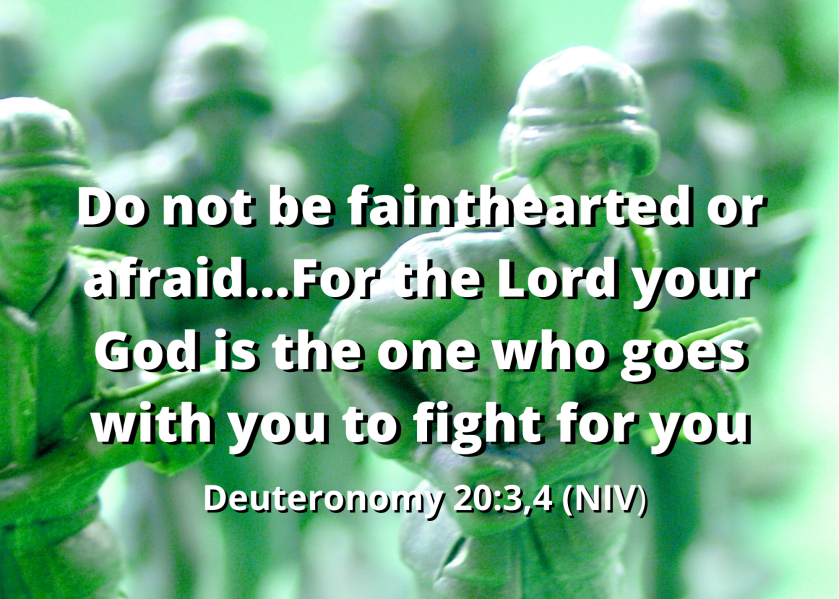
We’re going to continue our study of Deuteronomy today by looking at a principle that, although given specifically to the Israelites, also has application today.
Let’s look in chapter 20.
“When you go to war against your enemies and see horses and chariots and an army greater than yours, do not be afraid of them, because the LORD your God, who brought you up out of Egypt, will be with you. When you are about to go into battle, the priest shall come forward and address the army. He shall say: “Hear, O Israel, today you are going into battle against your enemies. Do not be faint-hearted or afraid; do not be terrified or give way to panic before them. For the LORD your God is the one who goes with you to fight for you against your enemies to give you victory.”
Promises in Action
First, it’s kind of cool to see examples of God’s people claiming this promise and God doing exactly what he promised. (Because frankly, more often than not, we see disobedience, don’t we?) In 2 Chronicles 32, Assyria invades Judah and Hezekiah does all the typical stuff to prepare for war. He consults his military advisors, makes some strategic moves, has weapons and shields made. Then he addresses the soldiers with these words;
“Be strong and courageous. Do not be afraid or discouraged because of the king of Assyria and the vast army with him, for there is a greater power with us than with him. With him is only the arm of flesh, but with us is the LORD our God to help us and to fight our battles.”
Want to know what God did?
“And the LORD sent an angel who annihilated all the fighting men and the leaders and officers in the camp of the Assyrian king. So he withdrew to his own land in disgrace.”
Moses’ successor, Joshua, also reminded God’s people of this very promise before his death in Joshua 23.
“…the LORD your God fights for you, just as he promised.”
God will fight for you
Wondering how this principle applies to us today? After all, I don’t know about you, but our church doesn’t have its own military battalion. Paul tells us in Ephesians 6 that our battles are against the “powers of this dark world and against the spiritual forces of evil in the heavenly realms.” He further encourages us to “be strong in the Lord and in his mighty power.”
Whatever you are battling today, God will fight for you.
Even if you are out-manned, out gunned, or have every reason to run….don’t.
Be like Hezekiah—consult advisors, make a plan, do what you can do. And then remember,
“The LORD your God is the one who goes with you to fight for you against your enemies to give you victory.”
Susan Landry
Today’s Bible reading can be read or listened to at https://www.biblegateway.com/passage/?search=Deuteronomy+17-20&version=NIV
Tomorrow’s reading will be Deuteronomy 21-23 as we continue the 2020 Chronological Bible Reading Plan
Susan lives in balmy Minnesota with her favorite person, Greg, and (except for this year) their two sons. She teaches, tutors and writes. You can find her blog, The Sparrow’s Home, online at thesparrowshome.com Some of Susan’s favorite words include grace, kindness, and authenticity. Also snuggling.


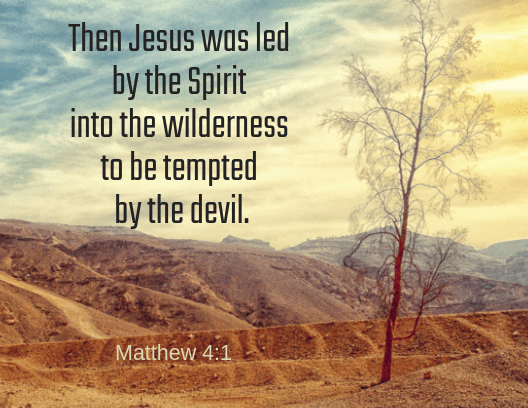
 Looking to Jesus, how can we be ready to do battle with temptation? First, he knew the word of God. It is how He responds not only to the temptation, but even when the word of God is seemingly being used against Him. How can you know the will of God? It is as ironically simple as losing weight: diet and exercise. Consume the right thing, His word, and practice it daily, so you will be spiritual healthy. Next, do God’s business. Know that temptation can come at any moment, but comes easier when we are idle (Prov 16:27-29). Keep your eyes on God and your hands and feet busy to his work. Like the old adage, “if you’re going through hell, just keep going,” Jesus faced the temptation, but immediately moves onto His ministry. Temptation IS NOT sin. No guilt required; pick up and move on. Finally, be on guard. Relapse can setback or even kill your spiritual life. Removing unnecessary temptation from our lives is a must. Even if we are in the word every day, engaging in spiritual disciplines, or deeply involved in a ministry, at the very height of our endeavors, it only takes a moment to go back to sin and fall harder and faster than we ever did (the very nature of relapse). If you can’t hang out with your friends without getting drunk, then don’t hang out with them. If you can’t be on the internet without looking at inappropriate sites, then don’t get on it. If you can’t use social media without bridling your tongue and speaking in love, then stop. Jesus uses hyperbole to illustrate the practical advice when he states, “it is better to cut your hand off” or “pluck your eye out” (Matt 5:29, 30) than to be lost to sin, and ultimately the kingdom of God.


 If you are in that moment, remember that God does not leave Elijah there, and he doesn’t want to leave you there either. Instead, he says, “Get up and eat (v. 5). After Elijah eats twice, he goes on a journey forty days and forty nights to the mountain of God. There, Elijah waits, first through a great wind, then through an earthquake, and lastly through a fire. In each of these places, he does not hear God’s voice. Finally, he hears it in the soft whisper, as God asks him “What are you doing here Elijah?” (v. 13) Elijah responds by saying, “I have been very zealous for the Lord God of Hosts, but the Israelites have abandoned your covenant, torn down your altars, and killed your prophets with the sword. I alone am left, and they’re looking for me to take my life” (v. 14). Elijah feels this despair because he had forgotten what God just showed him. In the desert when he was hungry, God was there with provision. He had forgotten that in the showdown, God was there with provision. When we turn our eyes from God to focus on our fractured circumstances, it can lead us to doubt. But, one remedy for that doubt is not only to remember the character of God but also to remember how God has exhibited that character in previous actions of faithfulness. We can trust in him not only because of what we know from the Bible but also because of what we know from our own lives. So, if you are in a wilderness period in your life, pause and remember God’s past faithfulness instead of dwelling on your despair. These reminders can help us to remember that even in our darkest times, God will carry us through.
 Over the next few days, we’re going to look at four wilderness stories in the bible to learn a lesson about what the wilderness is and what it can teach us. The first Wilderness Wandering Lesson is this: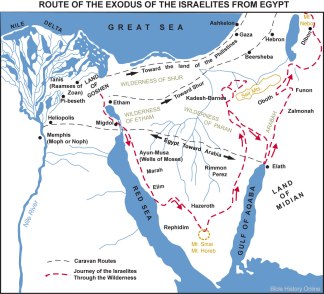


 Seek Grow Love