Our Job

2 Thessalonians 1-3

Devotion by Emilee (Ross) Christian

After spending the last two days discussing unity, today’s reading from 2 Thessalonians may seem counterintuitive as there appear to be a lot of divisive factors. In Paul’s explanation of the second coming there is clear division between the saved believers and evil doers. What I find interesting is who is doing the dividing. 

Paul makes it clear God will take care of Evil. There is a plan. While we may not have all the details of how said plan will work out, verses like 2:8 make it pretty obvious a plan exists. Today’s text seems to be saying it is God’s job to judge and take care of evil; it is our job to love and teach. 

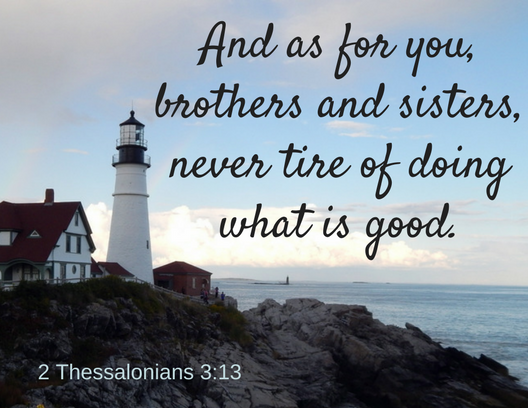
Throughout both letters to the Thessalonians, Paul commends their ability to love one another and remain faithful. In this letter, Paul specifically instructs them to “never tire of doing good” (3:13). The Greek word used here is kalopiountes meaning “to do well, act honorably, do what is right. From Kalos and poieo; to do well, ie Live virtuously” (Strong’s 2569). We know from Paul’s other writings he regards love as the greatest virtue (1 Corinthians 13:13). Basically, after discussing God’s plan to vanquish evil, Paul instructs the Thessalonians to show love. I think there is significance in the order he presents these topics. Our response to God’s judgment upon the earth is to love. 

Yet, it’s also clear Paul does not equate love with acceptance. Again, Paul warns against idleness. Here is where I believe the call to teach comes. While we are not called to judge, we’re also not called to hold the truth to ourselves. In fact, Paul even instructs the Thessalonians to “warn” the ones who “refuse to obey what we say in this letter” (3:14 NLT). As Paul did with the Athens people, we need to find a way to express the Gospel Truth to those with destructive ways of living. This takes faith. This takes action. This takes love.  

Reflection Questions

  1. What are your thoughts on the statement: “Our response to God’s judgment upon the earth is to love”?
  2. What does a loving warning look and sound like? Have you ever received one? Have you ever given one? Is there a person to whom God is asking you to give a loving warning? Pray about it.
  3. When have you been guilty of holding the truth to yourself? How could you respond next time?
  4. How will you show your faith, action and love this week?

The Struggle With New Revelation

Acts 11-12 

Devotion by Juliet Taylor (Tennessee)

It is good to change your beliefs based on revelation you’ve received about God’s word and what it means as it applies to your life, though it can bring on emotions you may not be prepared for. The first revelation I changed my mind about regarding the word of God was hard to handle, as it was a deeply held belief I was taught to accept and defend as truth by trusted individuals (with good intentions). But it was wrong.  

I learned it was wrong by way of other trusted individuals who had studied and changed their minds. They were able to present a good case for the error originally taught. I accepted that I believed something in error, however I didn’t fully understand the new revelation. I was confused. My confusion made me rethink what I had been taught about God and his thoughts about me. Be careful, this can happen to you. 

Thank God for his constant workings in me. The process I went through to cut through the confusion taught me how to not fear being wrong. It taught me to seek God for his wisdom about truth instead of holding on to pride. Pride does come before the fall, but it was good, as I was humbled. I can now handle being wrong. 

What I love most about the things I learned from the reading for this week’s devotional is that God’s wisdom is blaring through the pages. We get to read about how the early Christians struggled with new revelation and what they did about it.  We read about those who fell, those who were humbled, and the approach of those who did better. The better approach was rewarded with more work and a more intimate relationship with God. He gave the humble more of what they sought – his wisdom and power about what to do to spread the Gospel. 

In Acts chapter 11, some Jewish Christians took issue with Peter for eating with uncircumcised men. To convince them that this was God’s will, Peter explained his vision and experience with Cornelius. They listened and responded with the right responses, “When they heard this, they quieted down and glorified God, saying, “Well then, God has also granted to the Gentiles the repentance that leads to life” (Acts 11:18). What a response. 

After Stephen’s persecution however, fear took hold of some, to the point of stifling the spreading of the Gospel to Jews only. But there were some who took it to the Gentiles in Antioch. To those who didn’t let fear lead them, “the hand of the Lord was with them, and a large number who believed turned to the Lord” (Acts 11:21).  

Barnabas was sent to witness the workings of God with the Gentiles by those in Jerusalem. When he witnessed the grace of God, he rejoiced and encouraged them to remain true to the Lord. Barnabas was a good man, full of the Holy Spirit and faith. He brought Paul to them and together they taught the new Christians for an entire year.  

Doing God’s will (preaching the Gospel to the Gentiles, teaching them for a year, rejoicing, etc.) brought on many good things for those who were faithful to the news. They received a prophecy that there would be a famine so they behaved like Kingdom bound citizens and gave money to those in need. 

But we know that doing God’s will can also make us targets. King Herod killed the disciple James. This pleased the non-Christian Jews, so he also sought Peter’s life. The church used their powerful weapon of fervent prayer, leading to an angelic rescue of Peter from prison and death. 

Most in these chapters took the news of the new revelation from Peter very well. They rejoiced and accepted the news straight away. They got to work for the Lord, preaching the Gospel to the Gentiles and remaining with them for a time to help them grow.  

REFLECTION QUESTIONS 

There were many things the disciples did right when they heard the new revelation from Peter. What are some good actions you can take to help someone so that they don’t fall when learning something new? 

What do you think Barnabas and Paul taught the new Christians in Antioch for the year they stayed with them? 

Herod was eaten by worms and died after an angel of the Lord struck him because he did not give God the glory when the people he fed cried out, “the voice of a god and not of a man!” Why do you think he was met with this immediate consequence? 

“The squeaky wheel gets the grease.” 

Luke 23 & John 18-19

Devotion by Rachel Cain (Ohio)

What a true idiom. I never cease to be amazed at how large a small minority can seem when given a message and a platform. The media spins the truth to sway unsuspecting observers one way or another, leading us to disregard critical thinking and become emotionally attached to the perceived (and sometimes invented) injustices. We begin to see this small, vocal group as representative of the entire population. This happens on both sides of the political spectrum. Even niche groups can seem large if they’re loud and persistent enough. 

In Luke 23 it seems like “everyone” wants Jesus punished! The chapter begins with an emotional interaction between the Sanhedrin (the religious court) and Pilate, the governor of the Roman province of Judaea. The very first verse indicates that “the whole Sanhedrin” brought Jesus before Pilate, hoping for a death sentence.  A text note in my Complete Jewish Study Bible for Jews and Christians (p 1513) clarifies that “this literally means, ‘the multitude of them’- namely, the whole of those present… this reflects not the whole of the Jewish people but instead some members of the religious court…” 

This small-but-loud crowd succeeded. Even though Jesus had been healing multitudes, teaching with authority, and relating the people to God in no way they had ever experienced before, all it took was a small, mad mob to fuel the emotional fire that would cause the crowd to exclaim, “crucify him!” and end Jesus’ life.

We all know these actions fulfilled God’s plan; this is how it had to happen, but that doesn’t mean we can’t learn a lesson from the chaos. We need to be aware of fallacies in arguments that aim to sway us away from God’s Truth. We must be watchful to notice the sly work of the deceiver who “masquerades as an angel of light” (2 Corinthians 11:14). We should constantly compare the cries of the culture to the ways of God so we will not be conformed to the world, but “test and approve what God’s will is” (Romans 12:2). It would behoove us to remember the words of Jesus, that his life-giving way is straight and narrow, not the broad path that leads to destruction (Matthew 7:13-14). 

So, as Christians, let’s be the WD-40 on the “squeaky wheels” that are leading people astray from God. We must help encourage other Christians to stand for what is right, even when it seems like we’re standing alone. Also, we should be a different kind of “squeaky wheel”: unashamedly sharing God’s love to the world around us and shining His light everywhere we go. The world is watching. 

Reflections: 

How have you been influenced by the world around you – or resisted that influence and stayed true to your faith? 

In what ways can you be WD-40? Or be the squeaky wheel for Jesus? 

This is Eternal Life

John 16-17

Devotion by JJ Fletcher (Minnesota)

What is eternal life? According to Jesus in John 17:3, it is “knowing the only true God, and Jesus Christ”. 

John 17 is often referred to as “Jesus’ High Priestly Prayer”. Here we see Jesus praying for the deliverance of his disciples (that they remain in God’s name) and for them to have unity, the same kind of unity that Jesus has with God, his Father. 

John 10:29 quotes Jesus saying, “I and the Father are one”, and I see John 17 as giving that some context. God and Jesus are not one person, they are not one entity, they are not members of a godhead. They are one in purpose. They are united through the will of God and Jesus’ obedience to that will. There is clear subservience to God in Jesus’ words here, but God has also elevated and glorified him. They have a special relationship as we see through Jesus’ prayer life and language. 

Jesus wants his disciples to have that same kind of unity in purpose and in relationship. Jesus also points out that this is not just for the inner circle of his disciples; this unity and deliverance that Jesus is praying for extends to us. All those who came to faith because of the testimony of the Apostles.

There is also an exclusivity claim here. Eternal life is dependent on knowing the true God and his Messiah, Jesus. There are not many paths that lead to God, only one. 

Jesus emphasizes the importance of truth in 17:17-19. As Jesus’ father is the only true God, Jesus recognizes him as the source of truth. He says, “Your word is truth.” Jesus has been the truth bearer throughout the course of his earthly ministry, but soon, his disciples will be bearing that mantle of truth bearers. Jesus is sending them out into the world, just as God sent him into the world. This ties into the Helper that we looked at yesterday.

The Spirit of Truth, the power of God, God’s operational presence, the finger of God. There are a few ways that the spirit is described or defined. But it comes alongside, and that is in Jesus’ mind as he prays for the well-being of his friends and followers. God keep them safe, not from man, but from falling away. 

Reflection Questions:

1.        What jumps out at you from today’s reading? Is there anything here that has been particularly impactful in your faith?

2.        How should the unity that God and Jesus have impact the unity that we have as believers? If our oneness is supposed to be like theirs, how do we navigate disagreements?

3.        You shall know the truth, and the truth shall set you free. I think we read that recently. How does the truth of knowing who God and Jesus are and having the word of truth from God motivate you? Do you often consider the importance of truth in this age of lies?

The Truth Will Set You Free

John 7-8

Devotion by JJ Fletcher (Minnesota)

Freedom. An idea. A goal. A buzzword? During election cycles, we hear candidates speak about freedoms that the other side of the political spectrum is trampling or encroaching on. Those of us who live in the United States enjoy many freedoms that are not experienced in other parts of the world. While there are some exceptions, we enjoy freedom of speech and expression. We enjoy the freedom of expressing our beliefs and following whichever faith tradition we choose (or we can choose not to believe in anything in particular). 

We have to follow the laws of the land, but we don’t typically have to worry about occupying forces that try to control our populace. On the flip side, the incarceration rate in the U.S. is the highest of any independent country with democratic ideals, and it has the most incarcerated people of any nation. While the U.S. has eliminated slavery, there is still an issue with human trafficking, and there are nations that still have forms of forced labor practices.

The Israelites had a history of slavery and occupation. They were in Egypt for over 400 years, around half of that being enslaved to the Egyptians. Throughout their history, there were other occupations, including the Roman occupation that existed at the time of Jesus’ ministry.

In John 8:32, Jesus said to those who believed in him, “You will know the truth, and the truth will set you free”.  Though they lived under occupation, the Jews were not enslaved, and this pronouncement from Jesus befuddled them. They didn’t know slavery, so how or why would they need to be set free?

Jesus is, of course, speaking of the enslaving forces of sin. Whoever practices sin is a slave to it. The Apostle Paul writes that the wages of sin are death. So, this enslavement that Jesus speaks of is that sin that leads to death. The Mosaic Law highlighted sin, made sin apparent in the lives of those under it, but the law did not eliminate sin. The law did not remove temptation and the desire to sin. Jesus, on the other hand, suggests that his teaching holds the keys to throwing off the shackles of sin and death. “If you abide in my word, you are truly my disciples and you will know the truth, and the truth will set you free”. In verse 36, Jesus says, “If the Son has set you free, then you are free indeed”. Jesus’ teachings were/are powerful and are important to follow, but we also need to remember his place as the lamb who was slain to liberate the captives of sin. Our ability to obey Jesus doesn’t free us from sin, but our allegiance to Jesus and his words can give us victory in our daily battles with sin. Jesus paid the price and gives us victory over sin through the New Covenant that is sealed by his blood. While we suffer and struggle with sin, we should not feel enslaved to it because Jesus has already liberated us from the penalty of sin. A great reminder from John later in chapter 14: Jesus is the way, the truth, and the life. 

Reflection Questions:

1.        Do you ever feel enslaved to sin? Do you question why you still feel inclined to sin, even though Jesus has brought forgiveness to you? 

2.        What can you do to deal with temptation? Do we sometimes set ourselves up to sin by not being careful about the situations we allow ourselves to be in? 

3.        Is it encouraging to know that Jesus has given liberation from sin and death, even if we are still experiencing the effects of them? How does this frame how you approach sin? We don’t need to defeat sin; we need to submit to the one who did. How can you take that approach day by day? 

Running with Their Message

Jeremiah 23-25

Jeremiah’s heart was broken over the ungodliness and wickedness he witnessed among God’s people. As noted in 23:11, the priests and prophets were particularly godless. Their wickedness was so immense that God compared them to Sodom and Gomorrah. The prophets were not speaking inspired words, but rather what came to their own minds. I can’t help but wonder if these prophets told the people simply what they wanted to hear. In other words, they were good old fashioned con artists. My mind immediately went to the concept of today’s prosperity gospel and how preachers like Joel Osteen tickle the ears of the people with assurances that God wants you to be wealthy. Or there are even pastors who justify, minimize or normalize sins that are clearly spoken against in God’s word. God issues a clear warning in Jeremiah 23:16-17 about not listening to those who are sharing their own ideas as opposed to God’s inspired word.

16 This is what the Lord Almighty says:

“Do not listen to what the prophets are prophesying to you;
    they fill you with false hopes.
They speak visions from their own minds,
    not from the mouth of the Lord.

Someone who is truly sharing the word of God will compel people to repent of their sins and turn toward God. Be wary of anyone who always tells you just what you want to hear.

22 

But if they had stood in my council,

    they would have proclaimed my words to my people

and would have turned them from their evil ways

    and from their evil deeds.

To whom are you listening? If those people are making you feel complacent with your sin, encouraging you to follow after ungodly things or not make the kingdom of God a priority, then you know that they are leading you astray and that will have dire consequences if continued. 

32 Indeed, I am against those who prophesy false dreams,” declares the Lord. 

“They tell them and lead my people astray with their reckless lies, yet I did not send or appoint them. They do not benefit these people in the least,” declares the Lord.

– Kristy Cisneros

Reflection Questions

  1. How do you discern what is a godly message and what did not come from Him?
  2. When have you seen people chasing after a message that did not come from God?
  3. To whom are you listening?
  4. How can your words better align with God’s message? What would God have you say, and to whom?

Sorting Through the Muck

Jeremiah 10-13

 In nursing school, we were taught to remind patients not to google their symptoms because of all the “muck” there is out there. And given the right combination of benign systems, you can diagnose yourself with the black plague pretty quickly. But I can tell you right now not a single one of my patients under the age of 100 didn’t google their symptoms as soon as they surfaced. In conversations with my patients, I quickly learned that an admonishment against googling wasn’t going to work. I needed to help my patients navigate through all the muck of the internet to find information that is actually helpful (sites that are sponsored by hospital systems such as Mayo Clinic or Cleveland Clinic, or associations such as the American Heart Association or Cystic Fibrosis Foundation are generally reliable). 

Since you’ve probably visited the internet before, you probably already know much muck exists in the writings of any topic you look up. Even in looking up commentary on the book of Jeremiah, I came across writings that were complete perversions of the scriptures. The writers added “facts” to twist scripture to their agendas. I wonder if they even noticed the irony that their writings on Jeremiah are EXACTLY the kind of things God was warning Judah about. 

We saw in chapter 7 and now in 10 that the people of Judah added their idol worship to their worship of the ONE TRUE GOD. And clearly, people are still doing it today. 

I learned, through what seems to be a much more godly commentary site, that this is called syncretism. Syncretism is “the amalgamation or attempted amalgamation of different religions, cultures, or schools of thought.” (Internet dictionary). The writer of the commentary notes, “ YHWH hates syncretism. He has given us clear instruction on how we are to live, behave, and worship Him. He does not take lightly when we decide to trust more in our wisdom and modify His instructions as we see fit.” 

In chapter 12, we really start to feel bad for Jeremiah. He’s asking God why the evil are getting away with everything and seem to prosper and God’s response was that it was going to get a lot worse! In light of our present circumstances and prophecy, we may feel the same way. 

Then in chapter 13, God uses an object lesson to show what will happen to Judah if they do not turn to Him. The NASB calls it a linen belt and the Message calls it shorts. Either way, Jeremiah was commanded to wear it right away. As this belt or shorts was worn close to the body, it represented how closely the Lord holds Judah to Himself. God then has Jeremiah take them off and stick them between some rocks and retrieve them a few days later. Not surprisingly, they were completely tattered and torn (though being a guy, Jeremiah probably wore them anyway 😀). Just like time, weather, and lack of care ruined the shorts, God promised to ruin Judah if they continued to ignore His commands. In verses 15-16, God tells the people to hear, pay attention, do not be arrogant and give God the glory and He would not destroy them. Stay tuned to find out if they heed this warning…or not. 

Jeremiah was not called “The Weeping Prophet” for nothing. But I think the more tragic thing is that society hasn’t changed much. There are those who are doing the EXACT same things for which God severely punished the practitioners. Jeremiah would be appalled. He would be weeping that there are so many sinking in so much muck. 

Praise God that we don’t need to wade through the muck of untruths that surround us. No matter the person or their credentials, we must always hold up their teachings to the only source for truth, the Holy Bible, because God and His truth are not hiding from us nor are far from us! (Acts 17:24-28) 

Prayer: 

Dear Lord, 

Please let me be aware if there are any thoughts, beliefs, or behaviors that contradict your decrees. Please help me to keep my offering of worship pure and true. 

In Jesus’ Name, 

Amen 

-Maria Knowlton

Reflection Questions

  1. What ailments does the world have today? What symptoms do they have? What is the prognosis? Is there any cure available? How many will ignore the warnings of the wise doctor (and nurse)?
  2. What muck have you seen others and/or yourself following or mixing with Bible truth? Continue praying for God to show you truth – and keep seeking it in God’s precious Word.
  3. What are your thoughts and feelings reading through all of God’s warnings to Judah through the prophet Jeremiah? Who needs to hear these warnings today? Are there words God wants you to speak? Ask him.

Imposters

Isaiah 44-48

Each morning as I open and check my email inbox, I am compelled to clean out and delete all of the spam messages that are delivered as well. Every time, I “block sender” and yet those pesky messages still show up! Have you ever noticed how similar some of the spam messages are to a legitimate vendor or service? Most are easily identified as junk, but every once in a while, I need to look a bit more closely to see if it’s the real deal or not. According to a CBS report in April 2025 over $16.6 BILLION was lost due to fraudulent emails, text messages, and phone calls in the previous year. Imposters are very persistent and clever in disguising themselves as valid and trustworthy sources.

In Isaiah chapters 44-48, God emphasises that He alone is God, there is no other and none are like Him. In fact, there are nine times within this section that a variation of this phrase is stated. 

  • Isaiah 44:6
  • Isaiah 45:5, 6, 14, 18, 21, 22
  • Isaiah 46:9
  • Isaiah 48:12 (variation) 

As God’s people had been captured by Babylon, they were surrounded by false, fake gods. Through the prophet Isaiah, God makes it crystal clear who the REAL God is. 

The false, fake gods are man made. The one, true God made man and the entire universe.

The false, fake gods are unable to speak and fulfill promises. The one, true God not only claims things to come, but works to see those claims come to fruition.

The false, fake gods have no power, authority, or sovereignty. The one, true God orchestrates unlikely foreign leaders to rescue His people.

The false, fake gods cannot provide salvation. The one, true God is salvation for His people.

As a reader of this passage of Scripture, it’s tempting to think, “How could someone be duped by a false, fake god?”. But when you never seek and study the one, true God, it becomes a challenge to distinguish between the imposter and the authentic. When you are familiar with the characteristics, the qualities, the patterns, the motivations, and the promises of the one, true God, it becomes easier to discriminate against the attempts of the false, fake gods. 

So spend a little extra time today in the presence of the one, true God so your heart and mind can confidently claim, “There is no other; there is none like You”. 

Reflection Questions

  1. What are some “false, fake gods” or imposters in your life that compete for your attention, trust, or hope?
  1. How can you become more familiar with God so you’re not fooled by spiritual imposters?
  1. Finish this prayer: “God, there is no other; there is none like You because…”

-Bethany Ligon

Warning, Mourning and a Whisper of Grace

Micah 1-3

Like many times in history, Israel had to be confronted by a prophet who had a message from God that wasn’t savory. That is, in times of comfort, complacency, and wickedness they would find that they were not walking with the Lord. In Micah 1-3, Micah speaks for the Lord and completely rebukes the state of Israel and the leaders that allow for it to be in the state it is. Their morals have been corrupted, their path is unjust, and they have implemented idols again into their nation. 

The themes from previous days’ devotions persist here. Violent imagery and a great lament is detailed in Micah 1-3 as he warns and mourns the judgement that is to come. The imagery from Micah 3:1-4 is especially fiery and vivid to the imagination as Micah rebukes the leaders of Israel. To pile onto the agony being described, Micah also details that God will be separated from those in religious authority in Israel in Micah 3:7:

“The seers will be ashamed

    and the diviners disgraced.

They will all cover their faces

    because there is no answer from God.”

With this, we must reflect on our own lives. In a position of leadership, we must set an example. James 3 echoes this idea of the judgement that will be faced by those who teach and lead those astray. If we are to act as examples for others, we must also walk in the ways of the Lord. Micah is clear with this striking message: where in our lives have we settled for religiosity without righteousness? Comfort without compassion?

God’s heart breaks over injustice. He doesn’t just call it out. He promises to act. That’s a sobering reminder: God cares too much to remain silent in the face of oppression. However, tucked inside Micah’s warnings is a whisper of grace: “I will surely gather the remnant…” (Micah 2:12). God’s judgment is never the end of the story. Even as He tears down, He is preparing to build again. On that foundation, with that remnant, he will build on principles of humility, justice, and faith.

-Colby Leggitt

Discussion Questions

1. Where in your life or community do you see injustice that needs to be addressed?

2.Are there areas where you’ve grown comfortable with compromise or overlooked truth?

3. How can you walk more humbly and live more justly today?

Hearing What We Don’t Want to Hear

1 Kings 22, 2 Chronicles 18

In First Kings 22 and in Second Chronicles 18 we find the same account of evil King Ahab considering going to war against Ramoth Gilead.  He asked about 400 prophets what he should do and they all said to go victoriously to war.  When encouraged by King Jehoshaphat of Judah to ask a prophet closer to the matter about this, King Ahab’s response is found in First Kings 22:8.  He says, “There is still one man through whom we can inquire of the LORD, but I hate him because he never prophesies anything good about me, but always bad.  He is Micaiah son of Imlah.”  Now remember, it is said of evil King Ahab from First Kings 21:25-26, “There was never a man like Ahab, who sold himself to do evil in the eyes of the LORD, urged on by Jezebel his wife.  He behaved in the vilest manner by going after idols, like the Amorites the LORD drove out before Israel.”  It is no wonder the true prophet of God never had anything good to prophesy, but always bad!

It is noteworthy that King Ahab avoided the truth because he deemed it as bad.  Instead, he listened to the 400 voices that told him what he wanted to hear.  King Rehoboam did the same thing in First Kings chapter 12.  Instead of listening to the advice of the elders, who gave advice he did not want to hear, he followed the advice of his peers.  He followed what he wanted rather than what was best for him.

It would be easy to look at these kings and heap ridicule upon them in judgment.  However, it might be beneficial to consider our own ways.  How often do we gravitate toward people who affirm our immorality, rather than seeking the truth of God?  How often do we lean into confirmation bias, rather than seeking godly ways of thinking about a matter?  The book of Proverbs consistently supports the idea of seeking wise counsel.  Consider Proverbs 1:5, “let the wise listen and add to their learning, and let the discerning get guidance”.  Also, Proverbs 19:20 says, “Listen to advice and accept instruction, and in the end you will be wise.”  Clearly, God desires that we would listen to the voices that speak His wisdom into our lives, even if we don’t want to hear it.

One more thing to consider today.  Sometimes we are the ones who need to hear something from God, even when we don’t want to hear it.  However, sometimes we are the Micaiah’s who have something to say that someone else may not want to hear.  Progress in these situations slowly, discerning God’s wisdom to speak in love.  Ephesians 4:15 says, “Instead, speaking the truth in love, we will in all things grow up into him who is the Head, that is, Christ.”  The words we speak must be spoken in love.  Our goal of speaking should be for us to grow into Christ together.  

Listen to God’s Word, especially if you don’t want to hear it.  Speak to others in love, especially when they might not want to hear God’s Word.

-Michael Cisler

Reflection Questions

How can you actively seek godly voices in your life?

What does it mean to speak the truth in love?  What does each element (truth and love) entail?

When is the right time to speak and when is the right time to be quiet?