To Wash or Not to Wash?

Matthew 15 and Mark 7

Well, that was the question the Pharisees and teachers of the law asked Jesus: Why don’t your disciples wash their hands before they eat? Good question, most of us would agree it’s a good thing to wash your hands before you eat, and when you return from the marketplace, and several other times of the day. This Jewish delegation (comparable to today’s church leaders) were very curious about Jesus and his followers. They had traveled all the way from Jerusalem to Galilee (approximately 70 miles over rough terrain, most likely walking for 2 or more days) to check out this Jesus. They had heard about his many miracles and teachings, and had probably been around long enough to witness some as well. They were watching him closely to decide what they were going to do with this man. And then they saw a problem they could attack: Jesus’ disciples didn’t wash before they ate. It is interesting that Matthew says “your disciples”, Mark says, “some of your disciples”, but it does not say that Jesus didn’t wash – so it doesn’t appear the Pharisees could personally attack Jesus for his own uncleanliness – but what of his disciples? They asked Jesus, “Why do your disciples break the tradition of the elders? They don’t wash their hands before they eat!” (Matthew 15:2 – even with exclamation!)

Jesus quickly flipped the question around – “And why do you break the command of God for the sake of your tradition? (Matthew 15:3). And then he gave an example of how they enticed people to break God’s law which said to honor their parents. It appears they were encouraging people to give large showy gifts to God even when it meant they no longer had the means to provide for their aging parents. Jesus shows how the Pharisees had majored in the most minor issues (like pointing out someone’s dirty hands) and left the most important things neglected.

I think of my daycare children and all the potty-training and hand-washing I have taught over the years. I can certainly attest that hand-washing is very important. However, supremely more important is that child’s love for God and others. Imagine a child who is a beast all day long. Fighting with the other children, biting, ripping toys out of their playmates’ hands, yelling at authority, and screaming during lunch time prayer. But, they washed their hands very well before coming to the table. When I give a report to the parents at the end of the day how foolish it would be for me to congratulate them on a child who follows well the rules of man and has clean hands to eat.

Likewise, at the end of the day, we will stand before Judge Jesus. Some will expect to be commended. They did a really great job of following the laws of the land or the traditions of the church, they loved their family, excelled in their business and other man-made expectations. They always washed their hands before they ate. They were good people.

But, that is not what will matter. Jesus will be rewarding those who truly love God and love people – not just in their words but in their actions and sacrifices and daily priorities. Did they keep God’s law first, even when society said they should follow man’s law instead? Did they accept God’s son as the only way to salvation, even when the world said there are many different roads to salvation? Did they carry their cross, even when the world mocked and pointed fingers and threw accusations?

Beware of following the wisdom of this world and the traditions of men. It won’t get you where you want to be in the end. Instead, consider carefully God’s way, every time, and walk in it. In what areas of your life would God have you turn your back on the traditions of men and human rules and expectations to instead dive deeper and deeper into His way – love God, love others, accept Jesus, prepare for the Kingdom.

-Marcia Railton

Today’s Bible reading can be read or listened to at BibleGateway here – Matthew 15 and Mark 7

Tomorrow we will read Matthew 16, Mark 8, and Luke 9:18-27 as we continue reading God’s Word.

Overcoming the Opposition

Nehemiah 6-7

So much work had already been done – the walls of Jerusalem had been rebuilt – now they just needed to finish the gates. Surely this project was God-ordained and he picked the right leader for the job – Nehemiah. He was able to get everyone motivated and working together, and despite the opposition they were able to finish their job on the 25th of Elul (which appears to correspond to somewhere between Sept 15 and October 2). So, this week is a super time to celebrate the work that is accomplished when working for God.

So much good had been done already – but the work did not end and neither did the opposition!

Nehemiah was under attack. Satan (along with Tobia, Sanballat, Geshem and the rest of those fighting against God) were using every weapon at their disposal to bring this righteous leader down: lies, fear, wolves in sheep’s clothing, attempting to distract him from his work with other business, spreading gossip and accusations of sedition to either silence him or get him in serious trouble with the authorities, even hiring a false “prophet” to scare him into sinning.

But Nehemiah stood strong. We continue to see him turn to God in prayer. Asking for strong hands and asking for God to take care of those getting in the way of the Lord’s work. He obviously had a strong knowledge of God’s law to not be tricked into sinning. This gave him wise discernment in knowing who to listen to and what to do, and not do. And, he knew to fear God not men.

We can learn a lot from Nehemiah today because Satan keeps using the same ploys. Adolf Hitler wrote, “Mental confusion, contradiction of feeling, indecisiveness, panic; these are our weapons.” Evil men seeking to destroy God’s work have come and gone and yet remain today. It is indeed a vivid reminder that, “Our struggle is not against flesh and blood, but against the rulers, against the authorities, against the powers of this dark world and against the spiritual forces of evil in the heavenly realms.” (Ephesians 6:12 NIV). They love nothing more than trying to interrupt God’s work and if they can bring down a godly leader at the same time they probably get bonus points.

We see so much of this evil and oppression today. But like Nehemiah, we must not give up! We must turn to God again and again when faced with the lies and fears and Satan’s strong man tactics that would love to have us throw in the towel and take the easy way instead. Pray, fast, seek His word and His way, don’t fear man, resist sin, use discernment in knowing who to trust, what to say and do. Pray, too, for our leaders that they will have the wisdom and strong hands of Nehemiah

Satan has been running rampant and the result is a broken world. Keep at God’s rebuilding work – one brick at a time.

Marcia Railton

Speaking of our opposition, mental confusion, lies, panic, and pleasing man not God, reminds me of the life and death fight for the most innocent of God’s creations. Tonight would be a great time to watch See Life 2020 and #LoveEveryHeartbeat. And pray for strong hands – and hearts – to do the work God wants you to do.

Today’s Bible passage can be read or listened to at BibleGateway here – Nehemiah 6-7

Tomorrow we will read Nehemiah 8-10 as we continue seeking God on our

Dem Bones…Can They Live?

Ezekiel 35-37


It would probably be blasphemous to suggest God asks silly questions, so I won’t. But I would imply that the creator of the universe makes inquiries which His creatures wouldn’t. I don’t think most of us, upon seeing a valley full of human bones, dried out by years of the sun beating down on them, would think to ask: Can these bones live? No, I think the first question would be: “What on earth happened here?” Followed by: “What’s the quickest way out of this place?” But that is not what happens in chapter 37 of Ezekiel. No, Ezekiel doesn’t get to ask a question, instead, one is posed to him by God, “Can these bones live?” And he responds with either the biggest cop-out of an answer there is or the wisest: “Only God knows.” I would lean towards wisest. God’s not trying to learn something from Ezekiel; He is trying to reveal something to the prophet so Ezekiel can relay it to the people of Israel, which is why he doesn’t try to guess at an answer. Ezekiel doesn’t care to have his opinions heard by God; he wants to know what God has to say. We would do well to learn this trait from the prophet–you could say it would be quite profitable (sorry!).

While Ezekiel doesn’t provide a yes or no answer to the question, God does: yes, these bones will live again. These bones, representing the house of Israel, who have been cut off from their land, and whose hope is gone, will live again. God’s people who, time after time, have rebelled against Yahweh and received mercy only to rebel further, will once again experience the grace of God and return to the Promised Land. This vision, like all those received by the prophets, is first for the Jews. It concerns God’s People and it is for God’s People, but there is much for us, as Christians, to learn from the words of the prophets today.

A few things we should recognize from this particular revelation and meditate on are (1) God’s relentless love for His people, despite their blunders, foolishness, and obstinate ways (to put it mildly). (2) That God can (and does) redeem those who have been abused, discarded, and forgotten. (3) We can (and should) have hope and trust in Yahweh, despite any and every problematic, perilous, or pernicious situation we may be in. The God we serve does not cower at death, does not withhold second chances, and does not fail to love the unlovable. Neither should we. 

– Joel Fletcher

Today’s Bible passage can be read or listened to at BibleGateway here – ht

tps://www.biblegateway.com/passage/?search=Ezekiel+35-37&version=NIV

Tomorrow we will read Ezekiel 38-39 as we continue on our

Why, God?

Habakkuk 1-3

Habakkuk 1 3 NIV sgl

It is a common question asked through the ages, “Why, God?”  Why do the wicked succeed?  Why do the violent survive?  Why is there injustice in the nation and even in the courts?  Why, God?  Why?

Habakkuk had the same questions.  He lived during the “end” days of Judah, before the Babylonian captivity we have read about the last 2 days.  He had a heart for God and sought to do what was right.  But, what about everyone else?  He was outnumbered, “The wicked far outnumber the righteous, so that justice has become perverted.” (Habakkuk 1:4 NLT).  And that can be a hard place to be.  Where right has become wrong and wrong has become right.  And, where was God?  Why was God not taking action to right the wrongs, punish the evil and make things right?

God answered Habakkuk, but it certainly wasn’t the answer he was expecting or wanting.  God did see the evil, violence and injustice. and he was taking care of matters – in His time and His way.  He revealed to Habakkuk that He was preparing the wicked, idolatrous Babylonian neighbors to the north to bring God’s judgment on Judah.  Wait, a minute, God – they are even worse than us!  That’s not fair!

If God had a penny for every time He heard that line – but, He owns everything already.

He doesn’t need your penny – or your advice.  God doesn’t need to be understood by His creation.  But we would be wise to accept His sovereignty, as Habakkuk did.  Even when faced with answers He didn’t fully understand or like, Habakkuk realized and accepted that God was in control.  He would punish Judah – and then Babylon – when and how He wanted.  And, He would show His power, His patience, His justice, His grace, and His love when and how He saw fit.  God’s people can rest in that knowledge.  There is a lot we don’t have to know or understand – a lot of “why’s” we can’t answer.  But we can rest in knowing that God knows.  He knows.  He sees.  He’s got this.  He is working out all things.  We can bolster our faith and reliance on God’s way by joining with Habakkuk as He proclaims:

I heard and my heart pounded,
    my lips quivered at the sound;
decay crept into my bones,
    and my legs trembled.
Yet I will wait patiently for the day of calamity
    to come on the nation invading us.
17 Though the fig tree does not bud
    and there are no grapes on the vines,
though the olive crop fails
    and the fields produce no food,
though there are no sheep in the pen
    and no cattle in the stalls,
18 yet I will rejoice in the Lord,
    I will be joyful in God my Savior.

19 The Sovereign Lord is my strength;
he makes my feet like the feet of a deer,
he enables me to tread on the heights.

Habakkuk 3:16-19 NIV


In our questioning, in our fear, in our uncertainty – yet we will wait patiently for God.  He WILL set things straight.  His perfect judgment is coming.  Until then, wait and rejoice in God our Savior – He is our strength.

Marcia Railton


Today’s Bible passage can be read or listened to at Habakkuk 1-3

Tomorrow’s reading will be Jeremiah 41-45 as we continue the 2020 Chronological Bible Reading Plan

Take Action

2 Kings 22-23 and 2 Chronicles 34-45

2 kings 22 25 NIV sgl

Josiah was only eight years old when he became king, yet he still did what was right. This was unlike many of the other kings that ruled in Jerusalem. We are told in these chapters that this young and inexperienced king did what was right in the eyes of the LORD.

It is amazing how zealous King Josiah was. He was truly grieved when he discovered, from the reading of the Book of Law, how far his people had strayed. He tore his clothes and audibly wept. I feel like this should inspire modern day Christians. It seems as though evil has become an ordinary thing that we see happen every day. We have news stories of murders, burglaries, and other reports of violence and suffering flash across our phones on a daily basis. Does this evil pain us the way the evil of Jerusalem pained Josiah? Or have we grown numb to this constant occurrence?

Not only did this pain Josiah, it also sparked a change. King Josiah did something with this revelation. He tore down the high places and idols built to glorify and worship false gods. He sought to destroy the things in Jerusalem that went against the LORD. He completed this quest with passion. He wanted Jerusalem to again turn to the LORD.

This should also inspire us. It is one step to see what is happening, but it is another to take action. What are we doing to combat the darkness? There is so much pain in this world. How are we being proactive?  It is easy to become complacent, but we must aspire to do all that we can as Josiah did. Josiah is an example of someone that truly sought the LORD.

Because of Josiah’s heart and his commitment, the LORD promised him that he would not see the destruction of Jerusalem. Josiah, however, was eventually killed in battle. This came about, though, because he did not heed the warning which God had sent him. We need to constantly look to the LORD and seek him as Josiah tried to do during his reign.

Therefore, let us allow the things we see to inspire us to also seek change. Let us, as Christians, be a city on a hill and reach out to the hungry, wounded, and lost. Even opening the door for someone or buying someone’s coffee in the drive-thru behind us can make another person’s day. This life can seem difficult at times, so let us be a light that keeps the creeping darkness at bay in the lives of many people. Josiah did not only grieve for the state of Jerusalem, he took action to better it. In the same way we should not be satisfied with only grieving for our world. We too, like Josiah, should seek to be the difference that we wish to see in this world.

Hannah Deane


Today’s Bible reading can be read or listened to at https://www.biblegateway.com/passage/?search=2+Kings+22-23%3B+2+Chronicles+34-35&version=NIV

Tomorrow’s reading will be Zephaniah 1-3 as we continue our 2020 Chronological Bible Reading Plan


God Has Answers

Isaiah 5-8

Isaiah 8 20 NLT sgl

Today’s reading contained some pretty grim and possibly confusing stuff. In some sections it seems the people of Judah are completely doomed for destruction, while other parts tell of a coming protection. If you have come here today looking for an explanation and clarification on all that took place in these chapters – I’m sorry to say, I haven’t got one. Mainly because one perfect answer doesn’t exist. Scholars, theologians, historians, have all made attempts at understanding biblical prophecy. There has yet to be one universal agreed upon interpretation. The language barrier is one reason, as is the lack of context and historical gaps. If you want to know more about today’s reading and other prophecy, I encourage you to do two things. One, reach out to your local pastor with your specific questions. He or she would love to help you digest the Old Testament. Many have a wealth of biblical knowledge and bookcases stocked with resources. Plus, during this Covid time, many pastors are feeling a disconnect with their congregation, unable to meet under normal circumstances. They would welcome your questions and this opportunity to serve.

My second bit of advice is to follow that in Isaiah 8:20, “Look to God’s instruction and teachings! People who contradict his word are completely in the dark.” (NLT) Isaiah goes on to describe the type of darkness these people experience as a sort of wandering aimless search for answers. He paints a picture of people looking at the sky and shaking their fists at God. These people sought psychics and other mediums for answers, instead of seeking the LORD’s instruction. Whenever you are reading scripture and stumble upon a passage that confuses you, look to what you know to be true about God. Some of these Old Testament passages can be tricky and may produce the picture of God as being only angry and vengeful. Be sure to look to ALL of God’s instructions and teachings. Personally, when reading doom and gloom in the Old Testament, I try to keep in mind what God says about Himself as being “the LORD, the compassionate and gracious God, slow to anger, abounding in love and faithfulness, maintaining love to thousands, and forgiving wickedness, rebellion and sin. Yet he does not leave the guilty unpunished;” (Exodus 34:6-7 NIV). I love this verse in Isaiah, because right in the midst of confusing prophecy, he gives us an answer, encouraging us to seek “God’s instructions” known to us through scripture.

This advice from Isaiah can also be applied to other aspects of our lives when searching for answers. I would say all aspects, except I’ve not yet found the part in scripture that explains calculus. Math aside, when we face difficult or confusing challenges, wandering in unknown darkness, we as believers are encouraged to seek God for the answers. We can approach God through our wonderful redeemer, Jesus Christ. Whether these answers are revealed to us by understanding scripture, receiving peace, or prayer, answers exist. I am experiencing some personal challenges in my life right now. A couple weeks ago, one of my best friends sent me a text reminding me to seek answers from God during this trial. Her encouragement applies also to you, and whatever your current struggles may be. The last part of Isaiah 8 reminded me of her words. I want to share some of them with you as a closing thought.

“It may seem like the pain, loss, confusion, and hole in your heart, are the only things you will ever know, but please remember, the Lord has a plan for you and He is there to listen to you, He is there to listen to your cries of anguish and despair. And He will console you, but you have to ask Him for His help. Please don’t shut yourself out of His sweet  and divine presence, my dear friend. Ask Him to give you guidance for what you should do next. How you should proceed with your life. Ask Him for His wisdom so that you can understand what lesson He wants to teach you, how He is trying to mold your character. And also maybe think of what He wants you to ask Him. What is HIS will?”

Emilee Ross


Today’s Bible passage can be read or listened to at https://www.biblegateway.com/passage/?search=Isaiah+5-8&version=NIV

Tomorrow we begin another prophet writing at a similar time – Amos, chapters 1-5 – as we continue the 2020 Chronological Bible Reading Plan


A King with a Divided Heart

2 Kings 14 & 2 Chronicles 25

2 chronicles 25 2 NIV sgl

Today’s reading looks at King Amaziah.  2 Kings 14:3 explains, “Amaziah did what was pleasing in the LORD’s sight, but not like his ancestor David” (NLT). In 2 Chronicle 25:2, we are again told of Amaziah’s faith as he “did what was pleasing in the LORD’s sight, but not wholeheartedly” (NLT).  The literal Hebrew translation for the phrase wholeheartedly means with a loyal heart. So, King Amaziah served the LORD, but not with a loyal heart. Sometimes he obeyed God, as explained in 2 Chronicles 25:5-10, by heeding the prophet’s warning to not use the troops from Israel. Other times, he forgot God and chose to worship idols. His heart was not loyal. He was a king divided.

The idea of serving with a divided heart reminds me of a sermon I preached last summer on Philippians 4:2-9. This passage begins with the ever popular “Do not be anxious about anything” verse. I conducted a closer word study over this passage and discovered what Paul is really saying is not “don’t worry” but not to be divided. The Greek translation for the word anxious is merimnate. The root word merimnaó actually means to be divided, not to be whole. Paul is asking believers not to let their hearts and minds become divided, but to invite God into all aspects of our lives doing this through “prayer and petition, with thanksgiving.”

While worry is one thing that can divide a heart, it is not the only thing. Right now, living in pandemic times, it is easy to be distracted by many feelings. Despair, anger, depression, grief, uncertainty, doubt, and loneliness are all feelings that can be developed during this time. All very reasonable feelings, considering all that is happening. The key is to not let these feelings divide our hearts or keep us from serving God. I believe the best thing we can do to ensure we serve God with a loyal heart, despite our circumstances, is to invite God into our feelings.

Share with Him the things troubling you. Do not keep your worry to yourself, tell God about it. Tell Him when you are lonely. Tell Him when you are angry and doubting His sovereignty. Tell Him when you are sad. Invite God into your struggles so your heart will not be divided. It may not change your circumstances but unlike King Amaziah it will help keep our hearts loyal.

Emilee Ross


Today’s Bible passage can be read or listened to at https://www.biblegateway.com/passage/?search=2+Kings+14%2C+2+Chronicles+25&version=NIV

Tomorrow’s reading will be the (short) book of Jonah as we continue the 2020 Chronological Bible Reading Plan .  What can we learn about God or about ourselves from this prophet in the belly of the big fish?

Beware of the Buttkissers

1 Kings 22 & 2 Chronicles 18

1 Kings 22 5 NIV sgl

Yes, I know, a bit of a sensational title. In fact, I can hear my mom reaching for the Irish Spring to place in my mouth because “butt” is not a church word. Please give me grace just a few sentences longer as I am someone who spends a great deal of time at school with 11 and 12-year olds. I often use a bit of high-brow potty humor for the connection and to make sure that I have your attention.  From here on out, I promise <crossing heart> I will use yes-men, suck-ups, sycophants, or something similar, but we’ll both know that I truly mean <in a whisper> “the ones who kiss b-u-t-t.”

Scattered throughout the last couple of weeks, we have read about the life of King Ahab. Today we will finish off Ahab [spoilers ahead] in more ways than one.  Ahab has grown unhappy that a previously Israeli owned-city, Ramoth Gilead, is now occupied by the Syrian (Aram) people, the very nation that was given over to him by God (1 Kings 20).  No doubt that Ahab’s misintentioned mercy to the Syrian nation (Again 1 Kings 20) has become less than advantageous, contemptuous, or is now, simply biting him in the…rear.  Ahab forms an alliance with Judah’s king, Jehoshaphat, who says he will fight with Ahab to take back Ramoth Gilead if he consults the LORD first.  Ahab thinks, “No problem; I have plenty of prophets.”. Enter the yes-men.

‘So the king of Israel brought together the prophets—about four hundred men—and asked them, “Shall I go to war against Ramoth Gilead, or shall I refrain?”  “Go,” they answered, “for the Lord will give it into the king’s hand.” – 1 Kings 22:6

Jehoshaphat isn’t convinced by the mass of soothsaying suck-ups for a simple reason: they do not mention God, YHWH, which prompts his head-scratching statement “Is there no longer a prophet of the LORD here whom we can inquire of?” “But didn’t the prophets say ‘the Lord will give <Ramoth Gilead> into the king’s hand?’” You may have heard it before, but it is worth reminding, that not all “lords” are equal in most English translations of the Old Testament.  L-o-r-d means master, which is often used for God, but L-O-R-D is the indisputable proper name of God, the Father, YHWH.  The sycophantic seers have not consulted with the Almighty, but have most likely consulted one another, telling the king whatever they think he wanted to hear.    Ahab confesses there is still ONE prophet of the LORD, Micaiah, but he doesn’t like to use him because he doesn’t like to kiss-up like the others. In fact, Ahab’s reluctance shows that he most likely already knew the truth. Micaiah lives up to his reputation, delivering a Word from the LORD that was unfavorable to what Ahab had already set upon his heart to do.

Is Ahab’s folly not our own? As I read about his fatal flaw, I can feel my own groan, lurch, and tumult described by Paul in Romans 7:15-20, between what I have intentioned in my heart and what the LORD wants of me.  What makes it worse is the body of booty smoochers ready to tell me that fulfilling my desires are what will ultimately make me happy.  In 2020, it doesn’t take much searching to find 400 people that agree with you.  Just because a crowd has formed in agreement with you, it doesn’t mean they (or you) know what’s best.  There are well-established organizations, conferences, websites, movements, forums, etc. that have opposing views to God’s desire for your life.  No matter how convincing the mob, there is only one way to get the truth: The Word of the LORD.  Yet the fact of the matter is as I wrestle with my desire, my pride, and my sin, I’d rather hear comforting, confirming, justifying lies from hundreds than hear a truth from a single person that would convict me and cause me to change. This would mean that the problem doesn’t externally exist in the world I live in, but within me, which is the hardest thing to hear (and the reason why we don’t invite challenging scriptures or a truth-telling Christian friend to the party, i.e. Micaiah)

“The word of God is quick, and powerful, and sharper than any two edged sword, piercing even to the dividing asunder of soul and spirit, and of the joints and marrow, and is a discerner of the thoughts and intents of the heart.” – Hebrew 4:12

There is great advice in the word of Jehoshaphat, “First seek the counsel of the LORD.”  Before taking any course of action, no matter how great or small, let me stop consulting my social circle of “yes people” and search the Word of the LORD for discernment.  Almost always, our only reluctance is because we already know the answer that is buried not-so-deep within our heart. Let’s pray that God will bring his convicting truth to our aspirations and challenge us to listen to His voice only as He guides us to His way.


Aaron Winner


Today’s Bible passage can be read or listened to at https://www.biblegateway.com/passage/?search=1+Kings+22%2C+2+Chronicles+18&version=NIV

Tomorrow’s reading will be 2 Chronicles 19-23 as we continue the 2020 Chronological Bible Reading Plan

Sin Snowballs

1 Kings 15:25-16:34 & 2 Chronicles 17

1 Kings 16 25 NIV sgl

In our chronological journey through the Bible we took nearly 7 weeks to read and discuss the life and writings of David.  But in today’s reading in 1st Kings (15:25-16:34) we will cover 6 kings of the Northern Kingdom Israel and in 2 Chronicles (17) we will be introduced to a king in the Southern Kingdom of Judah.  Hold on to your hat – here we go!

THE NORTHERN KINGDOM – ISRAEL (10 tribes) – will have 9 different family dynasties reign (with 19 kings) over a period of 208 years

Jeroboam – rebelled against Solomon’s son Rehoboam – reigned 22 years – evil – set up golden calves for worship so the people wouldn’t return to the temple in Jerusalem – succeeded by his son….

Nadab – 2 years – evil – overthrown by…

Baasha – 24 years – evil – Jehu prophesied Baasha’s family would be ruined – succeeded by his son….

Elah – 2 years – evil – drunk – overthrown by…

Zimri – 7 DAYS – (next time you think you’ve had a tough week – remember Zimri) – long enough to kill all of Baasha/Elah’s family, as prophesied – but he too was evil and when their army (and Omri, its commander) heard Zimri killed Elah and made himself king they marched against the palace – rather than be captured, Zimri burned the palace down around him as he was overthrown by…

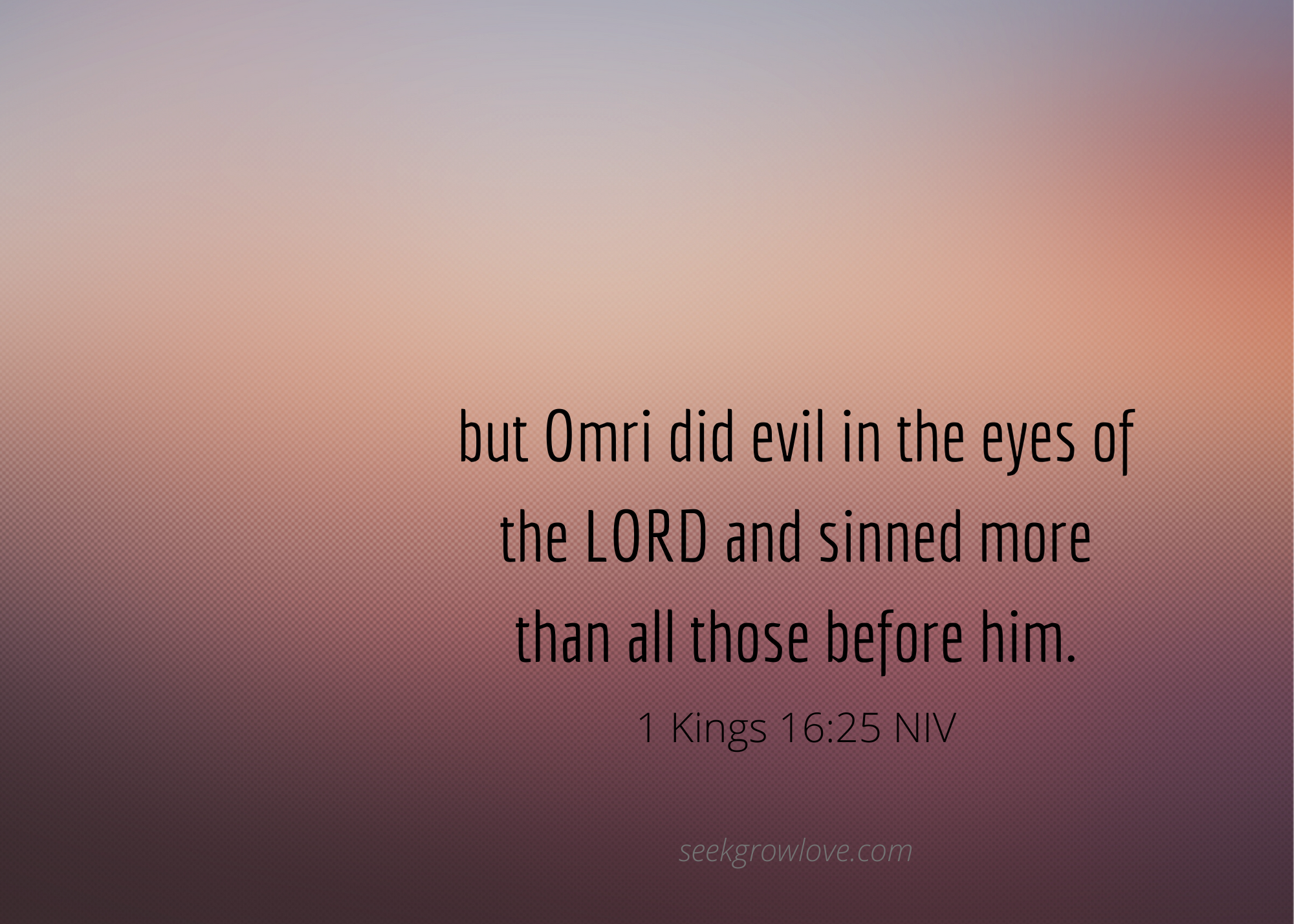
Omri – 12 years – evil – moved capital city to Samaria – “sinned more than all those before him” (I Kings 16:25)

Ahab – 22 years – evil – “did more evil in the eyes of the LORD than any of those before him.” (1 Kings 16:30)


Well, that’s where our reading will leave the nation of Israel today – so far that is 4 of the 9 dynasties – not bad for a quick history lesson.  Do you see a pattern developing for the Northern Kingdom of Israel?  Not a very pretty one I am afraid.  Spoiler alert – NONE of their 19 kings are going to be deemed good and upright by God.   You would think with all the rebellions and overthrowing of the old nasty king, someone better would come along at some point.  But, no.   Can you imagine living in a country with one after another dirty, rotten, scoundrel, violent, unfaithful leaders?  I wonder if the people thought back to Samuel’s words about the wisdom of being led by God rather than a man?  They already had God, why did they think they needed a king?  Over and over again we read, “(He) did evil in the eyes of the LORD, walking in the ways of Jeroboam and in his sin, which he had caused Israel to commit.” (1 Kings 15: 34).  Even when it is no longer Jeroboam’s family line,  the sin continues to snowball.  Unfaithfulness breeds unfaithfulness.  Tomorrow we get to read a ray of hope and inspiration as we watch  a man of faith witnessing in the midst of this evil and tumultuous world.  Never give up -even when evil is on the rise!

The rest of 1st & 2nd Kings will focus on the rest of the evil kings of Israel (from Ahab on) as well as the prophets who spoke for God and worked to turn the hearts of the people to God.

Meanwhile, 2nd Chronicles will continue their retelling of the house of David – what has become the Southern Kingdom of Judah.  Quite in contrast to their northern neighbors, Judah will remain under the leadership of ONE family – the line of King David!  And, while there will be a fair number of kings judged to be evil – we will also meet some who seek God and strive to lead their country to do what is right as well.  Here’s the start of our chart for Judah

SOUTHERN KINGDOM – JUDAH – (2 tribes) – from the split to the exile 20 kings in the line of David

Rehoboam – 17 years – evil – David’s grandson – but heart not set on seeking God

Abijah – 3 years – gave a great speech about God as the leader – but didn’t continue to live it out – evil

Asa – 41 years – called good and upright – commanded Judah to seek the LORD – but then at the end of his life put his trust (& treasuries) in men rather than turning to God in his troubles

Jehoshaphat – 25 years  – “the LORD was with Jehoshaphat because in his early years he walked in the ways his father David had followed.  He did not consult the Baals but sought the God of his father and followed his commands rather than the practices of Israel” (2 Chronicles 17:3)
We will get to know Jehoshaphat better in our coming readings, but today I am most impressed with his deep desire to seek God rather than doing whatever is politically/religiously “correct” at the time (following the neighbors).   And, he knew it wasn’t enough for him to do it alone – his desire was to see his whole country following the LORD.  I see great wisdom in his act of sending out godly teachers throughout Judah with the Book of the Law.

You may be feeling surrounded by evil and bad examples.  Don’t give up.  The world needs your light and example and godly teaching just as much as it did back in the day of Jehoshaphat.  How will you shine and spread the word of God today?

Marcia Railton


Today’s Bible passage can be read or listened to at https://www.biblegateway.com/passage/?search=1+Kings+15%3A25-16%3A34%2C+2+Chronicles+17&version=NIV

Tomorrow we get to read several events from the life of Elijah as we cover 1 Kings 17-19 in our 2020 Chronological Bible Reading Plan

His Story

1 Kings 15:1-24 & 2 Chronicles 13-16

2 Chronicles 15 15b NIV sgl

History is a curious thing.  Today’s reading covers two different kings of Judah, Abijah and Asa, from the perspective of two different writers.  It is quite interesting to see what is remembered and omitted and concluded from the lives of these two kings from the two different authors writing at different time periods for different purposes.

Let’s look at Abijah, King David’s great grandson.  It is easy to love the Abijah recorded in 2 Chronicles 13.  King Jeroboam of Israel is closing in with an army twice the size of King Abijah’s of Judah.  But Abijah responds with courage, faith in God and a rousing speech.  He speaks of Israel’s united history under David and God and then records the sins of Jeroboam (& Israel) in breaking with God, the God-ordained priests, and the house of David.  He concludes that, “As for us (Judah), the LORD is our God, and we have not forsaken him….God is with us, he is our leader.” (2 Chronicles 13:10,12). And then, even though an army twice their size is before and behind them, God gives the victory and Abijah’s army wipes out over half of Jeroboam’s fleeing and destroyed army.  It’s exciting to see how God shows His strength through Abijah.

And then we read the account of King Abijah as recorded in 1 Kings 15.  The details of his life agree completely with what is recorded in 2 Chronicles: reigned 3 years, son of Rehoboam and Maacah, there was war between him and Jeroboam, and his son Asa would rule after his death.  But, absolutely nothing is said of the moving speech or victorious battle or God as his leader.  Instead, the writer of Kings sums up Abijah’s life by saying, “He committed all the sins his father had done before him; his heart was not fully devoted to the LORD his God, as the heart of David his forefather had been.” (1 Kings 15:3).

Oh, Abijah, we had such hope for you from that one outstanding snapshot of your life.  Your sermon that day was so full of convicting truth – that you forgot?  What went wrong?  How was your heart divided that sin won out?  Didn’t you daily recall how God fought for you?  Did you think you did that on your own?  It is discouraging to see what could have been, or once was, a strong testimony for God crumble and cave to sin and a divided heart.

But, it is also encouraging to see what God can do for His purposes – even when He’s working with and through sinful, broken people.  He can use the Joshua’s, the David’s and the Abijah’s and you and me.  He has and can and will have the victory any time He wants – and He can do it using any one He wants.

It is also interesting to see what one chooses to remember when looking back on history.  How do we portray and ultimately judge the heroes and the villains?  Which statues do we decide to pull down, if any, or why not all?  Everyone is certainly a mix of wise and foolish choices.  Some of our forefathers had some really good, faithful days (like Abijah’s) and these can still be celebrated today.  Remember the Chronicles were written long after these events took place and were written to encourage the returning exiles.  They needed to remember the faithful God who worked through the house of David and the priestly line.  They were being prepared for the coming arrival of a Messiah from the house of David who would be a priest like none before.  It would be helpful for them to remember their history as they prepared for their future.  It was time to bolster their courage and faith and remind them that God is their leader.  They needed the story of Abijah’s Really Good Day and the God who supplied it.

And, it is also valuable to consider the bigger picture of someone’s life to see what to avoid in order to get us where we want to go.  Rather than using our own flawed measuring stick to judge (popularity, wealth, good speaker, etc…), whenever possible it is helpful to know what God thought of the man.  That is going to be what really counts, so that is what I want to pay attention to so I am not setting up heroes for my life that God would disapprove of.

All that and we finally get to Asa – one of the few kings recorded as, “good and right in the eyes of the Lord his God” (2 Chronicles 14:2).  And the writer of Kings agrees completely.  There are some beautiful passages you won’t want to miss about God’s provision and Asa’s seeking and working for God wholeheartedly, even when it meant going against some of his family.  Although, for all his wise and courageous decisions, he still had a rough spot towards the end of his reign when he chose to rely on man instead of God – and there was a price to pay for that error.  But it would be a mistake for us to judge and remember Asa only for that sin that sadly would affect him and many others for years to come.

History is interesting, as is our record of it, and our judgement of those who have come before.  But first and foremost lets learn to us it to grow closer and closer to living a life seeking and serving with an undivided heart the God who created all history and present and future.  What would He have you learn from His Story today in order to live better today and prepare yourself for His Future?

Keep Reading His Word and Seeking Him

Marcia Railton


Today’s Bible passage can be read or listened to at https://www.biblegateway.com/passage/?search=1+Kings+15%3A1-24%2C+2+Chronicles+13-16&version=NIV

Tomorrow’s Bible reading will be 1 Kings 15:26-16:34 & 2 Chronicles 17 as we continue on the 2020 Chronological Bible Reading Plan