In these final chapters of Joshua, we read his deathbed advice to his people. Filled with nuggets of wisdom, Joshua calls the people to remember their history and God’s faithfulness, and he encourages them to continue following God. Joshua reminds the people that there is only One True God, YHWH, and that the household idols and the gods of the people around them are not truly going to save them. Yet still Joshua asks them to make a conscious decision, to declare their devotion one way or the other: “Choose this day whom you will serve… but as for me and my house, we will serve the LORD!” What a powerful charge to the people! If anyone had been unclear about Joshua’s position, there was no doubt after this profound declaration. Of course, the people agree that they will follow God, and of course, it wouldn’t be long before they would turn away yet again.
Joshua, famous among his people as a devoted follower of the One True God, knew humanity’s tendency to have idolatrous hearts. As he closed out his life, he wanted to remind the people to focus on what – WHO – is truly the most important. If you’re anything like me, you probably scoff at the ways in which the Israelites kept turning from God in spite of all His miraculous provisions, but in reality, all of humanity worships something; the idols are just different for each of us. We have an innate desire to worship, and that should be directed toward our Creator. However, our flesh can often lead us to worship the things of this world – money, entertainment, sex, identity, work, comfort, power, nature, and self – more than we worship our God. We must be alert to the things of this world that are vying for our devotion, keeping our eyes attuned and faithful to our God above all else.
Don’t let Joshua’s words be just an empty platitude on your dining room wall, but really take it to heart. Whom will you serve? Will you follow the empty gods of this age, or will you wake up every day willing to follow the One True God?
-Rachel Cain
Reflections:
What does it mean to really serve the Lord? What idols do you need to cast aside to really seek and serve Him?
Research the ways in which Joshua is a foreshadowing of Jesus. There are many interesting parallels!
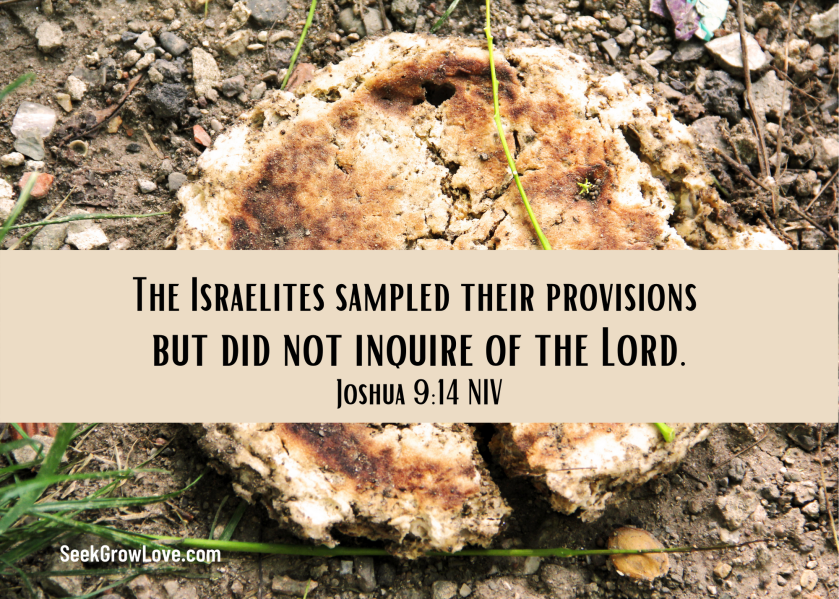
When the inhabitants of Gibeon heard what Joshua had done to Jericho and Ai, they acted deceptively. They gathered provisions and took worn-out sacks on their donkeys and old wineskins, cracked and mended. They wore old, patched sandals on their feet and threadbare clothing on their bodies. Their entire provision of bread was dry and crumbly. They went to Joshua in the camp at Gilgal and said to him and the men of Israel, “We have come from a distant land. Please make a treaty with us… Then the men of Israel took some of their provisions, but did not seek the LORD’s decision. 15 So Joshua established peace with them and made a treaty to let them live, and the leaders of the community swore an oath to them. Joshua 9:3-6;14-15 (CSB)
“Be skeptical of everyone, including the skeptics”. I don’t know where this quote or phrase came from, but I often find myself in that mindset. Why? Because of stories like this. There are those out there who would try to deceive and use this deception to take advantage of others. I used to get calls and emails all the time at the church from people who were looking for money to help with something. There was always a story about why they were in this tough situation. The second half of that quote also resonates because sometimes people just like the status quo or throw cold water on other people’s ideas.
Maybe some of those people were deceptive, and maybe some of them were genuine. I don’t know. What I do know is that there were occasions where I would try to give something, but there were times that I did not. I did my best to discern who was authentic, but I couldn’t really know. What I could do was pray about it and see if God gave me a push in one direction or another, but if he didn’t, I’d need to make a choice. In situations of meeting needs or requests, you can’t help everyone, we have finite resources. I do think it is important not to be dismissive of every request because there are people who genuinely have needs and come to churches as a last resort.
When the Gibeonites came to Joshua and the men of Israel, they did their best to pull one over them, and it worked. The leadership did appear to be skeptical and questioned the Gibeonites, but they neglected to check with something powerful that they had at their disposal: access to Almighty God! Rather than checking on what God wanted them to do, to seek wisdom in this situation that some of them even thought might be a little fishy, they made a knee-jerk decision and swore a treaty to do no harm.
Don’t you think that it would have been wise to consult God when there were treacherous peoples all about the land? The Gibeonites got their protection, but they found themselves indentured to the Israelites because of their shenanigans. I guess that beats death? Some might disagree.
When faced with big decisions, we should come before God and seek wisdom. Especially when we are the leaders of his institutions. Whether leading the Israelites four millennia ago or leading in Christ’s Church today, when we face big decisions (skeptical about what is going on or not), we must always ask what God would have us do. We have scripture to guide us, as well as the Spirit of God that will guide us when we are earnestly seeking after him. When we see leaders fall or make ruinous decisions, we can probably rest assured knowing that they did not honestly seek God’s will and input for that decision. Unless God is intent on making a statement with you like he did with Hosea, he is not going to tell you to make decisions that would be considered dubious by wise observers.
-JJ Fletcher
Reflection Questions
Can you think of a time that not seeking God’s decision burned you? How did you respond or recover after?
Do you find yourself to have a healthy level of skepticism, or do you often find yourself being a bit too Pollyannish? Is there value in both? What are some of the drawbacks of each of these traits?
Do you think Joshua and the leaders learned something from this experience?
How do you think it best to navigate people who are too extreme on the scale of being too trusting or distrusting? What can we do to be a good emissary of Jesus in those situations?
Then Moses called Joshua, and said to him in the sight of all Israel, “Be strong and courageous; for you will go with this people into the land that Yahweh has sworn to their fathers to give to them, and you will cause them to inherit it. Yahweh, it is he who goes before you; he will be with you, he will not leave you or forsake you. Do not be afraid, and do not be dismayed.”Deuteronomy 31:7-8 (REV)
In Deuteronomy 31, Moses begins to reflect on the fact that his life is about to come to an end and he will not be leading the Israelites into the promised land. We see Joshua enshrined as Moses’s successor, as God directed Moses (Numbers 27).
Succession plans are important as leadership changes are critical junctures for organizations. When a known change is coming, it is easier to start laying the groundwork for succession, but that can be short-sighted. There is wisdom in succession plans that consider the unknown. No one knows how many days they have left to live in this age. Illness can come on suddenly, and tragic accidents happen frequently. By the grace of God, you reader, will live many more years to serve God faithfully, but what if the unthinkable happens? Have you ordered your house? Have you, in your role as pastor, leader, director, or church volunteer, poured into those around you and prepared individuals to do the necessary ministry of the church if, for some reason, you must vacate your position, voluntary or otherwise?
In my first year at Atlanta Bible College, I took the course Principles of Ministry and Leadership (I think that was the correct class name) with Professor Jon Cheatwood. One of the books that we used was the 21 Irrefutable Laws of Leadership by John Maxwell. While I have not touched that book in nearly twenty years, I remember clearly one of the concepts in the book: Leaders should be training their replacements, figuratively working themselves out of the job. You should ensure that those under you or around you can take over the tasks and responsibilities you are responsible for. This is not to create job insecurity but to ensure stability for an organization or ministry if unexpected departures happen.
Just as Moses was chosen by God to lead his people out of Egypt, Joshua was chosen to lead them into the promised land. Moses publicly enshrines Joshua as leader, making clear the succession plan and avoiding a power vacuum with multiple individuals striving for the top spot or fearful individuals that pick up camp and head back to Egypt.
Several years ago, there was a TV show called Succession that was loosely based on real events from a power struggle within a powerful business. I am not recommending the show, but it showcases the chaos that surrounds an organization that does not have clear protocols and succession plans in place.
About 10 years ago, my church was thrust into unexpected changes in pastoral leadership. While not without bumps in the road, the leadership of the church was equipped enough to manage a very difficult period. Clearer succession plans certainly could have made some things easier and maybe would have created some different dynamics in leadership structures than what was implemented during the transition. While you may not be able to perfectly clone yourself as a leader (and you probably shouldn’t), you can pour into the next wave or generation of leaders and begin preparing them for the joys and difficulties of ministry and leadership. Whether you are a senior pastor, a volunteer coordinator, or somewhere else on the spectrum of ministry roles, we should always be working to ensure that the ministry of the Gospel is primed to continue in our organizations, with or without us.
-JJ Fletcher
Reflection Questions
Have you ever experienced a sudden change in leadership? Either as a member of leadership or someone that looked to leadership, what were some of the takeaways that you had from that experience? What could have been better in that situation?
How important do you think it was that Moses made a public showing of the transition of leadership from himself to Joshua?
What are some of the pitfalls of tight-fisted leadership that does not allow for the incremental growth and training of future leaders?
Does God choose leaders now like he did in the times of Moses and Joshua? What does leadership selection look like now?
Leviticus is usually the most difficult book for people to read through, specifically because so many of the rituals from the ancient time of the Israelites don’t apply anymore. Many Christians when they come to this book in their Bible reading plans enter “skimming mode”, and brush over most of the content. However, we may be surprised at just how important this book really is when it comes to experiencing the presence of God. In order to understand how significant Leviticus really is, we need to look at the end of Exodus to grasp the story.
“Then the cloud covered the tent of meeting, and the glory of the LORD filled the tabernacle. Moses was not able to enter the tent of meeting because the cloud had settled on it, and the glory of the LORD filled the tabernacle.” – Exodus 40:34-35 NASB1995
The story up to this point has been God desiring to be with His people, but when His glory finally does come to earth in the tabernacle, even Moses isn’t able to experience it fully… Leviticus is the answer to the problem. Through the rituals and the laws that Leviticus spells out for the Israelites, they are able to fully experience God’s presence. What is really cool about this book is that it worked: when we come to the following book of Numbers, Moses is finally able to enter into the tabernacle and see God’s glory.
“Then the LORD spoke to Moses in the wilderness of Sinai, in the tent of meeting, on the first of the second month…” – Numbers 1:1 NASB1995
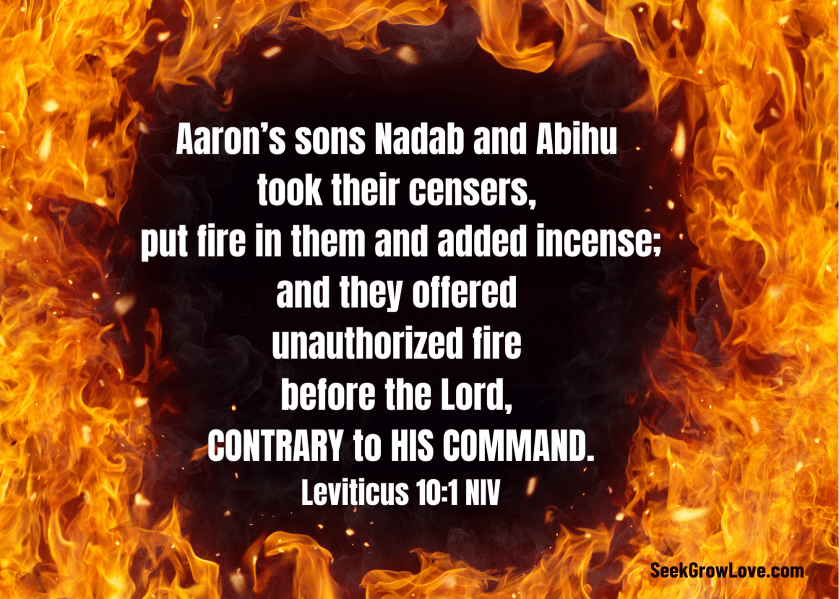
Moving forward, I hope that you will have a renewed appreciation for this often misunderstood and skipped-over book, especially as we discuss our chapters today. Through the first seven chapters, God has been telling Moses and his brother Aaron about all the very specific details they need to follow in order to bring forgiveness of sins into the Israelites’ lives. When we come to chapter eight today, they begin to put these instructions into practice: however, not everyone follows the clear instructions from God and suffers for it. Aaron’s sons, Nadab and Abihu, didn’t follow the proper procedure for worshiping before God, choosing to offer “strange fire” (10:1) onto the altar. Because they didn’t follow God’s instructions, they were struck dead and stand as an example for everyone that will worship afterwards.
We learn that God takes worship SERIOUSLY: to “worship” Him in an unworthy manner will not be tolerated. He told Moses and Aaron, “By those who come near Me I will be treated as holy, and before all the people I will be honored.” (10:3) He is a good God and Father who tells us exactly what we need to do, but will punish those who choose to “try it their own way”, especially those in positions of religious authority. No matter what, when we come to worship before our God and before our Savior, Jesus, we need to treat it as a serious matter, and seek to bring them total glory. True worship goes far beyond what type of music is played (hymns or contemporary), what order of service our church has “always used”, and beyond how we “feel” after the service: true worship is about God and Jesus being honored and exalted. If you don’t have that as your primary focus, nothing else matters.
-Talon Paul
Reflection Questions
Give some examples of how the world “tries it their own way” instead of following God’s instructions. When have you “tried it your own way” instead of following God’s instructions?
We aren’t told what Nadab and Abihu might have been thinking as they were experimenting with their ‘strange fire’. Whar are some possibilities?
Instant death is not always the consequence for acting contrary to God’s commands. What are some other consequences you have seen or experienced for acting contrary to God’s instructions?
Why do you think God places such great importance on worship, and worship done right? How do we come into His presence today?
Our reading in Job is coming to a conclusion with these chapters. Yesterday we heard God show Himself in the power and breath of creation. In chapters 40-41 we see that now God Himself is answering Job about His power and majesty and challenges him to answer. Job is completely overawed by God and finally sees the folly of his positions and arguments. He reacts as the lesson teaches us that God is everything, all power, all majesty, all strength and all knowledge. We in all our human strength and knowledge are nothing compared to God, and this is Job’s confession that turns the whole narrative.
Job 40:1-5(NLT) Then the LORD said to Job, 2 “Do you still want to argue with the Almighty? You are God’s critic, but do you have the answers?” Job Responds to the LORD 3Then Job replied to the LORD, 4 “I am nothing—how could I ever find the answers? I will cover my mouth with my hand. 5 I have said too much already. I have nothing more to say.”
Proverbs 1:7(NKJV) The fear of the LORD is the beginning of knowledge
Fear here is not that of a frightened mind, but an overwhelmed, overawed understanding of the power of God and the feeble strength of man.
Our ministry today is to explain to a fallen world what the message of God is, showing others the way to the truth. Our message is now in the cross of Christ and what God has done for us in Jesus’ life and death. Our responsibility is to show an Invisible God to a hurting world.
1 Corinthians 1:18-25(NLT) The message of the cross is foolish to those who are headed for destruction! But we who are being saved know it is the very power of God. 19 As the Scriptures say, “I will destroy the wisdom of the wise and discard the intelligence of the intelligent.” 20 So where does this leave the philosophers, the scholars, and the world’s brilliant debaters? God has made the wisdom of this world look foolish. 21 Since God in his wisdom saw to it that the world would never know him through human wisdom, he has used our foolish preaching to save those who believe. 22 It is foolish to the Jews, who ask for signs from heaven. And it is foolish to the Greeks, who seek human wisdom. 23 So when we preach that Christ was crucified, the Jews are offended and the Gentiles say it’s all nonsense. 24 But to those called by God to salvation, both Jews and Gentiles, Christ is the power of God and the wisdom of God. 25 This foolish plan of God is wiser than the wisest of human plans, and God’s weakness is stronger than the greatest of human strength.
Job 40:6-11(NLT) The LORD Challenges Job Again 6 Then the LORD answered Job from the whirlwind: 7 “Brace yourself like a man, because I have some questions for you, and you must answer them. 8 “Will you discredit my justice and condemn me just to prove you are right? 9 Are you as strong as God? Can you thunder with a voice like his? 10 All right, put on your glory and splendor, your honor and majesty. 11 Give vent to your anger. Let it overflow against the proud.
Job 42:1-6(NLT) Then Job replied to the LORD: 2 “I know that you can do anything, and no one can stop you. 3 You asked, ‘Who is this that questions my wisdom with such ignorance?’ It is I—and I was talking about things I knew nothing about, things far too wonderful for me. 4 You said, ‘Listen and I will speak! I have some questions for you, and you must answer them.’ 5I had only heard about you before, but now I have seen you with my own eyes. 6 I take back everything I said, and I sit in dust and ashes to show my repentance.”
Then we come to the end of the book. In only a few short verses with little explanation or elaboration we see Job pray for friends and then he is restored to life, health and position. Even double the wealth that he had before. What brings this amazing turnabout?
Job 42:8-10(NLT) My servant Job will pray for you, and I will accept his prayer on your behalf. I will not treat you as you deserve, for you have not spoken accurately about me, as my servant Job has.” 9 So Eliphaz the Temanite, Bildad the Shuhite, and Zophar the Naamathite did as the LORD commanded them, and the LORD accepted Job’s prayer. 10 When Job prayed for his friends, the LORD restored his fortunes. In fact, the LORD gave him twice as much as before!
The ”miserable comforters” do a sacrifice where they lay their hands on the heads of the bulls, transferring their sin to the animals. Then Job changes from self-justification and promotion to making humble prayer for the friends. When we are right with God then He is able to bless us because of His decision to do it, not because of our merit, works or traditions.
What is the conclusion of the matter?
With God I am everything, Without God I am nothing!
James 5:10-11(NLT) For examples of patience in suffering, dear brothers and sisters, look at the prophets who spoke in the name of the Lord. 11 We give great honor to those who endure under suffering. For instance, you know about Job, a man of great endurance. You can see how the Lord was kind to him at the end, for the Lord is full of tenderness and mercy.
-Tom Siderius
Questions for Reflection:
Did you have fun reading the book of Job and the lesson in it?
Has the reading changed your thinking about the “Oldest Lesson in the World”?
Has your heart changed about who God is and who we are?
Acts 17:24-27(NLT) He is the God who made the world and everything in it. Since he is Lord of heaven and earth, he doesn’t live in man-made temples, 25 and human hands can’t serve his needs—for he has no needs. He himself gives life and breath to everything, and he satisfies every need. 26 From one man he created all the nations throughout the whole earth. He decided beforehand when they should rise and fall, and he determined their boundaries. 27 “His purpose was for the nations to seek after God and perhaps feel their way toward him and find him—though he is not far from any one of us.
God answers Job
In our chapter reading today we come to the point where it shows us that God Himself challenges Job and his friends. How this happens, in audible words, or an angelic herald, we don’t know because it doesn’t say. Remember that this is an epic poem which is told as verbal story to people at that time. It is to give us understanding of who God is and how He deals with us in our lives. God starts by challenging Job with the majesty of the physical creation and how Job not only has nothing to do with it but does not begin to understand it.
God is Greater than Man
God starts first with the geological and astronomical pages of creation.
Job 38:1-7(NLT) The LORD Challenges Job 1 Then the LORD answered Job from the whirlwind: 2 “Who is this that questions my wisdom with such ignorant words? 3 Brace yourself like a man, because I have some questions for you, and you must answer them. 4 “Where were you when I laid the foundations of the earth? Tell me, if you know so much. 5 Who determined its dimensions and stretched out the surveying line? 6 What supports its foundations, and who laid its cornerstone 7 as the morning stars sang together and all the angels shouted for joy?
Job 38:19-21(NLT) “Where does light come from, and where does darkness go? 20 Can you take each to its home? Do you know how to get there? 21 But of course you know all this! For you were born before it was all created, and you are so very experienced!
Now in chapter 39 God shows the majesty of the work of His creation in the zoological and botanical realms.
Job 39:1-4(NLT) “Do you know when the wild goats give birth? Have you watched as deer are born in the wild? 2 Do you know how many months they carry their young? Are you aware of the time of their delivery? 3 They crouch down to give birth to their young and deliver their offspring. 4 Their young grow up in the open fields, then leave home and never return.
Job 39:19-21(NLT) “Have you given the horse its strength or clothed its neck with a flowing mane? 20 Did you give it the ability to leap like a locust? Its majestic snorting is terrifying! 21 It paws the earth and rejoices in its strength when it charges out to battle.
The object of most religious teaching today is to bring mankind to a better moral and ethical point in their lives. This is not God’s teaching. God’s teaching is that we need to come to Him and believe, and that the way to believe Him is through the lord Jesus Christ. When we confess Jesus as lord we are saying in our hearts that I am no longer the god of my life, I am no longer the one who decides good and evil, that I am subject to a different ruler than my own heart. We must confess the sinful nature of our hearts to get to this point. Not to just confess the individual sins we may have committed.
True Christianity is our relationship with Jesus our lord and God our Father, not in trying to fix the sins of our lives. This is truly the greatest lesson from the book of Job that we can learn. Stop looking at the morality of this world and events here and look to our Father who is He that has set it all in motion. Our strength is in Christ not in our own arm and power.
Our true ministry is to convey to others the God of grace that we have experienced and walked with. This is to be like Christ in what we do and speak.
I pray as we come to the end of this study of Job that it opens our hearts to hear God as we will see Job hear God.
-Tom Siderius
Questions for Reflection:
Do you truly believe that God has created the heavens and the earth and all that is here?
Have you grown in your understanding of the confession of Jesus as lord?
Do you better see the difference between religion and Christianity?
In this section today Elihu stops chastising Job and his friends and begins the transition to the next section by speaking for God. He begins to put a God-view perspective on all that has happened to Job and all that has been said. He is still wresting with the question which is “how does man relate to a Just and Righteous God”. Elihu absolutely schools us in the mind set we should have about the God that has created the heavens and the earth and all that is therein. Read with me and we will learn of God’s great position, works, and power.
Job 35:4-8(NLT) “I will answer you and all your friends, too. 5 Look up into the sky, and see the clouds high above you. 6 If you sin, how does that affect God? Even if you sin again and again, what effect will it have on him? 7 If you are good, is this some great gift to him? What could you possibly give him? 8 No, your sins affect only people like yourself, and your good deeds also affect only humans.
Shows us what our works really are in our relationship with God compared to our trust in His Word.
Job 36:1-6(NLT) Elihu continued speaking: 2 “Let me go on, and I will show you the truth. For I have not finished defending God! 3 I will present profound arguments for the righteousness of my Creator. 4 I am telling you nothing but the truth, for I am a man of great knowledge. 5 “God is mighty, but he does not despise anyone! He is mighty in both power and understanding. 6 He does not let the wicked live but gives justice to the afflicted.
God wishes for all to be saved and come to a knowledge of the truth of His Word.
Job 36:22-24(NLT) “Look, God is all-powerful. Who is a teacher like him? 23 No one can tell him what to do, or say to him, ‘You have done wrong.’ 24 Instead, glorify his mighty works, singing songs of praise.
So we can only praise the name of the LORD our God.
Job 37:19-24(NLT) “So teach the rest of us what to say to God. We are too ignorant to make our own arguments. 20 Should God be notified that I want to speak? Can people even speak when they are confused? 21 We cannot look at the sun, for it shines brightly in the sky when the wind clears away the clouds. 22 So also, golden splendor comes from the mountain of God. He is clothed in dazzling splendor. 23 We cannot imagine the power of the Almighty; but even though he is just and righteous, he does not destroy us. 24 No wonder people everywhere fear him. All who are wise show him reverence.”
-Tom Siderius
Questions for Reflection:
Has this section changed your thinking about how to approach our God?
Will this change how you tell others about how to approach God?
Does evil in the world stop God from being truly just and righteous? Why?
Now in these next 6 chapters we have a new character that changes the whole narrative. His name is Elihu, and he has not been mentioned so far in the book. He is by his own admission a younger man than the others and so has waited to speak. The presence of his speeches in the center of narrative gives us a true focus of the book of Job. It then transitions the book from the negative message of the first 31 chapters to positive of the last 7 chapters.
Elihu is a wise beyond his years speaker and proceeds to speak I believe as inspired words from God. He brings a true God perspective first to the arguments of Job, then to the replies of the comforters. Finally he speaks from God the perspective that we should have. This prepares us to hear from God Himself in the next section.
Job 32:1-10(NLT) Elihu Responds to Job’s Friends
Job’s three friends refused to reply further to him because he kept insisting on his innocence. 2 Then Elihu son of Barakel the Buzite, of the clan of Ram, became angry. He was angry because Job refused to admit that he had sinned and that God was right in punishing him. 3 He was also angry with Job’s three friends, for they made God appear to be wrong by their inability to answer Job’s arguments. 4 Elihu had waited for the others to speak to Job because they were older than he. 5 But when he saw that they had no further reply, he spoke out angrily. 6 Elihu son of Barakel the Buzite said, “I am young and you are old, so I held back from telling you what I think. 7 I thought, ‘Those who are older should speak, for wisdom comes with age.’ 8 But there is a spirit within people, the breath of the Almighty within them, that makes them intelligent. 9 Sometimes the elders are not wise. Sometimes the aged do not understand justice. 10 So listen to me, and let me tell you what I think.
Job 32:17-20(NLT) No, I will say my piece. I will speak my mind. 18 For I am full of pent-up words, and the spirit within me urges me on. 19 I am like a cask of wine without a vent, like a new wineskin ready to burst! 20 I must speak to find relief, so let me give my answers.
See how I think he is speaking by the prophetic spirit of God within Elihu?
Job 33:8-13(NLT) “You have spoken in my hearing, and I have heard your very words. 9 You said, ‘I am pure; I am without sin; I am innocent; I have no guilt. 10 God is picking a quarrel with me, and he considers me his enemy. 11 He puts my feet in the stocks and watches my every move.’ 12 “But you are wrong, and I will show you why. For God is greater than any human being. 13 So why are you bringing a charge against him? Why say he does not respond to people’s complaints
Elihu in one sentence destroys all of Job’s arguments “God is greater than any human being”.
Job 34:7-15(NLT) “Tell me, has there ever been a man like Job, with his thirst for irreverent talk? 8 He chooses evil people as companions. He spends his time with wicked men. 9 He has even said, ‘Why waste time trying to please God?’ 10 “Listen to me, you who have understanding. Everyone knows that God doesn’t sin! The Almighty can do no wrong. 11 He repays people according to their deeds. He treats people as they deserve. 12 Truly, God will not do wrong. The Almighty will not twist justice. 13 Did someone else put the world in his care? Who set the whole world in place? 14 If God were to take back his spirit and withdraw his breath, 15 all life would cease, and humanity would turn again to dust.
For all Job’s accusations of God Elihu says that God is righteous and can do no wrong. Job cannot accuse God of being unjust.
-Tom Siderius
Questions for Reflection:
Who is this masked man named Elihu?
Does he build a bigger picture for you of who our God is?
The section we are reading today is the last of the back and forth with the three miserable comforters. The whole first part of Job until the end of Chap 31 is a negative lesson to us. Job continues to justify himself as “blameless and upright”. The comforters continue to reason with him from human logic about God, which is that we receive what we deserve. The book is coming to a central point which will be the focus of this oldest lesson. Read with us today and don’t give up on this great story about man and God. It may take reading this several times in order to see the message in the speeches. Remember that this story probably predates the written Word that we take so for granted. It was told as an epic poem and speech where the speaker told the story to the hearers to give them understanding of the God that they could not see.
The other rich pictures in this book are the geographical, astronomical, zoological, metallurgical, gemology, oceanography and other knowledge that we hear that we seldom give the people of that time credit for understanding. Our modern scientists and methods are not as advanced as we think ourselves.
Job 26:1-4(NLT) Job’s Ninth Speech: A Response to Bildad 1 Then Job spoke again: 2 “How you have helped the powerless! How you have saved the weak! 3 How you have enlightened my stupidity! What wise advice you have offered! 4 Where have you gotten all these wise sayings? Whose spirit speaks through you?
Job 27:1-6 Job’s Final Speech 1 Job continued speaking: 2 “I vow by the living God, who has taken away my rights, by the Almighty who has embittered my soul— 3 As long as I live, while I have breath from God, 4 my lips will speak no evil, and my tongue will speak no lies. 5 I will never concede that you are right; I will defend my integrity until I die. 6 I will maintain my innocence without wavering. My conscience is clear for as long as I live.
Job 28:1-12 Job Speaks of Wisdom and Understanding 1 “People know where to mine silver and how to refine gold. 2 They know where to dig iron from the earth and how to smelt copper from rock. 3 They know how to shine light in the darkness and explore the farthest regions of the earth as they search in the dark for ore. 4 They sink a mine shaft into the earth far from where anyone lives. They descend on ropes, swinging back and forth. 5 Food is grown on the earth above, but down below, the earth is melted as by fire. 6 Here the rocks contain precious lapis lazuli, and the dust contains gold. 7 These are treasures no bird of prey can see, no falcon’s eye observe. 8 No wild animal has walked upon these treasures; no lion has ever set his paw there. 9 People know how to tear apart flinty rocks and overturn the roots of mountains. 10 They cut tunnels in the rocks and uncover precious stones. 11 They dam up the trickling streams and bring to light the hidden treasures. 12 “But do people know where to find wisdom? Where can they find understanding?
Job 28:27-28 Then he saw wisdom and evaluated it. He set it in place and examined it thoroughly. 28 And this is what he says to all humanity: ‘The fear of the Lord is true wisdom; to forsake evil is real understanding.’”
Job 30:20-23 0 “I cry to you, O God, but you don’t answer. I stand before you, but you don’t even look. 21 You have become cruel toward me. You use your power to persecute me. 22 You throw me into the whirlwind and destroy me in the storm. 23 And I know you are sending me to my death— the destination of all who live.
Job 31:33-35 33 “Have I tried to hide my sins like other people do, concealing my guilt in my heart? 34 Have I feared the crowd or the contempt of the masses, so that I kept quiet and stayed indoors? 35 “If only someone would listen to me! Look, I will sign my name to my defense. Let the Almighty answer me. Let my accuser write out the charges against me.
-Tom Siderius
Questions to Consider:
Are you starting to see the focus of this book on the relationship of man and God?
Do you see how it grapples with the question of why bad things happen to good people?
The book of Job is poetry not narrative and in the English it does not necessarily read as well as it could. Try reading this epic poem in a version of the Bible like the New Living Translation which I am quoting here, as it gives the speeches and poetry more flow.
We don’t know who wrote the book but it is probably not Job himself. Maybe Elihu? Or Moses? What about Solomon? We don’t know if the record is exactly what the people involved said or is it the gist of their arguments? Holy men of God wrote what God showed them to write and the scene in heaven at the beginning argues for someone who is very conversant with God and the Hebrew scriptures. Remember that the timeframe of this book predates the Law of Moses and the OT writings, but is very complimentary with them.
In today’s chapters Job continues to proclaim his innocence, and the comforters continue to reason with him from their human logic and understanding of God. Job does not disagree with their logic, but protests that he does not deserve God’s punishment because he has not sinned.
Job 21:1-6(NLT) Job’s Seventh Speech: A Response to Zophar 1 Then Job spoke again: 2 “Listen closely to what I am saying. That’s one consolation you can give me. 3 Bear with me, and let me speak. After I have spoken, you may resume mocking me. 4 “My complaint is with God, not with people. I have good reason to be so impatient. 5 Look at me and be stunned. Put your hand over your mouth in shock. 6 When I think about what I am saying, I shudder. My body trembles.
Job 21:34 34 “How can your empty clichés comfort me? All your explanations are lies!”
Job 22:1-5(NLT) Eliphaz’s Third Response to Job 1 Then Eliphaz the Temanite replied: 2 “Can a person do anything to help God? Can even a wise person be helpful to him? 3 Is it any advantage to the Almighty if you are righteous? Would it be any gain to him if you were perfect? 4 Is it because you’re so pious that he accuses you and brings judgment against you? 5 No, it’s because of your wickedness! There’s no limit to your sins.
Human logic demands that there is cause and effect in this life, even in our relationship with God. We continue to try to justify our own selves by pointing out to God all the good and minimizing all the evil of our hearts. Human nature causes us to want to earn our salvation and position because this is how we do it in the world. Our positions and wealth, family, friends, and possessions are a result of our hard work and shrewd dealing. Even if we are Christian we usually see it that God is the giver of all that is good, but I must deserve it because I have served Him so well.
Job 22:26-30(NLT) “Then you will take delight in the Almighty and look up to God. 27 You will pray to him, and he will hear you, and you will fulfill your vows to him. 28 You will succeed in whatever you choose to do, and light will shine on the road ahead of you. 29 If people are in trouble and you say, ‘Help them,’ God will save them. 30 Even sinners will be rescued; they will be rescued because your hands are pure.”
Job 23:1-5(NLT) Job’s Eighth Speech: A Response to Eliphaz 1 Then Job spoke again: 2 “My complaint today is still a bitter one, and I try hard not to groan aloud. 3 If only I knew where to find God, I would go to his court. 4 I would lay out my case and present my arguments. 5 Then I would listen to his reply and understand what he says to me.
Job 23:10-13 (NLT) “But he knows where I am going. And when he tests me, I will come out as pure as gold. 11 For I have stayed on God’s paths; I have followed his ways and not turned aside. 12 I have not departed from his commands, but have treasured his words more than daily food. 13 But once he has made his decision, who can change his mind? Whatever he wants to do, he does.
-Tom Siderius
Questions for Reflection:
What are the true motivations of your heart for the things that you do?
Are we trying to earn our way to the grace that God gives freely?