Fine-Sounding Arguments

Colossians 2

Thursday, August 25, 2022

Have you noticed that some of the greatest wisdom on this planet is defining a word by again, using that same word?  Here are some examples: Fair is fair. Business is business. The rules are the rules. A deal is a deal. Love is love.  While each of these sayings have a context and a more nuanced understanding, it tends to oversimplify complex issues that need some mulling over.  We accept these phrases because it makes our logic simpler and dismisses further discussion.  Fine-sounding arguments such as these may not be all they are cracked up to be.

Even worse, an apologist, for any belief under the sun, can use the words of God in the wrong context or without a key understanding and can distort it immensely.   In Matthew 4, Jesus actively combats the words of God taken out of their context.  The world is rapidly filling with empty arguments that lead to the rebranding and normalization of sin.  Like Jesus, it is our responsibility to call it out for what it is. And surely, God did say we will die, in a second death if we buy in, sell out, give up ourselves to these false teachings. Truth is truth.  Here are three ways for your eyes and ears to discern between the eternal wisdom of God or the shallow echoes of hollow human reason.

My goal is that they may be encouraged in heart and united in love, so that they may have the full riches of complete understanding, in order that they may know the mystery of God, namely, Christ, in whom are hidden all the treasures of wisdom and knowledge. I tell you this so that no one may deceive you by fine-sounding arguments. For though I am absent from you in body, I am present with you in spirit and delight to see how disciplined you are and how firm your faith in Christ is. – Colossians 2:2-5

Did God really say it?  While I believe that God has inspired wisdom since the Bible was composed, including some of what I hope is wisdom in this blog, you can’t go wrong believing only what is already written from Genesis to Revelation.  Well, God didn’t say anything about social media, phones, or college?  Truth.  But what he did say was how to treat your neighbor, how to spend your time, and how you should work.  These truths found in scripture are living and active.  If we truly feel we are faced with some ethical dilemma that is completely unique to us in our present state, we should pray for wisdom because God gives wisdom generously to all without finding fault.

Who, exactly, does it benefit? Jesus makes an important distinction between behaviors that are motivated by God and those that are motivated by self. Prayer, tithing, and fasting are all wonderful disciplines for every Christian to take up. However, when we do it in public or take God’s glory by making it about ourselves, we are not feeding our relationship with God; we are feeding our ego.  Jesus makes the case that motives and intentions are every bit as important as the action we take. Truth may be on the side. I can eat or drink whatever I wish, but it may cause a stumbling block for another. If I knowingly offer advice that gives me permission to act for my benefit alone, then my words are not heavenly Father’s.

Does it advance the Kingdom of God? When our Savior heals on the Sabbath, he speaks clearly to this measure. Isn’t it right to work for the Lord on the Lord’s day?  To act more like Him?  To worship him in not only words but action?  Choosing to live for God is vastly different than choosing what goes on your plate.  There are some clear lines drawn in the sand. The gate is narrow, and only those who intend to deceive you will widen it.  There are simply behaviors and relationships that God doesn’t give his permission or his blessing.  It doesn’t advance the Kingdom of God to make allowances for habitual, unrepented behavior.  A short-term gain of a warm-body in a seat on Sundays is an eternal loss when sin isn’t confronted.  We accept the whole of God’s moral will or we are rejecting the lot.  This wisdom can burn like a good rubbing alcohol, but it also allows us to heal and be cleansed.

My hope and prayer for the church of today is that we can rid ourselves of these fine-sounding arguments, and make the case for sound, Godly discernment. Wisdom and life stem from Him alone.

“So then, just as you received Christ Jesus as Lord, continue to live your lives in him, 7 rooted and built up in him, strengthened in the faith as you were taught, and overflowing with thankfulness.” Colossians 2:2-7

-Aaron Winner

Questions for Reflection and Discussion

  1. Reading Colossians 2 what are some of the dangers Paul is warning the church to avoid? What does he want the church to stay focused on?
  2. Where do you see God’s word and wisdom being distorted by fine-sounding arguments. Pray for wisdom and discernment to see clearly.
  3. What is the end result for those who are led astray and deceived?

The Creator’s Firstborn

Colossians 1

Wednesday, August 24, 2022

Before Adam, before the fall, there stood Christ. While his life wouldn’t begin for another 4000 years, God had already set salvation in motion.  It is why the stars and the sand could speak to Abraham. It is how Isaiah could see visions of one crying out, “prepare the way”.  It was the fabric that held two genealogies together to come crashing into miraculous birth in Bethlehem. It is the very dead Jesus being raised by His Father to be the firstfruits of the resurrection and giving him preeminence as a King in the life to come.  

The Son is the image of the invisible God, the firstborn over all creation. For in him all things were created: things in heaven and on earth, visible and invisible, whether thrones or powers or rulers or authorities; all things have been created through him and for him. He is before all things, and in him all things hold together.  – Colossians 1:15-17

Jesus Christ wasn’t Plan B because of a fall of man in the Garden of Eden. He wasn’t a contingency plan to be used in emergencies only.  He is the culmination of God’s love for man and the inevitability of the selfish nature of freewill.  In him, through him, and for him, ALL things were created. Things of heaven. Things of earth. Things we can see. Things we can’t.  And it all makes sense because of his life.  God, the Father of Jesus, is the author of providence and will.  Jesus Christ has been given the place as the executor, the head, the mediator, our way back to God after wandering in the desert, ritualistic religion, or feeling foreign in our own body.

Once you were alienated from God and were enemies in your minds because of your evil behavior.  But now he has reconciled you by Christ’s physical body through death to present you holy in his sight, without blemish and free from accusation— if you continue in your faith, established and firm, and do not move from the hope held out in the gospel. – Colossians 1:21-23a

The fullness of the word of God is revealed.  It isn’t a mystery. It is available to anyone, anytime. No matter the amount of struggle or hate we fortify and reinforce in our minds, our hearts are attuned to Jesus because he is stitched and woven into every creation, including each one of us.  Oh, how God was mindful of us. He knew. His creation surrounds us and testifies of His glory, which in turn, is distilled in Jesus Christ. My prayer is we all recognize that the glory of God can exist in each one of us when we live as Jesus lived, placing the Firstborn of Creation into our hearts, and embracing the very context for existence.

Lord, our Lord, how majestic is your name in all the earth! You have set your glory in the heavens. Through the praise of children and infants you have established a stronghold against your enemies, to silence the foe and the avenger. When I consider your heavens, the work of your fingers, the moon and the stars, which you have set in place, what is mankind that you are mindful of them, human beings that you care for them? – Psalm 8:1-4

-Aaron Winner

Questions for Reflection and Discussion

  1. How would you describe Jesus, The Creator’s Firstborn, to someone who has never heard of him before?
  2. What does creation teach you about the Creator and His plans?
  3. What does it mean to you to be reconciled to God through Christ?

To Wander or To Dwell

Philippians 4

Tuesday, August 23, 2022

Our minds wander. We can’t help it. Our brain is processing hundreds or even thousands of stimuli a minute through our fantastic five senses. In the midst of a great conversation, a beautifully delivered sermon, the most engaging of lessons, or important advice, we can be interrupted by a stimulus that snowballs into full-blown distraction.  It begins with the slightest tinge of pain, a quick movement entering peripherals, a muted rapping, a whiff of a smoke, or an unexpected bitter flavor rolling across our tongue.  Our mind goes into troubleshooting mode.  It begins to play out all of the possible threads to a perceived threat and searches for the worst case scenario, so it can prepare the nervous system to react.  We place much trust in our senses but in turn, we create narratives that do not exist in order to protect our bodies from ill-perceived observation.

When we allow the responses to take over, we are experiencing, on some level, psychosis. The lines between what is fact and fiction begin to blur.  We begin to believe lies and have adulterated perceptions.  We begin to live in the dark and the undesirable.  We begin to worship terrible and disgraceful moments we have self-induced.  We think about such things, and replay them over and over again, fiction becoming “our” truth.   I know it because I have been there. On my darkest days, I contort and twist every action into a gospel of fear, pain, and anxiety.  Wandering minds, when not properly anchored to Christ, can be our undoing.  First, and foremost, if we are in this place, we must pray for God to guard our hearts and quiet our minds.

“Do not be anxious about anything, but in every situation, by prayer and petition, with thanksgiving, present your requests to God. And the peace of God, which transcends all understanding, will guard your hearts and your minds in Christ Jesus. Finally, brothers and sisters, whatever is true, whatever is noble, whatever is right, whatever is pure, whatever is lovely, whatever is admirable—if anything is excellent or praiseworthy—think about such things. Whatever you have learned or received or heard from me, or seen in me—put it into practice. And the God of peace will be with you.” 1 Philippians 4:7-9

Don’t take the bait.  Don’t respond to the stimulus.  Instead, plant your feet even deeper into the foundation of Jesus Christ and stay.  Dwell here, rent free.  What is true? You are first and foremost loved by God.  The Creator of the heavens and the earth is the Creator of your very life.  You declare God with your very existence because he has fearfully and wonderfully made YOU (Psalm 139:14).  What is pure? The blood of Christ has sanctified you.  While there may be sin in your life, you are washed white as snow through repentance.  There is no sin greater than the Lamb of God’s sacrifice.  (Romans 3:23-24)  What is noble? You have an inheritance that makes you a royal priesthood.  You are from an adopted bloodline that will reign alongside Christ. (Revelation 5:10)  What is lovely? How beautiful are your feet when you bring Good News, proclaiming that your God reigns and brings living peace in the midst of the tumult of life (Isaiah 52:7) What is admirable?  You have not laid your eyes on Jesus, and therefore, you are greatly blessed for your belief (John 20:29)  What is excellent and worthy of praise? On my worst days, God confronts me.  He loves and comforts me.  He leads me beside still waters. He restores my soul.  He doesn’t take His promises from me.  I can walk through the darkest valley.  Hit rock bottom.  And guess who’s there?  My God.  (Psalm 23) He doesn’t see me for my shortcomings. He loves the faithful, but equally loves the prodigal (Luke 15:22-24).  He is the shepherd to the ninety-nine and the one (Matt 18:12).  Do not be deceived by your senses or your wanderings.  Let your mind dwell only on these things.

-Aaron Winner

Questions for Reflection and Discussion

  1. When has being led by your thoughts and feelings and senses led you into a troubled place? Do you often tend toward anxious thoughts? What has helped you in the past?
  2. How do you rate at bringing every situation before God in prayer and petition and with thanksgiving?
  3. What do you let your mind dwell on?
  4. What does the world say is the secret to peace? What does God say?

Update Your Status

Philippians 3

Monday, August 22, 2022

Paul had more religious credentials than any of the original twelve apostles of Christ.  His resume started in his infancy.  He was circumcised on the eighth day, his family strictly adhering to God’s rule.  His heritage came from the tribe of Benjamin, who were faithful warriors of God.  He was disciplined and studious, becoming a Pharisee. He passionately persecuted the church, having a direct hand in the stoning of Stephen. In so doing, he obtained and maintained a fleshly status that would easily make him an important member of the Sanhedrin in no time.  But that’s all it was.  Someone who lived with a long list of labels, accomplishments, and titles, but ultimately, will be a victim of the same death as those who live without them.

“If someone else thinks they have reasons to put confidence in the flesh, I have more: circumcised on the eighth day, of the people of Israel, of the tribe of Benjamin, a Hebrew of Hebrews; in regard to the law, a Pharisee; as for zeal, persecuting the church; as for righteousness based on the law, faultless.”  Philippians 3:4b-6

Status, which once was predetermined by feudal, caste, tribal or class systems, is now something that changes with our emotions or musings. Our connotation of the word has changed with the invention of social media..  The evolution of “status-ifying” oneself, has led to the rapid (d)evolution of a crushing identity problem.  Occupation, education, pronouns, history, trauma, gender, race, family, and religion have become our most featured bullet points. We become these things or sometimes, these identities are thrust upon us.  As unpopular as this messaging may be in my place and time, the words of Paul still ring true: It’s all garbage.  Every. Single. Bit.  Anything that doesn’t have eternal value is a name or stigma I no longer bear under the lordship of Jesus Christ.

“But whatever were gains to me I now consider loss for the sake of Christ. What is more, I consider everything a loss because of the surpassing worth of knowing Christ Jesus my Lord, for whose sake I have lost all things. I consider them garbage, that I may gain Christ  and be found in him, not having a righteousness of my own that comes from the law, but that which is through faith in Christ—the righteousness that comes from God on the basis of faith.”  Philippians 3:7-9

We are not simply made righteous by calling ourselves Christian.  Neither are we made holy because we’re a good mom, dad, or child.  Nor are we not justified because of our bloodline or heritage.  And we are not forgiven because we found a new definition for the same old sin. We are “status-ified” by Christ. So, what exactly is it?  We are, through faith, redeemed and adopted Children of God. It is not our first status.  It is our ONLY status. In his letter to the Galatians, Paul states there isn’t slave, free, man, woman, Jew, or Greek, meaning every title, other than that achieved through faith in Jesus Christ, is negligible, conditional, or temporary, — even dead. When we acknowledge him, He grabs hold of us and doesn’t let go. His Father calls us to resurrection and the treasure that is stored in heaven, ready to descend with the promised return of Jesus Christ, and on that day, there is only one group placed in the Lamb’s Book of Life: those who are saved by faith in Jesus Christ.  Hit the refresh button, and take a good, long look.  It might be time to update your status.

“I want to know Christ—yes, to know the power of his resurrection and participation in his sufferings, becoming like him in his death, and so, somehow, attaining to the resurrection from the dead.” Philippians 3:10,11

-Aaron Winner

Questions for Reflection and Discussion

  1. IF you were to follow the ways of the world what COULD you use to give yourself status?
  2. What is the eternal value of each item you listed in question 1?
  3. What will/does it look like to reorder your life to gain Christ instead?

Walk in Humility

Philippians 2

Sunday, August 21, 2022

For many of us, the last few weeks we have been reestablishing our school time routines.  The lackadaisical jazz of summer has transitioned into the tight structure of a concert march. Alarms begin to sound once more and the the score begins. Many times, my day begins with a morning run.  I pride myself in the ability to time this run in such a way that I squeeze in all my other to-dos before the school day (like shower, pack, dress, eat breakfast) and be in the school building with a minute to spare.  Everything was again like clockwork – run, shower, pack, breakfast – until I had an important realization as I crossed the threshold of the school door and met the flow of air streaming from the vent:  I had not stopped sweating since my run.  My body still thought it was summer.  My shirt was now mostly covered in sweat, and it didn’t show signs of slowing.  I walked down the hallway, was questioned multiple times about the appearance of showering in my shirt, but I was committed to going about my day with a sweat-filled shirt and a pride-filled attitude.  Fortunately, through the insistence of an administrator, I took up the offer of a sweat-free replacement. I finally humbled myself, and let my pride go.

Humility comes easier when you are sweating through your shirt with nothing else to wear, but it is more difficult to be humble when you’re on top.  You’re in charge.  You’re the boss. You’re the expert. You’re the best. When you have a history of achieving or exceeding large and meaningful goals. We beam with pride because we feel we “are” or “have” something. When our ego wins, we make a case for why we are better than others. We expect God to acknowledge us more, and when he doesn’t, oftentimes, we deny Him completely, becoming our own god, roleplaying as the savior, the judge, and the ultimate source of “being” in our own life. Pride becomes our sweat-filled shirt – it’s not a good look.

“Do nothing out of selfish ambition or vain conceit [vainglory]. Rather, in humility value others above yourselves, not looking to your own interests but each of you to the interests of the others. In your relationships with one another, have the same mindset as Christ Jesus.” Philippians 2:3-5

If there was anyone to ever walk upon this earth with pride, it should have been Jesus Christ.  He is the closest to God a human will ever get, yet “being in the form of God, he didn’t see equality with God as something to be grasped.” (Philippians 2:6) Here is the deepest of theologies about the nature and relationship of Jesus Christ to his Father.  Jesus Christ serves God Almighty alone, and we should do the same (see: the greatest commandment, Matt 22:37,38)   Jesus didn’t care he was viewed as an amatuer by many of the Pharisees. Who cares? He didn’t identify himself in the status in the company he kept.  Not on his radar  All he could lay his eyes upon was in his grasp. (Matt 4:8,9) He flatly refused.  He had a critical role to play for our Heavenly Father.  He chose humility, a life of service, knowing that His Father exalts those who humble themselves to His will, and also humbles those who choose to lift themselves higher than others (Luke 14:11; Phil 2:9-11)

Likewise, we are called and mandated to be humble. Less of me and less of you until only Jesus remains. How do we do this? In all our ways acknowledge Him (Prov 3:6), but are ready to give up time, effort, energy (life) for someone else (Matt 20:28) so they may know the Kingdom of God.  We can still be ambitious, but it must be driven by God, not simply a feather in the cap or degree on the wall. We can look for glory, but it is bestowed upon our heavenly Father, not to us. We must be on our knees, known more for the top of our head than the self-satisfaction of our face. We must minister to those who can give us no status or possessions in return, only a life given over to our Lord and Savior, Jesus Christ. We are to walk in humility, no longer run away with our pride.

“Therefore, my dear friends, as you have always obeyed—not only in my presence, but now much more in my absence—continue to work out your salvation with fear and trembling, for it is God who works in you to will and to act in order to fulfill his good purpose.” Philippians 2:12,13

-Aaron Winner

Questions for Reflection

  1. When does your pride and ego prevent you from being Christ-like?
  2. Would you rather humble yourself before God or be humbled by God?
  3. How can you fix prideful attitudes?

Cling to What is Good

Romans 12

May 28

More than any other year, I have had conversations with other teachers about leaving our profession. If you have a teacher in your life, you’ve probably heard it before: low pay, no appreciation, kids are getting worse, and no support.  Teachers, by nature, are critical thinkers and problem solvers, which can also make them quick to complain.  Change their donuts to bagels in a staff meeting and a mutiny will form.  I do not say this as one who stands outside the circle.  I am equally guilty, although my frustrations are often internalized and turned into canker sores and headaches. For a reason I can’t quite pinpoint, it has been especially hard to keep my morale up these past nine months.  I took off every day I could this year because I just had to get away.  Not necessarily go on vacation, visit the doctor, or spend time with a chore.  I just straight up needed to walk away from my classroom because I could feel the souring of my attitude and the shrinking of my heart.  I admit it: there is a lot not to like about being a teacher, BUT, and this is a really big BUT (snicker), it is an unbelievably fun, challenging, and exciting profession.  If you place your focus on the good, it far outweighs the day-in-day-out demands and frustrations. The intrinsic compensations are great, and why, ultimately, teaching is consistently ranked as one of the most rewarding careers.

Now, I do have a pro-trip, a trick, a game changer when it comes to negativity towards your career, or being a parent, or living as a teenager, or any other stage or status in life.  It is delivered at the end of today’s reading in Romans 12: Do not be overcome by evil, but overcome evil with good.  What a simple solution.  If we’d only heard that earlier, right?  Don’t do bad stuff.  Don’t let the bad stuff get to you.  You may have picked up that my commentary is laced with sarcasm.  However, for much of the chapter, this is the theme: something bad happens, do something good in its stead. Man, is it hard.  I mean, how is it even possible? Why would I reward someone for being bad to me?  Why should I indulge in any situation which makes me feel stressed?

Love must be sincere. Hate what is evil; cling to what is good. Be devoted to one another in love. Honor one another above yourselves. Never be lacking in zeal, but keep your spiritual fervor, serving the Lord.  Romans 12:9-11

There is a bleak backdrop to living in this world. There is war, famine, and disease.  There is poverty, addiction, and abuse.  There are shooting sprees, abductions, and pandemics, and we’re only beginning to list the atrocities of the present evil age. There is an onslaught of badness of the baddest worstiness.  BUT, and this is a really big BUT, there is good, and that good stems from our Heavenly Father, and with that good, we are triumphant. We can love those who have enslaved us, show mercy to those who have betrayed us, enrich those who have stolen from us, and give peace to those who bring war to us.  And with that good, the goodness of God, we win.  BUT, this time a slightly smaller one, we have to be ready to change our thinking.

If it is possible, as far as it depends on you, live at peace with everyone. Do not take revenge, my dear friends, but leave room for God’s wrath, for it is written: “It is mine to avenge; I will repay,” says the Lord. – Romans 12: 18-19

Do not conform to the pattern of this world, but be transformed by the renewing of your mind. Then you will be able to test and approve what God’s will is—his good, pleasing and perfect will. – Romans 12: 2

We cannot be conformed to the pattern of diseased thinking.  Although it is an easy path to follow, it is poisonous and breeds destruction.  We have to be ready to reframe and reform every situation, our own dire circumstance, into God’s good, pleasing, and perfect will.  The arrows for this fight are fledged with praying for our enemies and those who persecute us.  I remember distinctly this year I was becoming increasingly frustrated with a student, when she shouted “Jesus Christ!” I responded by saying, “You can’t talk to Him right now because He’s busy talking to me about you.” Playfully intended, when I become frustrated with a student, an adult, family, or children, prayer is my weapon. Talking to God about it changes my heart and exposes my faults. As those who follow the Lord, we have the ability to test and prove what action we should take to demonstrate the Kingdom of God.  In the vast majority of cases, our fiery arrows are plunged with the fruit we bear when mangled and tangled amongst weeds and thorns. Don’t drop the ball. Hold on to to what is good!  Cling!  We must be stringent to live out His moral will (see: fruits of the Spirit, Galatians 5:22-23) even if it causes our situation to deteriorate further. That’s hard, but this is when our testimony truly begins. Enemies and spectators, like Paul, and his jailer, and the thief on the cross, are actively watching and it changes their hearts. Don’t give your complaint a shelter to live in; give your life, your action, your attitude as the testimony to the Father.

-Aaron Winner

Questions for Reflection and Discussion

  1. What are the problems with negative thinking – for you and for others? Is there an area in which you get stuck in negative, stinking thinking? What gems in Romans 12 can help change this mindset? Write them out. How can you begin retraining the brain (be transformed by the renewing of your mind)?
  2. What evil will you work to overcome? How? Pray for God’s leading and strength.

Roots

Romans 11

May 27

I have never really pondered the meaning behind the politically-charged term “grassroots.” I have only thought about it in the most basic of terms.   The people are basic, grass is basic, so as an organization or movement made up of basic people; this must be their connection. These past few weeks creating a garden in a space that was previously untamed ground has really changed the direction of my contemplation on this term. I had taken a great deal of time to till up the ground, remove the vegetation, make a raised bed, and amend the soil.  We sowed new vegetable seeds and waited.  And waited.  And WAITED. To our horror, we watched the most beautiful patch of grass within our entire yard form but not a single seed germinate and reach the surface.  Together my wife and I removed the newly formed grass, this time with great care to remove as much of the roots as possible. We sowed the seed again and waited. This time the vegetables plants grew alongside the grass.

This is when I began rethinking “grassroots.”  There is and was so much of it.  It was impossible to get rid of, to stamp out (at least for the novice gardener). The roots run in so many directions and are intertwined.  Momentarily getting rid of the green is possible, but the grass comes back stronger, greener, and flourishes even more from the pruning.  Culturally and politically, grassroots make a deep connection to this extended metaphor.  As regular folk, we can be part of big ideas or shared values with expectations that are entrenched and hard to amend or move.  However, we are not the root, we are just the greeny growth that thrives off the vine.

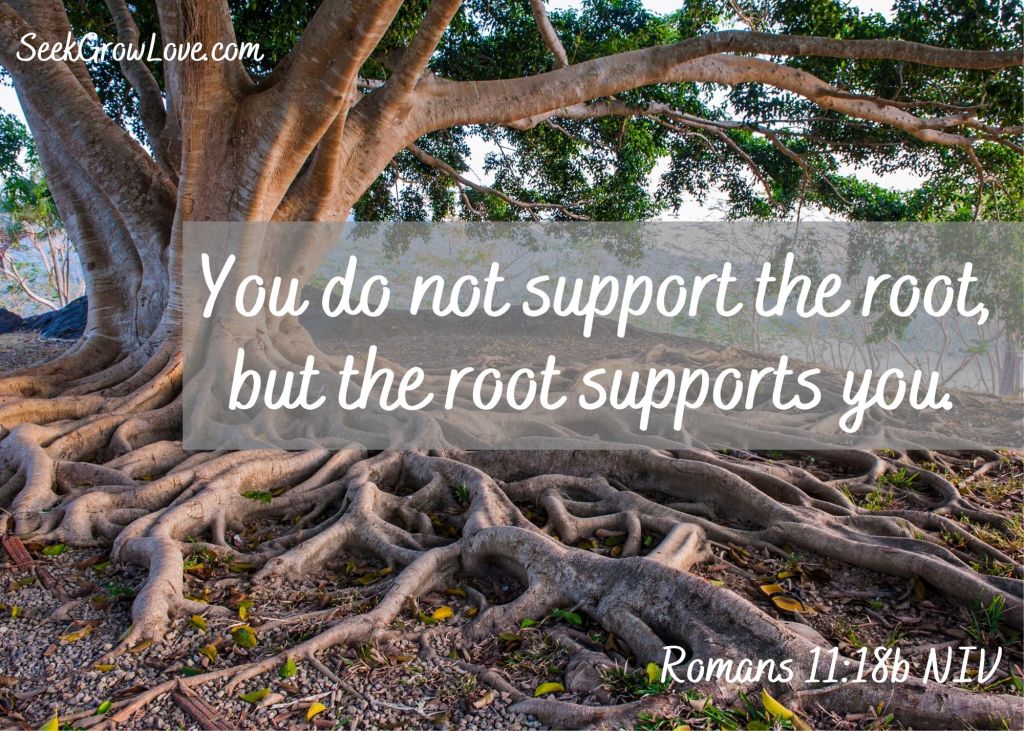
“Consider this: You do not support the root, but the root supports you.” – Romans 11:18b

I am the true vine, and my Father is the gardener. He cuts off every branch in me that bears no fruit, while every branch that does bear fruit he prunes so that it will be even more fruitful. You are already clean because of the word I have spoken to you.  Remain in me, as I also remain in you. No branch can bear fruit by itself; it must remain in the vine. Neither can you bear fruit unless you remain in me. – John 15:1-4

Romans 11 makes an ever deeper root connection (this is a pun, and you’ll see why in a moment).  In this case, the gardener is not a novice. Grafting branches onto a tree takes an experienced hand.  The metaphorical botanical in this passage is an olive tree. But why? Because they live an insanely long time. They are a millennial perennial. Additionally, the roots of an olive tree can grow deeper under the surface than above.  It is extremely hard to extinguish some of these species.  Impossible, when you consider the species specifically spoken about here: Jesus Christ.  His Father is the Gardener, He is the vine, and we are the branches. We are grafted by God into the Savior, which predates His arrival.  It is the oldest, deepest promise of God.  “After all, if you were cut out of an olive tree that is wild by nature, and contrary to nature were grafted into a cultivated olive tree, how much more readily will these, the natural branches, be grafted into their own olive tree!” Romans 11:24

No longer is there a single type of branch budding on the tree, but the Good Gardener has chosen a variety.  Each one is equal to the other because none can be supported without the vine.  This makes us all part of the same faith, intertwined in the same hope, which strengthens and flourishes the whole plant, (or body – 1 Corinthians 12)  These roots run from the origins of the universe and the branches are fruiting, growing, and reaching towards Kingdom Come.  Are you accessing the sap of the Spirit? Utilizing your provision to make fruit? Allowing the gardener to prune the dead bits? Tap into the power and the promise that most assuredly lies in the deepest root.

-Aaron Winner

Questions for Discussion and Reflection

  1. Reading Romans 11, what do we learn about the Gardener who grafts in branches? How would you describe Him? What is His purpose?
  2. How does the Doxology (an expression of praise to God, sometimes sung) in verses 33-36 tie in with the rest of the chapter?
  3. How is your grafting process going? How have the roots supported you? How are you getting along with the other branches?

There is No Difference

Romans 10

May 26

One of my favorite childhood stories is The Sneetches by Dr. Suess.  It tells the tale of two groups of the same fictional creature that are cliqued together by the presence and the absence of a green star on their bellies.  Those with the stars participate in exclusive events, while those without are excluded. More conflict follows, and you’ll love how it ends — But don’t take my word for it. Be warned there may be spoilers ahead.

Since they did not know the righteousness of God and sought to establish their own, they did not submit to God’s righteousness. Christ is the culmination of the law so that there may be righteousness for everyone who believes. – Romans 10:3-4

Christian of the 21st century have the tendency to be the star-bellied sneetches, or the modern-day pharisitical Jews. We are really good at identifying each other through our branding, participating in exclusive events together, and making sure others know they are not on the same level as us. We believe through family heritage, denominational existence, or culture perpetuations that we have increased in value and rarity like a fine wine. By comparison, we may look at others struggling with more physically or mentally identifiable sin, rolling in the hot mess of their struggles, and working through the consequences of poor choices, and keep them on the outskirts because they are a little too rough around the edges. Be informed. We all are the same sinful species.

For there is no difference between Jew and Gentile—the same Lord is Lord of all and richly blesses all who call on him – Romans 10:12

Again I say, woe to you, Christian.  You may be in a different position, but it is like comparing one steaming pile of muck to another. We are rotting stacks of stench that stink, stank, and stunk.  Polishing one pile of manure doesn’t make it more appealing than the pile to the left or right. However, one thing is true.  With age, compost makes some pretty fertile soil. In this process of breaking down, we come to terms with who we really are in Jesus Christ and can grow the seed of the Kingdom of God.

If you declare with your mouth, “Jesus is Lord,” and believe in your heart that God raised him from the dead, you will be saved. For it is with your heart that you believe and are justified, and it is with your mouth that you profess your faith and are saved. – Romans 10:9-10

Our eyes shouldn’t be focused inward on our marshmallow roast, but rather outward, leading others to the saving conversations about the grace of Jesus Christ. There are so many who already know Christ but are ashamed to try to live more abundantly because of the odor their life is currently putting off.  It is good to remind them you’re a decaying mess too.  Love like Jesus. The bigger the trash-fire, the greater the compassion, cause Lord knows we need it too.  The same creatures with the same Lord.

-Aaron Winner

Questions for Reflection and Discussion

  1. What stood out to you most in today’s chapter and devotion?
  2. Have you ever been guilty of a “better than…” attitude? Is that a good way to attract more people to become followers of Jesus? How can you improve?
  3. How pretty are your feet? Re-read Romans 10:12-15. How and where can you take the good news beyond your saved little circle/clique to the hurting world who is just like you?

Why Did You Make Me Like This?

Romans 9

May 25

Sweet adolescence.  A time of a personal experiment, finding one’s self, and coming of age. It is a scary season filled with growing feet, growing hair, and new body odors.  During these years we’ll try out more looks, hairstyles, and ideas than the rest of our lives combined.  For many of us, there is some perceived physical flaw, (acne and weight were mine) we try to hide or minimize because we don’t want to stick out or become the source of ridicule (and maybe this is still true today of some of us who are older, too). Why did I have to be made like this?  Why couldn’t my heavenly Father shape me to be more like them over there?

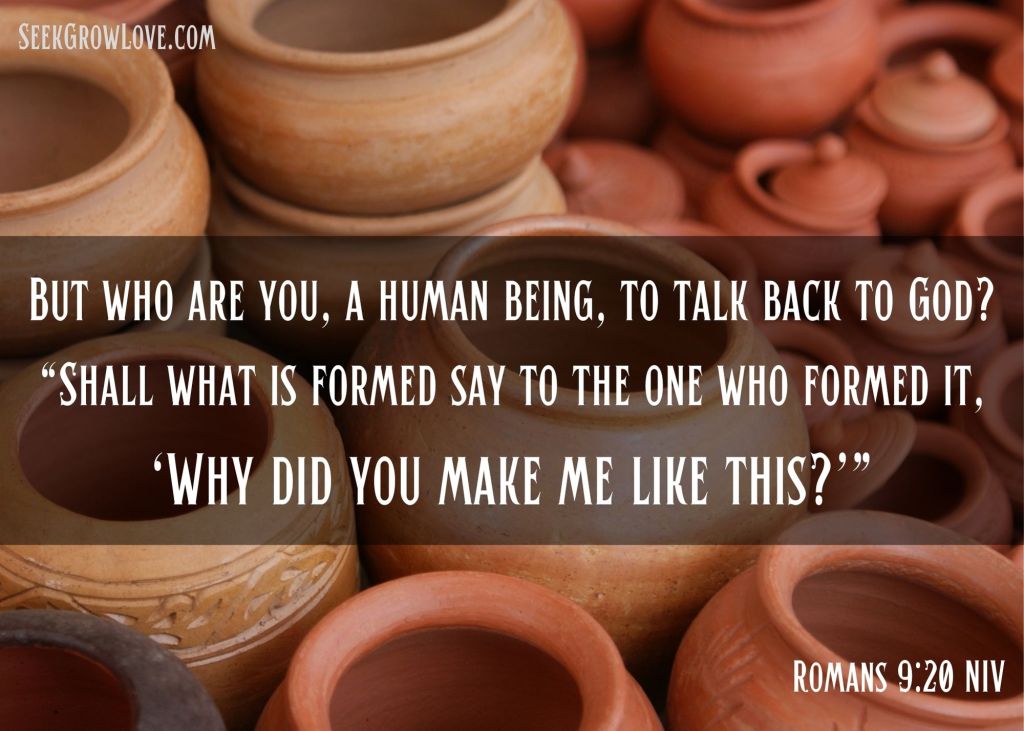
One of you will say to me: “Then why does God still blame us?  For who is able to resist his will?” But who are you, a human being, to talk back to God?  “Shall what is formed say to the one who formed it, ‘Why did you make me like this?’ Romans 9:19-20

Romans 9 seems to indicate that God has foreseen our identity and placed us to “be” in our present circumstance.  We’re all made out of the same clay, but we each have a different role.  He knows our hearts, and He will use each of us to his advantage.  We don’t even need to be “good.” God foreknew Esua’s flagrant disregard to his birthright and used it to continue his line through Jacob.  God used the hardened heart of Pharaoh to bring about the freedom of the Hebrews for Egyptian captivity.  He used King Cyrus to send the Jews home to rebuild their temple and wall.  The lack of relationship to the Heavenly Father doesn’t remove you from being a character in his story.  God made each of them like this and they fulfilled His purpose.

But let’s provide some contrast.  God used Esther, Joseph, and Solomon in almost identical manners to those listed above.  So, did God predestine the fate of the “good” and the “bad”?  Give some ungodly inclinations so they could move in the direction of wrongdoing, and give others no opportunity to fail at following Him?  Well, I’m not a theologian, but I feel the Bible is consistent about the free choice of man to choose and follow God at any point, including His son, Jesus Christ, who faces his own trials and temptations.  We may have perceived traits, inclinations, chips, chunks, or some other appraisal of malformation in our clay, which again, beg the question, “Why did I have to be made like this?” Well, whether it is the normal stuff or the special stuff (v.21), God has made you to be used for times such as this, according to His plan..

In other words, it is not the children by physical descent who are God’s children, but it is the children of the promise who are regarded as Abraham’s offering. Roman 9:8

Because there is no longer a single line of inheritance, Jewish heritage, he is calling all the pottery of different shapes and sizes to follow Him.  Our titled-question I cannot answer. That is the Heavenly Father prerogative and determination. What I can tell you is to spend less time questioning God about the chunky bits, the cracks, the struggles He has placed within you and before you. We have been formed exactly in a way to shine the fullness of God.  To find Him, not ourselves.  To look like Jesus, not everyone else.  For us, His work and craftsmanship, to trust in the Potter’s identity alone.

-Aaron Winner

Questions for Reflection and Discussion

  1. If you could ask Paul to further explain one of his points in Romans 9 what would you ask and why? What might he reply?
  2. What do you love about God’s plan? What do you wonder about God’s plan?
  3. What is the joy in being the clay not the potter?

The Chosen, The Groaning, The Story, & The Cross

Romans 8

May 24

There are a month’s worth of daily devotions that fill the pages of the eighth chapter of Romans.  It is my go-to chapter when I need a reminder of my definition in Christ.  I have read this chapter in thanksgiving and through blurry-vision tears.  I have turned here in the midst of demoralizing sin and great spiritual triumph.  God has reminded me time and time again that my definition, purpose, compassions, and mercies lie here.  Ultimately, the Spirit is governing me, being my guide, becoming my life and my peace (v.6)  This is all breathed into every square inch of Romans 8.  So I present to you four enduring truths that time and time again speak to me from these 39 verses.

1. You are chosen and adopted by God.

God created Adam and Eve. What I believe to be equally true is that he created each and every one of us since.  He stitched us together in the womb of our mothers (Psalm 139:14).  He counted the hairs on our head (Luke 12:7).  We are indeed each God’s creation.  Although this makes God our Creator, we are not yet called his children.  We are sons and daughters of a genealogy filled with sin and in turn, this creates a separation.  It is when we cry out to Him “Abba, Father! Daddy!” (v.15), admit our guilt, and respond to His will that we receive the outpouring of his blessing and the inheritance that truly belongs to us.  We trade the shackles of sin for the anticipation of adoption (v.23). We are spoken for by our Heavenly Father.  Our account is paid.  And in those moments when we stray, we are loved deeper by a Father desperately awaiting our return and calling for us to come back home (Luke 15:20).

2. The world is groaning for Jesus.

Is it not more apparent with each passing day?  Wars and rumors of wars (Matthew 24:6).  Men calling what is evil “good” (Isaiah 5:20). The rapid increase of widespread disease, famine, and earthquakes (Matthew 24:7). The hastening of the spread of the Gospel through the information age (Matthew 24:14).  The physical world, the spiritual world, and our individual hearts are groaning for Christ’s return.  The beat of our pulse is quickening.  The contractions have begun (v.22). The Spirit of God is cuing us to the long awaited return of Christ. Hiding behind our pews and pulpits will do nothing to advance the Gospel and satisfy the aching within.  It is time to share his message with the most desperate and broken who may seemingly be the furthest away (not so..see #4).  The abandoned, the sickly, the tax collector, the prostitute, and everyone else on the outskirts and in between.  Bring their attention to the aching they have within. The harvest is plentiful, but the workers are few (Matthew 9:37).

3. God controls the narrative.

When asked, “How are you doing?”  You might simply reply, “Good,”  as a catch-all synonymous with happy, pleased, content, or a lack of present conflict.  But if we are “good” and follow the will of God, we can expect our contentment to be frequently interrupted. We can expect conflict to be a recurring feature of our life. We can expect happy to be a word reserved for experiencing persecution on the behalf of Christ (1 Peter 4:13).  This is why it is tough to hear, especially in the deepest, darkest moments of our life, “that in all things God works for the good of those who love him, who have been called according to his purpose (v.30)” He isn’t using your circumstance to make you happy. He is using your circumstance to further testify of his Good News. He is using the joy in your struggle, your steadfastness in conflict, and your love for those who have wronged you as a testimony for good.  If you are following Christ, you no longer write the story.  Sometimes you end up at the bottom of a well, falsely accused, thrown in prison, and sharing your faith with the most unsuspecting ears. (Genesis 37-40)  But how sweet it is.  How great is our hope.  How wonderful our reward. Our story, when it becomes His story, is very, very good.

4. No matter…The cross.

What can separate us from the Love of God is Christ Jesus? Nothing. Absolutely nothing.  As long as we suck air. As long as we can consciously reflect and repent, there is God.  You can fail in a moment or run for decades, yet there before you He stands. No matter what.  Abusing or abuse.  Addiction or depression.  Idolatry or simply burying your head in the sand.  Murder or loss. Demons or baggage. Denial of his presence and cursing His name will never stop His knocking and will never rescind his love.  He is ready to bring you into a life of adoption, that will help you understand the groaning within, and will change your narrative for good. Those who love Him understand. Those who don’t yet most certainly can.  No matter where you are today, you are just one step away from the cross.

-Aaron Winner

Questions for Reflection and Discussion

  1. Have you accepted God as your Creator and your Father? What does that mean to you?
  2. Ask God to show you who is stuck in the groanings of this world without the hope of the return of Jesus Christ. Together with God, make a rescue plan. What is His role, what is yours? Pray and proceed.
  3. How is your story different because of God’s love for you in Christ? Throughout Romans 8 what do you find about who God created you to be and who you are in Christ? How is the cross a part of your story?