Unredeemable?

Acts 9-10

Devotion by Rachel Cain (Ohio)

Saul was hell-bent on getting rid of those pesky “little Christs” by any means necessary. But as he marched to Damascus to arrest any he could find, Saul was literally blindsided by Jesus. Ananias, aware that Saul was in the area to persecute The Way but willing to obey God’s call to reach out to Saul anyway, bravely befriended blind Saul, which ironically helped Saul to see more clearly than he ever had before. Just as Jesus spent three days physically dead and then was resurrected, Saul’s three days of visual darkness prepared him to be resurrected to a new kind of life as a bold follower of Jesus, one of the most prolific missionaries the world has ever known. Saul realized that though he followed the law and had an impressive resume, he was actually the worst of all sinners. It was this outpouring of God’s amazing grace that created such dramatic change. 

I always assumed that Saul’s name was changed to Paul to represent this big change in his life, much like Abram to Abraham, but in reality the two names were just different versions of the same name: Saul (or “Sha’ul”) was a Hebrew name, and Paul was the equivalent name in Roman circles. As a Jewish Roman citizen, he would have been called both names. The fact that the New Testament increasingly refers to him as Paul probably indicates his growing involvement in the Gentile world. 

Speaking of Gentiles… God gave Peter quite an obscure vision (Acts 10:9-16) which left him befuddled. Finally, in verse 28, he seemed to figure out the meaning: “God has shown me not to call any person common or unclean.” Jews had sometimes viewed Gentiles as unclean, but now Peter had confirmation from God that the hope of Jesus is for Gentiles too. 

Some Jewish people still thought that Jesus had come only for their race, their “clean” kind. This might sound silly, but some today still try to discriminate against those who can go to a church or be saved based on how “clean” their lives are. We too can be prone to unconsciously judge people’s faith by the unnatural color of their hair, the number of tattoos or piercings, clothing choices, marital status, past mistakes, etc. It’s important to remember that “man looks at the outward appearance, but the Lord looks at the heart” (I Samuel 16:7). I suspect that some churches wouldn’t recognize or welcome even Jesus himself if he came through their doors. 

God had created Saul with such passion, and God knew if he could just channel that passion for saving Christians instead of killing them, the wonderful Gospel could spread. What a testimony! God brings Saul to my mind every time my finite, sinful, human, faith-lacking brain tries to label someone as unredeemable. 

What if we took the time to hear the stories of people who look different from us, to listen to stories of how Jesus has changed their lives, to experience their excitement as they learn things about Jesus that we take for granted because we’ve heard it so many times? Jesus came for all of us. We all are in need of the saving grace of Jesus.

I love to hear 180 stories – people who were completely changed, “flipped turned upside down” – because of Jesus. Some of us were raised in Christian homes and grew up in church and don’t have a dramatic testimony, but that doesn’t make our faith any less valid! We as humans can tend to think that someone is too far gone, but God… God can change the unchangeable, love the unloveable, save the unsaveable – and all of those would be all of us, if not for His mercy. 

Reflections: 

Listen to this song and consider how we might overlook Jesus if he were here with us today. 

Have you had a spiritual epiphany or eureka moment? It’s probably not quite as dramatic as that of Saul, but still very important. Write it down and share it with someone to show how your life has been changed by God! 

Ominous Lines

Acts 7-8

Devotion by Rachel Cain (Ohio)

“Marley was dead, to begin with.”

These ominous lines commence the first stave of Charles Dicken’s classic novella, A Christmas Carol, which my children and I read together for the first time last year. Such chilling inaugural language sets the tone for the serious nature of the story. The tale delves deep into the meaning of life and Ebeneezer Scrooge’s radical transformation before concluding the final stave with these hopeful words: “And so, as Tiny Tim observed, God bless us, everyone!” 

As I read Acts 8, I was struck by the similarity between the forbidding opening phrases of A Christmas Carol and this sinister introduction to Saul: 

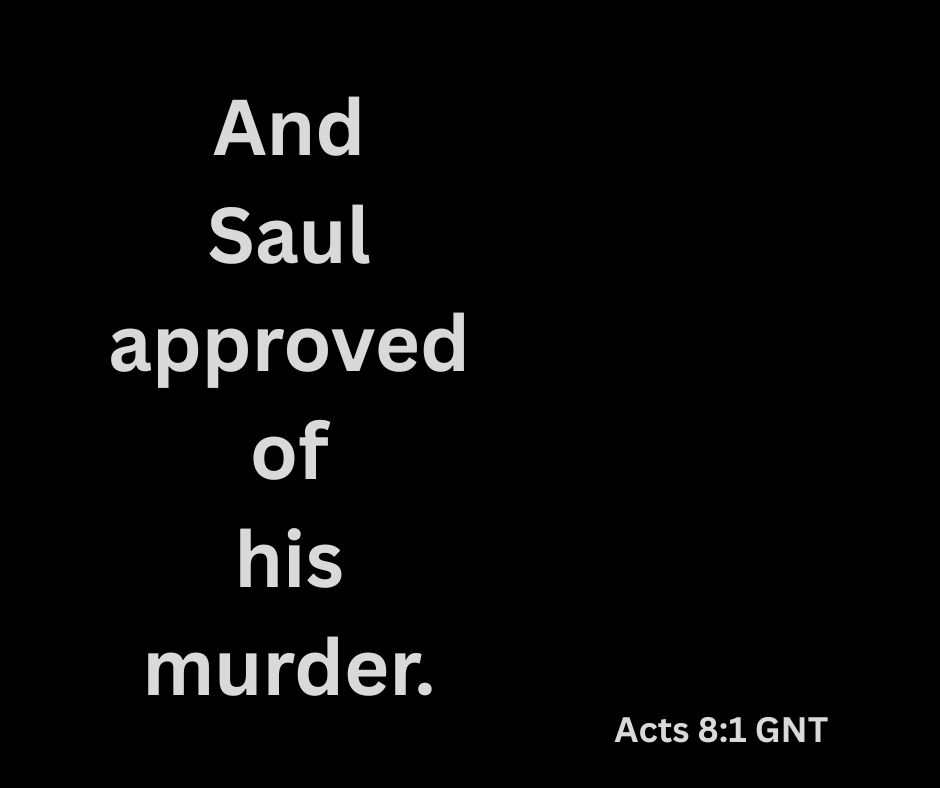
“And Saul gave approval to his murder” (8:1). 

Saul, a devout pharisee who kept every letter of the law and then some, was complicit in the death of the first martyr. But he didn’t stop there: Saul made it his mission to destroy the church by going house to house, imprisoning people who followed the ways of this Jesus guy. Saul thought he was working passionately for God by persecuting the followers of this heretic Jesus who claimed to be the Messiah. 

I always wonder how such heinous acts can be justified in the name of God. Did pride take over his heart? Was Saul so wallowing in his prideful Pharisee ways that he could not understand the grace and love that Jesus had shown and that his people were demonstrating? Was he blind to the prophecies that were fulfilled in Jesus? (Spoiler: In Acts 26, Saul gives some insight into his thoughts during that time, but ultimately he realizes that he was for sure NOT doing the work of God by persecuting his church.)

This is a good reminder that just because we claim to follow God doesn’t mean that everything we feel so strongly about is correct or God’s way. We can be sincere and still be sincerely wrong. Since it can be difficult to distinguish God’s voice from the myriad of opinions we hear constantly, it is important to be regularly grounded in the Word and prayer, truly seeking God’s desires more than our own preconceived notions or cultural norms. 

Just like with Scrooge’s interactions with the three spirits, all it took was one encounter with Jesus to turn everything on its head, transforming Saul’s heart and ultimately leaving us with many hopeful words in the New Testament. But you’ll just have to come back here tomorrow to read more of that story!

Reflections: 

Think about your life before vs. after you decided to fully live for God. What would be the opening line to your “before” chapter? 

What do you want the closing line of your chapter of life to be (like your epitaph)? Write it out as a guide and inspiration to keep you focused on what truly matters. 

Ordinary People – Who Have Been with Jesus

Acts 4-6

Devotion by Rachel Cain (Ohio)

Abraham Lincoln (president), Charles Dickens (author), Steve Jobs (Apple creator), Dave Thomas (founder of Wendy’s), and Ingvar Kamprad (IKEA originator) seem like an unlikely bunch to be grouped into a similar category, but they all have this in common: each one either had little formal training or dropped out of school early, and yet became very successful. Our protagonists in Acts 4, Peter and John, also fit among this list. 

“Now when they saw the boldness of Peter and John, and perceived that they were uneducated, common men, they were astonished. And they recognized that they had been with Jesus.” (Acts 4:13, ESV) Though Peter and John lacked formal training, their time of hands-on learning with Jesus probably equated to an advanced doctorate degree! Their accusers probably recognized that they had been taught by Jesus because their teaching styles and tones so closely matched that of their Rabbi. 

We, too, are disciples! We are called to share the gospel to a hurting world, following closely to the way of our Rabbi, Jesus. So remember your mission! Here are some tips from this text to help us be more like the early church. 

Share Jesus Boldly and Without Shame

Word about Jesus’ resurrection power spread, people were healed in Jesus’ name, and the number of followers was growing exponentially. The jealous religious leaders, however, did not appreciate this threat to their authority. So the council – likely the same one that condemned Jesus to death – tried to silence the ragtag bunch and ordered them to keep quiet. The disciples’ bold response? “We can’t keep quiet about what we have seen and heard!” (Acts 4:20). Their lives had been totally changed, and they just had to spread the word! 

Humans haven’t changed much – we still can’t keep quiet about the good stuff! If you compliment a woman’s new dress, she will tell you three things about it: where she purchased it, how inexpensive it was, and that it has pockets! She is just so excited that she can’t keep it to herself! Likewise, if you visit a fantastic new restaurant and they’re offering a ton of great deals, you’ll probably tell all your friends so that they can get in on it, too. We love to spread good news to other people, so why do we shy away from sharing Jesus with the same zeal? (I’m preaching to myself here. I long to have that kind of boldness that I just can’t keep quiet about all things Jesus, don’t you?) Pray for boldness to share with others how Jesus has changed your life. 

Obey Only God 

When the religious leaders tried to shut them up again, the disciples replied, “We must obey God, not men.” (Acts 5:29) It’s always been so easy for us to slowly assimilate to the culture around us and begin to obey the gods of this world or match the expectations of the people around us. The Israelites did this chapter after chapter in the Old Testament, and we still stray today. Romans 12:2 warns us about getting too conformed with the world. Though it would eventually cost many of them their very lives, the disciples in Acts were compelled to continue sharing the hope of Jesus with everyone. Jesus had cautioned: “Do not be afraid of those who kill the body but cannot kill the soul. Rather, be afraid of the One who can destroy both soul and body in hell.” (Matthew 10:28) Pray that we – the global Church – would stay faithful until the end. 

Maybe you’re like me – never been to Bible college, don’t know an ounce of Greek or Hebrew, just living an uneventful, mundane life. God can use us still! Even without special training, we can be bold lights in a dark world. God can, and will, use you right where you are to make a difference for Him! 

Reflections: 

Your prayer prompts are within the text. Take a moment to pray over those.

  1. How do you spend time with Jesus? Can others tell that you do? What can you do to spend more quality time with Jesus?
  2. How can you lovingly, humbly, courageously show the world (including, but not limited to your family, your church, your neighbors, your “enemies”, the disadvantaged, the other side of the world, etc…) what you have seen and heard and learned from Jesus?
  3. When/how have you fallen into the trap of obeying men rather than God? What can that look like? What can you do to strengthen your resolve to Obey Only God?
  4. What courageous task will you do today to obey God?

Unmet Expectations

Luke 24 & John 20-21

Devotion by Rachel Cain (Ohio)

Unmet expectations are a leading cause of relational conflicts. 

Sometimes the expectations were simply not communicated, so the offending person had no idea what was expected. Other times the expectation was communicated but not met, such as a broken promise. Sometimes it is no fault of anyone, but life and happenstance got in the way of the anticipated outcome. 

In the case of Jesus’ resurrection, multiple prophecies and even Jesus himself foretold what would happen, but still the disciples had their expectations shattered: “We had hoped that he would be the one to liberate Israel!” (Luke 24:21). 

They were disappointed in Jesus because their expectations did not match his reality. The disciples, among others, had believed he was the Messiah, but then they were confused when he didn’t fix their political problem by conquering the Romans and establishing an earthly kingdom – even though he had never promised to do those things. He had a much larger spiritual plan to save all of humanity by conquering the sin within their hearts. Perhaps they didn’t understand God’s big-picture promise of an eternal Kingdom. 

Today we look back with disbelief on their disbelief. DUH! Of course he’s the Messiah! Why couldn’t they just listen to him and recognize him and his plan? But how many of us today fail to recognize Jesus and his mission because it looks different than we expect? 

I think sometimes we expect a clean-cut Jesus, tidy Christians, an easy life. But none of that is promised; in fact, following Jesus guarantees quite the opposite (see John 16:33). How often do we fail to recognize the gifts of God because they don’t come packaged the way we expect? Can we see the blessing of prayers that were not answered the way we asked? Do we see every person – annoying, incarcerated, stinky, unborn, elderly, troubled, or just plain “different” – as God’s precious children, and view every interaction with them as a mission for the Kingdom? 

It’s so easy to be hostile toward fellow Christians over all kinds of unmet expectations – differing doctrines or political views, whether or not Christians should be involved in this activity or celebrate that holiday, etc. We definitely should encourage each other to keep seeking Jesus in these and all areas of our lives, but if we just put half that energy we use fighting one another into uniting to spread the love of Jesus to a hurting world, united we could have a tremendous Kingdom impact. God’s ways are not our ways (Isaiah 55:8-9), so we should always expect the unexpected. 

Reflections:

Listen to this song. How have some trials turned out to be unexpected blessings? 

What are some things that you are waiting for with expectant hope, and how can you share that hope with others around you? 

“The squeaky wheel gets the grease.” 

Luke 23 & John 18-19

Devotion by Rachel Cain (Ohio)

What a true idiom. I never cease to be amazed at how large a small minority can seem when given a message and a platform. The media spins the truth to sway unsuspecting observers one way or another, leading us to disregard critical thinking and become emotionally attached to the perceived (and sometimes invented) injustices. We begin to see this small, vocal group as representative of the entire population. This happens on both sides of the political spectrum. Even niche groups can seem large if they’re loud and persistent enough. 

In Luke 23 it seems like “everyone” wants Jesus punished! The chapter begins with an emotional interaction between the Sanhedrin (the religious court) and Pilate, the governor of the Roman province of Judaea. The very first verse indicates that “the whole Sanhedrin” brought Jesus before Pilate, hoping for a death sentence.  A text note in my Complete Jewish Study Bible for Jews and Christians (p 1513) clarifies that “this literally means, ‘the multitude of them’- namely, the whole of those present… this reflects not the whole of the Jewish people but instead some members of the religious court…” 

This small-but-loud crowd succeeded. Even though Jesus had been healing multitudes, teaching with authority, and relating the people to God in no way they had ever experienced before, all it took was a small, mad mob to fuel the emotional fire that would cause the crowd to exclaim, “crucify him!” and end Jesus’ life.

We all know these actions fulfilled God’s plan; this is how it had to happen, but that doesn’t mean we can’t learn a lesson from the chaos. We need to be aware of fallacies in arguments that aim to sway us away from God’s Truth. We must be watchful to notice the sly work of the deceiver who “masquerades as an angel of light” (2 Corinthians 11:14). We should constantly compare the cries of the culture to the ways of God so we will not be conformed to the world, but “test and approve what God’s will is” (Romans 12:2). It would behoove us to remember the words of Jesus, that his life-giving way is straight and narrow, not the broad path that leads to destruction (Matthew 7:13-14). 

So, as Christians, let’s be the WD-40 on the “squeaky wheels” that are leading people astray from God. We must help encourage other Christians to stand for what is right, even when it seems like we’re standing alone. Also, we should be a different kind of “squeaky wheel”: unashamedly sharing God’s love to the world around us and shining His light everywhere we go. The world is watching. 

Reflections: 

How have you been influenced by the world around you – or resisted that influence and stayed true to your faith? 

In what ways can you be WD-40? Or be the squeaky wheel for Jesus? 

Three Pictures of Judgement

Matthew 25

Devotion by Jacob Rohrer (Rhode Island)

Today as we look at Matthew 25 we should take notice that though we are starting a new chapter the context surrounding this chapter is the same as that of chapter 24. Matthew 24 and 25 are a single unit of thought. This can be seen in verse 1 with the word “then” (the NIV says “at that time”) indicating what Jesus was speaking about in chapter 24 is continuing into chapter 25. The focus of the chapter is about the end of this age when Jesus returns and the judgement that he will enact. 

There are three pictures of judgement in chapter 25. The first two are parables (the parable of the ten virgins and the parable of the talents) and the last one is a description of the judgement scene. 

In the first parable there are ten virgins who wait for the bridegroom. The bridegroom delays in appearing and all fall asleep but suddenly the bridegroom appears but only five are ready for the bridegroom while the other five are not ready and they are denied entrance into the wedding feast. The virgins denied entrance are then told by the bridegroom he never knew them. 

The second parable is about a master and his slaves. The master gives each slave a talent (an amount of money) and went on a journey. When the master returns only two of the three slaves honored the master with what they were given. The third slave squandered his talent and is rebuked by the master and the slave is thrown out into the outer darkness.

The third picture of judgement involves Jesus separating goats from sheep among the nations. The sheep and goats represent those who belong to Jesus and those who do not. The sheep (believers) are rewarded with the kingdom and the goats (non-believers) are cast into hell with satan and his demons. 

What are we to make of this chapter? What does Jesus want us to learn from these three pictures of judgement? I believe it is this.

There is a judgement coming and not everyone who calls themself a Christian will enter into life. The reality is, not everyone who calls themself a Christian is a true believer. In all three teachings there is one group of people who are then divided into those who are accepted and those who are rejected. Many people comprise the Church but not everyone who attends church is a true believer. The judgement of Christ sorts out the self-deceived from the real believers. Jesus himself teaches this earlier in Matthew 13.24-30, 36-43 in the parable of the tares. And he also teaches this in Matthew 7.21-22. 

Who are you? Are you deceived or a true believer in Christ? The five virgins were accepted into the feast because they were ready and prepared. The 2 slaves were honored by the master because they were faithful with what the master had given them. And the sheep entered the kingdom because they loved and served other Christians in need. 

A true believer will have evidence of salvation in their life. A true believer bears the fruit of the spirit, they grow in holiness, they grow in their disdain for sin, they hunger for the scriptures, they serve other Christians and people. A real believer matures and grows in Christ.

Paul tells the Corinthians in II Cor. 13.5 to test themselves against the scriptures to see if they are in the faith. Compare yourself to scripture and to the words of Jesus. Have you really received salvation from God? In addition to this, talk with mature believers closest to you about this serious matter if you question your salvation.

(Originally posted for SeekGrowLove on November 7, 2020)

Reflection Questions:

  1. What do you think Jesus wants you to learn from Matthew 25?
  2. “Who are you? Are you deceived or a true believer in Christ?” What does a true believer look like, sound like, do, believe?
  3. What can you do today to be more prepared to be judged by Jesus?

Who is this Good Shepherd?

Luke 10, John 10:22-42

Devotion by Jerry Wierwille (New York)

John 10:22-42 opens with the Feast of Dedication in Jerusalem, where Jesus walks in Solomon’s porch and faces many direct questions about his identity. The passage is filled with challenges to expected norms, the importance of faith, and the safety and strength of the Shepherd’s hand.

The Challenge of Faith

As Jesus walks through the Temple, a group gathers around him, pressing in on him with questions that reveals both their curiosity but also their skepticism: “How long will you keep our souls in suspense? If you are the Christ, tell us plainly” (John 10:24). Jesus responds by saying, “I told you, and you do not believe. The works that I do in my Father’s name, these testify about me. But you do not believe because you are not of my sheep” (John 10:25-26).

Here, Jesus points out that belief is not simply a matter of intellectual assent or witnessing miracles. True belief is about recognizing the Shepherd’s voice and responding in trust. The works of Jesus—his miracles, his teachings, his ministry—are clear evidence of his mission and that he is from God. Yet, as Jesus notes, only those who are truly his “sheep” respond to him in faith. This situation echoes a recurring theme in Scripture: the spiritual life of faith is not about seeing the miraculous but about having a heart that is receptive to the things of God.

Reflect: Are there areas in your life where you find it difficult to trust Jesus, even when you see evidence of God’s work? What might it look like to move from being less skeptical to more faithful, trusting the Shepherd’s voice even when some answers are not immediate or obvious?

The Shepherd’s Hand

Jesus continues with one of the most comforting promises in all of Scripture: “My sheep listen to my voice, and I know them, and they follow me. I give them life in the age to come, and they will absolutely not perish, and no one will snatch them out of my hand. My Father, who has given them to me, is greater than all, and no one is able to snatch them out of the Father’s hand. I and the Father are one” (John 10:27-30).

This passage reveals one of the most profound promises that comes from belonging to Jesus. His followers are not only known by him, but are also protected by the power of God. The assurance that “no one will snatch them out of my hand” is a promise of lasting spiritual safety and belonging for those who follow Jesus. Undergirding this assertion is the truth about the unity of Jesus and God. But it is not a unity of identity, but about a perfect partnership in purpose and action. This unity in purpose with God and Jesus is the foundation for the believer’s confidence and hope.

Reflect: In what ways do you need to rest securely in the hand of the Shepherd? How does knowing that the purposes of Jesus and God are unified change your outlook on challenges, fears, or uncertainties?

Invitation to Deeper Faith

The immediate response to Jesus is intense and divisive. Some pick up stones, accusing him of blasphemy for making himself “a god” (John 10:33). Jesus, however, points them back to Scripture, referencing Psalm 82:6: “Is it not written in your law, ‘I said, you are gods’?” (John 10:34). He challenges their understanding and invites them to examine his works as evidence of his mission from God: “If I am not doing the works of my Father, do not believe me. But if I am doing them, though you do not believe me, believe the works, so that you will come to know and continue to know that the Father is in union with me, and I am in union with the Father” (John 10:37-38).

As the opposition persists, Jesus withdraws beyond the Jordan, where many people come to him. They recall John the Baptist’s testimony and recognize that everything John said about Jesus was true (John 10:41-42). The Jordan area was away from the hustle and bustle of Jerusalem and was a quiet countryside. Many believe in him there, showing that trust often grows in places and moments where hearts are open and receptive.

Reflect: Are you willing to examine Jesus’ works and words with fresh eyes/ears and an open heart? How can you invite others to explore the truth of who Jesus is, even when it challenges their expectations?

Encouragement

This section reveals who Jesus is and why people should listen to him and believe him. He is the Shepherd who gives life to those who follow him, challenging the audience to move from doubt to faith. Take time today to listen for his voice, trust in his protection, and share his truth with those around you. As you do, may you experience the peace, assurance, and security that only the Good Shepherd can give.

Lost and Found

Matthew 18

Devotion by J.J. Fletcher (Minnesota)

Yesterday, we read Mark 9, and today we see some of its parallels in Matthew 18. The idea of causing “a little one” to sin is here, as well as dealing with one who sins against you, and addressing our own sinful actions. Sandwiched in between these teachings, we read the parable of the lost sheep.

The image of Israel as a flock of sheep is prevalent in the Old Testament. Leaders are viewed like shepherds, but God is the ultimate shepherd. When Israel loses its way, God sends a messenger or “shepherd” to seek out the lost and bring them back to the fold, to the path that they should be walking on.

Sheep get a bad rap. They are often characterized as dumb, but they are far from it. Sheep can remember human faces and differentiate between them. Sheep are herd animals, and the fact that they rely on following the herd, or the sheep in front of them, contributes to the mischaracterization of their lack of intelligence.

You have probably followed someone whom you had a level of trust in, but at some point, you realized that you had followed them the wrong way. Was it easy to course correct, or did you wander for a while? Did someone have to come and find you to bring you back to where you were supposed to be?

There’s a saying that not all who wander are lost, but many who wander are in fact lost. We follow the wrong crowd or come under the teaching of someone who is guiding us in the wrong direction. Those of us who are parents are acutely aware of how challenging it is to raise our “flock” in a culture that embraces self-gratification and relative truth (my truth as opposed to objective truth). Maybe we have become devotees to tradition rather than God’s commands (see the Unwritten Rules devotion from Tuesday). 

We probably all have friends or family members who have gone astray, and we desperately hope to get them back to the flock. We see that God has that same desire, for the lost to be found, to be reunited with his flock. There is much joy when someone returns. The rejoicing over the one who returns over those who remained is not a statement of value; all the sheep are valuable. The celebration is that the one who has been saved from death is now safe, like the 99. 

There are powerful testimonies from people who have lived problematic lifestyles, who walked in a way that was destructive or even dangerous. Many of us have boring testimonies. What a joy to have not had to be saved from a life of trauma, addiction, or danger! We celebrate those powerful testimonies not because those who have struggled are better, but because we can see in their stories the power of the one who went out and found them.

Reflection Questions:

1.        Think about ways that you were lost and how God brought you back. What methods did he use? How can you see His handiwork in your faith story?

2.        How has God used you to seek out his lost sheep? When you feel God’s prompting, do you embrace it, or have you struggled and responded in some other way (Jonah, anyone?)? 

3.        What ways can we work to keep the flock together and avoid having that one sheep split off that we may need to go searching for?

The Fight Against Temptation

Matthew 4 

Luke 4-5

John 1:15-51

Devotion by Cayce Fletcher (SC)

At the beginning of Jesus’ ministry, we read of his baptism. This is a special moment of God clearly anointing Jesus with his spirit as he says, “This is my son, with whom I am well pleased.” Jesus is anointed and commissioned in that moment to go and preach the gospel of the Kingdom – which is what he does in Matthew 4:17. 

In between the anointing and commencing of his ministry, we read of a curious episode in Jesus’ life. He is led by the Spirit into the wilderness to be tempted by the devil. 

The devil shows Jesus three things to entice him to reject God in disobedience. He tells Jesus to turn the stones to bread, to command the angels to come and rescue him, and to elevate himself physically and figuratively so that the world will bow down to him. 

Interestingly, these things aren’t necessarily the same struggles we may be tempted by. In one Bible Study I was teaching about this passage, one of my friends looked puzzled and mentioned that he would think that Jesus would have been tempted with ‘the lust of the eyes’ because that is such a ubiquitous struggle for our society. But, I think that this instance is more than Jesus staying strong against the seven deadly sins – though he does and remains sinless throughout his temptations. 

In each instance, the devil says, ‘Just show your power to do these things. Show yourself to be like God.’ The devil knows that Jesus has the authority to do the things that he is tempting Jesus with. Jesus also has the power to do those things. But, Jesus knows that he must remain obedient. Jesus is not God, and Jesus knows that the only reason he has the power and authority to do supernatural things is because God has granted him that authority. 

These temptations echo the first temptations in the garden. The ancient serpent also tempted Adam and Eve with the chance to become ‘like God.’ Instead of trusting in God and remaining obedient to his word, Adam and Eve trusted the serpent and grabbed at the chance for the knowledge of Good and Evil. Of course, the serpent’s promises were empty and brought death, not happiness. 

We are also tempted. Yes, temptations mean that we have to be sure to follow the law of God and live righteously. But, more than that, temptations mean that we have to trust that God knows what is best for our lives. Jesus could have looked at his situation in the wilderness (that he was led to by God) and decided that he knew best. In that moment, he could have rejected God, acted disobediently, and sinned. 

But, he didn’t. 

Instead, his obedience required him to humble himself and trust God. Ultimately, this proved to be a training ground for what would be required of him later on. Philippians 2:8 says, “He humbled himself by becoming obedient to the point of death — even to death on a cross.” 

We have to take the same path. We don’t know best. We have to trust God and his word. 

We can take comfort in the end of the story, too. Jesus wasn’t exalted by the devil, but we know that the thing the devil tempted him with will come true because Jesus was obedient. One day, every knee will bow and every tongue confess that Jesus Christ is Lord. 

We wait in hope for that day, and we live in obedience today. 

Cayce Fletcher writes and podcasts at amorebeautifullifecollective.com. Check out the blog and other resources to help you create a life you love and cultivate your heart for God. This free resource here will help you take your Bible study one step further with a Bible reading tracker, Bible study reflection page, and more.  

Reflection Questions

  1. How are the temptations of Jesus in the wilderness similar to and different from the temptations of Adam and Eve in the garden? 
  2. How does Jesus fight against temptation? How can you better equip yourself to fight against temptation? 
  3. Why did God lead Jesus to the wilderness? How was Jesus’ time in the wilderness preparation for the rest of his ministry? 

SGL.2025.SeptemberFullPageDownload

The Beginning of Ministry

Matthew 3

Mark 1

Luke 3

Devotion by Cayce Fletcher (SC)

The past year, I just celebrated the big 3-0. With every new decade, life speeds up, and the long stretch of the future that seems endless at 18 starts to look shorter and shorter. 

I remember when I graduated from high school, I – and all my friends – wrestled endlessly with what to make of our lives. What college? What major? What city? What guy? It seemed like we needed to have it all figured out as soon as we walked across the graduation stage. 

But, as anyone who has a little life experience knows, life rarely goes as planned. What we thought would make up our lives at 18 rarely fits with what our life actually looks like at 30, 40, or 50. 

It always seemed strange to me that Jesus, with such a short life, waited to begin his ministry until 30. Here are some reasons why that could be

Traditionally, 30 was the age in Jewish culture of full maturity. It matches up with the pattern of scripture: David was 30 years old when he became king, Joseph was 30 when he entered the service of Pharaoh, the Levitical priests were 30 when they started their service, and so on (Ezekiel, King Saul, and maybe even Paul the Apostle). 

Jesus needed to wait to gain the experience and wisdom that comes with age. His authority and testimony depended on it. 

When I was younger, it seemed like if I had not decided on a thing by age 22 that opportunity would have passed me by for the rest of my life. Whether that’s a career or a specific ministry, it seems like I’m already too set in my ways to be able to make a change and start doing the thing. 

But, I’ve realized that is not how life works. Our lives are long and full of twists and turns. Joseph probably could not have dreamed of the many changes that would take place between his time among his flocks and entering the service of Pharaoh, but God knew and had a plan. 

Sometimes, I find myself falling into this trap today. If someone has moved on from the church or a friendship is broken, I often give up. I feel as though this will be how this person, this relationship, or this work will be for the rest of my life. 

We need to remember this: As long as we are willing to walk in obedience, it is never too late to start the work. God uses the time waiting and praying as preparation to help to mature our faith and grow our wisdom. 

What can we do in the waiting? 

We can pray, prepare, and trust – as we look to all those who had to wait to begin their ministry. We can trust that God, ‘who started a good work in us, will see it through to completion.’ 

Cayce Fletcher writes and podcasts at amorebeautifullifecollective.com. Check out the blog and other resources to help you create a life you love and cultivate your heart for God. This free resource here will help you take your Bible study one step further with a Bible reading tracker, Bible study reflection page, and more.  

Reflection Questions

  1. Why do you think Age 30 was so significant in God’s plan? What is special about this age? 
  2. What thing do you feel is ‘too late to change’? It could be a job, a personality trait, a failed relationship, or a church ministry. How could you pray for change for this thing? 
  3. How can we ‘wait well’? What are some practical steps we can take to make the most of our time of preparation? 

SGL.2025.SeptemberFullPageDownload