If you have the time today I would like you to read through Psalm 101 before reading this and then read it again after.
Psalm 101 speaks of integrity. It’s pretty clear-cut, in the ESV version, the Psalm is even called “I will walk with integrity”. The way it’s put there speaks to me, it isn’t saying “I should”, there is no question in that statement, “I will walk with integrity”. I’ll wrap back to the part about integrity later.
First, I want to focus on a phrase. Throughout the whole Psalm, the phrase that we read over and over is “I will”. Throughout the world, and even in myself, I don’t hear that sort of conviction in daily life. “I will” is substituted for “I might”, “I could”, etc. These all convey a sense of being able to back out. Even the term “I can” lacks the certainty that “I will” has. “I can” can mean that you can but lack the conviction to do it. And taking it a step further, even the phrase “I will” can lack conviction. For example “I will go take out the trash” or “I will drive you to school”. In Psalm 101 it’s a much different form of “I will” from those.
So we have conviction, but for what? As said before with the heading, integrity. When I search for the definition of the word “integrity”, I get this in response, “integrity is the quality of being honest and having strong moral principles; moral uprightness.” I think this definition has been generalized for the public and for the rest of the world. The word moral can be subjective in exactly what it entails. I think we as Christians have a great example of what to look for in integrity though, Psalm 101. It lays out our “moral principles” pretty well throughout it. Which I think makes it a great thing to read and study.
As I said at the start, I would challenge you to read Psalm 101 again. But this time, focus on the conviction behind it, and look at the integrity it talks about. Take it one line at a time and dwell on what is said.
-Philip Kirkpatrick
Reflection Questions
What are you convicted about doing?
What “I will” statements do you find in Psalm 101? Which do you already feel strongly about and would also say, “I will…”? Which seem like wise statements but you could use more conviction in this area to move from “I should” or “I can” to “I will”? Pray about these.
How would you rate your own integrity? What do you admire about people you know with strong moral principles? What is God looking for as far as integrity goes?
The start of 1 Thessalonians 5 shares the promising truth of Jesus’s return. We can rest assured as children of light and look forward to Jesus’s glorious return that will usher in the Kingdom of God. This mindset of being children of light or being light itself is shared in the following passages:
“For you were formerly darkness, but now you are Light in the Lord; walk as children of Light.” Ephesians 5:8
“You are the light of the world. A town built on a hill cannot be hidden. Neither do people light a lamp and put it under a bowl. Instead they put it on its stand, and it gives light to everyone in the house. In the same way, let your light shine before others, that they may see your good deeds and glorify your Father in heaven.” Matthew 5:14-16
“But you are a chosen race, a royal priesthood, a holy nation, a people for his own possession, that you may proclaim the excellencies of him who called you out of darkness into his marvelous light.” 1 Peter 2:9
Our identity is found within the Bible. We can find peace and hope in our identity. You are a child of light. You are light through Christ. This means you are filled with the love and goodness of God, and your life has been sanctified through Christ’s sacrifice on the cross. What you have read about in the last few devotionals are all centered around living out this light. Living in a manner that brings glory to God by shining your light to all those around you.
I grew up going to Midwest Family Camp every year. One of the most important items I would pack would be a flashlight. The walk from the tabernacle to the girls’ yurts was long and dark at night so that flashlight made it less likely to trip and fall over uneven ground. One of my friends would commonly forget her flashlight so most years we would walk together sharing the light. It would have been selfish to have kept the light to myself and it would have caused her to stumble and fall without it. The same applies to the light we have received from Christ. It is not something to be hidden under a bushel, we have to let it shine, let it shine, let it shine. Allow the identity you find through Christ to shine forth to those around you.
Take Solomon as an example of this. Was he a perfect guy? Absolutely not. But as you read in today’s readings his actions and skills shined brightly to those around him. The queen that visited Solomon saw how much God cared for His people through the actions of Solomon. She recognized the glory of God because of Solomon. He did not hide the light that God had given him. Solomon worked hard and would always point his work back to God, like you have read in the last few days of 2 Chronicles. God’s light and love shines through all His children. Don’t hide it!
-Makenna Landry
Reflection:
1- What has been the main takeaway of 1 Thessalonians?
2- How has King Solomon’s life served as an example to you?
3- What is one way you can shine your light to those around you?
Key Verses: “You also became imitators of us and of the Lord, having received the word in much tribulation with the joy of the Holy Spirit, so that you became an example to all the believers in Macedonia and in Achaia.” – 1 Thessalonians 1:6-7
In 1 Thessalonians 1, we see Paul praising the church of Thessalonica due to their receptiveness of the gospel message and their life changes that came from following the Word of God. Instead of living in sin, they turned their lives around to honor God and their example was seen by other believers. Those in Thessalonica were not the only ones who had a pivotal life change due to their faith. Take the author of this letter, Paul, as an example. He had been a devout Jew who persecuted the Christians and attempted to put a stop to the spread of the gospel message. After being confronted by Christ on the road to Damascus, Paul had a pivotal life change that would impact people for generations. To this day, Paul and his inspired writings shape the lives of people around the world.
This pivotal life change that the people in Thessalonica experienced and that Paul had experienced due to their faith in God and His son Jesus, wasn’t uncommon. God has been working in the lives of His people since the beginning of the world. In the reading of 2 Chronicles today, we see a life change God grants to King Solomon. Even the King of another nation recognized the gifts and talents God himself had given Solomon. The gifts of wisdom and knowledge shaped King Solomon’s reign and allowed the kingdom of Israel to prosper. What an impressive life change for King Solomon.
God continues to grant gifts to His believers and change the lives of those who follow Him. Galatians 5:22-25 says, “But the fruit of the Spirit is love, joy, peace, patience, kindness, goodness, faithfulness, gentleness, self-control; against such things there is no law. Now those who belong to Christ Jesus have crucified the flesh with its passions and desires. If we live by the Spirit, let us also walk by the Spirit.” When we repent from our sins and commit our lives to Christ, there is a pivotal life change that happens. We are granted the holy spirit as a gift that produces good fruit and spiritual gifts in order to be imitators of Christ. It is a slow work in progress to hone your skills and to produce the positive fruit of the spirit, but it will be worth it! Each person has been called to be an imitator of Christ and to dedicate their life to God. The way we spend our time, the things we say, and how we treat other people will serve as an example of our faith. Those in Thessalonica lived as imitators of Christ producing good fruit that was seen by those around them. King Solomon was recognized by the gifts God had granted him because of his faith. How are you impacting those around you? Can you be seen as one imitating Christ, standing in your faith, and working with your spiritual gifts granted by God? Reflect on these things as you go about your day today.
-Makenna Landry
Reflection Questions
How have you been changed by your faith?
What does it look like to imitate Christ? If others started imitating you – what would they start doing? What would they stop doing? Are there any more changes you want to work on in your own life, with the help of the holy spirit, to be imitating Christ Jesus better?
Just like Makenna asked: How are you impacting those around you? Can you be seen as one imitating Christ, standing in your faith, and working with your spiritual gifts granted by God?
Scripture: “David and the chiefs of the service also set apart for the service the sons of Asaph, Heman, and Jeduthun, who prophesied with lyres, with harps, and with cymbals.” — 1 Chronicles 25:1 (LEB)
“Whatever you do, work at it with your whole being, for the Lord and not for people, because you know that from the Lord you will receive the reward of the inheritance. Serve the Lord Christ.” — Colossians 3:23-24 (LEB)
“Blessed be the Lord, the God of Israel, from everlasting to everlasting! Amen and Amen.” — Psalm 90:2 (LEB)
In 1 Chronicles 25, David and the leaders set apart the sons of Asaph, Heman, and Jeduthun to prophesy with musical instruments. Their dedication to worship through music is a powerful example of using one’s talents for the glory of God. This act of worship was not just about playing instruments; it was about prophesying and communicating God’s messages through music. Through music, they made Him known!
1 Chronicles 26 outlines the responsibilities of the gatekeepers. Their role was crucial for maintaining the sanctity and order of the temple. These gatekeepers demonstrate that every role in God’s house, whether seen or unseen, is significant and valuable. These chapters highlight the importance of worship and service in the life of God’s people. They remind us that every task, whether musical, administrative, or protective, no matter how menial or mundane, is an act of worship when done for the Lord.
Colossians 3:23-24 continues this message as it encourages us to work heartily for the Lord, not for human masters. This perspective transforms our daily tasks into acts of worship. Whether we are serving in the church, at home, or in our workplaces, doing our work for the Lord gives it eternal significance.
Psalm 90 reminds us of God’s eternal nature: “Blessed be the Lord, the God of Israel, from everlasting to everlasting! Amen and Amen.” In our worship and service, we acknowledge the everlasting nature of God and our place in His eternal plan.
The organization of musicians and gatekeepers in 1 Chronicles shows that both worship and practical service are vital in God’s kingdom. Every role, whether public or behind the scenes, is important. Colossians 3:23-24 reminds us to do everything wholeheartedly for the Lord. This attitude turns everyday tasks into meaningful acts of worship. Psalm 90’s focus on God’s eternal nature encourages us to see our service and worship in light of eternity. Our actions have lasting value when done for God.
These are great examples of dedication and service to God. Through them, perhaps, we will all be more inclined to use our talents for His glory and to see every task as an act of worship, to live with an eternal perspective, acknowledging His everlasting nature.
-Jeff Ransom
Reflection Questions:
How can you use your talents and skills to worship and serve God in your daily life?
In what ways can you adopt an eternal perspective in your work and service?
How does understanding that you are working for the Lord, not just for human recognition, change your attitude toward your daily tasks?
I sat down several times to work on this devotion today. Every time I distracted myself. I struggle, often, to stay on task, as I’m sure many people do. There are just so many different things I can focus on! I stopped again just now and distracted myself by recounting all the things I did this morning rather than write this.
Back to the topic at hand: Staying On Topic. The first chapter of Philippians (one of my FAVORITE books) is full of love and encouragement toward people that desperately need it. And Paul (who is imprisoned) gets right to the point: Their focus should be on spreading the gospel message.
Verses 1- 14: Paul loves these people. Carrying on in ministry is not a job one accomplishes alone. We draw on each other for strength and encouragement. He loves his brothers and sisters in Christ and prays over them.
Stop for a moment and pray over your brothers and sisters in Christ. Pray blessings over them, particularly the ones who might feel discouraged. Who can you reach out to encourage today as Paul is doing here?
Paul says his imprisonment is to be celebrated because he has been able to spread the message of Jesus Christ. In this he acknowledges that in all of our circumstances and trials, we are to use our lives as a testimony.
Ask yourself what trials or difficult circumstances you are experiencing at present. How can you use this as a testimony to others? How are you displaying Christ? How can you do it better?
Verses 15-26: Paul cuts to the heart of the matter, and asks that his friends ignore motives for just a moment. Who can judge the heart but God, after all? Their focus, and ours, should be on one important mission: that the gospel of Jesus Christ be spread. Nothing. Else. Matters.
Yes, the present life is difficult. Yes there are people out there trying to create harm, trying to make circumstances worse for Paul. But we must keep our focus on spreading the gospel. And any time the Good News is shared in ANY way, we are to rejoice!
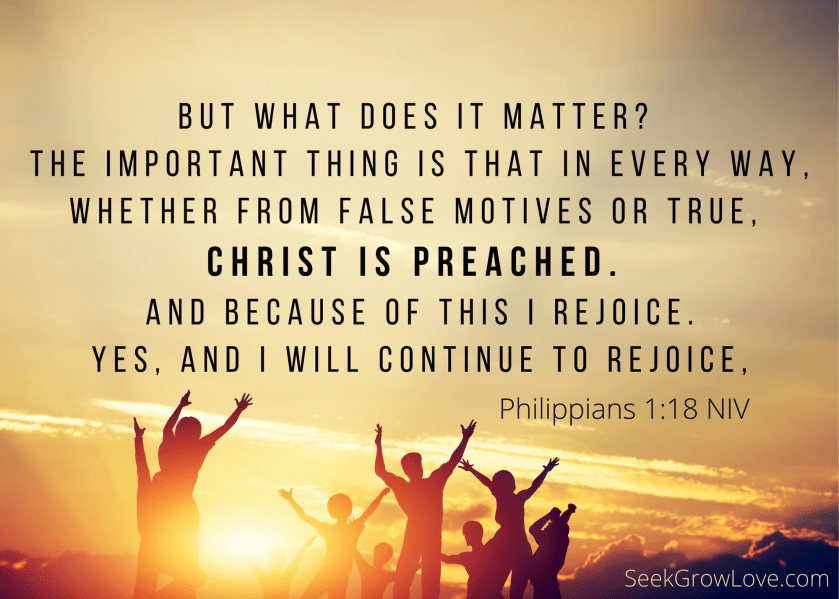
“In every way, whether from false motives or true, Christ is preached. And because of this I rejoice.”
Do you get sidetracked, sometimes, worrying about the motives of others? I know I do. I’m frequently suspicious. And I must force myself to ask, as Paul does, “What does it matter?” So long as the gospel message is preached, I should rejoice.
Verses 27-30: Paul encourages the Philippian church to stay on track. No matter what happens, be concerned first that the gospel is preached in your words and in your actions. Don’t be distracted by those who oppose you or by those who may have false intentions. Live a life that glorifies Christ and spreads the message of the kingdom.
Are you distracted by the negative voices and actions in your life? Have you lost focus? The gospel of Christ is first! Are you conducting yourself “in a manner worthy of the gospel of Christ”? What adjustments do you need to make in your life to be a better representative of the kingdom?
As your sister in Christ, I’m praying over you now that you find encouragement in whatever your situation is. I pray that you are able to defend and confirm the gospel in your actions and your words. I pray that you find support in your fellow believers to continue on in your important task of spreading Christ Jesus to others, and that you do so without distraction! Let’s continue to advance the gospel together. I love you!
-Jenn Haynes
Reflection Questions
See above – lots of great questions in Jenn’s devotion
Close your eyes with me and replay in your mind the best day of your life so far. Try to recall all the vivid details – the sights, sounds, and smells, the intense feelings! (Then open your eyes so you can continue reading!)
Want to hear about one of the best days of my life? There are obvious ones not to be downplayed, such as my wedding day and holding each of my children outside the womb for the first time, but one of the most special days of my life was the day I swam with the manatees.
Perhaps it sounds silly to you, but I adore manatees. I have spent copious amounts of time gazing at them through the massive glass aquariums at our two local zoos, both of which have manatee rehabilitation centers. So you can imagine my excitement a few years ago when my husband agreed that on our trip to Florida that year, we could splurge on an excursion to swim with the manatees in the Crystal River! I’ll never forget floating on the water while observing my beloved sea cows in a submerged, restful state ten feet away, surfacing every few minutes for air. It was an incredible experience to watch the momma manatee with her calf coasting through the shallow river beside us, the small herds interacting peacefully just under the surface, the chubby mermaids living their best (slow) life soaking in the warmth of the underwater spring. The tranquil experience was very healing for me, as one prone to anxiety who had to overcome many anxious thoughts to even pursue this swim-with-manatees dream. My mind still wanders in wishes… Why can’t life just be as peaceful for us as it is for our manatee friends? I’ve relived that day in my mind many times, and it always brings a smile to my face.
“How lovely is your dwelling place, O LORD Almighty. I long, yes, I faint with longing, to enter the courts of the LORD. With my whole being, body and soul, I will shout joyfully to the living God… A single day in your courts is better than a thousand anywhere else! I would rather be a gatekeeper in the house of my God than live the good life in the homes of the wicked.” (Psalm 84:1-2,10, NLT).
Psalm 84 is generally considered a song of pilgrimage, one that was recited or sung when God’s people would journey to the Temple to worship. The writer was longing to be in God’s presence again. Now that Jesus has made a way for us to connect to God again even without a temple, this song could apply to coming into His presence anytime, anywhere, describing our longing just to be near him. Though I am so grateful that we can come into His presence all the time now through prayer and worship, I have always thought of this Psalm as more of a hope of the coming Kingdom. Perhaps we take for granted that we can approach God at any time with our praise and concerns. (I know I do.) And perhaps we don’t really wholeheartedly perceive the amazing promise of the Kingdom. (I know I don’t.)
This world claims to have it all: fame, fortune, fun. But it will never truly satisfy. C.S. Lewis once said, “It would seem that Our Lord finds our desires not too strong, but too weak. We are half-hearted creatures, fooling about with drink and sex and ambition when infinite joy is offered us, like an ignorant child who wants to go on making mud pies in a slum because he cannot imagine what is meant by the offer of a holiday at the sea. We are far too easily pleased.”
Sometimes I feel so overwhelmed with my never-ending to-do list and difficult, anxiety-provoking decisions that I lose focus of the eternal perspective. And other times, I think that everything is awesome and couldn’t possibly get better! For good or bad, it’s easy to get lost in the chaos of each day, isn’t it? It is important to focus on our purpose as followers of Christ and on the amazing hope of the Kingdom, which will be better than anything we can imagine. Even your best day in this life is nothing compared to the Kingdom experience, in which we will live with God and Jesus forever and where there will be no more sickness or crying or pain (see Revelation 21:4).
Even just one day in God’s Kingdom will be better than a thousand of your best days in this lifetime. What a fantastic hope we have!
-Rachel Cain
Reflections:
Close your eyes and imagine what the Kingdom will be like. Now, multiply that by a bazillion and you still won’t even be close to envisioning the peace and beauty of the Kingdom!
Approach God in prayer and worship this week with a similar longing as expressed in this Psalm. Thank Him for the ability to enter His presence. Pray for a deepening desire to experience His presence during this life, as we await the coming Kingdom.
Who doesn’t love a good game of hide n seek? I have memories of my dad getting in on a game of hide n seek by helping one of us kids get up to the never-accessed attic from the hallway game closet. That round lasted a LONG time. And just last week I watched as cousins enjoyed the thrill of the classic game at my sister’s house. But what about when God hides?
When I think of hiding in the Bible I think first of all of Adam and Even hiding in the garden, and then of Jonah hiding on a ship to Tarshish. When people hide it seems it is often because of fear, embarrassment, and/or shame. But, what about when God hides his face? I think we can rule out fear, embarrassment and shame. And, it is definitely no game. So, what causes God to hide His face?
The verse I am referring to is Micah 3:4 – “Then they will cry out to the Lord, But He will not answer them. Instead, He will hide His face from them at that time Because they have practiced evil deeds.” (NASB). I looked at 55 other translations/paraphrases (made easy on biblegateway). I will compile some of the other options together: Someday you will beg the Lord to help you in your time of trouble, you will plead with Him, you will pray to Him, but He will not answer, He will not listen, He will not even look at you. Do you really expect Him to answer? But he will turn away from you, He will hide His face from you because of your sins, because of your evil deeds, because they/you have acted so wickedly.
So, what makes God hide His face from them – or from you?
Sin.
A few years ago I did a bit of study on prayer and more specifically unanswered prayers – or prayer requests that don’t receive the answer we were asking for when we asked. I keep the worksheet I created in my Bible because I keep adding to it as I find more and more reasons and instances as I read and re-read the Bible. Some of the reasons for “unanswered” prayers given in God’s Word are: not enough faith, asking with wrong motives, it’s not in God’s will or it’s just not time for it, yet. But, by far I have found the most examples and teachings about prayers not being answered – or even heard – because of unrighteousness.
Micah has many examples of the people’s unrighteousness. In this chapter he is speaking of the leaders of Judah and Israel and how they hate what is good and love what is evil. Perhaps if you think really hard you might be able to think of a time when you celebrated something that grieves God or you put down, ignored or disrespected something He created and called good? Where else have you seen evil celebrated and goodness trampled upon? Micah also spoke of the prophets who were leading Israel astray and their selfishness in looking out for themselves and their needs instead of speaking God’s truth and warnings to a nation in danger of God’s coming wrath. He says, “They will all cover their faces because there is no answer from God” (Micah 3:7 NIV). And, suddenly, our ‘game’ of hide and seek now has no seekers at all. Because of sin. What happens when no one is seeking? Game over. Israel would be finding out very soon what happens. For even though they say, “Is not the Lord among us? No disaster will come upon us” (Micah 3:11 NIV); disaster is indeed coming. They will find, just as Micah foretold, that you can’t live your sinful selfish lives against God’s laws and heart and then when you are in trouble expect God to sweep in to save the day. In fact, He is sometimes sending the disaster, because of their sinfulness. He is hiding His face from them – not because He isn’t powerful enough to stop the disaster. Not because He isn’t loving enough to stop the disaster. Indeed, God has a love for the whole world and hates the spread of sin – so it could be precisely His love to send the disaster/judgment/day of trouble before even more are led astray.
Don’t wait til it is too late. Be a Micah. Stand up against sin. Be filled with power, with the Spirit of the Lord. Speak and show justice and might. Don’t follow the lies of unrighteous leaders. Follow His laws. Love Good. Hate Evil. Seek God’s face – always.
-Marcia Railton
Reflection Questions
Are you good at recognizing what God calls good and what He calls evil? Do you hate what He calls evil and love what He calls good? How could you get better at recognizing and treating evil as evil and good as good?
What examples can you give of leaders who hate what is good and love what is evil? How does this affect a whole family/church/nation?
If our sin and unrighteousness keeps God from hearing and answering our prayers – and we know ALL have sinned – how do we continue to seek God and turn from sin so that He does not hide His face from us?
How can you be a Micah amongst the false prophets and sinful, selfish leaders? What do you need on your side (see verse 8)? How do you get it?
What is your favorite book? Who is your favorite speaker? Do you have a favorite preacher? What kind of prophet would you really like to listen to?
The verse in Micah 2 that really caught my attention this time around was verse 11 – “Suppose a prophet full of lies would say to you, ‘I’ll preach to you the joys of wine and alcohol!’ That’s just the kind of prophet you would like!” (Micah 2:11 NLT). It got me to thinking – maybe I should be spending a little more time listening to the preachers and prophets that I DON’T really like listening to.
Poor Micah might not have been a very popular guy in his day and age. Most of the people of Israel and Judah would rather not hear what he had to say. His social media accounts might not have had a lot of friends and followers and his devotions might not have gotten a lot of likes. Sometimes when we speak the truth it’s not real popular, and neither are we. But being popular and comfortable isn’t nearly as important as speaking and hearing and doing what God desires. I think Micah recognized this when he said, “If you would do what is right, you would find my words comforting.” (Micah 2:7b NLT).
How do we recognize a prophet that is full of lies? There are so many lies being circulated today. Whether they come from the Dove chocolate candy wrapper, social media or the preacher/prophet at the local church – everything we hear needs to be checked. Not just to see if it’s popular (do a lot of people believe it). Not just to see if it is comforting (do I like to listen because it makes me feel good). But of life and death consequence – does it line up with what God says is right and true and beneficial – even when it is unpopular and uncomfortable. And if it doesn’t line up with God’s standards, disregard it! And seek truth elsewhere! How do we know if it lines up with what God says is right and true and beneficial – even when it is unpopular and uncomfortable? Take a look (a lot of them, actually) in His Book! Like everyday – every book of the Bible (not just our favorites) – all year long.
-Marcia Railton
Reflection Questions
What prophets of lies have you heard? How did you distinguish it as untruth?
Micah’s example of the prophet of lies spoke of the joys of wine and alcohol – a popular belief indeed that brings a lot of ‘comfort’ to many. What do you think Micah’s thoughts on wine and alcohol were? Do you think he was preaching God’s truth here? Do you see dangers in wine and alcohol? What problems could develop by listening to and following the prophet speaking of the joys of these beverages?
Who do you listen to/read/watch? Why does what you listen to/read/watch matter?
What other Bible passages can you find to support what Micah is saying?
Since the pandemic, mental health has become an important topic that has not only been destigmatized, but has rapidly appeared in popular culture. Looking at the vocabulary passed along in social media, I’m sure you’ve seen a quote or two referencing toxic behaviors, triggers, gaslighting, or keeping some type of balance. The vast majority of those offering this advice are not certified to give it, but many have the ability to identify, and for the most part avoid, unhealthy relationships and behaviors that would emotionally exhaust us. So I, as one not certified to give advice, offer some advice, albeit unpopular and radical wisdom for the day and age we live in: God asks us to form addictive, dependent relationships in abandonment of self.
When the LORD began to speak through Hosea, the LORD said to him, ‘Go, marry a promiscuous woman and have children with her, for like an adulterous wife this land is guilty of unfaithfulness to the LORD’” (Hosea 1:2, NIV)
In a very specific instance, God instructs Hosea to marry Gomer, taking on an unhealthy relationship, knowingly to a woman who would be unfaithful to him. Not only a symbolic representation, but a real life metaphor, Hosea’s heart mimicked that of the Most High who was heartbroken by Israel’s infidelity. Yet in the same way, Hosea’s persistent love and commitment would mirror God’s unwavering love for His people. In spite of our own betrayal, God beckons us to return to Him and be restored. This is a promise for Israel but truly, for each one of us.
Jesus also speaks directly to the demands of this type of abandonment in relationships. Conversely, His focus is the reciprocation of God’s reckless love to us. In the same manner, we prioritize Him above all else, even above family and possessions. In maybe the toughest pill to swallow in the ministry of Jesus, he states in Luke 14:26, “If anyone comes to me and does not hate father and mother, wife and children, brothers and sisters—yes, even their own life—such a person cannot be my disciple.” Jesus double-downs on this statement, saying that we each must carry our own cross to follow Him. The demands of following Christ are toxic to self and most indeed will destroy us.
But this is the very cost of knowing Christ. If we were not aware of it before, be reminded of it as you read and re-read these words today. There must be a willingness to give up everything that hinders our relationship with God, and not only accept this, but embrace the sacrifices of discipleship. No doubt there could be a growing dissonance in our minds. If this is the case, it could be that we are trying to preserve the self that remains instead of running to our relationship with the abandonment of Hosea, and ultimately, our Heavenly Father. True discipleship demands more than superficial commitment. It requires a deep and wide devotion to Jesus, the same dedication He showed to His Father and to us.
Although we have lived in a manner that made us unworthy, God’s love for us is restorative and sufficient for any loss. The Church of God is His bride in the coming kingdom, and it matters not our history before coming to Him. We must no longer accept Jesus, for this implies He is tolerated. We must make a covenant with Him, becoming one. He has fully demonstrated His love for us, so we must embrace the cost of this radical relationship that continues to transform every aspect of our life.
-Aaron Winner
Reflection Questions
“True discipleship demands more than superficial commitment.” Where else can you see this principle taught and illustrated in the Bible?
How deep does your commitment to God go? What do you find gets in the way of diving deeper into commitment?
How would you describe God’s love? What is your response to His love for you? OR – asked another way – What is God asking of you in your relationship to Him and to His Son? And what does He offer in return?
I have spent the last 3 years of my life and academic studies focusing on the subject of human flourishing. Let me ask you a question this morning…Are you flourishing in your life? Would you like to? To flourish is to grow healthy, to thrive. I believe it is God’s ultimate goal for us to flourish. If you look at the Bible from beginning to end, it is all about flourishing. In Genesis God creates the heavens and the earth. He fills the earth with abundant plant and animal life and that places humans on the earth to act as his stewards. Humanities first job was to cultivate and enjoy a flourishing garden. God’s first command to humans was “be fruitful and multiply.” That is all flourishing language. At the end of the Bible, in Revelation 22 it shows the culmination of God’s plan to live with humans on a restores and renewed earth where there is flourishing. There is a picture of a river flowing from God’s throne and along the banks of the river are the tree of life that bears fruit all year long and whose leaves bring healing. This is, once again, flourishing language.
Throughout his ministry, Jesus uses the language of flourishing as well. He says things like “I have come that they might have abundant life.” (John 10:10). That is the language of flourishing. In John 15 he says that he is the vine and we are the branches. We must remain connected to him to bear fruit. This is flourishing language. Later, the Apostle Paul picks up this same language of flourishing. In Galatians 5:22-23 he speaks of the “fruit of the spirit” as love, joy, peace, patience, etc… This is most definitely flourishing language.
God wants His children to flourish. As we know, in order for a plant to flourish it needs certain conditions. It needs good soil with good nutrients, it needs the right amounts of sunlight and rain, it needs to be nurtured, weeds to be pulled, pruning, pests and parasites need to be kept away. In the same way, God’s children need to have conditions that are favorable to our flourishing. God lays these out throughout the Bible.
The week we are going to focus on Proverbs. I think it is helpful for us to think of the Proverbs as very simple and clear instructions on how to spiritually, emotionally, relationally and even physically flourish. To learn how to grow a flourishing garden you might want to talk to a wise and seasoned gardener who can give you insights into how to get the most flourishing. How to prepare the soil, when to plan the seeds of plants, how deep to plant, how far apart to space them, how much watering is needed, do they need more sun or more shade, when and how to prune. Proverbs give these kinds of practical wisdom instructions to help God’s people flourish.
Consider one of the short Proverbs in today’s reading: “Gracious words are like a honeycomb, sweetness to the soul and health to the body.” (Proverbs 16:24). Raw honey has health benefits, it contains antioxidants and other good things, and it tastes sweet. I remember as a child seeing my very English grandfather put a giant teaspoon of honey into his cup of tea which he drank several times a day. He lived to be almost 100 (hey maybe I need to start putting honey in my tea?). So honey tastes good and is good for you, win-win, right? In that same way, in our spiritual, emotional and relational life, speaking gracious words or words that are full of grace also taste good and are good for you. Jesus is the ultimate example of what a flourishing human life looks like and it was said of Jesus that he was “full of grace and truth.” (John 1:14). Colossians 4:6 says: “Let your speech always be gracious, seasoned with salt, so that you may know how you ought to answer each person.”
Maybe I am just getting old, but it seems to me that people are often not very gracious in the ways they speak to each other. In many ways, social media makes it easier to speak very ungracious words to others behind the safety of anonymity or the filter of a phone or computer screen. Now, when I hear someone speaking graciously in public or on social media, I am like, “Wow, that was nice to hear for a change.”
God wants us, His children, to experience flourishing lives. One way toward flourishing is to monitor how we speak and intentionally choose to speak words that convey grace to others. We do not always have to agree with others and even Jesus spoke truth to his opponents, but even hard truth can be spoken with grace. That is part of being wise in our speaking and that is one-step towards a fruitful, productive and flourishing life.
~ Jeff Fletcher
Jeff is a pastor and chaplain who lives in the beautiful mountains of Virginia. He has spent his life in ministry and recently earned his doctorate from Vanderbilt University. He has a large, loving family and is very active in all the COG events and ministries.
Questions:
In what ways are you flourishing in your life? Where do you feel like you are not flourishing?
Have you noticed flourishing language in the Bible before? How does the Bible speak about flourishing? What is flourishing according to the Bible?
How does the wisdom of Proverbs help you to flourish in your life?






 Seek Grow Love