The End of Division

Galatians 3

Wednesday, August 10, 2022

            I don’t know about you, but to me, it feels like the world is really divided right now.  More divided than we’ve been in a long time.  Liberal vs. Conservative.  The liberals call the conservatives Fascists or Nazis, the conservatives call the liberals Communists.  We are divided between theists and anti-theists, or some would divide us as racist or anti-racist.  Still, others would divide us as binary or non-binary, pro-live or pro-choice.  Living in perpetual states of division is stressful, painful, and exhausting.  In the words of Rodney King during the L.A. racial riots of the early 1990’s “Can we…can we all get along?”

            That’s kind of what Paul was saying to the Galatian Christians.  There was division going on in their Church.  Paul taught them that we are saved by putting our faith in Jesus Christ as the son of God who died for our sins and whom God raised from the dead.  This salvation is open to everyone who believes, young or old, male or female, Jew or Gentile (non-Jew).  As Paul was traveling on his mission to other places in Asia and Europe to share the message of Jesus Christ and the Gospel of the Kingdom of God with as many as he could, he received reports that people had come into the Churches in Galatia insisting that Gentile believers must begin practicing Jewish law in order to be saved.

            Paul was pretty angry with the Christians there who were being led astray by the teaching of these “Judaizers”  (people who insisted that Gentile Christians must practice Jewish Law in order to be saved).  Paul calls them fools and victims of witchcraft for allowing themselves to be taught something so clearly contrary to the gospel that he preached to them previously.

            Paul goes back and shows from the Hebrew Bible (our Old Testament) that even back in the time of Abraham God made his plan very clear.  God always planned to bring salvation not only to the Jews who were descendants of Abraham but also to Gentiles who were not biological descendants of Abraham.  Paul shows that God called Abraham long before the Ten Commandments and Ceremonial Laws were given to the Jewish people.  As Jews, they were always recipients of God’s grace.  The Law was never a precondition to them being chosen as God’s covenant people.  Paul wants it to be clearly understood that for the Gentiles they are brought into God’s chosen family not on the basis of observing Jewish ceremonial law or even moral law, but on the basis of faith in Jesus Christ.

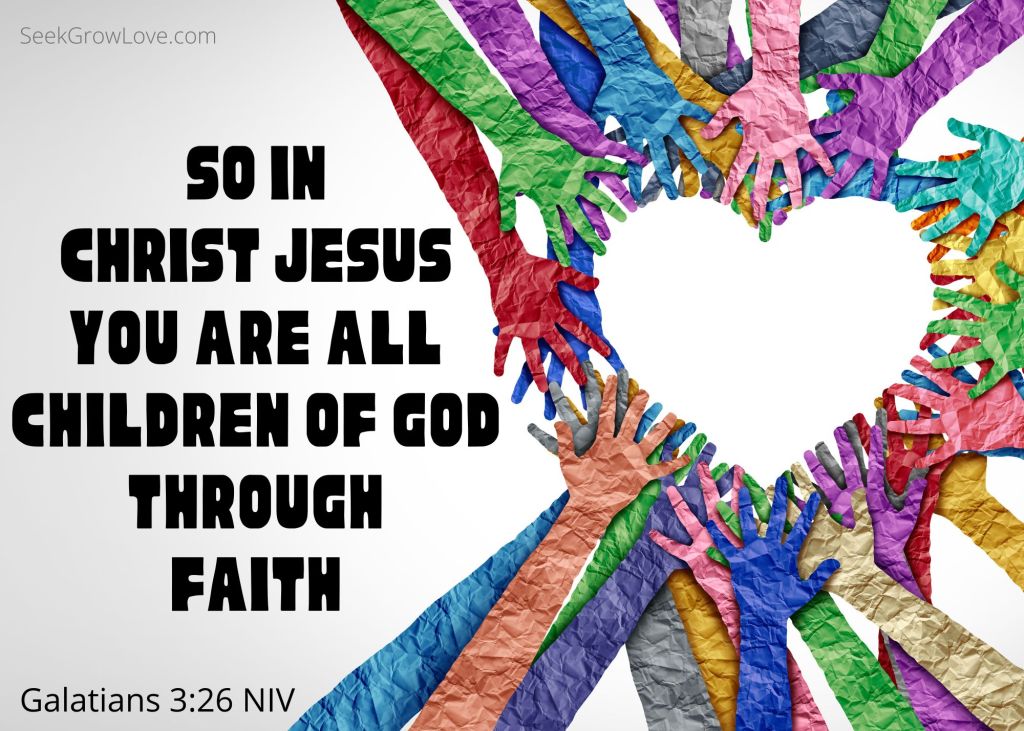
            In Christ, old barriers and divisions come falling down.  We all become a part of the one family of God through Jesus Christ. It doesn’t matter our nationality, our age, our sex, our citizenship status or our righteousness according to the law.  What matters is that we come to Jesus Christ and have been clothed in Jesus Christ.

            Later in Galatians Paul will talk about what it means to crucify the flesh and to live according to the spirit and produce virtuous actions by the spirit, but the fruit is a result of salvation, not the precondition to being saved.

            The only true way to end division in the world is by becoming one with Jesus Christ through faith.

-Jeff Fletcher

Questions for Discussion:

1.  What are the kinds of things that divide Christians and Churches today?  What action will you take to help remove divisions where you worship and serve?

2.  Why is it important to understand virtue as a result of salvation rather than as a precondition to salvation?

Watch Out!

Romans 16

June 1

One of the best ways to say “I love you” in the midwest without using those words specifically is to say, “Watch out for deer” when someone is leaving your house in the evening. This is a phrase that is so common, especially in the summer months when deer are more willing to wander further distances before there are plenty of crops to munch on. Ask anyone who has ever hit a deer: the damages to any vehicle can be severe. It is devastating. So, although it is obvious that it is not ideal to hit a deer, nor would anyone want that, we still remind one another to watch out for them. It’s a simple way to show concern to something that is an all too common experience.


The Apostle Paul does just this when he is closing out his letter to the Romans. In Romans 16 he says to the church, “I urge you, brothers and sisters, to watch out for those who cause divisions and put obstacles in your way that are contrary to the teaching you have learned. Keep away from them. For such people are not serving our Lord Christ, but their own appetites” (Romans 16:17-18). We all know instinctively that division is not a good thing. Division causes pain and strife in any family, but we see this specifically in the family of God. Just like in the summer months we ought to watch out for deer, so we need to be on guard against people whose goals are to cause divisions and create obstacles. This type of behavior is found in a person who is not interested in growing God’s kingdom by sharing the gospel. Rather, this type of person is interested in dividing God’s kingdom into different sections. Paul further explains the type of people who are always dividing: they are interested in serving themselves and not the Lord Jesus.


We live in a time where politics and culture are always in the forefront of people’s minds. It is hard to take in any form of media without having some type of political statement attached to it. The division that is caused by the polarizing view of politics is something that can be avoided in the church almost altogether. I say almost altogether because there are issues that Christians should vocally stand for such as being pro-life. A majority of political issues fall under the category of “opinion” however. I heard it said well recently that the Apostle Paul could have filled his letters with news concerning the Roman empire. But he didn’t. He spent his time and efforts sharing the good news of the kingdom of God and the Lord Jesus. We need to be on guard from anything that divides the body of Christ, and to seek unity in the body of Christ. Especially when the divisions are created over opinions, and not because of a dissent in sound doctrine. Division should be avoided as best as we can. We should never roll over because it is easier, nor should we have a church split because it would be easier. We should make every effort to keep the family of God in a unified stance. We are stronger and better together. The kingdom grows because of our common faith. Let’s grow God’s kingdom together and not divide it into smaller pieces.

-Nathan Massie


Application:

  1. Seek to build in unity with those around you and don’t become divided away from other people on the basis of opinions.
  2. Watch out for people who seek to make divisions in the church for their own gain.
  3. To remember Christ wants us to be unified in his body and to rejoice in the unity
    in faith that we all share.

Watch Yourself – as you step outside

1 Corinthians 9-11

Remember when I said yesterday that the message about spreading the Good News was coming?  Well, we start slowly diving into that idea with these passages today. 

In chapter nine Paul discusses how he reaches outsiders… by becoming like them (9:20-22).  Did anyone else have to reread those verses a few times?  What apostle would tell people that they should become like the outsiders in order to reach them?!?  (Hint: Probably one who knew what he was talking about!)  Before we get too worked up, let’s look at what was really being written here:

Paul wasn’t saying that we need to go out and change our lifestyles to match the sins of the world, and then try to convince them that a godly lifestyle is better.  Rather, Paul is saying that in order to reach people on the outside, we must actually go out and meet people where they’re at.  As the Church, we cannot expect to sit high and mighty in a physical building and still reach the lost.  We must go out, find those people on the outside, and witness to them from a humble perspective that understands how desperately we need the same message of grace and hope that they do. 

Within these chapters Paul does not let the Corinthians forget to think introspectively.  In fact, he spins it to describe the importance of checking on our own faith life to continue in our mission.  Chapter nine verse 27 reads “I discipline my body and bring it under strict control, so that after preaching to others, I will not be disqualified.” And chapter 10 verse 12 reads “So, whoever thinks he stands must be careful not to fall.” And finally, chapter 11 verse 28 says “So a man should examine himself [before] he should eat the bread and drink from the cup.”.  All these verses are essentially Paul saying “Check yourself before you wreck yourself!” Which is completely valid!  As the Church goes out into the world to reach those outsiders the temptation and draw away from righteousness is greater than if we only surround ourselves with like-minded people.  Without taking time to focus on our own faith life, we will be just as ineffective in spreading the Word as if we did not go out in the first place.

The other idea that Paul writes about in these chapters is how the body of believers must respect one another and stay focused on what really matters.  “No one should seek his own good, but the good of the other person.” (10:24) I think it is pretty clearly laid out here; put others first!  In chapter 10 Paul is touching on the disagreements that came up related to what the believers were eating, in chapter 11 it was on what the women were wearing while praying.  In both these areas, essentially Paul is saying, “It doesn’t matter as long as they aren’t going against God!”.  Sometimes the Church can get wrapped up in those little disagreements and start to divide over things that will not matter in the Kingdom, which is why Paul tells us that “whatever you do, do everything for God’s glory.” (10:31) When we can recognize what issues in the Church truly matter, the body is built up and can refocus on their main mission of reaching those on the outside.

Today, take time to evaluate your own walk of faith.  See where you can come closer to God while still being closer to those on the outside.  Reflect on your local church and see which little issues you can set aside for the sake of the Kingdom. 

I’m excited for our next few chapters as we talk about the importance of each member in the Church!

Happy Monday everyone!

Sarah Blanchard Johnson

Today’s Bible passage can be read or listened to at BibleGateway here – 1 Corinthians 9-11.

Tomorrow we will continue with chapters 12-14.

Disputable Matters are Disputable

Romans Chapter 14

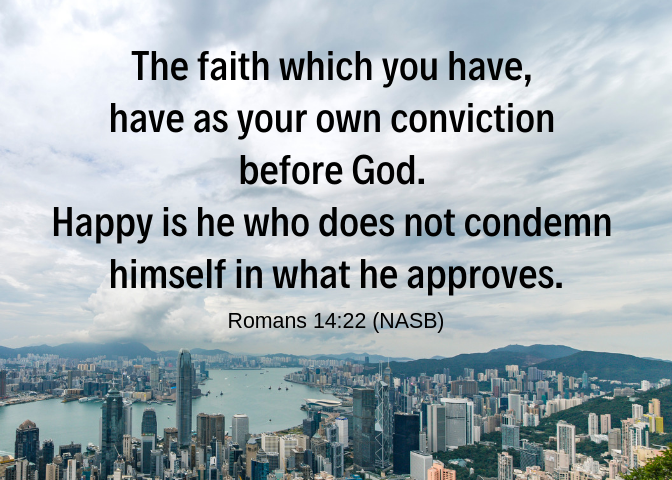
The faith which you have, have as your own conviction before God. Happy is he who does not condemn himself in what he approves.

Ah yes.  Disputable matters.  What are those exactly?  Well, that’s disputable.  We were only given a short list of what those are for sure.  Meat or no meat?  Days all the same or some more sacred?  And from a parallel passage in 1 Corinthians 8;  food sacrificed to idols able to be eaten?


What modern disputable matters can you think of?  Drinking alcohol?  Voting?  Putting up a Christmas Tree?  Playing Dungeons and Dragons?  Rooting on the New England Patriots?  No, we all know that last one is evil.


I have heard arguments for and against these so-called disputable matters.  I have also heard from those who hold a strong stand on them that they are NOT disputable.  In fact, those with opposing stands can often both point to scripture to back their conflicting viewpoints.  What then?


As Christians, moreover as people, we are going to disagree about things.  Paul knew this.  He saw it.  And he was concerned about the division within the church that would create.  And for good reason.  I once heard that a church actually split over the chosen color of the new carpet.  That is rather ridiculous.  I don’t know if that would classify as a disputable matter, but the point is that we are easily divided if we are not careful.  The enemy wants to divide us.  Don’t let the enemy win in regards to these issues.


Sometimes we have to agree to disagree and leave it at that.  And I am not saying that truth is not important.  It is of the utmost importance.  But there are some things that people are simply not going to agree on.  That doesn’t mean that anything we disagree on is automatically a disputable matter.  But if it is something that we can disagree on and still have fellowship together, then maybe we need to leave it at that.


Let’s strive for unity, and still be mature enough to disagree on some matters.


I’m sure I cleared this right up for you.  Or maybe you dispute that?


Greg Landry