The Weight of Unconfessed Sin

Old Testament Reading: Exodus 7 & 8
Psalms Reading: Psalm 32
New Testament Reading: Romans 2

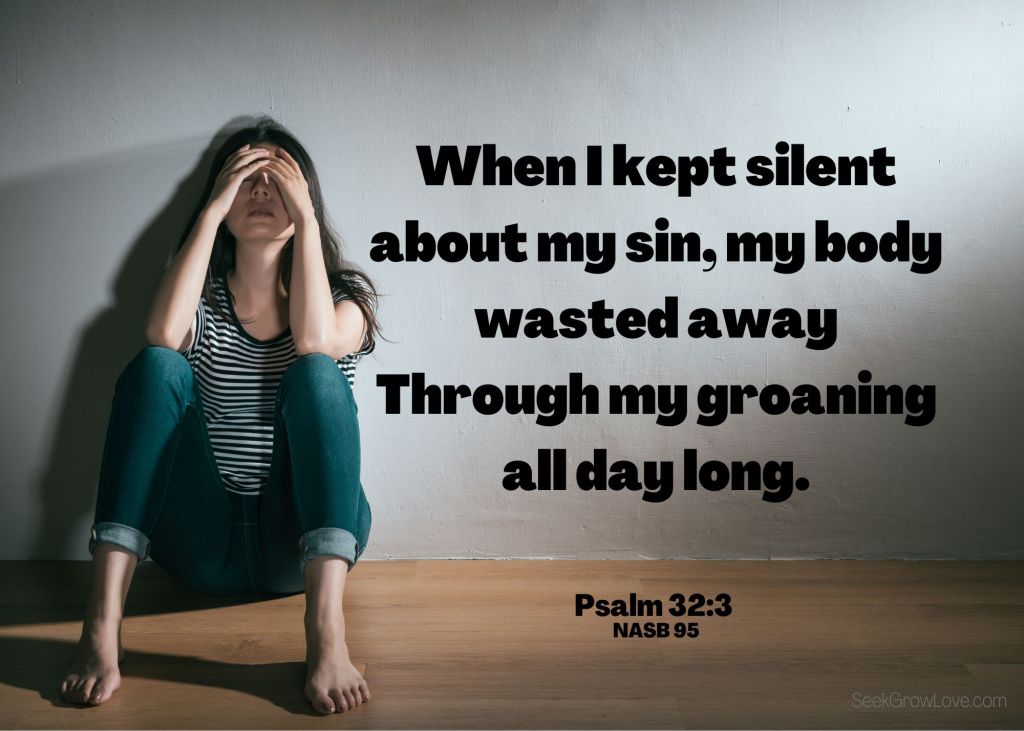
The weight of unconfessed sin is heavy. Today’s passage in Psalm 32 helps us to see that unconfessed sin takes a spiritual, emotional and physical toll on us. David mentions that his body was wasting away under the burden of his unacknowledged sin.

Psalm 32

3 When I kept silent about my sin, my body wasted away

Through my groaning all day long.

4 For day and night Your hand was heavy upon me;

My vitality was drained away as with the fever heat of summer. Selah. (NASB 1995)

When we confess our sins to God and repent of them, God is faithful to forgive. Many times we can be like Adam and Eve clamoring to find our leaves to cover our shame and nakedness. It is futile to try and conceal our sin from an omniscient, omnipresent God.  

5 I acknowledged my sin to You,

And my iniquity I did not hide;

I said, “I will confess my transgressions to the Lord”;

And You forgave the guilt of my sin. Selah. (NASB 1995)

I hope the admonition in verse 6 was not lost on you. 

6 Therefore, let everyone who is godly pray to You in a time when You may be found;

Surely in a flood of great waters they will not reach him. (NASB 1995)

This verse reminds me that we do not have unlimited time and opportunity to right our wrongs with the maker of the Universe. There will be a time when God can no longer be found, so if you are bearing the weight of unconfessed sin, what are you waiting for?

Romans 2 reminds us of some of the amazing attributes of God’s character: kindness, patience and tolerance. However, it also warns us not to take those attributes lightly.

4 Or do you think lightly of the riches of His kindness and tolerance and patience, not knowing that the kindness of God leads you to repentance? (NASB 1995)

Meditating on how amazing our Heavenly Father truly is and how much He loves us should compel us to repent and to reconcile with Him. However, we are not special and there is a limit to His kindness, tolerance and patience. He is also a God of justice. We read in verse 11 of Romans 2, “For there is no partiality with God.” (NASB 1995) The subsequent verses make it clear what the outcome will be if we remain stubborn and unrepentant.

5 But because of your stubbornness and unrepentant heart you are storing up wrath for yourself in the day of wrath and revelation of the righteous judgment of God, 6 who will render to each person according to his deeds: 7 to those who by perseverance in doing good seek for glory and honor and immortality, eternal life; 8 but to those who are selfishly ambitious and do not obey the truth, but obey unrighteousness, wrath and indignation. (NASB 1995)

I would like to circle back to the Psalm 32 passage of how David’s unconfessed sin was causing his body to waste away.  We see a similar concept in Romans 2 and how our conscience accuses our thoughts and wears on us if we do not confess and repent of our wrongdoing. 

14 For when Gentiles who do not have the Law do instinctively the things of the Law, these, not having the Law, are a law to themselves, 15 in that they show the work of the Law written in their hearts, their conscience bearing witness and their thoughts alternately accusing or else defending them, 16 on the day when, according to my gospel, God will judge the secrets of men through Christ Jesus. (NASB 1995)

It all comes down to our hearts. In verse 29 of Romans 2, we see that our circumcision should be of our hearts. If we are a people after God’s own heart like David, we will inevitably have ‘the work of the law written in our hearts’ and our priority will be pleasing God and not man. That means confessing our sins and returning back to God while He still may be found.

29 But he is a Jew who is one inwardly; and circumcision is that which is of the heart, by the Spirit, not by the letter; and his praise is not from men, but from God. (NASB 1995)

-Kristy Cisneros

Reflection Questions:

  1. Are you currently bearing the burden of unconfessed sin? Enlist God’s help in confessing and freeing yourself of this burden. Go a step further and ask God to help you alter your course so that you aren’t falling into the same sin traps over and over that continue to get in the way of your relationship with God.
  2. In reflecting on your life, does it seem to show more of an effort toward pleasing man or pleasing God?
  3. What does God reveal about Himself in today’s Bible reading – and why does it matter?
Spiritual Darkness – and Light

1 John 1

Saturday, October 15, 2022

It is impossible for me to read this opening statement in 1 John 1:1 without immediately thinking of its strong parallel to John 1:1. John 1:1 says in the beginning was the word and 1 John 1:1 says that all they have seen and heard and touched – that was from the beginning (what beginning?) concerning the word of life. John was with Jesus from the beginning of his ministry, so he may be referring to the beginning of Jesus’ ministry. There is a lot to unpack here, so I will leave that for another day, but you can think about some of these correlations.

John says that they are proclaiming the word so that his readers may have fellowship with John and his community, as well as fellowship with God and Jesus through the ministry of the word (that is an implication of having true fellowship with John et. al.). Also, John emphasizes that he is writing these things so that joy may be made complete. True joy, that transcends all circumstances, is a direct result of having fellowship with God and Jesus in a life of faith (see also James 1 for insight into the relationship between authentic faith and joy).

John then gets into a dichotomy between light and darkness. God is light and in him there is no darkness, therefore if we are walking in darkness (not in the midst of darkness but having elements of darkness ingrained into our life) we do not have fellowship with God. We are deceiving ourselves if we think that we can live a dualistic life embracing both God’s will and abiding in the ways of the world. Purity of heart precludes us from walking in darkness. If we’re doing this (walking in darkness), the implication is that we are liars and live a life that is antithetical to the truth.

Conversely, if we walk in the light (i.e., the truth, abide in the word), we have true fellowship with one another and we have our sins cleansed by the blood of Jesus. Walking in light does not mean that we have no sin, that would be a ridiculous assertion, but it means that we do not live lives defined by sin. We all stumble, but there is a difference between falling short and living in sinful pursuit. Our self-deception can come from being double-minded, or from a false notion that being forgiven makes us sinless. We are free from the bondage of sin through Christ, but we still fall short of perfection. In confessing our sin (and repenting of it), we are cleansed and through our faith are counted as righteous. If we don’t acknowledge our sinfulness, how can we confess (we can’t!)? Worse than deceiving ourselves, if we deny that we sin, we make God out to be a liar!

It’s not a good look to make God out to be a liar, so I would strongly encourage each of us to take into consideration our behaviors and not try to explain them in a way that denies the authority of scripture to call out wicked behavior and attempt to justify our (sinful) behavior as acceptable. Sin is offensive to God, so we should not attempt to explain it away as inoffensive. Confession is a powerful tool, and we should be quick to utilize this, rather than explain away or double down on any sinful elements that encroach on our lives. It is better to suffer for doing what is right now (deny our sinful desires) than to embrace sin and deception now and miss out on the amazing Kingdom of God (which will trump all imaginable satisfaction in this life).

-J.J. Fletcher

Reflection:

1. Do I regularly confess my sin to God? Do I confess my sin to other believers (1 or 2 people who you can trust) and reap the benefits of having accountability in brothers or sisters (who likely have had similar struggles) that can speak truth into my life?

2. What am I doing that could constitute self-deception? How might you assess and address this?

3. What relationships do I have that allow people to speak truth into my life? Do I surround myself with yes men? Do I live in an echo chamber? What changes can I make in my life that can help me more effectively eliminate sinful habits?

The Power of Confession

Acts 19 

May 7

No one wants to look bad. The perfect example of this is social media. No one is ever like I want to post that picture that is the most authentic version of me. We want the absolute best version of us on the internet, with all the cropping and filters and perfect lighting we can find. I definitely understand why. The internet is forever. This does go into our real lives though, too. 

We all have video cameras on the front of our phones. I am very thankful that I grew up in an era where if you said something dumb only the people within earshot knew. People in general are more afraid of trying new things publicly because they are afraid of it ending up on snapchat or insta or as a meme. I think most of us realize that many of the stories or memes we see don’t reflect that whole person’s life. 

We all make mistakes. I feel like our flow chart for mistake making is in the wrong order though. The first thought for me is either towards the person or towards God and then we normally don’t want anyone else to find out. Once again no one enjoys looking bad, not even me. 

In Acts 19.11-20 Paul is in Ephesus and an incident occurs where the sons of a Jewish priest try to perform an exorcism. Exorcists were common during this time period. Exorcists would claim a name of high power, during their exorcisms, thinking the higher power the name, the higher the percentage chance of an exorcism . The sons of Sceva made an error this time. They claimed the name of Jesus as the source of their power and they weren’t following Jesus. They said it works for Paul and it should work for us. That really isn’t how the name of Jesus works though. The man with the spirits attacks the sons of Sceva and beats them and sends all seven running away naked. That was a bad day for those brothers. 

Word of this incident spreads around the region and in v. 18 “Also many of those who were now believers came, confessing and divulging their practices.” People realized how wrong the magic arts were after hearing about the sons of Sceva. These were people who were already believers and still had these books and maybe were still practicing magic arts. 

I admire the people of Ephesus for this one. When they figured out something was wrong, they confessed and divulged their practices. When there is a sin that has more power in our life, we don’t come and confess it. We want to have victory over it or be healed of it before we confess it. We want to have a problem, fix it ourselves and then tell everyone about it. This is to our detriment. In darkness sin can grow. If you confess it to someone, your problem will not magically go away but, it’s the start in the right direction. 

Most alcoholics don’t think they have a drinking problem. The first of the twelve steps in recovery is admitting that you cannot manage your own life. (I actually wonder if many Christians get past this first step.) 

Admitting you have made a mistake is half the work. You can find a trustworthy individual to talk about what you are struggling with and in doing so you can take a little more ground on the thing that you are working on. 

Everyone likes confession until they have something to confess. It is worth the time and the embarrassment. The church in Ephesus after they burned their magic books kept growing. It says in v. 20 that “the word of the Lord continued to increase and prevail mightly.” I want that for my church and for myself. Bite the bullet and let’s take some medicine and see God work.

Thank you for sticking around. I have enjoyed writing for you guys this week. 

-Daniel (Dan, Danny) Wall

Questions for Reflection and Discussion

  1. How does this relate to your everyday life? What is your experience with confession – or not confessing?
  2. What is the problem with believing but not confessing?
  3. What is the power of confessing? Prayerfully consider if there is something you need to confess.

Be Careful that You Don’t Fall

2 Samuel 11

March 11

The story of David and Bathsheba is probably familiar to most of us.  King David, described elsewhere as a “man after God’s own heart”, had a little too much time on his hands while his army was away fighting.  One evening, he got up from his bed and walked around on the roof of his palace; and from his roof, he saw a beautiful woman taking a bath.  I’m reminded of 1 Corinthians 10:12, “So, if you think you are standing firm, be careful that you don’t fall!”

You might be tempted to stop right there and ask what this beautiful woman was doing taking a bath in public. Wasn’t she inviting unwanted attention? Presumably, she was in her own fenced backyard, and nobody could see her unless someone was on the roof of the palace next door – and who would be walking around on a roof?  Regardless, she isn’t the real topic of the story, David is.

The fact remains that David took a long look at her.  David lusted after her.  David violated one of the 10 commandments: “Don’t covet your neighbor’s wife…”.   Lust is a trap, especially for men – even for a “man after God’s own heart”.  David should have stopped right there, confessed, and asked God for forgiveness.  Instead, he asked one of his servants who she was.  He was definitely showing too much interest.

Once he found out that she was the wife of Uriah, one of his bodyguards, and the granddaughter of Ahithophel, his chief advisor, he certainly should have walked away.  But she was gorgeous, so instead, he invited her over and slept with her.  David violated another of the 10 commandments: “Don’t commit adultery” – and the punishment for this one was supposed to be death.

When David found out that Bathsheba was pregnant, he recalled her husband from the battle so he could go home – to try to hide the fact that David was the father.  But Uriah didn’t cooperate; he didn’t go home.  Ultimately, David then schemed to have Uriah put on the front line of the battle, and have everyone else withdraw, so Uriah was killed.  And so he violated another of the 10 commandments: “Don’t kill”.

David seemed to successfully hide all of this until after the son was born.  But God sent Nathan, the prophet, to confront David.  Nathan told David that God was going to discipline David, according to his sins.  

David wrote Psalm 51 after Nathan confronted him about his adultery with Bathsheba.  In this psalm, we find in verse 1, “Have mercy on me, O God, according to your unfailing love; according to your great compassion, blot out my transgressions.”  In verses 11-12, “Do not cast me from your presence or take your Holy Spirit from me.  Restore to me the joy of your Salvation…”  David’s heart was broken, he confessed, and was reconciled to God.

The discipline came a little later.  During Absalom’s rebellion, Absalom slept with 10 of David’s concubines in public;  David’s daughter Tamar was raped by her half brother Amnon; four of David’s sons died: this baby, Amnon, Absolam, and Adonijah; and David had problems for the rest of his life.  God forgave David’s sins, but David still had to live with the consequences of his sins.

God’s discipline isn’t punishment handed out by an angry God bent on vengeance, it’s difficulty allowed by a loving Father who wants to see his children develop godly character.  Otherwise, it would be too easy to just accept and live with sin, and God loves us too much to let that happen without a fight.

This brings us to our application for us today.

Do you consider yourself to be Godly?  If so, “If you think you are standing firm, be careful that you don’t fall!”  If you don’t consider yourself to be Godly, what do you think your long-term future (eternity) looks like?  Isn’t today the best time to solve that problem?

Look at the progression in David’s life.  A glance, lust, adultery, then murder.  Are there places in your own life where you are at that “glance” stage?  The “lust” stage?  Further down the path (to destruction)?  Wherever you find yourself, don’t continue down the path of sin.  Turn around.

Was David’s wild fling worth it?  Absolutely not!  Is the pleasure of your sins worth it?  It never is!  I’m reminded of Hebrews 11:25-26, where we’re told that Moses “chose to be mistreated along with the people of God rather than to enjoy the pleasures of sin for a short time… because he was looking ahead to his reward.”  Are you strong enough to forgo “the pleasures of sin for a short time” and instead look ahead to your reward?  If not, ask God to help you.

And when you do sin, don’t just try to hide it.  Remember 1 John 1:9, where God promises, “If we confess our sins, he [God] is faithful and just and will forgive us our sins and purify us from all unrighteousness.”  It was only after David’s confession that he was reconciled with God.  The same is true for us.

You may be tempted in similar ways as David, or you may be tempted in other ways, but you will be tempted.  1 Corinthians 10:13 reminds us, “No temptation has seized you except what is common to man.  And God is faithful; He will not let you be tempted beyond what you can bear.  But when you are tempted, He will also provide a way out so that you can stand up under it.”

-Steve Mattison

Questions for Reflection and Discussion

  1. In your own experience, have you ever observed (or are currently in) the downward spiral of sin where one sin leads to another? Where would have been the best place to stop? How? How do you turn around now – look at David’s example (Psalm 51 is a beautiful place to start).
  2. To avoid the painful and long lasting consequences of sin in your own life how can you build your resolve to forego the “pleasures of sin” which last a short time? What can you do now to help yourself stand strong when you are tempted? What can you do when you are right in the the middle of a strong temptation? How can you help others stand firm against their temptations?
  3. Like David, sometimes we need our sin pointed out to us before we reach a point of confession. Read 2 Samuel 12. Have you ever needed a Nathan to help you see your own sin? Pray to see your own sin clearly. Then confess it. Have you thanked those who have helped you see your sin. Then, as David said in Psalm 51 – with a pure heart he could, “Then…teach transgressors your ways, so that sinners will turn back to you.”

The Overwhelming Compassions of God

Nehemiah 9-10

Everyone needs compassion. Our gracious God, the ultimate source of love and mercy, readily extends compassion to us when we face the great challenges in our life.  But it doesn’t stop there.  God is not “deservingly” showing compassion to us because we have made sacrifices for his namesake.  He overwhelms us with compassion when we deserve it the least.  When our ears have been deaf to his calling, when our back has been turned, when our eyes are glistening with selfish pride, that is when he is most compassionate.  It is pretty simple:  life is best lived in and by the design of God.  Anything else is to be pitied.  But we do not serve a God of overwhelming pity.  He doesn’t stop at, “man, that stinks, wish you would have made some better choices there, bud.” He picks us up in our filth, gives us the full concentration of his blessings, and turns our feet back on the path that leads to him.  Over and over again. Undeservedly. In today’s reading, we get a quick lesson in the history of compassion of Israel from Abraham to Nehemiah.  Draw some (rather easy) parallels to your own life as your study this account of the rich mercies of God.

“But they, our ancestors, were arrogant;  bullheaded, they wouldn’t obey your commands. They turned a deaf ear, they refused to remember the miracles you had done for them;…And you, a forgiving God, gracious and compassionate, Incredibly patient, with tons of love – you didn’t dump them.” – Nehemiah 9:16 MSG

  1. God still has compassion for you, even after you have been arrogant.  You can attempt to go it alone.  God doesn’t give up that easily.  When the miracles no longer come, when the blessing subside, and you decide to turn back, he doesn’t merely say, “told you so.” He says “turn around, I’m still here.”

“Yes, even when they cast a sculpted calf and said, “This is your god Who brought you out of Egypt,” and continued from bad to worse,  You in your amazing compassion didn’t walk off and leave them in the desert.”  – Nehemiah 9:18 MSG

  1. God still has compassion for you, even when you don’t give him credit.  Oh, how we like to take credit. How scorned are we when we don’t get the little credit due to us?  And we haven’t really done anything.  It would be simple enough to say, “Good luck in the desert by yourself,” yet God hears the cries of his people and comes rushing in to, again, fight the battles.

But then they mutinied, rebelled against you, threw out your laws and killed your prophets, the very prophets who tried to get them back on your side— and then things went from bad to worse.  And in keeping with your bottomless compassion you gave them saviors: saviors who saved them from the cruel abuse of their enemies.  – Nehemiah 9:27

  1. God still has compassion for you, even when you stab him in the back.  That’s right, literal stabbing of prophets delivering the word of God.  Maybe you are not guilty of such a crime, but openly denying the word of God delivered to you in your life is an equal abuse of the Word of God.  That’s pretty much what sin is.  But guess what?  Those who openly and defiantly deny the gospel, receive sanctification and redemption through Jesus Christ if they make him the Lord and Savior of their life.  Your confession is never rejected, if done so from the heart.

But as soon as they had it easy again they were right back at it—more evil. So you turned away and left them again to their fate, to the enemies who came right back. They cried out to you again; in your great compassion you heard and helped them again.

This went on over and over and over. They turned their backs on you and didn’t listen. – Nehemiah 9: 28, 29 MSG

  1. God still has compassion for you when you return right back to your sin.  That’s right, we are almost cartoonish in our behavior sometimes.  Do the sin.  Ask for forgiveness. <5 min later> Do the sin.  Ask forgiveness.  Thankfully, we have a God of infinite mercies, BUT as Paul says our goal is not to exhaust the grace of God.  If you haven’t figured it out, somewhere in our sinful nature is the habit to turn back to sin, but we must try to actively stop or flee from it.  God is unfatigued with extending his compassions if we truly seek him through repentance.

You put up with them year after year and warned them by your spirit through your prophets; But when they refused to listen you abandoned them to foreigners. Still, because of your great compassion, you didn’t make a total end to them. You didn’t walk out and leave them for good; yes, you are a God of grace and compassion.  – Nehemiah 9:30,31 MSG

  1. If you’re reading this, God still has compassion for you.  You are not abandoned.  It may feel foreign because you have pitched a tent outside the wall, but there is NOTHING that can separate us from the love of God in Christ Jesus.  Maybe you’re seemingly satisfied to be out there for now.  Man, that’s awful.  You will not receive even the pity of men if this is where you stand.  But God looks compassionately upon you, and leaves the gate open, giving every opportunity to be a part of his grace, love, forgiveness and hope.  There is a time limit though, an end game. Once you stop breathing, it’s over.  There are no guarantees when this will be.  An even more compelling argument than “no guarantees” is every moment you are not living in the presence of God, you walk around heavily burdened with sin, guilt, doubt, and shame because you don’t know His compassion.  He will take it all from you and cast it as far as the east is from the west.  Stop. Turn. Cry. Listen. Let go. It is time to let His compassion overwhelm you.

–Aaron Winner

Today’s Bible reading passages can be read or listened to at Bible Gateway – Nehemiah 9-10 NIV or – from The Message Nehemiah 9-10 and 1 Corinthians 11

“God, I’m sorry if I sinned in some way”

Ezra 9-10 … 1 Corinthians 6

We hear a lot of meaningless apologies. “I’m sorry if you took that the wrong way,” “I apologize if anyone was hurt,” or “Mistakes were made.”  But the reality of sin in light of God’s holiness doesn’t allow for wiggle room with insincere confessions like, “God, I’m sorry if I sinned in some way.”

When we are confronted with the reality of our sinful attitudes and actions, our response should be like Ezra — to throw ourselves before the Lord in repentance and confession. Not because we are worms groveling at the feet of a sadistic monster, but because, like Ezra, we know that our God is gracious.

“Even in our slavery, God has given us new life and light to our eyes. Though we are slaves, our God has not abandoned us in our slavery. He has extended grace to us in the presence of the Persian kings, giving us new life, so that we can rebuild the house of our God and repair its ruins, to give us a wall in Judah and Jerusalem.” Ezra 9: 8b-9

Upon arriving in Jerusalem, Ezra finds out that the people of Israel, including the priests and Levites, have been intermarrying with the pagan cultures surrounding them. His reaction?

As soon as I heard this, I tore my garment and my cloak and pulled hair from my head and beard and sat appalled” (9:3)

It seems almost inconceivable that the Israelites of Ezra’s day could have fallen into the sin of intermarrying with the idolatrous peoples around them. God had strictly forbidden inter-marriage with other nations, because He knew that His people’s hearts would be led astray by these unions. This was not an issue of racial purity, by the way, but spiritual purity.

And much like patterns of sin in our own lives, Israel’s pattern of intermarrying with pagan cultures was not new. Solomon married many foreign women who worshipped detestable idols and turned his heart from the Lord.

We might have thought that Israel’s seventy-year captivity in Babylon finally cured God’s people of their infatuation with idol worship. But here were some of the former exiles, including the leaders, disobeying God and inviting His judgment again by taking foreign women as wives for themselves and their sons. No wonder Ezra tore his clothes and even pulled out some of his hair, a sign of extreme anguish.

In my more modern image, I picture Ezra doing a major forehead slap and screaming at them, “Are you KIDDING me?!?!”

If spiritual amnesia comes as easy to us as it did the people of Ezra’s day (and it does), maybe we need to practice our remembering.

Here’s a brief prayer checklist list I found that you can use each day to keep your memory of God’s will sharp in your mind.

1) Give thanks in everything (1 Thess. 5:18)

2) Ask God to search your heart and show you any “offensive way” (Ps. 139:23–24)

3) Don’t be anxious about anything, but bring your requests to God (Phil. 4:6)

4) Ask God to cleanse you from “hidden faults” and keep you from “willful sins” (Ps. 19:12–13)

After sitting appalled, and praying to God himself, Ezra gave the people this advice,

make a confession to Yahweh the God of your fathers and do His will. Separate yourselves “ Ezra 10:11

Being sorry is a necessary step, but doing something about it is what shows sincerity. It also can help to keep us from repeating the same mistake again. 

Maybe we should add a step 5 to that list in honor of Ezra…

5.) Take action in your repentance. Show it. Live a changed life. (Ezra 10:11)

-Susan Landry

Today’s Bible reading can be read or listened to at BibleGateway here – Ezra 9-10 and 1 Corinthians 6

Feasting on His Word

Nehemiah 8-10

Now that the wall of Jerusalem was completed the people gathered together at the Water Gate to have Ezra read from the Book of the Law of Moses on the first day of the seventh month (which was actually last weekend on the Jewish calendar and the Feast of Trumpets. It’s not really the Jewish New Year, that was adapted from a later time in exile. The first month of the Jewish year is Passover). It states NINE times that “all the people” are included in the events happening in chapter 8.  The priests even helped the people to understand the readings, (8:8) and the people responded with WEEPING (8:9). Nehemiah encouraged them to go and “eat fat and drink sweet” for this day is holy to the Lord. They weren’t to be sad, for “the joy of the LORD is your strength.” (8:10) They knew the words were declared to them.

 The second day they gathered again to hear the Law and learned that in the seventh month they were to dwell in booths for a week.  They were to go to the mountains and gather olive branches, myrtle, palm, and leafy branches to make a booth.  The other day on my fast walk in the neighborhood I plucked various leafy bushes to add to the pop-up booth card I’m making to send to our grandson next week. 😊   I’m going to also include some fruit snacks he can enjoy by his “booth” as a celebration of the end of the harvest season. In Israel today, where we lived for many years, they still make and “dwell” in booths during this weeklong holiday.  They’re on rooftops, balconies, and yards.  They’re decorated with paper chains, lights, and pictures. Our kids liked to sleep in them some nights with their friends.  The people in Nehemiah’s time hadn’t celebrated the Feast of Booths/Tabernacles since the time of Joshua, so it was a time of “great gladness” (8:17), and still is to this day. Although, this year might be different as they’re on a full lockdown in Israel during these holiday times because of Covid.   

            They continued to read the Book of the Law for a ¼ of the day and for another ¼ of the day they confessed their sins and worshipped the LORD their God. (9:3) Some of the Levites stood up and recalled God’s work through Moses, Egypt, Wilderness, and how He brought them into a good land.  However, they “cast His Law behind their backs and killed prophets sent to them.” (9:26) So God “gave them saviors” when they cried out for help and many times delivered them. (9:27) “For many years You had patience with them and testified against them by Your Spirit in Your prophets, yet they would not listen.” (9:30)

Now therefore, our God, the great, the mighty, and awesome God, who keeps covenants and mercy… (9:32) You are just in all that has befallen us.” (9:33) How patient God was and is with His peopleIt says not the kings, princes, priests, or fathers have kept God’s Law.( 9:34)  How important it was for all the people to gather together and recall God’s work over time and their own lack of commitment, and thus to refocus their love and service for the LORD their God for the future.  Now that the wall of Jerusalem had been rebuilt, they needed God’s protection over them. Instead of blaming God for failures, it’s good they acknowledged they were wrong and refocus on Him as they move forward.  We too, can learn from their example in our lives today.

Stephanie Schlegel

Today’s Bible passage can be read or listened to at BibleGateway here – Nehemiah 8-10

Tomorrow we will finish the book of Nehemiah and read Psalm 126 as we continue seeing God’s faithfulness in our

They Will Know

Ezekiel 5 – 8

Ezekiel 6 10a NIV sgl

According to chapter 1, God called Ezekiel on July 31, 593 BC (using our calendar).   Jerusalem didn’t fall to Nebuchadnezzar until 586 BC.  This means that the first 7 years of Ezekiel’s prophesying in Babylon overlapped the last 7 years of Jeremiah’s prophesying in Jerusalem.


In addition to foretelling Jerusalem’s destruction for her sin, Ezekiel adds another recurring theme – “then they will know that I am the Lord.”  This phrase occurs 70 times in the book of Ezekiel, so it must be important.  Ezekiel 6: 9b-10 is an example, “They will loathe themselves for the evil they have done and for all their detestable practices.  And they will know that I am the Lord; I did not threaten in vain to bring this calamity on them.”


7:3-4 says, “The end is now upon you and I will unleash my anger against you.  I will judge you according to your conduct and repay you for all your detestable practices.  I will not look on you with pity or spare you; I will surely repay you for your conduct and the detestable practices among you.  Then you will know that I am the Lord.”


And God pointed out through Ezekiel that He wouldn’t listen to their prayers, because of their sin.  We see an example of this in 8:18, “Therefore I will deal with them in anger; I will not look on them with pity or spare them.  Although they shout in my ears, I will not listen to them.”


As we read this, we may think, “They were sure idiots for not turning back to God.”  But I wonder what truths might apply to us today?


Some of their sins were: idolatry, greed, arrogance, and lack of mercy – and these infuriated God.  If we were compared with the ancient Israelites, how would we as a nation measure up?  How would I as an individual measure up?


You may want to ask yourself a few questions:


  1. Is God more important to me than anything and everything else?  (If the answer is no, that sounds like idolatry).  And to make sure we understand what it means to put God first, is He obvious in every area of life – including areas as diverse as finances, conversation, entertainment, and charity?

  2. Am I merciful?  If you answer yes, how are you demonstrating that?  For example, how are you helping resolve the racial tensions that seem to be tearing our nation apart right now?  How are you helping those less fortunate than yourself?

  3. Am I greedy?  If the answer is no, where and how are you giving your time and money to God’s work – and to others?


If I’m honest, I see that I may not be much more righteous than the ancient Israelites.  And we as a nation don’t measure up well at all.


Romans 15:4 reminds us, “For everything that was written in the past was written to teach us, so that through the endurance taught in the Scriptures and the encouragement they provide we might have hope.”


If these things were written to teach us, will we learn?  What will it take for us to know that God is the Lord?  Will we humble ourselves, confess our sins, repent, and turn to God wholeheartedly?


2 Corinthians 6:2 reminds us, “I tell you, now is the time of God’s favor, now is the day of salvation.”


Hebrews 3:15 says, “Today, if you hear his voice, do not harden your hearts as you did in the rebellion.”


What will you do?

Steve Mattison

Today’s Bible reading passage can be read or listened to here Ezekiel 5-8

Tomorrow’s passage will be Ezekiel 9-12 as we continue on our 2020 Chronological Bible Reading Plan


God Works with Broken Spirits

Psalm 32, 51, 86 & 122

psalm 51 10 niv sgl

Have you ever done something and lacked the words to express everything to God? Saying, “God, forgive me” seems to fall short of what my sin deserves and how I feel about what I have done. If any of you have grown up in a church that was severely focused on obedience but didn’t give a full picture of who God was then you probably have felt this way, too.

Today as I was reading over Ps. 51, which is one of my favorite Psalms, I was conflicted about what I really wanted to write. What I really wanted to write about was Ps. 51.17 and correlate that back to Matthew 5.3. I actually wrote a devotion on Matthew 5.3 earlier this year and didn’t want to just duplicate the material. So today I am going to look at this Psalm in a new way.

This Psalm at its heart is a psalm of complete repentance. It expresses David’s emotion right after being confronted on his sin with Bathsheba. David’s heart is over flowing with that godly grief while in the moment of confrontation and writing his prayer to God he may have laid out a model for us to use in our own repentance. I want to break the Psalm down in sections and look at it in parts.

I think verse 1-2 provide a good preamble for what David is going to prayer for. I don’t think there is real reason to dive too deep into it.

Verse 3-6 is our first real section of the Psalm. Until recently when I looked at this section I thought lines seemed unconnected and kind of thrown together. I have changed my view on this now. I now know that all of these verses are looking to serve one purpose. In verse 3 David confesses of his sin and acknowledges that his sin is before him. Verse 4 is extremely interesting setting aside the “against you and you only” I think that this verse is referring back to 2 Samuel 12.9. David is acknowledging, according to God’s response through Nathan, that he did evil in God’s sight. By acknowledging that what God says is true is an act of obedience and submitting to God’s truth. David in line 3 and 4 says that he is admitting his fault in order to acknowledge the judgements of God as righteous and true. Verse 5 David admits that he has a deep sinfulness rooted inside him from his mother’s womb. Verse 6 is where we have the truth shine through. David says that God delights in truth in the inner being and he teaches him wisdom in his secret heart.  This is a strange statement in context at first glance. David starts out this section with confession and ends it with God delighting in truth. What is confession at its root? It’s simply telling the truth. David is acknowledging throughout this whole section his sin before God and confessing God’s truth to him. He is acknowledging God’s judgements are true and the full depth of his sin. The drive of this section is confession. We can’t ignore this last line either. God teaches him wisdom in his secret heart. This sounds almost exactly like the conviction of the Holy Spirit. The Holy Spirit made David fully aware of his sin before God. So, to close this section out verses 3-6 are entirely about confession.

The next section comprises verses 7-12. They articulate exactly what I want God to do to my heart. Verse 7 in summation is, “God cleanse me, wash away my sin”. In verse 8 he is asking God to bring joy back into his heart. His sins had just drained the joy from him. In verse 9 he is asking God to overlook his sins and remove his iniquities. In verse 10 David asks God to create in him a clean heart and to put a steadfast spirit within him. In verse 11 David is asking God to not cast him away from his presence and not remove the Holy Spirit from him. In verse 12 David asks God to restore the joy he once found in how God saved him and help him have a willing spirit. I think you probably get the point but in every one of these verses David is petitioning or asking God to help or cleanse him from his sin.

I want to really delve into each one of these verses in the section 13-17 but I don’t want to wear out your attention here. So, I am just going to give away my point. In each one of these verses David is telling God his response. In each one of these verses David is ascribing an action or a change that David is making in his heart. True repentance always comes with with a new set of actions or a change in heart.

To pull all these together, David started out in verses 3-6 with a pure confession and a confession of God’s truth in the world. In verse 7-12 David petitions God to cleanse and purify him, to replace his heart, uphold him, give him a right spirit and finally to restore his joy. In verses 13-17 David tells God what he is going to do in response. David says he will teach transgressors God’s ways, his tongue will sing aloud of God’s righteousness, his mouth will declare God’s praise and finally give God the true sacrifice which is a broken or contrite spirit. This model of confession, petition of cleansing, and response is a great example for us. It firstly acknowledges our sin, then asks God to cleanse us and then gives God the response to our sin. This model allows us to do what we can do and allows God to do what ultimately only he can do. It is our responsibility to acknowledge our sin but ultimately, we can’t cleanse ourselves or restore our joy. Those things are dependent on God and David in this section of scripture acknowledges that fact. David doesn’t just stop his life, though. He acknowledges that he can still praise God and he can still offer up the proper sacrifice of a broken spirit through which God can work.

Daniel Wall


Today’s Bible reading can be read or listened to at https://www.biblegateway.com/passage/?search=Psalm+32%2C+51%2C+86%2C+122&version=NIV

Tomorrow’s reading will be 2 Samuel 13-15 as we progress on our 2020 Chronological Bible Reading Plan


Confess

Leviticus 5-7

Leviticus 5 5 NIV

Confession – yesterday we talked about Christ’s sacrifice replacing the Old Testament offerings. I also mentioned how we often take for granted the fact we no longer have to make the sacrifices. In those sacrifices, it was just that, a sacrifice – the people had to give something that they could have enjoyed because of their sin.

Even though there was a loss, the people had no clear way to alleviate the weight of guilt and find forgiveness in their lives. God has provided another way to help with that – Confession.

Confession is something that is hard to do. Many lie, deny and push blame on others just to avoid confessing. It is something that God asks of us not for his benefit but for ours. I remember being told often as a kid the only way to fix a problem  is to realize there is one. And that is what confession is.

Further, confession gives a proper view on sin, God and ourselves.

The punishment for sin is death – we need a proper view of sin. I have often heard of people talk about their sin as “Not that big of a deal.” Sin is just that, SIN. If it is wrong, we shouldn’t do it. Sin that is not confessed and not repented of leads to missing out on the Kingdom.

God cannot be in the presence of sin – we need a proper view of God. Our God is a holy God. He expects purity not just in our actions but also our hearts. (Matt. 5:8 says the pure heart will see God.)

We cannot do it on our own – we need a proper view of ourselves. We often try to fix our problems on our own. Sin is not something we can fix on our own or earn enough to repay the debt. We need a savior and Christ is willing to step in on our behalf.

A couple tips on confession:

Confess immediately – when you know you have done something wrong do not push it off. It is easy to push it off.

Confess specifically – I hear a lot of prayer that vaguely ask for all sins to be forgiven. Make it personal and specific.

Confess honestly – Take it serious and do not make promises you know you will not keep.

Confess to someone else – this is something I push in the church. For some reason people are afraid of letting others know about their sin. Most will acknowledge they are a sinner but would never discuss their struggles for fear of other’s judgement. Find someone you trust and create an open discussion and ask for accountability.

John Wincapaw


Today’s Bible reading can be read or listened to at https://www.biblegateway.com/passage/?search=Leviticus+5-7&version=NIV


Tomorrow’s reading will be Leviticus 8-10 as we continue the 2020 Chronological Bible Reading Plan