Do you Know the Son of the Vineyard Owner?

Theme Week: 1 God, 1 Messiah – Mark 12

Old Testament Reading: Deuteronomy 5 & 6

Psalms Reading: Psalm 79

In Mark 12 Jesus hinted at his identity as God’s son, starting in the parable of the tenants. For a listener to have recognized Jesus in the parable may have depended on recognizing the tenants as his opponents, the current leaders of the nation – but they recognized themselves in the parable. The parable is quite different from how Nehemiah 9 presented the history of the nation. The whole of the land is pictured as a vineyard, carefully prepared by God. The emphasis is on the great lengths God went to in His mercy despite the repeated failings of the tenants. Jesus’ parable focuses on the last stage of the story, the current leadership which betrayed the trust they had been given. No parable conveys the real life situation exactly, and the image in the parable of the tenants seeking to take the inheritance for themselves by killing the heir cannot be precise – the leaders were not going to acknowledge Jesus’ identity. But they did arrange his death out of a mix of reasons that included avoiding having their positions disrupted.

     Jesus hinted at his identity again when he discussed Psalm 110:1, the Old Testament verse most often quoted in the New Testament. In the Hebrew the phrase “the Lord said to my Lord” uses God’s name (as revealed to Moses) and sets up a conversation between God and someone David (the psalmist) calls “my Lord”. Jesus asks the reasonable question why, since it was understood that the “Lord” in this text was David’s own descendant, that David would write of his descendant as his own “Lord”. The crowd may only have seen this as an interesting puzzle, but we can recognize he was showing that one of the sons of David was going to be something more significant than that one role could involve.

     In various ways Jesus came “at the right time”, fulfilling prophecies and meeting needs, including by arriving when he would be rejected. If he was not rejected, the plan could not go forward as God intended. Yet Jesus was recognizable, in a number of ways. Even in this chapter he showed his insight more than once. He showed it when he declared that holding to the one God above all, and loving your neighbor, are the height of wisdom. Anyone who set out to follow those commands would see in Jesus a fellow servant of God. But those who valued something else were still able to turn against him.

     The fact that idolatry was no longer accepted in Jewish society did not make the nation righteous, and it did not mean that the people all gained a clear grasp of God. “Idolater” may once have seemed like a good shorthand for describing a sinful character. Why, after all, would someone who did not wish to serve God choose to worship at His altar, when there were so many options to choose from? But with idolatry uncommon the “sinners” mingled with the “purer” of the flock. And sinners wished to masquerade as righteous. Some perhaps even tried to fool themselves. As Jeremiah once said, “the heart is more deceitful than all else” (17:9, NASB); God can understand all human hearts, but we can have difficulty understanding even our own. The sort of person who in the past might have knelt at a family idol of silver, while mocking his neighbor’s wooden idol, could easily fit in with some niches of Israel’s new religious elite. The scene described at the end of the chapter, with the wealthy dropping off tiny portions of their riches to great acclaim while a poor widow gave all she had, screams that the system needed reform. Yes, the donations might achieve some purpose in terms of charity or service work. But it seems like a system with fewer risks for the givers could be developed.

Lord, thank you for giving your son for me. Allow me to grow in love for you each day, and to grow in my understanding of love so that I can share it with others as well. You are a great God, and greatly to be praised. Your son, who allowed himself to die for me, is a remarkably trusting and loving man and I want to grow in my ability to be like him. Thank you, Lord. In Jesus’ name, amen.

-Daniel Smead

Reflection Questions:

  1. What do you think are some things that God wants people to understand about Him?
  2. Having created your list from the first question, based on whatever standards, now try to think about what practical benefits might exist for people to know those things. There may be cases where you trust God wants a thing known, because of scripture for example, but you aren’t actually sure why.
  3. What are characteristics you think are true of both God and His son, and what are some characteristics that are different between them? How about characteristics that are specific to only Jesus, and no one else?
Covenant with the One True God

Theme Week: 1 God, 1 Messiah: Nehemiah 9

Old Testament Reading: Deuteronomy 3 & 4

Psalms Reading: Psalm 78

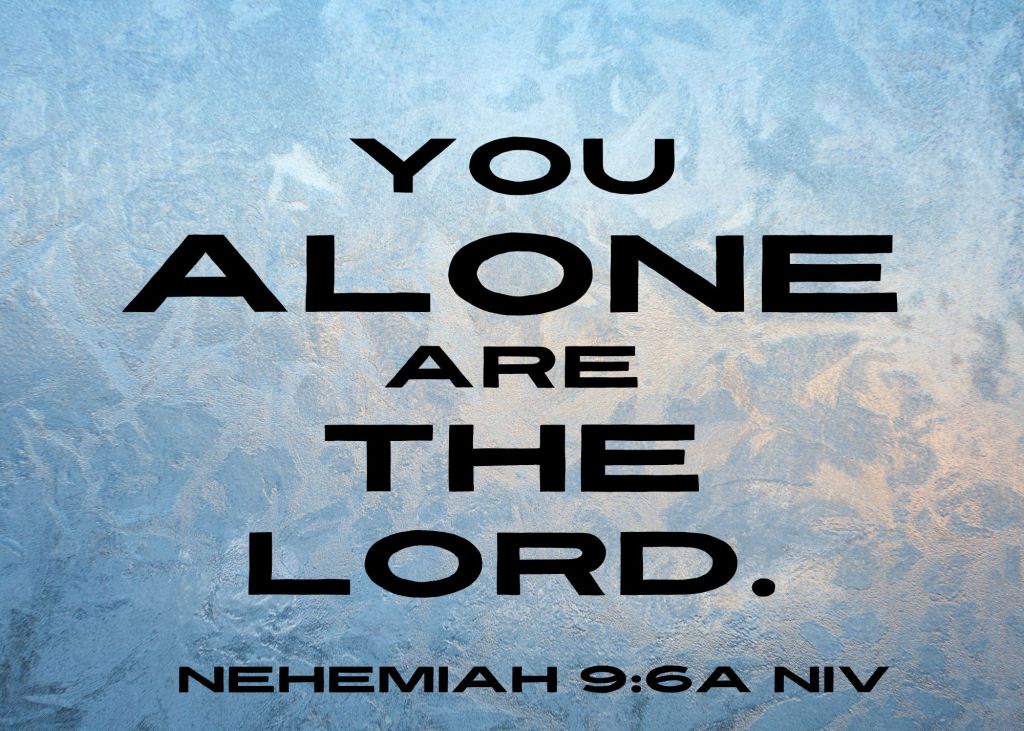
To read Nehemiah 9 after Deuteronomy 6 could make a jarring shift of perspective, as we are skipping almost to the end of Old Testament history. But certain elements remain the same. The group that has gathered in mourning is the Hebrew people, hearing Moses’ words from Deuteronomy (“the Book of the Law”). They have received a call to commitment, but not in preparation for the people’s history with God in the promised land. Rather, after looking back on many centuries of Israel’s history, leaders of the people (who at this point are not a nation but under the rule of Persia) are signing a pledge to serve God as they were always meant to.

     A poor understanding of God’s intentions from the Book of the Law was part of the problem. That book is meant to be read aloud to the nation every seventh year (31:9-11), but such readings rarely took place. In fact we are told more than once in Nehemiah that the people had forgotten about certain laws. Just before our chapter the people learned about the existence of the Feast of Booths, and they commemorated it for the first time since the days of Joshua (Nehemiah 8:14-18).

     Reading through the people’s history as the chapter describes it may make it difficult to understand why God did turn back in mercy so often, but God set the precedent at the very start. God “chose” Abram because of his faith and made a covenant with Abram which included blessings on Abram’s descendants; they had to survive (v. 7, NASB). And at the very base level God fulfills promises because God is righteous, not because anyone else is (v. 8). That is part of why God deserves and receives the praise He is given throughout the chapter. God is not like the idols, not only in being real, God is not like the selfish and inconsistent beings they were described as being.

     In jumping from Deuteronomy to Nehemiah we have skipped over centuries of difficult history, full of incomplete response to God’s direction. If you haven’t read the events of that history it might be unclear to you how idolatry maintained its presence in the promised land during those centuries. But even when reading those texts you may be left muttering “why?” at different points. God showed His power in judgment time and again, as well as demonstrating powerful mercy when the people called out to Him, but time and again the people turned away. The mourners did not intend to sugarcoat that history. They arrived at this balanced plea about their situation: “Do not let all the hardship seem insignificant before you . . . However, You are just in all that has come upon us” (v. 32, 33). In effect they said ‘Please don’t decide that we should suffer more for our past failings, but we will not question what you have done.’

     Coming after all that pain, it would be nice to think that the people had finally ended the cycle of idolatry, and established a commitment to the Law, but it seems they had not. The “last straw” event for idolatry in the land was tied to the Maccabean Revolt (160s B.C.). So while the pledge of devotion was a heartfelt effort at a changed relationship with God, it was not permanent, or it did not sweep over the whole people. (The Bible does not record what happened, the events occurred in the 400-year gap between the Old Testament and the New Testament.)

     Lord, I think it can be easy for our own lives to resemble the history of Israel in Nehemiah 9, for you to choose to enter a covenant with us and bring great moments of rescue, and food and water as support in our personal deserts. But many of us have also been through some cycles where we turned stubborn shoulders and stiff necks and wouldn’t give you our ear. Thank you that you are patient and righteous. Thank you that you do not give up on what you know to be true. For myself, at least, thank you for putting me through enough hardship, at least in my heart, to keep me attentive to you and your will. In the name of your Son, Jesus. Amen.

-Daniel Smead

Reflection Questions:

  1. A covenant is a binding agreement between two parties. God chose to put Himself under a covenant with Abram and then reemphasized and clarified it with his descendants. Verse 32 describes God as “the great, the mighty, and the awesome God, who keeps covenant and lovingkindness” – how important do you think the fact of covenant is to God’s willingness to maintain patience with His people?
  2. Have you felt that you were caught in a cycle of struggles with God? Do you remember that God is in a covenant with you? Recall that God isn’t going anywhere.
  3. It can be striking how unthankful the Hebrews sometimes seemed. Looking through the chapter, find five or so good things God did for the Hebrews – do you think they gave God enough thanks for them?   With that in mind, can you identify items or events that are in any way comparable that God has done or promised for you? Do you think you have thanked God as much as you think the Hebrews should have done in your place? If you have not, what do you think causes the difference? (Is it one of perspective, in perceiving another person’s issues compared to yourself? Is it about thinking the Hebrews should have been more thankful because you know they were punished for their behavior?) How highly do you value the expression of thankfulness to God, in itself? How highly do you think God values it?

Loving the One Lord our God

Theme Week: 1 God, 1 Messiah – Deuteronomy 6

Old Testament Reading: Deuteronomy 1 & 2

Psalms Reading: Psalm 77

(Our SeekGrowLove 2023 Bible reading plan includes 7 theme weeks spread throughout the year. This week is the first and will focus on 1 God, 1 Messiah. The OT and Psalms readings will continue and the third reading will be a chapter that lends itself to the theme. At the bottom of each devotion is a link to the yearly schedule you may download and print if you would like to keep track of where we are going next. Thanks for reading along! Let’s keep Seeking God in His Word, Growing our Faith and Loving Him More and More!)

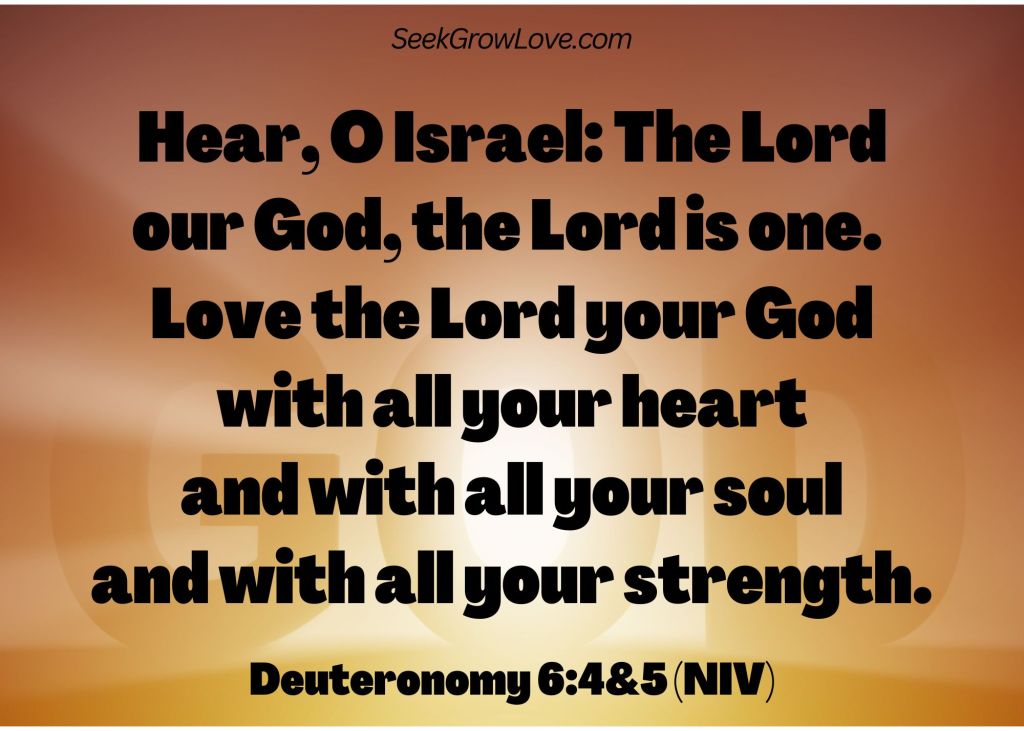
     Deuteronomy 6 is seen as a foundational chapter for discussing the “oneness” of God. People sometimes divide the teachings of Christianity into orthodoxy (right teaching) and orthopraxy (right action). On that basis the idea of there being only one God generally gets put under the heading of a teaching. But I think God may see our faith as a more active part of our lives than that description brings to mind.

     When Moses says, at the start of Deuteronomy 6, that he is relaying “the commandments, the statutes and the judgments which the Lord your God has commanded me to teach you” (NASB) he is continuing a thought from Deuteronomy 5 (see v. 31). Moses had described how it made the Hebrews afraid when they heard God’s voice at Horeb (Sinai) almost 40 years earlier. They had asked God not to speak aloud to them anymore, but to speak to them through Moses. The people gathered at that mountain knew that God was their God. God had already proven His faithfulness (He brought them safely from Egypt, after all), but God had also shown His judgment. They believed that to keep hearing that voice would mean their deaths. And God didn’t object to what they said. Maybe God even agreed that they risked death from being exposed so closely to God’s holiness, if only because they wouldn’t always respond to it properly. “Oh that they had such a heart in them, that they would fear Me and keep all my commandments always, that it may be well with them and with their sons forever!” (5:29).

     Moses says he is going to tell us “the commandments, the statutes and the judgments,” and what he starts with is that the Lord is God and is singular, which feels close to the core of the matter. This chapter opposed the nations in the land the Hebrews were about to enter. But the message is deeper than a warning against the idols that would all too often distract coming generations of Hebrews. This is about commitment and devotion in living for God. To love with your whole heart, your whole soul/life, and all your might – that is not something you can just fall into, it is something you choose, and which you need to keep on choosing.

     Moses was about to die, this speech was his farewell address, and he offered a plan that could steer the course of the history ahead of him. The generation that was being told these things was able to remember the miracles of the desert; many of them still could recall the Exodus and crossing the Red Sea. The idea was for that knowledge, that certainty about God, to be presented to each generation so it could take hold of faith for itself. But things did not go that way.

     Lord, please allow me to love you with my whole heart, soul and might. I know this is not the first time I have pledged this, and that I have not maintained that focus. But you, Lord, are a great God. You are worth turning back to, I will not give up on you because I am imperfect. And you are a merciful Lord who is willing to receive those who turn back. You will not give up on me because I am imperfect. Please help me to be renewed in what is appropriate for your glory, and to do service for your name and the name of your son, Jesus. Thank you, Lord. Amen

-Daniel Smead

Daniel Smead is a father of two, former pastor of the Eden Valley Church of God, former editor of the Church of God Adult Quarterly and sometime teacher at Atlanta Bible College. He lives in Minnesota with his family and attends the Pine Grove Bible Church. In his free time he is working on creating a board game centered around early Christian heresies.

reflection Questions:

  1.  The text says to bind these words on your hands and your foreheads. Some see this as a metaphor, saying to let the scripture affect what you do with your hands, and how you think. What are some ways you could do that?
  2. Verse 24 says that we are to “fear the Lord our God for our good always”. Is it difficult to remember that God does not want anything for us that is bad for us? How do you remind yourself of that?
  3. It sometimes seems impossible that the Hebrews were denying God’s existence, rather they failed to worship their God by choosing to describe God to themselves as something other than what God is. At Sinai they pictured God as a golden calf, wanting to see the unseeable God, making God more understandable for themselves. Perhaps at Jericho Achan – who had been present for Moses’ speech – managed to mistake God for someone who cared about human wealth and advancement more than purity. Perhaps you can think of some other applications of this principle. How clearly do you think you understand what God is like? How does that understanding help you?

42 Months. 1,260 Days.

Revelation 11

Saturday, November 26, 2022

In Revelation 11 John is told to measure God’s Temple and the altar, and the people worshipping there – except the outer court. We never learn that John reported or used these measurements, perhaps it is all a complex object lesson. (Later an angel also measures the New Jerusalem, see 21:15.) Still, the fact of doing this made John walk over every part of the Temple, and it took time. Ezekiel 40‑42 seems to list what he needed to measure – with the addition of the worshippers, and I don’t know how he did that. The whole scene also creates another lengthy pause for John in the vision, which is hard to visualize when reading.

John then learns about the Two Witnesses, who sound like a combination of Elijah with Moses and Aaron. The ability to breathe fire, while new for prophets, fits well if these verses are taken as part of the second woe. Reading about their authority it could seem odd that the nations will walk over Jerusalem and the Temple’s outer court in that time, rather than being driven away. But the witnesses will be in sackcloth for mourning. It will not be their role to drive out all the wicked, but to speak truth. The choice of what happened to the city belonged to its population. Their miracles will strike against those who seek to kill them, and back up their statements, but their basic ministry will be in their words.

And “when they have finished their testimony” the witnesses will be killed in Jerusalem. It is quite the image to think of wicked people celebrating ‘Happy Two Witnesses Day’ and exchanging gifts, perhaps commemorative shirts or mugs. But the wicked will have rejoiced in error. In the immediate aftermath thousands in Jerusalem will die, but the rest “gave glory to God.” Maybe those giving glory will be the first fruit of the witnesses’ ministries at that time. If so, I think they will be welcomed to the truth with joy, and the witnesses will count their own deaths as worthwhile. But I believe that the testimony of what these two will faithfully do has already brought great good, before they have even begun to prophesy – that is one of the strange potentials with prophecy about prophets.

The blowing of the Seventh Trumpet is answered with voices from heaven. The kingdom of the world has become the kingdom of our Lord and of His Christ! God, the Almighty, has begun to reign! But it seems like God will be reigning over a world that is still populated by many of the wicked. If the seventh trumpet launches the third woe there is a lot of damage to come, although nothing more is said about that here. John has been told he needs to “prophesy again,” and perhaps it will be necessary to go backward to gain traction to go forward. The three-and-a-half year period which is discussed early in chapter 11 will come up again in chapters 12 and 13. While many people see the seven trumpets as leading into the woeful seven bowls of the wrath of God that is not for several more chapters.

Chapter 11 closes with another reference to the Temple in heaven, as it opens to reveal the ark of the covenant. I think that for the equivalent of the Holy of Holies in the heavenly tabernacle to open says the separation between God and mankind is being reduced or eliminated. This may not be a safe thing for the general population. Rather than a promise of blessings about to pour onto the world, it may mean that holiness will be called for.

Lord, I see in John and the unnamed witnesses people who understood servanthood, who accepted the risks in following Jesus and were completely committed. Allow me to be as humble and as brave as one of your prophets. I don’t need to tell the future. Please let me grow into that passion to do what you desire of me, guided by your Spirit, living in your love, serving in faith, working toward hope. May your will be done. Amen.

-Daniel Smead

Reflection Questions

  1. What good can come from the prophecy of the coming of the Two Witnesses before they have even come? What do you personally gain from looking into the book of Revelation? Who do you know who could potentially benefit from knowing what is in this revelation? Pray for them, and for your faithfulness as a servant of God.
  2. What are your thoughts and feelings about the separation between God and mankind being reduced or eliminated? Why?

The Mystery

Revelation 10

Friday, November 25, 2022

After the sixth trumpet we have a break when John is prepared for what comes next, which mirrors the break after the sixth seal when the 144,000 were sealed. We are reminded that all through this vision John has been writing what he sees, as Jesus told him to do back in 1:19 (10:4). I wonder if he started the vision in front of a blank scroll and finished with a completed work. Or was the writing part of his vision, and he needed to rewrite it all afterward? And I wonder, again, how often what he wrote came to him as part of the vision and how often his words are his efforts to convey what he experienced. For example, did John make the distinction of a “strong angel” himself, based on experience in this vision looking at different angels?

It wasn’t pointed out at the time, but in chapter 5 it was a “strong angel” that proclaimed the question about whether anyone could open the seals of the book in God’s hand. And now a “strong angel” holds the small book John will eat. Perhaps this is setting up transitions in the vision for us, as the book John eats seems to establish his personal involvement in the next part of the vision. (There is one more “strong angel” reference, in 18:21, punctuating and concluding the section on Babylon.)

When our strong angel in chapter 10 cries out like a lion roars, seven peals of thunder respond – these may refer to the peals of thunder that come from God’s throne (4:5). But John is told by a voice from heaven not to write down what the thunders said. Among all the details in Revelation this lack of information can be one of the most interesting things for us. What secret is left out here? I have sometimes suggested it might have been a self-unfulfilling prophecy (my own phrase), something we can’t be allowed to know because knowing it in advance would make it awkward for it to still take place. Like “tomorrow [fill in the blank date] king [fill in the blank name] falls.” In the context it is hard to expect a minor statement – the strong angel is just about to swear an oath by God that the mystery of God is on the verge of being completed.

The same voice from heaven tells John to get the book and eat it, which he does, but first he is warned by the strong angel that it will be sweet in his mouth but bitter in his stomach. This is interesting, because in Ezekiel 2:8–3:3 we get a similar story of eating a scroll that tastes sweet but there is no mention of bitterness. This is more like comments in Jeremiah 15:16-17 about him eating God’s words and finding them a joy and delight, but then being filled with indignation. What John ate was easy to take in but would result in him needing to “prophesy again concerning many people and nations and tongues and kings.” The phrase “prophesy again” is sometimes taken to mean that the next part of the vision will revisit ground, duplicating some parts of the story to get at new aspects of it. And not all of that prophecy would be a joy and a delight. But God will be revealing what He recognizes needs to be shown.

It may be worth recalling that John is in exile when he sees this vision. He will emerge from it to send his letters, his warnings and encouragements and predictions, and continue in exile. We don’t really know how bringing more attention to himself this way during a time of persecution affected his situation. Maybe not positively. But John was God’s worker and working for God isn’t always pleasant for the one working, at the time. But I trust that John absolutely knew the job was worth it, and I hope that he found the experience of his vision encouraging.

Lord, forgive me the foolishness I sometimes experience of wanting to know what you aren’t interested in telling me, and showing too little interest in what you have made plain for me. You have shown me things that are good, help me to act on that awareness. You have shown me things that are not good, help me to act on that awareness as well. If at times I have found your words bitter in my stomach I have little right to claim I have been cheated, for they were sweet on my tongue. And I acknowledge you have given me far more than I ever can give you. Help me to serve you as I ought to, even if I feel I am in the valley of the shadow of death. Your light can never be overcome. I will trust in you. Amen.

-Daniel Smead

Reflection Questions

  1. What are your thoughts and feelings when you read verse 7, “But in the days when the seventh angel is about to sound his trumpet, the mystery of God will be accomplished, just as he announced to his servants the prophets.”
  2. What words of God might be sweet in the mouth, but sour in the stomach?

The Right Days and Hours

Revelation 9

Thursday, November 24, 2022

Chapter 9 gives much more detail on the first and second woes than the first four trumpets, which received just six verses. That mirrors the brief coverage of the first four seals. It is true that seven is “a number of completion or perfection”, but I think more than that is involved with the several sets of seven in Revelation. John’s vision is very complicated, but how it was relayed to him helped him pass it along. It also helped others to memorize it (many believers have heard rather than read Revelation). One aspect is how certain descriptions parallel or contrast with each other. Another useful detail is the images it contains, particularly the throne. Most of John’s vision can be placed relative to that central image. We can’t automatically visualize how that gives the vision structure, but we can attempt to bring it to mind. Perhaps John didn’t always hear the 24 elders at the same volume in the background of a scene, they could have been ‘turned down’ in his perception to let him concentrate on a new event, but several times we read of scenes happening near the throne or of John looking farther away. We don’t always understand the significance of the details John provides, but some of that may be in what we are actually looking for. John provided this book for audiences with varying needs, encouraging in times of persecution, reminding of God’s promises, and offering warnings, among others. Perhaps the final generation of this age will make very special use of the vision, employing some of its peculiar design as an aid to its understanding, when taken in context with events.

The fifth trumpet involves a pit being unlocked to release creatures that are like winged locust-horses prepared for battle. They have human faces with lion’s teeth, long human hair and something like gold crowns. They also have scorpion tails that they will use for five months to deliver pain in a reign of terror. Their targets are only those who don’t have God’s seal on their foreheads (9:4, referring back to chapter 7). These attacks cause so much pain people wish to be dead, but they aren’t killed. You can choose whether to see them as monsters, or perhaps a really complex metaphor. In Jeremiah 51 we read of an army serving God in bringing judgment described as “a population like locusts” (v. 14) and “horses like bristly locusts” (v. 27), maybe picturing their armor. But this goes a fair way beyond that. And it doesn’t help that their leader is described as an angel king known as Destruction or Destroyer. We only hear of him this one time, but it seems like we will read about the pit again a few days from now – the key to the pit will be brought back by another angel so that the devil can be locked up there (20:1-3).

The sixth trumpet is blown, and a voice speaks from the four horns of the golden altar (in front of God’s throne). This takes us back to just before the start of the sequence of seven trumpets when a censer filled with fire from the golden altar was cast onto the world. Each of the first four trumpets related to flame, and the fifth trumpet involved a burning star falling from the sky and smoke rising up. Now with the sixth trumpet the reference to flame is very distinct. The voice calls for four angels which have been bound at the Euphrates River in the Middle East to be released. We are told they were kept in waiting for this exact day and hour, but it isn’t fully plain what their role in the situation is. Perhaps they act as generals directing the force which emerges, for there comes a massive army of what are in effect mobile flame throwers. They are described as 200 million horsemen mounted on creatures with lion’s heads and snake tails capable of producing fire, smoke, and sulfur from the mouths at both ends. Sulfur (which has also been known as brimstone) produces a dangerous gas when it burns, and its flames are difficult to put out. The text pictures the fire, smoke, and sulfur as three plagues on humanity.

We are not given a timeframe for how long the second woe devastates humanity, but the death toll is a third of the global population. We also learn that in the wake of these events the survivors do not change their ways. In 6:16 we heard that the people realized God’s wrath had come, but they wanted to hide from it rather than repent. This text reaffirms that remorseless attitude, as well as stating some of the evils they were guilty of. Between the two trumpets there is quite the display, first a group of people who hurt so badly they wish they were dead but who don’t improve their lives during the course of five months of this, and then the deaths of masses of people without providing a cautionary tale to anyone. If God is teaching lessons by these events perhaps it is less to the people of that time than to us, letting us see how far gone matters will be by then, making us aware that God picked the right time for the end of the age. Renewal needs to come, I long for renewal actually, but let it be at the right time. The Father knows all the right days and hours.

Lord, you are loving and patient and kind. But you will not let the wicked go unpunished. You are the one who provided the Lamb, you wanted the stain of sin to be removed from me before I even knew what it was. You want to avoid punishing. You want to save, to protect, to shelter. You once flooded your creation and said you would never do it again. But you reserved this world for fire because the flood didn’t solve everything. And I’m sorry all this came about. I grieve that it was necessary. Please show me how to be a blessing, to use your Spirit to make this world a better place and reduce some of the suffering that might have been in it when you will need to act. Thank you God, I love you. Amen.

-Daniel Smead

Reflection and Application Questions

  1. Would you rather…live through the events of the 5th trumpet or be killed in the events of the 6th?
  2. Why do you think God prompted John to write down the vision of the book of Revelation? Why are we reading it today? What specific further actions should it lead us to?
  3. Can you give an example of God’s perfect timing, either from the Bible or a personal account?
  4. How would you describe God’s love AND His need to punish the wicked to someone who has never met God?

Silence in Heaven…Then the Trumpets Begin

Revelation 8

Wednesday, November 23, 2022

            At the start of chapter 8 the Lamb opens the final, seventh, seal of God’s book, and there is silence in heaven for about half an hour. John may have experienced this, felt it, but it is difficult as a reader to appreciate a dramatic pause. And it was not just a pause but a silence – praise has been the backdrop of John’s vision for some time, from beasts and elders and angels and creatures, and more recently they were joined by a vast throng. Suddenly all is silent. This was reverence. The book was fully open. We humans still aren’t told what that means precisely, but what it means is very big.

We then transition into a new series of seven with the blowing of trumpets. It isn’t quite clear whether this resulted from opening the seventh seal, or not. People question whether the trumpet blasts proceed chronologically after the seals or if the trumpets describe some of the same time as the seals, perhaps focusing in tighter and narrowing our attention. 

After the trumpets were distributed, and before they were to be blown, we are reminded that the tabernacle on earth was a shadow of the one in heaven. An angel works with the prayers of the saints that are on the golden altar before the throne, mixing them with incense in a censer and letting the mix go up to God on His throne. Maybe these are the prayers of believers on earth, or this may be yet another reference to the souls of the saints that are beneath the altar, calling God to render judgment soon. Then the angel puts fire from the altar into the censer and casts it down onto the earth – the sounds that accompany its fall suggest this may symbolize judgement commencing (or resuming).

            As the trumpets begin to blast (sounding after the quiet, like a new fall of Jericho) there are disasters that bring to mind the plagues against Egypt, and the destruction of Sodom and Gomorrah. As with the first four seals the first four trumpets seem to go together in a set, but the big number this time is one-third rather than one-fourth. We don’t know whether a single huge portion of the planet (land, sea, and rivers) is rendered uninhabitable or if scattered sections across it are devastated. Each of the first three trumpets involves things falling from the sky, and the fourth involves the sky growing darker as the lights start to go out. The impression is of creation being undone – but not fully undone, because God still has use for it. It is tempting to say that the falling objects are of increasing size and violence, but we struggle to understand John’s reporting of his vision. For one thing, sometimes we are unsure whether to treat John’s words more as descriptive of what he saw in the vision or as coming from the vision. For example, verse 8 says that something like a mountain fell into the sea, and verse 10 says a great star fell in the waters – from our perspective of what a star really is we may suppose that these two objects were not very different in size but that the “star” probably glowed as it fell. Both would be terrifying.

            One more pause comes with the final verse of the chapter, as an eagle warns that the remaining three trumpet blasts will mark terrible woes. It is unclear if anyone living on the earth can hear the warning. Of course the warning has long been available in the book of Revelation. It remains remarkable for God to offer a warning to people He is on the verge of bringing these punishments to for their sins. But God doesn’t stop caring about His creation even when faced with tearing it apart. We’re talking about the God who is aware of the death of every bird. Creation groans, but God lays out plans so that one day it will be freed from the curse.

             Lord, thank you for your openness to the prayers of your saints. And thank you for not always saying yes to prayers. I, for one, would not have been wise enough to choose all of your plans. You are kind enough to guide us into things we do not understand. Thank you for the opportunity to worship you and rejoice in your presence. Please also help me take opportunities to be silent before you. You are awesome and deserving of both my loudest praise and my silent reverence. Thank you, Lord. Amen.

-Daniel Smead

Reflection and Application Questions

  1. What do you think the significance or purpose of the silence might be when the 7th seal is opened? Have you sat before God in silence? What might the benefit be?
  2. What are your thoughts on God’s justice and judgment? Have you ever prayed for it (for someone else more sinful than yourself of course)? How can we better appreciate God’s timing and wisdom in this matter?
  3. Have you thanked God for his creation today? Thank Him for His plans to free us from the curse.

God’s Gifts and Rewards

Revelation 7

Tuesday, November 22, 2022

Chapter 7 is one of the passages in Revelation which can seem like it reverses or unworks what God had done before. God had called out a people for His own, setting Israel apart. Then God sent Jesus and brought up an upheaval in the relationship of God and humanity. The events of Pentecost launched the church, and while it took some time for Jews and Gentiles to be combined in one organization it can be a surprise for people to find Israel identified here again, and not just as a nation but with 12 tribes. But even in this context the tribes are set together with the peoples of the world, based on their common acceptance of God and the Lamb.

 At the start of the chapter a period of calm is established. Perhaps this does not follow chronologically from the events that were described just before, we may be stepping away from that part of the vision to get another angle on things. We are told about four angels who have been authorized to bring destruction with the four winds of the world – from the four main directions – but for now the angels are keeping the winds still at the instruction of another angel holding the seal of God. In this time of calm that angel seals 144,000 people, 12,000 each from 12 tribes of Israel. This is a vision so perhaps the sealing process passed quickly, as can happen in a dream.

The identities of the tribes who were sealed create a small puzzle. We are used to reading of Joseph’s blessing being passed to his sons Manasseh and Ephraim (for the ‘half-tribes’), forming a set of 12 tribes only when Levi is excluded from the normal count. Levi gets excluded because Levi’s descendants gained a special role with God in the time of Moses and that was treated as their inheritance instead of land. But here Ephraim is excluded, and we have the “Tribe of Joseph” and the Tribe of Manasseh joining the Tribe of Levi. We lose Dan, the northernmost tribe, instead. Why? It might be because Ephraim’s name is so associated with the line of kings who brought idolatry to Israel, and that Dan was the tribe first associated with idolatry in the time of the judges (Judges 18:30-31). But we also have in Ezekiel 48:2 the prophecy that Dan will be in the kingdom and receive land, so there is something symbolic happening here rather than something permanent.

The larger point is that God continues to have a portion of people who are sealed for Him – God never gave up on Israel, never gave up the promises made to Abraham, Isaac, Jacob, David, etc. The results may not look like what people were expecting at different points along the way, but God does not forget to give gifts (just as God does not forget to give punishments, which the previous chapter was establishing). The significance of the seal itself in the Revelation vision doesn’t come up until chapter 9, but in marking those who are with God it provides protection (at least). I see this as being rather like the Passover in Egypt, but rather than being told to remain safe within certain buildings marked with blood the people themselves were marked for God and therefore able to travel with protection. And unlike those earlier Hebrew people they were not being told to separate themselves from everyone else, the context pairs them with a crowd “beyond count” from every nation and people.

The crowd in white robes sounds much like those who had been slain (6:11) who were “waiting” for their fellow servants who were to die. We are told that these many “came out of great tribulation” (7:14) but are not told how many (if any) survived it. This may be another reference to the souls from under the altar. Or others may have been added to the number. What is clear is that God rewards His servants. It says they shall hunger no more, thirst no more, and no longer will the sun beat down on them. It sounds like we are being told that the curse on the soil doesn’t apply to them anymore; they no longer must be concerned about working by the sweat of their brow to eat. Springs of living water are being offered, and God Himself will wipe the tears from their eyes. Pain and struggle is being reversed – permanently. You can see why I think this chapter may step out of the chronology of the vision to give an overview of promises that are being offered, refreshing our memory of joy.

Lord, you keep your promises, even the ones I don’t fully understand. Please help me to take seriously what you have said to me, and what I say to you. Thank you that you love so much better than I do. Let me be committed to learning from you, not simply facts or ideas, but growing as a person and growing in my relationships with others and with you. Help me to remember that you never want anything bad for me. Help me trust you to show me right paths. Thank you, Amen.

-Daniel Smead

Application & Reflection Questions

  1. Who will receive the punishments of Revelation 6? Who will receive the rewards of Revelation 7?
  2. What do we learn from Revelation 7 about worship, commitment and faithfulness?
  3. What are some gifts and rewards God has already given to you? What gifts and rewards are you still looking forward to? Give thanks to God for what He has done, is doing, and will do!

The 6 Seals of Revelation 6

Revelation 6

Monday, November 21, 2022

 With chapter six the Lamb begins to open the seven seals of God’s book. John has not been told what that book contains, but he understands it is important. It becomes clear that the breaking of each seal moves history forward toward the kingdom of God. Some people may think of the book of Revelation as a set of descriptions of disasters – it is not, really, but for those who think of it that way the start of their evidence is here. Great violence will precede the arrival of the reign of peace we all anticipate.

People have tried to understand what the seven seals of the book are like by questioning how they are set up. Must they all be broken before anything can be done with the book? Or does the breaking of each seal allow a new section of the book to be read out, until the next seal is reached? Might it be that the portion being read describes what John is seeing? Or are the contents of the book about matters beyond all of this? Either way, there is more to God’s plan than what is relayed to us at this time.

The first four seals (v. 2-8) tell us about the famous “four horsemen of the apocalypse” (“apocalypse” just comes from the Greek word for “revelation” or “uncovering” found in Revelation 1:1). We could describe them in different ways, but it looks like a pattern of conquest leading to war and crop failure and then widespread death (including from famine and wild animals). Here we get one of Revelation’s really big numbers – one fourth of the world is given over to the power of the fourth horseman. We don’t know if that means one fourth of the world’s population dies, or if that large a region of the world was affected by the warfare, but this implies massive displacement of people along with the deaths.

The fifth seal reminds us not to get too particular in our interpretation, however, as it shows us the souls of those who had died for the word of God complaining about the delay in judgment. Not the most literal image, certainly. Its presence here lets us understand the urgency and value God places on the restoration of those who have served Him, even though they are not literally suffering anxiety over the delay. It is similar to when God told Cain that Abel’s blood cried out to Him from the ground (Genesis 4:10). God is motivated to action even when the victim of evil is no longer alive to cry out. And even if by our standards God seems slow to act, God will act (2 Peter 3:9). The fifth seal reminds us why all of this destruction happens – God loves His children and will not leave guilt unanswered. The fifth seal also provides one reason why it is not happening faster – because there were still more to be killed who chose to serve God, and so of course there had been more to be saved in choosing God (v. 11).

The events described in verses 12 and 13 align this chapter with Jesus’ words in Matthew 24:29; Mark 13:24 (where Jesus quotes Joel 2:31). Notably, Revelation has sometimes been described as having perhaps 500 references to the Old Testament, possibly without a single direct quotation used in it. This can make it a challenge to keep up with the allusions to other texts.

            The splitting of the sky like a scroll in verse 14 picks up an image from Isaiah 34:4; if we read from that chapter we will get more language of the day of God’s vengeance. All the mountains and islands of the world moving seems to be more than the great earthquake in Revelation 6:12 could accomplish, so we may need to suppose many related earthquakes and aftershocks. A fourth of the world had been disrupted, but now all of it is. The world’s kings and all who had served them try to hide in what is left of the caves and rocks of the mountains. “Fall on us and hide us,” they plead, because the day of wrath of God and the Lamb has come “and who is able to stand?”

It seems like this is a parallel with the souls under the altar. Instead of being told to wait, and comforted, these people are trying to hide and finding no comfort. Something has happened that lets them know why the world is disrupted, but they have not chosen to repent. The text has not taken any effort to describe what kind of people they are, but the language is being picked up from passages about the wicked who spurned God (Isaiah 2:19; Hosea 10:8). I still find it hard not to grieve for them, even just reading about them in advance of their struggles. But I recognize that if we are ever to do anything for them we need to try to do that in advance, to prevent them from reaching this moment in time, and such a point of corruption. I’m not sure if I am meant to feel sympathy for people in the day of God’s wrath or not, but I know this – no one is living in that day yet, so I can still serve.

 Lord, please help me to care deeply about the lives of the people around me. There are so many lost sheep in need of a shepherd, and even dogs who need the opportunity to eat crumbs from beneath the table. One day it will be the last day, and no one will be able to stand. But right now there are things that can be done to strengthen those with weak ankles, to lift up those with faltering hearts, to encourage and to love. Please let me be forgiving, bold, honest, compassionate, so that Christ can be seen in His body and your name can be exalted. Thank you, Amen.

-Daniel Smead

Reflection Questions

  1. What feelings do you have as you read through Revelation 6? What images are most powerful to you? How does it make you view the One who sits on the throne and the Lamb who has the power to open the seals?
  2. How can you prepare today – and every day between now and then – for the coming wrath of the Lord and His Lamb?
  3. Continue to pray the prayer at the end of the devotion. Who is God revealing to you and what would God have you do for them? How? When? Why? With what attitude?

A Hero Shot

Revelation 5

Sunday, November 20, 2022

I think that Revelation 5 sets up a “hero shot” for us, as a film director might express it. A moment when we really get to be happy with who the main characters of the story are. I don’t expect us so much to explain all the details as to take it in as an image. We are allowed to see Jesus exalted, set apart for how great and powerful and significant he is.

Chapter four has already laid out the main setting, with God in heaven in the midst of thunders and voices, adored and honored by beasts and elders. The start of chapter five focuses in on the hand of the one in the throne (God, of course) – John sees in God’s hand a book covered in writing and sealed with seven seals. Maybe the book was always there and is only just now noticed. Or maybe the book has just emerged, as a gift or challenge or whatever role it takes. And the question is ‘who can open this book,’ and some time must pass because the answer comes back that no one can. No one anywhere is found capable of that act. And in his vision John understands the importance for this book which is being offered by God to be able to be opened, because he weeps.

But John is then told by one of the 24 elders not to weep, because the Lion of the tribe of Judah, the Root of David (two descriptions of Jesus as the Messiah) had prevailed, and would be able to open the book and its seals. (The seven seals themselves are finished being opened by chapter 8, and of course we could view that as setting off the further sequences of the seven trumpets and bowls, but notice that the book itself may be seen as a separate issue which involves a larger scope of God’s intentions.) But John is not shown a lion, but a lamb looking like it had been slain. The one who died for us, alive again and forevermore, victorious, ruling and serving.

He took the book, and the beasts and elders took up a new song proclaiming his worthiness. The lamb redeemed us to God, by his blood, out of every kindred, and tongue, and people, and nation. He is worthy to receive power, and riches, and wisdom, and strength, and honour, and glory, and blessings.

The scene described in this chapter shows us human history in the balance. It shows God providing the right weight to allow things to swing to our redemption. There may be no literal moment in history that this scene matches to, but the scene John describes allows us to see what God has done for us, and to praise Him for it. And it allows us to honour Jesus for what he has done for us. And of course they both continue to work for us. On our own we would never have been able to change the world to what it needs to be. God loved us so much that He gave us what we needed to save our lives, and to reshape our world.

Lord, thank you for your awesomeness. Thank you for allowing us the blessing of seeing some portion of your glory, in your creation, in the scripture, in the blessing of your Spirit in my life, in the work of your Church. Please allow our trust in you to continue to grow. Let us raise our hearts and our words in praise to your name and the name of your Son. Thank you for so carefully preparing and guiding Jesus that he could do what he has done for our lives, and for this world. Amen.

-Daniel Smead

Reflection Questions

  1. What do we learn about God in Revelation 4 & 5? What do we learn about Jesus? What are their similarities and differences?
  2. What is your favorite part of Revelation 5? Why?
  3. What do you praise God for? Tell Him – and others. How will you honor Jesus for what he has done for you and the world?