“Per My Last Email”

Jeremiah 14-17

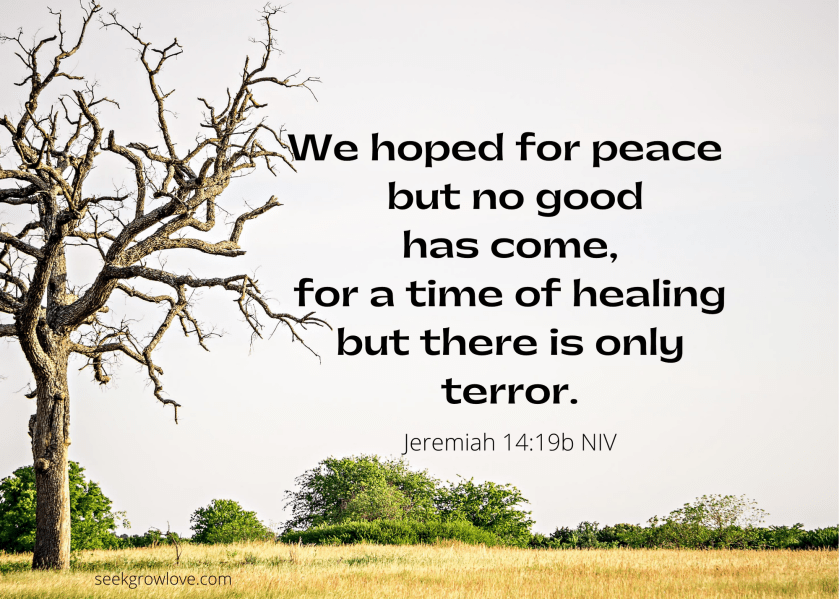
“Per my last email.” I’ve never actually used those words in text or speech, because everyone knows what that means, “ I ALREADY TOLD YOU THIS INFORMATION!!!” It’s a little passive-aggressive, so I’ve only ever thought it. I’ve often wondered throughout scripture, if God has thought similarly. In Jeremiah 14, Judah begins to experience a serious drought. The people begin crying as they start to notice God is not hearing their prayers. WHY are You treating us like a stranger ( 13:8)? WHY are You acting like You can’t do anything for us (13:8)? WHY have You afflicted us so that we cannot heal (13:19) I can only imagine God was thinking, “per my last PROPHET, I ALREADY TOLD YOU WHY!!!!” By this time, at least according to my study Bible’s timeline, Jeremiah had probably been warning the people of Judah for well over 15 years. The people could not claim ignorance of God’s coming judgment and this drought was just the beginning. It does dawn on some of the people that , oh yeah, maybe this has something to do with our complete disregard for Your laws and decrees. Or maybe, it wasn’t even that many people realizing their sins in this passage…maybe it was just Jeremiah…which means it really wasn’t much of an apology at all. 

In chapter 15, God gets a little graphic with His description of Judah’s destruction, using the sword, dogs, birds, and beast (15:3). And that sets the tone for the first half of the chapter. In the second half, Jeremiah and God have a heart to heart chat. I really feel for Jeremiah. It is really hard when you’ve tried so hard to be good, only to have people treat you bad. In this case, make plans to murder you (thankfully, although I can relate with the former, I can’t with the latter)! Jeremiah also expresses disappointment in feeling God has abandoned him. But God assures him He has not, and He will reward him. But not before chapter 16. 

God then asks Jeremiah to go into a type of self exile. He was forbidden from marrying, having kids, or participating in funeral traditions. As God used Hosea as a living object lesson, He uses Jeremiah to live out an example of what God’s coming punishment would be like. Families would be destroyed and so many would die there would be no time for mourning. 

All of this, including chapter 17 is a bleak description of Judah’s folly and God’s wrath. But then oddly, in the middle of the listed curses, is a blessing (17:7-8). If the people would trust in the Lord, they would be planted firmly and withstand the droughts and coming destruction. 

Today’s reading ends with a reminder of God’s command to keep the Sabbath holy. Apparently, the people had given up on this command and were treating the Sabbath just like every other day. ( We could have a very long discussion about what that means for us now… but that’s for another day). 

Unfortunately, like a previous email, the people of Judah disregard all of the Lord’s instructions and decrees brought to them by Jeremiah. 

Just like the people of Judah, we too have been warned, comforted, educated, and instructed by the Holy Word of God. When it comes to the final judgement, we can’t claim ignorance. WE GOT THE EMAIL! Let us put into the practice all we have read and heard until the day of Christ’s return! 

Prayer: 

Dear Father, 

You have given us all we need to come to an understanding of You, Your love, and Your decrees. Please open our hearts to greater learning and understanding so that You know we take Your word seriously. 

Im Christ’s name we pray, 

Amen 

-Maria Knowlton

Reflection Questions

  1. What do you tend to think and feel when someone “under” you completely ignores directions you gave? What happens to your relationship? What are your thoughts and feelings when/if they apologize and return to following directions well? What are the similarities and differences when it is God over you and you are His child who has ignored His direction?
  2. When/in what regards might God be telling you: “Per my last email”?
  3. What benefits do you find in reading and studying God’s Word- his “original email” to you? What are the problems and dangers of not reading and studying His Word?
  4. What is needed beyond reading and studying His Word?

Breaking the Sin-Cycle

Old Testament: Isaiah 1-2

Poetry: Psalm 59 

New Testament: Hebrews 4

In yesterday’s devotion, we were reminded of the importance of obedience and the dangers of disobedience. Even though the passages that we read yesterday were years and years removed from our reading today in Isaiah, similar themes run through both. Israel was continuously going through a sin-cycle of disobedience, discipline, and then a decision to return to God. In Isaiah 1, we see the harsh consequences of sin again. Verse 5 says, “Why will you still be struck down? Why will you continue to rebel? The whole head is sick and the whole heart is faint.” Sin has eternal consequences, and it also has consequences in our daily life. Because of the Israelites’ sin, their home was destroyed, and all of the things that they loved were taken away. Even though sin was destroying them from the inside out, they still refused to submit to God. 

In many ways, we can talk about sin with the same language that we use for other negative repetitive behaviors, like addiction. People who are addicted to something keep returning to it even if the actual desire to do the thing isn’t there. They may actually hate the thing that they do, but they can’t seem to stop themselves from returning to it (which sounds a lot like my relationship with social media). Israel continued to return to sin despite the pain that it caused. 

In verses 18-20, we see a promise to the Israelites. It says, “Come now, let us reason together, says the LORD: though your sins are like scarlet, they shall be as white as snow; though they are red like crimson, they shall become like wool. If you are willing and obedient, you shall eat the good of the land; but if you refuse and rebel, you shall be eaten by the sword; for the mouth of the LORD has spoken.” On their own, Israel could never break out of the sin cycle. When they rested on their own power, they fell back into disobedience. 

But, we don’t have to rely on our own power to break our addiction to sin. This promise for the Israelites – the promise to be made clean, to be freed from sin – found its fulfillment in the sacrifice of Jesus on the cross. 2 Corinthians 1:20 says, “For all the promises of God find their Yes in him.” We now have been grafted into the body of Christ. The promise that was given to Israel has been given to us as well. This is why we can break the sin-cycle in our lives. We don’t have to rely on our own works; we find our rest in him. Hebrews 4:9-11 says, “So then, there remains a Sabbath rest for the people of God, for whoever has entered God’s rest has also rested from his works as God did from his. Let us therefore strive to enter that rest, so that no one may fall by the same sort of disobedience.” We can enter into this state of rest because Jesus has done the work for us. He was the sacrifice that made us clean. Just like the Israelites waited for the Promised Land, we wait in hope for the Kingdom, our eternal glorious place of rest. We have to hold fast to the truth and choose to live rightly. 

How then should we live? Isaiah describes a life that is lived rightly: “Wash yourselves; make yourselves clean; remove the evil of your deeds from before my eyes; cease to do evil, learn to do good; seek justice, correct oppression; bring justice to the fatherless, plead the widow’s cause.” (Isaiah 1:16-17). 

Let’s pursue righteousness as we wait for the fulfillment of the promises of God. 

~Cayce Fletcher

***You can find more of Cayce’s writing at www.amorebeautifullifecollective.com.***

REFLECTION QUESTIONS

  1. Why is it so hard to change our behavior on our own power?
  2. In what ways does it comfort you to know that the Holy Spirit can help you break the sin-cycle?
  3. Do you feel as though you are resting in Christ, or are you relying on your own works?

sgl23bibleplanDOWNLOAD

God’s Restoration

Old Testament: Numbers 31-33

Psalms Reading: Psalms 74

New Testament: 2 Corinthians 11

My Bible notes explain that Psalm 74 is from the time of the exile, after the nation of Israel had been destroyed and the temple left in ruins and the promised land completely ravished. The first half of the Psalm is a recounting of how the sanctuary of the Almighty was decimated by the enemy. The second half of the Psalm is a cry out to God to do something about it. Verse 12 is the pivot point between the two halves. 

As I read Psalm 74, my inner first-born older-sister voice says something like, “Well, what do you expect? Your insolent behavior was basically an invitation to the enemy to come and wreak havoc. You opened the door to the temple wide open with your disobedience. And now you realize your mistake and want God to fix it???”

As if I never did anything foolish. Not once have I been disobedient. And I never have had to deal with the consequences of my poor choices. Nor have I ever asked God to come to my rescue and defend me when I got in over my head. Nope, not at all. Not me.

Maybe this Psalm hits a little too close to home. Because there have been so many times when my disobedience has left me on my knees. I said something that shouldn’t have been said; I ignored God’s voice telling me to walk the other way; I refused to forgive; I thought too highly of myself. And when I realized what I got myself into, the only thing I could think of doing was crying out to God for help.

While God fully desires us to be obedient, he knows our human nature and capability to mess things up from time to time. He wants us to call out to Him. He longs for us to recognize our need for Him. So even when we open the door of our hearts to something less than God’s best and our lives are turned inside out and upside down, He will come and restore us to who we are meant to be.

Thank you God, for being full of mercy and grace and hearing me when I call out. Thank you God, for not turning your back on me when my mess is a result of my foolishness. Thank you God, for loving me unconditionally, that even though I may have to suffer the consequences of my actions, you redeem me.

-Bethany Ligon

Reflection Questions

  1. When has your disobedience caused the need for restoration?
  2. Is there an area of your life that you have already experienced God’s restoration? What did it look like when it was in ruins? What does restoration look/feel like?
  3. What has God revealed about Himself in today’s Bible reading?

Abandoned Inheritance

Lamentations 1 & 2

Whenever I see a post on my social newsfeed that features images of abandoned buildings, especially amusement parks, I go ahead and click on it to scroll through the photos. I am always intrigued with what I see: carousels with missing horses; buildings with broken window panes; rusted park rides; overgrown weeds winding their way through what used to be “Main Street”. 

To think that these amusement parks used to be the location of families creating memories, friends laughing with one another, people being thrilled have now turned into deserted playgrounds creates a sadness over what used to be.

As I read through the first two chapters of Lamentations, I get a similar feeling of sadness because I cannot help but think about how Jerusalem was described at its apex of prosperity. If you have a few extra minutes, go back and read 1 Kings 10. King Solomon had completed building the temple and his palaces and in this chapter it states that silver was considered of little value (1 Kings 10:21). God’s people truly were experiencing the Promised Land, the land overflowing with milk and honey. If there were a time in history to visit, this would be it!

And 400-ish years later, Jerusalem falls and its inhabitants are taken into captivity in Babylon. God’s Presence literally left the building and the city, as well as its walls, are left to erode.  

As Believers, you and I are filled with God’s Spirit. We are meant to be thriving and living life abundantly. Sure we have seasons of struggle, but overall, we get to experience God’s blessings NOW and have an even greater hope for eternity. Think of it like the days of Solomon where prosperity rules.

Let’s learn the lesson from these two chapters in Lamentations. Let us not find ourselves losing our inheritance due to disobedience. Let us not become like an abandoned place that is left to devastation. Instead, let us focus on being diligent with our studies of Scripture and allowing God to be ruler of our lives.

-Bethany Ligon

Today’s Bible reading passages can be read or listened to at BibleGateway.com here – Lamentations 1 & 2 and James 5

Enter into My Rest

Jeremiah 25-26 and Hebrews 4

In Chapter 25 & 26 of Jeremiah, he continues prophesying to the people of Judah about what is going to happen to them. It sounds to me like he is getting a little irritated with them. Have you ever heard “If I’ve told you once, I’ve told you a thousand times” from your parents? He says that he has been talking to them for 23 years but they will not listen to him. Not only has he been talking to them but God has sent prophets to them for years and they refuse to listen. He is telling them that they have a choice to make. He says in Chapter 25:5&6 “Turn now, each of you, from your evil ways and your evil practices, and you can stay in the land the Lord gave to you and your ancestors for ever and ever. Do not follow other gods to serve and worship them; do not arouse my anger with what your hands have made. Then I will not harm you.” God has always given us a choice, which is to choose good or evil, the choice is ours. But he is hoping that we choose to turn from evil and do good, and if we do, he will always forgive us.  But on the flip side, he says, if the children of Judah refuse to listen they will go through hard times and captivity that will last for years.

The prophet Jeremiah could have lied to the Judean people like the other prophets during that time and told them what they wanted to hear, and his life would have gone easier (perhaps for a time), but he did the hard thing and he obeyed God and told them what God wanted them to hear. The people did not like what they heard and they wanted to kill Jeremiah. He put his trust in God knowing that he might be killed. He trusted God with his life and trusted that what God purposed in his life would happen. He says in 26:14-15 “But as for me, behold, I am in your hands; do with me as is good and right in your sight. Only know for certain that if you put me to death, you will bring innocent blood on yourselves, and on this city and its inhabitants; for truly the Lord has sent me to you to speak all these words so that you hear them.” He knows what Paul tells us in Acts 5:29b “We must obey God rather than men.”

Hebrews 4 seems to go hand in hand with the chapters in Jeremiah. The Israelites before them, and then the children of Judah were not able to enter into God’s rest because of their disobedience. We are invited to live our lives in such a way that we will be allowed to live in God’s rest. The children of Judah needed prophets and priests to help them to have a relationship with God, but we do not have to go to the synagogue to have our sins forgiven or go to the town square to listen to the prophets. It says in Hebrews in verses 14-16 “Therefore, since we have a great high priest who has passed through the heavens, Jesus the Son of God, let’s hold firmly to our confession. For we do not have a high priest who cannot sympathize with our weaknesses, but one who has been tempted in all things just as we are, yet without sin. Therefore let’s approach the throne of grace with confidence, so that we may receive mercy and find grace for help at the time of our need.” God’s rest is a life that is filled with the knowledge that God is in control and we will trust Him no matter what hardships we may go through. If we would like to enter into God’s rest, all we have to do is accept the salvation that God has provided to us through Jesus and we are free to enter into God’s rest for eternity.

-Sherry Alcumbrack

Today’s Bible reading passages can be read or listened to at BibleGateway.com here – Jeremiah 25-26 and Hebrews 4

Don’t Withhold the Cure

Jeremiah 9-10 and Psalms 99-101

The Old Testament prophets who spoke for God, including Jeremiah, were entrusted with preaching a lot of doom and gloom. Because God’s children had strayed from his commands, judgment would be coming and the people needed to know. I loved Jeff Fletcher’s illustration in his devotion yesterday of a doctor who could be charged with malpractice if he knew the sick condition of a patient’s insides and knew how to fix it and what changes the patient would need to make in order to cure the potentially deadly ailment, and said nothing. This would be like the Christian who sees the broken sinful world and pretends everything is okay. Don’t withhold the cure.

Jeremiah paints a very vivid picture of a world that is not okay. Chapter 9 opens with the prophet mourning the sinfulness of God’s people. He would love nothing more than to pack up and go to a desert retreat where he could get away from and forget this crowd of unfaithful people. Can you relate? But, rather than abandoning the people in their sin, Jeremiah continues passionately speaking truth for God, over and over, even though his words often seem to fall on deaf ears. He still must speak and write and hold out the cure to these wayward people.

God has had it, too. He aptly describes the situation this way:

“It is not by truth that they triumph in the land. They go from one sin to another; they do not acknowledge me,” declares the LORD. (Jeremiah 9:3b NIV)

and again, “They have taught their tongues to lie; they weary themselves with sining. You live in the midst of deception; in their deceit they refuse to acknowledge me,” declares the LORD. (Jeremiah 9:6 NIV)

It sounds to me like God and Jeremiah are describing the sad state of affairs in 2021. So many lies and deceptions abound when attempting to justify and explain and even celebrate sin and sinful lifestyles that fester and grow when individuals and nations and societies have turned their backs on God.

It is as though God is left without a choice. “What else can I do because of the sin of my people?” (Jeremiah 9:7 NIV) “‘Should I not punish them for this?’ declares the LORD. ‘Should I not avenge myself on such a nation as this?’ ” (Jeremiah 9:9 NIV). God had drawn up the rules long ago with blessings promised to those who followed and curses to those who stubbornly disobeyed. Many chances had been given. Prophets had been sent to remind the people of the deadly disease and of the cure – repentance, turning away from sin and turning back to God. But these were a very stubborn people who took delight in continuing in their sin and lies and more sin and more lies.

God had given mercy. God had given reminders. God had given prophets. God had stretched out the cure. But, to no avail. So, God says – it is time. It is time to teach your daughters how to wail – death and destruction is coming. (Jeremiah 9:20,21).

Towards the end of chapter 9 an interesting section seems almost out of place…

 This is what the Lord says:

“Let not the wise boast of their wisdom
    or the strong boast of their strength
    or the rich boast of their riches,
24 but let the one who boasts boast about this:
    that they have the understanding to know me,
that I am the Lord, who exercises kindness,
    justice and righteousness on earth,
    for in these I delight,”
declares the Lord. (Jeremiah 9:23-24 NIV)

Perhaps it was written more for us who would be reading Jeremiah centuries later, to remind us of the choice we have. And, the great opportunity we have to boast about our God, our Creator, Our YHWH. He created the cure. His Son is the cure that was not yet available in Jeremiah’s day. Sin is the same and comes with the same consequences – death. People today need to know about the cure. They don’t need to hear you bragging about your dinner, your kids, your car, your job, your grades, your house, your ______ (on social media or at the checkout line). They need to know about the LORD our God who exercises kindness AND justice and always righteousness. The Psalms passages today have some great examples of boasting about our God while holding out the cure. How can you hold out the cure today to a nation and world that is unknowingly in the stages of the deadly disease of disobedience?

-Marcia Railton

Today’s Bible reading passages can be read or listened to at BibleGateway.com here – Jeremiah 9-10 and Psalms 99-101

2 Chronicles 28 & 2 Kings 16-17

Storing up treasures in heaven is greater than receiving momentary glory and recognition.

Wishing blessings to everyone this week and all the time. Watching quizzing at FUEL on Tuesday was always a joy, and I always would feel the adrenaline on the edge of my seat watching many friends compete for the championships. At the end of the night watching brothers and sisters in Christ hoist up their trophies and see their hard work come full circle inspired me to want to know the word better and to celebrate them in their accomplishments.  


Looking at 2 Chronicles and King Ahaz, we see a young man become king when he came into a place of power. He angered the Lord because his deeds were for his own self and never gave glory to God nor sought the Lord’s guidance in his actions. Ahaz wanted glory for himself and provoked the Lord. He built alters and offered sacrifices that disgraced the Lord.

As humans we want to be known and want some of our deeds to bring us our own glory and recognition. Ahaz came to power when he was only twenty. He did not follow in the steps of his father, David. Sometimes we want to do things that honor us and get us recognized in front of our friends and others. It feels good, makes us feel worthy. Even when Ahaz tried to make amends, the Lord gave Judah over to those lands surrounding it. It continued with Hoshea as his deeds were evil in the sight of the Lord (2 Kings 17). God calls us to rely on him and give the glory to him for through him we accomplish all good deeds. God gives and he can also take away. God gave the Israelites what he promised them in the promised land. However, because of their disobedience and pride, God took it away.  2 Kings 17:12–13 explains why God let Israel fall as they turned from him. God wishes for us to seek and give glory to him and perform services in his honor. Doing such deeds brings more delight to him and feels you with spiritual delight than any earthly recognition. Storing up treasures in heaven is greater than receiving momentary glory and recognition. God has called you; do not forget these things as we read about others who forgot who their deliverer was. 

Right now, even though we aren’t close to one another, we can still celebrate the accomplishments and the deeds of our friends scattered around the US. This isn’t normal for us right now, but I want you to know I cannot wait for the time to celebrate, laugh, worship and hug everyone glorifying the Lord once again in the future and especially when the kingdom comes. 

“For all things are for your sakes, so that the grace which is spreading to more and more people may cause the giving of thanks to abound to the glory of God.” ~ ‭‭2 Corinthians‬ ‭4:15‬ ‭NASB‬‬

~ Evan Grant


Today’s Bible passage can be read or listened to on Bible Gateway – 2 Chronicles 28 & 2 Kings 16-17.

Tomorrow, we continue reading more about the history of Israel in Isaiah 13-17 – as we continue the 2020 Chronological Bible Reading Plan


God’s Presence and the Garden

Genesis 2 8

Text: Gen 2:4 – 3:24


Yesterday we began talking about the presence of God, starting with the creation account in Genesis 1:1-2:3. We saw that God not only created the earth as a place for us to live, but also as a place for him to be present with us. The heavens and earth are God’s temple.


As we move on in Genesis, starting with 2:4 and going to the end of chapter 2, we find another creation account, and its focus is different than the first, paying special attention to humans and what seems to be agriculture. We are introduced to a garden, and people to cultivate and rule over it: Adam (which literally means man or mankind) and Eve (which literally means living or life). The garden also includes two special trees, the tree of life, and tree of the knowledge of good and evil. The tree of knowledge could have easily been called the tree of certain death, because God promises they will die if they eat from it. But they can eat from anything else.


This garden is a special place. It seems to be a focal point, almost like a holy of holies for God’s cosmic temple. It is sacred space that he shares with his creation. God walks in the garden and is present there with Adam and Eve. Can you imagine just sharing space with God, doing some gardening, and God just walks by, like it was a normal thing? “Oh, hey God.”


That kind of closeness and intimacy with God in his presence was how it was for Adam and Eve, until something happened. There’s a talking serpent. This mischievous serpent character convinces Eve that she won’t in fact die if she eats from the tree of knowledge, she’ll just have knowledge like God. This is tricky because it has just enough truth in it. Maybe you would call it a white lie, but still a deception. Eve eats from the tree of knowledge, and Adam follows suit.


As Adam and Eve ate from the tree of knowledge, they disobeyed God’s direct command and took matters into their own hands, going down a path to prematurely obtain the knowledge of good and evil. They likely had a childlike innocence about them before, and maybe God would have in time revealed this knowledge of good and evil to them in his way, in his time. Well, now things were going to be different for them. They suddenly realized they had no clothes and hid from God. They were ashamed. God finds out what they did (surely he already knew what they did) and kicks them out of his garden.


The consequences were very serious. God has cherubim (winged creatures sort of like a sphinx, not at all like a baby with wings) and a flaming sword guard the entrance so they can’t enter and eat from the tree of life. They are exiled from the garden, they are effectively sentenced to death by no longer having access to the tree of life and God’s presence. They will have to work much harder to grow food to survive, and some other fun consequences.


Reading an account like this makes you think a lot. What sorts of things are symbolized by the tree of life, and tree of knowledge? What is a serpent doing there? Are we really talking about fruit? I have no definitive answers to these questions. The beauty of this passage is that it forces you to think more every time you read it, and I believe that is why it is there.


The garden account is ripe with symbolism to interpret. While it is an account about real people, it is written in a way that makes it much bigger than that. Adam and Eve can be seen as archetypes for us, meaning the things that are said of them are also true of us. Adam is formed from dust (Gen 3:19), so are we (Ps 103:14). Eve is made from one of Adam’s sides, while we recognize that men and women are each other’s halves in a way. They face temptation and shame, so do we. They do things in defiance against God, and so do we (Rom 3:23), and as a result of that defiance, they exiled themselves from God’s garden, as we frequently exile ourselves from God’s presence when we sin, in a way. Their story is much like ours.


This isn’t the most encouraging chapter in the story of God’s presence. It’s one of the lower places we could go in scripture. The reality is that sin and the presence of God are not compatible things. Sin, separation from God, and death are all connected, if not three heads of the same monster. Of course, God knows this, and still wants to be present with us, so there has to be some kind of remedy for sin. Ultimately, we know that remedy to be Christ, but there was a progression to get there.


Tomorrow we’ll look at Exodus 40 – how God used a man named Moses to renew his presence among his people.


-Jay Laurent


Hold Firmly

Hebrews Chapter Four

Hebrews 4_14

There is a belief in the Christian world that some hold to called “once saved, always saved.”  Basically this means that if you come to a saving relationship with God and Christ, then you can never lose your ticket to eternal salvation.  This can be a dangerous perspective because it enables Christians to become complacent with where they are at if they believe they can never lose their salvation.  Worse yet, it can lead people to a life of sin and destruction if they do not take seriously the consequences of sin.  Verse six of Hebrews chapter four discusses this doctrine of once saved, always saved a bit by stating, “Since therefore it remains for some to enter it, and those who formerly received the good news failed to enter because of disobedience.”  The author is stating that some who receive the good news/gospel fail to enter rest because of their disobedience.  They initially accepted the promises of the gospel, but they failed to enter because of their disobedience.  In other words, they were once considered saved when they accepted and received the gospel, but they lost it when they disobeyed.  This verse suggests that maybe the doctrine of once saved, always saved is not founded in the Bible.

This should provide a wakeup call for us!  We need to take the sin in our lives very seriously.  We are to be sanctified and set apart from this world, so let’s act like it!  Let’s not become complacent and degrade the consequences of sin.  God hates sin.  The hardening of our hearts can lead us to sin, and again the author warns us of hardening our hearts in verse seven.  We should take this warning seriously since the author has repeated it three times in chapters three and four.

The concept of rest is repeated a lot in this chapter.  What exactly is the author referring to when he is talking about rest?  Let’s take a look at what this rest is described as in chapters three and four:

  1. Israelites unable to enter God’s rest because of their disobedience and unbelief (3:18-19)
  2. The promises of entering God’s rest still stand (4:1)
  3. We who believe enter the rest (4:3)
  4. God swore that some will not enter his rest (4:3,5)
  5. God rested on the seventh day (4:4)
  6. Remains a Sabbath rest for the people of God (4:9)
  7. Whoever enters God’s rest also rests from his works (4:10)
  8. Strive to enter the rest (4:11)

Here’s what I get from all of this.  God offered the Israelites during the exodus a chance to rest, but they were not able to enter God’s rest because they were disobedient.  The author then compares the rest that was offered to the Israelites to the coming Kingdom.  I come to this conclusion because the promises of entering God’s rest still stand.  There is still a chance to enter God’s rest.  However, not everyone will attain that rest, only the people of God.  In fact God swore that not everyone will enter his rest.  If we are disobedient and unbelieving, then we will not enter God’s rest.  However, if we are a people after God’s own heart, then we surely will enter God’s beloved rest in the coming Kingdom.  Hallelujah! Praise God! Amen!  Therefore, continue to strive toward the Kingdom and bring as many people with you as possible because one day you will enter God’s rest in the Kingdom.

Chapter four ends with talk of Jesus being the great high priest.  We truly do have a great high priest in Jesus.  One of the awesome things about Jesus being our high priest is that he is able to sympathize with us.  Jesus was tempted just like we are, but fortunately he did not sin.  He knows what we go through when we are faced with trials and temptations.  He is no stranger to struggle and suffering.  We can seek refuge in our high priest when we face these temptations because he is able to sympathize with us and plead our case to our Heavenly Father, YHWH.  Jesus being tempted is also more great proof against the trinity.  James 1:13 states, “God cannot be tempted with evil.”  If Jesus were God as well, then James and the author of Hebrews would be contradicting one another.  It cannot be possible for the word of God to contradict itself.  Jesus can’t be tempted, and never have been tempted at the same time.  It doesn’t work that way.  It logically does not make sense.  Jesus was indeed tempted like us, and being our high priest, he is able to sympathize and help us.

To close out today’s devotion, I want to point out Hebrews 4:12, “For the word of God is living and active, sharper than any two-edged sword, piercing to the division of soul and of spirit of joints and of marrow, and discerning the thoughts and intentions of the heart.”  I hope you have gotten benefit from reading these posts.  However, if you don’t get anything else, I want you to know and fully understand that the word of God is living and active.  We are beyond blessed to have the Bible today.  If it weren’t for God’s supervision, there would be no stinking way that we should have it because of the numerous attempts to rid the world of the Bible.  The Bible has only flourished though.  It is truly a divine miracle that we all have access to a Bible, God’s word.  I want to encourage you to keep up the awesome work in delving into God’s word through these devotions.  You are truly doing a great deed.  Keep up the awesome work, and truly believe in your heart that these words are living and active.

-Kyle McClain

God of Mercy. God of Justice.

Ezekiel 17-19

ezekiel

Thursday, March 23

God used the King of Babylon, Nebuchadnezzar to enact His judgment against Israel.  He carried off King Jehoiachin and 10,000 nobles to Babylon and installed Zedekiah to act as his vice regent or king in Jerusalem.  The prophet Jeremiah warned Israel that this was God’s judgment and that the exiles would not return from Babylon until the people repented.  But the people didn’t listen and false prophets gave Israel false hope that Babylon might soon fall.  So Zedekiah broke his treaty with Nebuchadnezzar and made an alliance with Egypt.   This led to a revolt against Babylon.  Nebuchadnezzar crushed the revolt.   Eventually, Jerusalem fell to Nebuchadnezzar and King Zedekiah and family were carried back to Babylon where they faced Nebuchadnezzar’s wrath.  Zedekiah had his eyes put out and his sons were executed.  Israel did not repent quickly nor easily, and because of her stubborn disobedience they continued to suffer.

In Ezekiel 17 God chose to use the allegory of an eagle plucking up the top of a cedar and then replanting it to depict His judgment against his people and to remind them of his power to build and His power to destroy.

In Ezekiel 18 God gives a very clear teaching to His people on the nature of sin, righteousness, judgement, repentance and forgiveness.  Each person is responsible for their own actions.  Parents are not held responsible by God for the sins of their children, and children are not held responsible by God for the sins of their parents.  Each person is responsible for their own behavior.  In the same way, you don’t get credit for your parents good behavior if you do bad.  Each person is responsible for their own sin and will be judged accordingly.

There is good news imbedded in Ezekiel 18.  God doesn’t take any pleasure in seeing wicked people die.  God wants to see people who do evil turn away from their evil.  God wants everyone to repent.  If an evil person repents, God will not punish them.  If a righteous person turns evil, they will be punished for their evil behavior.  God is a God of both mercy and justice.  He will punish unrepentant evildoers and he will forgive and restore those who repent of their evil.  This chapter is best summarized in the final three verses:  30 “Therefore, you Israelites, I will judge each of you according to your own ways, declares the Sovereign Lord. Repent! Turn away from all your offenses; then sin will not be your downfall. 31 Rid yourselves of all the offenses you have committed, and get a new heart and a new spirit. Why will you die, people of Israel? 32 For I take no pleasure in the death of anyone, declares the Sovereign Lord. Repent and live!


In Ezekiel 19, there is a lament for the end of the Messianic dynasty that came from David.  Since the time of David, his descendants, beginning with Solomon reigned as Kings over Israel.  But that has been brought to an end.  There were no more descendants of David serving as the Lord’s anointed over Israel.  Of course, we have the benefit of hindsight.  We live on this side of the New Testament.  After several hundred years of NOT having a descendent of David as King of Israel, one was finally born in Bethlehem and his name is Jesus.  One day, Jesus will sit upon the throne and rule over not only Israel, but all the earth.  In the meantime, we have a choice, we can turn away from our sins and turn to God, or we can face the judgment.  Jesus Christ is God’s provision for our salvation.  We go to him to get a new heart and a new spirit.

-Jeff Fletcher