Well, here is the biggest rescue scene ever! Mark 13:24-27, “But in those days, after that tribulation, the sun will be darkened, and the moon will not give its light, and the stars will be falling from heaven, and the powers in the heavens will be shaken.”
Can you picture it? The utter despair and hopelessness that the world will experience?
Well, thankfully there’s more. “And then they will see the Son of Man coming in clouds with great power and glory. And then he will send out the angels and gather his elect from the four winds, from the ends of the earth to the ends of heaven.”
Does that give you chills? Just when everything appears to be doomed and evil is going to win, God steps in and sends Jesus back. For us.
Verses 19-20 say, “For in those days there will be such tribulation as has not been from the beginning of the creation that God created until now, and never will be. And if the Lord had not cut short the days, no human being would be saved. But for the sake of the elect, whom he chose, he shortened the days.”
It isn’t going to be fun, in those last days, for believers. Those who follow Jesus Christ will be persecuted; sadly, some to the point of breaking. This is why we need each other – to be encouraged to stand firm. Verses 32-33 say, “But concerning that day or that hour, no one knows, not even the angels in heaven, nor the Son, but only the Father.33 Be on guard, keep awake.[a] For you do not know when the time will come.”
But we do know that it WILL come.
Amy Blanchard
Reflection Questions
We must encourage one another to be on guard, to stay awake, and to stand firm. We must see one another to do this, build genuine relationships, and be available to serve one another. Hebrews 10:25 tells us to not neglect meeting together. If you do not have a church you call home, please reach out to someone to help you find one. If you do, are you involved in ways that encourage others, serve others, support others?
Trusting God’s promise of being rescued can be hard. What are some ways He has come through for you already? Keep reminding yourself of the times He has shown Himself faithful to you.
Mema Ballard owned a set of Encyclopedia Britannicas … or is it Encyclopedias Britannica? That is exactly the kind of question one my be tempted to look up in an encyclopedia. Technically, it’s the latter, but she only owned one Encyclopedia, with multiple volumes. It felt like no matter what question we wanted answered, all we had to do was look in the Encyclopedia and boom! Question answered. Crisis of unknowing averted. “All’s right in the world.”
When I entered college, I thought of the Bible much the same way. One library of books, containing multiple works, and if I came with a question, I would have it answered as soon as I learned to know where to look.
It sure would be nice if the editors of the Bible just put it all into easy-to-read statements of fact and doctrine. Why use all this narrative, all these stories, all these symbols? Poetry; why, couldn’t that lead to interpretation, discussion, and, horror of horrors, more questions?
Obviously, it does.
And yet God did not inspire an encyclopedia. He inspired a library of books that pokes and prods and needles as much as, or much more than, it answers and comforts and assuages.
If we are asking, “what can we know about death and the Kingdom at the end of the age”, and we turn to Revelation 20 (conveniently at the end), suddenly a lot of questions crop up.
Which angel comes down and binds Satan?(20:1) Why does Satan need to be released? (20:3) Why is this the only chapter where the dead in Christ are raised in a resurrection apart from the rest of the dead (20:5), and why is this the only chapter where the 1000 year reign of Christ is spelled out in clear detail (20:4, 6)? How could people who saw immortals ruling over them, as is implied, think that they stood a chance, and join forces as “Gog and Magog,” against the “camp of the saints and the beloved city”? (20:8-9)
I think these questions do have answers; for some, they are complicated, and for others, I don’t know them.
Should I say that again?
I don’t know everything.
Questions unanswered, hurtling directly into the unknown, and I feel the anxiety all around.
Do you sometimes feel the same way? That you don’t know everything and the things you do know you aren’t sure about?
You don’t have to know everything, because we can’t.
But we can know one thing with absolute certainty,
We know the ONE who does know everything.
Which angel? An angel sent by the God who controls all things and cannot lose to Satan. Satan is ALREADY defeated, one day he will be bound.
Satan’s release and turning away of the nations? God gives everyone a choice to believe, and people can make the choice to not believe.
The 1000 year reign and two resurrections?
I don’t know everything, but I know that if we place our hope in Jesus, we receive eternal life. (John 17:3) We can and should argue, teach, and debate theological and doctrinal points, because they are important.
But those are secondary to trusting in the Messiah for salvation, and living the way Jesus showed us to live. Because those who do not give in to the sins of this world, and live for the will of God (20:4), they will be blessed. And they are blessed in this way : “Blessed and holy is the one who shares in the first resurrection! Over such the second death has no power, but they will be priests of God and of Christ, and they will reign with him for a thousand years.” (Rev. 20:6)
Do you believe? Because if you do believe, there is just one more thing I know.
Revelation 21:3-4 “Behold, the tabernacle of God is among men, and He will dwell among them, and they shall be His people, and God Himself will be among them, and He will wipe away every tear from their eyes; and there will no longer be any death; there will no longer be any mourning, or crying, or pain; the first things have passed away.”
I know I want that experience.
No death.
No grief or crying.
No pain.
Every tear of sorrow wiped away.
God with us.
I know I want that for you.
And, even with all your questions, you know you want that too.
Because that is good news.
That’s gospel message.
That’ll preach.
Amen.
-Jake Ballard
Reflection Questions
Describe the ONE that you know with absolute certainty. What do you learn about Him in His words? What do you still want to learn about Him?
Why do you think God inspired the Bible as it is, rather than to be like an encyclopedia?
How often do you think about what happens at/after death or what will happen at the end of this age? What is the benefit of studying what the Bible says about these topics?
Jake Ballard is pastor at Timberland Bible Church. If you’d like to hear more from him, you can find Timberland on Facebook (https://www.facebook.com/TimberlandBibleChurch/ ) and on Instagram (https://instagram.com/timberlandbiblechurch?igshid=t52xoq9esc7e). The church streams the Worship Gathering every Sunday at 10:30. Besides studying and teaching God’s word, he is raising three beautiful children with the love of his life, is a big nerd who likes fantasy (right now, Harry Potter), sci-fi (Star Trek), and board games (FrostHaven). If you’d like to reach out to talk Bible, talk faith, or talk about your favorite nerdy things, look Jacob Ballard up on Facebook (https://www.facebook.com/jacob.ballard.336 ) or email him at jakea.ballard@yahoo.com. God bless you all!
I am practically lost without an instruction manual. I have relied on instruction manuals for everything, from constructing Legos and Bionicles when I was young (does anyone remember those?), to building cheap furniture from the department store. Instruction manuals bring order to the chaos; they provide a clear path forward to your desired goal. I admire people that can “wing it” and still accomplish their task without a set of instructions; I am not one of those gifted people. However, I believe that instruction manuals are a good analogy for our Christian life and purpose moving forward; after all, Jesus gave us clear instructions too.
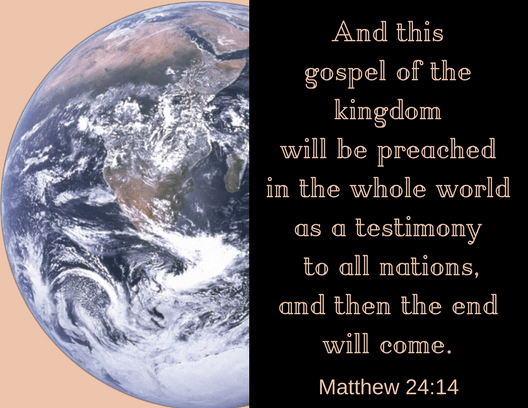
In Matthew 24, we find one of the most interesting and debated texts in the entire Bible. There are details that depict what is going to happen when the city of Jerusalem is conquered by Rome in 70 AD, and there are details about when Jesus will come again on the clouds of heaven to establish the Kingdom of God. Books on top of books have been written about this passage, and its parallels in Mark and Luke; however, not enough has been said about the practical instructions Jesus gives to us here among all the chaotic images described. In verse 14, we are told that, in the midst of all the craziness, we Christians have one job: to share the gospel of the kingdom to the whole world. In fact, Jesus tells us that he will not return until this job has been accomplished.
Brothers and sisters, the greatest contribution you can make in this life is telling someone else about God’s coming kingdom. It is in this message that true salvation is found. It is in this message that God will redeem humanity and the earth. It is in this message that your sins can be forgiven. This message needs to be shared not just in other countries, but with your friend, your neighbor, and everyone else in your life. This is our only mission in life as Christians before Jesus comes back: let’s follow the Great Instruction Manual given by Jesus by sharing the same message that he shared (Luke 4:43). You can truly save a life.
-Talon Paul
Reflection Questions
What are your thoughts and feelings as you read Matthew 24? In your opinion, what is the best part of the chapter? What do you find of great value?
Reading through Matthew 24 what instructions, warnings and promptings do you find from Jesus?
What are you doing to share the good news of the coming Kingdom? What might Jesus like to see you doing this month that you haven’t already been doing?
What did God reveal about Himself today in your reading of His words?
Most people are a bit apprehensive about living in the end times. In Luke 21, Jesus described many things that are going to happen, and quite frankly, most of them don’t give us the warm fuzzies. There will be a lot of death and suffering, but Jesus gives us some good advice on how to approach those days.
I don’t want to freak you out but there will be wars, disturbances, earthquakes, plagues, famines, terrors, great signs from heaven, persecution of Christians, family and friend betrayals, some will be put to death, you will be hated by all, roaring of the sea, men fainting from fear, and the powers of heaven will be shaken. It is safe to say that these will be scary times for Christians, and for non-Christians as well. Therefore, you might think the word to describe the end times is “hopeless”, but quite the opposite is true according to Jesus.
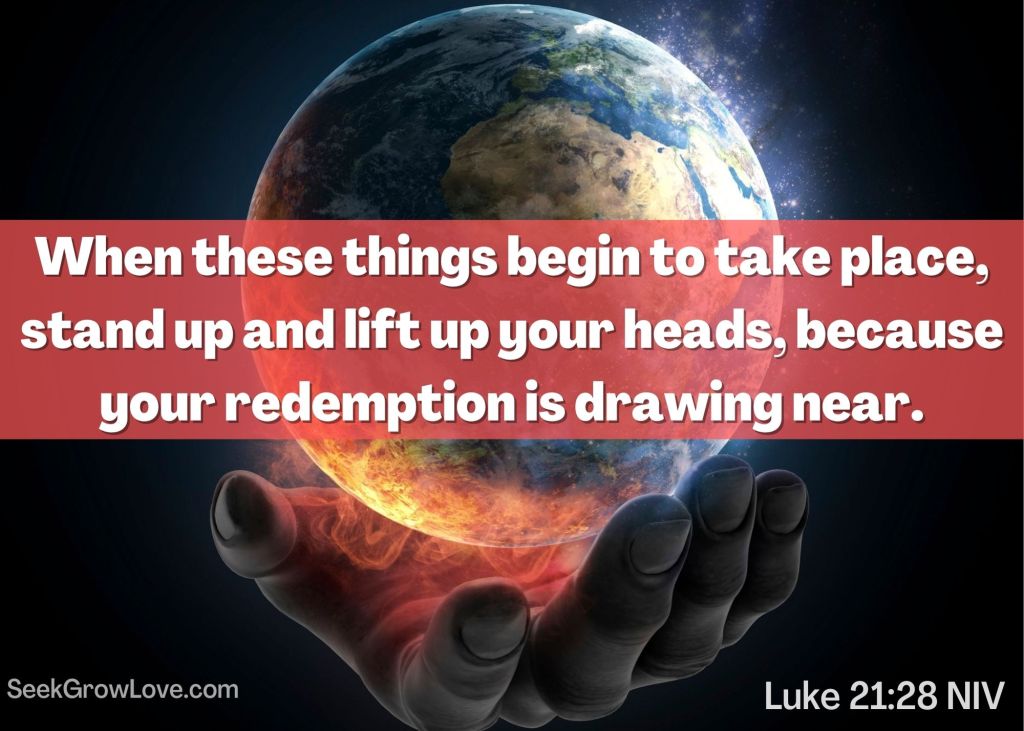
In verse 9, he tells us not to be terrified. He tells us in verse 28 to straighten up and lift up our heads when these things begin to take place because our redemption is drawing near. He continues in verse 31 saying that when we see these things happening, we will know the kingdom of God is near. These are actually going to be pretty exciting times for Christians because we know the start of the kingdom is right around the corner.
Jesus also gives us some advice on how to handle the end times. In verse 34, he tells us to be on guard so our hearts will not be weighted down with the worries of life, and to be on guard so it does not surprise us like a trap. He instructs us to stay alert in verse 36, and to keep praying that you will have the strength to escape all these things.
However, the most surprising and interesting part of this chapter to me was verses 13 to 15. “It will lead to an opportunity for your testimony. So make up your minds not to prepare beforehand to defend yourselves; for I will give you utterance and wisdom which none of your opponents will be able to resist or refute.” I surely wasn’t expecting that guidance. We’re not supposed to be preparing beforehand to defend ourselves because we could potentially have a chance to give our testimony to those who we would be defending ourselves from. We could help someone be saved at this last hour by talking to them, with the words and wisdom given to us by Jesus, rather than fighting against them.
If you are alive during the end times, it will be difficult to watch what will be happening all around you. Nevertheless, you need to remember that we already know who wins in the end, and it is not the bad guys. Some that are weak will lose faith, but those who understand what is happening will be glad that the kingdom is near.
-Rick McClain
Time to ponder:
Do you worry about what is going on in the world today? If so, do you not believe that God is in control and those who put their trust in Him will live happily ever after? Ask God for a big dose of peace that only comes from Him during these difficult times.
How can you prepare today for the end times? How should we not prepare (verse 13)?
Why is it important to study what is going to happen in the future? What could happen to you during the end times if you are not aware of what is happening?
Multiple times throughout the book of Revelation Jesus is referred to as faithful and trustworthy. In chapter 12 we are introduced to a deceptive dragon and in 13 his beast minions that also deceive.
We are all given a choice. To follow what is faithful and true or what is deceptive and false.
When painted so clearly it seems silly that some would actually choose the latter. Unfortunately, if you look around, we see Christians dabble in the ways of the world. They straddle the fence of what is right and wrong.
Those who straddle will be deceived. Right and wrong becomes muddied. Black and white becomes gray. They will slowly drift further from what is faithful and true and more in line with the way of the world.
Vs. 8 describes those who fall into that trap:
“And all the people who belong to this world worshiped the beast. They are the ones whose names were not written in the Book of Life that belongs to the Lamb who was slaughtered before the world was made.”
Revelation 13:8
A few verses later is the mark of the beast. A time when a clear choice will have to be made. Will you be branded and continue to live a worldly life that takes your name out of the book of life? Or will you maintain your allegiance to Christ even if it means severe persecution, being cut off from buying goods and even possible death?
That day may come in our lifetime; it may not. You do not have to wait until then to make your choice.
Like Joshua (Joshua 24) – choose for today whom you will serve – as for me, I will serve the Lord.
Where does your allegiance lie?
Choose today! Choose to follow what is faithful and true and stay vigilant to not be deceived.
-John Wincapaw
Reflection Questions
Can you think of a time when you were deceived by Satan or by “the world”? What could you do differently to not be deceived next time?
Because of the evil, deception and difficult times John writes that God’s people will need what 3 characteristics (see Revelation 13:10 and 18). What grade would you give yourself in each of these areas? What can you do to strengthen yourself in each area?
How has Jesus shown himself to be faithful and true?
Chapter 9 gives much more detail on the first and second woes than the first four trumpets, which received just six verses. That mirrors the brief coverage of the first four seals. It is true that seven is “a number of completion or perfection”, but I think more than that is involved with the several sets of seven in Revelation. John’s vision is very complicated, but how it was relayed to him helped him pass it along. It also helped others to memorize it (many believers have heard rather than read Revelation). One aspect is how certain descriptions parallel or contrast with each other. Another useful detail is the images it contains, particularly the throne. Most of John’s vision can be placed relative to that central image. We can’t automatically visualize how that gives the vision structure, but we can attempt to bring it to mind. Perhaps John didn’t always hear the 24 elders at the same volume in the background of a scene, they could have been ‘turned down’ in his perception to let him concentrate on a new event, but several times we read of scenes happening near the throne or of John looking farther away. We don’t always understand the significance of the details John provides, but some of that may be in what we are actually looking for. John provided this book for audiences with varying needs, encouraging in times of persecution, reminding of God’s promises, and offering warnings, among others. Perhaps the final generation of this age will make very special use of the vision, employing some of its peculiar design as an aid to its understanding, when taken in context with events.
The fifth trumpet involves a pit being unlocked to release creatures that are like winged locust-horses prepared for battle. They have human faces with lion’s teeth, long human hair and something like gold crowns. They also have scorpion tails that they will use for five months to deliver pain in a reign of terror. Their targets are only those who don’t have God’s seal on their foreheads (9:4, referring back to chapter 7). These attacks cause so much pain people wish to be dead, but they aren’t killed. You can choose whether to see them as monsters, or perhaps a really complex metaphor. In Jeremiah 51 we read of an army serving God in bringing judgment described as “a population like locusts” (v. 14) and “horses like bristly locusts” (v. 27), maybe picturing their armor. But this goes a fair way beyond that. And it doesn’t help that their leader is described as an angel king known as Destruction or Destroyer. We only hear of him this one time, but it seems like we will read about the pit again a few days from now – the key to the pit will be brought back by another angel so that the devil can be locked up there (20:1-3).
The sixth trumpet is blown, and a voice speaks from the four horns of the golden altar (in front of God’s throne). This takes us back to just before the start of the sequence of seven trumpets when a censer filled with fire from the golden altar was cast onto the world. Each of the first four trumpets related to flame, and the fifth trumpet involved a burning star falling from the sky and smoke rising up. Now with the sixth trumpet the reference to flame is very distinct. The voice calls for four angels which have been bound at the Euphrates River in the Middle East to be released. We are told they were kept in waiting for this exact day and hour, but it isn’t fully plain what their role in the situation is. Perhaps they act as generals directing the force which emerges, for there comes a massive army of what are in effect mobile flame throwers. They are described as 200 million horsemen mounted on creatures with lion’s heads and snake tails capable of producing fire, smoke, and sulfur from the mouths at both ends. Sulfur (which has also been known as brimstone) produces a dangerous gas when it burns, and its flames are difficult to put out. The text pictures the fire, smoke, and sulfur as three plagues on humanity.
We are not given a timeframe for how long the second woe devastates humanity, but the death toll is a third of the global population. We also learn that in the wake of these events the survivors do not change their ways. In 6:16 we heard that the people realized God’s wrath had come, but they wanted to hide from it rather than repent. This text reaffirms that remorseless attitude, as well as stating some of the evils they were guilty of. Between the two trumpets there is quite the display, first a group of people who hurt so badly they wish they were dead but who don’t improve their lives during the course of five months of this, and then the deaths of masses of people without providing a cautionary tale to anyone. If God is teaching lessons by these events perhaps it is less to the people of that time than to us, letting us see how far gone matters will be by then, making us aware that God picked the right time for the end of the age. Renewal needs to come, I long for renewal actually, but let it be at the right time. The Father knows all the right days and hours.
Lord, you are loving and patient and kind. But you will not let the wicked go unpunished. You are the one who provided the Lamb, you wanted the stain of sin to be removed from me before I even knew what it was. You want to avoid punishing. You want to save, to protect, to shelter. You once flooded your creation and said you would never do it again. But you reserved this world for fire because the flood didn’t solve everything. And I’m sorry all this came about. I grieve that it was necessary. Please show me how to be a blessing, to use your Spirit to make this world a better place and reduce some of the suffering that might have been in it when you will need to act. Thank you God, I love you. Amen.
-Daniel Smead
Reflection and Application Questions
Would you rather…live through the events of the 5th trumpet or be killed in the events of the 6th?
Why do you think God prompted John to write down the vision of the book of Revelation? Why are we reading it today? What specific further actions should it lead us to?
Can you give an example of God’s perfect timing, either from the Bible or a personal account?
How would you describe God’s love AND His need to punish the wicked to someone who has never met God?
At the start of chapter 8 the Lamb opens the final, seventh, seal of God’s book, and there is silence in heaven for about half an hour. John may have experienced this, felt it, but it is difficult as a reader to appreciate a dramatic pause. And it was not just a pause but a silence – praise has been the backdrop of John’s vision for some time, from beasts and elders and angels and creatures, and more recently they were joined by a vast throng. Suddenly all is silent. This was reverence. The book was fully open. We humans still aren’t told what that means precisely, but what it means is very big.
We then transition into a new series of seven with the blowing of trumpets. It isn’t quite clear whether this resulted from opening the seventh seal, or not. People question whether the trumpet blasts proceed chronologically after the seals or if the trumpets describe some of the same time as the seals, perhaps focusing in tighter and narrowing our attention.
After the trumpets were distributed, and before they were to be blown, we are reminded that the tabernacle on earth was a shadow of the one in heaven. An angel works with the prayers of the saints that are on the golden altar before the throne, mixing them with incense in a censer and letting the mix go up to God on His throne. Maybe these are the prayers of believers on earth, or this may be yet another reference to the souls of the saints that are beneath the altar, calling God to render judgment soon. Then the angel puts fire from the altar into the censer and casts it down onto the earth – the sounds that accompany its fall suggest this may symbolize judgement commencing (or resuming).
As the trumpets begin to blast (sounding after the quiet, like a new fall of Jericho) there are disasters that bring to mind the plagues against Egypt, and the destruction of Sodom and Gomorrah. As with the first four seals the first four trumpets seem to go together in a set, but the big number this time is one-third rather than one-fourth. We don’t know whether a single huge portion of the planet (land, sea, and rivers) is rendered uninhabitable or if scattered sections across it are devastated. Each of the first three trumpets involves things falling from the sky, and the fourth involves the sky growing darker as the lights start to go out. The impression is of creation being undone – but not fully undone, because God still has use for it. It is tempting to say that the falling objects are of increasing size and violence, but we struggle to understand John’s reporting of his vision. For one thing, sometimes we are unsure whether to treat John’s words more as descriptive of what he saw in the vision or as coming from the vision. For example, verse 8 says that something like a mountain fell into the sea, and verse 10 says a great star fell in the waters – from our perspective of what a star really is we may suppose that these two objects were not very different in size but that the “star” probably glowed as it fell. Both would be terrifying.
One more pause comes with the final verse of the chapter, as an eagle warns that the remaining three trumpet blasts will mark terrible woes. It is unclear if anyone living on the earth can hear the warning. Of course the warning has long been available in the book of Revelation. It remains remarkable for God to offer a warning to people He is on the verge of bringing these punishments to for their sins. But God doesn’t stop caring about His creation even when faced with tearing it apart. We’re talking about the God who is aware of the death of every bird. Creation groans, but God lays out plans so that one day it will be freed from the curse.
Lord, thank you for your openness to the prayers of your saints. And thank you for not always saying yes to prayers. I, for one, would not have been wise enough to choose all of your plans. You are kind enough to guide us into things we do not understand. Thank you for the opportunity to worship you and rejoice in your presence. Please also help me take opportunities to be silent before you. You are awesome and deserving of both my loudest praise and my silent reverence. Thank you, Lord. Amen.
-Daniel Smead
Reflection and Application Questions
What do you think the significance or purpose of the silence might be when the 7th seal is opened? Have you sat before God in silence? What might the benefit be?
What are your thoughts on God’s justice and judgment? Have you ever prayed for it (for someone else more sinful than yourself of course)? How can we better appreciate God’s timing and wisdom in this matter?
Have you thanked God for his creation today? Thank Him for His plans to free us from the curse.
With chapter six the Lamb begins to open the seven seals of God’s book. John has not been told what that book contains, but he understands it is important. It becomes clear that the breaking of each seal moves history forward toward the kingdom of God. Some people may think of the book of Revelation as a set of descriptions of disasters – it is not, really, but for those who think of it that way the start of their evidence is here. Great violence will precede the arrival of the reign of peace we all anticipate.
People have tried to understand what the seven seals of the book are like by questioning how they are set up. Must they all be broken before anything can be done with the book? Or does the breaking of each seal allow a new section of the book to be read out, until the next seal is reached? Might it be that the portion being read describes what John is seeing? Or are the contents of the book about matters beyond all of this? Either way, there is more to God’s plan than what is relayed to us at this time.
The first four seals (v. 2-8) tell us about the famous “four horsemen of the apocalypse” (“apocalypse” just comes from the Greek word for “revelation” or “uncovering” found in Revelation 1:1). We could describe them in different ways, but it looks like a pattern of conquest leading to war and crop failure and then widespread death (including from famine and wild animals). Here we get one of Revelation’s really big numbers – one fourth of the world is given over to the power of the fourth horseman. We don’t know if that means one fourth of the world’s population dies, or if that large a region of the world was affected by the warfare, but this implies massive displacement of people along with the deaths.
The fifth seal reminds us not to get too particular in our interpretation, however, as it shows us the souls of those who had died for the word of God complaining about the delay in judgment. Not the most literal image, certainly. Its presence here lets us understand the urgency and value God places on the restoration of those who have served Him, even though they are not literally suffering anxiety over the delay. It is similar to when God told Cain that Abel’s blood cried out to Him from the ground (Genesis 4:10). God is motivated to action even when the victim of evil is no longer alive to cry out. And even if by our standards God seems slow to act, God will act (2 Peter 3:9). The fifth seal reminds us why all of this destruction happens – God loves His children and will not leave guilt unanswered. The fifth seal also provides one reason why it is not happening faster – because there were still more to be killed who chose to serve God, and so of course there had been more to be saved in choosing God (v. 11).
The events described in verses 12 and 13 align this chapter with Jesus’ words in Matthew 24:29; Mark 13:24 (where Jesus quotes Joel 2:31). Notably, Revelation has sometimes been described as having perhaps 500 references to the Old Testament, possibly without a single direct quotation used in it. This can make it a challenge to keep up with the allusions to other texts.
The splitting of the sky like a scroll in verse 14 picks up an image from Isaiah 34:4; if we read from that chapter we will get more language of the day of God’s vengeance. All the mountains and islands of the world moving seems to be more than the great earthquake in Revelation 6:12 could accomplish, so we may need to suppose many related earthquakes and aftershocks. A fourth of the world had been disrupted, but now all of it is. The world’s kings and all who had served them try to hide in what is left of the caves and rocks of the mountains. “Fall on us and hide us,” they plead, because the day of wrath of God and the Lamb has come “and who is able to stand?”
It seems like this is a parallel with the souls under the altar. Instead of being told to wait, and comforted, these people are trying to hide and finding no comfort. Something has happened that lets them know why the world is disrupted, but they have not chosen to repent. The text has not taken any effort to describe what kind of people they are, but the language is being picked up from passages about the wicked who spurned God (Isaiah 2:19; Hosea 10:8). I still find it hard not to grieve for them, even just reading about them in advance of their struggles. But I recognize that if we are ever to do anything for them we need to try to do that in advance, to prevent them from reaching this moment in time, and such a point of corruption. I’m not sure if I am meant to feel sympathy for people in the day of God’s wrath or not, but I know this – no one is living in that day yet, so I can still serve.
Lord, please help me to care deeply about the lives of the people around me. There are so many lost sheep in need of a shepherd, and even dogs who need the opportunity to eat crumbs from beneath the table. One day it will be the last day, and no one will be able to stand. But right now there are things that can be done to strengthen those with weak ankles, to lift up those with faltering hearts, to encourage and to love. Please let me be forgiving, bold, honest, compassionate, so that Christ can be seen in His body and your name can be exalted. Thank you, Amen.
-Daniel Smead
Reflection Questions
What feelings do you have as you read through Revelation 6? What images are most powerful to you? How does it make you view the One who sits on the throne and the Lamb who has the power to open the seals?
How can you prepare today – and every day between now and then – for the coming wrath of the Lord and His Lamb?
Continue to pray the prayer at the end of the devotion. Who is God revealing to you and what would God have you do for them? How? When? Why? With what attitude?
In comparison to the previous several chapters, Mark chapter 13 takes a rapid shift into a different topic. Recently Jesus has been responding to the trickery of the Sadducees and corrupt chiefs and priests, but as he and the disciples leave Jerusalem, he begins to speak on the nature of the end of times. Other than the fact that several of the disciples specifically questioned Jesus on the matter privately, I am assuming that this is sparking the point at which Jesus is coming to some sort of terms with what is about to happen. He has been warning the disciples of his death in somewhat cryptic manners, but I would imagine that seeing the state of the city and the leaders who were about to crucify him only made him feel worse.
Now of course, as is always the case, it is important to be able to read the Bible with discernment between literal and poetic/prophetic verse. Interpret with great caution for yourself what makes the most sense in the context of what is being said, so that we don’t confuse literal for metaphor or vice versa. For this reason, I will go through some of what Jesus is about to say and without completely putting a definitive interpretation to it, as much as I can (as is so difficult to do with revelational scripture), I will provide objective fruit for thought that is applicable regardless of your interpretation.
Alright, Jesus begins answering four of the disciples’ questions on what will happen at the end of days, when the stones and buildings will be thrown down. Jesus starts explaining the things that will happen, presumably in order although that is not clarified here, in detail. He first says, “Watch out that no one deceives you. Many will come in my name, claiming, ‘I am he,’ and will deceive many.” Mark 13:5-6. Already he explains that false prophets will come claiming to be the Messiah, and that we are not to believe them. This is the main delineating difference between Christians and the Jewish beliefs; they still await a Messiah. This first point is fairly simple; we must be careful that we do not accept or invite another Messiah, for the one and only has already come. Let’s continue.
“When you hear of wars and rumors of wars, do not be alarmed. Such things must happen, but the end is still to come. Nation will rise against nation, and kingdom against kingdom. There will be earthquakes in various places, and famines. These are the beginning of birth pains.” Mark 13:7-8. Is this not incredibly applicable with what’s going on in the world right now? The news, 24/7, is pumping us with the prospect of potential growing war as the war in Europe is expanding and tensions between America and China heighten day after day. Increased frequency of earthquakes and constant food shortages around the world as farmers are told to stop planting their farms… But remember, “Do not be alarmed.” Have we not already won the war? Our battle is not in the flesh but for the salvation of our souls. The world will always be a bad place, as it is destined to be, but we aren’t put here to worry and cower in fear.
The passage continues with, “You must be on your guard. You will be handed over to the local councils and flogged in the synagogues. On account of me you will stand before governors and kings as witnesses to them. And the gospel must first be preached to all nations. Whenever you are arrested and brought to trial, do not worry beforehand about what to say. Just say whatever is given you at the time, for it is not you speaking, but the Holy Spirit.” Mark 13:9-10. This is a tale as old as time, but ever more important to be prepared for as rights and freedoms around the world are being slowly and quietly removed or revoked in the heat of terror. Not only that, but believers will be brought forward within the church to be punished for the truth. We’ll be thrown in jail and persecuted for his sake. But again, we are told not to worry. What better cause is there to not worry about ridicule than the unquestionable word of God and truth? We have won the war with God on our side, have no fear in the face of adversity.
But what should we do in light of these things? Sure, we can say that we should have no fear, but it’s much easier said than done when facing the edge of tyranny’s sword against faith that is coming. Let’s continue reading to find out. “Therefore, keep watch because you do not know when the owner of the house will come back—whether in the evening, or at midnight, or when the rooster crows, or at dawn. If he comes suddenly, do not let him find you sleeping. What I say to you, I say to everyone: ‘Watch!’” Mark 13:35-37. Be prepared! Fortify your heart and soul with the truth of the word and watch for the second coming of Christ! Don’t wait until tomorrow to finally start that Bible reading plan, or tell your family you love them, or volunteer to work at that homeless shelter. We know not when Jesus is coming back, so we must be prepared at all times for when he does.
Remember, “All men will hate you because of me, but he who stands firm to the end will be saved.” Mark 13:13. Our battle is already won, in the face of all worldly adversity, so be prepared for his coming.
-Mason Kiel
Application Questions
How many times in Mark 13 does Jesus warn to watch, watch out or be on guard (or whatever terms your translation uses)?
Why is this important to Jesus? Is it important to you?
What will it look like for you to be diligently watching for the owner of the house to return?
Do you sometimes find yourself worried about the condition of the world or the end times events? What would Jesus say? What can we do to overcome these fears?
Do you know someone who had a quote or a phrase that they said so often that you can hear it in their voice? Maybe it’s Jerry Seinfeld’s “What’s the deal with…” or you can see a cute electric mouse and hear “pika-pi”. I think most people at Timberland Bible Church can hear these words in my voice : “That’s good news! That’s gospel message! That’ll preach! Can I get an amen?!”
I bring up this aural phenomenon because it happened to me while reading Matthew 24. Every time I read Matthew 24:14, I am transported back to my grandparent’s house. I am sitting at the kitchen table, and James Mattison, who I knew as Papa Jim, is telling me about his ministry in Africa. I had asked, “Why did you go?” right before we ate lunch. And he opened his worn down Bible, though he quoted the verse by heart. “This gospel of the kingdom shall be preached in the whole world as a testimony to all nations, and then the end will come.” I can hear and see him, but I can also feel him : I still see his composure brimming with energy, I can still hear his confidence tempered with humility, but I FEEL his burning conviction. It was not someone else’s duty to speak this gospel to the world. It was his. Malawi, Mozambique, Africa needed the gospel of the kingdom of God to be preached to them. It was imperative, and Papa Jim knew it was his imperative.
James Mattison was consumed by the vision of Matthew 24. He knew it inside out and backwards. But most of all, he knew what it entails. Lots of Matthew 24 is worrisome. Things look bleak, destruction is coming, the end is scary. But that isn’t what Jim was focused on. Primarily he knew that the end had to come so that the perfection of the Kingdom could come. He also saw in this teaching commands, commands that I want you to see. He was consumed by three truths of Matthew 24.
No matter what comes at the end, there is given to the faithful the strength to endure it all. Jesus says the one who endures (in Revelation, the parallel phrase is “the one who conquers”) will be saved. (24:13) But that enduring is not merely hanging on.
In verses 42-51, Jesus declares that he will return like a thief in the night, like a master on a long journey. The ready and alert won’t be caught off guard, and therefore they will keep doing what the master has commanded them.
And what Jesus has commanded each of us is to preach the gospel of the Kingdom. Technically, in Matthew 28:19-20, Jesus commands us to make disciples (more on that later), but part of that is to teach people to follow the commands of Jesus. Preaching the gospel of the Kingdom and teaching all Jesus commanded us is the call for Christians. Let us continue so that the master might find us working.
You may not be called to Africa and in fact most of you AREN’T. You are called to where you are. To endure, to be ready, you need to be consumed by the vision that we see in Matthew 24. Will you listen to the call of Jesus, and tell others the gospel of the Kingdom?
-Jake Ballard
Questions for Reflection and Discussion
Are you consumed by the vision of Matthew 24? James Mattison believed it was his imperative to preach the gospel to the world, especially Eastern Africa; to where are you called? Are you listening for the call of Jesus at all, and if you are telling others of your faith, do you tell them about the gospel of the Kingdom?
Do you feel like you have been skimming by, enduring, or conquering the last year? Do you feel like you AREN’T enduring or conquering? How can you be empowered?