Allegiance to the King

1 Samuel 7-8 and John 19

            When I was a kid in public school back in the dark ages, we used to begin each school day by standing at our desks, placing our hand over our heart, facing the United States flag and pledging our allegiance to that flag.  We did it day after day, year after year.  I never thought much about it, it was just something you did.  In music classes we sang “God bless America, land that I love…”  Then in 6th grade we had a new kid in the class named John.  I didn’t like John very much- as an early bloomer I had actually been the tallest kid in the class for the previous couple of years (with the exception of Linda, a freakishly tall girl).  But among the boys I was the tallest which was a great help on the basketball court where I ruled during recess and after school.  But tall, lanky John was a good 2-3 inches taller than me.  Fortunately, his height did not translate into coordination and he wasn’t any good at basketball, so I still ruled supreme there, but it was still annoying that my height domination had been superceded.  (Fun fact, I stopped growing after 6th grade, so while I was a massively tall presence on the basketball court at 5’10” in sixth grade, by the time I hit 9th grade, still 5’10” I was too short, not quick enough and didn’t have a good enough outside jump shot so I didn’t bother to try out for the high school team.  Post-up skills don’t go very well with being NOT the tallest kid on the team). 

But I digress, back to lanky, uncoordinated taller John who wore clothes that looked outdated and never seemed to comb his hair, and was just a weird kid.  What really set this weird kid, John, apart was that when the rest of us stood by our desks to pledge allegiance to the flag every morning, John didn’t stand.  What is with this strange outlier among us?  Eventually, I discovered the reason for this.  John said he didn’t stand for the pledge of allegiance because he was a Jehovah’s Witness and it was against his religion.  His parent also didn’t vote, and they didn’t celebrate their birthdays or Christmas.  I was quite relieved that I wasn’t a Jehovah’s Witness.  I got to celebrate my birthday and Christmas, I didn’t have to be the odd-ball sitting during the pledge,  and my parents got to vote for Richard Nixon as President.  (that didn’t age well, now, did it?).

It was at that time that I first became aware that for some religious people there was a connection between their religious faith, how they worshipped God on Sunday, and other parts of their life like politics.  It’s been nearly 50 years since I learned that Jehovah’s Witnesses like John didn’t pledge allegiance to the flag, but I still remember that day I learned it.

What do we mean by allegiance?  Webster’s dictionary defines allegiance as:

“the obligation of a feudal vassal to his liege lord, the fidelity owed by a subject or citizen to a sovereign or government. Devotion or loyalty to a person, group, or cause. allegiance to a political party. Synonyms:adhesion, attachment, commitment, constancy, dedication, devotedness, devotion, faith, faithfulness, fastness, fealty, fidelity, loyalty, piety, steadfastness, troth.”

That’s a lot to unpack but for our purposes look at some of those synonyms like commitment, devotion, faith etc… those are all clearly religious words.  For many people their flag represents their nation, their family, their people, their way of life, all that matters to them.  Particularly those who serve in the military often have a ferocious loyalty and allegiance.  The Marine Core motto is Semper Fi, Latin for Always Faithful.

What does any of this have to do with today’s readings?  In his books Salvation by Allegiance Alone and Gospel Allegiance, Matthew Bates makes the case that the Greek word “pistis”, which is often translated “faith” into most English translations of the Bible should more accurately be translated “allegiance.”  Salvation, then is transformed from simply faith in Jesus Christ to Allegiance to Jesus as Christ, or more precisely, Allegiance to Jesus as God’s anointed King.  What does it look like to place your allegiance in Jesus as God’s anointed King over the whole earth? 

In today’s readings in 1 Samuel and John’s Gospel the concept of king and allegiance come to the forefront of both narratives.  During the time of Samuel Israel transitioned from being led by various judges: Gideon, Deborah, Samson and others to a place where they demanded to be led by a king.  Their stated reason for wanting a king was interesting as they wanted “to be like all of the other nations.”  Think of the teenager who makes a request to a parent and when rebuked comes back with “but all the other kids are doing it.”   Samuel took the people’s request for a king as a personal rejection of his leadership, but God pointed out that HE had been their king since they left Egypt and that this constituted a rejection of Him, not Samuel.  God told Samuel to go ahead and give the people what they wanted, a king, along with a word of warning- kings require those in their kingdom to show them a high level of Allegiance, and if you get a narcissistic, proud man as king you will regret it as he will use his power to enrich and empower himself still more.  “Yeah, but we still want to be like everybody else.”

So begins the next phase of Israel’s history in the time of the kings and in coming weeks you will read about those king’s like Saul, David, Solomon and many others.  You will see how even the bravest and godliest, like David and the wisest, like Solomon, misused their power and privilege and eventually the kingdom split, then was taken into captivity and constantly battled the empires and kingdoms around them.  Having a sinful king was no better than a judge.  How much better it would have been if they had simply given their full allegiance to God as their king.

In the Gospel of John Israel gets a do over.  God has given them His own son, Jesus, the sinless human representative of God to be their king.  After Jesus is arrested and brought before Pilate to be judged and sentenced Pilate looks to persuade the Jewish people to change their minds about Jesus.  “Here is your king,” Pilate said to the Jews. But they shouted, “Take him away! Take him away! Crucify him!” “Shall I crucify your king?” Pilate asked. “We have no king but Caesar” the chief priests answered. Finally Pilate handed him over to them to be crucified.”

In the account in Samuel, Israel rejects God as their king so that they can be like everybody else.  He gives them that choice.  In the Gospel of John, a thousand years after they rejected God as king, God’s son, Jesus,  is presented to them as their king, and once again they decisively reject God’s anointed King. Instead, they demanded that he be crucified.  They declared their allegiance that day to Caesar, I guess because they wanted to be like everybody else.  Not much changed in 1000 years in Israel.

2000 years and half a world a way we still have the same choice.  To whom will we give our allegiance?  Will we give our allegiance to the principalities and powers of this age.  Will we give our loyalty to trying to be like everybody else, going along with the crowd, whatever direction the crowd decides we should be going?  Or will we give our allegiance to God’s anointed king, Jesus?

            If you are a Christian living in this world you are a resident alien living in exile.  Your body may be in Ohio or Indiana or Virginia or India, but your citizenship is in Heaven because that’s where your King is currently living.  One day King Jesus will return from heaven to earth and reign right here on earth during the renewal of all things (See 1 Corinthians 15:20-24).  But for now, you and I are living in exile and while  living in exile we should strive to be respectful and law abiding in areas that don’t conflict with our primary allegiance to King Jesus (See Romans 13).  You can be a good citizen in many ways, but never forget that if you are a follower of Jesus, your allegiance is to him first and foremost, not to your country, or your family, or your friends, or your culture or fashion or whatever seeks to define you.  Your allegiance must be to Jesus.

            Can you be a Christian and still pledge allegiance to the US flag?  My childhood classmate John thought, “No, you can’t” and Christians may not always agree on these kinds of questions, but there should be no doubt in your mind as to whom your ultimate allegiance is due, Jesus Christ the King, and God our Father.

-Jeff Fletcher

Today’s Bible reading passages can be read or listened to at BibleGateway here – 1 Samuel 7-8 and John 19.
In Suffering – surrounded by enemies

Psalm 69

We’re going to take a little break from discussing Joshua today to look at Psalm 69. This is one of the Psalms which is most often quoted or referenced in the New Testament (probably coming in 3rd after Psalm 110 and Psalm 22). Similar to Psalm 22, it is a portrait of a suffering servant. In the New Testament these verses will be used to describe Jesus, the ultimate suffering servant. But most likely, there have been a time or two when you thought theses verses could have been describing you, too.

Have you ever felt like you were sinking? Your troubles choking out your breath? The saddest picture I find is from verse 3 “I am worn out calling for help, my throat is parched, my eyes fail, looking for my God.” You can tell someone needs a hug! They are feeling so desperate. Their suffering is so great!

But this is not the cry of someone who has just had a couple bad days in a row – flat tire, sickness, general stress mounting. No, this is David, Jesus, or you surrounded by enemies. You know you aren’t perfect, certainly God knows that (verse 5) but these enemies don’t want to destroy you for something evil you have done, but for the very God you serve. They don’t understand you or your God so they hate you without reason and seek to bring you down for who and what you stand for. “For I endure scorn for your sake…zeal for your house consumes me, and the insults of those who insult you fall on me…people make sport of me. Those who sit at the gate (the town elders, ie – politicians, city councils, professors and principals) mock me” (Psalm 69:7a, 9, 11b, 12a).

Just this week I heard of the 3rd grader in trouble for wearing her favorite mask to school. It said Jesus Loves Me and the principal didn’t like that. Or the college student who was told he had to reserve a small “free speech zone” on campus from which to speak to others about his Christian beliefs and excitement. And when he complied with their rules he was once again told by campus police that he had to stop because some of the students were still complaining. Luckily the Supreme Court had something to say about that one recently.

Surrounded by enemies. We, in America, are watching our nation slip (or free-fall nosedive) from being a nation of “In God we Trust” where the large majority claimed Christianity to a foreign feeling country where our rights are being restricted at every turn. Suddenly “Dare to be a Daniel” means something to us. As new laws and policies develop, we have a new-found appreciation for what our brothers and sisters in Pakistan and other Christian hostile nations have endured for generations. Surrounded by enemies – for our faith? It feels so strange to us – but we are not the first to feel this way. Remember Paul, repeatedly thrown in jail for the crime of speaking the name of Jesus? David, Daniel, Jeremiah, Jesus, Paul and the disciples, the list goes on and on and includes many modern and Biblical role models and even martyrs. Hopefully you didn’t sign up to be a follower of Christ because you thought it was always going to be easy and pleasant. Surrounded by enemies – for our faith! Christians unite, and take up our armor of God (but that takes us into another devotion for another day).

Back to Psalm 69 – After saying his eyes fail looking for God, and all he does see is enemies who insult God surrounding him, he says, “But I pray to you, O LORD”. He is NOT throwing in the towel. Even though it is sometimes hard to see God in the suffering, we keep on praying to Him, knowing He is the Creator, the Sustainer, our Loving and Powerful Rock. Even when it looks bleak, we know the war is far from over. And, we know who does indeed win the war. And, that is why we don’t give up and don’t give in. We are not swayed by the town elders or those who mock us or try to destroy us because of our God. Our God is bigger.

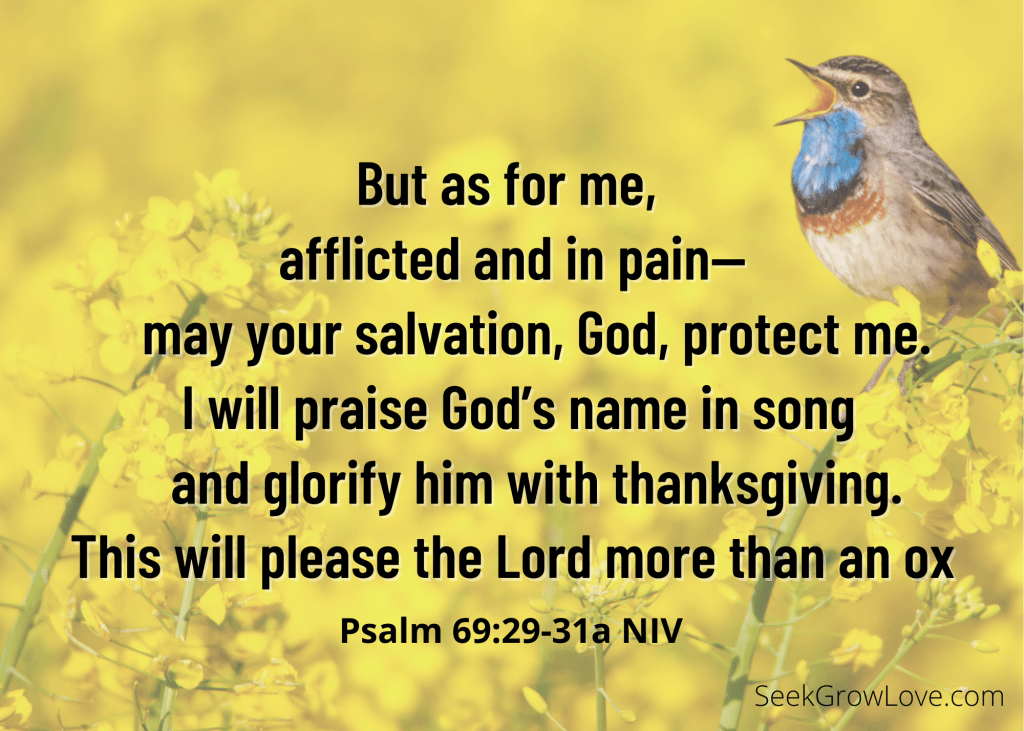
There is one verse towards the end of the psalm that says, “I will praise God’s name in song and glorify him with thanksgiving.” (Psalm 69:30). Doesn’t that sound like he is having a good, sunny, easy day! It’s almost like this verse landed smack dab in the wrong Psalm. Singing, praising, glorifying, thanking. What happened to the enemy surrounds and I am scared and suffering? Oh, it’s still there. In fact, the verse IMMEDIATELY proceeding the praising, singing, glorifying, thanking says, “I am in pain and distress; may your salvation, O God, protect me.” (Psalm 69:29). The trouble isn’t over, but David is still praising. It reminds me of Julie Andrews/ Maria (yes, The Sound of Music was my favorite growing up). Anytime she needed a confidence boost, when she was scared in a thunderstorm, or when the dog bit or the bee stung – she burst into song. We have something much better to sing about than girls in white dresses with blue satin sashes. We have a God who saves, even though we suffer. When we are caught in the storm we have a God who saves. And even while the winds blow and our enemies surround we can pray and lift our voice in song. Jesus did, too. After the Last Supper, before going to the Mount of Olives knowing that is where he would be physically surrounded by his enemies, he sang a hymn.

Keep praying. Keep praising. Keep singing. Keep glorifying. Keep thanking.

The enemy surrounds but they don’t win in the end. Our God saves.

-Marcia Railton

Today’s Bible reading passages can be read or listened to at BibleGateway here –Joshua 15-16 and Psalm 69

Sour Gummy Worms & Copper Coins

Luke 21

My young cousin got a bag of sour gummy worms for Christmas this past year. The following week, he carried the bag along everywhere he went, proudly savoring each lick. He loved those sour gummy worms! At the end of the week, he tried to give me his precious worms; of course, I declined because I don’t delight in stealing candy from children. As he was leaving my house, he hid the candy in my bedroom because he wanted me to have them. He didn’t have much to give, but he gave all he had and did so sincerely. 

Luke describes a similar encounter Jesus had with a poor widow at the temple: 

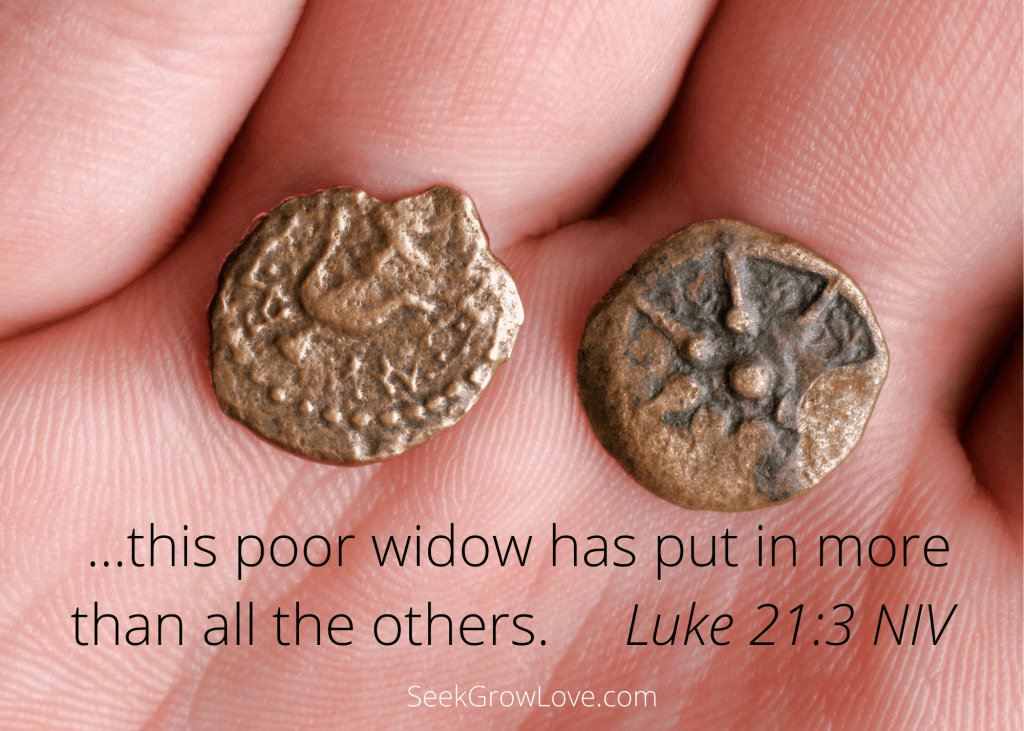
As Jesus looked up, he saw the rich putting their gifts into the temple treasury. He also saw a poor widow put in two very small copper coins. “Truly I tell you,” he said, “this poor widow has put in more than all the others. All these people gave their gifts out of their wealth; but she out of her poverty put in all she had to live on.” (Luke 21:1-4)

We know three things about the woman mentioned: she was poor, she was a widow, and she gave a small amount of money to the church. Her story isn’t flashy and her name isn’t even mentioned. Yet, she honored God by giving the little she had. And you know what? Jesus said her gift was greater than all the others. 

Jesus had spent the past day discussing the intricate details of religious rules and hypothetical situations. They were concerned with religion, but perhaps not the conditions of their hearts. Their attitudes are juxtaposed by the poor widow whose heart was generous and faithful. By the world’s standards, the poor widow’s actions were foolish. She should have used the money to feed her family and allowed the Jews with more money to support the church. In God’s eyes, her giving was a reflection of her faith, and I am sure her family didn’t go hungry that night.

To be clear, God doesn’t need your money—neither your time nor gifts. 

I could have bought my own bag of sour gummy worms at the gas station down the street. In the same way, God can accomplish anything and everything by his own accord. However, He still wants your sour gummy worms, copper coins, and anything you have to give. 

God wants your trust.

God wants you to participate in the mission of the Church. 

God wants to bless you. 

-Mackenzie McClain

Today’s Bible reading passages can be read or listened to at BibleGateway here – Deuteronomy 25-26 and Luke 21

It’s Not Always Easy

Luke 8

Jesus is not know for being particularly easy with his teaching. It can be just plain difficult. 

Sometimes the teachings are easy enough to understand but hard in their application. We know what Jesus said about enemies. He didn’t mince words or obfuscate. Love them. Full Stop.  But, when you have an enemy, you don’t WANT to love them. If you HAVE to love them, then you CAN’T hate them, and in the darkest parts we want to hate some people. But Jesus came to shine a light into even those parts and to change them. So, love (wish and seek the best for) your enemies and pray (bring their needs, cares, and burdens before God) for those who persecute you. That is hard. 

Other times Jesus doesn’t seem to make a ton of sense. A lot of the people in John 6 stopped following him because he said, “You have to eat my body and drink my blood.” And today we can say, “Oh yeah, he was talking about communion.” But THEY didn’t know that. There is a rabbi talking about eating a person and drinking his blood, and they are just thinking about the number of Torah laws and cultural traditions they would have to break. But mostly, they would be thinking “WHAT?! WHY?! What is he on about?” Maybe we shouldn’t be so quick to judge. But they didn’t seem to get it, because his mission wasn’t complete yet. 

And sometimes, the teaching is BOTH hard to understand and seems difficult in the day-to-day living. 

Luke 8 is full of them. Why does Jesus, who is so insistent on US spreading the Kingdom message to all corners of the world, teach with hiddenness? Why does he say, “Go into all the world” and tell everyone to keep it quiet? Why does he teach in parables, so that the crowds would be confused? I could give an astute scholarly answer, that references the nature of prophecy and the different purposes for the mission of Jesus and mission of the church, but in the end it is a head scratcher. It feels weird. It feels hard. It weighs on me. 

Nothing weighs heavier on me from this chapter than Luke 8:18. As a reminder: “18 So take care how you listen; for whoever has, to him more shall be given; and whoever does not have, even what he thinks he has shall be taken away from him.” That’s a hard one! Why should the rich get richer and the poor get poorer? Is that what Jesus is saying?

Though the questions are important, there are times for answers. And of course that is not what he is saying. 

Jesus has just finished saying that a light will not bet covered up but put on a lampstand, and how everything will be disclosed and made known. He has been speaking about the knowledge of the Kingdom, the Gospel, the Word of God, the Knowledge of God, the Logos of God, up to this point.  So the question we need to answer is “whoever has what?” Whoever has a desire and thirst to learn the things of God. Whoever has a desire to serve Jesus. Whoever has a desire to follow him where he leads. Whoever, once the lamp is lighted, wants to see it in its fulness. THAT person will be given more. They will actually acquire the knowledge they are looking for. They will be equipped to serve. They will be empowered to follow. They will see the light, and it will fill them up, all the way from the inside out. 

But whoever does not have those desires…

Well, what little power, strength, might, authority, ability, talent…

It’ll be taken away. 

It’s a hard teaching. But it makes sense. Jesus comes to offer life. If we don’t want life, we don’t get it. It’s not forced upon us. 

You may be wondering, “But right now I don’t want it. I am reading because it’s a habit I can’t break. I am reading while crying because I want it to be true but can’t pull out that belief in me.” Welcome to the Christian Faith, where desires like that have existed beside the “most devout” since the dawn of the church! Ancient Christian authors wrote statements like (and forgive the modern paraphrase) “I don’t want God, but I want to want God.” Even a man declared to Jesus “Lord I believe, help my unbelief.” Maybe you have believing unbelief, or unbelieving belief. Maybe you want to want God. Or want to want to want him. 

Jesus can work with that glimmer. 

Because in the end he will work with us on all the hard passages, on the ones that weigh on us, on the things that are hard to understand and hard to live out. 

The promise from scripture is that, if you let him work, “He will finish the good work he began in us.”

Jesus will give you understanding and peace when you don’t. 

Jesus will give you the skills and ability for service. 

Jesus will give you power to follow. 

Do you want him to? Do you want to want him to?

-Jacob Ballard

Today’s Bible reading can be read or listened to at BibleGateway – Numbers 35-36 and Luke 8

Numbers 21-22, Luke 1

The Israelites’ wilderness wanderings continue in Numbers 21-22. Even though they had chosen not to enter the Promised Land because of their perceived battles, the battles came to them in the wilderness. They faced the kingdoms of Edom, Arad, Amorites, and Ammonites. In all of these battles, the outcome of the standoff was based not in the strength of the Israelite people, but in the amount of trust they had in God. 

The Israelites were a stubborn people though. They had a tendency to forget the lessons they had just learned. In Numbers 21, they had just shown their trust in God when they defeated the king of Arad. But, in verse 4, they began to grumble and complain against God, asking why they had come out of Egypt to the wilderness. This is a recurring pattern with the Israelites. When they face difficult circumstances, they begin to complain. God always responds strongly to their complaints – sometimes strikingly so. It makes him incredibly angry each and every time they begin to act in this way. In this instance, he sent poisonous snakes among the people. At other times, he sent plagues, fire, or disease – anything to show his displeasure. 

We know that this action – the complaining and grumbling against God’s ordained path – causes God anger. But, as I am reading through the book of Numbers, it’s hard for me to really rectify the description of this wrathful, vengeful God and the God of the New Testament who sent his son to wipe away all sins. Why did it make God this angry? Is it really that bad to complain? 

To answer this question, we can turn to the other passage that we were looking at today: Luke 1. This is the story of the pregnancy announcements of both John the Baptist and Jesus – both of which happened before they got pregnant! John the Baptist parents were Zechariah and Elizabeth, another Levite from the line of Aaron. Zechariah was chosen to serve in the temple, a once in a lifetime opportunity for him, when an angel of the Lord appeared and told him, “Do not be afraid, Zechariah, because your prayer has been heard. Your wife Elizabeth will bear you a son, and you will name him John. There will be joy and delight for you” (Luke 1:13-14). After this, I would imagine that Zechariah would be jumping for joy – the desires of his heart, his deepest prayer, had been answered! But, that’s not the picture that we get. Zechariah responds, “How can I know this? For I am an old man, and my wife is well along in years” (Luke 1:18). Zechariah’s prayers were answered, but he wanted proof. He wanted God to prove himself to Zechariah. It seemed like an angel of the Lord appearing to Zechariah just wasn’t enough for him. 

In both the Israelites’ and Zechariah’s situation (as well as the situation with Balaam and his donkey in Numbers 22), they wanted God to prove himself to be God. The previous faithfulness God had shown them wasn’t enough; they wanted God to prove himself to be big enough and powerful enough in that moment for them to trust him. But – I don’t think, for any of these people, anything that God could have done in that moment would truly have caused them to trust him more. It wasn’t on God to prove himself to them. For the Israelites, he caused the plagues in Egypt, split the Red Sea, routed whole armies. For Zechariah, he sent a messenger to talk to him face to face and tell him that his greatest desire was answered. They had already received their signs. It was the people’s responsibility to soften their hearts enough to trust in God. They needed to believe that God was who he said he was and would do what he said he would do. 

We are required to trust in the same way. God has done tremendously more than we have ever deserved. He is currently doing more in our lives than we could ever hope for. It is our responsibility to trust him to be God. We just have to follow in obedience to him.

~ Cayce Fletcher

Read or listen to today’s Bible reading at Biblegateway.com: Job 1-2 and 2 Corinthians 2 .

The Third Option

Mark 11

            Have you ever been in a situation when you didn’t know what to do? Maybe you felt like you only had one or two options and you didn’t like either of them? We will all run into obstacles in our lives that we don’t know how to handle. With almost certainty, this will happen with your faith. You will probably at one time or another be questioned about your faith or pushed on what you believe. Jesus himself experienced multiple situations like this in his ministry. We read about one of those situations in Mark 11:27-33. In this passage, Jesus is confronted by the religious leaders in the temple. They asked him by what authority is he doing and saying these things. If Jesus said that he was doing these thing by the authority of being the Messiah, the son of God, he probably would have been attacked. If he said that that we was doing it by his own authority, he might have lost credibility. Either way, answering this question, at this particular time, would have disrupted the plans God had made for Jesus. This isn’t the only time Jesus was seemingly trapped with a difficult question.

            In John 8:1-11, the Pharisees brought a women, caught in the act of adultery, to Jesus. They asked him if they should stone her according to the Law of Moses or let her go? This lands Jesus in another difficult to answer situation. If he says to stone her, then he is condemning this women. If he let her go, then the Pharisees’ trap would have worked and they could have accused Jesus of denying the authority of the Law. In both passages, what we read in Mark 11 and John 8, Jesus is in a tricky spot and seemingly only has a couple of options. However, Jesus, in the wisdom given to him by the Spirit, comes up with the third option. In Mark 11, he asks the religious leaders a question they can’t answer, effectively ending the conversation. In John 8, Jesus defuses the situation by saying, “He who is without sin among you, let him be the first to throw a stone at her” (John 8:7). After that, everyone leaves. The point is, God provides us with other options.

-Josiah Cain

Links to today’s Bible Reading – Exodus 27 & 28 and Mark 11

Lessons from Jacob’s Dream

Today’s Bible Reading – Genesis 27 & 28 and Matthew 14

In Genesis 28, we find the story of “Jacob’s Ladder.”  Jacob had deceived his father, Isaac, and had “stolen” the blessing intended for Esau.  Jacob was on the run to move in with his uncle, roughly 500 miles away, so his brother Esau wouldn’t kill him.  That night Jacob had a dream with angels going up and down a ladder between God and Jacob.  When God spoke to Jacob, He didn’t condemn him for his trickery; instead, He extended the covenant to Jacob that He had made with Abraham and with Isaac.  God promised Jacob that he and his descendants would inherit the promised land, his descendants would be numerous, and all nations on earth would be blessed through Jacob and his descendants.  God also promised He would be with Jacob wherever he went.

When Jacob woke up, his first response was surprise and fear.  He named the place “Bethel” which means “the house of God”.  He set up this stone pillow as an altar and worshiped.  Finally, he dedicated his life to God.

According to “The Wiersbe Bible Commentary” by Warren Wiersbe, “The ‘if’ found in many translations of verse 20 can also be read ‘since’.  Jacob wasn’t making a bargain with God; he was affirming his faith in God.  Since God had promised to care for him, be with him, and bring him back home safely, then Jacob would affirm his faith in God and would seek to worship and honor Him alone.”

I see several applications for us.

As I understand it, the ancients believed gods (with a little “g”) were local, and if you left an area, you left the protection of the local god.  In this encounter, Jacob thought he had stumbled into the “house of God”, but found that God isn’t limited like that.  Since God would be with him everywhere, everywhere can be the house of God.  According to James 4:8, if we come near to God, God will come near to us.  

Once Jacob encountered God, his first response of surprise and fear quickly turned to worship.  When we first encounter God, we may also be struck with surprise and depending on the circumstance, fear too.  I think it is important for us to continue on to the worship stage as Jacob did.  Note that the altar he built wasn’t for offering sacrifices, it was really more of a memorial that reminded him of his encounter with God.  When we encounter similar milestones in our own lives when God has done something noteworthy for us, I think it is important for us to set up a memorial of some sort.  Ideally this is something physical, that we can look at and be reminded of what God has done for us.

Jacob’s next step was to dedicate his life to following God.  I think this step is imperative for us.  Given what God has done for us so far, our natural response should be, “Since you have brought me this far, and since you have made such great promises to me – the promise of eternal life if I remain faithful until Christ’s return, because of these things, I will live the rest of my life for you, God.”

As the story continues, Jacob had many hardships throughout his life.  Despite them all, God was still with Jacob. And Jacob remained true to God for the rest of his life.

Psalm 46:7 says, “The Lord of hosts is with us; the God of Jacob is our refuge.”  God kept his promises to Jacob, and he will keep his promises to us.

The real question is, will you remain true to Him?

–Steve Mattison

Jesus is Greater: Live it Out!

Hebrews 11-13

Hebrews 11 is one of the greater chapters of the Bible. If you want to learn about love, you can read 1 Corinthians 12. Resurrection is the theme of 1 Corinthians 15. Hebrews 11 is all about Faith. We are told what faith achieves for us, examples of who the faithful were in the Old Testament, but most importantly, we are given a call to be the faithful ones now. I’d encourage you to memorize Hebrews 11:1-2, 13-16, and 39-40. These verses show us what faith does for us, where faith will lead us, and what God has prepared for his faithful.  

Hebrews 12 and 13 then are exhortations, encouragements, of how to live. In light of the greatness of Christ, in light of the faith he gives us and his life of faith, follow these commands. 

Hebrews is hard to read. It is well-written but it feels different than the straightforward, sometimes blunt writings of Paul, and different from the simple writings of John. In Hebrews, our author gives us her (yes, her) greatest effort to not only argue but to prove one singular point: 

Jesus is GREATER. 

May we become the faithful who acknowledge the greatness of Christ. 

-Jacob Ballard

Today’s Bible passage can be read or listened to at BibleGateway here – Hebrews 11-13.

Tomorrow we will read 2 Timothy 1-4.

Your Work, Labor & Endurance – through Faith, Love & Hope

1st & 2nd Thessalonians

1 Thessalonians 1:3 – We continually remember before our God and Father your work produced by faith, your labor prompted by love, and your endurance inspired by hope in our Lord Jesus Christ.


Work Produced by Faith

Faith is defined as having a firm belief, complete trust and confidence in something. As a Believer, our faith is determined by the extent of which we believe that God is who He says He is and that His son, Jesus the Messiah, was born of a woman, lived a perfect life, died on the cross for the redemption of your sins, was raised to life, is currently sitting on a throne next to his Father, waiting to return again to reign in the Kingdom. IF you and I believe all of that – then our day to day life will be a compilation of evidence of acts done in faith and by faith. 


James makes the claim in the third chapter of his letter “to the twelve tribes scattered among the nations” (James 1:1) that “in the same way, faith by itself, if it is not accompanied by action, is dead” (3:17). And in verse 26 of the same chapter, James writes, “As the body without the spirit is dead, so faith without deeds is dead”. 


The Thessalonians didn’t just accept the gospel message, they acted on it. Jesus was both their Savior and their Lord, meaning that they were obedient to the call on their lives. They were doing the work that God had prepared in advance for them to do (Ephesians 2:10). Likewise, when we accept the gospel message for ourselves, we have to respond. Jesus tells us in the book of Luke that we must take up our cross (do the work) and follow him (9:23). 

Labor Prompted by Love

Mark 12:30 says, “Love the Lord your God with all your heart, and with all your soul, and with all your mind, and with all your strength”. Have you ever wondered why these four domains are identified? Have you ever loved someone so much that there isn’t anything you wouldn’t do for them? You sacrifice all that you have in order to serve them, sacrifice for them, and labor for them. In the following verse, we’re told to love our neighbors as ourselves. Sacrificing ourselves for family members and close friends is one thing…serving and laboring for others beyond our closest relationships is quite another. 


This is why we’re told to love with all of our heart, soul, mind and strength – because it’s not easy. Sometimes loving another is labor. It’s hard work. It’s humbling ourselves by putting our own desires off to the side in order to honor others. But it’s what we are called to do. And it is possible if we lean into the strength that is provided through our faith in Christ. 

Endurance Inspired by Hope

One of my favorite types of exercise is a 20 minutes HIIT (high intensity interval training) workout. I like it because I don’t have to do it everyday, it’s quick, and efficient. And I get to rest for almost half of the time during the “down” intervals. If I were ever called upon to do something that took longer than 20 minutes, I would be gassed! I do not have the endurance for it. And I have no enthusiasm to train for it! 


Walking out your faith knee deep in “works produced by faith” and “labor promoted by love” is not for the faint of heart! It’s not a one time deal. And unlike my HIIT workouts, it’s an all-day, everyday kind of commitment –  for a lifetime! This requires an endurance that cannot be faked nor manufactured. The only source for the necessary fuel to keep this faith-centered life going is HOPE. A hope that has a foundation on the love God has for us. When we stay zeroed in to that – we are able to dig deep and and go the distance. As Paul says in his second letter to Timothy, “I have fought the good fight, I have finished the race, I have kept the faith”. We can have a FULL life that gives us the endurance needed to do the good works. 


The Christian life is not for the wimpy. In this single verse out of 1 Thessalonians, we are told that we must work, labor, and endure. I don’t know about you, but this doesn’t seem very comfy. It’s not a life of luxury and indulgence. The ONLY way that we will be able to sustain this day to day living is doing so out of Faith, Love, and Hope. May these virtues fill your heart today.

-Bethany Ligon

Today’s Bible reading passage can be read or listened to at BibleGateway here – 1st Thessalonians & 2nd Thessalonians.

Tomorrow we will read Acts 18:19-19:41.

No Longer a Slave

Galatians 4-6

Galatians 5:1 – It is for freedom that Christ has set us free. Stand firm, then, and do not let yourselves be burdened again by a yoke of slavery.


Growing up in the great Southwest, I have had the luxury of enjoying authentic Mexican food. I could eat chips and salsa every day, all day. When I’ve got a craving, I will even eat chips and salsa from New York City. (Click here for reference to an old TV commercial.) 


Tacos, quesadillas, enchiladas, burritos are all very, very good. But one main entree dish tops them all, the chimichanga. If you’re not familiar with the chimichanga, you can think of it as a deep fried burrito topped with sour cream and guacamole. Or if you’re feeling extra decadent,  queso fundido sauce. My mouth is watering just thinking about it…


When I was in college, I spent a semester at Kansas State University. For the most part, I enjoyed going to school there. One of the only drawbacks was that back in 1993, there weren’t any Mexican restaurants in the area. And while I could get chips and salsa from the grocery store, and tacos from Taco Bell, there wasn’t any authentic Mexican cuisine to be found. 


Then one day, I was dining at an Applebee’s. And low and behold, there on the menu was a chicken chimichanga. I almost cried. I was so excited! With great anticipation, I waited for the plate to be brought out to the table. And when the dish finally arrived, it was everything I could do to hold back the tears. Not because I was so thrilled, but because the chimichanga was covered in chili! Not Mexican red or green chili, but chili beans! I was dumbfounded. How could anyone mess up my chimichanga?!?! When I spoke with my parents later that evening (they were still living in Arizona), I let the tears fall. I was so homesick. 


I tell you all of this because when I read the book of Galatians, something stands out to me. The church in Galatia had enthusiastically accepted the Gospel that the apostle Paul had preached to them. But after he had left, interlopers had begun to convince Believers that there were certain rituals that they had to practice, including circumcision, to be considered righteous. When Paul heard of this, he was so frustrated! 

Here’s Bethany’s interpretation of Galatians 5:1 – Why, why, why would you go back to living under the burden of all these rules and regulations? Don’t you know that Christ died so that you wouldn’t have to be a slave to all that? Your faith has set you FREE! Now start living like it! 


The same message applies to you and me. Once you realize what life can be like living under the grace of God through faith in what His son did on the cross on your behalf, why, why, why would you ever think about going back to a previous lifestyle? And yet, that’s what we encounter every single day. We’re faced with decisions on how to treat others, how we spend our time, how we invest our finances. It might be tempting to make concessions in stressful circumstances, but we must stay strong, to persevere and be firm in our faith. 


When you get in the habit of living in freedom, going back to a former way of living becomes just as inconceivable as eating a chimichanga with chili beans dumped all over it. When you experience the REAL DEAL – you never want to go back. 


Grace from God gives us a glimpse of His goodness.

Mercy from the Most High motivates us to move mountains.

Forgiveness from the Father fills in the fissures of the heart.

Rest within the shadow of the Rock renews our responsiveness.

Acceptance by the Almighty alters our attitudes.

Joy from Jehovah jolts our joints! 


It is for Freedom that Christ has set you Free. Now start living like it!  

Bethany Ligon

Today’s Bible passage can be read or listened to at BibleGateway here – Galatians 4-6

Tomorrow we will read Acts 17:1-18:18.