The Error of Innovation

1 Kings 12-14

If you’re like me, you’ve purchased an “assembly required” item and unpacked the contents without thumbing through the instructions. “How hard could it be to turn a few screws and boards into a bookshelf?” Halfway through the build, you realize you used the wrong board in one section, another is fitted upside down, and in your haste, you’re now down at least one screw. Necessity may be the mother of invention, but sometimes innovation comes from darker places—with consequences far greater than a shoddy IKEA build. Pride and fear can quickly lead us into folly as we try to adjust and adapt without seeking counsel. Likewise, our spiritual life was never meant to be self-driven, self-led, or self-defined. To build our relationship with God, we are called to be faithful to His instructions and selfless in their pursuit.

In today’s reading, King Jeroboam is appointed as the new leader of Israel. As he takes the reins, he surveys the political pieces of a recently split kingdom. His people had long worshiped in Jerusalem, which remained part of the rival kingdom of Judah. Jeroboam feared that his people’s loyalty would ultimately shift back to Rehoboam, king of Judah, from the anointed house of David. Instead of consulting the God of Abraham, Isaac, and Jacob or one of His prophets, Jeroboam devises his own solution to keep the people close to home.

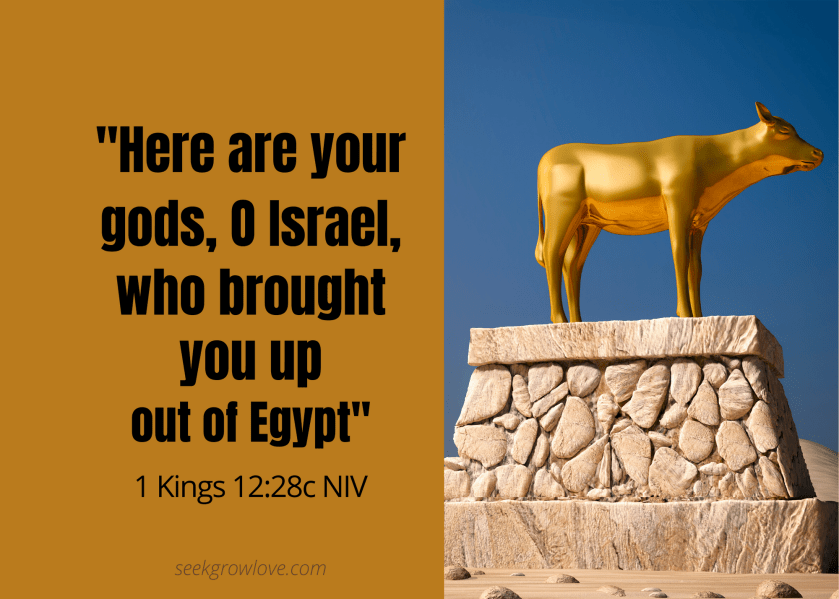
“Jeroboam thought to himself, ‘The kingdom will now likely revert to the house of David…'” So the king made two golden calves. He said to the people, ‘It is too much for you to go up to Jerusalem. Here are your gods, Israel, who brought you up out of Egypt.'” (1 Kings 12:26, 28)

Jeroboam took up his place as both the political and spiritual leader of Israel, but motivated by fear and a desire for control, he led God’s people astray. He created false idols, counterfeit altars, and bogus festivals—all in an attempt to keep his people from returning to the holy city of Jerusalem. Leaving behind the moral clarity of God’s commands, it became easier and more accessible to engage in a made-up religion that appeared similar on the surface to what they knew to be true. They were working with the same pieces, but some were flipped upside down, some placed in the wrong spot, and others lost along the way. As their worship moved farther from Jerusalem, the distance between Israel and God grew greater.

There is a stark warning here for the adjustments and innovations we see in the Church today. We must be careful that our worship, ministry, and evangelism do not favor convenience over obedience or comfort over conviction. If we fail to heed this warning, we may end up with well-developed systems that contain many of the same pieces—but are no longer building the Kingdom of God. Instead, we risk creating idols and events that offer no eternal hope. Granted, we may not be fashioning golden calves, but when we prioritize comfort over truth, we risk building spiritual lives rooted in fear, insecurity, and pride—lives that are void of God’s instruction.

It has never been about innovating what works for us or embracing a “you do you” mentality. God demands surrender and faithfulness in our daily worship, which means we will likely find ourselves worshiping in the city of our enemies from time to time. Resist the urge to craft a god who fits us. Instead, let us be molded to fit His purpose and to build His Kingdom according to His Gospel instructions.

-Aaron Winner

Reflection Questions

  1. What problems do you think God saw in Jeroboam? Do you think God ever sees these same problems in you?
  2. What does God desire from us – in our worship and in the way we live our lives?
  3. What are your thoughts about the following: “If we fail to heed this warning, we may end up with well-developed systems that contain many of the same pieces—but are no longer building the Kingdom of God” ? Have you seen this occur? How can we better heed this warning for our lives and for our church and for the Kingdom of God?

Living Beyond Contentment

Proverbs 30-31

When eating, it takes our bodies roughly twenty minutes to register that we are full. During this window, it’s still easy to overindulge—residual hunger hormones convince our brains that we aren’t yet satisfied. Giving in to a few extra bites can become a few extra pounds, and even small overindulgences, even in the short-term, can harm our well-being.

In many ways, we are wired to live beyond contentment. We accumulate extra clothes, extra cars, and extra rooms. While I have certainly faced seasons where I have battled with “not enough,” more often, I’ve wrestled with “too much.” And the more I feed desire, the more ravenous it becomes. When indulgence becomes a habit, our appetite grows louder while our awareness of God’s provision grows quieter under the noise of stuff-shifting.

To be content at the dinner table is to put the silverware down and wait. It requires restraint—a virtue that feels increasingly radical in every facet of living. As we saw with Solomon’s story yesterday, prosperity can easily deceive us into thinking we are self-sufficient. In today’s reading, Agur’s prayer in Proverbs 30 echoes a more familiar prayer taught by Jesus to His disciples. Daily bread is the quiet miracle of enough. [1 Kings 17:13-16; Matt 6:9,10]

“Two things I ask of you, Lord; do not refuse me before I die:
Keep falsehood and lies far from me;
give me neither poverty nor riches,
but give me only my daily bread.
Otherwise, I may have too much and disown you
and say, ‘Who is the Lord?’
Or I may become poor and steal,
and so dishonor the name of my God.” (Proverbs 30:7–9)

Wisdom is a gift that Solomon received, and God still gives generously to those who expectantly ask (Jam 1:5-8). Contentment, too, is a gift from the Heavenly Father—who provided manna in the wilderness, the Bread of Life in Christ, and continues to meet our daily needs. Contentment stretches far beyond finances or hunger. It reaches into our identity, our roles, our relationships, even our location and life stage. Paul’s famous declaration—“I can do all things through Christ who strengthens me (Phil 4:11:13)”—wasn’t about achievement , but learning contentment even within prison walls, fully surrendering the perks of his previous identity.

We do not live to satisfy our cravings. To live beyond contentment is to collect moldy manna, an untrusting load that serves no purpose. Instead, we are invited to live as shrewd and savvy worshipers: disciplined with our efforts, generous with our resources, and joyful in simplicity (Proverbs 31). In this way, we show ourselves devoted and dependent—not on what we can store up, but on the One who supplies.  If we are to live in excess, let it be in the goodness of a Father who meets every need and has satisfied our debt with the death of His Son and whose grace is sufficient for every demand.

-Aaron Winner

Reflection Questions

  1. Are there instances/areas when you have lived, or are living, beyond contentment? Do you have a collection of moldy manna?
  2. What do you think the secret of contentment is?
  3. How does Proverbs 30:7-9 differ from “worldly wisdom”?

Sayings of the Wise

Proverbs 22-24

There have been countless attempts to condense all the complexities of life into a few simple and concise rules to follow. If the steps are practiced effectively then success will be rewarded. Variations of these lists are reiterated over time through experience of generations adapting to changing societies. Each one tries to improve upon the previous list, but there are often more similarities than differences. While there are some noticeable differences between many of these lists and Proverbs 22-24, as a whole these chapters are simply a list of sayings meant to be followed for success. It certainly wasn’t the first list nor last, but it accomplishes the same goal, with the added benefit of being God’s trusted word. 

These thirty sayings are introduced in chapter 22, and it is encouraged for all to hear and pay attention to. “Counsel and knowledge” are provided with a reward of increasing trust in God along with honesty and speaking the truth (NIV, Proverbs 22:17-21). They don’t necessarily promise to bring worldly success, though many do, but instead offer the opportunity to further develop a relationship with God. These sayings align with seeking wisdom. Following them will result in the growth of truthful actions, trust, and an increased ability to love God and others. 

Each of the sayings provide guidance on some aspect of life, though there is overlap. Some of the sayings teach how to interact with others and develop meaningful relationships. For example, avoid exploitation, consider the perspective of others, and don’t be associated with people who will only cause trouble and be a bad influence. Other sayings claim that righteous character and behavior will be rewarded socially, and even if there is no benefit in today’s society God will reward those in the future. Similarly, the opposite is warned against. Another common theme is to not get caught up in chasing money or other common indicators of success, as they aren’t as meaningful as they may initially seem. Lastly, these sayings teach the value in learning and the willingness to be taught.

Study the sayings of the wise and learn from them. These thirty sayings are included in the book most known for wisdom, so if wisdom is loved these sayings should be considered in daily life. The increase in wisdom associated with applying these chapters will encourage genuine care and love for others through truthful words and actions. Further, trust in God is strengthened by wisdom in knowing how God defines success. Although it is still just a condensed list, follow these sayings and success will naturally be rewarded.

-Josiah Railton

Reflection Questions

  1. How is the wisdom found in Proverbs 22-24 similar to wisdom literature from other times and cultures? How is it different from what “the world” today says is wise and profitable for success?
  2. In your relationships with others which of these sayings of the wise would you benefit from focusing on this week?
  3. How can you work towards the ultimate success of having a better, growing relationship with God?
  4. Which verses would be great on your refrigerator, desk, bathroom mirror or bedside table for the next month? Post them.

David’s Costly Mistake

2 Sam 24, 1 Chr 21

When David sinned with Bathsheba, we see him at his lowest point. He is made to confront his sin as Nathan the profit reminds him how God brought him up from being a shepherd boy to king over all of Israel. God humbled him and cut through his swollen pride to remind him of his true heart. 

We would think after such a time as that David would be ‘home free.’ The story was played out, exposition, conflict, resolution, and all. David would be able to live righteously the rest of his life, ‘happily ever after.’ 

But we know that life isn’t like a fairy tale. As we talked about earlier this week, we all experience highs and lows. We have many story arcs throughout the years. And, David did too. 

We don’t know how many years have passed since David and Bathesheba’s sin and the events we read about today. But, today we read about another step off the good and righteous path that David took. This blunder resulted in more than the death of one man and one child. It resulted in the death of 70,000 people. 

In 1 Chr. 21, it says, “Then Satan stood against Israel and incited David to number Israel. So David said to Joab and the commanders of the army, “Go, number Israel, from Beersheba to Dan, and bring me a report, that I may know their number.” 

David’s request seems pretty innocuous. Censuses happened throughout scripture, but generally, they occurred when God commanded them. (The first part of that passage is a whole different theological question… that we are not going to talk about today.) In this case, the people weren’t being numbered because it pleased God. They were being numbered so that David could be puffed up in pride over the strength of the army he had gathered. Even Joab, not a very righteous man, told David he was crazy for wanting to do this. 

David’s guilt left him with a choice: How was he going to atone for his sins? The price of his sin turned out to be a disease against Israel, because of which 70,000 people died. 

Finally, David fell to the ground and pleaded for God to stop for the sake of his ‘sheep’, the people of Israel. David bought an altar that would become the future site of the temple of God. 

From today’s reading, we see: 

  • We should never think that we are ‘too righteous’ to never sin. No matter how long you walk with God, you have the potential to be tempted away from the right path. This does not mean that we live in fear. It means that we need to recognize the importance of relying on God. 
  • Our sins affect our community. When David did this thing, he chose to sin himself. But, his sins affected an entire nation. 70,000 people is more people than the US casualties in the Vietnam war… and every major US conflict since. We think we are doing things in isolation but they have far-reaching consequences for the people around us. 
  • God can use painful things for good. The altar that David sacrificed to end the plague ended up being the future site of the temple. Even evil situations can be redeemed by God and used for good – if we humble ourselves, repent, and ask God to enter into the situation. 

How are you living today?

-Cayce Fletcher

Cayce blogs at https://amorebeautifullifecollective.com about faith, family, and life. You’ll find encouragement for how to build intentional lives rooted in faith and beauty. Check out the latest post on the human nature of Jesus here. 

Reflection Questions

  1. Have you ever felt ‘too big to fail?’ What are some ways that we can cultivate humility in our lives? 
  2. How does sin have far-reaching consequences? How have you seen others affected by sin that seemed like something done in secret and isolation? 
  3. How can God use broken situations for good? Is there a broken situation in your life that you need to invite God into today?

SGL.2025.MayFullPageDownload

Worthy of Worship

Ps 95, 97-99

Music has always been a huge part of my life. From singing along to Veggie Tales songs in the car to being dressed up in my Sunday Best doing a ‘special’ on Sunday Mornings, from an early age I was taught the importance and beauty of song sung in worship. 

I still like to sing and dance to ‘I Like Bananas’ around a campfire, but my understanding of worship has expanded and grown. Just singing doesn’t mean that we are worshipping God, and sometimes the most worshipful moments are done in silence. We all know the days where we are going through the motions in a Church service, singing familiar words without it ever truly reaching our hearts. 

What should a heart of worship look like?

In today’s reading, we see Psalm after Psalm of praise and worship. Importantly, the Psalms show the heart behind worshipping God. 

A heart of worship is: 

  • Based on the character of God, not the quality of our voices. We don’t sing praises because we ‘sound good.’ We sing praises because God is the ultimate thing that is worthy of praise. We sing because he has truly done ‘marvelous things.’
  • Grounded in the truth of scripture, not the beat of the song. The Psalms repeat the truth again and again: “The Lord reigns.” Why? Because the transformative power of worship is focused on repeating the truths of scripture to ourselves. We can praise God and weather difficult circumstances because God reigns. 
  • Focused on remembrance, not emotions. Our summer camps were always a highlight of the year because we loved the worship. But the truly quality of worship isn’t based on the quality of the band. It’s based on the way we remind ourselves of the goodness and faithfulness of God and praise him for it. 

Today, let’s cultivate a heart of worship.

-Cayce Fletcher

Cayce blogs at https://amorebeautifullifecollective.com about faith, family, and life. You’ll find encouragement for how to build intentional lives rooted in faith and beauty. Check out the latest post on the human nature of Jesus here. 

Reflection Questions

  1. How do you cultivate worship in your life? 
  2. What should characterize a ‘heart of worship’?
  3. Create a list of attributes about God that you can use while you worship. 

SGL.2025.MayFullPageDownload

The Rollercoaster Ride of Life

2 Sam 22-23, Ps 57

One of my son’s favorite places to go is Dollywood Theme Park in Tennessee. He loves the decorations, the shows, and the food, but his favorite thing to do is ride the rollercoasters. I’ve never been a huge fan – I’m deathly afraid of heights and don’t like the feeling of being slung around. But, you can tell the joy (and a little fear) on his face as he clicks up to the first big drop and then races down through the twists and turns. Of course, at the very end, he always turns to me and says, “Can we ride it again?” 

David’s life was definitely a roller coaster ride. He was sent to watch sheep by his father while Samuel came to pick the king, only to be called from the fields and anointed. He was elevated to be a part of King Saul’s court, only to be forced to flee for his life at night. He spent 15 years running from Saul, only to finally be crowned king. And this isn’t to mention Bathsheba, Abasolom, and the census. 

So many highs and so many lows. 

But, through it all David remained faithful. 

We can see the contrast between the highs and lows as we read Psalm 57 and David’s song in 2 Samuel 22.

In Psalm 57:4, David cries out, “My soul is in the midst of lions; I lie down amid fiery beasts— the children of man, whose teeth are spears and arrows, whose tongues are sharp swords.” But still, he praises God. 

In 2 Samuel 22:17-20, he exclaims, “[God] sent from on high, he took me; he drew me out of many waters. He rescued me from my strong enemy, from those who hated me, for they were too mighty for me. They confronted me in the day of my calamity, but the Lord was my support. He brought me out into a broad place; he rescued me, because he delighted in me.”

In both the highs and lows, David cried out to God. He praises God. He finds refuge in God. 

You may be stuck on the roller coaster now. You may be in the lowest of lows, or you may be high on that mountaintop. But, wherever you are, remember God is there with you. 

Wait on the Lord. Put your trust in God. He is faithful. He will walk you through it. 

-Cayce Fletcher

Cayce blogs at https://amorebeautifullifecollective.com about faith, family, and life. You’ll find encouragement for how to build intentional lives rooted in faith and beauty. Check out the latest post on the human nature of Jesus here. 

Reflection Questions

  1. Have you experienced a low time in your life? Where did you turn for comfort and support at this time? How did you see God’s faithfulness in this time? 
  2. How does remembering God’s past faithfulness help you to navigate your present circumstances? 
  3. What are some ways that you can incorporate more worship into your life? 

SGL.2025.MayFullPageDownload

A Man After God’s Own Heart

Ps 5, 38, 41-42

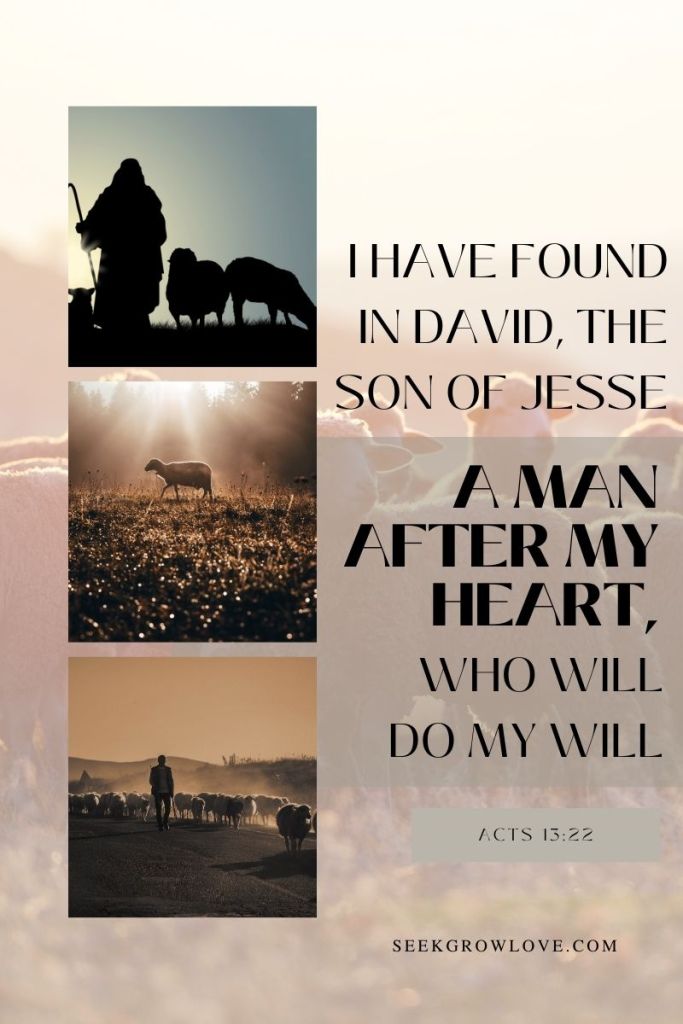
One Sabbath day, Paul came to a synagogue in Antioch (a city in modern-day Turkey) and sat down to listen to the law and scriptures. After the reading was down, Paul got up and gave a sermon. Nestled in the middle of his speech is this interesting passage, “After [God] had removed [Saul], [God] raised up David to be their king, of whom he testified and said, ‘I have found in David the son of Jesse a man after my heart, who will do all my will.” (Acts 13:22)

How amazing it would be to be known as a man (or woman) after God’s own heart! Of all the epitaphs that we could put on our tombstones, this would be the highest praise. 

But, we know that there is more to David’s life than just this statement. In fact, it seems a little incongruous to describe the man who sent Uriah to die because of his sin and who sent an Angel of the Lord on his people because of his decision to do a census as a man after God’s own heart. 

I think the Psalms we read today – the cries written from David’s own heart – show how he reflected the heart of God. 

In the Psalms, we see that: 

  • David understood that God loves righteousness and hates evil. David repeats the truth to himself that God does not delight in wickedness. When he comes to God in prayer, he describes his wickedness as wounds that stink and fester. This bleak picture demonstrates his view of sin: it is evil and something from which you should flee.
  • David understood the importance of confession. David’s harsh view of sin did not mean that he was blameless. We know that he slipped and fell multiple times and had to deal with the consequences of his actions. Still, when David veered from the good and right path, he recognized it and he turned back toward God. He didn’t minimize sin, and once he humbled himself, he didn’t stay in his sin. Instead, he confessed and repented. 
  • David longed for God. He longed for God’s temple, God’s favor, and God’s very presence. He longed for it as deer pants for streams of water. He describes his soul as thirsting for God. And we know that God is the author and sustainer of life. As the very best thing, he is the ultimate thing we should long for. 

To be a man after God’s own heart didn’t mean that David had to be perfectly sinless. No human is able to do that in this lifetime. Instead, being a man after God’s heart means that we are trying to make our heart – our priorities, desires, and understandings – match the heart of God. 

If we want to be people after God’s own heart, we should: 

  • Love righteousness, and hate evil 
  • Repent from our sins in humility
  • Place God as our utmost desire

How would you describe your heart today? 

-Cayce Fletcher

Cayce blogs at https://amorebeautifullifecollective.com about faith, family, and life. You’ll find encouragement for how to build intentional lives rooted in faith and beauty. Check out the latest post on the human nature of Jesus here

Reflection Questions

  1. David was anointed king after the downfall of Saul. How would you describe the difference between the heart of Saul and the heart of David? 
  2. What is your view of sin? How do you show your view of sin in your actions or your willingness to confess and seek repentance? 
  3. What does it mean to long for God ‘as a deer pants for streams of water’? Do you long for God in this way? How could you deepen your desire for God? 

SGL.2025.MayFullPageDownload

Our Hope in Every Season

Blessed is the man who makes the Lord his trust

Ps 26, 40, 58, 61-62, 64

Mother Teresa spoke of ‘the dark night of the soul.’ You would think that someone who served in such a ministry would be a titan of faith, impervious to doubt. But still, she wrestled with God. 

And, who could blame her? I’m sure that the stresses of her ministry continually bashed against the rock of her faith. 

All of our circumstances have a way of doing that. They are the waves of doubt, of shame, of sin, and of fear. They hit us throughout life in the jeers of our friends in middle school to the first heartbreak that comes with young love to the frustration of parenthood to the inevitable pain that comes with the final breaths our loved ones take.

James says that someone who doubts is like a wave blown and tossed by the wind. The antidote to that doubt is faith. But, what can be said of us then? For who can say that they haven’t wrestled with God? 

As we turn through the pages of scripture, we find that we are in good company. Abraham, Moses, and of course, Jacob wrestled with God in their own way. And, we see David struggling through the pain of his circumstances in the Psalms we read today. 

David cries out to God. He begs him to turn and listen. For someone who had slept on the floors of caves and pretended to be a madman in an enemy’s court, these words are more than just cliché. 

David always goes back to the same statement, ‘In God alone I trust. I will wait patiently for the Lord.’ 

How powerful that statement is. And, oh how hard it is. 

In the seasons of my life, I have prayed. When I woke up, when I lay my head down, and all the footsteps in between were filled with the same cry. And yet, my prayers were unanswered. What could I do? 

In those times – even now – I could make a choice to turn my face from God. But, the question “Oh Lord, who could I turn to? Where could I go from your presence? Who have I but you?” rings out. 

David understood this truth. God is our strong refuge in both the good times and bad. In health and sickness. Riches and poverty. Joy and sorrow. We turn to him in every season, and we wait patiently for him to act. 

And when we do, we understand the truth of Psalm 40:4-8: 

“4 Blessed is the man who makes

    the Lord his trust,

who does not turn to the proud,

    to those who go astray after a lie!

5 You have multiplied, O Lord my God,

    your wondrous deeds and your thoughts toward us;

    none can compare with you!

I will proclaim and tell of them,

    yet they are more than can be told.

6 In sacrifice and offering you have not delighted,

    but you have given me an open ear.

Burnt offering and sin offering

    you have not required.

7 Then I said, “Behold, I have come;

    in the scroll of the book it is written of me:

8 I delight to do your will, O my God;

    your law is within my heart.”

-Cayce Fletcher

Cayce blogs at https://amorebeautifullifecollective.com about faith, family, and life. You’ll find encouragement for how to build intentional lives rooted in faith and beauty. Check out the latest post on the human nature of Jesus here. 

Reflection Questions

  1. Have you ever experienced a season of sorrow or silence? What was the outcome?
  2. What does it mean to wait on the Lord? Try to create a sentence-long definition of what that looks like.
  3. How is the perseverance of the saints related to waiting on God? Why is perseverance an important virtue in the Christian life?

SGL.2025.MayFullPageDownload

Wrong Place, Wrong Time

2 Samuel 11-12
1 Chronicles 20

And in the spring of the year, at the time when kings go out to battle, David sent Joab, and his servants with him, and all Israel, and they laid waste the children of Ammon and besieged Rabbah, but David stayed at Jerusalem. – 2 Samuel 11:1 (REV)

                  In today’s reading, we see two realities. Both happened, but at different times and represent different things. In 2nd Samuel, we see David, king of Israel. Where do we see David? At home. Sitting on his keister and not doing what a king would normally be doing: overseeing his generals as they go out to battle.

                  David is not where he is supposed to be. He should be meeting with his generals. He should be motivating his armies. He should be praying and fasting and seeking out God’s direction for the safety and prosperity of Israel, but he’s back in Jerusalem. Twiddling his thumbs? Playing his harp? We don’t know what he was doing at all hours of the day when he held up in his palace.  We do, however, know what he was doing on one specific evening.

                  David is out walking on the roof, where he shouldn’t be, and he sees Bathsheba bathing. David does not turn away from seeing the nakedness of this woman whom he is not married to. He stares. He dwells. He obsesses. She’s beautiful. He needs to meet her. To be with her.

                  David ends up having her come into his home, and he has sex with her and gets her pregnant. We may have seen this story happen in the lives of some people we know, but this is high profile. This is a problem. A bunch of people are going to know what has happened, and this is going to be hard to explain to Bathsheba’s husband, Uriah, who is out at war, where he is supposed to be: fighting for the armies of the people of Yahweh. While the king is out preying upon the wife of his soldier.

                  David finds himself in a sticky situation, so he sends for Uriah and does his best to get Uriah to go have sex with his wife and cover his… keister. Uriah, however, cannot fathom such a thing while his comrades are off fighting a war. He refuses to even go visit his wife. This poses a major problem. People are going to know that Bathsheba is expecting, and they are going to know that Uriah hasn’t been with her in months, maybe longer. David tries multiple times, but no dice. Uriah is a man of honor and conviction, and that is not going to fly in this situation. David needs an out. David essentially puts out a hit job on Uriah. David cannot control his urges, so a good man dies.

The story unfolds. Uriah is dead. David marries his baby mama, and then the baby dies. Nathan the prophet comes to confront David and gets David worked up with a parable. David wants vengeance for the perpetrator in the story, but then the tables are turned when David is revealed to be the bad guy in the tale. David grieves, David repents, but the baby does not survive. It’s rough.

In 1 Chronicles 20, we see that it is the time when kings go out to war. And David goes out to war. And his armies thrive. He gets an awesome new crown. God blesses the armies of a king who acts in good faith. David is more than capable of doing the right thing, but even a man after God’s own heart can allow himself to fall off the rails.

Here’s the rub: Sometimes we get complacent. Sometimes we get lazy. Sometimes we do things, go places, consume content that we know we shouldn’t, but we’ve allowed ourselves to be in the wrong place at the wrong time, and we fall victim to the allure of the temptations of sin around us.

We’ve all allowed ourselves to be in bad situations that we could have avoided. Sometimes we may come out on top, but given enough opportunities to sin in the situations we create, we are bound to fall. We play with fire… and you know the cliché, but it’s true, we get burned.

-JJ Fletcher

Reflection Questions

  1. Can you recall some times you allowed yourself to be in a place you shouldn’t have been? What was the outcome? How could you have avoided putting yourself in that situation? What did you learn from it?
  2. What do you think of Nathan’s tactics of getting David to see the gravity of the wickedness that he had perpetrated?
  3. What does the story of David and Bathsheba teach us about grace, repentance, and forgiveness?
  4. If David can be forgiven for this travesty, who can you forgive that may have done much less harm in the way that they have wronged you?
  5. How does the contrast of 2 Samuel 11-12 and 1 Chronicles 20 sit with you? Does it give you any insight or change the way you perceive David’s sin?

Let the Nations be Glad

Psalm 65-67, 69-70

So many of the psalms focus on directly worshipping and declaring the goodness of God, which is good, but this psalm takes that knowledge of God and comes in with a missional view: Let God be known and praised by all the people. All the nations. Not just Israel, his covenant people, but by everyone.

The psalmist recognizes the goodness of God and what he has done for his people. In light of this fact, they want the goodness of God to be experienced by all people and for there to be abounding joy for all.

God provides sustenance for all people, the earth yields its produce. It does so because God designed it that way, so may the nations recognize that Yahweh created life and sustains it through his order.

Verse 4 talks about the nations being judged with equity. Equity here is the Hebrew word mishor, which literally means levelness or uprightness. God will not play favorites with his judgment, he will judge with prejudice, but he will judge fairly and give the same outcomes to the faithful of all tongues and tribes. In the same way, destruction comes from rejecting God, regardless of the background of the individual.

We can look at this through the lens of Jesus, but even without a clear picture, the psalmist saw a future where there was no Jew nor Greek, nor slave nor free, but a world where all could bask in and enjoy the glory of God and worship him in spirit and in truth.

Let the nations be glad.

-JJ Fletcher

Reflection Questions

  1. Where does your joy come from?
  2. Do you view your role as a believer to be missional? To bring others into a saving relationship with Jesus and his Father?
  3. Do you have trouble with being equitable in your sharing? Can it be difficult to share with people from different backgrounds?
  4. If you find great hope and strength in the gospel, shouldn’t you share it? Why are we worried about “offending people” with the gospel?