One of the major themes of the Bible is God making a broken people holy. Holiness is a characteristic of God; in fact, God is repeatedly called the “Holy One of Israel” throughout scripture. But, what is holiness? “The Hebrew word for “holiness” is qōdes, a word that highlights the realm of the sacred in contrast to everything common and profane.” (See here for more info.) Holiness describes what is sacred or set apart. God is the ultimate holy one, and he sets the bar for what is holy or sacred. We can determine if something is holy by comparing it to the standard that God has set for us.
Unfortunately, after the fall, we were not a holy people anymore. We would die if we were in the presence of God because of this fact. God’s ministry of reconciliation which we read about yesterday is all about God bringing us back into relationship with him. God cannot lessen his holiness, but he can redeem us and make us more holy. This is what the whole Bible is about. God making his chosen people holy. In the Old Testament, God made his people holy through sacrifices and the law. The law could not completely redeem us though. So, in the New Testament, the new covenant was establish in which God was making us holy – reconciling us to himself – through Christ. We are saved through this reconciliation (2 Cor. 6:2).
At the end of the chapter we read today, we see some important warnings that Paul gave to the Corinthians encouraging them to remain holy. In verses 16-18, it says,
“As God has said:
“I will live with them
and walk among them,
and I will be their God,
and they will be my people.”
Therefore,
“Come out from them
and be separate,
says the Lord.
Touch no unclean thing,
and I will receive you.”
And,
“I will be a Father to you,
and you will be my sons and daughters,
says the Lord Almighty.”
We are called to be set apart, called to be holy. Our lifestyles should reflect that. This requires discipline and an awareness of our habits. Are we living in a way that shows we are set apart? Or are we living just like the world? When we live a holy life, we have the promise of a deep and personal relationship with God. He will walk among us. He will be a Father to us. That promise is worth all the sacrifices that we make.
~ Cayce Fletcher
Questions for Application:
When you read the word ‘holiness’, what kind of feelings does it stir in you? Do you think that become holy is a worthwhile pursuit?
What does a holy lifestyle look like?
One characteristic of being holy described in this chapter is in verse 14: “Do not be yoked together with unbelievers.” What do you think this verse means? Why is this important in our pursuit of holiness?
Most of our lives are spent trying to make sure that we are doing all we can to live bigger and better. We spend years in school so that we can get a good job and make good money. Then, we can buy a nice house/car (which we may sell later on to get a bigger and better house/car). We accumulate lots of stuff that we can eventually pass on to our kids – which may not actually want any of it. It seems kind of pointless when you describe it this way, but this is truly what we talk about when we say we are pursuing the American Dream. It’s a materialistic pursuit of wealth and things… that ultimately prove meaningless when held against the gospel of Christ.
Though the concerns of the Romans and Jews were different than what we worry about today, we still see the distractions that can come from the pursuit of things other than God. These idols could be wealth (and Rome had its own version of the American Dream), but it could also be power, status, or a legalistic self-righteousness. All of these idols are forms of the old self that should have been put to death with Christ.
In 2 Cor. 5:14-15, Paul says, “For Christ’s love compels us, because we are convinced that one died for all, and therefore all died. And he died for all, that those who live should no longer live for themselves but for him who died for them and was raised again.” This is such a counter-cultural statement. We are not living for ourselves anymore. We are not trying to pursue lives that are bigger and better according to the world’s standards. We have “died” to that pursuit and are raised again. We no longer live for ourselves but instead we live for Christ.
This is what it means to be a new creation. In verse 17, it says, “Therefore, if anyone is in Christ, the new creation has come: The old has gone, the new is here!” When we are raised with Christ, our concerns change to the concerns of Christ. What is the concern of Christ? Verses 18-19 say, “All this is from God, who reconciled us to himself through Christ and gave us the ministry of reconciliation: that God was reconciling the world to himself in Christ, not counting people’s sins against them. And he has committed to us the message of reconciliation.” We are being reconciled to God so that we can become the righteousness of God. Praise God! We have been made new!
~ Cayce Fletcher
Questions for Application:
What are some of the things that you spend time pursuing? What are things that distract you from God?
Do you believe that these distractions are idols?
If you are a believer, you are a new creation in Christ. Do you live in a way that shows that you are a new creation? How?
Growing up, I loved to run in races. I never had the fastest time, but I loved the sense of community that came from everyone pursuing the same goal: finish the run. Even though I don’t run as much as I used to, I still see the power of pursuing a unified goal in my family, my job, my church, and my community. We encourage one another to set our eyes on the more important things even when we may not feel like doing so on our own.
In today’s reading, Paul continues to give a defense of his ministry. He tells the Corinthian church, “Rather, we have renounced secret and shameful ways; we do not use deception, nor do we distort the word of God. On the contrary, by setting forth the truth plainly we commend ourselves to everyone’s conscience in the sight of God” (2 Cor. 4:2). Paul speaks plainly about the gospel and does not try to manipulate or somehow warp the message of the cross to be more pleasing to others. Even so, this message is so winsome that it wins people over anyway.
This being said, just because the message itself is convincing and life-changing, it doesn’t mean that Paul became rich and famous, living a life of ease. His life was difficult and the only thing that kept him going was the reminder of his purpose and his commitment to reaching his goals. During Paul’s ministry which started with him being blind for three days, he was almost stoned to death, bitten by a snake, shipwrecked, and kept under house arrest. He left for Rome towards the end of his life knowing that he was going to be killed there. A martyr, he was beheaded by the Roman emperor Nero. Despite the difficulties of his life, he recognized that the message that he was speaking was too important to keep hidden. In 2 Corinthians 4:16-17, he says, “Therefore we do not lose heart. Though outwardly we are wasting away, yet inwardly we are being renewed day by day. For our light and momentary troubles are achieving for us an eternal glory that far outweighs them all.” The troubles that he faced did not destroy him. Instead, they renewed him day by day because Paul recognized that through his troubles the gospel was being spread even more effectively!
So, how can we grow to have the same mentality as Paul? In verse 18, he says, “So we fix our eyes not on what is seen, but on what is unseen, since what is seen is temporary, but what is unseen is eternal.” Just like a runner in the race, we have to keep our eyes set on the finish line. We need to keep our mind set on the eternal. If we do that, the distractions of the present day start to fade away. What are your eyes fixed on? Live life in light of eternity.
~ Cayce Fletcher
Questions for Application:
What do you say the goal, mission, or purpose of your life is?
Are you facing difficulties that keep you from reaching this goal?
How might these difficulties be renewing you day by day? What could be some of the lessons or benefits from these difficulties?
As a middle school teacher, I have an ‘in’ for knowing what’s currently trending whether it’s the Visco girls and HydroFlasks of a few years ago or the devious licks of the past year. Because of TikTok and Instagram, these trends spread like wildfire among my students, and they tend to burn out just as quickly. Quick-moving trends aren’t new either. I remember silly bands and Hollister jackets from my middle school days almost 15 years ago. The common theme with these fads and trends is that they spread like crazy and then are soon forgotten. Facebook was just beginning to grow in popularity when I was younger, so it may seem strange that such fads existed. But, as everyone can tell you, this is just part of humanity and culture. We tend to jump on things that are popular and want to be a part of them. Because of this, we sacrifice time and money accumulating junk and doing some pretty stupid stuff just so that we feel like we are part of the crowd.
In today’s reading, Paul is addressing the Corinthians and pointing out reasons why the Corinthians should trust his apostleship (or authority about the gospel). He is encouraging the Corinthians to rely on the Spirit to be transformed into the image of Christ. Paul knows the power of this transforming Spirit from his own experience and so speaks with boldness to the Corinthians (v.12). As he describes the difference between the law and the new covenant of Christ, he points to how Moses communicated with God compared to how we are able to through Christ. When Moses talked with God in the wilderness, his face would shine (Ex. 34:35). The Israelites were so terrified of this that they begged Moses to wear a veil when he returned. With the new covenant, the veil was torn (Matt. 27:51), and through Christ, we can see the glory of God.
In verses 17-18, Paul says, “Now the Lord is the Spirit, and where the Spirit of the Lord is, there is freedom. And we all, who with unveiled faces contemplate the Lord’s glory, are being transformed into his image with ever-increasing glory, which comes from the Lord, who is the Spirit.” A poet, William Blake, said, “We become what we behold.” When I think of the trends and fads I see in culture, I think of people who are beholding (or seeing) so many things around them that they feel like they need to buy or participate in. Watching the culture around them makes them want to become more like the culture around them. Pretty soon, they are stealing bathroom vanities because they saw it on TikTok (a true story that happened at my school). We don’t want to become more like the world, but if all we are beholding comes from the world, what can we expect? We need to spend more time beholding God by spending time in prayer and his word. Only then can we be ‘transformed into the same image from one degree of glory to another.’
~ Cayce Fletcher
Questions for Application:
What is a trend or fad that you see in culture? Is it something you find beneficial to society or detrimental to society?
What do you behold daily? How is what you are beholding affecting the way that you live?
What does it mean to be ‘transformed into the same image [of Christ] from one degree of glory to another’? What would a person who was in the image of Christ look like?
Growing up around a group of girls, I’ve definitely had my fair share of girl drama. You know the kind: Side eyes, lack of confrontation, passive aggressive comments, and lots of gossip. Basically, this drama is the basis for the movie Mean Girls and a lot of hurt and pain in young girls everywhere. Most of these conflicts were caused by a simple misunderstanding that snowballed into a big ol’ mess. But, in every instance, the only way that we were able to get over the issues and become friends again was to truly forgive each other. That forgiveness generally required one person to repent of what they had been doing – gossiping about someone else, for instance – and then another person to acknowledge their repentance and move on. We read about a similar, but more serious, situation in 2 Corinthians today.
2 Corinthians is a letter written from a place of vulnerability as Paul defends his mission and apostleship to some who thought the grace he showed to them was a sign of weakness. The fourth letter written to the Corinthian church (see more info here), it is a letter filled with the personal pains and testimony of Paul.
Today’s reading begins with Paul referencing a letter (lost in history) where he addressed some concerns that he had with the Corinthian church. Most of the issues that Paul is discussing in verses 5-11 are most likely about the man in 1 Corinthians 5 who was living immorally with his father’s wife (his stepmom). Pretty gross, right? In 1 Corinthians 5, Paul tells the church that they should not associate with this man anymore because he claimed to be a believer but was acting in a way that was totally opposite from that. By 2 Corinthians 2, the man had apparently repented, but the Corinthian church was refusing to associate with him still. In verses 7-8, Paul says, “Now instead, you ought to forgive and comfort him, so that he will not be overwhelmed by excessive sorrow. I urge you, therefore, to reaffirm your love for him.” After he had repented, Paul encouraged the people in the church to welcome the sinner back into their community.
Even though the man had committed a serious sin, Paul recognizes what’s at stake in this conflict. In verses 10-11, he goes on to say, “Anyone you forgive, I also forgive. And what I have forgiven—if there was anything to forgive—I have forgiven in the sight of Christ for your sake, in order that Satan might not outwit us. For we are not unaware of his schemes.” Paul encourages them to forgive the man not just for the man’s sake, so he would be welcomed back into the family of God. He also encourages them to forgive so that ‘Satan might not outwit us. For we are not unaware of his schemes.’ When we deal with conflict in the church, we are not just working through the conflict for our own benefit. We are working to maintain the witness and effectiveness of the church. Conflict in the church is part of the spiritual battles that we face in this life (Eph. 6:10-11, 2 Cor. 10:4-5, James 4:7). When we work through our conflict towards forgiveness and unity with people who have truly repented from sin, we are working against Satan’s schemes. He comes to kill and destroy (John 10:10) and to cause divisions among believers. But, we can take heart and stand against it through the power of the Holy Spirit.
~ Cayce Fletcher
Questions for Application:
When was the last time you faced a conflict? Did you try to resolve that conflict with the other person? How?
What is the meaning of true forgiveness? How should forgiveness characterize how we interact with our friends and family as believers in Jesus?
Are there situations where we should be hesitant to forgive? Look up the following verses to read more about forgiveness: Eph. 4:32, Matt. 6:14-15, Luke 17:3-4, Mark 11:25.
1 Corinthians Chapter 16 begins with Paul directing the Corinthians to set aside some money on the first day of the week. He wants them to budget their charitable donations before they spend their money on other things during the week . From this chapter alone it may not be immediately clear what the fundraiser was for. Through supplemental materials we can see that the common consensus was that Paul was raising funds for the Christian Jews living in Jerusalem. They were being persecuted for their Christianity and there were many impoverished widows to support. Paul was collecting donations from many of the Gentile churches he had helped to establish, including the church in Corinth. (Partially sourced from Bibleref.com). Paul does not want to handle the money directly but plans to write letters of reference or maybe even personally accompany delegates to deliver the money to Jerusalem so that the recipients know they can trust the source.
The chapter also talks about several people that will be visiting the Corinthians. The Corinthians are instructed to trust and accept these visitors as ministers officially recognized by Paul himself.
Finally Paul closes his lengthy letter with well wishes and invites the Corinthians to authenticate his handwriting.
As I read this chapter, it seems to me that the Corinthians may have had trust issues. Paul seems to be challenging them to trust in God’s provision through the week even though they give charitably at the beginning of the week. He directs them to trust the visitors he sends their way and finally he invites them to verify that the letter is really from him in case they don’t trust its content.
-Brian Froehlich
Questions for Reflection and Discussion
Do you ever distrust someone’s motives?
Was there a reason that person lost your trust?
Do you ever struggle to fully trust God?
Is there a reason God has given you to not trust him?
What is God calling you to trust him with in your life today?
When I was a kid, I amassed a pretty good collection of action figures. I had a lot of He-Man and Teenage Mutant Ninja Turtle toys. I even had a few from the lesser known franchise Silverhawks. Transformer toys (the cars and trucks that convert to robots and visa versa) were popular then, too. I didn’t have many officially licensed Transformers, but several of the toys I did have, could be rapidly changed from one configuration to another in some way. With just a squeeze of the figures legs, a flip of a switch or a dip in hot or icy cold water and the figure’s costume or facial expression might change.
It seemed easier to tell the difference between heros and villains in the 80’s than it is now. For example, The evil Skeletor was He-Man’s enemy. You could tell just by looking at Skeletor, “he was a bad dude”. He had a face like a skeleton and always dressed in all dark clothing. In the cartoons on Saturday mornings, he would cackle with delight at the misfortune of others while I ate Cap’n Crunch.
I still have most of my toys from when I was a kid, but especially those action figures. I didn’t destroy stuff like some kids do; like MY KIDS do. (Remember a few days ago, “puddles” and “Whacko”.) At this point I figure I’d better save those old toys just in case I don’t ever find that savings bond, or my pension fails to keep up with inflation. Sometimes old toys have a lot of value. Sometimes the value isn’t monetary.
My toys helped me explore the differences between good and evil and imagine epic battles. They helped me envision how just when the world seems to be at its darkest possible moment and we feel powerless to the evil closing in around us, our Messiah will return and save the day.
1 Corinthians 15 is one of my three favorite Chapters of the whole Bible. It paints a vivid picture of a war story more intense and dramatic than any Hollywood blockbuster. The chapter is chocked full of memorable quotes such as:
“The last enemy to be destroyed is death.”
1 Corinthians 15:26 NIV
“Listen, I tell you a mystery: We will not all sleep, but we will all be changed—in a flash, in the twinkling of an eye, at the last trumpet. For the trumpet will sound, the dead will be raised imperishable, and we will be changed.
1 Corinthians 15:52 NIV
“Where, O death, is your victory? Where, O death, is your sting?””
1 Corinthians 15:55 NIV
So often, people seem to forget that the Bible calls death the enemy, not the reward. It is in fact the LASTENEMY to be destroyed. It is like the “boss” at the end of a video game.
My favorite restaurant in my hometown, DeKalb, Illinois is Pizza Villa.
In the basement of Pizza Villa there is a small arcade. Some of their video games have changed over the years but for as long as I can remember two have been the same.
They have always had a plastic egg dispenser that has a Fred Flinstone inside that spins around slowly when you put a quarter in it. Fred says “Yab ah Dab Ah doo. Yab ah Dab Ah doo” twice and a little plastic “Dino egg” falls out with some cheap prize inside. Maybe it’s a plastic spider ring or an old tootsie roll. The prizes aren’t worth a quarter but the nostalgia of the experience is priceless. Then there is a four player Teenage Mutant Ninja “Turtles in Time” game. It’s pretty much a “must play” every time I’m there. As you may already know, the Ninja Turtle’s final enemy is “Shredder”. Before you get to face Shredder in the video game though, you have to beat several other opponents that gradually increase in formidability. Among them, is a huge fly character that I’ve never known the name of, a giant humanoid hippo named Bebop and a rhinoceros named Rocksteady.
I can’t tell you how many quarters my Dad, my buddies and I have plunked into that machine over the years trying to beat Rocksteady. We could definitely get that horn nosed beast blinking and jumping around faster (a sign that he was taking on damage). We feverishly thrashed the joy stick and hit “A B B A A B” over and over, desperately trying to deliver just the right combination of bow staff blows and ninja kicks. I would bargain for more quarters as a kid. Now, when my kids get to that spot in the game, they will beg me for “just one more quarter?!” as they watch the final seconds tick away. There never seems to be enough “pizza power” or pocket change to finish him off. I’ve never seen anyone beat the game.
Some people seem to think that Satan is God’s final enemy and death is just one of his attack moves. They act like we can put on some kind of invincibility shield by saying the promise of eternal life means we don’t really even die, that we just go somewhere else, maybe even “a better place” immediately. (Remember the Bingo card I wish I had?).
Satan’s first lie was that Adam and Eve would not really die. He tried to put a positive spin on sin. He made it appear as though sin was a pathway to a higher consciousness of some kind; an avenue to special powers or secret knowledge; a way to become almost an equal with God.
What Satan was actually doing was setting up an ambush by the enemy of death. In the Garden of Eden, Adam and Eve had access to the tree of life. As long as they ate from it, they would continue to live. They were protected from death. Satan knew he needed to get them out on their own and away from the tree of life for them to be vulnerable to death. The plan worked.
Separation from God and the life sustaining properties of the tree of life was the wage of their disobedience (sin). That separation resulted in death. Their flesh decayed and they returned to the dust from which they were made. Absolutely predictable, scientifically repeatable decay takes place when a human body dies. The changes a dead body goes through are EXACTLY what God said they would be. Every time.
Without obedience to God we cannot be in his presence. Without being in his presence we do not have access to the tree of life. Without access to the tree of life our bodies will grow tired and weak and we are vulnerable to be overcome by the enemy of death. We spend our lives fighting off gradually more formidable foot soldiers of death that attack when we are isolated by our disobedience. You know the ones: loneliness, poverty, obesity…when we get to the end we have no energy left to fight off the final enemy- death. I can’t tell you how much money people have spent trying to keep fighting off death. Sometimes we make bargains with our father at the last minute for just a little longer. Nobody beats the game. Death wins every time.
It stings to realize that.
I vividly remember my first bee sting. I was about 6 years old. I was helping my dad clean out a little ski boat we had on a trailer in our driveway. I moved a pile of life jackets and disturbed a bee. It was like life switched to slow motion for a minute. I saw the little thing wiggle it’s bottom against my arm as it deposited its dagger. I felt the pain pulsing up my arm. I cried and gnashed my teeth. I flailed my arm, but the damage was already done. It stung me. My dad removed the stinger and I held an ice cube against the spot to numb it. Eventually the sting was gone, but the memory wasn’t. Every time I hear the word “sting” I think of that incident. As a Funeral Director and a Deputy Coroner, when I meet with a grieving family, I often see the sting of death in their eyes. I can almost feel it. Death stings. The enemy of death has not been destroyed.
1 Corinthians 15 tells us there is a day coming when things will be changed faster than a transforming action figure. We will be made imperishable and the sting from the enemy of death will be no more. Death itself, the final enemy, will be defeated.
Let us cherish these truths more than our most beloved childhood toys. Like a box of favorite action figures, let us pass these promises on to our children and their children. When their savings bonds and pension plans fall short may their hope in Christ sustain them.
-Brian Froehlich
Application questions:
What was your favorite Saturday morning Cartoon? Did you ever have any of the corresponding toys? Do you still have them?
Besides a bee sting, or the sting of death what are some other things that “sting”?
What comes to your mind when you hear the word “enemy”?
How do you define the word “destroy”?
What will it mean for the enemy of death to be destroyed?
“for God is not a God of confusion, but of peace. As in all the churches of the saints,” 1 Corinthians 14:33 NASB
In our house, we narrate the dog’s thoughts. Somebody will see Zippers make a funny expression and they’ll say “She’s like: “Umm guys I’d like to go to the park too. Is that okay? Or if not, I guess I’ll just stay here.” Then somebody else will chime in… “No, Zippers is like I really like to ride in the car…” and it goes on like that for a while. Then somebody will miss-hear what one of the previous dog interpreters said and will ask “Did you just say, ‘She said she wants to use a fork too?’” And everyone will bust out laughing. It’s not quite the same as speaking in tongues or sharing a revelation of prophecy, but it helps me imagine what it may be like to be in a church where more than one person is trying to do those things at once. With a family of six people plus a big dog, when everybody wants to talk at once, it gets a little overwhelming.
We have grown accustomed to our kids’ speech patterns and can usually understand what they are saying. For quite a while EmmaGrace could only say “ahhhhhh” with subtly different inflections to indicate if she was asking a question or affirming that she wanted milk to drink. As she got a little older she would tell you her favorite color was “lello”- which most people can probably figure out by context. But if she was just pointing out something that was yellow, you might need an interpreter.
When Weston was smaller he drooled more than our English Mastiff. So much so that he earned the nick names “Puddles” and “Weston the wet one”. When he spoke with a mouth full of slobber he sounded a lot like Sylvester from the Bugs Bunny Cartoons. When we make smoothies, they are “poovees” to him. When he had a little tummy bug, he told my mom that he had “buffered in the hall way.” That needed a little interpretation. (It’s the word that rhymes with scarf and when kids did it in school the janitor had to get those funny smelling wood chips).
Carter is all about airplanes. So he loves to talk in acronyms that he learned in his ground school for pilot training. From time to time he talks about MSL, VNO or VNE. I went to most of the classes with him but my 40 year old brain has less RAM (Random Access Memory) than his does. So I can get MSL- Mean Sea Level. I can remember that VNE is one that varies from plane to plane but basically it is the speed at which your wings will probably fall off if you continue to accelerate or hit any kind of turbulence. It is the Velocity to Never Exceed. Sometimes I have to ask him though “What does VNO stand for again? Oh yeah, velocity of normal operation.”
Communication is a two way street. When speaking we have to use words that the audience can understand. We also have to listen to the person that is speaking. I fear I am developing the multigenerational genetic gift of hearing loss, so sometimes I wish life had closed captioning.
1 Corinthians 14 tells us that these unique abilities to receive and deliver messages from God are pretty cool but they really only work if we have some order in the church. We can’t have everybody talking at once.
-Brian Froehlich
Application questions:
Paul seems to assume that the Corinthian church will have more than one person at a time that wants to speak in a tongue or deliver a prophetic word. It is almost like how he assumed they would be practicing communion. Are these gifts practiced in your church today?
If not, should they be?
If so, are they practiced as directed by Paul in this chapter?
More than any other year, I have had conversations with other teachers about leaving our profession. If you have a teacher in your life, you’ve probably heard it before: low pay, no appreciation, kids are getting worse, and no support. Teachers, by nature, are critical thinkers and problem solvers, which can also make them quick to complain. Change their donuts to bagels in a staff meeting and a mutiny will form. I do not say this as one who stands outside the circle. I am equally guilty, although my frustrations are often internalized and turned into canker sores and headaches. For a reason I can’t quite pinpoint, it has been especially hard to keep my morale up these past nine months. I took off every day I could this year because I just had to get away. Not necessarily go on vacation, visit the doctor, or spend time with a chore. I just straight up needed to walk away from my classroom because I could feel the souring of my attitude and the shrinking of my heart. I admit it: there is a lot not to like about being a teacher, BUT, and this is a really big BUT (snicker), it is an unbelievably fun, challenging, and exciting profession. If you place your focus on the good, it far outweighs the day-in-day-out demands and frustrations. The intrinsic compensations are great, and why, ultimately, teaching is consistently ranked as one of the most rewarding careers.
Now, I do have a pro-trip, a trick, a game changer when it comes to negativity towards your career, or being a parent, or living as a teenager, or any other stage or status in life. It is delivered at the end of today’s reading in Romans 12: Do not be overcome by evil, but overcome evil with good. What a simple solution. If we’d only heard that earlier, right? Don’t do bad stuff. Don’t let the bad stuff get to you. You may have picked up that my commentary is laced with sarcasm. However, for much of the chapter, this is the theme: something bad happens, do something good in its stead. Man, is it hard. I mean, how is it even possible? Why would I reward someone for being bad to me? Why should I indulge in any situation which makes me feel stressed?
Love must be sincere. Hate what is evil; cling to what is good. Be devoted to one another in love. Honor one another above yourselves.Never be lacking in zeal, but keep your spiritual fervor, serving the Lord. Romans 12:9-11
There is a bleak backdrop to living in this world. There is war, famine, and disease. There is poverty, addiction, and abuse. There are shooting sprees, abductions, and pandemics, and we’re only beginning to list the atrocities of the present evil age. There is an onslaught of badness of the baddest worstiness. BUT, and this is a really big BUT, there is good, and that good stems from our Heavenly Father, and with that good, we are triumphant. We can love those who have enslaved us, show mercy to those who have betrayed us, enrich those who have stolen from us, and give peace to those who bring war to us. And with that good, the goodness of God, we win. BUT, this time a slightly smaller one, we have to be ready to change our thinking.
If it is possible, as far as it depends on you, live at peace with everyone. Do not take revenge, my dear friends, but leave room for God’s wrath, for it is written: “It is mine to avenge; I will repay,” says the Lord. – Romans 12: 18-19
Do not conform to the pattern of this world, but be transformed by the renewing of your mind. Then you will be able to test and approve what God’s will is—his good, pleasing and perfect will. – Romans 12: 2
We cannot be conformed to the pattern of diseased thinking. Although it is an easy path to follow, it is poisonous and breeds destruction. We have to be ready to reframe and reform every situation, our own dire circumstance, into God’s good, pleasing, and perfect will. The arrows for this fight are fledged with praying for our enemies and those who persecute us. I remember distinctly this year I was becoming increasingly frustrated with a student, when she shouted “Jesus Christ!” I responded by saying, “You can’t talk to Him right now because He’s busy talking to me about you.” Playfully intended, when I become frustrated with a student, an adult, family, or children, prayer is my weapon. Talking to God about it changes my heart and exposes my faults. As those who follow the Lord, we have the ability to test and prove what action we should take to demonstrate the Kingdom of God. In the vast majority of cases, our fiery arrows are plunged with the fruit we bear when mangled and tangled amongst weeds and thorns. Don’t drop the ball. Hold on to to what is good! Cling! We must be stringent to live out His moral will (see: fruits of the Spirit, Galatians 5:22-23) even if it causes our situation to deteriorate further. That’s hard, but this is when our testimony truly begins. Enemies and spectators, like Paul, and his jailer, and the thief on the cross, are actively watching and it changes their hearts. Don’t give your complaint a shelter to live in; give your life, your action, your attitude as the testimony to the Father.
-Aaron Winner
Questions for Reflection and Discussion
What are the problems with negative thinking – for you and for others? Is there an area in which you get stuck in negative, stinking thinking? What gems in Romans 12 can help change this mindset? Write them out. How can you begin retraining the brain (be transformed by the renewing of your mind)?
What evil will you work to overcome? How? Pray for God’s leading and strength.
I have never really pondered the meaning behind the politically-charged term “grassroots.” I have only thought about it in the most basic of terms. The people are basic, grass is basic, so as an organization or movement made up of basic people; this must be their connection. These past few weeks creating a garden in a space that was previously untamed ground has really changed the direction of my contemplation on this term. I had taken a great deal of time to till up the ground, remove the vegetation, make a raised bed, and amend the soil. We sowed new vegetable seeds and waited. And waited. And WAITED. To our horror, we watched the most beautiful patch of grass within our entire yard form but not a single seed germinate and reach the surface. Together my wife and I removed the newly formed grass, this time with great care to remove as much of the roots as possible. We sowed the seed again and waited. This time the vegetables plants grew alongside the grass.
This is when I began rethinking “grassroots.” There is and was so much of it. It was impossible to get rid of, to stamp out (at least for the novice gardener). The roots run in so many directions and are intertwined. Momentarily getting rid of the green is possible, but the grass comes back stronger, greener, and flourishes even more from the pruning. Culturally and politically, grassroots make a deep connection to this extended metaphor. As regular folk, we can be part of big ideas or shared values with expectations that are entrenched and hard to amend or move. However, we are not the root, we are just the greeny growth that thrives off the vine.
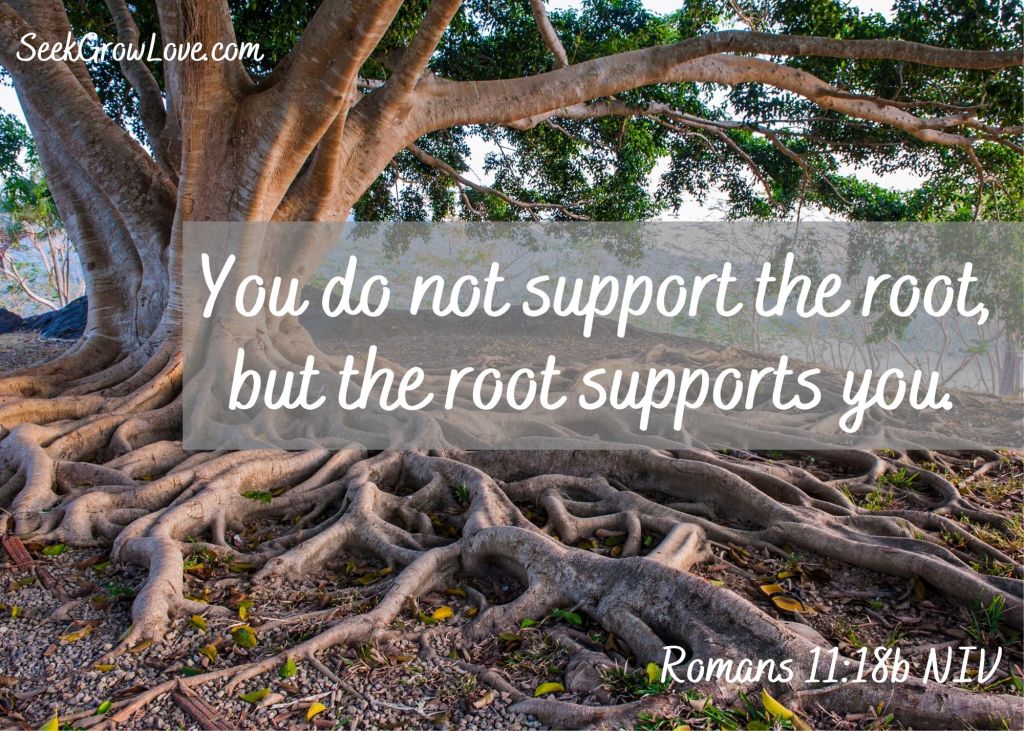
“Consider this: You do not support the root, but the root supports you.” – Romans 11:18b
I am the true vine, and my Father is the gardener. He cuts off every branch in me that bears no fruit, while every branch that does bear fruit he prunes so that it will be even more fruitful. You are already clean because of the word I have spoken to you. Remain in me, as I also remain in you. No branch can bear fruit by itself; it must remain in the vine. Neither can you bear fruit unless you remain in me. – John 15:1-4
Romans 11 makes an ever deeper root connection (this is a pun, and you’ll see why in a moment). In this case, the gardener is not a novice. Grafting branches onto a tree takes an experienced hand. The metaphorical botanical in this passage is an olive tree. But why? Because they live an insanely long time. They are a millennial perennial. Additionally, the roots of an olive tree can grow deeper under the surface than above. It is extremely hard to extinguish some of these species. Impossible, when you consider the species specifically spoken about here: Jesus Christ. His Father is the Gardener, He is the vine, and we are the branches. We are grafted by God into the Savior, which predates His arrival. It is the oldest, deepest promise of God. “After all, if you were cut out of an olive tree that is wild by nature, and contrary to nature were grafted into a cultivated olive tree, how much more readily will these, the natural branches, be grafted into their own olive tree!” Romans 11:24
No longer is there a single type of branch budding on the tree, but the Good Gardener has chosen a variety. Each one is equal to the other because none can be supported without the vine. This makes us all part of the same faith, intertwined in the same hope, which strengthens and flourishes the whole plant, (or body – 1 Corinthians 12) These roots run from the origins of the universe and the branches are fruiting, growing, and reaching towards Kingdom Come. Are you accessing the sap of the Spirit? Utilizing your provision to make fruit? Allowing the gardener to prune the dead bits? Tap into the power and the promise that most assuredly lies in the deepest root.
-Aaron Winner
Questions for Discussion and Reflection
Reading Romans 11, what do we learn about the Gardener who grafts in branches? How would you describe Him? What is His purpose?
How does the Doxology (an expression of praise to God, sometimes sung) in verses 33-36 tie in with the rest of the chapter?
How is your grafting process going? How have the roots supported you? How are you getting along with the other branches?