Deceived by Pride

Jeremiah 49-50

Jeremiah 49 16 NIV sgl

More sin, more judgment, more destruction, and a little more restoration – just like yesterday – only the names have been changed.  Yesterday we read about the judgment God was planning against Egypt, the Philistines, and Moab.  Today, we read what was in store for Ammon, Edom, Damascus, Kedar and Hazor, Elam and the big one – Babylon.  God saw their sins and would be bringing judgment and destruction to their lands.

There is one sin that is mentioned again and again.

“Why do you boast of your valleys, boast of your valleys so fruitful? O unfaithful daughter, you trust in your riches and say, ‘Who will attack me?'” (Jeremiah 49:4  NIV).

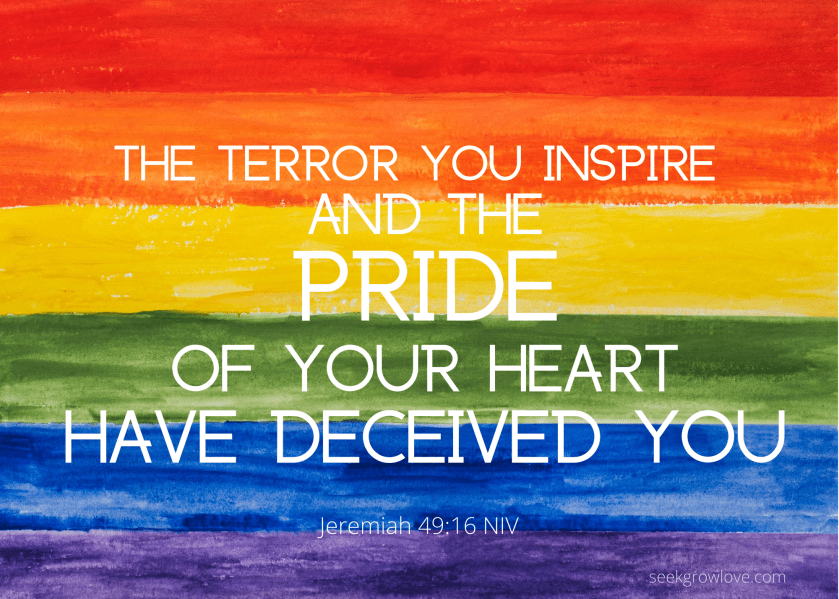
“The terror you inspire and the pride of your heart have deceived you” (Jeremiah 49:16 NIV).

“See, I am against you, O arrogant one” (Jeremiah 50:31 NIV).

It may come by many names – boasting, pride, arrogance – but every time it is a sin worthy of judgment.

How could the pride of your heart be deceiving you?

A few weeks ago I was preparing a devotion for posting and I was looking for a background photograph for a verse referring to Hezekiah’s pride (2 Chronicles 32:25).  I didn’t know exactly what I was looking for – but figured I would know it when I saw it.  So I typed in that I wanted to see photos of pride and I started scrolling.  and scrolling.  and scrolling.  You of course are smarter than I and know what I ran across – over and over again.  I am pretty sure there were thousands upon thousands of options for gay pride – rainbows, couples, signs, and more rainbows, a lot of rainbows (when did they get to hijack the symbol of God’s promises?).  There was also the occasional national flag or beaming, proud parent pictured with her perfect child.  But, there was NOTHING there to indicate that pride is a sin, a deadly sin worthy of judgment.  Finally, I opted for the proud peacock as my photo background and shook my head at dismay over what we have become – a culture that celebrates and basks in pride.  Are we any different from the countries of Jeremiah’s day?  Arrogant, boastful, flaunting sin and deceived by pride.  Can we expect anything less than what Jeremiah foretold for these sinful nations?

What about on a personal level?  It can be overwhelmingly depressing to think about trying to fix all the evils of a nation – but what can I work at fixing about myself?  Where do I let pride puff me up so I no longer care for others or about what God says?  How is my use of social media contributing to the spiraling problem of pride?  How is pride connected to so many other sins?

It is time to see our pride and sin for what it is – and treat it as the deadly gangrene it is.  Don’t be led astray and deceived by pride.  Jump down from your high horse and humble yourself.  You aren’t as much as you think you are.  For God has promised judgment for the proud and arrogant.  He has also promised restoration and forgiveness for those who humble themselves  – “If  my people, who are called by my name, will humble themselves and pray and seek my face and turn from their wicked ways, then I will hear from heaven, and I will forgive their sin and will heal their land.” (2 Chronicles 7:14 NIV)

Marcia Railton


Today’s Bible reading can be read or listened to here – Jeremiah 49-50

Tomorrow we will finish the book of Jeremiah with chapters 51-52 as we continue searching God’s Word in our 2020 Chronological Bible Reading Plan
Isaiah 40-43

He gives strength to the weary and strengthens the powerless. Those who trust in the LORD will renew their strength; they will soar on wings like eagles; they will run and not grow weary; they will walk and not faint

“Comfort, comfort My people,” says your God. “Speak tenderly to Jerusalem, and announce to her that her time of forced labor is over, her iniquity has been pardoned, and she has received from the LORD’s hand double for all her sins.” ~ Is. 40:1-2 

While the first 39 chapters of Isaiah consist of the judgment pronounced on Israel & Judah, the book of consolation begins in chapter 40 and continues for the last 27 chapters of the book (mirroring the set-up of the Bible itself). Isaiah 40-43 contains beautiful pictures of who God is and breath-taking prophecies of the future messiah. When we look at the story of the Israelites a central theme that we see is the forsaking of the true God for idols. Because they could see the idols and because other nations worshipped in the same way, they felt like it was more profitable to worship them. However, these idols always proved to be worthless and caused pain and destruction. If we see that we are worshipping idols, what should we do? How can we turn away from the worthlessness of these idols to the infinite value found in God through Christ. 

Isaiah 40-43 gives us an answer to that as well. In Isaiah 40, Isaiah reminds us who God is. He asks the question in v. 18-19, “Who will compare God with? What likeness will you compare Him to? To an idol? Something that a smelter casts, and a metalworker plates with gold and makes silver welds for it?” Instead of worshipping a created thing, God points us to what he has created to show his power and to show us that he is the only one worth worshipping. In v. 26, he says, “Look up and see: who created these? He brings out the starry host by number; He calls all of them by name. Because of His great power and strength, not one of them is missing.” When we find ourselves looking towards idols for our value and worth – and in turn worshipping them, we need to remind ourselves of where our true value comes from. To do that, we have to turn our eyes away from ourselves and the things we think define us – whether that’s our relationships, money, career, or anything else – and turn them towards the only thing that really gives us worth. By focusing on God and basing our lives on his unchanging character, we can rest in God through the storms and trials of life. He is our firm foundation. 

~ Cayce Fletcher


Today’s Bible passage can be read or listened to on Bible Gateway – Isaiah 40-43.

Tomorrow, we continue reading about the history of Judah and Israel in Isaiah 44-48 – as we continue the 2020 Chronological Bible Reading Plan.

Isaiah 37-39 & Psalm 76

I will defend this city and rescue it because of Me and because of My servant David._

In Isaiah 36-37, we read more about the good king Hezekiah. Like we learned last week, Hezekiah worked hard to take down the idols in the land and point the people back to God. In Isaiah 36, Judah came under attack from the neighboring nation of Assyria. Hezekiah then undergoes a battle for the minds of the people as he argues against King Sennacherib and the people of the court. In these two chapters, the Rabshakeh, a high-ranking military officer, tries to convince the people to forsake their kingdom and God. In his three speeches, we may see some similarities between what he says and the way that we are tempted today. At the heart of all of his speeches is a desire to turn Judah away from trusting solely in God. 

In the Rabshakeh’s first speech, he points out one of Israel’s insecurities. He says in Is. 36:4-6, ‘What are you relying on? Your strategy and military preparedness are mere words. Look, you are trusting in Egypt, that splintered reed of a staff that will enter and pierce the hand of anyone who leans on it.’ Israel and Judah had both sought protection and manpower from Egypt as we read about in Is. 31. Now the Rabshakeh was pointing out that weakness and mocking them for it! We’ve all experienced a time when we have had our insecurities pointed out. I’m a terrible volleyball player. When I would have to play volleyball in gym class, I remember one of the cute guys at my school saying to me ‘You just have to hit the ball like this. It’s not hard!’ You can imagine that in that moment – when a shortcoming of mine was pointed out – all I wanted to do was for someone to take that problem away from me quickly! In my gym class that meant sitting out the next game, but the Judeans didn’t have that option. The Assyrians gave them the option instead to give him 2,000 horses if they could supply riders for them (v. 8). Again, this pointed out the lack of manpower and ability for the Israelites to protect themselves. 

At this point, we would probably say, ‘Well, that’s fine! Israel doesn’t need to protect themselves – they should trust in God!’ The Rabshakeh thought of that too. In verse 7, he says, ““Suppose you say to me, ‘We trust in the LORD our God.’ Isn’t he the One whose high places and altars Hezekiah removed, saying to Judah and Jerusalem, ‘You are to worship at this altar’?” The Rabshakeh twisted the actions of Hezekiah to make it seem like he had done something against God rather than something that God wanted. He even goes so far as to say in v. 10, “Have I attacked this land to destroy it without the LORD’s approval? The LORD said to me, ‘Attack this land and destroy it!’ In his second speech, the Rabshakeh describes how he had destroyed the gods of the surrounding nations, which would just show that God himself wouldn’t deliver the people either (v. 18-20). 

This is some powerful psychological warfare! We know the Judeans had trust issues to begin with. Now, someone is coming and laying out all of their insecurities for the world to see (right before they try to march in and destroy their kingdom)! The heart of all of the Rabshakeh’s temptation can be summed up with what he said in Is. 37:10, “Don’t let your God, whom you trust, deceive you by promising that Jerusalem won’t be handed over to the king of Assyria.” He basically says ‘Did God really say that he would save you?’ which may sound eerily reminiscent of another ancient tempter (Gen. 3:1). At this point, if someone had tried to break our trust in God in this way, we may have caved and believed them. However, Hezekiah does what we all should do when we have people who try to break our trust in God. He prays and then reminds himself of God’s unchanging character. 

God hears his prayer and we read about the victory that God brings in Isaiah 37:36-38 when an angel of the LORD strikes down the Assyrian army and the king is killed in the temple of his god, Nisroch.

When we face temptations and challenges that try to break our trust in God, we need to be reminded that he is who he says he is and will do what he says he will do. We can trust in what the Bible says. We can trust in the promises of God. 

~ Cayce Fletcher


Today’s Bible passage can be read or listened to on Bible Gateway – Isaiah 37-39 & Psalm 76.

Tomorrow, we continue reading about the history of Judah and Israel in Isaiah 40-43– as we continue the 2020 Chronological Bible Reading Plan.

Hosea 1-7

For I desire loyalty and not sacrifice, the knowledge of God rather than burnt offerings.

When we think about the faithfulness of God, we tend to speak in terms that I would call fluff in the papers I grade in my English classes. We always say that we have a faithful God, but what does that really mean? When we describe the faithfulness of God and his faithful love, we can easily let these tired terms cause the meaning to get lost. Today’s reading snaps the striking, relentless love of God into sharp focus. In the book of Hosea, the prophet Hosea is commanded to marry a prostitute, named Gomer. She continues to be unfaithful to him, but Hosea is told to return to her each time. The relationship that Hosea has with Gomer is one that mirrors the prodigal love that God shows to the northern Kingdom of Israel. Israel pursues other gods and kingdoms, but despite this, God still calls them back to him. He still loves them. 

When I read these stories, I always question the characters’ motives. Couldn’t Gomer see how much Hosea loved her by the fact that he was always there for her? Why would she pursue other people? Hosea 2 gives insight to her reasoning. In Hosea 2:5, it says that Gomer would pursue other men because she thought they would give her “my food and water, my wool and flax, my oil and drink.” She pursued these men, because she thought they would give her what she needed to survive. Notably, these things are the basics of what she might need to live comfortably. Out of a lack of trust, she did not realize that she was actually missing out on the best things, because she was turning to these men to fulfill her desire for provision and possessions. In verse 8, it says, “She does not recognize that it is I who gave her the grain, the new wine, and the oil. I lavished silver and gold on her, which they used for Baal.” Gomer never realized that the person who would take the best care of her and give her the best things was the person that she continued to leave for other men, Hosea. 

Too often, we follow in the footsteps of Gomer and Israel. We pursue other gods that seem like they could give us satisfaction and comfort, like our families, boy/girlfriends, work, money, education, or our beliefs and ideologies. We don’t recognize that the best things in our life actually come from the one who we continue to leave behind, God. James 1:17 says, “Every generous act and every perfect gift is from above, coming down from the Father of lights.” God will continue to give us the best things in life, but we need to turn back to him. Don’t turn to other idols. God is infinitely better than anything the world could offer. 

~ Cayce Fletcher


Today’s Bible passage can be read or listened to on Bible Gateway – Hosea 1-7.

Tomorrow, we continue reading about the history of Judah and Israel in Hosea 8-14 – as we continue the 2020 Chronological Bible Reading Plan.

2 Chronicles 27 & Isaiah 9-12

Surely God is my salvation; I will trust and not be afraid. The Lord, the Lord himself, is my strength and my defense[j]; he has become my salvation.”

I am not where I planned to be today. You see for many years this weekend is when I have helped load vans, buses, SUVs and even a Volkswagen bug with a lively group of cheerful travelers as we start making our way to Northern Indiana. Our group is always made up of students and youth workers heading to a youth camp named FUEL. Weeks spent at camp are so incredible because we intentionally set aside time to focus on God. We worship, we learn, we laugh, we encourage, we grow, we pray, . . . This camp offers us the chance to spend some intentional focused time with God. We remember our ultimate life goals of loving God with all that we are and loving others as ourselves. We align our lives with these main goals. We determine our next steps and develop practical actions that show that we have a close, loving relationship with God through Christ and that we truly love others.

Unfortunately, we will not gather physically for FUEL this year, but that shouldn’t stop us from taking time to connect with God. Yes, He is in northern Indiana, but He is where you are right now (He is not far from any one of us Acts 17:27). God loves us so much that He wants to connect with us and He is always there to direct us as well. We just need to focus on Him.

Today we read about a King who did exactly that. He was Jotham. Jotham was the eleventh king of Judah. It was stated that he did what was right in the eyes of the LORD.  What a great way to be remembered. We are also told that He grew powerful because he walked steadfastly before the Lord his God. Steadfastly-that could describe the way we order the habits of our lives! Walking resolutely, firm and unwavering because we are living our lives connected to God.

Jotham benefited from seeing what a king should and should not do from his father. He also benefited from being a contemporary with the prophets Isaiah, Hosea, Amos, and Micah. Praise God we have their writings available to us today! Just like the faithful kings we can read the message from God sent through these prophets. Isaiah (9-12) presents the coming of the Messiah, just judgment, the future rally of nations to Christ, the Lord’s glorious holy mountain, and the earth being filled with the knowledge of the LORD as waters cover the sea. What an amazing experience it will be to meet with those prophets and those kings that “did what was right in the eyes of the LORD” in the Kingdom of God!

So even though we may have to be socially distant right now, we look forward to that perfect time. Isaiah (12) describes the people rejoicing on that day because the Holy One of Israel is among them. Today we can rejoice because the Holy One of Israel can also be with us!

~ Rebecca Dauksas


Read or listen to today’s bible passage on Bible Gateway: 2 Chronicles 27 & Isaiah 9-12.

Tomorrow, we read more of God’s prophecies to Israel and Judah in Micah 1-7 – as we continue the 2020 Chronological Bible Reading Plan
God’s Jealous Love

Isaiah 1-4

Isaiah 1 4 NIRV sgl


Today, we begin the book of Isaiah. This book is full of poetry, prophecy, but also includes some narrative sections, as we will see tomorrow. Isaiah speaks of the coming judgment and future restoration upon the nation of Judah. The book contains lament over the nation’s sin, warning against God’s wrath, and the promises of a wonderful future for the faithful. As I read through the first four chapters, a single theme stood out to me. These passages reminded me of God’s passionate love and desire for our hearts. Like in the song “How He Loves” God is jealous for us.

The verses in Isaiah 1:10-15 express God’s disgust at the people’s empty rituals and sacrifices. While they may be executing all the correct religious actions, they are done without sincerity. Simply going through the motions. This is something we can fall privy too, as well. Routine worship. While Covid may have interrupted our usual routines, it is important to keep our worship sincere, in whatever form it may take.

While a rather grim verse, the verbiage in Isaiah 1:28 hints at a key factor regarding God’s love. Isaiah claims, “But rebels and sinners will be completely destroyed, and those who desert the LORD will be consumed.” Those who desert the LORD. It does not say those the LORD has deserted. God does not walk away and leave us. He is always ready to accept a repentant heart. At a time when you may be feeling particularly lonely, remember, God is always ready to receive you.

Finally, Isaiah 1:22 struck me as bittersweet, but very true: “Don’t put your trust in mere humans. They are frail as breath. What good are they?” Don’t misunderstand, Isaiah and I are not advocating for hermit life. There are plenty of verses in the New Testament, whole chapters written by Paul, that explain the need for church community. Our faith is not something we are meant to go about alone. However, this verse tells of one of the most important life lessons: people will fail you. The only ones we can truly depend upon is the LORD and His son, our redeemer. In fact, it is when we live from a place of securely trusting in God, we can have better human relationships. When our trust and hope is put in God alone, we become more ready to accept and forgive the failures of those around us.

The themes of God’s overwhelming jealous love for us are evident throughout the first four chapters of Isaiah. God’s anger over the people’s worship of idols, promises of a bright future, and redemption for the faithful exemplify God’s desire to be our number one priority. God knows the worship of idols and sin led lives will not fulfill us. That is why his anger burns so strong against His people in scripture like today’s. For He knows what is best, and they are not listening. He is not a narcissistic God who is angry and pours His wrath out in a desire to be right. He is a God of mercy who longs to bring His people to Him so they may experience true and abundant life.

Emilee Ross


Today’s Bible passage can be read or listened to at https://www.biblegateway.com/passage/?search=Isaiah+1-4&version=NIV

Tomorrow’s passage will be Isaiah 5-8 as we continue the 2020 Chronological Bible Reading Plan


Renovating the Temple

2 Kings 12-13 and 2 Chronicles 24

2 Chronicles 24 13 NIV sgl


A century after Solomon, both the people of Israel and the Temple had become a metaphor for one another. Both had grown to be a shadow of their former glory. The borders of Israel were shrinking along with the people inside.  Many had moved from serving the One True God to idol worship, and the holy relics inside the temple had been refashioned for use in Baal worship. No one seemingly cared, and it showed.  Enter Joash.  Made king at only the age of seven, yet he showed wisdom beyond his years.  Even if you’re a king, you haven’t truly found your ego at such a young age, which was much suffered by his predecessors.  In fact, psychologically speaking, your sense of right and wrong is never more attune and concrete than at this time in your life.  Just the king Israel needed at this moment. Joash is considered a “good” king because he did what was right in the eyes of the Lord, including temporarily restoring the Temple and the precious things inside – not the holy relics -the people of Israel.


In Mere Christianity, C.S. Lewis discusses a similar metaphor in our transition to become more like Christ. He compares our old-self to a shack, and the new man/woman to a castle.  I would dare say, with Lewis most likely agreeing, that God’s first move is not to take a bulldozer and knock our shanty to the ground.  When we hear Paul assert  “I no longer live, but Christ lives in me,” he is not implying such a thing either. Isn’t there some salvageable part that God made if he stitched me in my mother’s womb with a purpose? I believe the context of Paul’s words are more directed at building with a Christ-centered motivation, instead of using the law as we see fit (yesterday’s devotion – read Galatians 2 for context). Everything we do, from tying shoes to tithing, must go through a process of being purposed for God.


This means every wall must be inspected for integrity.  Every space designed with the intentions of the Father using it.  Yes, the sin, the junk, the addiction, the clutter, must go; however, when we do this, there are pieces – traits, relationships, gifts – that might be salvageable.  The “bones” might be good in a spot or too, but God simply isn’t looking to paint the walls and hang a few pictures.  He is using the most select pieces, making elaborate extensions, and has a detailed blueprint for more than we could possibly ever imagine. It is an extreme home makeover that begins with bringing Christ on the job-site. The home becomes more unrecognizable, yet with each phase, it is moving towards how it was intended to be.  There is a shadow, a glimpse, of what stood there before, but there is much that has been changed, added, removed, all having the mark of their Maker.


Construction – quality, enduring, sizable construction – takes time.  Joash did not restore Solomon’s temple overnight.  Your renovation from a shack to a castle will take God and you a lifetime to complete, and it will require a day-in-day-out dedication to get there. Most beautifully, alongside our metaphor is a literal Kingdom with Christ at the center.   This hard work is not without a promise.  We truly are looking ahead for a city whose architect and builder is God (Hebrews 11:10).  I desperately hope we see each other there.


Thank you so much for letting me be a part of your week.

Aaron Winner

Today’s Bible passage can be read or listened to at https://www.biblegateway.com/passage/?search=2+Kings+12-13%2C+2+Chronicles+24&version=NIV

Tomorrow’s reading will be 2 Kings 14 and 2 Chronicles 25 as we continue the 2020 Chronological Bible Reading Plan

The Opposite of God

Obadiah and Psalm 82 & 83

Obadiah 15 NIV sgl

In yesterday’s devotion, one of four bullet points focused on making God the judge. In today’s reading, there are calls from Obadiah and the Psalmist(s) for justice to come from on high.  To be clear, we are not appointing God to a position He doesn’t already command, and we aren’t necessarily persuading Him to intervene.  When we implore God to judge, we are inviting Him to rule in our favor by having a life-contrast or dichotomy that would allow Him to easily see we are for Him.  We are the wheat. We are the sheep. Whether he intervenes today or not, ultimately, “Come” will be the words of invitation we will hear from our King inviting us to dwell with God in love and in eternity.  Conversely, we are all declared guilty for the first death, but we can be condemned to a second and permanent death if we are not found covered by the innocent blood of Jesus Christ.  Those who remain are against Him. The chaff. The goats. “Depart” will be the words of condemnation to those who made themselves a stranger.  There is no invitation.  There is no love.  There is no eternity. God’s ruling is truly sovereign. There is no room for shades of gray.


Although the following isn’t a joy-filling thought to charge the beginning of your day, we need to be reminded there is a place opposite of God.  Sometimes those who dwell there actively and openly oppose Him (Obadiah 1:3). In fact, there are people in this world who would love nothing more than to imprison Christians, outlaw prayer, burn down churches, and try to expunge the name of Jesus Christ from existence.  Sadly, this happens quite a bit across the world today, and I dare say, at an ever-increasing pace in the United States. However, we must also remember, open defiance and apathetic faith are equally punishable in the eyes of God: women and men who prioritize their lives by accumulating wealth, try to make a name for themselves, acquire dizzying intellects, repeatedly give into vices, forget to take care of those who are hungry, thirsty, or imprisoned, or many other acts not listed here that do not center solely around God (Psalm 82:3,34, Matt 25:44,45). Apathy, complaisance, half-heartedness, and postponement can place us in imminent condemnation of God as plainly as open defiance.


To not share the name of Jesus Christ is to annul his message. To not lift up the church is to tear it down.  To not empower the weak is to place them in the hands of those who would do them harm.  Where is the contrast in your life?  Are you living for the finite or existing for the eternal? Are you with Him or against Him?  Yes, there is a place opposite of God, but let us pray that God uses these words we read today to convict us, bringing us closer to His calling as good and faithful servants.

Aaron Winner

Today’s Bible passage can be read or listened to at https://www.biblegateway.com/passage/?search=Obadiah+1%2C+Psalm+82%2C83&version=NIV

Tomorrow’s reading will be 2 Kings 1-4 as we continue our journey through the 2020 Chronological Bible Reading Plan

Heal Our Land

2 Chronicles 6-7 & Psalm 136

2 Chronicles 7 14 NIV sgl

Solomon addresses the people of Israel, reminding them of how they got to where they are in regards to the building of God’s temple.  Then he offers a prayer of dedication of the temple.

In his prayer, Solomon knows that as great as the temple is, it isn’t great enough for God.  Yet he asks God to hear what is brought before Him in this house.

40 “Now, my God, may your eyes be open and your ears attentive to the prayers offered in this place.

41 “Now arise, Lord God, and come to your resting place,
you and the ark of your might.
May your priests, Lord God, be clothed with salvation,
may your faithful people rejoice in your goodness.
42 Lord God, do not reject your anointed one.
Remember the great love promised to David your servant.”


God doesn’t have to hear us.  He doesn’t have to love us.  Yet he established a covenant with David that continued through the generations, that when it came to Jesus, was opened to everyone.  We should be so thankful to God for that!

God responded to Solomon’s prayer with fire and His glory filling the house.  And later, He appeared to Solomon.  One of my favorite verses is in this next section –

14 if my people, who are called by my name, will humble themselves and pray and seek my face and turn from their wicked ways, then I will hear from heaven, and I will forgive their sin and will heal their land.

I know this was directed to the people of Israel, but I’d like to think it can apply to us too.  Our land is so broken today.  I live in Minnesota.  These past few weeks we have been dealing with a huge mess of brokenness.  A police officer killed a man during an arrest.  Peaceful protests gave opportunists the chance to start violent riots with buildings being burned down, stores looted, people being sexually assaulted, kids going without food because the services that normally provide them with food are unable to operate amidst this, and much more.  And all I can think is how much our land needs to be healed.  And that is just in my little state.  I know there are problems all across our country, and our world.  If all of God’s people turned to Him and prayed, could our land be healed?

My comfort in this time is knowing that our land will be ultimately healed.  Jesus will return and the earth will be made new.  But until then, I do believe it is the job of God’s people to pray and to turn to Him and away from wickedness.

We’ll end today and this week with Psalm 136.

Give thanks to the LORD for He is good, His love endures forever.

If I counted correctly, that phrase “His love endures forever” is repeated 26 times in this psalm.

Thanks Marcia for putting this reading plan together.  What a timely reminder.  Whatever is happening in the world today, God’s love endures forever.

Come lord Jesus come.


~Stephanie Fletcher


Today’s beautiful and timely Bible passage can be read or listened to at https://www.biblegateway.com/passage/?search=2+Chronicles+6-7%2C+Psalm+136&version=NIV

Tomorrow’s reading will be Psalm 134 and 146-150 as we continue seeking God, and growing our Christian faith while learning to love Him and others better and better on our 2020 Chronological Bible Reading Plan.   Now is a great time to start following along. Print your own plan (red link above) and subscribe to the daily devotion emails at https://seekgrowlove.com/


Strike up the Band!

1 Chronicles 6

1 Chronicles 6 32a NIV

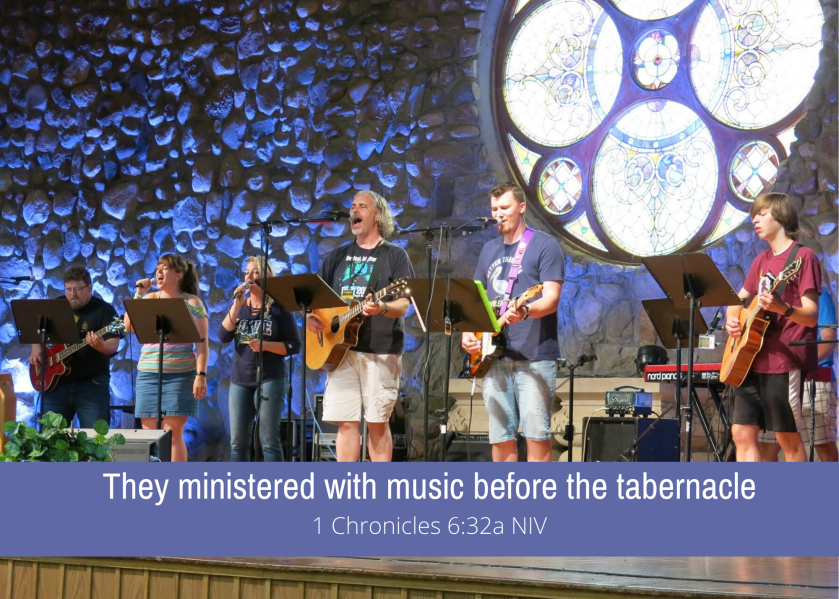
As our Bible reading today we have just one chapter in the book of 1st Chronicles (chapter 6) – still in the genealogies.  This chapter is devoted to the tribe of Levi.  Levi was one of the 12 sons of Jacob and his descendants would be the ones God chose to be the Levites for the nation of Israel.  They were set apart for service to God.  They would be the care takers of the tabernacle (where people sought God), and later the temple.  From their tribe would come the family line that would serve as priests and the most holy role of high priest, which later Jesus himself would take upon his shoulders.

But, that’s not all – some of the Levites (those listed in verses 33-47) – were given the responsibility of temple musicians.  They were to play, sing, and make music to the Lord – to lead the temple-goers in their worship of the Most High.

I love that God created us to enjoy music.  I love the power of music – just read any article on music and the brain or music therapy – or better yet – listen to the nurse as he plays his guitar in the hall of his covid-19 ward.  Or witness the miraculous turn-around of the struggling infant when his big sister sings to him the song that she always sang to the baby in her mommy’s belly.  Or hear the band play as the Titanic sinks.  Music grips us and moves us in many ways.  Let music be a source that moves you toward God as you come to worship.

As our church has gone online during this time of isolation, I miss the community lifting their voices and instruments together in worship.  But even now, music remains as a powerful means to move us closer to God.  Look up the words to an old hymn.  Pick up an instrument you have neglected too long.  Thank those who have used the gift of music to lead you into meaningful worship.  Share with your family a song that reminds you of God’s love, character and promises.  Search for Bible verses about music.  Play worship music as you go about your day.  Research how many instruments are listed in the Bible?  Post a song of Christian joy and hope on social media.  Write your own psalm of praise – maybe you will even set it to a tune.

Music was a powerful part of worship long ago, it is still today, regardless of our situation – and it will be in the future as well.  I love the verses in Revelation where the faithful will sing in worship to God and the Lamb Jesus Christ as the Kingdom of God is preparing to unfold.  Let’s get started practicing today to be a part of that choir!  God and His Son are worthy of our worship!  Sing it out!


Marcia Railton


Today’s reading can be read or listened to at https://www.biblegateway.com/passage/?search=1+Chronicles+6&version=NIV

Tomorrow we go back to the Psalms – 81, 88, & 92-93 as we continue on the 2020 Chronological Bible Reading Plan