Death and Life

*Theme week – Celebrating Jesus: John 20

Old Testament: Zechariah 13 & 14

Poetry: Psalm 148       

            It feels funny to be talking about Jesus’ death and resurrection during Christmas week.  Sunday we were expecting a baby to be born, Monday the angels were singing to the shepherds announcing his birth.  Here it is Friday and he has already been crucified and his cold, dead body lies in a tomb.  It is kind of jarring to go from celebrating a baby born to be king to suddenly mourning his death. 

            Life is often experienced as a kind of emotional roller coaster.  Something great happens, and you are laughing and joyful.  Then, suddenly you are hit with bad news and the laughter turns to tears.  The events we have been reading about took place over 30+ years from the time Gabriel first appeared to Mary with the announcement that she had been chosen by God to bear his son, the Messiah until she stood at the foot of his cross and watched him die.  As you may recall, there was death surrounding Jesus right from the beginning, as King Herod was trying to kill him when he was a baby, when the little innocent baby boys of Bethlehem were slaughtered.    Jesus warned in John 10:10 that “the thief comes to kill, steal and destroy”.  Right from the beginning evil was out to destroy Jesus.  It took 30 years, but finally Jesus was dead.  The rejoicing has turned to weeping.

            The good news of the Gospels is that death doesn’t have the final word.  Evil doesn’t win.  God wins!  At the Last Supper just before Jesus was arrested he laid out for his disciples what was about to happen:

16 Jesus went on to say, “In a little while you will see me no more, and then after a little while you will see me.”

At this, some of his disciples said to one another, “What does he mean by saying, ‘In a little while you will see me no more, and then after a little while you will see me,’ and ‘Because I am going to the Father’?” They kept asking, “What does he mean by ‘a little while’? We don’t understand what he is saying.” 

Jesus saw that they wanted to ask him about this, so he said to them, “Are you asking one another what I meant when I said, ‘In a little while you will see me no more, and then after a little while you will see me’? Very truly I tell you, you will weep and mourn while the world rejoices. You will grieve, but your grief will turn to joy. A woman giving birth to a child has pain because her time has come; but when her baby is born she forgets the anguish because of her joy that a child is born into the world. 22 So with you: Now is your time of grief, but I will see you again and you will rejoice, and no one will take away your joy. (John 16:16-20).

            This brings us to today’s reading in John 20.  As we saw yesterday, Jesus was unjustly killed for political reasons.  The principalities and powers tried to buttress their own power and control and they saw Jesus as a threat, so they had him unjustly killed.  However, it takes more than the death of his son to thwart God’s plan.  As it turned out, the powers who orchestrated Jesus’ death played right into God’s plan that goes back to the very beginning.  That’s right, since the time of Adam and Eve and the Fall, God’s plan to defeat evil included the sacrificial death of the one who would be the son of God and Messianic King.  Revelation 13:8 speaks of the “lamb that was slain from the foundation of the world.”  Before Jesus ruled as King, he first had to die as sacrifice, as savior, as redeemer.  He died to bear our sins as Isaiah 53 prophesied would one day happen.

            God raised Jesus from the dead.  Death did not have the final word, God has the final word and it is life.  Along with life, Jesus offers the gift of forgiveness.  When you believe that Jesus died and was raised to life and give your loyalty to him as your king, you will share in that blessing Jesus promised. Your sins will be forgiven and you will have your fellowship with God restored. The result of this restored fellowship is peace, the peace that only Jesus can give.

            Jesus points out to the disciples that they came to believe in him by seeing him in person after the resurrection.  Thomas even had the benefit of physically touching Jesus’ scars to help him accept the truth of the resurrection.  Jesus points to those who will believe in him without the benefit of having seen him after his resurrection. Those who have faith in the message of the gospel passed down for 2000 years in the Bible from the first eyewitnesses to the risen Jesus. The good news is, that is you, if you believe that God raised Jesus from death to life, you receive the blessing Jesus promised.  I hope you believe, I know I do.

-Jeff Fletcher

Reflection Questions

  1. What do you love about God and His plan as revealed in John 20? What questions do you have about God and His plan and Jesus’ part in that plan?
  2. What has Jesus offered to you? Have you accepted these gifts? Why or why not?
  3. What is the next step in God’s plan and what is your role in it?

His Love Endures Forever

Old Testament: Micah 3 & 4

Poetry: Psalm 136

New Testament: Matthew 22

If you are like me, it is troubling to watch what is happening today over in Israel.  Many lives have been lost in the Israeli Hamas war.  I feel bad for the innocent people who have lost their lives.  Moreover, I am confused about what I want to happen.  Of course, peace is the ultimate goal, but does blood have to be shed to reach that goal?

I wouldn’t necessarily pick such a grim and complex topic for a daily devotion, but I couldn’t help but think about what is happening today when I was reading today’s chapters in Micah, Psalms, and Matthew.  The topics were not all warm and fuzzy, in fact, they were quite violent at times.  I’m not sure what I read helped me frame my view of the war today, but I got a glimpse into the mind of God.  I still have more questions than answers, but I feel I am more prepared to understand why the events will unfold the way they will.

Let’s start with Micah.  When I heard what was happening in Israel, my first thought was that Israel was God’s chosen people and you really don’t want to mess with them if you value your own life.  I already know who wins in the end, and it is Israel.  But then I thought about all the times Israel turned their backs to God and bad things happened to them.  In Micah 3:9-12, it talks about the rulers of Israel who despised justice, distorted what was right, built Zion with bloodshed, and built Jerusalem with wickedness.  They thought that the Lord was among them so no disasters would come upon them.  Instead, because of them, Jerusalem became a heap of rubble.  Does this describe the leaders of Israel today?  Is it possible they are trying again to build up Jerusalem with wickedness and bloodshed?  Are they going against what God wants to happen when innocent people are killed?

Would God, the most loving being there is, be ok with so many people dying in a war?  Strangely enough, the answer to that came in Psalms 136.  The second part of all 26 verses says, “His love endures forever.”  It is a whole chapter that talks about many ways that God loved his people.  It starts out nice enough when it talks about how good He is and how He created great wonders for us, but it gets a bit weird later.  It talks about His love enduring forever because He struck down the firstborn of Egypt, swept Pharoah and his army into the Red Sea, struck down great kings, and killed mighty kings.  It is strange to read a verse that says, “to Him who struck down the firstborn of Egypt, His love endures forever.”  I don’t usually consider killing children as a sign of His love enduring forever.  However, it was a sign of His love because he did it to help His chosen people.  He loved the Israelites so much, that He was willing to kill others that were against them.  Is it possible Hamas is being killed because of God’s love for the Israeli’s?

The chapters from Micah and Psalms are sufficient in framing the discussion, but I was surprised to see that even Matthew had a little bit to say about the subject.  The parable of the wedding feast includes the king who was so enraged, he sent his armies to destroy the murderers and set their city on fire.  And the chapter ends with Jesus quoting David who said, “Sit at my right hand, until I put your enemies beneath your feet.”  These two examples in Matthew were not necessarily referring directly to the issue we are talking about today, but I thought it was interesting that God did not rule out violence to solve some of the problems talked about in Matthew.

I already mentioned I don’t have complete clarity about this war today, but in my position, I think that is fine.  I am not the one deciding how much death and destruction will occur and I really don’t think either side would listen to me anyways if I had an opinion.  I care about what is happening, but I am just not directly involved.  I am ok watching what is happening, and I think it will become clear with time how God wants this to play out.  My prayer is for peace, but I will be patient to see how that peace comes about.  Perhaps true peace won’t even occur until a time that Micah talked about in chapter 4 – when Jesus returns.  I will also pray for that day to come soon.

Reflection Questions:

Do you think God is an active participant in this war or is He just watching what is happening?

What is your prayer for this war?

-Rick McClain

Your Compassion

Old Testament: Jonah 3 & 4

Poetry: Psalm 134

New Testament: Matthew 20

I do not care for the ending of Jonah.  It is such a cliffhanger to me.  I love to read stories.  And when I read stories, my judgment on the quality is if it makes my stomach clench throughout.  Even a book I have re-read 5 times can have that same effect on me.  I know I’m involved with the characters when that happens.  And Jonah is a pretty good story.  But if the ending of this book was in the ending of another book I have read, I would be quite upset.  I want to know what happened!

So post-preaching to the Ninevites, Jonah has a bad attitude.  He starts out in a good mood, sitting down to wait for the smiting of his enemies.  But as time goes on and it doesn’t happen, he gets grumpy.  To the point of comedy in my opinion.

Do we see that in our own lives?  Maybe not the waiting for the smiting of enemies (or maybe for some readers, that is true), but just for the fulfillment of what we want?  Maybe you have something in your mind of how things should go, and you are happily waiting to see that happen.  But when it doesn’t, you get angry, grumpy, and over-dramatic.  Do we stop to think that maybe what we want isn’t always the best way?

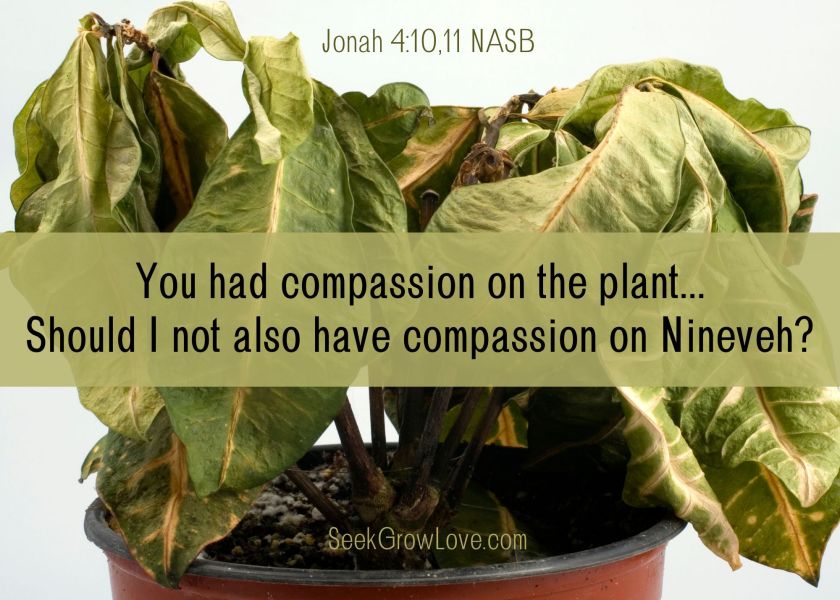
God’s response to Jonah in the last chapter is powerful to me.  He says to Jonah, “I made them, who are you to decide they need to die?  You care more about a plant that you didn’t even plant than these living, breathing people that I designed.” (not actually a quote from Scripture – my paraphrase).

Do you ever care more about what you want to have happen than the people God designed?  Again, it might not be that you are waiting for them to die.  But maybe you are more upset that your order at a restaurant was messed up than the fact that the person taking your order was having a really bad day and made a mistake.  Maybe you want so much to be proven that you are the most right about something at school or work or church that you are alienating people that you could be having an impact on?

When you are focused on yourself and what you want, remember that other people matter too. The fact that someone managed to show up for work might be a huge victory for them, even if your order got messed up.  Taking the time to care about people more than your own selfish, petty desires, not only can improve someone else’s life, but your own too.

~Stephanie Fletcher

Reflection Questions

  1. How would your rate Jonah’s compassion? God’s compassion? Your compassion?
  2. When do you find yourself more focused on what you want than on what others need and how you can serve them?
  3. What do you learn from Jonah in the book of Jonah? What do you learn about God in the book of Jonah?

An Important Message from Joel

Old Testament: Joel 1-3

Poetry: Psalm 127

New Testament: Matthew 13

12 Even now— this is the Lord’s declaration— turn to Me with all your heart, with fasting, weeping, and mourning. 13 Tear your hearts, not just your clothes, and return to the Lord your God. For He is gracious and compassionate, slow to anger, rich in faithful love, and He relents from sending disaster. Joel 2:12-13 (HCSB)

Today we’re going to read the book of Joel (hey, that’s my name!). It is one of the shortest books in the Old Testament, so I’ll keep my thoughts on it brief. It was written as a wake up call to God’s people. As you’ve been reading through the Prophets, it should have been quite apparent that God wasn’t the happiest about the actions of His people. That’s why we have this particular section of scripture; if Israel hadn’t messed up so bad, God wouldn’t have had to tell them so. Joel doesn’t say much different than the other Prophets; he is just rehashing the same message because apparently, Israel still hasn’t learned its lesson.
Here’s the condensed version of the message: you’ve sinned and made God angry, but He loves you and wants you to live, so turn away from your wickedness. 


This message, which was proclaimed to the Jews first, is just as relevant today for us as it was then for them. Only today we have the added part: God loved you so much He sent His only begotten son so you can live eternally (John 3:16). We still live in nations full of wickedness, we still raise idols to a status reserved only for Yahweh, we still do wrong when we know what’s right, and we still let the ungodly have undue influence over us. The words spoken through the Prophets to the people of Israel still hold value for us, and I hope we will do a better job heeding them than the original recipients. 

-Joel Fletcher

Reflection Questions

  1. What idols do you/have you raised to a status reserved only for Yahweh?
  2. What wrong do you do when you know what is right?
  3. In what ways have you let the ungodly have undue influence over you?
  4. What does the book of Joel reveal will happen to those who don’t return to the Lord? What is revealed will happen to those who do?

Married to a Prostitute

Old Testament: Hosea 1, 2, 3

Poetry: Psalm 121 

New Testament: Matthew 7

As the wife of a pastor, I know first hand that many unintentional happenings in our lives often later become fantastic sermon illustrations. Sometimes, once we recover from the initial shock of a momentous event, my husband Dan and I will look at each other knowingly as if to say, “this will be a great sermon story someday.” Once in a while, Dan will remember and share stories off the cuff while he is preaching. He’s always very respectful of me, choosing to present me in a positive light and make himself the butt of any jokes, but as an introvert who prefers to blend in, I still feel embarrassed when the eyes of the congregation turn to me mid-sermon to take in my reaction to reliving the story. (I’ve joked with Dan that I need to attach a shock collar to him, and every time he starts to say my name, I will activate the shock collar so he will stop talking about me!)

The prophet Hosea was a living, breathing sermon illustration tasked with the responsibility to demonstrate God’s relationship with Israel by marrying a prostitute and having children with her. The whole book is a metaphor about the intimacy, or lack thereof, between YHWH God and his chosen people. It reads almost like a soap opera, declaring how God continues to pursue them even though they keep turning away from Him as Hosea continues to redeem and love his wayward Gomer. (This seems to be the overall theme of the entire Old Testament, doesn’t it?)

It is frustrating to see how our world overall devalues true committed relationships, referring to marriage as a prison, for example. Likewise, our post-Christian culture does not understand the blessing of an intimate relationship with God, our Creator and Sustainer who loves us so much. I am grateful that, though I have sometimes rejected God, He still pursues me. Psalm 121 from today’s reading is evidence of God’s love for us – he wouldn’t help us so much if He didn’t love us and desire to draw us back into a relationship with Him! 

I am still in awe that, despite our wishy-washiness toward Him and even knowing that humankind would tend to always have such a desultory demeanor, still “God so loved the world that he gave his one and only Son, that whoever believes in him shall not perish but have eternal life.” (John 3:16, NIV) 

Reflection questions:

-How has God pursued you? 

-In what practical ways can you demonstrate the never-failing love of our Father YHWH to those around you? 

Rachel Cain

Weird

Old Testament: Daniel 11, 12

Poetry: Psalm 119

* New Testament: Matthew 5

As a fifth-grade introvert who wanted nothing more to blend in with the small class in my little Christian school, “weird” was about the meanest name one could call me. Because I didn’t even want anyone to so much as notice me, remaining quiet and going with the flow was the most obvious way to camouflage among my peers. 

I’ve had a bit of a wake-up call since my private school elementary days. In my public secondary and post-secondary education, God called me to stand up for my faith on several occasions, even when it meant that I was standing alone – resulting in <gasp> people noticing me! More recently, ever since my husband and I felt God leading us to do things that go against the culture, such as home-birthing and home-educating all four of our children, I’ve had to learn to be confident in those decisions and keep my eyes focused on God, no matter if others think I am weird. (As fate would have it, since opposites attract, I married an extrovert who thinks “weird” is a compliment and loves nothing more than helping others laugh at his own expense, so he tries to do silly things when we are out in public – which then, of course, draws attention to me too! I’ve learned to loosen up and not care as much what others think, and he’s learned to rein in the silly antics a little bit when I am with him.)

Jesus was the epitome of weird, but not in a bad way; in fact, many people were drawn to him because they could sense his sincerity and wisdom. (Some even failed to recognize him as the Messiah for whom they were searching because he didn’t meet their expectations!) Most of Jesus’ teachings in Matthew 5 are quite counter-cultural; for example, the Beatitudes is a list of dichotomous concepts which indicate (in my simple summary) that bad things can be blessings in disguise.

Because God is love (I John 4:8) and Jesus is God’s Son and representative, one could deduce that the primary mission of Jesus’ ministry was to demonstrate the love of his Father to this broken world. That, I believe, is why the end of this chapter (Matthew 5:43-48 NIV) gives perhaps his most controversial nugget of wise advice yet: “You have heard that it was said, ‘Love your neighbor and hate your enemy.’ But I tell you, love your enemies and pray for those who persecute you, that you may be children of your Father in heaven. He causes his sun to rise on the evil and the good, and sends rain on the righteous and the unrighteous. If you love those who love you, what reward will you get? Are not even the tax collectors doing that? And if you greet only your own people, what are you doing more than others? Do not even pagans do that? Be perfect, therefore, as your heavenly Father is perfect.” Showing love to people who are not like me or who don’t deserve it can be hard enough, but to show love to my enemies and those people who have hurt me? Well, that just takes Jesus’ weird, radical love to a whole new level. Jesus demonstrated this love throughout his ministry, though, by dying for generations of sinners including you and me (see Romans 5:8) and even forgiving the people who brutally murdered him (see Luke 23:34). 

Romans 12:1-2 is one of my favorite passages; I especially love the down-to-earth wording of The Message paraphrase that reminds us why it is important to be weird: “So here’s what I want you to do, God helping you: Take your everyday, ordinary life—your sleeping, eating, going-to-work, and walking-around life—and place it before God as an offering. Embracing what God does for you is the best thing you can do for him. Don’t become so well-adjusted to your culture that you fit into it without even thinking. Instead, fix your attention on God. You’ll be changed from the inside out. Readily recognize what he wants from you, and quickly respond to it. Unlike the culture around you, always dragging you down to its level of immaturity, God brings the best out of you, develops well-formed maturity in you.” 

(This is a reminder to myself, but you can read it too if you like: Because I am following Jesus, I need to not be so afraid of being weird that no one around me even knows I am a Christian. I need to be weird in a Jesus kind of way so that people want to have the eternally-focused hope that I radiate, the kind of contagious joy that shows others there’s something different and gives me a reason to share my faith with them (see 1 Peter 3:15). In Matthew 5:14 & 16 (NIV) Jesus says, “you are the light of the world… let your light shine before others, that they may see your good deeds and glorify your Father in heaven.” Our light must have a source, and today’s Psalm 119 has a great bit of wisdom in verse 105: “Your word is a lamp to my feet and a light to my path.” Help me, Lord, to know you more through your Word and relationship with you. May I not be so afraid to be weird that I fail to shine your light in this dark world.)

Let’s take courage together to be weird in a countercultural, Jesus kind of way!

Reflection questions: 

-What are ways that you have blended in with the culture rather than standing out for Jesus? 

-Pray about the actions God wants you to take to be more “weird” in a Jesus kind of way. 

Rachel Cain

Still Giving Thanks

Old Testament: Daniel 9,10

Poetry: Psalm 118*

New Testament: Matthew 4

In our homeschool history lessons, my children and I have been learning about much of the world exploration that happened following the Reformation. Prior to this time period, two entire continents – North and South America – were largely unknown to the charted world. When there was religious persecution in England, the Puritans, who believed they should be able to worship God in their own way rather than under the thumb of the Church of England, decided to venture to the New World, where they could be truly free. Explorers had already paved the way for their travels; some colonies survived, but some did not. These Pilgrims were supposed to arrive at an existing Virginian village, but because a fierce storm blew The Mayflower off course, they ended up in Massachusetts instead. Their journey was wrought with difficulties, but they were careful to make note of God’s provision along the way, such as providing a kind Native American named Squanto who knew English (as a result of his own hardship of being sold into slavery in England for a time) and taught them how to grow food and survive the winter. Though half of the Pilgrims died that first year, they joined with their new Native American family after the first fall harvest to give thanks to God for his blessings. 

Psalm 118 begins and ends with praise; what a great reminder of how we should start and finish each day! It continues on to tell of difficulties and challenges, but immediately shares how YHWH God showed up each time, a reminder of His faithfulness and provision. 

Last week, many of us gathered to thank God for our blessings, remember the historical first Thanksgiving, and express gratitude for our religious freedom. Thanksgiving is perhaps my favorite holiday; it’s often a simple gathering with a mighty feast of both food and gratitude. My favorite part of the day is participating in the Cain family prayer song. Before we dig into our meal, thirty or more of us – original Cains, their spouses and families and extended families, and many friends – hold hands and sing “Give Thanks with a Grateful Heart” in a variety of harmonies. This sends shivers through my body as it reverberates through the large room that was once a church sanctuary and in which there have been countless prayers offered and innumerable songs sung. I always think of the bookend verses of Psalm 118 (verses 1 and 29, NIV) on Thanksgiving, but it is wise to remember at the beginning and end of every day of the year: “Give thanks to the LORD, for he is good! His faithful love endures forever.” 

Reflection:

-Commit to memory the first and final verses of Psalm 118. Then practice saying them as you wake up for the day and as you tuck yourself back into bed at night.

-Gratitude is an attitude! How can you cultivate more gratitude? 

Rachel Cain

Remembering & Responding

*Old Testament: Daniel 5,6

Poetry: Psalm 116

New Testament: Matthew 2

Last Thursday, my fellow Americans and I demonstrated our gratitude for life’s blessings by stuffing our faces with stuffing, turkey, mashed potatoes, corn, and pie. Thanksgiving Day is a special time to remember not only our national heritage which includes the original Thanksgiving celebration of religious freedom and God’s providence of 400ish years ago, but also to reminisce about our own individual blessings. Sometimes we get so caught up with the ins and outs of life that we fail to remember how far we have come, the blessings that we have, the answered prayers and faithful love of our Father in Heaven. As we’ll see, we are not the first people in history to be so flaky and forgetful. 

In Daniel 5, we see King Nebby’s son, Belshazzar, ruling the kingdom. While drinking with his nobles out of goblets stolen from the Holy Temple, he notices a hand – just a hand – writing words on the wall. Flushed with terror, he promises a reward to whomever can interpret the cryptic message. Daniel, famous for having “power from the gods,” was summoned. Though his true interpretation of the text signified the imminent death and defeat of the current king, he was given a position of power, as promised. 


Daniel remained a leader for the new king, Darius. Because YHWH had blessed Daniel with wisdom and leadership qualities, it was widely assumed among the king’s men that Daniel would soon be given even more power than they had. Consumed with jealousy, they had to find a way to get rid of Daniel, but they could find no fault in him. 

…Except, there was that one thing: Daniel still prayed three times a day to the One True God. Maybe, if they could just get the king to sign a decree that everyone pray only to him, they could trap Daniel and get rid of him for good! 

Approaching the king with flattery to kindle the flame of his pride, the king’s leaders – minus Daniel, of course – recommended that the king enact a 30-day irrevocable law that people could pray only to King Darius. (Finally, a sure-fire way to trap their nemesis, Daniel!) The king signed the law, and the men immediately spied on Daniel. 

It didn’t take much spying, though. The men knew that Daniel always prayed at the window facing Jerusalem, and just as they suspected, his knowledge of the new law did not alter his commitment to this spiritual discipline and his allegiance to the True King. 

Giddy with pride at the simple success of their scheme, the men came back to the king, reminded him of the law, and tattled about Daniel’s offense. Darius, who considered Daniel a friend, was replete with regret. Aware that even he could not change his law, the king ordered Daniel thrust into the den of hungry lions, but offered one last hopeful prayer: “May your God, whom you serve continually, rescue you!” (6:16, NIV).  

Cue the children’s picture Bibles to show cute, cuddling lions purring on Daniel’s lap; maybe Daniel rubbed their bellies (a favorite pastime of my late cat, Maximus) or perhaps the lions just basked calmly in the ray of sunshine, as cats tend to do for the majority of their lives. However, that was not the case. The Bible states that an angel held shut the mouths of lions. Perhaps the angel was even wrestling with the powerful big kitties all night long to keep them from eating Daniel!  

Darius couldn’t sleep at all that night. As soon as dawn broke through, he scurried to the den to find out if Daniel’s God had miraculously saved his friend. The king was overjoyed when he heard Daniel’s voice and found him unharmed! Indignant at their trickery, Darius ordered the accusers to be thrown into the den, along with their families, who were mauled by lions before they even reached the bottom of the cell. Through this miracle, King Darius recognized YHWH as the One True God and decreed that his kingdom would follow YHWH, the God of Daniel. 

As a lover of all cats large and small, this story has always been a favorite of mine. I also noticed that the kings – and other characters – in the Bible have been as wishy-washy as a cat (“Pet me! Now stop or I’ll attack you! I’m hungry again! No, I want beef chunks in gravy, not beef pate!”) in the way they continue to forget or reject YHWH and then turn from their ways when they witness His power. Do they not remember? Did they learn nothing from the kings before them? Surely these events about hangry lions not eating a captive meal and three men (and an angel) walking around in a blazing furnace went down in history as turning points in their culture! It reminds me of the ridiculous cycle of the Israelites wandering in desert who would turn from the One True God, then come running back to Him when He allowed bad things to happen, then promised to always follow Him, and then forgot and worshiped other gods, and then He let their enemies attack them, and on and on and on… I feel no pity for the Israelites because they just keep on forgetting their One True God, but then I realize: how fickle am I sometimes, too. I am human; you are human; we all fail. We all forget to remember the faithfulness of our Father. We cease seeking Him when we need Him most. We, too, are like the amnesiac Israelites and the arrogant kings of the Old Testament. 

Thankfully, our reading from Psalms reminds us that “the LORD is gracious and righteous; our God is full of compassion…” (116:5, NIV). So as we depart today, let us not dwell on our offenses, but, with gratitude, ponder the question posed a few verses later (vs 12):  “What shall I return to the LORD for all His goodness to me?”

Reflection & Application: 

– Make a list of how you have seen the goodness of God, those recorded in the scriptures and in your own life, and pray about how He wants you to serve as a result of his faithfulness and grace, to share His love and joy with others. 

-Write out answered prayers and/or things for which you are grateful. Post it where you can see it. 

-Thank our Father in Heaven for His forgiveness and kindness when we forget and stray. How can you offer His grace to someone in your life today?

Rachel Cain

Even If

*Old Testament: Daniel 3 & 4

Poetry: Psalm 115

New Testament: Matthew 1

Millennials like myself will forever remember being engrossed in the dramatic animated retelling of Daniel chapter 3 in which our favorite anthropomorphic cucumber, tomato, and asparagus are punished for not bowing down to the giant chocolate bunny. While I appreciate the kid-friendly way in which Veggie Tales retold this story, the true account is quite dark and sad.

King Nebuchadnezzar, like many rulers in history, was very narcissistic. In the beginning of this book, we read how King Nebby (as we’ll call him for short) besieged Judah, claiming their strongest, handsomest, smartest young men as prisoners of war. It might sound nice that he ordered them to have the best food and education, but in reality, Nebby was trying to raise up men for his personal service who would be well-trained and informed about religions and philosophies that were contrary to the teachings of the God of Israel. Nebby even went so far as to try to remove their identities by changing their Hebrew names, which were rich with meaning and remembrance of the one true God, to Babylonian names referencing their false gods – Daniel to Belteshazzar, Hananiah to Shadrach, Mishael to Meshach, and Azariah to Abednego. (Fun fact: My oldest son, Azariah, is named after this character, whose name means “he who YHWH (God) helps”). I’ll refer to them with their Hebrew names during these readings. 

In chapter three, we observe Nebby announcing a law that whenever the ceremonial music begins, everyone must immediately bow to the obscenely large statue (idol) of himself. And if they don’t obey? They will be tossed into the furnace! Daniel and his friends had remained faithful to God, even in a foreign land with all kinds of pleasures, and they weren’t about to back down now. And so, when everyone else bowed, they stood. 

King Nebby, upon hearing of their disobedience, summoned Hananiah, Mishael, and Azariah to his presence. He gives them another chance to worship him and spare their lives. “But if you do not worship, you will immediately be cast into the furnace of blazing fire; and what god is there who can deliver you out of my hands?” 

King Nebby obviously didn’t know the One True God but was about to be overwhelmed by His power! The three men wisely replied, “Our God whom we serve is able to deliver us from the furnace of blazing fire; and He will deliver us out of your hand, O king.” (I imagine there was a dramatic pause here as the men looked into each other’s eyes, realized the potential implications of their choice, took a deep breath, and regained their courage.) “But even if He does not, let it be known to you, O king, that we are not going to serve your gods or worship the golden image you have set up.” (Daniel 3:17-18, NIV)

“Even if.” Two tiny words expressing such immense faith. 

“Even if.” Even IF God doesn’t come through in the way we hoped, we wouldn’t do anything differently. Even IF God doesn’t answer my prayers, I will not turn from Him. Even IF He seems absent, we can be confident that God is working behind the scenes. 

Well, if their confident, faith-filled response didn’t just burn the king’s biscuits! And he was about to burn theirs, quite literally! King Nebby, bubbling over with anger, ordered the already-scorching furnace to be made seven times hotter. When the guards threw in Hananiah, Mishael, and Azariah, the guards were consumed with fire and died. The king’s wrath turned to surprise when he noticed four men walking around in the fire. Awestruck, King Nebby ordered them to be removed from the fire. It is noted in the scripture that not a hair was singed, and they did not even smell like smoke. The King, beyond astonished by the miracle, declared their God to be the only one who is worshiped in his kingdom, and the three men prospered in Babylon. 

Even though the king had changed their names, he could NOT change their allegiance; the faithfulness of Hananiah, Mishael, and Azariah during a very fearful time allowed God to demonstrate His power. 

God didn’t save them FROM the fire; he saved them IN the fire. Even if He seems distant or you don’t understand your current struggle, continue being faithful. You might have to face some rain before you see a rainbow or go through the fire before you are refined? Continue seeking Him. He will show up, and your faithfulness will not go unnoticed. 

Reflection & APPLICATION:


-How has God saved you in the past?
-What did you learn from “going through the fire” that you would not have learned if he had saved you from the entire situation at the start?
-Give thanks for His provision! 

-Rachel Cain

The Final Thanksgiving

Theme Week – Thanks: Revelation 11

Old Testament: Daniel 1 & 2

Poetry: Psalm 114

Revelation is one of my favorite books in the Bible. It’s weird. It’s full of metaphor and symbolism. There is warfare, warriors, and a dragon defeated by a King upon a horse. 

But you just read all this! 

I want to end our week on thanks with the words of Revelation 11. 

At the end, when the kingdom comes at the sounding of the last trumpet, the voices in heaven say “The kingdom of the world has become the kingdom of our Lord and of his Christ, and he shall reign forever and ever.” There is no wait, no delay, no other kingdoms. Every kingdom good or bad, across all of time and around the world, will now be the righteous, holy, eternal kingdom of God. 

Of course the elders fall on their faces and worship God with thanks! Notice what they call the Lord God Almighty, “who is and who was”. No longer is the the one who is coming; he is HERE! He has taken power, he is going to reign. There will be judgment, yes, but it is also time for the saints, the prophets, and the God-fearers from every time and place to be rewarded. 

My friends, you who desire to seek God through his word, grow through the word you read, and love God, his Christ, and your brothers and sisters because of what you read, you are in this promise. Today, I ask that you thank God not for what he has done or even what he is doing, but what he will do. In Revelation 11, we get to see a glimpse of the joy of those who love God because the God of all joy has arrived to be with his people. 

Give thanks that God in the ages past created a good world, with great care, empowering humanity to carry his image. 

Give thanks that God gives faith, hope, and love through Jesus Christ and salvation in his name, and that God takes the the brokenness and pain of life and turns it into something beautiful. 

Give thanks that God will rule over the world, that God will destroy all wickedness, death, destruction, and pain, and that God will allow only righteousness, life, flourishing and joy to remain. 

Give thanks to God today!

Reflection Questions

  1. How long did you spend in prayerful thanksgiving this week? Did you keep track of everything for which you gave thanks? How many different items did you think of?
  2. How many of the things for which you gave thanks were about what God has done in the past? What God is doing now? What about what God is going to do in the future?

-Jake Ballard

Jake Ballard is pastor at Timberland Bible Church. If you’d like to hear more from him, you can find Timberland on Facebook (https://www.facebook.com/TimberlandBibleChurch/ ) and on Instagram (https://instagram.com/timberlandbiblechurch?igshid=t52xoq9esc7e). The church streams the Worship Gathering every Sunday at 10:30. Besides studying and teaching God’s word, he is raising three beautiful children with the love of his life, is a big nerd who likes fantasy (Pendragon), sci-fi (Star Wars) , and board games (Dungeons and Dragons). If you’d like to reach out to talk Bible, talk faith, or talk about your favorite nerdy things, look Jacob Ballard up on Facebook (https://www.facebook.com/jacob.ballard.336 ) or email him at  jakea.ballard@yahoo.com
God bless you all!