If there is one thing we can all do well, it is sin! We mess up and usually a lot, whether in thought, word, or action. We have all done something in our lives to fall short of God’s desires. David wrote Psalm 51 during a time in his life when he had messed up big time. Most of us probably can recall the story of David and Bathsheba, if not it can be found in 2 Samuel 11-12. At this time, David was completely broken, it was in his brokenness his heart revealed the words found in Psalm 51.
When I read this Psalm, I see three parts to it. The first is in verses 1-9. Here, David acknowledges that he has sinned, and he asks God to forgive him of his sins. The second part is verses 10-12. In these verses, David asks God to be changed from his sinful ways with the statement “create in me a clean heart.” The final section is verses 13-19. David proclaims what he is going to do because he has been forgiven. He says he will teach the ways of God, he will joyfully sing, and he will declare God’s praise.
I think we can apply all three parts of this Psalm to our lives. When we sin and mess up against God, we need to be like David by confessing our sins, and asking for forgiveness. Right away in verse 1, David asks God to “Be gracious with me, O God, according to your lovingkindness; According to the greatness of Your compassion blot out my transgressions.” We then need to take action, recognizing that we need a changed heart and restoration. But it doesn’t stop there, we need to take the forgiveness given to us and live for God. When you are transparent with people they will see your changed life with God and will hopefully want that as well. Just as verse 13 says, “Then I will teach transgressors your ways, and sinners will be converted to you.” Follow David’s example, ask for forgiveness, ask to be changed, then show others how you have been changed.
-Camden Bormes
Reflection Questions
Have you experienced God’s forgiveness and the changing of your heart? If so, did you use the opportunity to declare His praises and show/teach others how you have been forgiven and changed? How?
What does your heart need to be cleansed of today? What sins stand between you and God right now? Pray this Psalm to the Lord. What does it feel like to have your sins blotted out by God? What will your clean, changed heart look like? How will you share with others what God has done for you?
What does God reveal about Himself in Psalm 51 and your reading today? What words would you use to describe Him? What will your response be?
New Testament: 1st & 2nd Chronicles Introduction – see below
Psalm 47 is all about praising God and realizing His power. In my Bible (ESV), it is titled, “God is King over All the Earth”. When the sons of Korah wrote this psalm/song, perhaps they had just completed a great military victory, or maybe there was some other big event that called for a celebration!
It’s easy to praise God when things are going well, right? Or… do we even remember to praise Him in the good times? A lot of us probably come before God most often when we need something. Sometimes we treat him like a cosmic genie or Santa Claus, asking for the things we want. Sometimes, we simply get busy and forget Him during the good times, but when we need His intervention, then we remember to pray.
It is so important to remember (and I am speaking to myself here too!) to praise God regularly, and talk with Him often. No one likes having that “friend” who only calls when they need something; however, if we have a dear friend in need, we want to help them! God is our Father who cares greatly for us, and He wants a relationship with us. So instead of just asking Him for what we need, we should remember to praise Him regularly and get to know Him better by reading His Word and listening for His still, small voice to speak to our souls.
-Rachel Cain
Reflections:
Rewrite Psalm 47 into your own words, using actual examples from your own life. Sing or pray the psalm to your Heavenly Father!
What picture do you get of God from your reading today?
In preparation for beginning 1st Chronicles tomorrow in our New Testament reading, here is our…
Introduction to 1st & 2nd Chronicles
Paul wrote the books of 1 and 2 Corinthians to the church in Corinth which he had personally founded. The city of Corinth was rich and sinful, and the church was struggling to resist the ungodly influences of the pagan society. Paul wrote 1 Corinthians to the church in Corinth specifically to address division and sin in the church.
The most well-known chapter is 1 Corinthians 13, also known as the love chapter. This is sandwiched between two other chapters focusing on spiritual gifts and their use in the church.
The other well-known chapter is 1 Corinthians 15, also known as the resurrection chapter.
In 2 Corinthians, Paul defended the fact that he was an apostle. He emphasized the suffering he had endured for the gospel. He explained that he had not visited the church in Corinth again because he didn’t want to have to come down hard on them publicly. He was happy they had addressed the sin in the church. He emphasized the need to financially help other believers, and pointed out that “God loves a cheerful giver”.
Paul warned in 2 Corinthians 13:5, “Examine yourselves to see whether you are in the faith; test yourselves. Do you not realize that Christ Jesus is in you – unless, of course, you fail the test?”
I suspect that if Paul were to write to Christians today, he would write something very nearly like 1 & 2 Corinthians, so pay attention as you read it.
I am a Daddy’s girl, through and through. As a child, you could usually find me hiking with my dad, reading books with him, snuggling up to him, or helping him with a building project. He was so strong, secure, safe. Now, as his terminal illness has progressed, I have much more of a parental role toward him than he does toward me, but I’ll still always consider myself a Daddy’s girl.
Sometimes I like to sit back and just observe my daughters interacting with my husband too. They fawn over him! They want to attend all the Daddy-Daughter dances together. They draw him sweet pictures regularly. They beg him to scratch their backs to get them to sleep. When they are scared, they run to him for comfort and protection, knowing that he is strong and gentle.
Though in this flawed and sinful world many fathers don’t live up to God’s ideals, we all do have a Heavenly Father who wants to guide and protect us.
“God is our refuge and strength, a very present help in trouble.” (Psalm 46:1, ESV) I’ve always loved this verse. It has spoken to the depths of my soul during many tumultuous times in my life. Following these encouraging introductory verses, Psalm 46 proceeds to mention many catastrophic events – the earth gives way, mountains fall into the sea, waters roar, mountains tremble – and calls us to have no fear during these times. Verses 4 through 9 then remind us of the power and provision of our God.
“Be still and know that I am God.” This verse I have both underlined in my Bible and written in the margins so I will be sure to notice it as I read. It is a good reminder that when all the chaotic events occur (both the ones mentioned in this Psalm as well as any others that happen in my own life), I am still called to find shelter in His stillness and remember that God is on the throne and He is in control. I don’t know about you, but “be still” is a tough command for me to follow; I like to always keep my hands and mind busy. My mind, actually, does not often settle down at all; anxiety has been my constant (uninvited) companion for as long as I can remember. However, when I purposefully choose to be still, basking in the presence of God, I can feel His peace wash over me like a spring rain. It takes a lot of effort, as I am not naturally driven to “be still”, but I’ve never been disappointed following a quiet moment with God; to the contrary, I find a renewed sense of purpose and strength when I remember – rather, KNOW within the depths of my soul! – that He is God.
“‘Be still, and know that I am God; I will be exalted among the nations. I will be exalted in the earth!’ The LORD of hosts with us; the God of Jacob is our fortress.” God is our protector, our fortress… our Daddy who loves us so much!
-Rachel Cain
Reflections:
1. Pray this Psalm today. Think about it intently as you say each word.
2. Choose a time this week that you can “be still and know that He is God” – bask in his presence for a while as you praise and pray.
3. What in your reading today helps you KNOW that He is God? What are His qualities?
In our Old Testament reading, yesterday we finished reading Exodus, tomorrow we will begin Leviticus – here today is our
Introduction to Leviticus
Leviticus is the third book in the Old Testament, and the middle book in the Torah. Moses wrote Leviticus, which is mostly a record of God dictating His rules to Moses – while the Israelites were camped in front of Mount Sinai.
The recurring theme in Leviticus is, “Be holy, because I [God] am holy”. Leviticus 20:26 sums up the whole book pretty well, “You are to be holy to me because I, the Lord, am holy, and I have set you apart from the nations to be my own.”
God had rescued the Israelites from slavery to belong to God. They had served the Egyptians, and now they must serve God. And in order to do that, they needed to know what God required.
As you read, you’ll be struck repeatedly by the fact that God is holy, and people aren’t. God gave all these rules because He wanted His people to be holy, and if they followed all these rules, they would be holy. The story of Nadab and Abihu in Leviticus 10 is a stark reminder that misdirected zeal for God can result in death.
You will see that reconciliation is possible for those who break God’s laws in ignorance, but only punishment awaits those who defiantly break God’s laws.
You will recognize that some rules were fulfilled in Jesus. For example, Leviticus 23 describes the “Feasts of the Lord”, which have fulfillment in Jesus. For example, Jesus fulfilled the 4 Spring feasts on the exact calendar day of the feast. I suspect the 3 fall feasts will be ultimately fulfilled exactly when Jesus returns.
Passover – Jesus *was* the Passover lamb, and was killed on the date of Passover
Unleavened Bread – Just as yeast was to be removed from houses, Jesus removed sin to his grave on this date.
Firstfruits – Jesus was raised from the dead on the date of the feast of firstfruits.
Feast of Weeks (or Pentecost) – The Holy Spirit was poured out on the believers on this date in Acts 2.
Feast of Trumpets – I believe this will be the date the last trumpet sounds
Day of Atonement – I suspect this may be the date of the Great White Throne Judgement
Feast of Tabernacles – I suspect this may be the date of God’s dwelling with men.
Ultimately, I suspect what you’ll recognize is that God is holy, and no matter how hard we try, we just can’t follow all His rules to be holy. You’ll acknowledge that we couldn’t please God on our own. And will appreciate all the more that God sent his one and only Son to reconcile us to Himself.
Last year, my kids and I studied history from Creation through Greek civilization in our homeschool, covering the entire Old Testament alongside simultaneously-occurring secular world history. This study included details about the Mosaic Tabernacle, God’s temporary dwelling place in the wilderness before His people reached their Promised Land. As a visual and kinesthetic learner, I love to bring our lessons to life in a tangible way, so you can imagine how excited I was to discover that a traveling life-size interactive Tabernacle replica would be near our stomping grounds last summer!
The sun scorched down over the Tabernacle when we arrived, which I humored was very fitting since the real Tabernacle was built while the Israelites wandered in the desert. (However, keeping four young children calm in the heat was a bit of a challenge, and I had to make a pilgrimage from the Holy of Holies to the nearest well – I mean, my van – to get water to satisfy my parched children… but I digress). While we had already learned a lot about the Tabernacle before, it was fascinating to see it all with our own eyes and learn all about the symbolism of the Tabernacle to the Messiah and the coming Kingdom.
In Exodus chapter 40, we see that the Tabernacle, after several chapters of minute details describing its construction, was finally erected, “and the glory of the LORD filled the tabernacle… throughout all their journeys, whenever the cloud was taken up from over the tabernacle, the people of Israel would set out… for the cloud of the LORD was on the tabernacle by day, and fire was upon it by night, in the sight of all the house of Israel throughout all their journeys.” (Exodus 40:34-38, ESV).
The Tabernacle provided a way for God to live among His people again and guide them through the desert. I do wish that God’s direction was as clear to me as his presence in a cloud pillar leading me through this confusing life (wouldn’t that be nice?), but there is no longer a need for a Tabernacle like in those days, because Jesus is now our mediator and our Shepherd, and the Bible is our map and GPS. Because of Jesus, we have a direct line to God anytime, anywhere through prayer. Our ultimate hope is that someday, we will live together in the Kingdom with God, where there will not even need to be a sun because God will provide all the light we need!
Our Psalm reading ties into this well. Check out verse 6: “Your throne, O God, is forever and ever. The scepter of your kingdom is a scepter of righteousness; you have loved righteousness and hated wickedness.” God is on the throne! Hallelujah!
And I’ll leave you with this from our Romans passage (verse 13), as you journey through this life relying on God’s direction: “May the God of hope fill you with all joy and peace in believing, so that by the power of the Holy Spirit you may abound in hope.” Our hope is through Jesus in God the Father, who is preparing a Kingdom for us that will be permanent (not temporary like the Tabernacle), a place where we can one day dwell with Him. Go in that hope!
-Rachel Cain
Reflection:
Do some research about the symbolism of the Tabernacle to Jesus and the Kingdom. What speaks to your heart?
How is your prayer life, your connection with God? What could make it better? (Consider downloading a prayer app that pops up your prayer requests onto your phone throughout the day if, like me, having an uninterrupted prayer time is challenging).
What do you learn about God in our Bible reading today?
Romans 6 talked about God’s requirement that Christians die to sin. Romans 7 points out that we can’t do this in our own power alone. Romans 8 will give us the solution.
But today, we’re stuck in a quandary. We know that God requires that we put to death the sinful nature in our life. How do we do that? The obvious first thought is by following a long set of rules. (We call this Legalism – the idea that we can get right with God by following a bunch of rules.)
For a while, things seem to go along well. We’re following the rules, and we feel more spiritual. We develop a long list of “dos” and “don’ts”. Over time, the list grows, and it gets harder and harder to follow. The problem with this is that it addresses our actions, but doesn’t change our hearts. In our mind, we want to follow God, but our sinful nature wars against our mind, wanting to do whatever our sinful nature wants.
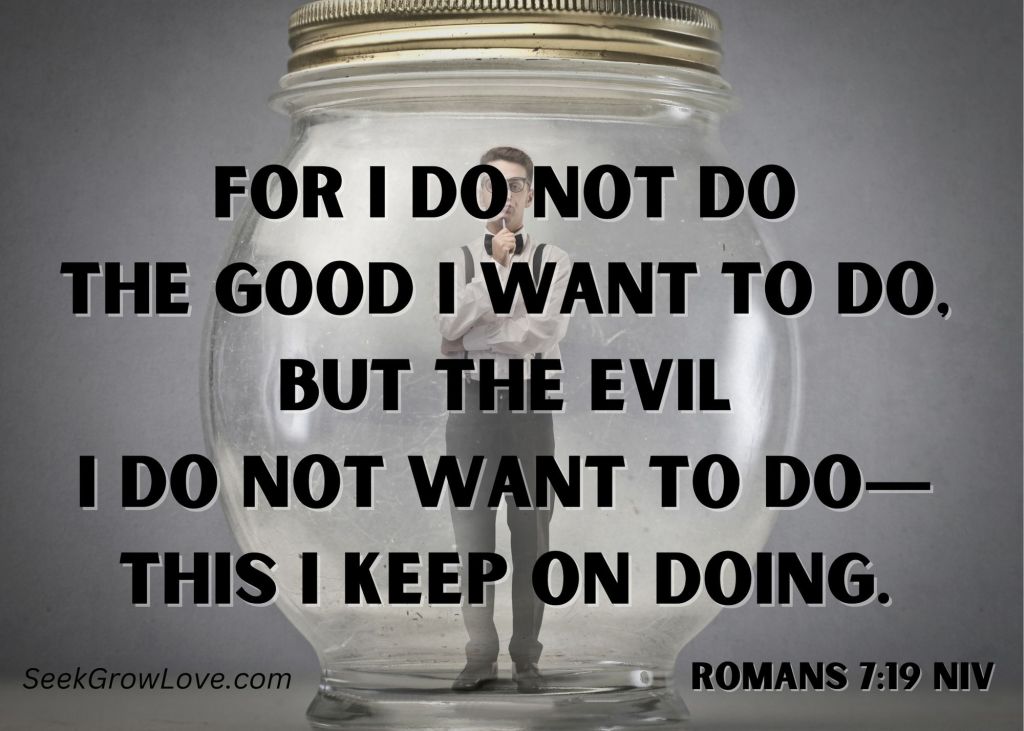
Paul said it like this in Romans 7: 15, “I do not understand what I do. For what I want to do, I do not do, but what I hate, I do.” And in 7:19, “For what I do is not the good I want to do; no, the evil I do not want to do – this I keep doing.”
Over time, it gets harder and harder to follow all the rules. If we carry legalism to its logical conclusion, eventually, either we get to the point where we just pretend (we become a hypocrite), or we abandon the whole farce and just walk away.
Paul sums up the desperation like this in Romans 7:24, “What a wretched man I am! Who will rescue me from this body of death?” If we are perfectly honest, I suspect all of us who profess to be Christians have experienced this.
Fortunately, the chapter doesn’t stop there. Paul goes on in 7:25a, “Thanks be to God – through Jesus Christ our Lord.” We don’t get into the details until Romans 8 of how we can not just overcome, but be “more than conquerors.”
In Romans 6, Paul said that we must die to sin. Here in Romans 7, he goes on to say that we also die to the law. This may seem crazy, since God’s law was good – pointing out what sin was. So we’re not bound by the law, and we’re not free to continue to sin. What is the solution?
We’ll find out tomorrow.
Spoiler alert:
Romans 8:10-11 says, “But if Christ is in you, your body is dead because of sin, yet your spirit is alive because of righteousness. And if the Spirit of Him who raised Jesus from the dead is living in you, He who raised Christ from the dead will also give life to your mortal bodies through His Spirit, who lives in you.”
-Steve Mattison
Reflection Questions
What has your experience been with your sinful nature? What good do you want to do that you haven’t? What evil have you done that you didn’t want to do?
Have you had any experience with legalism? How did you do at trying to follow every rule? Where was your heart? Did you tend more towards hypocrisy and going through the motions or giving up and walking away from God?
What is God’s desire for you? How do you know? What does He reveal about Himself in your reading of His words today?
Romans 5 talks about God’s amazing grace, and how we can be made right with God despite our ugly sinful past, because Jesus’ death paid for our sins. Romans 6 starts by asking a ridiculous question, “Shall we go on sinning so that grace may increase?” Paul then answered the question in verse 2, “By no means!”.
Paul went on to say that when people really accept Jesus as their Lord and Savior, they die to sin, just like Jesus physically died. And since Jesus was raised up to a new (eternal) life, our life should be radically different – a new life to be lived for God. Romans 6: 11-12 says, “In the same way, count yourselves dead to sin but alive to God in Christ Jesus. Therefore, do not let sin reign in your mortal body so that you obey its evil desires.” This means we must actively resist sin in our lives, and instead deliberately choose to live a life pleasing to God. This isn’t just a good idea, it’s required for true Christians.
Paul offered an analogy that everyone in his day would have been very familiar with: slaves. Slaves must obey their masters. A person living a life of sin is in rebellion against God and is a slave to sin, and therefore can’t follow God. By accepting Christ and dying to sin, a person can then be a slave to God. Paul then made the argument that, since you’ve been freed from slavery to sin, you can’t serve sin anymore – sin is not your master any more. God is now your master, so you must obey Him.
Romans 6:21-22 goes on to say, “What benefit did you reap at that time from the things you are now ashamed of? Those things result in death! But now that you have been set free from sin and have become slaves to God, the benefit you reap leads to holiness, and the result is eternal life.
This is a pretty stark contrast. Your life used to be filled with sin. You did lots of things you are now ashamed of. And oh yeah, the result of that lifestyle is death. God has liberated us from sin to become a slave of God – which causes us to live a holy life, with the result culminating in eternal life in the coming Kingdom of God.
Paul closed the chapter with a verse that is likely familiar, Romans 6:23, which says, “For the wages of sin is death, but the gift of God is eternal life in Christ Jesus our Lord.”
When we work, we earn wages. We deserve what we get paid because of the work we did. Similarly, we will get “paid” for the life we live. If we persist in our sin, the wage we can expect is death. Thanks anyway, but I’d rather accept God’s gift. But we can’t get God’s gift just because we want it, we must turn from our life of sin, and become God’s slave. Only then can we receive His gift of eternal life.
So, the choices are sin and death, or a life of service to God and eternal life. Some consider this a tough choice. Which will you choose?
-Steve Mattison
Reflection Questions
What are you a slave of? Are there any changes in your life that ought to be made?
Are you prepared to receive the wages of your sins? Or have you accepted the gift of God? If so, how and what difference does that make in your life?
What does God reveal about Himself and His heart in today’s Bible reading? What kind of Master is He?
We have been bought with the blood of the Lamb. What a glorious thing! Praise God!
The next day he saw Jesus coming to him and said, “Behold, the Lamb of God who takes away the sin of the world! (John 1:29 NASB 1995)
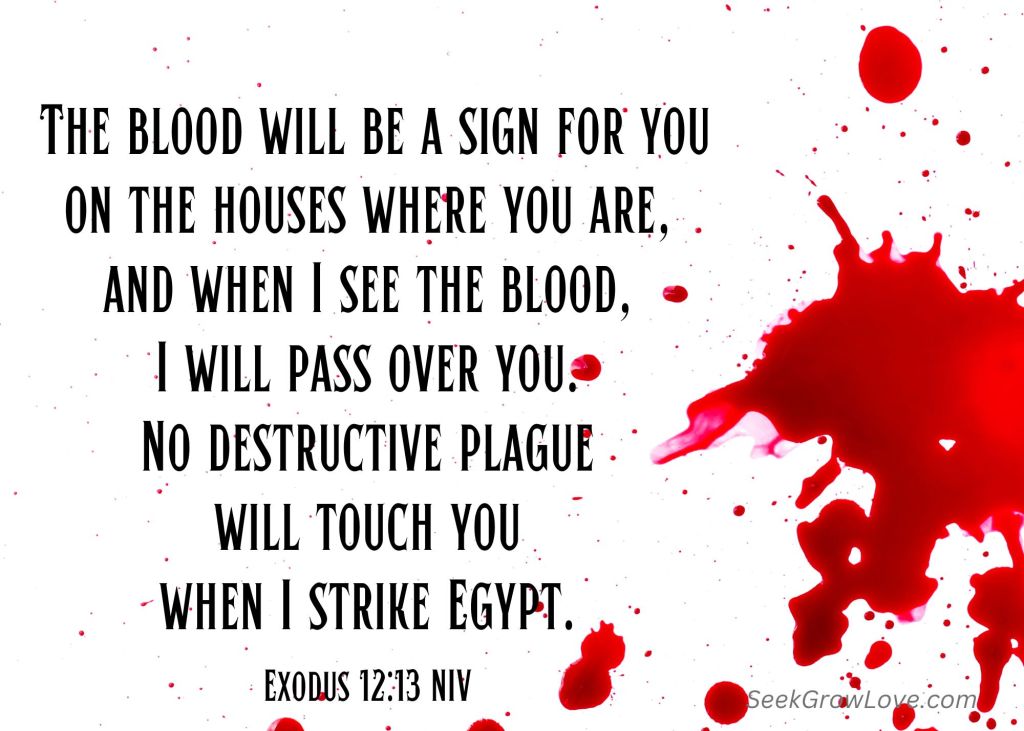
As you probably noticed, all of today’s readings tie together beautifully to point to God’s plan of redemption for mankind. We get a glimpse of this plan in Exodus 12 when the Israelites are spared from the angel of death by painting the blood of the passover lamb on their doorposts.
12 On that night I will pass through the land of Egypt and strike down every firstborn son and firstborn male animal in the land of Egypt. I will execute judgment against all the gods of Egypt, for I am the Lord! 13 But the blood on your doorposts will serve as a sign, marking the houses where you are staying. When I see the blood, I will pass over you. This plague of death will not touch you when I strike the land of Egypt. (NLT)
In Exodus 12, the specificity of the condition of the lamb—that no bone shall be broken—is significant.
43 Then the Lord said to Moses and Aaron, “These are the instructions for the festival of Passover. No outsiders are allowed to eat the Passover meal. 44 But any slave who has been purchased may eat it if he has been circumcised. 45 Temporary residents and hired servants may not eat it. 46 Each Passover lamb must be eaten in one house. Do not carry any of its meat outside, and do not break any of its bones. 47 The whole community of Israel must celebrate this Passover festival. (NASB 1995)
Psalm 34 also mentions how the righteous will be redeemed and we see another reference to no bones being broken.
19 Many are the afflictions of the righteous,
But the Lord delivers him out of them all.
20 He keeps all his bones,
Not one of them is broken.
21 Evil shall slay the wicked,
And those who hate the righteous will be condemned.
22 The Lord redeems the soul of His servants,
And none of those who take refuge in Him will be condemned. (NASB 1995)
Just like no bone was broken on the Passover Lamb, so too the scriptures tell us that no bones were broken on Jesus at the time of his crucifixion and death.
John 19
33 but coming to Jesus, when they saw that He was already dead, they did not break His legs. 34 But one of the soldiers pierced His side with a spear, and immediately blood and water came out. (NASB 1995)
Romans 4 reminds us that we can be credited as righteous through our faith in Christ Jesus and that is the only way.
6 David says the same thing when he speaks of the blessedness of the one to whom God credits righteousness apart from works:
7 “Blessed are those
whose transgressions are forgiven,
whose sins are covered.
8 Blessed is the one
whose sin the Lord will never count against them.” (NIV)
Jesus Christ paid the ultimate price for us and for that I am forever grateful!
23 The words “it was credited to him” were written not for him alone, 24 but also for us, to whom God will credit righteousness—for us who believe in him who raised Jesus our Lord from the dead. 25 He was delivered over to death for our sins and was raised to life for our justification. (NIV)
I was recently listening to a podcast that reminded me what a literary genius God is. Who else could seamlessly tie together this amazing story written over a course of some 1500 years? What other book has done the same thing? I had never thought about it that way and it gave me an even deeper appreciation of our amazing Heavenly Father and His word. To think, we get to be part of this amazing story if we so choose. The choice is ours. His story is ultimately a love letter to us. What could be more beautiful than that?
Reflection Questions:
Will we return the love that God has so generously bestowed upon us? He poured out His heart in His love letter to us. Will we stay the course and remain faithful?
What do you learn about God in His love letter to you today? What does He want you to know about Him?
I was struck by verses 3-5 of today’s reading in Psalm 33.
3 Sing to Him a new song;
Play skillfully with a shout of joy.
4 For the word of the Lord is upright,
And all His work is done in faithfulness.
5 He loves righteousness and justice;
The earth is full of the lovingkindness of the Lord. (NASB 1995)
Are we singing the same old song of praise to God? The thoughts that stirred in me when I read this passage were that we are on a journey of getting to know God and His word is His love letter to us. If we are open to it, He is gradually revealing the beauty of His character to us. His word is truly “alive and active” (Hebrews 4:12, NIV).
Furthermore, verse 8 reminds us that we should fear Him and be standing in awe of Him!
8 Let all the earth fear the Lord;
Let all the inhabitants of the world stand in awe of Him. (NASB 1995)
If we think about everything God has done and who He is, can we even help but do that? Well, I do think about Moses though from the reading earlier in the week. He seemed to lose sight pretty quickly of the majesty of God and that was evident in the way he communicated with God. He was showing up on holy ground with filthy sandals. However, some self-reflection compels me that I sometimes show up with filthy sandals on and don’t always remember to render the reverence God is due.
The contrast between David and Moses keeps revisiting my mind and heart, so maybe that’s a message God really needs me to hear and maybe you do, too. How are you showing up before God? Are we signing a new song of praise that can only be fueled by an intentional quest of getting to know Him more intimately. Otherwise, we will keep singing the same old song in those same old dirty sandals.
-Kristy Cisneros
Reflection Questions:
What are some new areas you can praise God in?
What new things have you learned about God’s character in this year’s reading so far that you could praise Him for?
Not everything in the Bible is what we would call “child-friendly”; there are numerous accounts of despicable things taking place at the hands of people who are supposed to be God’s chosen ones. Betrayal, murder, inappropriate relationships, and more; I guess you could say that the Bible isn’t designed to be a Disney sitcom, but instead, tells the story of real people in real situations. Unfortunately, thanks to sin in our world, those real situations are often bleak, strange, and sometimes down-right gross. That’s what we find in Genesis 38, and I’ll warn you ahead of time, it is not for the faint of heart.
In this story, we have an account of Judah, the man who is later promised to have the Messiah come from his family line (Genesis 49:10), caught up in a dramatic sequence of events with his daughter-in-law, Tamar. Unfortunately for Tamar, everyone she married, quickly died; even though we may not understand the cultural practices of a brother marrying his ex-sister-in-law to preserve their family line, we can understand the grief, disappointment, and the feeling of guilt she must have been under. Even though it wasn’t her fault, it would be difficult not to blame yourself when this happens over and over again.
Skipping ahead and not going into all the gross details about her tricking Judah into giving her a son (what?!), we find out that Tamar finally does bear children and can breathe a sigh of relief. What isn’t immediately obvious to us in this story is how significant these children would later be in the biblical story. Her children are named Perez and Zerah (v. 29-30); and if you skip ahead to the New Testament in Matthew 1:3, Perez is found in the genealogy of Jesus himself! It is through this gross, bleak, and very strange story that God brings about the Savior of the world! This is just one example among many of what the entire book of Genesis is trying to communicate to us: “you meant evil against me, but God meant it for good” (Genesis 50:20).
Just like Judah and Tamar, God can turn our most difficult, strange, and sometimes gross situations into something wonderful and life-changing. Paul tells us in Romans 8:28 that “God causes all things to work together for good to those who love God”. How true this is: God can use anything in your life, no matter how dark and disappointing it may be, and turn it into something great, if you will simply love and trust Him with it.
-Talon Paul
Reflection Questions
What do we learn of Er, Onan, Judah and Tamar in Genesis 38? What sins are they guilty of? We are not given all the details of what God is thinking, but from what we do know, why do you think some of these characters are struck dead and others become part of Jesus’ genealogy? (There might be a clue in verse 26)?
What do we learn of God in our reading today? Does He take sin lightly? Does He only work with perfect people? What type of heart and actions is He looking for?
In life we come to places where we are in distress, we feel hopeless, and we feel like our circumstances couldn’t be darker. But God is full of hope and knows his plans for us if we trust him.
We begin in Genesis, Jacob has fled from his home from his brother Esau, and after he left Laban now Jacob is being told by God to return to Bethel, the place where he had stopped after running from his brother and having a dream.
Before they get there Jacob tells his family in Genesis 35:2
“So, Jacob said to his household and all who were with him, get rid of the foreign gods you have with you, and purify yourselves and change your clothes. We must get up and go to Bethel. I will build an alter there to the God who has answered me in my day of distress. He has been there with me everywhere I have gone.”
Jacob is telling his family how God has blessed him and that they are not going back to that place of foreign gods. Just as we are not going back to our places of distress and false gods.
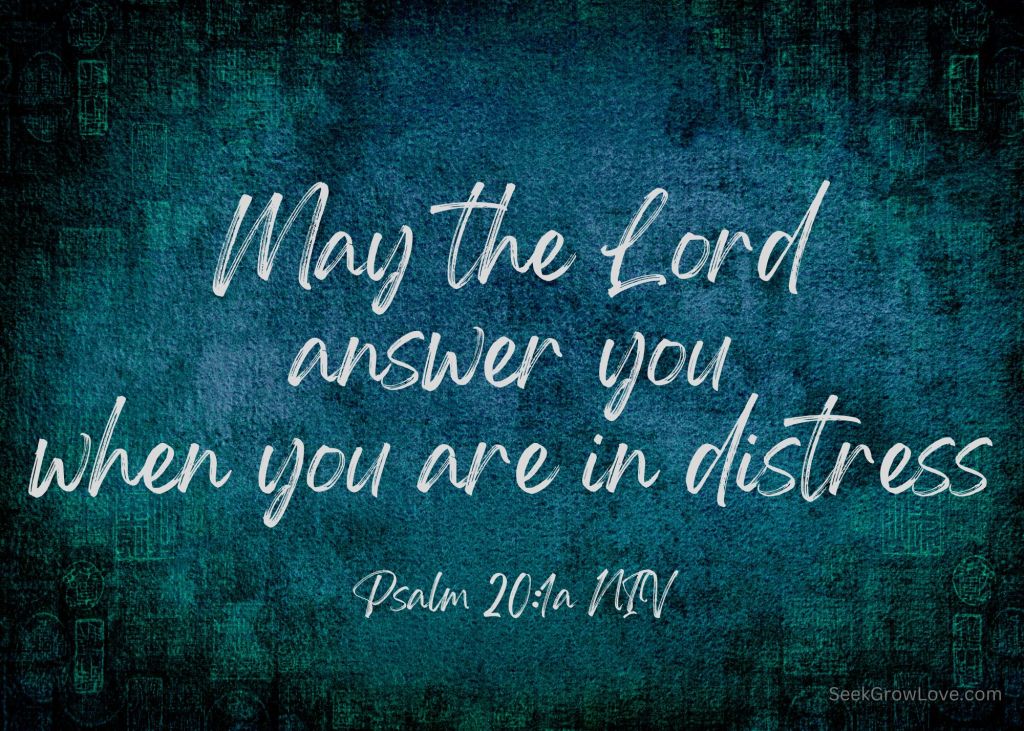
Psalm 20:1
“May the Lord answer you in a day of trouble; may the name of Jacob’s God protect you.”
God provides answers in all our times of distress. In our times of trouble, when we don’t understand why things are happening, he knows why things are happening. He provides us comfort in our struggles; we need to lean on him. God will provide.
It is after this that God tells Jacob to be fruitful and multiply, and he reminds Jacob of the promise he had made to Abraham and Isaac concerning the land.
This means something to us too when times get difficult. We will experience the blessings of God at times, but when questionable circumstances come our way, we need to remember how we obtained those blessings. Forgetting about God in times of need would be a sure sign that we are getting on the wrong path.
Matthew 19 also contains a lot of information. Jesus had to deal with the pharisees trying to trip him up constantly, but what stands out to me is Matthew 19:21-22.
“If you want to be perfect,” Jesus said to him, “go sell your belongings and give to the poor, and you will have treasure in heaven. Then come, follow me.” When the young man heard this, he went away grieving, because he had many possessions.”
This man was faithful to God and had a lot of possessions, but he did not connect his possessions with God’s blessings. The same goes with us, too often we forget that when times are good and we are feeling high in life, that our blessings come from God!
We can’t forget that in our good and bad times that no matter what, we are to devote ourselves to God. Trust in him and he will bring you through everything that you experience.
-Hannah Eldred
Reflection Questions
What are your usual responses when you feel you are in a time of distress? Are they helpful responses?
What can we learn from our Bible passages today regarding how to turn to God?
What can we learn from our Bible passages today regarding who God is and what He does?








 Seek Grow Love