With Humility, Carry Your Cross & Find the Lost

Luke 14-15

Devotion by Jerry Wierwille (New York)

Luke 14-15 presents some of Jesus’ most challenging teachings, calling us to embrace humility, count the true cost of discipleship, and rejoice in God’s relentless pursuit of the lost. Also, we find some of Jesus’ most memorable parables and statements that help us to understand what it means to be a servant and call him “Lord,” and the depth of God’s grace for all who turn to Him.

Humility and Hospitality in God’s Kingdom

Luke 14 opens with Jesus at a Sabbath meal in the house of a Pharisee, where he observes how the guests desired to sit in places of honor. Jesus uses this moment to teach about humility, saying, “Everyone who exalts himself will be humbled, and whoever humbles himself will be exalted” (Luke 14:11). In God’s kingdom, Jesus is declaring that status is not measured by one’s social standing, but by a heart that is willing to serve and take the lowest place. Jesus goes further, urging his listeners to invite not just friends and wealthy neighbors to their feasts, but “the poor, the maimed, the lame, the blind” (Luke 14:13). True hospitality, he teaches, is generous and selfless, reflecting God’s own gracious invitation to everyone.

Reflect: In what ways can you practice humility in your daily interactions with others? Who in your life might need an invitation to experience God’s love through your hospitality or kindness?

Counting the Cost

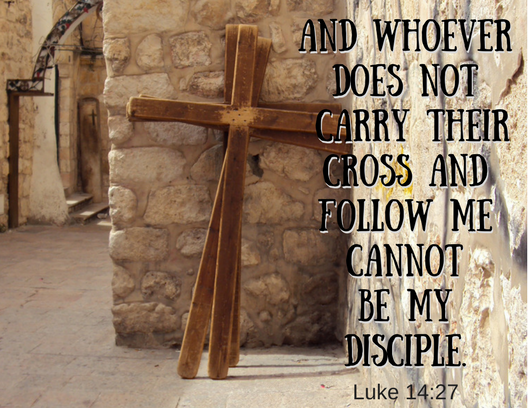
As crowds follow Jesus, he turns to them with sobering words and says, “If anyone comes to me, and does not hate his own father, and mother, and wife, and children, and brothers, and sisters, yes, and his own life also, he is not able to be my disciple. Whoever does not carry his cross and come follow after me is not able to be my disciple” (Luke 14:26-27). This statement would have certainly caused his audience to be taken back, wondering what this stipulation could mean. But Jesus is not commanding hatred or any ill-will toward others. Rather, he is using intentionally strong language to emphasize the supreme loyalty required to follow him. Discipleship means putting Jesus above all other relationships and comforts, and being willing to endure hardship and sacrifice for his sake. He illustrates this with parables about building a tower and a king preparing for war—both which require careful consideration of the cost (Luke 14:28-33). Jesus’ main point is that following him must be a wholehearted commitment and not a partial or casual decision.

Reflect: What does it mean for you to “carry your cross” in your current season? Are there certain comforts or relationships that are impeding your commitment to Christ that you do not want to let go of?

The Joy of God’s Restoration

Luke 15 is a chapter overflowing with God’s heart for the lost. The religious leaders grumble at Jesus because he welcomes and eats with sinners; something which they find repulsive and utterly alarming. In response to their judgmentalism and resistance to seek those who need help, Jesus tells three parables—the lost sheep, the lost coin, and the lost son. Each story highlights God’s relentless pursuit of the lost and the extravagant joy that accompanies when even one sinner repents and is saved (i.e., “found”).

The Parable of the Lost Sheep (Luke 15:4-7) shows a shepherd leaving ninety-nine sheep to find the one that is lost, rejoicing when it is found. “I tell you that in the same way there will be more joy in heaven over one sinner who repents than over ninety-nine righteous people who have no need of repentance.” In like manner, the Parable of the Lost Coin (Luke 15:8-10) and the Parable of the Lost Son (Luke 15:11-32) echo this theme about how God’s love actively seeks, restores, and celebrates the return of those who were lost.

These parables reveal the depth of God’s grace and mercy and the value he places on every individual, no matter how small they might seem. In the parable of the Lost Son, in particular, the father’s embrace of his long-lost son illustrates God’s loving heart and readiness to forgive and restore, no matter how far we have wandered, if we will just turn back to Him in repentance.

Reflect: Where have you experienced God’s restoring grace in your life? Who in your life might need to hear about God’s joy in welcoming the lost home?

Encouragement

This section of Scripture invites us to embrace humility, count the cost of following Jesus, and rejoice in God’s heart for the lost. As you reflect on these teachings of Jesus, consider how you can embody Christ’s humility, make courageous choices to follow him, and join in God’s joy by welcoming others into His grace and forgiveness. May you find encouragement in knowing that every step toward Jesus is met with God’s open arms and heaven’s jubilant celebration, for this is the will of God.

Daniel Prays

Daniel 7-9

Devotion by John Tullis (Ohio)

One of the most important Christian disciplines is learning how to pray and to keep praying.  For some of us, we learned to pray almost before we learned to walk!  For others, we learned about the discipline of prayer later in life after we decided to follow Jesus.  Prayer is an incredibly important part of our Christian lives.  To pray, or “entreat or implore” (fancy words for asking for something or giving God thanks) is necessary for any Christian.  God wants to enjoy a special relationship with you.  Praying allows you to express your desires, your faith, your devotion, and love to God.  Jesus even took time to teach his disciples how to pray (Matthew 6:5-15).

 Daniel understood the importance of prayer.  Time and again God had strongly supported Daniel during his captivity in Babylon under several kings.  Through it all, God had given Daniel special insight in which to interpret dreams and speak truth to powerful people.  In Daniel chapter 9, we see Daniel praying for the people of Judah and for answers about his dreams – which were a series of confusing dreams full of monsters and beasts!

Daniel is also praying for Judah, his homeland with Jerusalem as its capital.  For many years, Judah was held in captivity by the Babylonians, Medo-Persians, and Chaldeans.  All this time, God faithfully protected Daniel and blessed him.  Now, after many years of captivity, Daniel understood that the time was approaching when God would restore the people of Judah to their homeland.  Daniel intercedes for his people by praying to God.  In his prayer he confesses the sin of Judah to God, declares that only God is righteous, and agrees that they deserve the punishment put upon the nation.  But Daniel also thanks God for being a God of mercy.  Daniel understood that the punishments of God only come after we reject His mercy. Daniel believed in God’s word and looked forward to the day when God would rescue His people.

However, as he is praying,  he is surprised when the angel Gabriel arrives bringing a special message from God (Daniel 9:20-23).  The angel declares to Daniel that from the moment he began to pray, the word went forth from God to deliver a special message.  The special word from God to Daniel?  You are greatly loved (Dan. 9:23).  God would declare the interpretation of the dreams, but before anything else, God desired to express His love. 

When we pray to God, we often ask God to help us with something, to bless someone else, to bring deliverance or to confess our sins.  Whatever the reasons for you to pray to God, the most important thing to realize, whatever the answer to prayer might be, is that God loves you.  He loves you because of who you are and for your faithfulness to Him.  The message throughout the entire Old Testament can be shortened down to this:  God wants you to love him and obey him.  We might not get a special visitation by Gabriel, be we can be assured that God hears our prayers, acknowledges our prayers, and lovingly acts upon them. 

Questions for Discussion:

  1. Why was Daniel praying to God?  What was he looking forward to?
  2. What types of things do you believe occur in the “spiritual realms” when you pray to God?
  3. Why is it important for God to express His love for Daniel before getting into the interpretation of his dreams?

Set Me as a Seal

Song of Solomon 5-8

While I was in college at Ohio Northern, I was a member of their touring choir. We sang many beautiful pieces, most of them filled with Christian content and stories. Our director chose them for their beauty or technical difficulty, as he was not a man of faith. But I loved the content. One piece from my years there stands out to me to this day because our director told us the story of its composition, and it has never left me.

René Clausen, an accomplished American composer and director, wrote Set Me As a Seal after the tragic death of his unborn child. After three miscarriages, he and his wife were six and a half months into pregnancy. Because his wife was 39, and their three previous children died before birth because of birth defects, the doctor wanted an amniocentesis done. Due to misplacement of the needle, the baby was killed instantly during the process. The Clausens still had to deliver their baby, who had no birth defects and was perfectly sound, in a delivery room to the sound of crying babies being born around them. 

I cannot imagine the agony. The senselessness of the loss is overwhelming to me. It was to Dr. Clausen and his wife as well. After the stillbirth of their fourth child, Clausen went home and composed Set Me As a Seal in 20 minutes. 

I remember singing this song with our choir, time and again as we went on tour. It was beautiful in its simplicity of words, and complexity of notes and harmonies. It sounded like a plea from a grieving heart. The lyrics were short but profound, and straight from Song of Solomon chapter 8, verses 6 and 7. 

“Set me as a seal upon your heart, as a seal upon your arm: for love is strong as death.

Many waters cannot quench love, neither can the floods drown it.”

While grieving the loss of another child, Clausen turned to scripture and faith and found his inspiration in a book of love songs written for a husband and wife. But these love songs aren’t just for husband and wife. They are to mirror the love that God has for each of us, and the love we should have for him. These lines represent complete ownership and belonging. They represent a love that is to last forever, that cannot be removed or washed away. 

God wants us to belong to him in such a way. He wants us to seek him first and always. And his love for us is also without end. How beautiful it is to know that a love this deep exists. When we are in our darkest hour, or in our greatest moment of joy, his love is the same. He is unwavering. 

As you read through the last half of these songs today, I hope you see the beauty of God’s love for you and the relationship he longs to have with you, and also the relationship Christ has with the church. You are beautiful to him, and worthy of love. You are so worthy, in fact, that Christ died for you. 

– Jenn Haynes

PS: If you would like to hear a lovely recording of Set Me As a Seal, this choir performs it beautifully: 

UNT A Cappella Choir: René Clausen – Set Me As a Seal Upon Your Heart (1989) 

I hope it helps you to reflect on his profound love for you

-Jenn Haynes

Reflection Questions: 

Do you see yourself as beautiful and worthy of the love God has for you? 

How do you think God sees you? 

Take a quiet moment to reflect on the fact that God’s love for you is so deep and passionate that he desires your love above all else. The God of the universe wants a relationship with you that is deeper than any other relationship you’ve ever had. He sees you as valuable and lovely. Hold that close to you. 

Rise Up!

1 Chronicles 3-4

Psalms 43-45, 49

Hello everyone!

This week we will be primarily focusing on the Psalms passages, although you can find some very interesting name ideas as you read through the lineage passages in 1 Chronicles 🙂

All of the Psalms we are reading today are said to be written of “the sons of Korah”.  If you’re like me, you may not be completely aware of who these people are.  Although there are multiple ‘Korah’s mentioned in Scripture, most scholars believe the Psalmists come from the line of Korah who led the rebellion against Moses, and as a result was swallowed up by the earth and his followers burned with heavenly fire (Numbers 16).  BUT, Korah’s sons did not die as we see in Numbers 26:11.  With this historical knowledge, it can be helpful to put some of these Psalms into perspective.

Starting off in verse 1 of Psalm 43, I am immediately resonating with the writers as I consider our own nation for the last decade (and then some).  No matter what someone’s political perspective is, I feel confident we can all agree that this world, our nation, is in desperate need of God’s light and truth to lead us (v. 3).  It can be easy to feel rejected or abandoned by God when we focus on the world around us.  The Korahites express this very sentiment in chapter 44, calling an immortal, omnipotent Creator to Wake Up (v. 23) and remember them in their affliction.  Interestingly, the writers here don’t ask for rescue because they are so holy, or because of their own personal status.  Rather, they ask God to redeem them for the sake of His steadfast love (v. 26).  Their motive in asking is based in an understanding of the love of a powerful Father.  Despite their affliction, their feelings, and their very real enemy oppression, they are recognizing the love of God and praising His name, calling Him their greatest joy (43:4).  They are acknowledging His power while also acknowledging that they are in a pretty sucky situation they didn’t actively pursue like generations past.  

Of all people, the Korahites understood the power God had and what He could do to those who did not follow Him.  They knew this because of what their own generational line experienced!  They would have been painfully aware of Korah’s poor choices, and of God’s miraculous provisions for the Israelites throughout the years, because of their ancestors (44:1).  Rather than lashing out at God for His decision with Korah, or living in crippling fear with the knowledge of His mighty hand, they instead tied themselves closely to a God they saw as loving, protective, and desiring to redeem them (49:15).   They placed their trust in an Almighty authority with the capacity to bring eternal salvation, rather than the things of this world that wouldn’t follow them beyond the grave (49:17). 

When we experience challenges in life, it’s easy to place blame outside of ourselves (sometimes rightfully so!), become angry, or focus on all of the sucky parts around us.  During these moments, we can instead consider our greatest joy, remember our Sovereign God, and His redeeming love.  This doesn’t mean we have to ignore or hide the situations we’re in – that isn’t what these Psalmists did at all!  Instead, they placed their situations in perspective of a God they knew to be loving and eternal, worthy of praise no matter the circumstance.  Do you?

-Sarah Johnson

Reflection Questions

  1. What is your first response when you experience or observe injustice in the world?  Does this reflect the knowledge you have of God?
  2. How can you place your current situations into perspective of God’s power? How does this change your attitude about your situation?
  3. Do you pull a different theme from the Psalms today? What was God speaking into your unique circumstance?

Consider the Great Love

OLD TESTAMENT: Isaiah 48-50

*POETRY: Psalm 107

NEW TESTAMENT: James 3:13-18

My family has a book at home called 52 Bible Words Every Kid Should Know by Carrie Mars, and this last week, we read about the word “Psalm.”

One thing that I appreciate about reading things like this with my children or putting together lessons for young kids (teaching preschool is my favorite), is just stopping to examine simply defined truths.  When I personally go to classes, or small group, I do feel I gain things from those – a deeper understanding of things, an opportunity for discussion to hear other viewpoints, etc., but sometimes I miss the simple wonder like I had mentioned earlier this week.

When I am working on kid lessons or readings, they aren’t filled with the in-depth explanations or discussions, they are just boiled down, trying to give kids a foundation to grow from, and circling back to those things as an adult often touches me in a simple way.

In reading this book last week, it talked about how the Psalms show us how we can share all of our feelings with God.  We feel lots of things at different times, and there are psalms that fit so many different feelings.  We don’t have to just bring our good feelings before God – we can bring absolutely everything to Him.  It ends with a simple prayer “God, I’m so glad I can tell You anything.  I praise You for being so wonderful!”  God is wonderful for so many things, and us being able to bring anything before Him is just one of those things.

So let’s look a little at this specific Psalm – the first verse is one that repeats in other psalms (and repeats slightly altered throughout this one), and is a popular (if somewhat older) song:

“Give thanks to the LORD, for he is good; his love endures forever.”

It is simple; it is basic.  But God is good!  And He isn’t good the way we might call someone a “good” person.  He is really, truly, and fully good, and one of the most amazing things is that He loves us and that love will last forever.  This isn’t a revolutionary concept if you have been a Christian for a while, but it is a simple truth that can astound you when you stop to think about that.

If you were going to teach that to a child, you would break it down, emphasize how God’s good far surpasses ours, and emphasize how amazing His love is – get them excited about it!  As adults, I find we have heard those things so many times that we often gloss over them, but stop and think.  The great, amazing, good God of the universe loves you, and that love is perfect, and lasts forever.

When I truly stop and think about that, it just blows my mind.  And thinking about that makes it so easy to give thanks to the LORD for who He is.

The psalm ends with this verse:

“Whoever is wise, let him heed these things and consider the great love of the LORD.”

So this is my suggestion to you – slow down, view it through the simplicity of a child’s eyes, and consider the great love of the LORD.

~Stephanie Fletcher

Reflection Questions

  1. What feelings will you bring before God today? Are there some feelings you have that you typically don’t bring to Him?
  2. Make a list of what God does in Psalm 107. In this psalm how do we see God displaying His love? Which ones apply to you? How else could you describe what God has done for you? How will you give thanks to God for His love and mercy?
  3. How many times does this Psalm tell us that the thankful redeemed tell others about God’s love and what He has done?
  4. How would you describe God’s love and mercy to a child you know? How would you describe His love to an adult? What and how can you share at church about God’s love? Outside of church, who and how can you tell about God’s love?

From Everlasting to Everlasting

Old Testament: 2 Chronicles 25-26

Poetry: Psalm 103 (day 4)

New Testament: 2 Timothy 4

Welcome to the 4th day of questions on Psalm 103. Yesterday we focused our questions on verses 11-14, looking at God’s love, forgiveness, and compassion as well as the incredible facts that, “he knows how we are formed, he remembers that we are dust.” (Psalm 103:14). This verse says so much about God – and about man. The next couple verses continue on the topic of mankind.

VERSE 15 – Why do you think David compared man’s days to grass – what are the similarities? If you compared yourself to a flower of the field which kind of flower in what field would you be most like? Why? What might make the flower flourish? What else could have David compared man to? What ideas about mankind was David using poetry to explain? How might a scientist or a psychologist have explained these same ideas?

VERSE 16 – What happens to the flourishing flower of verse 15 in verse 16? What does David say caused this to happen? What do you think the wind symbolizes? What do you think of when you think of a flourishing flower suddenly gone? What emotions come with these thoughts? What do you feel when you read the second line of verse 16? What truths are David expressing in a poetic form?

VERSE 17 – What do the words, “But from everlasting to everlasting…” mean? What changes as we go from verse 16 to 17? How is God different from mankind? Is the Lord’s love for one generation more so than another? In what other verses in Psalm 103 have we seen a similar thought as we see in the first half of verse 17? What would it look like for God’s righteousness to be with your grandchildren? Will His righteousness be with ALL grandchildren? If not, then with whose? Do you fear the Lord? (Interestingly, this concept of fearing the Lord – and instructing others to do the same – came up in our Old Testament reading for the day as well. Did you find it in 2 Chronicles 26? How were similar ideas shared in the New Testament reading of 2 Timothy 4?) Do people just automatically know how to fear the Lord? What happens if it is not taught? If you do fear the Lord, who do you know that you want to see also fearing the Lord?

VERSE 18 – Who is verse 18 referring to? Who do you picture as part of this group? Are you included? What do they do? What will they receive (see verse 17)? What is a covenant? Do you have a covenant with the Lord God? If so, what does it say you will do? What does it say God will do? What are precepts? How is your memory? Do you remember to obey his precepts? When did you recently forget to obey and which precept did it involve? How can you work on further developing your memory so as not to forget God’s laws? What else is needed to stand firm against temptation?

What did you take away from these 4 verses? How will you live today because of them? Who will you share these truths with?

-Marcia Railton

“But can God Love Me?”

Old Testament: 1 Samuel 11 & 12

Poetry: Psalm 67

New Testament: 2 Corinthians 10

If you’re like me, that is, *if you are human*, then you have made mistakes. Some of those mistakes are major; not just a small white lie, but sins that harm others and put us out of sync with God. Sometimes, when we make those big sins, we feel like God could never forgive us, could never love us. The words of Samuel to the Israelites from the end of 1 Samuel 12 should give us hope in those moments.

“Do not fear.” “It is a dreadful thing to fall into the hands of the living God” (Hebrews 10:31), and we should not excuse the sins we commit. The first command given to the Israelites is to not let fear make them flee from the Lord. Instead, we should listen more closely to God than ever. If we recognize our sin, we also recognize that God’s ways are higher than our own, and  his ways are better than the ways of the world. If we flee from God, we turn toward things that cannot give us hope, cannot give us a future, cannot redeem us. As Samuel says, they cannot profit or deliver. They are futile. 

This all seems very good. “Maybe our sin wasn’t so bad”… we might say, foolishly. God does not ignore your sin because he is ignorant of it, or because he doesn’t care. Instead, “God will not abandon His people *on account of His great name*.” God has chosen a people to be his own possession. In the ancient world, it was Israel, those who were born from the line of Abraham, Isaac, and Jacob, children of the promise. Today, he has also chosen a people, also those born according to a promise, but now, it is all who have a faith like Abraham’s, who trust God like Isaac, who believe and wrestle with the Lord like Jacob, those who choose to trust in the final and ultimate descendant of the Patriarchs, Jesus Christ. God has made you a part of his people when you trusted in Jesus. Now, the reality is that we are not merely performing the law, but the law of God has been enacted in the life of Jesus, and by connecting with him, we both enact the law and go beyond it to the truth Christ taught! Christ taught us the truth of God, Christ showed us the life that God wants us to live, Christ died so that we might have life. “Consider the great things the Lord has done for you.” It is now more true than ever. Our sin was nailed to the cross with Christ. It was so terrible it cost Christ everything and he willingly paid it all. 

We are called to avoid sin, and we are warned by Christ himself that if we live wicked lives, his words will judge us in the last day. But now, if we do sin, we do not need to fear because we have an advocate who loves us, who gives us a spirit who can change us from the inside out, so we might stop sinning and stop desiring to sin. That is the glory and the power of living in the age of grace, of living in the shadow of the cross. 

“As for me, far be it from me that I should sin against the Lord by ceasing to pray for you.”

And so, this day and every day, may you be blessed as you “Seek, Grow, Love”. Far be it from me to cease praying for you!

-Jake Ballard

Reflection Questions

  1. Do Not Fear: We are commanded “do not fear” again and again in scripture. We are even told that perfect love drives out fear. But the fear of the Lord is the beginning of wisdom. Moreover, Jesus did not encourage his disciples out of their fear when they were in awe and terrified when the winds and waves obey him. With all those confusing passages in mind, what is the Christian relationship with fear? What should we fear? What should we not fear?
  2. Consider the great things the Lord has done for you: Make a list throughout the day today of all the blessings that God has given you. What are the big, great amazing things, and what are the small, everyday good. Consider them all and see that the Lord is good. 
  3. Far be it from me…: Would you take the next few minutes, and pray earnestly, for those who are reading Seek Grow Love. Pray for the blessings of God to be upon them. Amen. 

Selfless Love

Old Testament: Judges 12 & 13

Poetry: Psalm 57

New Testament: 1 Corinthians 13:7

            Love bears all things, believes all things, hopes all things, endures all things.

Through this week of reading through 1 Corinthians 13 Paul is giving us concrete examples of what It means to love.  He’s building this message into a kind of crescendo.  Like a great symphony or chorale masterwork, the various themes of the story build on themselves.  Here he is moving toward the peak of this love song with 4 things that love does: love bears, love believes, love hopes and love endures.  That would be a lot.  But he adds “all things.”

            I could take time and give you a detailed exegesis of what each of these words means in the original Greek and how they are used in Corinthians and throughout Paul’s writings and the Bible as a way to arrive at their precise meanings, but I’m not going to do that.  Instead, I’m going to tell you a story.

            I grew up in a loving family.  My father was a pastor and also a school teacher.  My mom was a pastor’s wife and drove a school bus and took care of our family, keeping us fed every day precisely at 6 p.m., our clothes washed and our house neat.  I felt loved and supported along with my 2 older sisters Cheryl and Debbie.  I was the baby, younger than my two older siblings by 7 and 10 years.  My parents were in their early 40’s, our family was settled and my oldest sister had already left the nest and gotten married.  I was an active boy, a happy ‘tween who played baseball and basketball and hadn’t started noticing girls yet at eleven, but life was sweet.  We went to Church every Sunday and learned about God and his love for us.

            Then the world changed.  My Mom found out that she was going to have another baby.  Surprise!   Jeff, you’re not going to be the youngest child anymore, you get to be a big brother.  I couldn’t wait, after years of being the only boy, the little brother who had to listen to his older sisters who both loved me but could also be a bit bossy.  Sometimes it felt like I had a Dad and 3 Moms telling me what to do.  Now I would have a little brother to boss around and to show how to hit a baseball and shoot a free throw.  I even had a name picked out for my little brother, Scott.  I don’t know why I picked that name, but that was the name I picked for my little brother.

            As it turned out, “Scott” was born a little girl, whom my parents named Christine Noelle (she was born right after Christmas so she got a very Christmasy-sounding name). Before I got to meet my little sister (I got over the fact that she was not my little brother Scott) my parents shared that she was a special child.  She was born with some differences in her little body that made her look different from other babies that I had known and she would not be able to do all the things that other children did in the way that they did them.  The name for my sister’s condition was called Down’s Syndrome.  I didn’t fully understand what that meant, but I was glad when my parents got to bring her home and we all loved her very much.

            For the next 50 years my Father and Mother, and after my father died my mother alone, provided love and care for Christine.  She received cutting-edge health care.  She had multiple surgeries to repair things that normally didn’t function well in children with Down’s Syndrome that would help extend her life.  She started getting therapy and schooling and grew to be a happy and loving young woman.

            I found out many years later, as an adult, that when she was born her doctor advised my parents to have her institutionalized.  He said she would never live with a good quality of life and would be a burden to them.  It would be best for them, for the family, and everyone else to let her be put away.  I am so glad that my parents did not listen to the advice of their physician but to the love of God in their hearts.

            My mother, who is now 90 has spent the last 50 years loving my sister Christine.  Christine has spent the last 50 years loving my mom.  My mom has spent 50 years bearing, believing, hoping, and enduring many trials and challenges while caring for my sister.  She has been for me, a model of what Paul talks about when he describes what true love is all about.

            At 90, my Mom has come to recognize her limits, she will not be around forever to care for Christine, but even now she is acting in love to help prepare my sister to live a good and flourishing life after my Mom is no longer here. 

            I could tell many other stories about love that I have seen and experienced in my life.

            When we love in selfless ways we bear God’s image to the world.

Pastor Jeff Fletcher

Reflection Questions

  1. Think of a person in your life who modeled a selfless love for others.  What does their life teach you about God’s love?
  2. Why does Paul connect bearing, believing, hoping and enduring all things with concrete examples of love?
  3. What is something you can do today to show selfless love for another?

Cheering for the Bad Guy?

Old Testament: Judges 10 & 11

Poetry: Psalm 56

New Testament: 1 Corinthians 13:6

            Usually, when we watch a movie we are introduced to a hero or heroic group to root for.  We want the “good guy” to win and the “bad guy” to lose.  We need to see Batman defeat the Joker or 007 to defeat the agents of SPECTRE.

            Occasionally, though, the filmmaker sneaks one by us and we find ourselves rooting for the anti-hero.  The show Breaking Bad did an outstanding job of getting us to root for Walter White who morphed from being an ordinary hard-working science teacher husband and dad to Heisenberg, the drug kingpin of the southwest who poisoned people with his methamphetamine creation.

            I recently saw someone post on Reddit that he realized later in life that the movie Top Gun had us rooting for Maverick instead of Ice Man when clearly Ice Man was the far better pilot and person. “Iceman was the only pilot that: actually obeyed the rules, was a skilled flier, never killed anybody in the entire movie and correctly identified all of Maverick’s faults.”  Yet we were all rooting for Maverick.

            To that, I will simply add that I can’t imagine why anyone would ever root for the evil New York Yankees, Dallas Cowboys, or Alabama Crimson Tide. (I’ll stop before I make some more lifelong enemies).

            The spirit of this age is constantly working to pull people away from finding joy in truth.  The Bible contains an epic story about our hero, a loving God who creates a place where everything is good and populates it with people in his divine image to care for the earth, who are opposed by those he created.  But God loves this creation so much that he will stop at nothing to find ways to rescue and restore that which is lost and broken and corrupt. 

            We are currently living amidst the ongoing battle against that which is true and right.  People are daily undermining what is good and just and loving and claiming that that which is evil and corrupt is good, and that which is good and holy is evil.

            For Paul, true love does not root for the villain or the anti-hero.  True love does not rejoice that evil is victorious.  True love finds its joy in the truth that is consistent with God and God’s love.

            Jesus predicted that before the end of this age, there would be a decrease in love.  In Matthew 24:12 Jesus says: “And because lawlessness will be increased, the love of many will grow cold.”  When people reject what is true and right, when people reject the ways that God lays before us to keep a rightly ordered society, it will result in a loss of love.  Lovelessness is the natural outgrowth of lawlessness.

            Jesus said “I am the way, the truth and the life.” (John 14:6).  If you want to have true life, you have to follow the path of Jesus, the path of truth.   Paul says essentially,  you can’t find love if you reject God’s truth.  You can’t truly love God and love people if you don’t love God’s truth.

            Today, ask yourself, “Are there things in my life that I know are the opposite of God’s truth?”  If you answer “yes”, you must be willing to reorient your life to pursue God’s truth and rejoice in God’s truth to practice true love.

Pastor Jeff Fletcher

Reflection Questions

  1. Why do you think increased lawlessness results in failure to love the truth?
  2. Why is society becoming more enamored with anti-heroes who are opposed to truth?
  3. How can you grow to love truth more in your life?

An Important Message from Joel

Old Testament: Joel 1-3

Poetry: Psalm 127

New Testament: Matthew 13

12 Even now— this is the Lord’s declaration— turn to Me with all your heart, with fasting, weeping, and mourning. 13 Tear your hearts, not just your clothes, and return to the Lord your God. For He is gracious and compassionate, slow to anger, rich in faithful love, and He relents from sending disaster. Joel 2:12-13 (HCSB)

Today we’re going to read the book of Joel (hey, that’s my name!). It is one of the shortest books in the Old Testament, so I’ll keep my thoughts on it brief. It was written as a wake up call to God’s people. As you’ve been reading through the Prophets, it should have been quite apparent that God wasn’t the happiest about the actions of His people. That’s why we have this particular section of scripture; if Israel hadn’t messed up so bad, God wouldn’t have had to tell them so. Joel doesn’t say much different than the other Prophets; he is just rehashing the same message because apparently, Israel still hasn’t learned its lesson.
Here’s the condensed version of the message: you’ve sinned and made God angry, but He loves you and wants you to live, so turn away from your wickedness. 


This message, which was proclaimed to the Jews first, is just as relevant today for us as it was then for them. Only today we have the added part: God loved you so much He sent His only begotten son so you can live eternally (John 3:16). We still live in nations full of wickedness, we still raise idols to a status reserved only for Yahweh, we still do wrong when we know what’s right, and we still let the ungodly have undue influence over us. The words spoken through the Prophets to the people of Israel still hold value for us, and I hope we will do a better job heeding them than the original recipients. 

-Joel Fletcher

Reflection Questions

  1. What idols do you/have you raised to a status reserved only for Yahweh?
  2. What wrong do you do when you know what is right?
  3. In what ways have you let the ungodly have undue influence over you?
  4. What does the book of Joel reveal will happen to those who don’t return to the Lord? What is revealed will happen to those who do?