The Resurrection and The Life

John 11

Devotion by Jerry Wierwille (New York)

Jesus was a master teacher but also a compassionate friend, deeply moved by the struggles and sorrows of those he loved. In John 11, we encounter one of the most powerful stories in the Gospels where we see Jesus’ emotion. This record invites us to consider how Jesus meets us in our grief, reveals the glory of God, and calls us to trust in God’s power—even when all hope seems lost.

The narrative opens with a startling circumstance—Lazarus, the beloved brother of Mary and Martha, is gravely ill. And so, the sisters send word to Jesus, confident in his love and his ability to heal. Yet, in a surprising twist, Jesus delays his journey. The text says, “Now Jesus loved Martha and her sister and Lazarus. But when Jesus heard that Lazarus was sick, he didn’t depart immediate but stayed two days longer in the place where he was (John 11:5-6). This delay, however, does not show Jesus as being indifferent. Given the timing and distance for the message to travel, it is very likely that Lazarus died soon after the messenger was sent by Mary and Martha, and perhaps Jesus already knew this by revelation when the message arrived. Furthermore, Jesus knew that through this situation, though, God’s glory will be revealed in a way that will deepen the faith of his followers.

Reflect: When have you experienced a delay in answered prayer? How might God be using that time to deepen your trust or reveal His purpose?

Walking in the Light

When Jesus finally prepares to go to Judea, his disciples are concerned for his safety. Jesus responds, “Are there not twelve hours in the day? If anyone walks in the day, he does not stumble, because he sees the light of this world” (John 11:9). Jesus uses this physical reality to make a spiritual point: as long as we walk in the light of God’s revelation, we can move forward with confidence, even in dangerous or uncertain circumstances. Jesus models courageous trust in God, reminding us that our times are in God’s hands.

Reflect: What does it look like for you to “walk in the light” in your daily life? Where do you need courage to trust God’s guidance, even when the path is uncertain?

Jesus—the Resurrection and the Life

As Jesus approaches Bethany, Martha meets him with a mixture of faith and sorrow. She believes Jesus could have prevented her brother’s death, yet she holds onto hope that somehow Jesus might still do something. Jesus boldly declares, “I am the resurrection and the life. The one who believes in me will live, even though he dies” (John 11:25). This is not just a promise for the distant future; it is a present reality. Jesus reveals that through him, God’s life-giving power is available now, even in the face of death. Lazarus’ resurrection serves as a glimpse and foreshadowing of the future resurrection of all God’s people to new life.

Reflect: How does Jesus’ promise of resurrection shape your perspective on loss and the comfort of the hope? In what areas of your life do you need to trust that God’s power can bring new life?

The Glory of God Revealed

When Jesus sees Mary and the others weeping over Lazarus, he is deeply moved—so much so that he himself begins to weep (John 11:35). Jesus had a special attachment to Lazarus, and his tears show his genuine empathy and sorrow. Jesus’ grief is mingled with righteous anger at the pain and brokenness that death brings. He stands at the tomb, not as a rabbi or religious figure, but as a friend who was there with Mary and Martha in their pain.

Jesus intentionally prays out loud so that all those who were present at the tomb would believe that God sent him (John 11:42). Then, with a loud voice, Jesus called to Lazarus for him to come out of the tomb. As everyone stood there watching, Lazarus emerges from the tomb still wrapped in grave clothes. This miracle is a powerful display of God’s glory—His power in action. Lazarus’ resurrection is not the final victory over death, but a sign pointing to the greater hope that all who trust in Christ will one day be raised to everlasting life in the age to come.

Reflect: How does knowing that Jesus was moved by compassion encourage you in your own struggles? Who around you might need the comfort of your presence and solidarity today?

Encouragement

This record reminds us that Jesus meets us in our deepest pain and invites us to trust in God’s power and timing. Jesus is the resurrection and the life, and through him, we have hope that transcends even the death and the grave. May you find comfort in knowing that the same Jesus who wept at Lazarus’ tomb walks with you today, offering life, hope, and the promise of resurrection. Trust in God’s love, timing, and power in every circumstance in your life.

Fruit over Frustration

Matthew 14, Mark 6, Luke 9:1-17

Devotion by J.J. Fletcher (Minnesota)

John the Baptist was a prominent figure in Judea in the time leading up to the ministry of Jesus. We see John as a forerunner to Jesus, preparing his hearers for the one who was to come, who was greater than him. John had a strong following and his own disciples that followed and supported him, not unlike Jesus. John’s following meant that on the day of Jesus’ baptism, there was likely a fair-sized crowd. While we don’t get much backstory on any interactions between  John and Jesus prior to the baptism, we know that they were cousins. John had his enemies as he was unafraid to speak truth to power, and this led to his demise at the hands of Herod. Perhaps Herod was paranoid after what was an unpopular execution of John, but we see a bit of a “conspiracy theory” as Herod attributes or considers the possibility that the power at work in Jesus’ ministry was potentially a resurrected John the Baptist.

We see throughout Jesus’ ministry a habit of going off to spend time in solitude. When Jesus hears the disappointing news of John’s death, this is where Jesus retreats. To solitude and time spent in communion with his father.

As we see Jesus dealing with this news in our reading today, we are shown a window into some of the grief and disappointment that Jesus experiences. Some time later, we’ll see Jesus’ grief and struggle as he begs God for another way to achieve God’s purposes, that doesn’t include his death and abuse. Here, we can see some more relatable moments.

John’s death probably puts a stark focus on the path before Jesus. As a prophet and teacher who will be walking a similar path, he becomes acutely aware of the reality that he is facing. He knows the path ahead, but knowing in theory and seeing in real-time are very different. 

We know through scripture that there will be those who hate us because of Jesus’ name, actually experiencing it or seeing others you know suffer for his name’s sake, stand in contrast to being aware of the possibility. Jesus sees the carnage of wicked men play out early on in his ministry. 

The death of John is not the only discouraging and disappointing thing that Jesus experiences. 

Jesus returns to his hometown of Nazareth. Now, when there are rumblings of a hometown kid making powerful impressions, there can often be a rallying of excitement. Local kid makes it to the big leagues or finds success in the music scene. There can be a sense of excitement, but that is not what is experienced by Jesus. While those who come to hear him in the synagogue recognize that there is wisdom in his words and that there have been powerful works done by his hands, they resent him rather than embrace him. It’s that son of Joseph and Mary… How is a tradesman going to come in here and teach us about the Law and Prophets? That line about a prophet having no honor among his people communicates a reality that I’m sure was stinging and disappointing. No support from your family or the community that helped raise you.

Jesus, I’d assume disappointed and discouraged, presses on and continues his ministry elsewhere, where people would receive him, and mighty works could be done.

Jesus does not allow discouragement and disappointment to stand in the way of his calling and ministry of the Gospel, and neither should we. When we are called, it is not to a life or ministry of ease. There will he highs and lows. There will be good times and bad times. There is a season for everything, as the Byrds sing (er, as Solomon writes). We need to recognize that the same power that Jesus relied on to support and sustain him (and that ultimately raised him from the grave) lives in us, and that that Spirit of God is capable of far more than we can imagine. Discouragement should not equal defeat, but rather create an opportunity to overcome difficulty and live lives of obedience in the face of discouragement or fear. Victory can be found through reliance on God when our own mettle runs low.

Reflection Questions

  1. What was a difficulty or discouragement that you have faced, and how did you respond? What lessons did you learn from the way that you handled the situation?
  2. How does a glimpse into Jesus’ responses help you? What can we glean from these small, yet powerful details?
  3. Are there things that we can do now to prepare ourselves to respond or cope with disappointment in the future?

Hope in the Middle of the Ruins

Lamentations 3-5

Devotion by Dustin Farr (South Carolina)

The book of Lamentations is heavy. It is a raw, unfiltered look at grief. Jerusalem has fallen, the temple is destroyed, and the people are either dead, exiled, or living in deep suffering. The city walls have been torn down, homes burned, leaders captured, and the streets are empty. Hunger, fear, and loss have touched every household, and the once-proud city is now a place of desolation. Every chapter is filled with heartbreak, and the writer doesn’t shy away from addressing the pain.

But this is more than just a story of destruction. It’s an honest record of what it looks like when life falls apart. When the consequences of sin, both personal and collective, are unavoidable. The people knew God’s commands, and they chose to break them. Now they are living with the fallout, and it’s not pretty.

What stands out is how Lamentations holds both grief and hope at the same time. In chapter 3, right in the middle of all the sorrow, comes this anchor: “The steadfast love of the LORD never ceases; his mercies never come to an end; they are new every morning; great is your faithfulness” (Lamentations 3:22–23). It’s not spoken after things get better. It’s spoken in the middle of the storm. That’s what makes it powerful for us. We all face seasons that feel like ruins, and the truth is, they do not always get better. Our faith cannot rest on whether life is comfortable or whether blessings are obvious. It has to be steady, no matter the circumstances. Like Job, who said, “The LORD gave and the LORD has taken away; may the name of the LORD be praised” (Job 1:21), we are called to worship God whether life is full or stripped bare. The struggle may not lift quickly, but we can rest in the salvation we have through Christ and in knowing that our God is a Redeemer. Even when we cannot yet see it, He is at work.

Lamentations reminds us that it’s okay to be honest about our pain, but it also calls us to cling to God’s character in the middle of it. His faithfulness isn’t proven by how quickly He fixes things, but by His presence and unchanging promises even while we wait.

Reflection Questions

  1. Lamentations shows the people facing the full weight of their choices. How does acknowledging the reality of your own situation, without excuses, change the way you pray?
  2. The writer of Lamentations keeps talking to God even when he feels unheard. How can you practice staying in conversation with God when your prayers seem unanswered? 
  3. The book ends without a neat resolution, yet with eyes still turned toward God. How can you hold on to hope when you have no guarantee of when or how God will act?

(Thank you, Dustin Farr, for writing this week! Dustin is a first-time writer for SeekGrowLove and we look forward to hearing more from him. He is a recent Graphic Design graduate.)

Living Wisely in a Wounded World

2 Sam 19-21

The Kingdom of Israel is in the midst of a terrible civil war. Brother had turned against brother and sons against their fathers. The battle was over. Absalom, the rebellious son, had been killed. 

At first glance, it seems like David should be rejoicing. He was king again over Israel. Instead, he was caught up in his grief.

 Joab told him in 2 Samuel 19:5-7, “You have today covered with shame the faces of all your servants, who have this day saved your life and the lives of your sons and your daughters and the lives of your wives and your concubines, because you love those who hate you and hate those who love you. For you have made it clear today that commanders and servants are nothing to you, for today I know that if Absalom were alive and all of us were dead today, then you would be pleased. Now therefore arise, go out and speak kindly to your servants, for I swear by the Lord, if you do not go, not a man will stay with you this night, and this will be worse for you than all the evil that has come upon you from your youth until now.”

Then, David picked himself up out of the sackcloth and ashes and made his way back to Jerusalem to take back the throne. 

This passage strikes me in the way that David has to navigate the circumstances that appear. People grovel at his feet while double-crossing their masters. Political turmoil and intrigue roil underneath the surface as another revolt occurs. A famine stretches the land to its breaking point, and difficult decisions have to be made. 

David has to live wisely to save not only himself but also the entire nation from more war, brokenness, and suffering. 

And through it all, we see this: our choices carry weight.

What does wise living look like? 

  1. Wise Living means stepping out of our circumstances to fulfill our God-given role. Grieving is a necessary part of life. It has its place as we mourn those we love. But, we cannot stay in a place of grief forever. We have to move on and step into our calling. 
  2. Wise Living means pursuing reconciliation without compromising truth. As David worked to restore peace in Jerusalem, he had to act as judge over the people who supported him and revolted under him. Through it all, David was not led by vengeance. 
  3. Wise Living means recognizing the long-term consequences of sin. In a heartbreaking scene, we see how to pay the blood guilt of Saul a mother who had to lose her sons. Our sin can cause brokenness in our lives, our families’ lives, and the lives of future generations. 

Wise Living is a radical decision in this world, but ultimately, it leads to righteousness. How are you pursuing wisdom in this broken world today? 

-Cayce Fletcher

Cayce blogs at https://amorebeautifullifecollective.com about faith, family, and life. You’ll find encouragement for how to build intentional lives rooted in faith and beauty. Check out the latest post on the human nature of Jesus here. 

Reflection Questions

  1. What decisions am I making today that will shape the next season of my life or family?
  2. Where is God calling me to seek reconciliation, even when it’s complicated
  3. How might I carry my grief with both honesty and courage?

SGL.2025.MayFullPageDownload

“Flowers Grow in the Valley”

Ruth 1-4

In my life, I’ve seen many people deal with troubling times and grief in various ways. Most of them initially take the path of least resistance, which often leads them further from God, but those with a strong support system are guided on pathways that lead them closer to God than they’ve ever been. I’ve had my fair share of troubles, and without the help of my school teachers, professors, friends, and family, I wouldn’t have been as close to God as I am today. I heard a song recently called Flowers by Samantha Ebert that contained the lyrics, “I’m a good God and I have a good plan, so trust that I’m holding a watering can, and someday you’ll see, that flowers grow in the valley.” Ruth’s story is a fantastic illustration of the beauty that God can bring to fruition in life’s valleys. 

The book of Ruth takes place during a time of trouble and famine. Naomi lost her husband Elimelek and her two sons Mahlon and Kilion. Ruth and Orpah became widows. However, a glimmer of hope came to Naomi as she heard what the LORD had done for His people (aiding and providing for them in this tough time). She urges her daughters-in-law to return to their mother’s house (because it would be a much easier route for them), but the unexpected happens. Instead of going home, Ruth decides to go with her, stay with her, make Naomi’s people her own, and remain alongside her in death/burial (1:16-17). Naomi tried to “talk some sense” into Ruth but failed to convince her to choose a different path. This resulted in an interesting and intriguing turn of events.

Shortly after arriving in Bethlehem, Naomi and Ruth’s tragic story spreads around town, and the overseer of Boaz’s harvesters and Boaz (who “just so happens” to be one of their kinsman-redeemers) hears of it. Boaz blesses Ruth with protection, provides her with the opportunity to earn an abundance of food, works diligently to ensure she is cared for, and continues the line of David through Obed. This information makes me believe that the “coincidences” along the way were more of a God thing than a perchance thing. As a result, Ruth and Naomi went from two widowed women in one of the biggest valleys of life put in their way to two well-off women blessed with the beauty of God’s providence.

Pain, suffering, and troubled times often bring forth heightened emotions, illogical judgments, and tough decisions. If we’re not careful to keep ourselves in check, we can go down a dangerous path towards death and destruction. In Matthew 7:13-14 we find Jesus urging others in his sermon on the mount to, “Enter through the narrow gate. For wide is the gate and broad is the road that leads to destruction, and many enter through it. But small is the gate and narrow the road that leads to life, and only a few find it.” We are presented with a choice, take the easy route and go back to what’s familiar, or choose the path with a few more hills and valleys that God can use to show us more than we could ever hope for.

-Jeffrey Seiders

REFLECTION Q’s

  1. Ruth took the harder path, went with Naomi, and God provided for her. What paths in your life have you taken that were difficult but God blessed you through them?
  2. Naomi tried to convince Ruth and Orpah to take the easier route, and only Orpah went. When did you take the easy route and how did God work through your decision? 
  3. What valleys are you going through now, and how can you see God’s beauty in them?

The Love Chapter

1 Corinthians 13

June 14

“Now these three remain: faith, hope and love.  But the greatest of these is love.”

“They” call 1 Corinthians 13 “the love chapter”.  It’s quoted from at most weddings.  So what is it talking about?  I don’t think it is a coincidence that Paul discusses love and speaking in tongues (a gift involving the ability to speak unique languages), in the same chapter.  Love is difficult to put into words.

In my work as a Funeral Director and Deputy Coroner, I am often at a loss for words.  I frequently have opportunity to speak with families when there is nothing to say.  Nothing that should be said, anyway.  That certainly doesn’t stop some people from trying.  I’ve heard people say all kinds of stuff to try to comfort the grieving.  Most of it, frankly, has no basis in scripture or reality.  Sometimes I wish I had a platitude and cliché bingo card I could pull out of my pocket and shout “BINGO!”.  About the only right thing to do in that situation is nothing at all. 

My father-in-law is a pastor and has served as Chaplain for a local fire department for a number of years and he recently commented during a sermon about how in most situations when the fire department is needed, if the crew showed up and just stood there people would say “Don’t just stand there, DO SOMETHING!” But when it comes to the work of a fire chaplain, the best approach is “Don’t do something, JUST STAND THERE!”  I liked that line.  I have stolen it and shared it with coworkers several times.  When a person has lost everything they don’t need a preacher, they need a presence.  To be able to just be present, is a gift.  (Do you see what I did there?).

As Christians, being confronted with a sudden and unexpected death is like being the pilot in charge of an airplane when the engines stall.  All that is really left at that point is faith, hope and love.  What words of comfort can you give when you know that a person did not have faith in Jesus Christ?  What chapter of systematic theology will you turn to for the family who has no hope in The coming Kingdom?

I said before, our dog is named Zippers due to her urge to chew on our coat zippers.  If we named our children using that method, one of my sons might have been named “Whacko”.  He has always liked to “whack” things with sticks.  When he was two years old we bought him a Sesame Street drum set for Christmas.

It was a pretty cool toy.  It came with a little stool to sit on.  It had a pedal for the bass drum.  It is hard to see in this picture, but there was even a tiny metal cymbal.  Man, did he love to whack that thing!

I honestly don’t know what ever happened to that drum set but I have a feeling it found its way to “a better place”.  The place where all the noisy toys end up.  You know the toys I’m talking about- the Jack in the boxes, the little microphones with the spring inside that toddlers yell…I mean sing into, the Fisher Price Pop “Corn Poppers” that aunts and uncles buy for their nephews as revenge for the year you wrapped up too many candy canes… We’ve all had noisy toys like that.             

Those noisy toys are exactly what I picture when I read 1 Corinthians Chapter 13.  To paraphrase, Paul says all of those gifts of the spirit we just talked about in the last chapter are great.  I’d really like for you to have ‘em, but in the end all that really matters is faith, hope and love.  Of those three qualities, if you only have room for one, choose love because when the rubber hits the road, what people need to know is that God loves them more than anyone has ever loved them.  All the rest is just noise.

-Brian Froehlich

Application questions:

  1. What is the noisiest toy you had as a child?
  2. What is the “noisiest” thing in your life right now?
  3. Have you ever had a friend who was just silently present with you when you needed them? 

The Weight of Sorrow

Matthew 11

Matthew 11 28.png


There is a destiny that makes us brothers:

None goes his way alone;

All that we send into the lives of others

Comes back into our own. —Markham


Today’s chapter is a solemn one for me. Jesus just finished the send-off of the 12 disciples out into the proving grounds and I imagine was watchful about the results. As word of the disciples broaden, John the Baptist hears about the Messiah’s latest turn of events and sends a question to Jesus in (verse 3): “Are you the one who is to come, or should we expect someone else?”


This question intrigues me because of what it doesn’t ask. “Why won’t you help me? Do you not care that I sit suffering in this prison cell?” John the Baptist was the cousin, a dear friend, and a mentor of sorts who baptized Christ himself. He knew Jesus and Jesus knew John. They most likely grew up together. Jesus simply replied, (verse 4-6)  “Go back and report to John what you hear and see: The blind receive sight, the lame walk, those who have leprosy are cleansed, the deaf hear, the dead are raised, and the good news is proclaimed to the poor. Blessed is anyone who does not stumble on account of me.


While this is a message of good report for the current gospel cause, what strikes me is what isn’t said to his friend. John would surely have known by this response that Jesus was referring to Old Testament prophecies like Isaiah 29:18-19, 35:5-6, or 61. These were the credentials of sorts that the coming Messiah would fulfill. Isaiah 61 is one of the most famous passages using phrases of comfort  like “ bind up the brokenhearted,” “proclaim freedom for captives,” and “release prisoners from darkness.” Yet, Jesus doesn’t convey any of THOSE phrases in the reply to John because he knew they couldn’t be upheld. Silence often speaks louder than words.


Have you ever had a friend or family member truly in sorrow and are unable to comfort them due in part to the schedule you must maintain? Maybe they were grieving a death, consequence, job loss, betrayal, or abandonment. You want nothing more than to stop everything and sit with them in their sorrow and to share the load. I have to believe this is what Christ wanted more than anything with John the Baptist, but his circumstances made this impossible and he ultimately knew that freeing John from prison was not the will of the Father. John was soon to die. Jesus sent a loving message of “omittance,” perhaps suggesting that he had not forgotten John, nor his sufferings. The tribute upon which Jesus bestows upon John in the next 14 verses following this makes me believe he was hurting for his brother. He wanted nothing more than to comfort, but his schedule and AGENDA would not allow.    


Jesus models a very important lesson here and later in Matthew 14 upon reaction to the terrible death of John the Baptist. SOMEtimes the best way to ease heartache is by getting back to work. Use your grief to empower your ministry. Rather than turning in on yourself and thinking “woe is me,” turn outward to serve and to love the crowds. It is ok to cry. It is ok to mourn for lost people or situations, but we must not let our emotions turn inward for long, lest it becomes pity. In our brokenness God is able to use us mightily. In desperation our dependence on Him will serve as a powerful testimony to a lost and dying world.


Is your heart broken today? Does life seem empty? Do you feel like giving up? Take hope in the example of Jesus. Take up whatever duties lie before you and dedicate them to God. Refuse the luxury of self-pity. Do something to lift the burdens of others and Jesus will strengthen you.

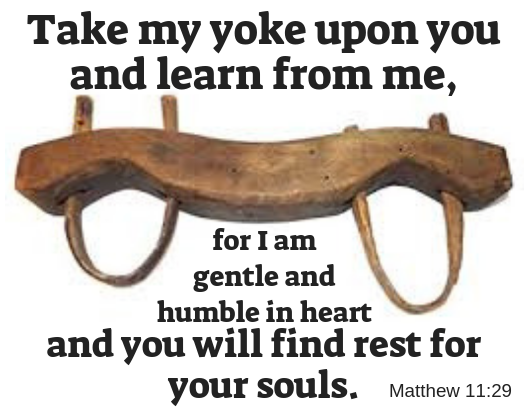
The final verses (28 – 30) of Matthew 11 confirm this truth. “Come to me, all you who are weary and burdened, and I will give you rest. Take my yoke upon you and learn from me, for I am gentle and humble in heart, and you will find rest for your souls. For my yoke is easy and my burden is light.”


When you serve others you will find yourself.


-Julie Driskill


matthew 11 29

Though He Slay Me

Job 13 – 17

 job-13

Saturday, December 17

Today’s reading records my favorite verse of the book of Job:


“Though he slay me, yet will I trust in him ”  (Job 13:15)


Job lived this song. The Psalms plead this song.  Because of God’s sovereign care for us, every pain in this life is producing a glory that will last forever.  A Christian’s suffering should never be meaningless. Not only is all our affliction momentary, not only is all our affliction light in comparison to eternity and the glory there. But all of it is totally meaningful. Every second of our pain, from the fallen nature or fallen man, every second of your misery in the path of obedience is producing a peculiar glory.

Job’s trust in God was not based upon emotion.  It was based upon a complete belief in God as the One who knew what was best for him in all situations.  It was based upon a complete belief that whatever God put into his life, God was still to be trusted.  Job uttered these classic words after he had gone through the worst testing that anyone has possibly gone through.  He didn’t look to what was seen, and neither should we.

Shane Barnard of the Christian contemporary music group, Shane & Shane, understands this truth too. After the untimely death of his father, he and his family desperately looked to God for comfort. They clung to God’s word, and in their deepest moments of grief, they were led to worship. The song below, “Though You Slay Me,” was born in that experience.


I come, God, I come
I return to the Lord
The one who’s broken
The one who’s torn me apart
You strike down to bind me up
You say you do it all in love
That I might know you in your suffering

Though you slay me
Yet I will praise you
Though you take from me
I will bless your name
Though you ruin me
Still I will worship
Sing a song to the one who’s all I need

My heart and flesh may fail
The earth below give way
But with my eyes, with my eyes I’ll see the Lord
Lifted high on that day
Behold, the Lamb that was slain
And I’ll know every tear was worth it all

Though you slay me
Yet I will praise you
Though you take from me
I will bless your name
Though you ruin me
Still I will worship
Sing a song to the one who’s all I need

Though tonight I’m crying out
Let this cup pass from me now
You’re still more than I need
You’re enough for me


Therefore, do not lose heart. Take these truths and day by day focus on them. Preach them to yourself every morning. Get alone with God and preach his word into your mind until your heart sings with confidence that you are new and cared for. Though He slay me, yet will I hope in Him!

-Julie Driskill