
-Devotion by Jeremy Martin (TN)
Today, we’re going to first examine an inconvenient truth, and then together examine a template for navigating back onto the proper path when we get lost. First, the inconvenient truth: just because you come from good stock doesn’t mean you’re good. I can speak for this directly first hand because while my parents were absolutely wonderful, fantastic, God-fearing, loving, and wise people; I took a hard turn off the proper path in my youth and kept running in that direction for most of my life (See 2/6 devotional for details). So here’s the thing, and I want you to memorize this because it’s really important: there is no corporate entry into the kingdom of God.
To elaborate on that statement: we are each held accountable for our own actions. Many of you know Dr. Joe Martin, my father. Understand well that in the day of judgment, when I am standing before the throne that if my defense of my actions is “But wait…You know Joe? He’s my dad, so…you know, *wink wink* I’ll just go ahead in and pick out one of the rooms…” I’m pretty sure the response would be along the lines of “Joe? Oh yea, we know him well, he’s a great guy. Let’s talk about YOU for a moment though…“. When you read that above bit of farce, you’ll probably chuckle a little bit, but stop for a moment and think about it seriously and with some trembling because there is no corporate entry into the kingdom of God.
Even if you go to an awesome church that not only feeds the homeless regularly but gives solid scriptural truths that are deeply insightful and applicable, even if your pastor is spirit filled and heals the sick with a touch and a prayer, even if there’s a lady in your church who you KNOW is an active and living prophet of the Most High God: what does that have to do with you? There is no corporate entry into the kingdom of God, you’re not going to slide into the kingdom on their coat tails. Some of the ancient Jewish folks were thinking exactly in that manner, when John the baptist explained to them in Matt 3:9 “and do not suppose that you can say to yourselves, ‘We have Abraham for our father’; for I say to you that from these stones God is able to raise up children to Abraham.” (LSB). We will each be judged according to our own actions: by our faith, by our love, and by our fruit. I pray to God that each of our names is found in the book of Life but understand fully that if it is, it’s not because of who you’re related to or which church you went to. There is no corporate entry into the kingdom of God.
For a good case in point of this very topic, let’s take a hard look at Manasseh and check off some of the boxes. Manasseh was not only a Jewish lad (check), but the son of Hezekiah (check) who is probably the most attested biblical figure in history (counting not only scripture but extra-biblical accounts of his reign). We know that God loved Hezekiah, just go back and read 2Ki 18-20, he’s blessed and highly favored. So Manasseh should have been an easy pick for being awesome, but that’s not at all what happened. We see in 2Ki 21:1-3 that Manasseh became king when he was 12, ruled for 55 years, and “did what was evil in the sight of Yahweh” (LSB). Keep in mind that dad (Hezekiah), did a lot of really good stuff: he tore down the false gods and altars, redirected the people to worship God, and humbly sought after and clung to the God who had rescued his fathers.
Manasseh, conversely, sounds like a bit of a jerk. All of the good things his father had done, he undid. In 2Ki 21:5-9 it gives an excruciatingly painful laundry list of offenses that Manasseh did, including setting up false idols in the actual temple, sacrificing his own son to a pagan deity, and then leading the entire nation astray to do more evil than the nations before. In v16 it says that in addition to all of this, he “shed very much innocent blood”.
At this point, God has had enough, and I’d like you to listen to the wording of 2 Ki 21:12: “therefore thus says Yahweh, the God of Israel, ‘Behold, I am bringing such calamity on Jerusalem and Judah, that whoever hears of it, both his ears will tingle.’ ” (LSB). This should be terrifying, these are not the words of one who is ‘a little upset’, but a potential extinction level event of anger from the Most High God. We can see from this example that it doesn’t matter who you’re related to or what group you belong to, but rather your own path, in the eyes of God.
Now let’s look at how to navigate back onto the proper path, if we ever get lost or go astray. Enter Josiah (2 Ki 22). Keep in mind that he’s the third generation in a line of truly terrible and evil kings, who “did what was evil in the sight of Yahweh” (see 2Ki 21 for details on Manasseh and Amon, grandpa and dad respectively). He’s just a kid when he takes office, 8 years old, but right away he starts back toward the right path. He sends Shaphan to the temple and makes arrangements for it’s restoration (2 Ki 22 3-7). Remember that wild idolatry and debauchery has been going on for two full generations, the temple itself has been defiled, and the people have been going in the wrong direction for 57 years.
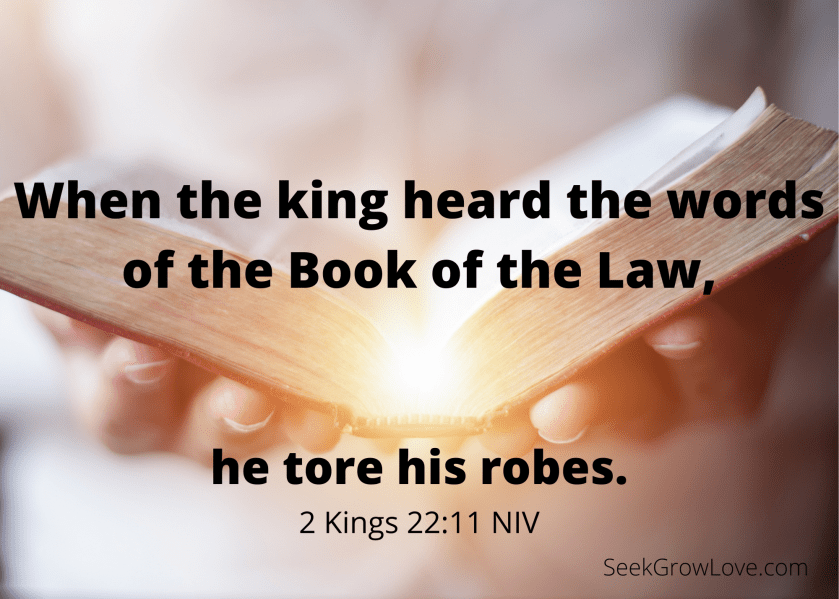
Now it came about as the temple was being cleaned out and restored, that Hilkiah the high priest found the book of the law. It had been lost for a long time. Hilkiah gave the book to Shaphan, and Shaphan took the book back and read it to King Josiah (2 Ki 22:8-10). Pay close attention here, because this is the turning point: “Now it happened that when the king heard the words of the book of the law, he tore his clothes” (2Ki 22:11, LSB). In ancient Israel, this is how people exhibited deep regret or sorrow publicly. He sent people to “inquire of Yahweh” and seek what might be done (2Ki 22:12-20). He basically humbled himself, and sought the will of God.
God’s response to this honest sorrow and humility defines our template for returning: “because your heart was soft and you humbled yourself before Yahweh when you heard what I spoke against this place and against it’s inhabitants that they should become an object of horror, and a curse, and you have torn your clothes and wept before me, I truly have heard you“, declares Yahweh.” (2Ki22:18), and He then relents.
According to the above template, I would suggest the following if your path has led you astray: First, find the book of the law (the Bible), and read it. Then, when you have realized how far off path you have become, inquire of God. Repent, soften you heart, and weep before God. Clean out the temple (you are the temple 1 Cor 3:16), remove the idols (anything can be an idol) you’ve placed there, and do the work to restore God’s temple. Clean it out, purify it, and rededicate it to God. If you do this with honesty and dedication, God will truly hear you (See Jer 29:13 for verification).
REFLECTION QUESTIONS
Examine yourself deeply and honestly, because we all probably have some: What idols have you built inside the temple of your heart, and why?
Considering the above question, what is the best way to remove them? Being honest, do you want to remove them? Why or why not?
How often do we honestly inquire of God His will, as opposed to handing him a list of our demands when we pray?
PRAYER
Heavenly Father, thank you for all of the blessings you’ve given to us. Thank you for sending your son to instruct us. Please forgive us of the many times we fall short, and help us to become servants who please their master. Lead us and guide us, Father, and teach us the way you would have us go. In Jesus name, amen.


