Equal

Old Testament: Job 38-39

Poetry: Psalm 47

*New Testament: Philemon 1


Lots of times it feels like people are just trying to find something that makes them better than others, whether it is the color of their skin, their ethnicity, their gender, etc.  You can always find someone who is trying to prove how much better they are.  They may be trying to use it as a reason for being better at their job, having better opportunities, or anything else.  But, these differences don’t matter, if you are in Christ.


Philemon 15-16 says, “For perhaps he was for this reason separated from you for a while, that you would have him back forever, no longer as a slave, but more than a slave, a beloved brother, especially to me, but how much more to you, both in the flesh and in the Lord.”  Onesimus was Philemon’s slave.  Philemon could have easily held it over Onesimus as a reason why he was better than him.  But, Paul tells Philemon that he should receive Onesimus not as a slave, but as a brother.  Paul is saying that there is no reason for Philemon to try to prove he is better than Onesimus, anymore.  They should now be equals, as brothers in the family of God.


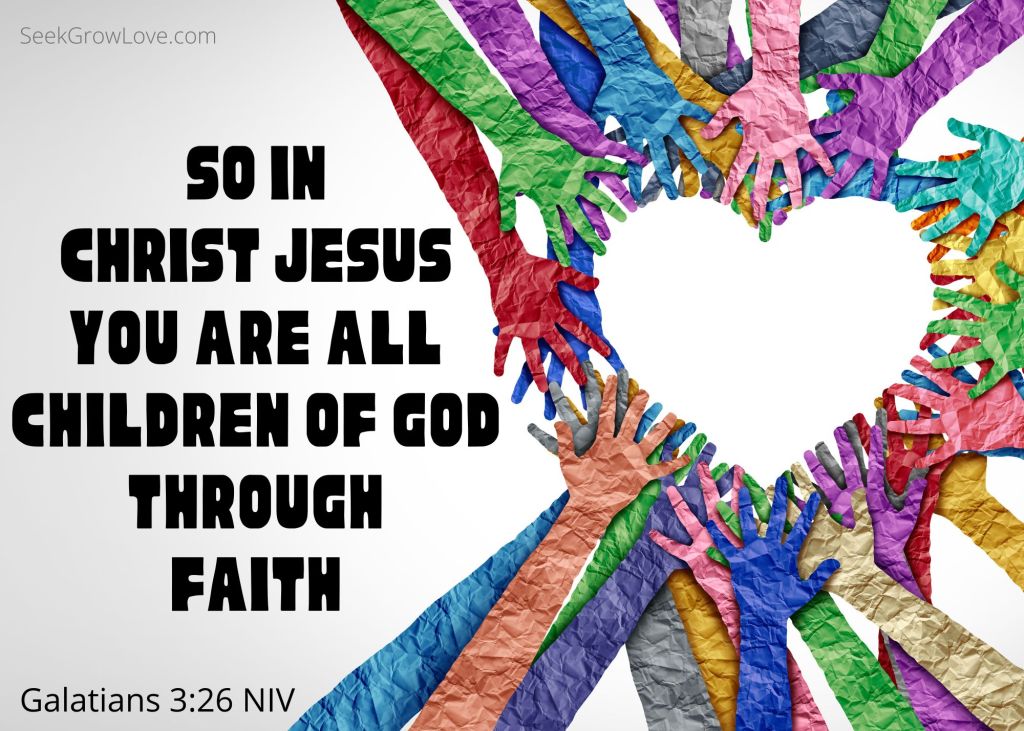
Galatians 3:26-29 says, “For you are all sons of God through faith in Christ Jesus. For all of you who were baptized into Christ have clothed yourselves with Christ. There is neither Jew nor Greek, there is neither slave nor free man, there is neither male nor female; for you are all one in Christ Jesus. And if you belong to Christ, then you are Abraham’s descendants, heirs according to promise.”  This doesn’t just apply to Philemon’s and Onesimus’ case; it applies to all of us.  Once we are baptized into Christ, there is no one better than another.  We are all part of the family of God and so are equal.


1 Corinthians 12:21-25 says, “And the eye cannot say to the hand, ‘I have no need of you; or again the head to the feet, ‘I have no need of you.’ On the contrary, it is much truer that the members of the body which seem to be weaker are necessary; and those members of the body which we deem less honorable, on these we bestow more abundant honor, and our less presentable members become much more presentable, whereas our more presentable members have no need of it. But God has so composed the body, giving more abundant honor to that member which lacked, so that there may be no division in the body, but that the members may have the same care for one another.”  Now that we are in Christ, we cannot be arguing over who is better or more needed.  We are all equals and necessary to do God’s work.  As equals, then, work to raise each other up so that others will not feel lesser and will instead feel equal, putting them before yourself.

-Kaitlyn Hamilton

Reflection Questions

  1. Are you a part of the body of Christ? If so, how does that affect how you view yourself and others?
  2. Is there any part of the body that you have been viewing incorrectly – as “less than” yourself?
  3. This week, how can you demonstrate care for others in the body of Christ?
The End of Division

Galatians 3

Wednesday, August 10, 2022

            I don’t know about you, but to me, it feels like the world is really divided right now.  More divided than we’ve been in a long time.  Liberal vs. Conservative.  The liberals call the conservatives Fascists or Nazis, the conservatives call the liberals Communists.  We are divided between theists and anti-theists, or some would divide us as racist or anti-racist.  Still, others would divide us as binary or non-binary, pro-live or pro-choice.  Living in perpetual states of division is stressful, painful, and exhausting.  In the words of Rodney King during the L.A. racial riots of the early 1990’s “Can we…can we all get along?”

            That’s kind of what Paul was saying to the Galatian Christians.  There was division going on in their Church.  Paul taught them that we are saved by putting our faith in Jesus Christ as the son of God who died for our sins and whom God raised from the dead.  This salvation is open to everyone who believes, young or old, male or female, Jew or Gentile (non-Jew).  As Paul was traveling on his mission to other places in Asia and Europe to share the message of Jesus Christ and the Gospel of the Kingdom of God with as many as he could, he received reports that people had come into the Churches in Galatia insisting that Gentile believers must begin practicing Jewish law in order to be saved.

            Paul was pretty angry with the Christians there who were being led astray by the teaching of these “Judaizers”  (people who insisted that Gentile Christians must practice Jewish Law in order to be saved).  Paul calls them fools and victims of witchcraft for allowing themselves to be taught something so clearly contrary to the gospel that he preached to them previously.

            Paul goes back and shows from the Hebrew Bible (our Old Testament) that even back in the time of Abraham God made his plan very clear.  God always planned to bring salvation not only to the Jews who were descendants of Abraham but also to Gentiles who were not biological descendants of Abraham.  Paul shows that God called Abraham long before the Ten Commandments and Ceremonial Laws were given to the Jewish people.  As Jews, they were always recipients of God’s grace.  The Law was never a precondition to them being chosen as God’s covenant people.  Paul wants it to be clearly understood that for the Gentiles they are brought into God’s chosen family not on the basis of observing Jewish ceremonial law or even moral law, but on the basis of faith in Jesus Christ.

            In Christ, old barriers and divisions come falling down.  We all become a part of the one family of God through Jesus Christ. It doesn’t matter our nationality, our age, our sex, our citizenship status or our righteousness according to the law.  What matters is that we come to Jesus Christ and have been clothed in Jesus Christ.

            Later in Galatians Paul will talk about what it means to crucify the flesh and to live according to the spirit and produce virtuous actions by the spirit, but the fruit is a result of salvation, not the precondition to being saved.

            The only true way to end division in the world is by becoming one with Jesus Christ through faith.

-Jeff Fletcher

Questions for Discussion:

1.  What are the kinds of things that divide Christians and Churches today?  What action will you take to help remove divisions where you worship and serve?

2.  Why is it important to understand virtue as a result of salvation rather than as a precondition to salvation?

A Job to Do

2 Corinthians 5

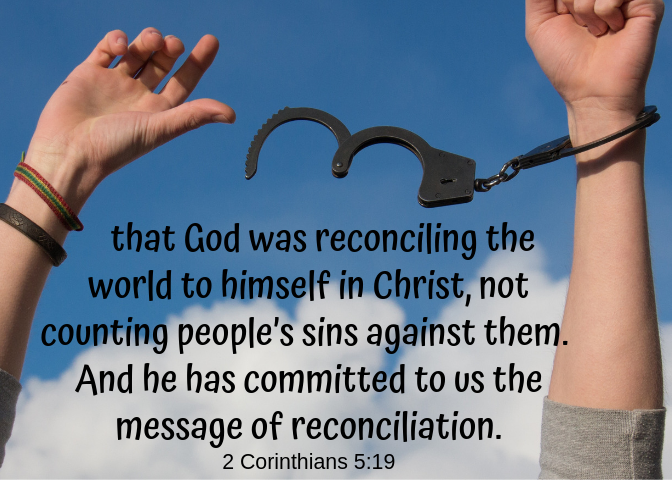
2 Corinthians 5 19


I recently watched Finding Hope Now (also more recently titled Streets of Hope) based on the true story of the ministry of Roger Minassian and his book Gangs to Jobs: Faith-Based Gang Intervention for Your City.  At 53 Roger left his comfortable pastorate to create a ministry to gang members (something he knew nothing about at the time – except that they needed help – even though they often didn’t want it).  I won’t share too much about the movie because I hope you see it for yourself.  But at one point a gang member is before a judge who has the power to convict the young man for crimes he did commit and deliver him to a punishment he did deserve.  But, Roger was there at the teen’s side – even though this kid had personally caused Roger much personal pain, heartache and property damage.  Roger was speaking for the troubled teen.  Telling the judge of the change he saw – the old was gone, the new had come.  Roger was deep in the ministry of reconciliation – both to reconcile this young man with the court system and his community – as well as to reconcile him to God.  Now, you have to watch the movie to see what happened next.


Reconciliation is “the restoration of friendly relations”.  And, the world is much in need of it – particularly as it pertains to restoring a relationship with God.  Paul says it best here:


Therefore, if anyone is in Christ, the new creation has come: The old has gone, the new is here! 18 All this is from God, who reconciled us to himself through Christ and gave us the ministry of reconciliation: 19 that God was reconciling the world to himself in Christ, not counting people’s sins against them. And he has committed to us the message of reconciliation. 20 We are therefore Christ’s ambassadors, as though God were making his appeal through us. We implore you on Christ’s behalf: Be reconciled to God. 21 God made him who had no sin to be sin for us, so that in him we might become the righteousness of God.                   (2 Corinthians 5:17-21 . NIV)


God seeks restoration and “friendly relationships” with His creation.  So much so that He sent His sinless Son to carry our sins to the cross so we could become new, righteous creations who could draw near to God.  Previously our mountain of baggage and sins we were carrying was keeping us from embracing God.  But God made a way for us to set it all down – at the foot of the cross.  Because Jesus spoke for us God is not holding our sins against us – if we are in Christ – and have asked for forgiveness, accepted Jesus as Lord, been baptized to demonstrate the putting off of the old self, and are living a life of obedience.


If you aren’t there yet – in Christ – why not?  “We implore you on Christ’s behalf.  Be reconciled to God.” (vs. 20).  Please talk to your pastor or Sunday School teacher or youth group leader or Godly parents or me.  You don’t have to wait until you are perfect or you know the whole Bible – none of us Christians fall into either of those categories.  You just need to be ready to put the old behind.  Drop the junk you are holding onto, accept the sacrifice the Son made for you as he was speaking to his Dad for you and put on a new friendly relationship with God.  Be reconciled to God.


If you are there – in Christ – Congratulations!  Best choice ever!   Daily enjoy that friendly relationship with God that was opened for you by Christ.  And, get to work – you have a job to do!


“God has committed/given to us, the ministry/message of reconciliation.” (vs. 18 and 19).  Saying it once wasn’t enough for Paul.  So, I will repeat it, too.  “God has committed/given to us, the ministry/message of reconciliation. (vs. 18 and 19)”.  Do it!


If you’ve got the priceless gift of reconciliation with God through His Son – give it to others.  It won’t subtract what you have, but it will only multiply as you follow God’s command.   Maybe you will bring the message to gang members and in the process save a whole town!  Maybe you will boldly speak to a neighbor, family member, friend, co-worker, or church youth and be instrumental in that priceless person’s decision to be reconciled to God.  And all of heaven will rejoice with you.  Pray for God to show you where to start – and then start!


People are listening.  People are looking for hope in a hurting world.  Yesterday my heart hurt to hear of a girl in Malaysia who posted an Instagram poll – should she live or die?  Tears are falling as I type that she received a 69% response to die – and she took her own life.


The enemy is alive and well and we have a job to do!   Spread life and hope and reconciliation.  You won’t convince everyone.  Paul didn’t.  Roger didn’t.  But they did change lives because of their ministry of reconciliation.  And, we can, too.  People need reconciliation with God – even if they don’t know it yet.  How will you share it?


In Christ and Reconciled With a Job to Do,

Marcia Railton

Resurrection, Transformation & VICTORY!

1 corinthians 15 52

Today’s section is over I Corinthians 15.50-57. In these seven verses there are two themes; transformation (50-53) and victory (54-57). Paul begins by stating that “flesh and blood cannot inherit the kingdom of God” and then the next phrase clarifies the previous. The perishable (flesh and blood) cannot inherit the imperishable (the kingdom of God). What this tells us is that we, in our current bodies and untransformed state cannot behold the nature to something such as the kingdom of God. In fact for us to be able to enter the kingdom, we need to undergo a transformation which happens at the resurrection and is only available “in Christ”. Paul says this in the next verse – that we will not all sleep (a euphemism for death in the Bible) but we will all be changed and then he specifies what change will occur in verse 52-53. He states that when the last trumpet sounds the dead will be raised “imperishable” and be changed. It it this act of being transformed that allows us to be in the presence of God and Jesus in the kingdom of God. Verse 53 restates and says that this mortal must put on immortality. In other words, at the resurrection the believer will receive the gift of immortality and will be granted entrance into the kingdom of God.

There are two things I would like to point out. First, you may be wondering, why would I have to change or go through a transformation to be with God? Well I think the answer is a practical one. For example, say I wanted to explore the sun. I want to get really close to it to explore and study it. The problem is I wouldn’t be able to get very close to it because of the intense heat and radiation. It would kill me if I got too close. However, if I somehow was made of the same elements of the sun I would be able to approach it because I would be like the sun. In a similar fashion, God is holy, bright, and other wordly. There is nothing in our experience to compare him to, he is incomprehensible. For you or I to be in the direct presence of God, we would have to be like him in some way or else we would die from his glory and majesty. The transformation we need in order to be in God’s presence happens and takes place at the resurrection. Philippians 3.21 says that we will be transformed into the image of Jesus’ glorious body. And where has Jesus been? He has been enthroned at God’s right hand.

A second point is notice what Paul says in verse 53 “…this mortal must put on immortality”. To be mortal means the capability to die. Immortality means the incapability of dying. Yet what does popular culture and church tradition tell us? When we die our souls or spirits go to heaven or hell. However this is only possible if there is a part of us that lives on after death, in other words, to go to heaven or hell would require us to be immortal. But Paul says that this “mortal” (this body that doesn’t have immortality), will put on, or be granted immortality. In short, we are not immortal now but those “in Christ” will receive it at the resurrection. Here are three verses to further this point:

I Timothy 6.16 – “who (God) alone possesses immortality and dwells in unapproachable light, whom no man has seen or can see. To him be honor and eternal dominion! Amen.”

II Timothy 1.10 – “…but now has been revealed by the appearing of our savior Jesus Christ, who abolished death and brought life and immortality to light through the gospel.”

I Corinthians 15.52-53 – “…and the dead will be raised…and this mortal must put on immortality.”

In short, only God possesses immortality, it is available through Jesus and the gospel, and those “in Christ’ will receive it at the resurrection. Will we let this challenge our thinking about the traditional view of what happens after death? The hope that God has placed before Christians is the hope for the return of Jesus and the resurrection, not going to heaven. Paul finishes that once the resurrection event happens that death will finally be defeated and swallowed up. And the power of sin and death will be no more and God, Jesus, and those “in Christ” will be victorious! God has given us victory over sin and death through our Lord Jesus Christ

-Jacob Rohrer

Resurrection Likeness

1 Corinthians 15_49 new

Today’s section (I Cor. 15.35-49) is a bit longer but it answers an important question. What will our resurrected bodies be like? The questions arises in verse 35 “…with what kind of body do they come?”. Paul answers this question in verse 42 but before he gets there he provides two analogies, we’ll go over just one though. In verse 36 and 37 he uses the example of a seed. A seed is sown or planted one way then sprouts a different and new way and when comparing the body to a seed he says “you do not sow the body which is to be…”, in other words, what comes out of the ground at the resurrection is not what goes into the ground at death. Paul is saying, the body undergoes a change just like a seed transforms when it is planted then sprouts.

In verse 42 he connects the analogies with the concept of resurrection, “so also is the resurrection of the dead..”. He then proceeds to distinguish two types of bodies, the one that is sown (the one that goes into the ground dead) and the one that is changed (the one that comes out of the grave transformed). To help see the contrast, I put verses 42-44 in a table:

It is sown It is raised
A perishable body An imperishable body
In dishonor In glory
In weakness In power
A natural body A spiritual body


Paul then picks up again the Adam-Christ parallel we saw in verses 21-22 in verses 45-49. The First Adam became a living soul but the last Adam (Christ) became a life-giving spirit. Whereas the first Adam was given life, the second Adam gives life. Paul continues this parallel into verse 47, the first man (Adam) is from earth, the second man (Christ) is from heaven. Now verse 47 is not talking about location but rather about identification. Adam is identified with the earth while sin runs rampant and the body is broken and damaged (see chart above); but Christ –  he is identified with heaven, where God is and where he is untouched by the brokenness of his creation. This is not saying that Jesus personally came from heaven to earth. Rather just as Adam is from earth in identification, Christ is from heaven in identification. Remember the context Paul is talking about is resurrection not Jesus’ origin. Then in verse 49 he concludes just as we have borne the image of the earthly (adam) so too will we bear the image of the heavenly (Christ). Here’s another chart to see the parallels:

The first Adam The second Adam
The first man is from earth The second man is from heaven
“Just as we have borne the image of the earthly..” “…we will also bear the image of the heavenly”
We are sown We are raised
A perishable body An imperishable body
In dishonor In glory
In weakness In power
A natural body A spiritual body


Now what does this all mean? When we are found “in Christ” our whole being including our bodies will be conformed to Jesus. Whereas our earthly natural bodies are powered by flesh and blood and will die, our resurrected bodies will be empowered by the spirit of God and will be glorified and will reflect the image of heaven. We will maintain our physical bodies, they will just be regenerated and powered by God’s spirit, this is the meaning of a spiritual body. Lastly, just as all of us have shared, in Adam, our earthly bodies, all those in Christ will share in his victory and his resurrected likeness. Thank you for your patience in reading this longer post today!

Have a blessed day and live boldly for the kingdom of God and Jesus!

-Jacob Rohrer

Resurrection and Loyalty


1 Corinthians 15 22

In today’s section we’ll look at verses 20-28 of I Corinthians 15. Did you know that you’re a king or a queen? So many blessings and riches are made available to us “in Christ” and in today’s section Paul speaks of another gift that comes with being “in Christ” – resurrection.

Paul begins by affirming that Jesus has indeed been raised from the dead, given the sad reality of if he hadn’t (v. 12-19). He then proceeds in verses 21-22 to compare Adam to Christ. Just as by a man came death, so to by a man came the resurrection of the dead. Paul clarifies this saying in the next verse by identifying the two men. In Adam all die but in Christ all live. This is a critical teaching of Paul about the dichotomy between Adam and Christ. By default all of us are in Adam, that is, we are identified and participate in the sphere of Adam which is rebellious and God hating. This inevitably results in death. But you and I can go from being “in Adam” to “in Christ”. When we are found “in Christ” that is our new identity (II Cor. 5.17) and this inevitably leads to life, specifically, resurrection and immortality (II Tim. 1.10). The way we can go from being “in Adam” to “in Christ” is by repentance, acceptance of the gospel, and obedience to Jesus as Lord. For more on the Adam-Christ teaching read Romans 5.12-21 and all of Romans 6 for what it means to be “in Christ” (“in Christ” is a technical term found often through Paul’s epistles that is rooted in his understanding of Adam and Christ). But Paul specifies that there is an order to the resurrection: Jesus first then those who are his at his coming.

Then Paul says literally “then the end”, when Jesus hands over the kingdom to his God and Father when he has abolished all rule and authority. In other words, when Jesus comes back he will dismantle and overthrow every human authority and government and establish his Father’s rule and reign with him as king. Then concluding, Paul says after this happens Jesus will hand over the newly established rule to his God and father, being subjected to him, so that God may be all in all forever and ever.

To be “in Christ” means so much more than just ‘I’m saved’ it’s larger meaning is that we get to participate in the sufferings and victories of Jesus. Specifically, because Jesus was raised from dead, we will be raised from the dead (I Cor. 15.20,23). Because Jesus ascended to God’s right hand and has been given all rule and authority, we too are seated with Christ and share in Jesus’ power and authority (Eph. 1.20-21, 2.4-7). You are a king and queen in the making whom God is making ready to rule and reign through our Lord Jesus Christ by means of the resurrection!

-Jacob Rohrer

Why Should We Pray?

Monday, October 2, 2017

Luke 18-1

I don’t want to spend any time talking about what prayer is or how we should go about it before I even convince you that we should be praying.

So why should we pray?

I think this is a pretty easy question to answer. Jesus commands it. There are a few verses that explicitly command prayer: Matthew 6:5-15, Matthew 26:41, Ephesians 6:18 and Luke 18:1. I want to look a little closer at the verse in Luke today.

”Then Jesus told his disciples a parable to show them that they should always pray and not give up” (Luke 18:1).  If we strive to be disciples of Jesus, then we should always pray. Being a disciple is essential to being “in Jesus,” just like our memory verse says. If we commit ourselves to constant prayer, than we can become a new creation.

Seems like a pretty easy step right? All we have to do is pray! Tomorrow we’ll talk about what that looks like.

-Nathaniel Johnson