As ignorant, stuck-up, entitled humans, we often think we know what we need. We have this nice little idea of what will make our lives better, and we go to God expecting Him to grant us our wishes. But the thing is, we don’t know what we need; we don’t know how God works or what He plans to accomplish through us, or how He even uses our situation for His glory.
In 2 Kings 5, we read about one particular ignorant human who went to Elisha hoping to be healed of his leprosy, despite being a gentile and enemy of Israel. Now this man, Naaman, wasn’t mistaken in thinking he would receive the help he needed, but what he thought he needed and what God knew he needed were two separate things. When Elisha told Naaman to wash 7 times in the river Jordan, he became angry and almost turned around to head home, because this wasn’t the grand solution he expected to hear. Fortunately, however, his servants reminded him what was at stake, and what he should be willing to try for the sake of healing his leprosy. So Naaman, I imagine quite reluctantly, went down to the river and followed Elisha’s instructions. And what do you know – he was healed!
After experiencing this miraculous restoration of health, Naaman knew who the one true God was (and is), and came back a changed man. Even in the few paragraphs we read about Naaman, we can see a drastic difference in his overall attitude and behavior. God changed his heart. If Naaman wasn’t lucky enough to have those servants around, he would’ve missed out on everything he gained in his short encounter with Elisha. Because of his own pride and desires, he was prepared to walk away from the only chance he would ever get at healing his fatal disease, and finding a relationship with his Creator.
Naaman’s story can serve as a reminder to let go of our self-conceived ideas of what is best for us, and instead trust God to handle every situation His way. God’s way is always the best way, whether or not we are capable of understanding it. He has a plan for all His children, and this plan has already been set in motion. He answers our prayers in ways we could never imagine, and sometimes in ways we can’t even see. We have to trust that our loving, heavenly Father knows what’s truly best for us, and that everything He does is part of the ultimate plan He has for us to live together with Him in His eternal Kingdom.
God knows what you need, all you have to do is trust Him.
–Isabella Osborn
Today’s Bible reading passages can be read or listened to at BibleGateway here – 2 Kings 5-6 and Proverbs 7
You know the feeling you get when you meet up with a couple of fellow kings, who aren’t really your fellows, but you have a common enemy, so you march on together in friendship and harmony, despite the odds that are against you, when you come to the devastating realization that your combined armies and cattle are on the road to dehydration, so you suggest finding that one prophet dude who can maybe help out in this situation, and the other kings agree, so you find the prophet dude and it miraculously turns out, yes! He, or more accurately God through him, helps you out with your water dilemma, (it’s “but a slight thing in the sight of the LORD) and not only that, but he also says that he’ll assist in the defeat your enemy!! Eeeeek, I’m practically bursting just thinking of it. Unfortunately, I can’t say I’ve actually experienced the aforementioned occurrence, but I have felt the amazing emotion that fills your heart with complete, unmatchable joy when you are assured that the most powerful, capable, fierce, wisest Being in the universe, loves you and has your back.
In 2 Kings 3, this is exactly what we see happening. Jehoram, the king of Israel, comes together with Jehoshaphat, the king of Judah, along with the king of Edom, and together they avoid dying of thirst, and totally crush the Moabites. Their epic victory wasn’t of their own works, though. It was God who provided water, and delivered Moab into the hands of the three kings. More often than we ever realize, God works in our lives too. Every single undeserved blessing, every single little victory we celebrate, is our Father’s loving presence. He is continually showing us how much He cares for us, and how deeply He loves us. He demonstrates this love not only in our lives now, but in the amazing promises He’s made to us. Promises of a perfect Kingdom in a beautiful land, where we will live eternally in absolute contentment and happiness with our wholly perfect and wholly good Father.
Notice, however, that Elisha clarified in verse 14 of chapter 3 that he would not even be seeing them if it wasn’t for the presence of the godly and faithful king Jehoshaphat. This king trusted his God, and knew to go to Him in his time of need. Back then, they had to go to God through a prophet, like Elisha, or Elisha’s predecessor, Elijah, but Jesus has since then connected us to our God, bridging the gap as a mediator between God and man. We have the ability to speak directly with God and form the relationship He so desperately wants with us, despite our utter imperfection and His divine perfection. Hold on tight to that gift, never forgetting how awesome it is that we can be so massively loved by such a great God; that He would care for us at all, even in our sin and weakness. Hold on tight to the unimaginable promises He’s made to us, and live everyday aware and thankful for the countless blessings He provides for us.
What a feeling, to know that you have such an awesome God on your side.
-Isabella Osborn
Today’s Bible reading passages can be read or listened to at Bible Gateway here – 2 Kings 3-4 and Proverbs 6
Okay, let me start by saying, it was SO hard deciding where to even start when I was writing today’s devotion. There is just so much meat in these two chapters, and I highly recommend that you set aside enough time today to really dig into these scriptures.
In today’s first chapter, John 7, we watch as Jesus instructs his disciples to go to the feast without him, because the Jews do not hate the disciples as they do Jesus. Eventually Jesus goes, but in secret. He went to the temple and began teaching, aware that if he were to make himself known to too many people, things wouldn’t end well. Which of course, in the long run, they didn’t – but let’s not get ahead of ourselves. As Jesus said, his time had not yet fully come. This is one of the reasons he was often so discreet. He couldn’t yet draw too much attention to himself, because he knew that would almost immediately lead to his death. This is important to note because he was not done with his time on earth; he knew there was more to accomplish before fulfilling the prophecy. And so he did, showing as much love and kindness as possible, and bringing thousands and thousands of people into the light. (And in doing so, setting an example for us to do the same.)
We could, of course, continue to talk about this one chapter for days and days, however, there’s also a ton of good stuff worth addressing from the next chapter, John 8. This one’s actually jam-packed with wise words and food for thought… so let’s dive in.
The first little section in John 8 is the story of the adulterous woman, which is definitely a good one and can teach us a lot. However if you don’t know already, this story was not in early manuscripts of the book of John, and was likely not written by him. Regardless, the important take away of this story is that none of us have the right to judge another, for we all sin, and we all deserve forgiveness. What stood out to me most though, is that Jesus said “I do not condemn you, either. Go…” which of course is the point of the story, but then he said, “From now on sin no more.” We can’t forget this part in Jesus’ line of thinking. Yes, we can be forgiven, but that doesn’t mean just getting away with something and then going and doing it again. It’s also about repentance; turning yourself around and doing things different from there on out. That’s maybe the most important step: what you do after the fact.
In the next few sections of chapter 8, we’re walked through a series of conversations between Jesus and the Pharisees/Jews. Repeatedly, Jesus (humbly) says something authoritative, and repeatedly, the Pharisees have some illegitimate reason to disagree. Jesus describes himself in many ways over chapter 8: the Light, the Son, the Truth, etc. This is who he is, always, but it is in this chapter that these attributes resulted in so many people coming to believe in him, and so many people coming to hate him. What the Pharisees failed to understand was that Jesus truly did have authority over them. He is the Mediator between God and man. When he claims all these things about who he is, it’s not to glorify himself, it’s simply the truth, God’s truth. As the Son of God he speaks God’s truth, not on his own initiative, but as the Father teaches him (John 8:28).
Jesus has to repeat himself many times in chapter 8, because his audience is really not getting it. At one point he even asks, “Why are you not understanding what I am saying?” which I always imagine was said in slight exasperation. From this point on, he really begins spelling it out for them, and for us. In verses 38-47 Jesus refers to two fathers, ours and his. At first the Jews think he means their descendant, Abraham. He proceeds to tell them that if they were truly children of Abraham, they would be acting like Abraham, but they’re not. Then they try to refute this by saying, oh well actually no, God is our one Father. Jesus then replies with, well if God was your Father, you would love me, because He’s the one who sent me. Then he reveals that the father he was really referring to as theirs was the devil, which had to have stung, but should really make us think. Who are we allowing to lead our lives? As children of God, are we fully giving ourselves to Him- our Creator, our Potter, our Abba.
Lastly I want to quickly mention something about 8:58. Jesus says, “Truly, truly, I say to you, before Abraham was born, I am” (NASB). Many times trinitarians take this verse and try to claim that this means Jesus was around forever, making him one with God. However, it was really translated wrong, (as many verses are, due to the overwhelming amount of biased translators) and if translated correctly, would read something more like, “I am he,” or “I am the one,” which in this context, would just be referring to himself as the Messiah, existing not physically in Abraham’s time, or before, but in God’s plans for the world.
As you go through the rest of your week, pray that, being of God, you may hear the word of God, because followers of God WILL hear Him, and will know the truth (John 8:45-47), and the truth will set you free (John 8:32).
– Isabella Osborn
It’s a treat to hear from Isabella today. She is a wise and caring home-school student from South Carolina who loves loving God and others.
Today’s Bible passage can be read or listened to at BibleGateway here – John 7-8
Tomorrow we will read John 9:1-10:21 as we continue on our journey through God’s Word. Come follow along!
Wow! It’s now been a full week since Fuel ended, and I’m sure that many of you who attended are, like me, missing your friends, your classes, the sessions, and the overall atmosphere. But hopefully, we have been able to take what we learned that week and apply it to the way we live our everyday lives. How to be (drum roll, please)…DIFFERENT! We can see many examples of how to be different and serve the way Jesus served in Mark chapter 6. I think of this chapter as a sort of series of steps telling us how we are meant to serve.
So Jesus starts this chapter off with saying, “A prophet is not without honor except in his own hometown and among his own relatives and in his own household.” (Mark 6:4) The King James version actually says, “in his own country.” So in essence, he’s telling us, “Hey, I know you like your friends, your family, your home, and it’s easy to feel comfortable there, but I need you to GO OUT and share the truth with the world.” It is not God’s will for us to stay confined to our own little nook of the world. We have to go love everybody, everywhere. Don’t be afraid to venture outside your comfort zone, and love people there.
The next main point Jesus gets to is that when you stop in a town to share the truth with people, they might not accept it; they may simply say “no”. In that case, our job is to “shake the dust off our feet” (Mark 6:11), and move on. Because what happens when we stay in one place, working on bringing the same person to the truth for too long? We miss out on bringing so many other people to the truth! If someone is not willing to accept the truth and live for God, we have to know that it’s time to move on and find people who are. Because our mission is to get as many people into the Kingdom as possible.
After the sad and brutal story of the death of John the Baptist, Jesus told the disciples to “Come away by yourselves to a secluded place and rest for a while.” (Mark 6:31) In order to help other people build a relationship with God, we need to keep ours strong. Luke 5:16, one of the memory verses from last week, says “But Jesus Himself would often slip away to the wilderness and pray.” So one important step we have to take in our lives is to take the time to go somewhere by ourselves and focus on our own spiritual health, so that we may be better equipped to go out and make disciples.
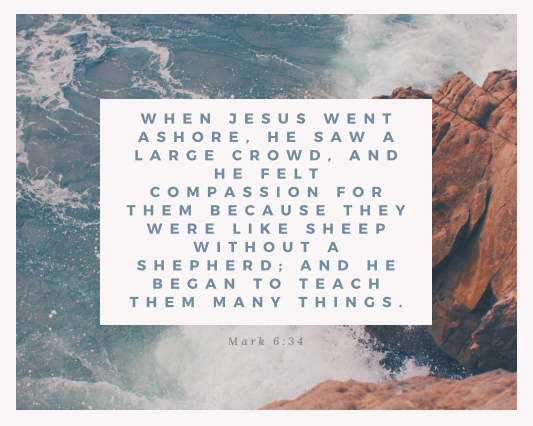
In verses 33-44, we read about how Jesus fed five thousand people with five loaves of bread and two fish. It says in verse 34 that Jesus saw them and felt compassion for them. But he didn’t just push the feeling away and continue on; he acted on his compassion. He did something. It may seem impossible to do what Jesus did, but God provides you with the means to do what you are called to do. And it’s not impossible by the way – if God thinks that you should feed five thousand people with a couple of tacos and a strawberry shake, you will feed five thousand people with a couple of tacos and a strawberry shake.
Next we come to Jesus walking on the water. His disciples were astonished when he climbed in the boat all nonchalant after walking out to the middle of the sea to calm the winds for them. Why were they so flabbergasted? I mean, they just witnessed him feed five thousand people with five loaves and two fish! Well, in verse 52 we read that they “had not gained any insight from the incident of the loaves, but their heart was hardened.” Don’t let your heart be hardened. Open your eyes to the things God is doing all around you, and let it affect you. Let it change your mindset, your behavior, the very way you live your life. Because that’s why God let Jesus do these crazy things, so that we could see His power and have faith in Him. Later on, in verses 53-56, we see how the people of Gennesaret recognize Jesus and flock to him, assuming that he can heal them, because they know he has before. Flock to Jesus. Know his Father’s power. Trust in Him. Let Him make you different.




 Seek Grow Love