Conflicts and violence are problems we humans have always dealt with. If only there were some insights in the book of James to help us understand why, and how we might be able to help the situation.
“Those conflicts and disputes among you, where do they come from? Do they not come from your cravings that are at war within you? You want something and do not have it; so you commit murder. And you covet something and cannot obtain it; so you engage in disputes and conflicts. You do not have, because you do not ask. You ask and do not receive, because you ask wrongly, in order to spend what you get on your pleasures.” (James 4:1-3 NRSV)
James says the source of conflict is the cravings at war within us. We covet things that we don’t have, and perceive that there isn’t enough to go around, leading us to take what we want by force, many times at the expense of others. We’re wired so deeply for survival that the fear of scarcity often drives us to get what we need in whatever way we can. It’s both a blessing and a curse.
The passage goes a level deeper into the investigation and explores why we don’t have what we need: It’s because we don’t ask. That’s something I’m not good at. I often feel uncomfortable asking someone else for something, because I think it’s my own responsibility to take care of it. By not asking, I’m underutilizing one of the biggest strengths of being part of family and community. There is more than enough to go around if asking and sharing happen freely.
There’s another layer to this. Sometimes when we ask, we don’t receive because we ask with wrong or selfish motives. By chasing after the wrong things, we are fueling the fire of conflict. James is prompting us to take inventory of our desires and motives. It’s not wrong to need or want things, but the challenge is to seek the right things with a pure heart.
James continues his train of thought by contrasting “friendship with the world” and friendship with God. When we seek things with the wrong motives, we make ourselves friends of the world, and therefore enemies of God. Instead, make yourself a friend of God by humbling yourself and submitting to the leading of his spirit that lives within us. Set aside your selfish desires, as painful as that may be, and ask for truly good things.
James is offering us an antidote to conflicts and violence, advocating for a more peaceful way—partner with God (“draw near” to him) by properly aligning your desires. Seek after and ask for the right things, and have enough as you share in God’s abundance and grace.
-Jay Laurent
Questions to consider:
1. What are some things you need or want, but don’t have?
2. Do you think these needs/wants are because of selfish desires, or are they good things to seek after?
It can be a challenge to control what we say. James describes the tongue like a poisonous and evil beast we can’t tame. He says that it’s a fire that sets the whole cycle of nature ablaze. That’s a lot of power to ascribe to one small part of the body. How can it be so powerful?
James gives us two potent analogies for how this works. You can put a small bit in a horse’s mouth and be able to steer them wherever you want, and you can steer a large ship with a small rudder. It’s the same with the tongue. It’s a small part of the body, but it has great “steering power.”
Have you ever met someone who is just always a positive thinker? It’s equal parts encouraging and annoying how they can always manage to put a positive spin on things. On one side, it seems like they’re not acknowledging the reality of the situation, but on the other, they might have a deeper handle on reality. There is something I can learn from this kind of person. Thinking and saying positive things is like a small investment in those truths. It signals that we are aligned with them and committed to them, and when that is the case, we’ve paved the road for positive actions.
The same could be true for negative thoughts, words, and actions. If you’re putting your chips down on your dismal predictions, you want to be right. Sometimes we want to be right more than we want things to be right, so we can say, “See, I told you so.”
The influence of your tongue goes far beyond just yourself. Imagine you are having a conversation with someone you care about. Somewhere along the line, you start interpreting each other incorrectly (which happens all the time), and one or both of you gets triggered by what the other says. In such a moment, especially when you are angry, it is like all control of the tongue goes out the window. You are suddenly saying hurtful things that you are wishing you didn’t say—even before you finish saying them. The tongue takes over and starts steering the conversation into a fiery disagreement. This is real. You know it’s real because you’ve experienced it. This is the wildfire James is talking about.
For moments like those, it is appropriate to remember to be quick to listen, slow to speak, and slow to get angry (James 1:19). When my pastor, Michael Hoffman, talks about this verse, he says that is why God gave us two ears and only one mouth. If only this was something I could remember more in the moments that count. When you really put effort into hearing people, you take some of the destructive ammunition away from the tongue.
These days, we have quicker and easier ways to cause wildfire than James could ever imagine. I’m pointing at social media. The internet is an amazing innovation and it’s hard to imagine my life without it, but we were clearly not ready for it as a species. Now we are dealing with a beast more ferocious than just the tongue. Now anger, polarization, fear, disillusionment, disinformation, and pure stupidity can be spread across the world in just a short moment with a comment, tweet, post, video, or what-have-you. Those who see or hear it will likely not react or filter themselves as if they are interacting with a real human, and their response will reflect that. It’s a terrible feedback loop. To make it worse, there are algorithms lurking in the background making sure you see the things that are most likely to trigger you. If the tongue is a wildfire, social media is uncontrolled nuclear fission.
Somewhere around 10 years ago now, I realized that social media was not a healthy thing for me, for various reasons. I imagined what would happen if I just quit using it. So one day I quit, and I’ve never missed it. I’m not saying you should do the same, but if you ever find yourself burdened or distracted by it more than you know is healthy, consider it.
The things we say really do affect us. They ripple out and affect our families and friends. They touch our communities and influence our world in ways we don’t even comprehend. This is the reality that James recognizes and wants to warn us about. And given how fast and wide technology allows our communication to spread, that means we have an even higher level of responsibility for what we say.
-Jay Laurent
Questions:
1. When was the last time you started a wildfire with your words?
2. Are there any strategies you could use to help tame the beast that is your tongue?
In the second chapter of his letter, James continues with his onslaught of practical but difficult advice.
“What good is it, my brothers and sisters, if you say you have faith but do not have works? Can faith save you? If a brother or sister is naked and lacks daily food, and one of you says to them, ‘Go in peace; keep warm and eat your fill,’ and yet you do not supply their bodily needs, what is the good of that? So faith by itself, if it has no works, is dead. But someone will say, ‘You have faith and I have works.’ Show me your faith apart from your works, and I by my works will show you my faith. You believe that God is one; you do well. Even the demons believe—and shudder.” (James 2:14-19 NRSV)
It would seem from this section that just believing things is no good. If my interpretation of James is correct, that means it’s not enough to go around quoting John 3:16 and telling people they only need to believe in Jesus and they will be saved. There is no checklist of beliefs where you can just tick all the boxes and receive salvation. No single belief will save you, and neither will any magical combination of beliefs.
James is asserting that action must accompany faith in order for it to be the real thing. Doing good works is the evidence of your faith. Faith and good works don’t live isolated lives, but are coupled together. To decouple faith and works is to reveal an inconsistency.
Imagine that someone claims to believe in the value of human life as the image of God, yet they go around hurting or killing people. Or maybe they just neglect to help someone else they know is in need. You would notice the inconsistency in that. They must not truly believe in the value of human life since their actions show they don’t value it. James is telling us that actions are louder than words. He cuts right through the nonsense and says, “Hey, don’t just tell me what you believe. Show me.”
When we talk about this passage, it’s likely that we’ll also think of a passage from Ephesians that seems to be in tension with it.
“For by grace you have been saved through faith, and this is not your own doing; it is the gift of God—not the result of works, so that no one may boast. For we are what he has made us, created in Christ Jesus for good works, which God prepared beforehand to be our way of life.” (Ephesians 2:8-10 NRSV)
Paul here is saying that works can’t save you; it’s a gift you accept through faith. James is saying faith alone doesn’t save or justify you; you need works too. Is there a conflict between what James and Paul are saying?
Part of the beauty of this collection of writings we call the Bible is that different authors often have different perspectives on things. We have four different gospel accounts, each with their own angle and emphasis. The general story and message are the same, but some of the finer details differ. This is exactly what you would expect if you asked four different people to describe something they witnessed years ago. This is not a problem at all for the gospels, and in actuality, bolsters the case for their authenticity. It shows that four people didn’t get together in a room for a weekend and collude to produce the exact same fairy tale. Four real people wanted to pass on what they witnessed, and they did so under the inspiration of God.
We see the world with two eyes, each from a slightly different angle. This allows us to perceive depth, in other words, to see things in 3-D. Your brain does some kind of trigonometry with the signals from your eyes to give you an idea of how far away something is. If you had only one eye, it would be much harder to judge depth.
We can regard James and Paul as two eyes looking at the topic of salvation from two different angles, and the result is seeing it in 3-D. It’s the same core truth with different emphases. James sees something Paul doesn’t see, and Paul sees something James doesn’t see. At great risk of oversimplification, I’ll try to bring their viewpoints together. They would agree that faith and works go hand-in-hand. James is saying faith alone is not enough, and Paul is saying works alone are not enough. Neither would say that you can earn salvation by works, but would agree that the works are evidence of a saving faith. Well, I took a stab at it. My only hope is that they can get together sometime to discuss this topic and release it as a long-form podcast.
-Jay Laurent
Question Time
1. Why do you think it is so hard to really live out what you believe?
2. What small steps could you take this week to put your faith in action?
The letter of James has some of the most immediately practical wisdom you can find in the Bible. Some have called it the “Proverbs of the New Testament.” If you are looking for guidelines about how a Christian should live, James is a great place to start.
The only problem is that some of James’ advice is hard to take:
“My brothers and sisters, whenever you face trials of any kind, consider it nothing but joy, because you know that the testing of your faith produces endurance; and let endurance have its full effect, so that you may be mature and complete, lacking in nothing.” (James 1:2-4 NRSV)
I don’t know about you, but when I’m going through difficult things in life, I’m not feeling joy. Isn’t joy supposed to be reserved for things that are… joyful? Isn’t joy for when people get married, or when babies are born, or when a new season of your favorite show is available to stream, or when you are going to have tacos? Yes, joy is for the good things in life.
So why does it sound like James is telling us to enjoy suffering? Is he insane?
Well, no. In order to understand what he is saying, we have to think of the long game. We’re not to be joyful because of the difficult times we are facing, but because of the growth potential they provide for us. Going through things teaches us to endure, and being able to endure makes us more mature and complete. Pressures shape us into stronger people. Recall that if you subject carbon to intense heat and pressure, you get diamonds!
Consider any elite athlete. They didn’t get where they are by accident, but through years of difficult and intense training. Do you think they truly enjoyed all of that training? Of course not, but I bet they did enjoy knowing that through their training, they were going to be the GOAT at their sport.
If you want your muscles to become stronger, you have to progressively challenge them. Likewise, when our faith is challenged, it also becomes stronger. James is asking us to take on the right attitude of joy during our times of discomfort, because we know that through those challenges, we are deepening and growing our faith.
In thinking about all these things, I’m reminded of the time Jesus was in the garden of Gethsemane, under unimaginable distress because he knew he would soon lose his life. Imminent death is the kind of thing that would test anyone’s faith, even Jesus. He didn’t want to go through with it any more than you’d want to drive a stake into your own eye socket. In his situation, I would have been tempted to just run away and wash my hands of the whole thing. I’d say to myself, “This whole messiah business has taken quite a turn and I just want a quiet life somewhere.” I can imagine he had that same temptation. Surely he didn’t enjoy being betrayed, put on trial, scourged, and nailed to a piece of wood to die in total humiliation.
Jesus didn’t have to do what he did, but he was thinking of the long game. Yes, he knew he would face a horrible death, but deep in his heart he had something resembling joy. Not joy because of the circumstances he was enduring, but because of what was just over the horizon. It was this joy and hope that allowed him to muster the strength to say with his dying breath, “It is finished.” He knew that his dying would mean, paradoxically, conquering over the powers of sin and death, and leading us on a mass exodus out of their clutches. He knew that his resurrection would unleash a new reign of God on the earth and again put us at one with God.
Jesus did what he did because he was thinking of us.
-Jay Laurent
A couple questions to reflect on:
1. What are some trials or difficult times that you have had to endure?
2. Can you think of any ways you grew as a result of these times?
“All this I observed, applying my mind to all that is done under the sun, while one person exercises authority over another to the other’s hurt.” (Ecc 8:9)
As you are all aware, the United States has a deep and dark history with slavery. Generations of family wealth were built on the blood, sweat, and tears of slaves. We abused our power and took advantage of others for our own gain. Thankfully, although through great struggle, we abandoned the practice.
But we still feel the ripples of our past today. Slavery ended, but it took many, many years before everyone could say they had the same fundamental rights. It takes a long time to recover from being held down as a people for so many years, especially as those in power do everything they can to stay in power. It is painful to see that senseless acts of racism and hate still happen, and that the systems and powers still propagate forms of racism. I do not claim to know what the solutions are, but there is still a lot of work to be done to correct our great wrongs.
The United States wasn’t the first nation to have a practice of slavery. For an example, let’s go back in time to the exodus. You probably remember the story, but if not, it’s… in Exodus. Moses and the Israelites were miraculously delivered from slavery in Egypt. This was an important memory for the Israelites and was commemorated by the Passover meal. In fact, we trace our tradition of communion back to one particular Passover meal that Jesus had with his disciples.
If we move forward to the time when Paul was writing to the Galatians, slavery was a thing then too. It was a normal part of the culture. Although, compared to what the United States did, it was milder. Think more along the lines of indentured servitude. It was not a good situation to be in, but it was not to the level of horror that we took it.
Unfortunately, the practice of slavery is still alive and well in our world. There are more slaves in the world than ever before. Usually we call it “human trafficking” now, but the concepts are not that different. It is about owning people. The mindset that you can own a person and profit from them is big business, and it’s terrifying to think about.
We come to Galatians 4 and see that Paul is drawing a strong connection between following the Jewish law and being under slavery. This seems to fly in the face of what we have seen elsewhere in scripture about the law. The law is supposed to be a good thing that was received from God. For the Israelites, it was an important pathway toward connecting with God. Jesus himself upheld it as something good (Matt 5:17 and surrounding verses). In Galatians 3, Paul seems to agree it was good, and even necessary for a time. But if we have a chance to corner Paul and ask if he thinks the law is good or bad, he’ll probably say “Yes!” There are two sides to this.
Usually you don’t think of things as absolutely good or bad. You compare them to other things or judge them in context. A burger is better than salad. It is savory with lots of protein and fat. The salad is better for providing micronutrients and some fiber, otherwise it is worthless. I would put a tomato slice and lettuce on the burger and call it a day. If you are hard pressed for finding food, then a salad is better than nothing. But if you had access to a burger, then you would not bother with a salad. I am the least picky eater I know. I can enjoy and see the value in a salad. They are a good thing. But there is just no comparison to a burger. A burger wins every single time.
The law is like the lettuce that the Jews had to live on until they had burgers. It was the best option for a long time, and it was a blessing from God. But now that we have grace, the promises of God, and the spirit through Jesus, the law looks pathetic in comparison. After a bite of that burger, you won’t go back. Taste and see!
“But when the fullness of time had come, God sent his Son, born of a woman, born under the law, in order to redeem those who were under the law, so that we might receive adoption as children. And because you are children, God has sent the Spirit of his Son into our hearts, crying, ‘Abba! Father!’ So you are no longer a slave but a child, and if a child then also an heir, through God.” (Gal 4:4-7)
Paul is saying it is better to be a child and heir than to be a slave. Because of what Jesus has done, your status has changed from a slave under the law to a child of God and an heir of his promises. If you’re a child and heir, with rights and a large inheritance, you wouldn’t think of going back to having nothing.
You can imagine that trying to follow the letter of the law would feel burdensome, like it owned you. And the law has a way of making you hyper-aware of your sin. And sin is all tangled up with death. Thankfully we are filled with and are influenced by the spirit of God to help guide us. If we keep in step with the spirit and make ourselves vessels of God’s love, we don’t have to worry about breaking God’s laws. It is like they take care of themselves.
Starting in Galatians 4:21, Paul gives us an allegory of the slave woman and the free woman. He’s presenting us with a crossroads of sorts, but the choice should be easy. Of course if Jesus hands you a burger, you take it, and don’t bother with the salad. Why be a child of the flesh when you can be a child of the promise? Why be a slave when you can be free?
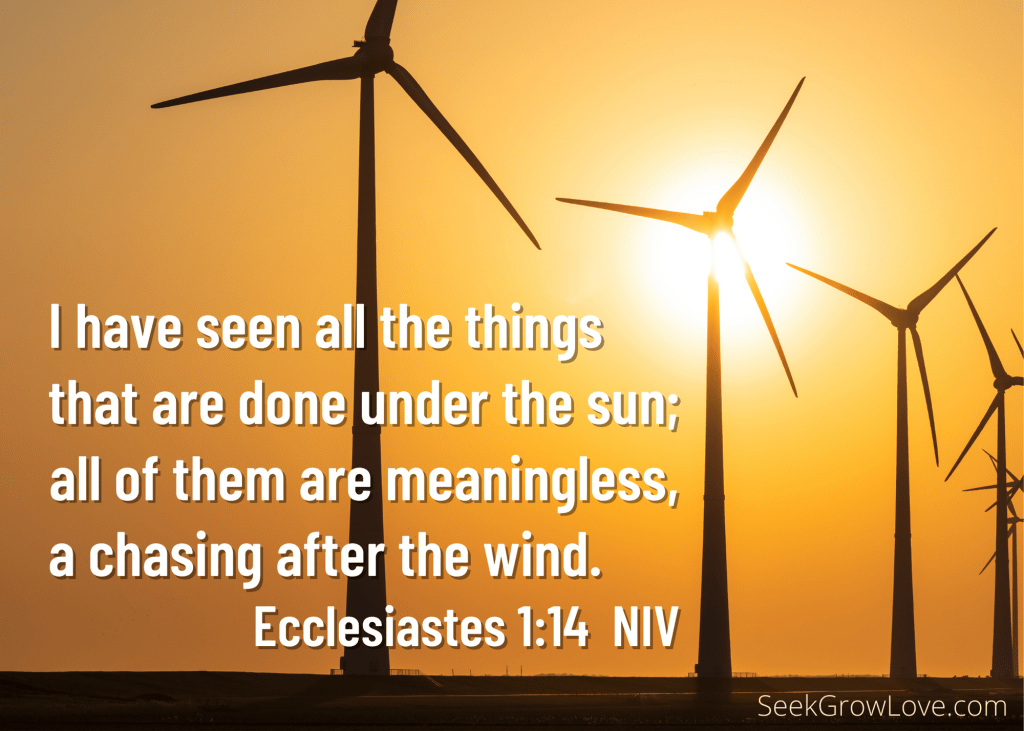
With all of this influence from Ecclesiastes lately, I can’t help but think Paul would say being slaves to the law is like chasing after the wind.
Sometimes when you read a section of the Bible, something in particular sticks out to you. As you think about it, several other thoughts bloom from it. I love Ecclesiastes, but there are 4 verses from Galatians 3 that stole my attention.
“…for in Christ Jesus you are all children of God through faith. As many of you as were baptized into Christ have clothed yourselves with Christ. There is no longer Jew or Greek, there is no longer slave or free, there is no longer male and female; for all of you are one in Christ Jesus. And if you belong to Christ, then you are Abraham’s offspring, heirs according to the promise.” (Galatians 3:26-29)
Paul is letting the Galatians know that any lines that divide people do not exist under Christ. Anyone who calls Jesus “Lord” is right there with him as an heir to the promise, as much of a child of God as any other child of God. As much of a child of God as Jesus himself!
Does this seem too good to be true? Is it too radically inclusive? As we’ve explored, some of the early Jewish Christians scoffed at the idea of including the gentiles without making them meet certain conditions. That’s like saying that in order to have access to God, you have to be like me. How would you feel if I expressed that I was part of the “in” crowd that has particular boxes checked, and unless you also have them checked, you’re an outsider without proper access to a relationship with God? Do you sometimes think other Christians are not real Christians because they think differently than you do or have other ways of doing things?
What other categories might Paul have included in his list if he were here today in our culture? Would he have said there is no Republican or Democrat, no conservative or liberal, no boomer or millennial? No black, white, brown, or any other skin shade or culture you can think of? No rich or poor, young or old, dumb or smart? No Catholic, Lutheran, or Pentecostal? No introvert or extrovert? No lawyer or plumber? No young earth, old earth, or evolutionary creationists? No five-point Calvinists or process theologians? I can go all day.
How does it make you feel that everyone belonging to Christ is equally a child of God? Is it a liberating and empowering thought, or does it ruffle your feathers a little? How does it sit with you to know that females and males equally carry the image of God (Gen 1:27)? Can you handle that those with political views different than yours have a place at the table with you? Are you uncomfortable that you are a brother or sister in Christ of someone who doesn’t have the same doctrine as you, or has less money than you, or has a thousand times the money you have? Through Jesus, God extended his promise out to anyone who would accept it. Who are we to try to take that away because of dividing lines that were already erased?
When we think of a round table, we think of King Arthur and Camelot. We think of the Holy Grail, the Bridge of Death, questions about swallows, Tim, witches, and very small rocks. At least I can’t help but think of all those things and so many more. Anyway, it’s a round table because it doesn’t have a head. Nobody has the seat of honor; everyone has equal status. It’s the kind of thing that elevates everyone and excludes no one. Are the Christian circles you are part of really like that?
Paul is saying that under Christ we’re all sitting at a big round table. That’s just how it is. You and I differ in important ways. Being in Christ doesn’t make us all uniform, but it does make us united. Your personality, gifts, and things that make you unique do not disappear under Christ! They are expressive of a beautiful diversity capable of reaching all the dark corners of the world.
We have a lot to talk about, and so many things to do. Will you sit at the table?
What we know as Christianity started as a movement within Judaism. The first Christians were Jews who became part of this new movement that Jesus started. They recognized not only that Jesus was a great guy with revolutionary ideas, but that he was also the son of God and the messiah, and that his death and resurrection shifted the course of history.
The Jews had certain traditions and customs to stay right with God and set themselves apart. They followed the law of Moses as closely as they could and worshiped at the temple. The males were also set apart physically by one particular practice called circumcision. Within a different age and culture where public nudity wasn’t that rare, you might be able to tell if a guy was Jewish by catching a glance. It sounds completely strange to us now, but it was an important marker that set them apart. Over time, the idea of circumcision didn’t just mean cutting off some skin, but started to symbolize all the things the Jews did to set themselves apart as belonging to God.
Through Jesus, the grace and promises of God that belonged exclusively to the Jewish tribe for millenia were suddenly being extended to the entire world of uncircumcised gentiles. Imagine how scandalous this would have seemed to the Jews. The gentiles didn’t have their penises cut a certain way (literally uncircumcised), but also, they hadn’t done anything else that a Jew is supposed to do to live out being the image of YHWH (metaphorically uncircumcised). It doesn’t seem fair because it isn’t.
Naturally, this caused some conflicts and disagreements in the early church. Some thought that in order for them to be truly justified, the gentiles would need to be circumcised and follow the law. You might say they would need to become Jews. Others, like Paul, thought that the gentiles didn’t need to do this. Paul had already shared the gospel with the churches in Galatia and told those gentiles that they were just fine not becoming Jews. Then others came along to them saying that they were doing it wrong and that they had to become Jews to be in the club.
When Paul heard about this, he knew he had to write this letter to the Galatians. You can almost feel his frustration bleeding through the pages. Paul says in chapter 1 that if anyone (even an angel) comes around preaching a different gospel than what he originally shared, they should be “accursed.” Those are strong words.
Paul mentions in chapter 2 that he had a big argument with Cephas about this issue. Cephas was hanging out with the gentiles until he came under pressure from the people who insisted the gentiles needed to be circumcised. So he separated himself from the gentiles to avoid criticism. Paul was rightfully disgusted by this two-facedness.
According to Paul in Gal 2:16, we aren’t justified by following the law, but by faith in Jesus (or by the faith or faithfulness of Jesus, some interpreters suggest). Jesus loves us and gave himself for us. That is how we received that grace. If we are made right with God by following the law and being circumcised, then what did Jesus die for? We can’t earn grace by jumping through hoops. It has already been given to us. The gentiles had already received the grace through Christ and were walking in the spirit. Paul was not going to let someone come along and say what they had was not real and try to heave them back to square one.
There was a lot hanging in the balance. What if Paul and others had not intervened, and the gentiles had been convinced they should become Jewish for all intents and purposes? Would Christianity among the gentiles have died away, leaving just a sect of Judaism? The message may not have spread like it did. Maybe everyone who believed Jesus was the messiah would have quietly died out and we never would have even heard the good news today. All we’d read about is some first century Jewish insurrectionist being executed by the Roman government and his strange but brief cult following.
No wonder Paul was frustrated. He knew that having the gospel twisted in such a way could have been the demise of the church. Thank God that Paul channeled his anger and pain in this matter to write an important letter of correction and encouragement. And thank God that it has been preserved and passed down so that we are able to read it today.
Often I think that mowing the lawn is pointless. Why do we mow lawns? Who decided for all of us that it is just something we have to do? Wouldn’t the grass and weeds exist happily without being cut down every week during the warmer months? How does it really benefit me or anyone to mow the lawn? Also, it’s time consuming, and costs money for gas and to maintain the mower.
Yet, I cave to societal expectations and take reasonable care of my lawn. It isn’t so bad. Often it is enjoyable, and can be therapeutic or meditative. It’s a chance to sort out my thoughts. But still, there are so many things on the list of things I’d rather be doing.
We could all come up with lists of what we think is pointless. It would be an easy project. The harder project would be to see what is left over. What actually matters? What has true significance?
This is the question brought to the table by the book of Ecclesiastes. Our Qoheleth (Hebrew for teacher) is beginning to let us know about all the things he thinks are pointless, and there are a lot of them. All the work we do is pointless, because you can’t take the results with you when you die. Someone else gets all of it (2:18). The pursuit of wisdom is pointless because “in much wisdom is much vexation, and those who increase knowledge increase sorrow” (1:18). The pursuit of pleasures is pointless too, like chasing after the wind. He tried all of them, and gained nothing from it.
Are these things bad? The teacher doesn’t say that. Surely working is something we have to do, otherwise we can’t provide for ourselves or our families. Wisdom and knowledge are positive things. Isn’t it beneficial to understand things? Pleasure is a good thing given a few healthy boundaries. We all need opportunities to appreciate and enjoy the good things in life.
The teacher does mention a few things that might be worthwhile: eating, drinking, and enjoying your work. They are from the hand of God, he says. Also on the list of not-so-pointless things is pleasing God. This is a good start. If we think about it long enough, maybe we can figure out what the essence of something meaningful is. Could we decide what is meaningful or not based on a set of criteria? I currently don’t have a good method of deciding this, but I’d like to get better at recognizing what is meaningful and what is not.
What if we spent more time thinking about and pursuing things that are truly meaningful? Doesn’t that allow us to focus our efforts on things that will actually benefit us and others? If only it was easy to know what those things are. We constantly have to prioritize the many options for how we could spend our time, whether we consciously think about it or not. The teacher is not giving us a complete guide for what should take priority, but he is challenging us to think about it.
Looking at Galatians 1, we might be able to pick out a few things the apostle Paul thinks are pointless. Perverting the gospel, being a people-pleaser, persecuting the church, and climbing up the ladder of Judaism all could make his list. What does Paul think is worthwhile? Serving and proclaiming Christ! As we continue on through Ecclesiastes and Galatians, maybe we will get more insights into what these authors think is important, and by doing so, improve our understanding of what God thinks is important.
Seek ye first…
Jay Laurent
Today’s Bible reading passages can be read or listened to at BibleGateway here – Ecclesiastes 1-2 and Galatians 1
I struggle with the book of Job. I come to the end of it anticipating answers. I’ve read it before, and I didn’t find answers then, so why would I expect answers this time? Maybe I will read it enough times that the key to all of it will suddenly spark into my understanding. But I could be asking the wrong questions. What if the author of Job wasn’t trying to answer the questions I care about? Is it still fair for me to excavate it for the answers I want?
If I was going to judge the book of Job like I would a television series, I would say it got canceled and they had to scramble to figure out a way to end it in the last episode. But there were too many details and connections to squeeze into one episode. There are only so many options in that situation, and none of them are good. So the producers of The Job Show, driven by the fans’ need for closure, opted for the fairy tale ending where some magical element swooped in out of left field and restored Job to his former glory. Then nothing really had to be explained. It was tied up with a bow without the need to craft all the right connections.
Somehow having two Ferraris to replace the first and getting a replacement family doesn’t feel like closure or justice to me. Really, I’m happy that Job had a great life after all of that, but that doesn’t wipe away the lingering questions.
Probably the biggest question everyone has about the book of Job is how a good and loving God can allow such terrible suffering. In Job, it is even more problematic, because God is making some kind of wager with the accuser and giving him permission to take everything from him. It doesn’t really take God off the hook to say that technically he didn’t do anything to Job. It sure sounds like Job was a chip being pushed out into the middle of the table during a divine poker game.
Another uncomfortable question is about the satan/accuser. The assumption might be that he is the bad guy, and that if justice is done, he should be dealt with. But he isn’t dealt with. He’s not important enough to even mention as the story comes to a close. It isn’t clear at all from the text that he is supposed to be understood as being evil. It sounds like he is just fulfilling a role of someone on God’s staff responsible for playing devil’s advocate, to enact checks and balances against God’s policies.
Short of having good answers for these questions, the next best thing I can do is suggest that they were probably not on the radar of Job’s author. The book of Job is not really about why we suffer or where suffering comes from, although Job’s suffering is like the emotional setting of the story. It isn’t about who or what the satan is, nor about his relationship to God. Not that these are not important questions! It’s just that the author of Job didn’t set out to address them. I think the real questions on the table are more about God’s wisdom and justice, and that the events at the beginning of Job serve to propel us into a hypothetical situation where we can sandbox the questions with Job and his friends.
In all the haste to bring the series to a close, there was time for a good bit about Leviathan. He’s a chaos water-dragon type of creature that we are apparently completely powerless against. You could take him to be a representation of our deepest fears and unknowns. How do we face such absolute terror? And if God is his creator, how much more terrifying must God be? Just imagine that we are like ants to Leviathan, but Leviathan is just a tadpole to God. Just a tadpole in a drop of water on a rock orbiting a star, somewhere within a galaxy of billions of stars, somewhere among billions of other galaxies. Do you feel insignificant?
After reading Job, we are left feeling small and with more questions than we had before reading it. Our status is upset from expert to beginner. This is a good place to be. This is humility that can lead to wisdom. God didn’t inspire the author of Job to answer all of our questions or connect all the dots for us. God is prompting us to ask bigger and better questions.
God trusted that Job would endure the most severe unrest and still serve him. Job was somehow able to trust that God was a God of justice even though he didn’t have the evidence we’d all require to do the same. Can I really trust that ultimately God will set everything right? Am I willing to accept that I most likely will not see all of this happen in this lifetime? Can I accept that God has the wisdom to enact true justice in his time, to his standards?
Little did Job know that having his riches restored was only a small taste of God’s restorative justice. Our ideas of what justice, goodness, and love look like are so tiny compared to the true versions of these that come from God.
“Righteousness and justice are the foundation of your throne; steadfast love and faithfulness go before you.” (Psalm 89:14)
-Jay Laurent
Today’s Bible reading passages can be read or listened to at BibleGateway at Job 41-42 and Psalm 89
I’m intrigued by tardigrades. They are eight-legged microscopic animals that look almost like bears when they move, earning them the alternate name water bears. They can be found anywhere on earth, surviving the most extreme temperatures and pressures. Apparently it is no big deal for them to have no air, water, or food for a while. They can dehydrate in a water shortage and sit dormant for decades until more water comes along, and then rehydrate and continue their life as if nothing happened. They can even survive exposure to outer space unshielded from dangerous radiation. They have a resilience of almost mythical proportions.
Consider Behemoth (Job 40:15-24). He seems pretty solid. He makes me think of an elephant, hippo, or in the Harry Potter universe, an erumpent. Who knows what he is anyway? All I know is that I’d rather not cross paths with one. The most a tardigrade could do to me is crawl on me, and I wouldn’t notice it. Encountering a black bear could be scary, but they’d likely run away, especially if we are in a group. They don’t want to run into you any more than you want to run into them. But Behemoth doesn’t care. He’d trample you.
“Even if the river is turbulent, it is not frightened; it is confident though Jordan rushes against its mouth. Can one take it with hooks or pierce its nose with a snare?” (Job 40: 23-24)
Like the tardigrade, Behemoth is resilient. You or I would be swept away by the current, but not Behemoth. He makes his way through the turbulent Jordan and doesn’t lose his confidence. He knows the struggle is real, and the waters may even slow him down, but this is not the end of Behemoth. Not even close.
We’re of “small account” just like Job (40:4). We all have our struggles, our raging Jordans, that we are trying to make our way through. During the process, it’s fair to want to know why we have to struggle and suffer, and where all of it comes from. Is it from a broken world paying forward the hurt? Is it the natural consequence of our poor decisions? Does it come from God, like the author of Psalm 88 might suggest? Is it from evil forces trying to discourage us? Is it just general suffering we’re guaranteed to experience? Is it some combination of all of them?
But do you think Behemoth or the tardigrade worry about why they suffer? Probably not. They just try to get through it. Maybe while you are suffering, the “why” questions aren’t going to be the most important thing. You may only have the energy or capacity to react to the crisis and pick up the pieces later. Figuring out the deeper questions might be something you only worry about on the other side of suffering.
The ability to think about suffering is both a blessing and curse. If you think about your situation and realize that you are at least partly responsible for your suffering or the suffering of others, you have the ability to learn from your mistakes and avoid making them again. In that way, being able to avoid unnecessary suffering is a blessing. But it can seem like a curse to keep thinking about the purpose of your suffering when it comes from something completely beyond your control. This is the carousel of painful thoughts Job was on.
In that situation, it is fair to want to challenge God, like Job did. Where is his supposed justice? Go ahead and challenge God and have the wrestling match (Gen 32). He can handle it. Just be prepared to be challenged back. Be prepared for the possibility of injury. Be prepared to grow and receive a new name. Be prepared to be more resilient, more Behemoth or tardigrade-like.
To quote someone who voluntarily took on suffering for our benefit and was resilient through death itself: “I have said this to you, so that in me you may have peace. In the world you face persecution. But take courage; I have conquered the world!” (John 16:33)
-Jay Laurent
Read or listen to today’s Bible reading passages at BibleGateway here – Job 39-40 and Psalm 87-88






 Seek Grow Love