Flesh & Blood

Luke 22 & John 13

Devotion by JJ Fletcher (Minnesota)

Throughout Jesus’ ministry, we see him bring a new level of focus and understanding to different laws or topics. When the Pharisees question Jesus about why his disciples are doing something on the Sabbath, Jesus says that the Sabbath was made for man, not man for the Sabbath. It was a day to honor and remember God, but it was also a day of rest.

In the lead-up to Jesus’ arrest and trial, we see the hustle and bustle of everyone getting ready for the Passover. Passover was the remembrance and celebration of the Israelites’ deliverance from Egypt and takes its moniker from their firstborn being spared during God’s final plague that killed the firstborn of Egypt.

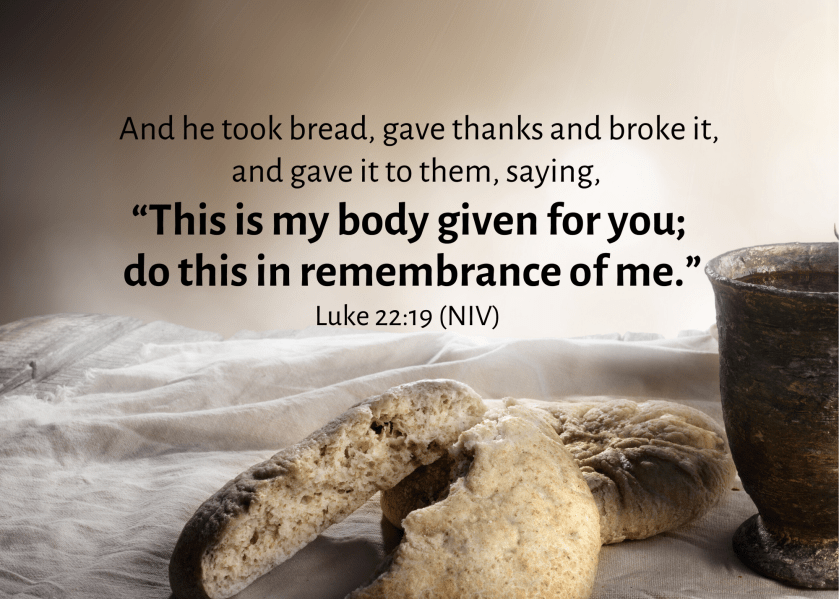
This was already a day of remembrance and of sharing a meal, but Jesus is giving it a new context as the birth of his church grows near. This will be a time to reflect on the New Covenant. Jesus’ physical blood marks the sealing of the New Covenant, so this cup of wine will be a reminder of his blood that would be poured out just a few days after the meal they were sharing. The bread is a reminder of Jesus’ body, which would be beaten and abused. Breaking the bread is a reminder of how his body would essentially be broken through the abuse and execution that were upcoming.

Today, we get to celebrate the Lord’s Supper under much different circumstances. We have the context that the disciples didn’t. A resurrected Jesus and the testimony of his disciples. We can also celebrate this as often as we’d like, but typically it is monthly (at least in my church). We perhaps do the remembrance part right, but later, Paul talks about the need to examine oneself. We should be examining how we’re doing. Are we doing an okay job living our lives for Jesus, or do we need to refocus? I would add that there is also an element of fellowship here. Typically, we observe the Lord’s Supper during a service, but it would perhaps be a good thing to observe it during a meal. Engaging in meaningful interactions with brothers and sisters during celebration.

One other thing to take away from Jesus’ last supper, he’s doing all this with Judas at the table. He knows what’s about to happen, but he doesn’t let that derail this important gathering. When we are having interpersonal issues in the church, we should be striving to repair what is wrong. We should, however, also be able to set aside our differences as we observe the remembrance of Jesus by fellowshipping and breaking bread together. If Jesus can face Judas, you can face someone who has done far less by comparison.

Reflection Questions:

1.        Is it easy to let communion become a rote practice and not a real time of reflection? How can that be changed?

2.        Have you participated in different ways of observing the Lord’s Supper? Were some practices more impactful than others? Why or why not?

3.        A monthly observance was mentioned earlier. Is there a benefit to observing communion more or less frequently? Why do you think this? If you don’t have an opinion, why do you think someone else might have strong opinions on the frequency of observation?

Preparing our Attitude

*Theme WEek – Jesus: John 13

Old Testament Reading: Deuteronomy 31 & 32

Psalms Reading: Psalm 92

I used to read the Gospels and try and compare myself with various characters. And I never wanted to see myself in Peter, and yet here we are. I never wanted to compare myself to the man who seemed to so frequently fly off the handle or get things wrong. I didn’t want to be like the one who sunk in the waves and denied his Christ three times in one night. But I most definitely feel a kinship with him, especially when I read this passage. 

Poor Peter. His Rabbi, who he has been so close to and loved so much, is humbling himself to wash Peter’s feet and he’s clearly mortified. This was something only the lowliest of servants did. And here was Christ, washing his feet, when none of his disciples had thought to do the same for him. And then when Christ says his disciple can’t be clean unless his feet are washed, he insists Christ wash his hands and head as well. He’s so desperate and proud that it’s a little heartbreaking. Because he has it all wrong. 

Jesus is about to die. He’s about to suffer and die for each of them, and for each of us. And they all have to humble themselves enough to accept that sacrifice. They cannot save themselves. They cannot fully cleanse themselves. Only by accepting Christ and his act of servitude for us can we be clean. 

And not only that, but we have to follow Christ’s example and humble ourselves to serve others. We are not too good to be served, and we are not too good to serve either. 

Peter is fighting this internal battle with himself. He wants to serve Christ, but can’t accept with grace the gift of service that has been given to him. He wants to serve Christ, but perhaps not humble himself so low to serve others in this manner as well. 

Jesus loved his followers dearly. In the beginning of the passage it says that he loved them to the end. This means he loved them to the fullest of capacity and without end. And here he has poured out every bit of himself into complete humility and served them in the basest of ways. 

Our savior did that for us when he was tortured and crucified. This is the attitude of love and service we should have for others. 

Take some time today and prepare your attitude with me. Ask yourself: 

Have I truly acknowledged the deep, humbling act of service that Jesus has done for me? 

In what areas of my life am I still too proud? 

Am I focusing too much on the fact that my feet climbed out of the boat and walked on water, rather than the fact that my feet also sank beneath the waves and I had to be pulled out? 

How can I serve someone else in humility as well this week? 

Am I showing others a deep love and a servant’s heart? 

My prayer for each of us today is that we truly and fully recognize the gift that has been given to us and accept it with full humility, acknowledging our great need for it. I also pray that as we acknowledge our need for salvation and cleansing, we turn and offer grace and service to others as well, so that they can see Christ serving in us. 

Jenn Haynes

Known by Your Love

John 13

April 10

Do the people you pass in your daily life know that you follow Jesus? Your coworker in the adjacent cubicle, the cashier at the grocery store, your neighbor down the street? How do they know? It’s probably not the length of your prayers, the Bible verses you have memorized, the fancy church jargon you use, or the gourmet casseroles you bring to your church potlucks. 

They will know you by your love. 

“A new command I give you: Love one another. As I have loved you, so you must love one another. By this everyone will know that you are my disciples, if you love one another” (John 13:34-35).

Following Jesus isn’t about knowing the most, but loving the most. 

Love is our faith in action. It might not always make sense to unbelievers, especially in the midst of our self-obsessed culture. 

Love your enemies and pray for those who persecute you (Matthew 5:44). 

Sell your possessions and give to the poor (Luke 12:33). 

Honor one another above yourselves (Romans 12:10).

Look after orphans and widows in their distress (James 1:27). 

Carry each other’s burdens (Galatians 6:2). 

We ought to lay down our lives for our brothers and sisters (1 John 3:16). 

When we love—even when it doesn’t make sense—we show our allegiance to Jesus. He is the perfect personification of love. This week, we celebrate the love he showed on the cross, where he bled and died to win your heart, where he was scoffed at by a world who couldn’t make sense of such great love. 

If we’re followers of Jesus, we’ll do as Jesus did. We’re called to pour even when our cup is empty, to give when it hurts, to expect nothing in return, and to lay down our lives for others. By this, the world will know you belong to Jesus. 

-Mackenzie McClain

Discussion & Reflection Questions: 

  1. Who will you show this nonsensical love to this week? How will you do it?
  2. Loving others cost Jesus his life. What might loving others cost you?
  3. By being known as a follower of Jesus, people will make assumptions about who Jesus is based upon how they see you act. What implications does this have for how you live your daily life? 

Love Like Jesus

Luke 22 & John 13

John 13 is the only chapter in the four gospels that record Jesus washing his disciples’ feet. In John 13.34 Jesus teaches “A new commandment I give to you, that you love one another, even as I have loved you, that you also love another”. What is the newness of this commandment Jesus gives his disciples and to us? I believe it is the phrase “even as I have loved you”. The way believers are to love each other is no longer patterned after how we would want to be loved (Lev.19.18) but there is a new way to love each other. The new pattern of love is Jesus himself. 

What does it mean to love other Christians like Jesus? This is a very tall order! Where do we start?! I believe the washing of the disciples feet provides a framework for what Jesus had in mind when he said love each other as I have loved you. 

There are two lessons/principles we can learn from Jesus in this account that we can emulate in our lives towards other believers. The first one can be read in John 13.4-5,12-15. Jesus illustrates humility. Jesus as Lord and teacher took the position of a common house servant when he got on his hands and knees and girded himself with a towel to wash feet. If anyone’s feet should have been washed it was Jesus yet the holy selfless Lord and teacher put aside his rightful privileges to serve his students. Jesus humbled himself. Likewise we as Christians are called to humble ourselves before each other and seek out the interest of others before ourself (Eph. 4.2, 5.21, Phil. 2.3-5). 

The second lesson we can learn form Jesus is that to love each other involves humbling ourselves before each other and serving one another in practical ways. The act of washing feet in antiquity served a very practical purpose. Most people wore open-toed shoes or sandals and people walked everywhere. The result was people’s feet would easily become dirty, rough, and caked with filth. No one would want to track the dirt through someone’s home so either the homeowner or a servant would wash the guests feet as they came in. It was practical for the guest and the homeowner. 

What is involved in loving other Christians as Jesus loved us? Looking at the real life illustration of Jesus washing his students’ feet, we learn to love one another involves humbling ourselves before others and serving them in practical ways. 

-Jacob Rohrer

Today’s Bible passages can be read or listened to at BibleGateway here – Luke 22 & John 13

Tomorrow we will read John 14-17.

Holy Week and Dirty Feet

John 13

John 13 14 (1)

Today is Palm Sunday. Your pastor probably talked about it, and the kids probably sang about. In the Christian tradition writ large, the names of the days of the week are used to express different stages of the auspicious moment. Palm Sunday kicks off everything as the day that the crowds celebrate Jesus and call him their king. Monday and Tuesday don’t have special names. Wednesday is called “Spy” Wednesday, signifying the betrayal of Judas to seek a time to sell out his master. Friday we call “Good”, not in that it is a happy occasion, but in that it was a day when the goodness of God was revealed and we were able to be saved. Holy Saturday comes next and then it is Easter/Resurrection Sunday.
Today, in John 13, we read what is traditionally associated with Maundy Thursday. Jesus takes off his outer garment and gets down and washes his disciples feet. To give context, in a culture where everyone walked it was dusty, baths were not as common as they are today and soap was less aromatic – touching feet would be gross. The disciples knew that the one who washed feet would be a servant. But Jesus, the master, the rabbi, the Christ, the King who was just regaled with Palm branches and crowds shouting his praise, is now quietly washing their feet. The disciples, being with him for at least 3 years are used to his weird antics and personal teaching style.
But Peter, never one to be silent, says “No way Jesus!” And who can blame him. The king doesn’t do the slaves’ work. The king has his slaves wash his feet. That’s how the world works. But Jesus lets Peter know that his kingdom works differently. The King serves, and the King’s advisors should serve, and future rulers should serve. If you want to be like Jesus, it’s not about being a King and being served. Jesus said “I did not come to be served but to serve and to give my life as a ransom for many.” He expects us to do the same. “So if I, your Lord and Teacher, have washed your feet, you also ought to wash one another’s feet. For I have given you an example that you also should do just as I have done for you.” (John‬ ‭13:14-15‬ ‭HCSB‬‬)
I’ve got a challenge. Actually DO it. Jesus gave us an example in this moment. Of course this means we should make ourselves servants and try to serve people everyday. But one way to make yourself humble is to grab your stinky younger siblings, or your mom or dad or grandparents or friend, and actually wash their feet. If you can, today or this week, actually get a group together and have the oldest person wash the next oldest person’s feet and down the line. It is a humbling experience. After you wash their feet and dry them off, pray for that person, and then pass the bucket and the towel until everyone has been washed. Then talk about the experience. Was it weird? Did you think it was OK? Do you think it made sense for Peter to feel a little weird? How would you react if Jesus tried to serve you?
Once you answer these questions and any others, read John 13:1-38. Remember that Jesus served people he knew would betray him and deny him; how much more should we serve those who we know love us: our friends, grandparents, aunts and uncles, moms and dads, brothers and sisters… even when they’re stinky.
Jake Ballard