Three Pictures of Judgement

Matthew 25

Devotion by Jacob Rohrer (Rhode Island)

Today as we look at Matthew 25 we should take notice that though we are starting a new chapter the context surrounding this chapter is the same as that of chapter 24. Matthew 24 and 25 are a single unit of thought. This can be seen in verse 1 with the word “then” (the NIV says “at that time”) indicating what Jesus was speaking about in chapter 24 is continuing into chapter 25. The focus of the chapter is about the end of this age when Jesus returns and the judgement that he will enact. 

There are three pictures of judgement in chapter 25. The first two are parables (the parable of the ten virgins and the parable of the talents) and the last one is a description of the judgement scene. 

In the first parable there are ten virgins who wait for the bridegroom. The bridegroom delays in appearing and all fall asleep but suddenly the bridegroom appears but only five are ready for the bridegroom while the other five are not ready and they are denied entrance into the wedding feast. The virgins denied entrance are then told by the bridegroom he never knew them. 

The second parable is about a master and his slaves. The master gives each slave a talent (an amount of money) and went on a journey. When the master returns only two of the three slaves honored the master with what they were given. The third slave squandered his talent and is rebuked by the master and the slave is thrown out into the outer darkness.

The third picture of judgement involves Jesus separating goats from sheep among the nations. The sheep and goats represent those who belong to Jesus and those who do not. The sheep (believers) are rewarded with the kingdom and the goats (non-believers) are cast into hell with satan and his demons. 

What are we to make of this chapter? What does Jesus want us to learn from these three pictures of judgement? I believe it is this.

There is a judgement coming and not everyone who calls themself a Christian will enter into life. The reality is, not everyone who calls themself a Christian is a true believer. In all three teachings there is one group of people who are then divided into those who are accepted and those who are rejected. Many people comprise the Church but not everyone who attends church is a true believer. The judgement of Christ sorts out the self-deceived from the real believers. Jesus himself teaches this earlier in Matthew 13.24-30, 36-43 in the parable of the tares. And he also teaches this in Matthew 7.21-22. 

Who are you? Are you deceived or a true believer in Christ? The five virgins were accepted into the feast because they were ready and prepared. The 2 slaves were honored by the master because they were faithful with what the master had given them. And the sheep entered the kingdom because they loved and served other Christians in need. 

A true believer will have evidence of salvation in their life. A true believer bears the fruit of the spirit, they grow in holiness, they grow in their disdain for sin, they hunger for the scriptures, they serve other Christians and people. A real believer matures and grows in Christ.

Paul tells the Corinthians in II Cor. 13.5 to test themselves against the scriptures to see if they are in the faith. Compare yourself to scripture and to the words of Jesus. Have you really received salvation from God? In addition to this, talk with mature believers closest to you about this serious matter if you question your salvation.

(Originally posted for SeekGrowLove on November 7, 2020)

Reflection Questions:

  1. What do you think Jesus wants you to learn from Matthew 25?
  2. “Who are you? Are you deceived or a true believer in Christ?” What does a true believer look like, sound like, do, believe?
  3. What can you do today to be more prepared to be judged by Jesus?

Clean the Pot

Ezekiel 24-27

Devotion by Rebecca Dauksas (South Carolina)

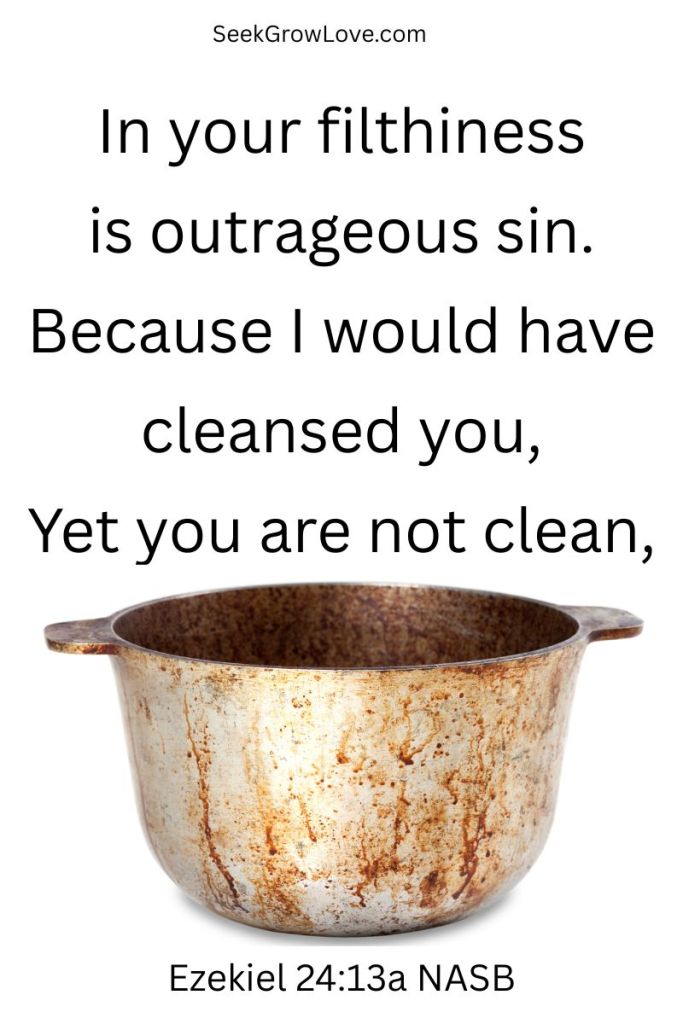
Today I scrubbed out our cast iron skillet. It would have been easier the night before, but I put this task off until today. It reminded me of our reading from Ezekiel 24. The parable for the Israelites contains a dirty, rusted boiling meat pot destined for cleansing by destruction. The pot was symbolic of Jerusalem. Ezekiel once again shares what the Sovereign LORD has said by telling his people this parable. The king of Babylon has laid siege to Jerusalem. The LORD shows the people what will happen if they continue in their evil practices. The LORD refers to Jerusalem as the city of bloodshed. When faced with a warning that severe negative consequences including death for many will follow their actions, we would think that they would stop sinning. We want the people to repent, to turn to God and accept His deliverance and His salvation. Unfortunately, they do not. 

That nasty stuff in the pot should have been removed long ago, but the people continued in their sins. We could compare the rust of the pot to the bloodshed that had taken place in Jerusalem. God had seen the killing and wounding of others in this city of blood. All the actions of the people were in full view for God. He also states that their impurity was lewdness. They did detestable acts and committed adultery. They chose indecent, obscene behaviors rather than allowing God to clean out all that crud.  They should have been filled with shame and repentance, but they openly committed their sins. The scripture tells us that the LORD tried to cleanse them, but they would not be cleansed. They were told, “You will be judged according to your conduct and your actions,” declares the LORD. 

The people of Jerusalem would not turn from their sin, but we can. We can recognize when we fall short and confess our sin. After all, He is faithful and just and will forgive us our sins and purify us from all unrighteousness. So God can make us a “vessel for honor, sanctified, useful to the Master, prepared for every good work.”

Reflection Questions

  1. What sins has Ezekiel mentioned in his book? What does God not like about them?
  2. Why do you think God is giving warnings before the punishment comes?
  3. What sins do you think God sees today – in you – that he would (or is) sending you a warning about? And what sins in the world around you?
  4. What would the cleansing process look like if we turn to God? What would the cleansing process look like if we don’t?

The Final Word

FRIDAY DEVOTION Jeremiah 51:24–64

(if you read that yesterday you could re-read it – and then also get a start on Jeremiah’s next book, Lamentations – Lamentations 1-2)

Devotion by Dustin Farr (South Carolina)

All week, we have seen God speak against nations. We have read about judgment on neighbors, warnings to the proud, and promises of restoration for His people. Again and again, the theme has been clear, God humbles the exalted and lifts up those who seek Him. Today’s passage brings that story to a close with the final word on Babylon.

Babylon was not just another nation on the list. It was the empire that crushed Jerusalem, burned the temple, and carried God’s people into exile. To Judah, Babylon’s power must have felt like an unmovable wall. Yet in today’s reading, that wall crumbles. God declares that Babylon’s destruction will be complete and final. “When you finish reading this scroll, tie a stone to it and throw it into the Euphrates. Then say, ‘So will Babylon sink to rise no more because of the disaster I will bring on her. And her people will fall.” This is what will happen to the city that once seemed untouchable.

But this isn’t just about Babylon. It’s about the God who keeps His word. The God who, decades earlier, through the prophet Habakkuk, promised that Babylon’s reign would end. The same God who disciplined His people was also the one who defended and redeemed them. 

So when we are in the places where we feel stuck, powerless, or forgotten, we know that we can rest assured in the justice and redemption of God. There may be “Babylons” in our lives.  Health struggles that weigh us down, broken relationships that leave us hurting, financial pressures that keep us up at night, or just the struggles of life. Things that feel too strong to ever fall, and It can be easy to believe that nothing will change. But our God has the final word. His justice may take time, but it is certain. His restoration may not come when or how we want it, but it will come, and we can rest assured in that. 

If we can trust Him with the big stories of nations and empires, then surely we can trust Him with the smaller but deeply personal battles we face. The same God who threw down Babylon is the one who lifts up His people, heals what is broken, and keeps every promise He makes. Our call is to remain faithful, not letting what we see in the moment shake our confidence in the One who rules over it all.

Reflection Questions:

  1. Where have you experienced a “Babylon” in your life that God eventually brought down?
  2. Looking back over this week’s readings, what is the biggest truth about God’s character or His promises that you want to carry with you?

No Strength Can Stand Against the LORD

Jeremiah 46-48

Devotion by Dustin Farr (South Carolina)

In Jeremiah 46–48 the focus is shifted outward, showing that God’s rule is not limited to Israel alone. He is sovereign over every nation, and His justice reaches far beyond Judah’s borders. In these chapters, God speaks to Egypt, Philistia, and Moab, nations confident in their own strength, secure in their own plans, and certain of their own futures. Yet in each case, the LORD declares that their confidence is an illusion. Egypt’s pride was in its armies and alliances. To human eyes, they seemed unstoppable. But God declares that they will be defeated at Carchemish, their power lost and their strategies useless before Him. Next Philistia’s fate is pictured in chapter 47 as an unstoppable flood, with the Babylonian forces sweeping across the land, leaving cities silenced and grief in their wake. Finally, In chapter 48, God addresses Moab, whose downfall comes not from a lack of defenses, but from a heart of pride. They trusted in their wealth, their fortified cities, and their false gods, but even they could not stand against the living God. However, God ends with a promise that in the latter days, Moab will be restored. This spoke to me as proof that despite his justice being sure, God is always capable of restoration.

What also stood out to me is how easily pride can blind us to the truth. Egypt, Philistia, and Moab all felt secure in what they had built, yet none of it could stand when the LORD came with judgement. Strength apart from God is only just an illusion. I think this calls us to examine what we’re leaning on. Is it our abilities, relationships, resources, or position? If it’s not God Himself, it will eventually fail us. The God who brought nations low is the same God who offers Himself as a stronghold to those who take refuge in Him. Psalm 27:1 “The LORD is my light and my salvation; whom shall I fear? The LORD is the stronghold of my life; of whom shall I be afraid?”

Reflection Questions:

  1. Which false securities do you most see most in our world today?
  2. Where might pride or misplaced confidence be keeping you from full dependence on God?
  3. How does God’s promise of restoration to His people encourage you in a season of uncertainty?

A Time to Uproot – THEN – A Time to Plant

Jeremiah 32-34

In today’s reading in Jeremiah 32-34, God is furious with His people and promises to punish them. It won’t be pretty for a while, but eventually God’s love and mercy makes it back on the scene. We learned in yesterday’s reading how important God’s discipline is for shaping our character and turning us back to Him. I hope whoever is reading this realizes that you are never too far gone from God’s love and mercy. Yes, He might teach you a lesson to help you learn from it, but true repentance will lead to restoration. God will not stay mad at you if you choose to turn from your sinful ways. Maybe you’re holding back because you feel so embarrassed and humiliated at your poor choices and feel completely unworthy of God’s love. Maybe you feel like the prodigal son sheepishly returning home and expecting your father’s wrath, but you’re so desperate you will work as a servant in order to survive. Maybe you’re afraid you’ll receive a cold and resentful reception like the older brother gave the prodigal son. Don’t let fear of others’ judgment of you stand in the way of restoring your relationship with your Heavenly Father. His opinion of you is the only one that truly matters.

We can take comfort in God’s character revealed in 33:26 “…For I will restore their fortunes and have compassion on them.” God will meet your repentance with compassion and restoration, but you first have to face the reality of your sin and the damage it has done to your life and your relationship with God. 

-Kristy Cisneros

Reflection Questions

  1. What are some of the consequences of sin in your life? Have you experienced a time when your own personal true repentance has led to restoration? What might that look like – both today and in the future?
  2. How does God’s justice and mercy work together?
  3. Realizing there are still consequences for sin, how might God expect us to mirror His mercy to the repentant? How can your justice and mercy work together?

“Per My Last Email”

Jeremiah 14-17

“Per my last email.” I’ve never actually used those words in text or speech, because everyone knows what that means, “ I ALREADY TOLD YOU THIS INFORMATION!!!” It’s a little passive-aggressive, so I’ve only ever thought it. I’ve often wondered throughout scripture, if God has thought similarly. In Jeremiah 14, Judah begins to experience a serious drought. The people begin crying as they start to notice God is not hearing their prayers. WHY are You treating us like a stranger ( 13:8)? WHY are You acting like You can’t do anything for us (13:8)? WHY have You afflicted us so that we cannot heal (13:19) I can only imagine God was thinking, “per my last PROPHET, I ALREADY TOLD YOU WHY!!!!” By this time, at least according to my study Bible’s timeline, Jeremiah had probably been warning the people of Judah for well over 15 years. The people could not claim ignorance of God’s coming judgment and this drought was just the beginning. It does dawn on some of the people that , oh yeah, maybe this has something to do with our complete disregard for Your laws and decrees. Or maybe, it wasn’t even that many people realizing their sins in this passage…maybe it was just Jeremiah…which means it really wasn’t much of an apology at all. 

In chapter 15, God gets a little graphic with His description of Judah’s destruction, using the sword, dogs, birds, and beast (15:3). And that sets the tone for the first half of the chapter. In the second half, Jeremiah and God have a heart to heart chat. I really feel for Jeremiah. It is really hard when you’ve tried so hard to be good, only to have people treat you bad. In this case, make plans to murder you (thankfully, although I can relate with the former, I can’t with the latter)! Jeremiah also expresses disappointment in feeling God has abandoned him. But God assures him He has not, and He will reward him. But not before chapter 16. 

God then asks Jeremiah to go into a type of self exile. He was forbidden from marrying, having kids, or participating in funeral traditions. As God used Hosea as a living object lesson, He uses Jeremiah to live out an example of what God’s coming punishment would be like. Families would be destroyed and so many would die there would be no time for mourning. 

All of this, including chapter 17 is a bleak description of Judah’s folly and God’s wrath. But then oddly, in the middle of the listed curses, is a blessing (17:7-8). If the people would trust in the Lord, they would be planted firmly and withstand the droughts and coming destruction. 

Today’s reading ends with a reminder of God’s command to keep the Sabbath holy. Apparently, the people had given up on this command and were treating the Sabbath just like every other day. ( We could have a very long discussion about what that means for us now… but that’s for another day). 

Unfortunately, like a previous email, the people of Judah disregard all of the Lord’s instructions and decrees brought to them by Jeremiah. 

Just like the people of Judah, we too have been warned, comforted, educated, and instructed by the Holy Word of God. When it comes to the final judgement, we can’t claim ignorance. WE GOT THE EMAIL! Let us put into the practice all we have read and heard until the day of Christ’s return! 

Prayer: 

Dear Father, 

You have given us all we need to come to an understanding of You, Your love, and Your decrees. Please open our hearts to greater learning and understanding so that You know we take Your word seriously. 

Im Christ’s name we pray, 

Amen 

-Maria Knowlton

Reflection Questions

  1. What do you tend to think and feel when someone “under” you completely ignores directions you gave? What happens to your relationship? What are your thoughts and feelings when/if they apologize and return to following directions well? What are the similarities and differences when it is God over you and you are His child who has ignored His direction?
  2. When/in what regards might God be telling you: “Per my last email”?
  3. What benefits do you find in reading and studying God’s Word- his “original email” to you? What are the problems and dangers of not reading and studying His Word?
  4. What is needed beyond reading and studying His Word?

Ambivalent

 Jeremiah 1-3 

So I talked to this young, expecting mother about the importance of safe sleep for a newborn. No pillows, blankets, toys. I arrive at her home, as a home visiting nurse, to see the baby shortly after birth. And she is asleep, surrounded by pillows, blankets, and toys. I talked to another mother about cutting back on smoking by using nicotine patches. On my next visit, I ask if she was able to get a prescription for the patches. Her eyes drop and she says a shy, “No…” I try not to look judgmental or disappointed. We have further discussions but inside, I am a bit frustrated and when I have a full day of those kinds of interactions, I really start to question my choice of vocations. And I also feel like I might be getting a taste of what Jeremiah went through and understand how he got his nick-name, “The Weeping Prophet.” 

In his self-titled book, Jeremiah is introduced as the young son of a priest, making him a Levite. Most Biblical scholars agree he was probably a cup bearer and probably around 17 to 20 years old. Reminiscent of Moses, God calls Jeremiah to him and gives him an important job. While Moses’s excuse was that he was not a good public speaker, Jeremiah tells God, “But I’m just a boy.” (1:6) I wonder if God rolled His eyes. : ) 

But God goes on to tell him that he is to be a prophet, to warn Judah that destruction is coming. God gives him the words and in the first 3 chapters of the book, Jeremiah is pretty harsh. Like in Hosea, and throughout the Old Testament, he compares Judah, and Israel as a whole, to cheating spouses. But unlike Jonah and the prophet Zephaniah, Jeremiah is largely ignored. He warns, he pleads, and the people continue to do their own thing. They know God exists but ignore His direction and commands. And Jeremiah knows what the coming consequences are. 

They were ambivalent. I mentioned that word in yesterday’s devotion. It is a good word for describing those sitting on a proverbial ‘fence.’ They know the consequence of their behavior, but the behavior is easier, more fun. There are a lot of, “ Yeah, but…” in the conversations. Yeah, I know I should stop smoking, but it’s so hard. Yeah I know God is going to destroy our nation, but is my little idol really going to make a difference? It can be so frustrating for those whose job it is to dole out the warnings. I’ve only been a nurse, giving medical and safety advice for about 7 years. Jeremiah was a prophet for over 40 years. I can only imagine! And he wasn’t allowed to quit! 

As we read these passages that are hard to read or hear, let us think about the areas in our own lives where we are ambivalent about our obedience to the Lord. 

Prayer: 

Dear Lord, help us to listen to your Word and those in our lives who give us Godly wisdom. Help us embrace what is good and what is good for us in Your eyes and reject the bad. Please let us let go of excuses. 

In Christ’s Name, 

Amen 

-Maria Knowlton

Reflection Questions

  1. Do you more often stubbornly follow your own evil heart or go God’s way?
  2. In what areas of your life have you been or are you currently ambivalent about obeying God? What excuses have you tried giving God or others about your actions or attitudes?
  3. What changes might Jeremiah prescribe for you personally? For your church? For your nation and world today?

Justified Judgment


Nahum 1-3

The book of Nahum takes place a century after Nineveh repented following the preaching of Jonah. It took less than a hundred years for the city to return to idolatry, violence, and arrogance. Nineveh was proud of her supposed invulnerability, with walls that reached 100 feet high and a moat surrounding the city that was 150 feet wide and 60 feet deep. The Assyrians, who ruled the city, were known for being an unusually cruel and blood thirsty nation, who were spiritually and morally depraved. Not only did the leaders and inhabitants of Nineveh violate God’s laws, they often did so by preying on God’s chosen people, the Israelites.

The prophet Nahum was a messenger of the divine judgement against Nineveh. The first chapter of Nahum declares the looming destruction of Nineveh and illustrates God’s power as an omnipotent, holy, and jealous God who will punish the wicked to avenge his own. Although He is a jealous God, he is also slow to anger and is long-suffering. Remember, he nearly destroyed the city one hundred years earlier, in the time of Noah. Despite his mercy and patience, His righteousness, holiness and justice prevent Him from leaving the wicked unpunished. Nahum announced God’s specific judgement against Nineveh, interweaving blessings and hope for Israel. Judah was to be no longer afflicted by Assyria, rather God would vindicate them, as He is the stronghold and fortress to those who put their hope in Him.

The second chapter of Nahum vividly details the future assault of Nineveh, at the hands of Nebuchadnezzar of Babylon. God’s vindication is justified through depictions of Nineveh’s treachery against her enemies. In verse 13, God himself declares, “Behold, I am against you” – not something that any person or nation in the world should want to hear!

Chapter three continues to detail the arrogance of Nineveh, as well as details of their fate and God’s righteous wrath against them. Our Heavenly Father won’t allow arrogant or violent empires to endure forever. Nineveh’s fate is a testimony of God’s commitment to bring down the arrogant in every age. God is grieved by the death of the innocent and his goodness and justice compel him to allow the downfall of oppressive nations.

Nahum 1:7 declares, “The Lord is good, A stronghold in the day of trouble, And he knows those who take refuge in Him.” May we all humble ourselves before God’s justice and trust in His sovereignty and timing to punish the oppressors of this present, evil age.

Prayer:

God, you are awesome, omnipotent, holy, mighty and just! We pray that our nation, her leaders, and her people would humble ourselves and turn to you. May we submit to your ways, trust in your plans, obey your laws and seek your righteousness. Father, forgive us for putting our trust in mankind and things of this earth, rather than fully depending on you. You are our strength, our hope, and salvation! In your precious son’s name, we pray – Amen.

Reflection Questions:

• How might you react if you were a citizen of Nineveh hearing this prophecy?

• How can the people of Nineveh’s actions serve as a warning for modern society?

• How does this chapter influence your understanding of sin and its consequences?

• How does Nahum 1 influence your understanding of God’s protective love for His people? 

-Beth Osborn

Separated

Hosea 5-9

In chapter 5 of Hosea, we see judgement pronounced over Israel.

“Listen to this, O priests! Listen, O house of Israel, and give ear, O house of the king! For the judgment is against you; for you have been a snare at Mizpah, and a net spread on Tabor.”
 (Hosea 5:1, REV)

Later in verse 14, Yahweh says:

“I myself will tear them in pieces and go away. I will carry them off, and there will be no one to rescue them.” (Hosea 5:14, REV)

Things are starting to look bleak for Israel. Yet some begin to consider returning to Yahweh:

“Come and let’s return to Yahweh; for he has torn us to pieces, but he will heal us; he has injured us, but he will bind up our wounds.” (Hosea 6:1, REV)

But in verse 4, Yahweh reveals a deeper issue – Israel is not loyal to its covenants. He compares them to a morning cloud or dew that vanishes early. Yahweh knows they won’t truly turn back, but will continue down a path of unrighteousness:

“The pride of Israel testifies to his face, yet they do not return to Yahweh their God, nor have they sought him for all this.” (Hosea 7:10, REV)

In chapter 8, Yahweh continues to speak on the corrupt mindset of Israel and the many reasons for their separation from Him. Midway through the chapter, we see what happens to Israel.

“Israel is swallowed up. Now they are among the nations like a vessel that nobody wants. For they have gone up to Assyria, like a wild donkey wandering alone. Ephraim has hired herself out to lovers.” (Hosea 8:8–9, REV)

Back in chapter 5, verse 4, it says that Israel cannot return to God because of their deeds. That verse reminds me how important it is to change our actions when we turn to God. We can’t claim to be pure in mind and soul while continuing in sin and partaking in things that bring us further from God.

Since working in the construction industry and expanding my social circle beyond the church, I’ve noticed something. When I talk to people about faith and religion, many say they follow Christ but in the same breath, they contradict that by showing allegiance to themselves. My prayer for them is that they would not follow the path that Israel took, but recognize this hypocrisy and take steps to correct it. If they are sincere, they will allow God to begin to move in their lives or maybe even discover who God truly is for the first time.

-Bridger Grable

Reflection Questions

  1. How would you describe Israel’s problem in Hosea’s day?
  2. Where have you seen similar problems?
  3. In your own life when has your love evaporated quickly, like the morning dew? How are you doing right now? Are your deeds taking you closer to God or further from Him? What might Hosea (speaking for God) say about your heart?

The Problem – and The Solution

Isaiah 23-27

Isaiah 23-27 tells of God’s judgement upon the earth, the peace that comes from God, and the redemption that we find in Him. Though these may seem in opposition to each other, each of these elements is a key facet to the overall theme of these chapters. In chapters 23 and 24, we read about the suffering, desolation, and punishment which is a result of the people’s wickedness. Isaiah 24:5 says that:

              [5] The earth lies defiled under its inhabitants; for they have transgressed the laws, violated the statutes, broken the everlasting covenant. (ESV)

My mind immediately recalls Romans 3:23 which says, “for all have sinned and fallen short of the glory of God”. All of mankind have done things that are displeasing to God and are deserving of the punishment which is talked about in Isaiah 23/24. Often when we sin, there is a conscious knowledge that what we are doing is wrong, yet we continue anyways. Our sin pushes us away from God’s presence and leads us down into some very dark places where we try to cover up or escape the last bad thing we did. This cycle of sin continues, and we draw further away from God and for our unrighteousness, God will punish us. However, there is hope that for those who trust in God and repent from sin, he will save us and deliver us from destruction.

              [8] He will swallow up death forever; and the Lord GOD will wipe away tears from all faces, and the reproach of his people he will take away from all the earth, for the LORD has spoken. (ESV) – Isaiah 25:8

This passage gives me so much hope and encouragement for what is to come when there is no more pain, suffering, and death. Everyone at some point in their lives will experience hardship. Maybe that is the loss of a loved one, battling addiction, becoming seriously ill without any warning, or maybe going through a breakup. Maybe you’re in that time of life right now or maybe it is around the corner. Whatever it is, there is hope that someday, God will restore this earth to its rightful state, but in the meantime, we can set our eyes to the one who has the power to save and deliver.

Isaiah 26:3–5 says:

[3] You keep him in perfect peace whose mind is stayed on you, because he trusts in you. [4] Trust in the LORD forever, for the LORD GOD is an everlasting rock.

I’d like to end with this portion from our text as a final reminder to set your mind on God. This can be very difficult amidst the infinite distractions in our world, but when you set aside these distractions, you can see clearly through that business or pain and find everlasting peace.

Here are some application questions to ask yourself:

Are you building your life upon the God?

When was the last time you asked God to be your rock or firm foundation?

How can you encourage someone in your life and lead them to the hope of deliverance?

-Jeremiah Grable